Home » EST (Page 36)
Category Archives: EST
EST and Green Urbanism
I had the great opportunity of presenting excerpts of the National Environmentally Sustainable Transport Strategy (NESTS) and talk about its implementation at the local level at the recently concluded Green Urbanism Conference. The Conference was organized by the School of Urban and Regional Planning (SURP) of the University of the Philippines Diliman in cooperation with the Faculty of Design of Kyushu University, with support from various partners including AusAID. It ran from October 18-20, 2011 at the Heritage Hotel Manila, featuring a variety of topics divided into 5 sessions namely:
- Green Cities
- Green Architecture and Ecological Landscapes
- Green Infrastructure
- Environmentally Sustainable Transport
- Developing Climate and Disaster Resilient Urban Centers
“This paper presented current and past efforts focusing on sustainable transport. Many of these are continuing especially the promotion of good practices in EST that emanate from the national strategy that was recently formulated. The national EST strategy identifies action plans and the corresponding responsible agencies or entities. The key competencies and skill sets that will enable cities to formulate and implement meaningful programs and projects were also presented. More importantly, the paper examined the capacities of cities for transportation planning and recommended for collaborative agreements with local universities with sustainability in mind.
The general observation has been that LGUs are often unaware that certain programs and projects they are implementing or planning actually fall under EST. As such, they are unable to package their programs and projects in a way that can be attractive to both local and foreign support. One main objective of social marketing for EST is to assist cities by capacitating them with the fundamentals they would need to undertake projects geared towards sustainable transport.
The strategies developed for each EST thematic area are collectively called the national strategy and implies responsibility of a national agency for its implementation. Upon closer scrutiny, however, it must be realized that significant impacts will only be attained if EST is successfully implemented at the local level. The role of national agencies such as the DOTC and the DENR is to provide guidance and capacity to cities for the latter to be able to come up with meaningful programs and projects. After all, while big ticket EST projects may be initiated by national agencies, their success will be determined by how these are implemented at the local level. In the Philippines, cities have been empowered for such purposes and localizing national programs and strategies would be essential in addressing enduring and emerging problems concerning transport and traffic.”
First battery swap program for E-jeepney
I am posting a press release from the proponents of the electric jeepney about the first battery swap program launch this morning. The program will allow for the continuous operations of the e-jeepney in Makati, extending its operating hours as they are no longer limited by the depletion of their batteries. This program will surely have a significant impact on how e-vehicles (not just e-jeepneys) are deployed and presents a model for local government units who are at least curious about having the electric vehicles (perhaps) to replace conventional public transport in their respective cities. This should be a game-changer in the promotion of EST in the Philippines.
Electric jeepney fleet proponent pioneers country’s first battery swap program
(October 19, Manila) The pioneer of the country’s first electric jeepney fleet unveiled this morning an innovative battery swap scheme which its proponents expect “to dramatically improve the efficiency and revenue generation of eJeepney operators.” Over thirty guests, including 22 British volunteers headed to Bohol on Friday for climate change solidarity work, graced the occasion.
“With a little practice, we expect the battery change to take the whole of 10 minutes, which is like a common stop in a gasoline station. The previous eight-hour charging process becomes a thing of the past with this program. It means eJeepney drivers can use their vehicles for a longer period and reduce battery depreciation as well,” said iCSC executive director Red Constantino.
Constantino said “green aims must be coupled with robust economic benefits. We anticipate double earnings for operators, which is superb since we’re already saving a huge amount just because we’re using electricity instead of gasoline to power the vehicles.”
The Institute for Climate and Sustainable Cities, which owns and operates the celebrated eJeepney fleet in Makati City, designed and fabricated the battery program with the support of the British Embassy in Manila. Also known as iCSC, the group is implementing the program in partnership with private sector groups Ejeepney Transport Corp (EJTC) and Motolite.
The scheme is based on a simple roll-off, roll-on logistical set-up, using eJeepneys retrofitted with battery trays and a battery loading bay at the eJeepney depot. A dispatcher rolls out spent battery sets of an eJeepney and replaces it with a fully charged set through a palette lifter manufactured by iCSC.
“Ejeepneys represent carry huge business potential and improvements in operations such as this scheme can create new revenue streams for groups interested not just in eJeepney operations but in battery leasing as well,” said the CEO of EJTC, Yuri Sarmiento.
“We are with you not as passengers but as partners. Together, we can steer our way to a brighter, more sustainable and prosperous future,” said Trevor Lewis, the British Embassy’s Deputy Head of Mission in remarks made during the event.
“Our company is determined to invest in the future of this country and we are elated to be part of this venture,” said Arnold Sarmiento, who represented leading Philippine battery manufacturer Oriental Motolite.
The battery swapping project aims to accelerate the expansion of electric public utility vehicle applications in the Philippines by increasing the operating time of electric jeepney fleets while reducing time used to charge eJeepney batteries. The pilot test period will take place from October 19, 2011 to February 14, 2012. Partners in the initiative hope data from the project can promote a more rapid transition to low carbon transport in the Philippines.
The battery swapping system is located in Makati City’s Fire Station, the site of the country’s first battery-charging station for electric vehicles. Ejeepney units plying the country’s first two routes – the Legazpi Village loop and the Salcedo Village loop — will utilize the battery swap pilot system, which will be run by iCSC, EJTC, Motolite and Makati City jointly.
“We thank the British Embassy in Manila for their support of the city’s endeavors. We are committed to build a low carbon future together with climate change-resilient development,” said Makati City transportation consultant Ernie Camarillo.
iCSC works on fair climate policy and innovative energy solutions for localities. It is the pioneer of the Climate-Friendly Cities project, which integrates sustainable waste management and renewable energy generation with electric public transport alternatives.
Traffic going bananas
I’ve written about land use and parking along Katipunan Avenue, which is part of Metro Manila’s Circumferential Road 5. Katipunan extends southwards to Blue Ridge, St. Ignatius and White Plains (the latter subdivisions just across the street from Camp Aguinaldo) where there are also many establishments along either side of the road. Most of these establishments are restaurants that attract significant private vehicle traffic. Note that there are no public transport routes along Katipunan/C5 in the Blue Ridge, St. Ignatius and White Plains areas. As such, establishments are more likely to attract people with cars rather than those taking public utility vehicles.
Many of these establishments are on lots formerly occupied by residential buildings (i.e., houses) considering the predominant land use in the areas. These were eventually purchased and converted for commercial use, resulting in layouts that generally do not include adequate parking spaces. The consequence of shortcomings in parking have been the propensity for on-street parking such as shown in the following photo in the Blue Ridge area.
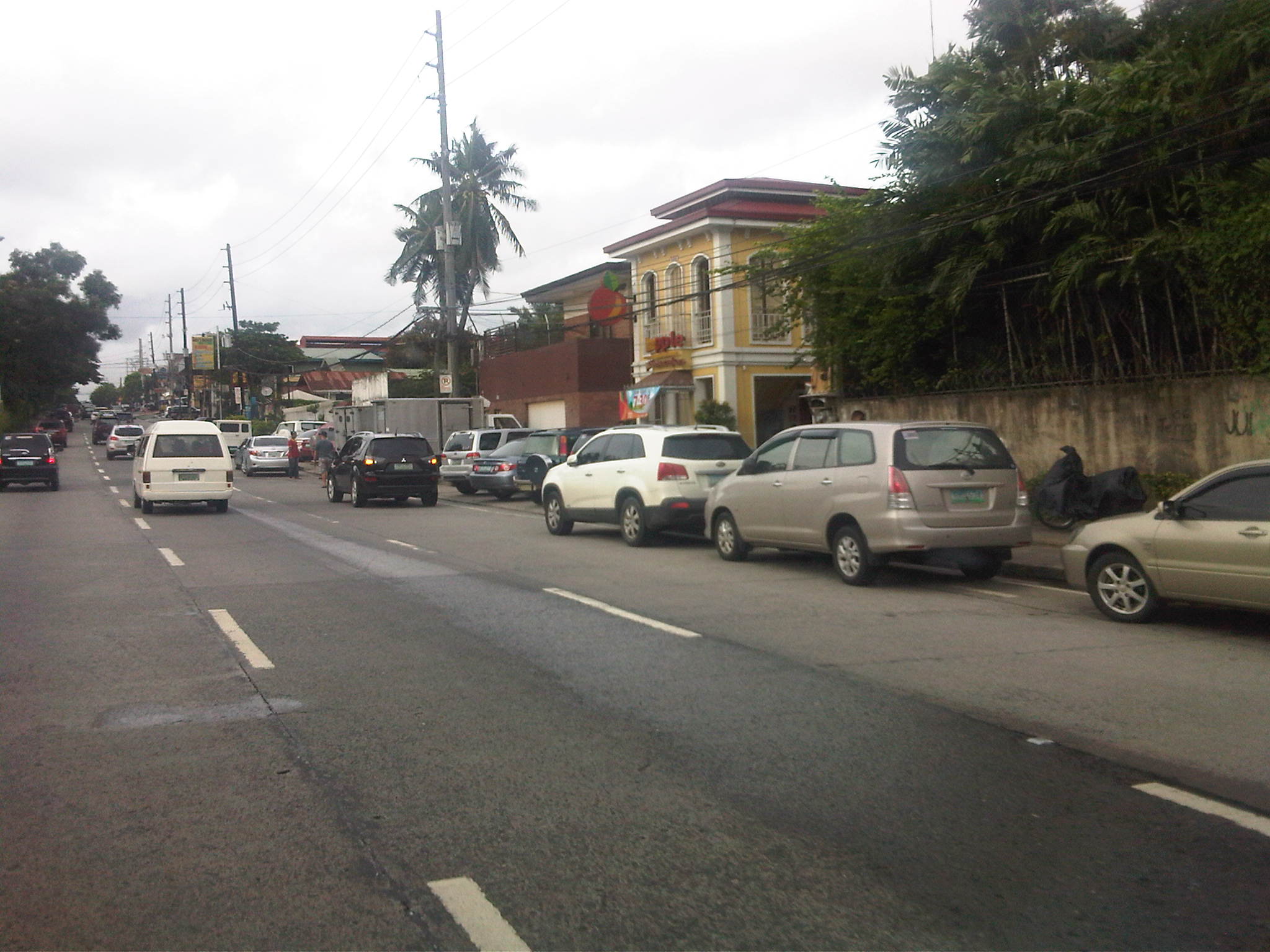 On-street parking for a popular restaurant/cafe along Katipunan/C5 at Blue Ridge.
Such case and many others like it along Katipunan (and other Metro Manila or Philippine cities roads) are the result of both poor planning and lax enforcement of traffic rules and regulations in this country. Being a primary arterial, Katipunan/C5 should be clear of such unnecessary sources of roadside friction that effectively decreases road capacities while also increasing the risk of crashes as vehicles maneuver, or in some cases wrestle, for parking spaces.
Katipunan parking predicament
Developments along Katipunan Avenue in Quezon City are good examples of fragmented land use and transport planning in Philippine cities. The developments, particularly the high rise condominiums have been the subject of much opposition from residents of subdivisions in the area as well as two major institutions of higher learning that have defined the stretch of Katipunan that has been developed in the 15 years. I mention 15 years because this is the period during which most of the high density developments along Katipunan have been constructed, apparently with the blessings of city hall. It is also in the last decade that schemes such as road widening and the U-turns were implemented.
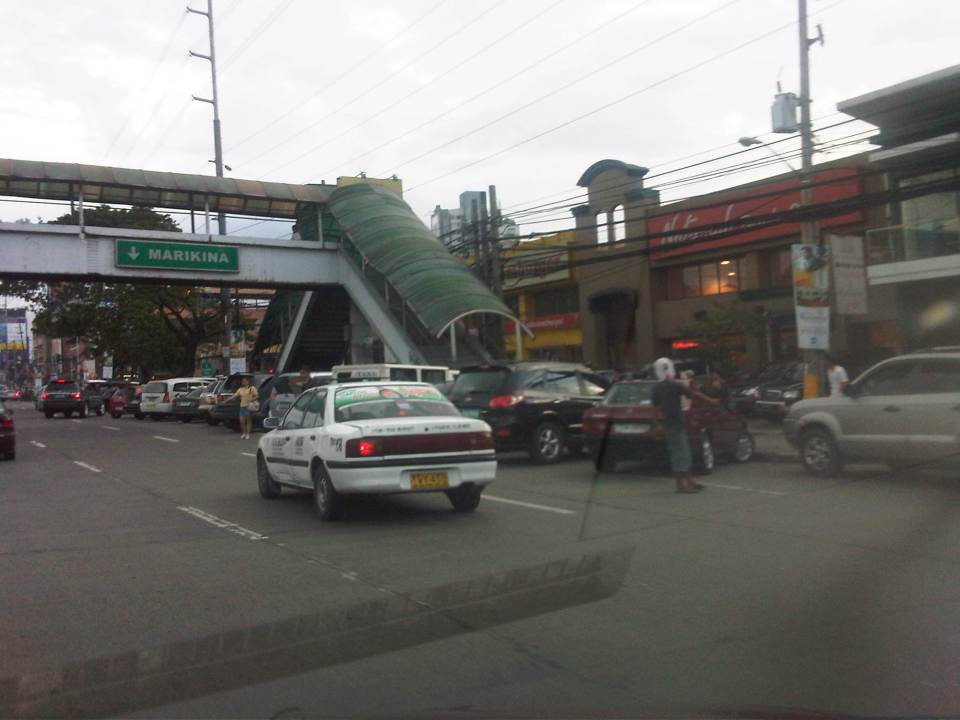
On-street parking along Katipunan at lanes that used to be part of what was a west service road. In many cases, onstreet parking has been the result of a violation of a very basic provision of the National Building Code, which prescribes the minimum number of parking slots for establishments such as restaurants, shops, banks and offices. Despite being quite outdated and disconnected with more progressive parking generation principles, the NBC should have been a basis for the local government to assess whether minimum guidelines are satisfied, and perhaps impose penalties on those who are not able to comply such provisions. This is a fundamental case where individuals (owners of parked vehicles) impose external costs (e.g., congestion and crash risk) upon the general public.
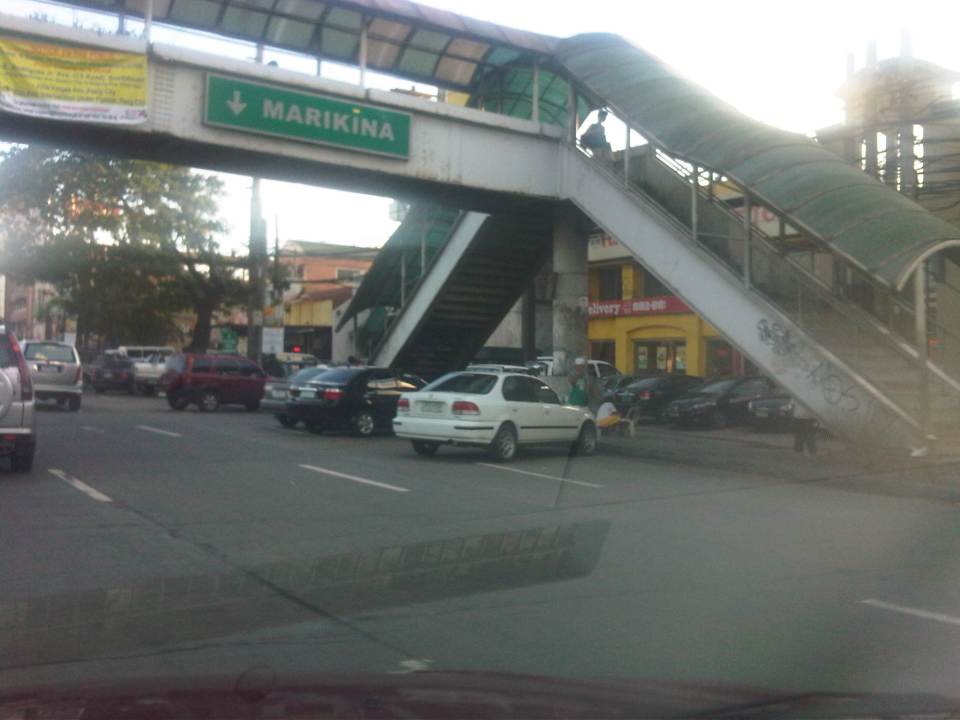
Another look at onstreet parking just beneath the pedestrian overpass across from Ateneo’s Gate 2 – restaurants along Katipunan are major traffic generators and despite the presence of public transport (jeepneys and tricycles) a significant number of trips generated by these establishments use private vehicles including cars, vans and SUVs. Katipunan’s pedestrian facilities are inadequate as there are practically no sidewalks, thereby forcing people to walk along the road. This exposes many and particulrly students to risks like getting sideswiped by vehicles driven by reckless drivers.

Waiting vehicles effectively occupying 2 lanes of Katipunan – many employ drivers who can stay with the vehicles while the occupants eat, shop or transact at establishments. In most cases, standing vehicles are practically parked vehicles as they occupy road space. High-rise residential condominiums along Katipunan may have complied with minimum parking requirements stipulated in the NBC but their trip generation characteristics considering the commercial establishments located at the same buildings surely require many more parking spaces than what are available.

Congestion along Katipunan’s southbound side – may be caused by onstreet parking, standing (waiting), or vehicle maneuvers with respect to the limited parking slots fronting most establishments along the road. One tutorial center located near a U-turn slot, for example, generates significant vehicle traffic that it affects both U-turn and through traffic. Meanwhile, traffic enforcers seem either ineffective or helpless in their efforts to manage traffic, including preventing vehicles from taking 2 lanes of Katipunan.

Standing/waiting vehicles in front of a new development along Katipunan – the new building hosts several establishments including a major bank, a book shop, a popular gym, and several restaurants or cafes. Despite the potential for vehicle attraction, only a few parking spaces were provided, leaving all other vehicles and their drivers on their own to find parking spaces or just occupy road space in front of the building. The footbridge across Ateneo’s Gate 3 has been extended to the building but this obviously has marginal impact in reducing vehicle generation and parking demand.

Another photo showing the parking situation in front of the new building – while traffic is generally a manifestation of economic activity, one opinion is that many developers are irresponsible by designing buildings that have inadequate parking and resulting in the general public bearing the burden of traffic externalities. Add to this local governments that turn a blind eye on such discrepancies in design (who reviewed the design that obviously violated the building code?) only to be on the receiving end of complaints. In some cases, LGUs probably will be forced to shoulder costs of providing solutions that developers should have covered in the first place if they were responsible enough or made responsible for mitigating negative impacts of their projects.
In the end, it is inevitable that we need to address the root of the problem, which pertains to land use planning and the zoning policies LGUs are implementing. Consistency is one thing and being circumspect about established guidelines is another. Sustainable development, after all, does not pertain to continuous transformation from low to high density development but more about balancing elements that would preserve the character of neighborhoods and communities, particularly and most importantly to ensure that quality of life is not compromised.
Sustainability and the roads to Baguio
News about the garbage in Baguio City and the slide that caused the death of many in that city brought back memories of my last visit. That was back in June 2009 when we were conducting consultation workshops for the formulation of the national environmentally sustainable transport strategy. We stayed and held the workshop at a hotel that was a short walk away from the Good Shepherd Convent. The convent, of course, is famous for the strawberry jams and other delicacies bearing the convent’s name. Also nearby was the Mines View Park that used to give a breathtaking view of mountains covered with pine trees. Those among my older friends who were able to experience this many years ago attest to the pleasing scent of pine in the cool breeze that is also a characteristic of this city. Nowadays, the view is mainly of mountains covered with shanties and looking downwards you would have a good view of a lot of roofs and, surprise, even a couple of structures that look like graves! If you’re unlucky enough, you would be taking in the scent of smoke coming from something that is being burned nearby.
Another thing that caught my attention in 2009 was the uncollected garbage along the streets and in front of many houses and other buildings leading to the convent and the park. Residents explained to us that Baguio already had a garbage problem and that waste management and disposal has been an issue in the city for quite some time. Previous to this visit, I had the chance to go to the city a few other times, even staying there for almost week in 2004 when we were conducting another study. At that time, I was not aware of the garbage problem probably because the problem has not yet manifested itself as it did in 2009. It is sad that the city has done little to address such issues considering the many indications of impending (if not ongoing) disaster due to their waste. It is also disappointing to see their leaders pointing fingers at others but seemingly refusing to take responsibility for the tragedy of the garbage slide.
On the way up to Baguio, we usually take Kennon Road, which is usually my choice when riding our own vehicle, rather than the more common Marcos Highway. The latter is a relatively easier route that was constructed as a safer alternative to the two more traditional routes via Kennon or Naguilian Roads. I usually choose Kennon because the drive provides great vistas including those you can view from observations points along the road. During bad weather, however, Kennon and Naguilian can be treacherous with both being relatively narrow as compared to the newer and upgraded Marcos Highway. There are many incidences of rockslides or landslides that have often made these roads impassable. In fact, Kennon Road is usually only for light vehicles and can be challenging to those who are unfamiliar with its combination of curves and slopes. Naguilian is no longer a choice among travelers from Metro Manila as it starts further from both Kennon and Marcos. Buses and trucks commonly use Marcos Highway, which has slope protection along critical sections and even a roof along one that makes it look like a tunnel section. It is also easier to negotiate this highway for most motorists though there is one long climbing section just before you get off the highway that has caused many radiators to overheat or brakes and clutches to malfunction.
The photo below was taken as we negotiated a populated area along Kennon Road in 2009. Note the two jeepneys in the photo that are loaded with passengers. It was a surprise that no passengers were hanging by the door of the jeepney like what we usually see in Metro Manila during the peak hours. Nevertheless, such an image suggests that the public transport supply is no longer sufficient for the passenger demand along this route. Perhaps their numbers are no longer enough or maybe there is a need for a public utility vehicle with a larger capacity? One thing is sure and that the practice of overloading is unsafe and is a fatal crash waiting to happen given the geometry of Kennon Road. While this seems acceptable to many (I couldn’t even count how many people were sitting on the roofs of the jeepneys we passed.), this is not something that should be encouraged, and careful examination of services is necessary for both the local government (in this case Baguio) and the national agency in-charge (LTFRB).
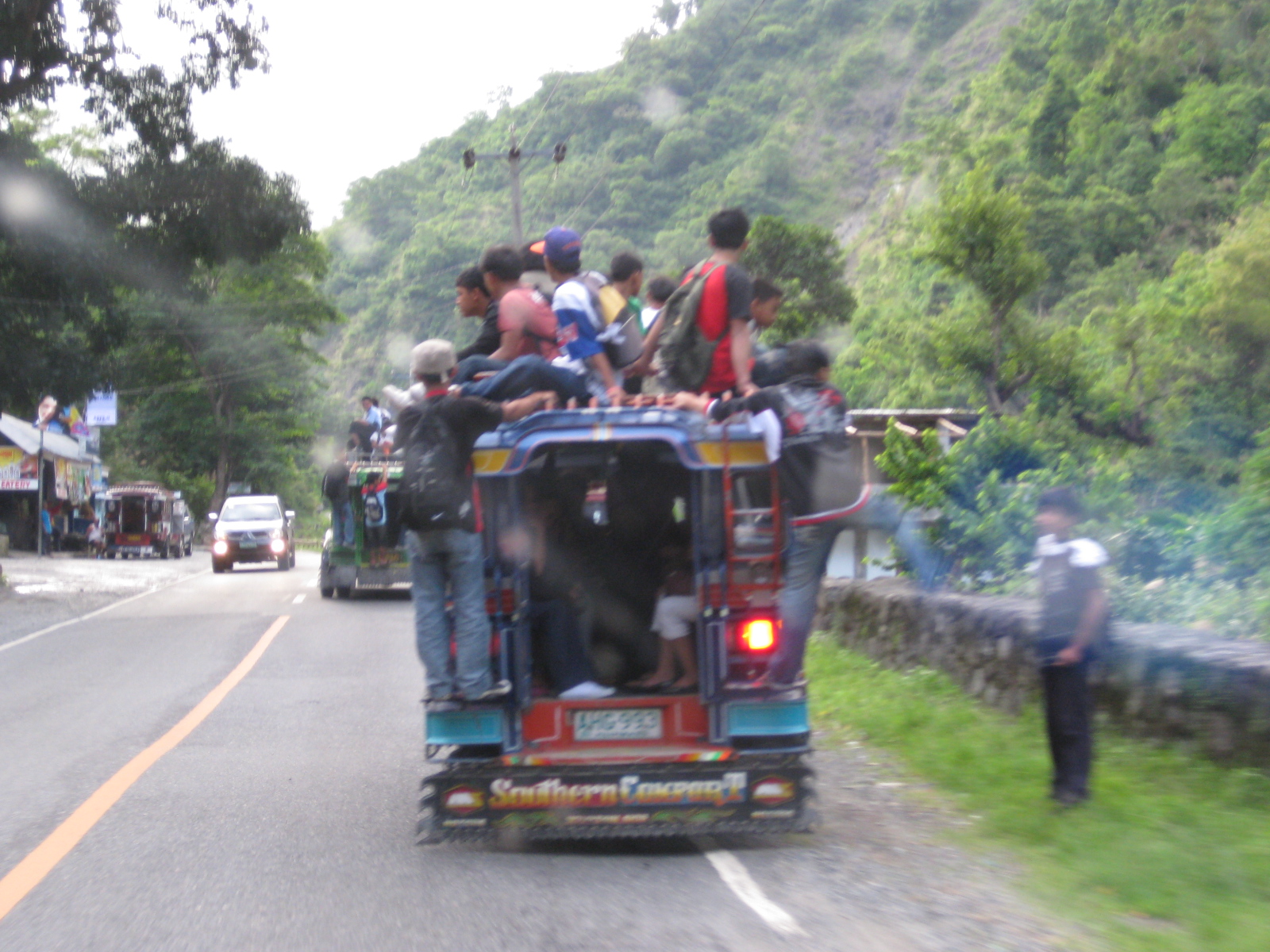
More on Baguio and jeepneys on future posts.
Traffic and flooding
Metro Manila and other cities around the country are again in the headlines because of flooding brought about by strong rains. Rains are not new to the Philippines and there are many articles (and blogs) that have been written about the history of flooding in the Philippines. Some even feature old photos or caricatures showing how life was during the Spanish and American periods when floods also occurred, probably due to similar strong rains brought about by the monsoons or by the typical typhoons that regularly visit the country during the wet season.
In those times many years ago, the subject of drainage has already been mentioned and there is evidence that certain infrastructure were constructed to address the problems of flooding. In fact, the esteros that we presently associate with informal settlers and garbage were man-made waterways that functioned as open channels that could alleviate flooding in times of heavy rains. These waterways also functioned as transport facilities as they were constructed wide enough for boats to travel along the network of esteros that also connected with the Pasig River. These were not so different as the waterways that are now being used in Bangkok that have significant commuter and even goods traffic. There are many photos of these esteros as they were back in the Spanish and American periods. There are even more recent postwar photos that allow for comparison with photos at present. Unfortunately, I cannot post these here as there may be IP issues involved. Nevertheless, one can use your preferred search engines to find and view these photos.
Through the years, however, these esteros have been neglected and, as more and more squatters came to construct their shanties above the channels and tons of garbage disposed of, they became clogged and thus resulting to flooding in many parts of Manila. The esteros, however, are not wholly to blame when the subject of floods come up every now and again. It is a fact that the drainage systems of Metro Manila and other Philippine cities are already quite antiquated and their designs cannot accommodate the amounts of rainfall experienced these days. This is the result perhaps of poor planning and even more due to the neglect of national and local governments. And so we now experience floods almost each time we have significant rainfall. In some areas, the floods do not recede until after the wet season is over. Such is the sad plight of many Filipinos who are reduced to prayers and tests of faith if only to assure themselves that things will improve – some day.
Meanwhile, other cities have engaged similar flooding problems head-on and have invested on solutions that have saved their cities from much of the costs due to damages brought about by floods. Among those cities is Kuala Lumpur in Malaysia where they constructed a tunnel that is usable as part of their drainage system as well as a highway. Kuala Lumpur’s SMART Motorway Tunnel is an example of an engineering solution that could help alleviate flooding in Metro Manila. It is quite costly, with construction amounting to about USD 514.6 million at the time of its completion in the first quarter of 2007 with construction starting about 4 years earlier in 2003. Much has been written about this infrastructure and its benefits. It has saved KL and Malaysia from potentially disastrous flooding so many times now since its opening. Was it worth it? No doubt our Malaysian friends with tell us it is and will continue to save them from more floods years from now. Thus, the cost of such projects can easily be justified and the return in investment will be quite quick given the costs of flooding that have been compiling these past years including 2009’s Ondoy (Ketsana). In fact, KL’s SMART Motorway Tunnel is part of its tollway system and was built using a public-private partnership (PPP) arrangement that is much like what the current administration is preaching.
Perhaps its not yet too late for Metro Manila and other Philippine cities? Maybe we should get our acts together in finding and contributing to solutions that also address multiple problems facing our cities in this era of climate change and extreme weather conditions.
Technology-driven transit system development
The proposed UP transit system, whether it will be an AGT or a monorail, is a technology-driven project. As such, it can be argued that it does not need hard studies to establish the need for the system. Indeed, it is packaged as a prototype and one which, if implemented properly, will hopefully be a good example that can be deployed elsewhere where such a system is necessary. Such places may include CBDs like the rapidly emerging one in Bonifacio Global City or in small cities where there is a need for a more efficient form of mass transportation but could not afford the conventional MRTs or LRTs that have been constructed in Metro Manila. Also, a significant part of the initiative is the development of the vehicle, which is being undertaken by the DOST’s MIRDC. Their design and their production process should be replicable and they should have been able to bring down the costs according to the marching orders of their Secretary. After all, this system is being touted as something that would cost a fifth of a conventional system.
The conventional way of planning, designing and building transit systems require a lot of studies including the so-called ridership studies that would establish the demand for the system. Of course, there are also considerations pertaining to the stations and analysis of the superstructure that will also cost something. It is no joke that the best examples of AGTs or monorails in other countries are priced so because of all the effort and expertise that went into their developments. We should not kid ourselves by claiming this will cost much less because we did not take into consideration just compensation to people who will be devoting their time and expertise to develop a “home-grown” version of what has been built in other cities. We shouldn’t also sacrifice the quality of the superstructure that includes the stations just because we want to reduce costs. We have to keep in mind that the infrastructure should be able to resist typhoons and the possibility of earthquakes. The foundations for the columns, in fact, should be designed well considering UP’s soil characteristics.
On Wednesday I might just get my first look at the prototype vehicle when I visit the DOST for a meeting not quite related to the proposed transit system although it would be about customized vehicles. The vehicle that is the rolling stock for the proposed system is supposed to have already been built and being tested on a very limited basis at the DOST compound. Perhaps I can see for myself if it is something that will eventually be an impressive piece or something that will need much work once it is brought to UP.
Is it “Commonwealth” or “Commondeath” Avenue?
There is an excellent article appearing today in the Philippine Star written by Arch. Paulo Alcazaren aptly titled “‘Commondeath’ Avenue.” I stumbled on when it was shared by a friend, Dr. Dayo Montalbo, who is a faculty member of the UP School of Urban and Regional Planning. It provides a rare insight into the history of our highways and streets in Metro Manila. It is required reading for planners and engineers with backgrounds in civil engineering, architecture, urban planning, etc., and, I must say, for anyone who can appreciate history and how we seem to not have learned (or refused to learn) from it. It certainly should be required reading for students who want to become future planners and engineers.
When the MMDA “discovered” plans where it was indicated how wide the RROW for Commonwealth should be and started acquiring land left and right from those who were supposed to have been encroaching on the avenue, including UP Diliman, it apparently didn’t study the old plans and the context by which the capitol, Commonwealth, UP and other institutions where laid out back in the day. That interpretation translated into what we see now as probably the widest highway in the country.
I see the article as something that can be used by the DPWH and the MMDA as an input to whatever planning or engineering they plan along Commonwealth. The avenue is just too wide and definitely not friendly to people. Perhaps it should be transformed into the parkway it was meant to be in the first place.
National EST Strategy Formal Launch
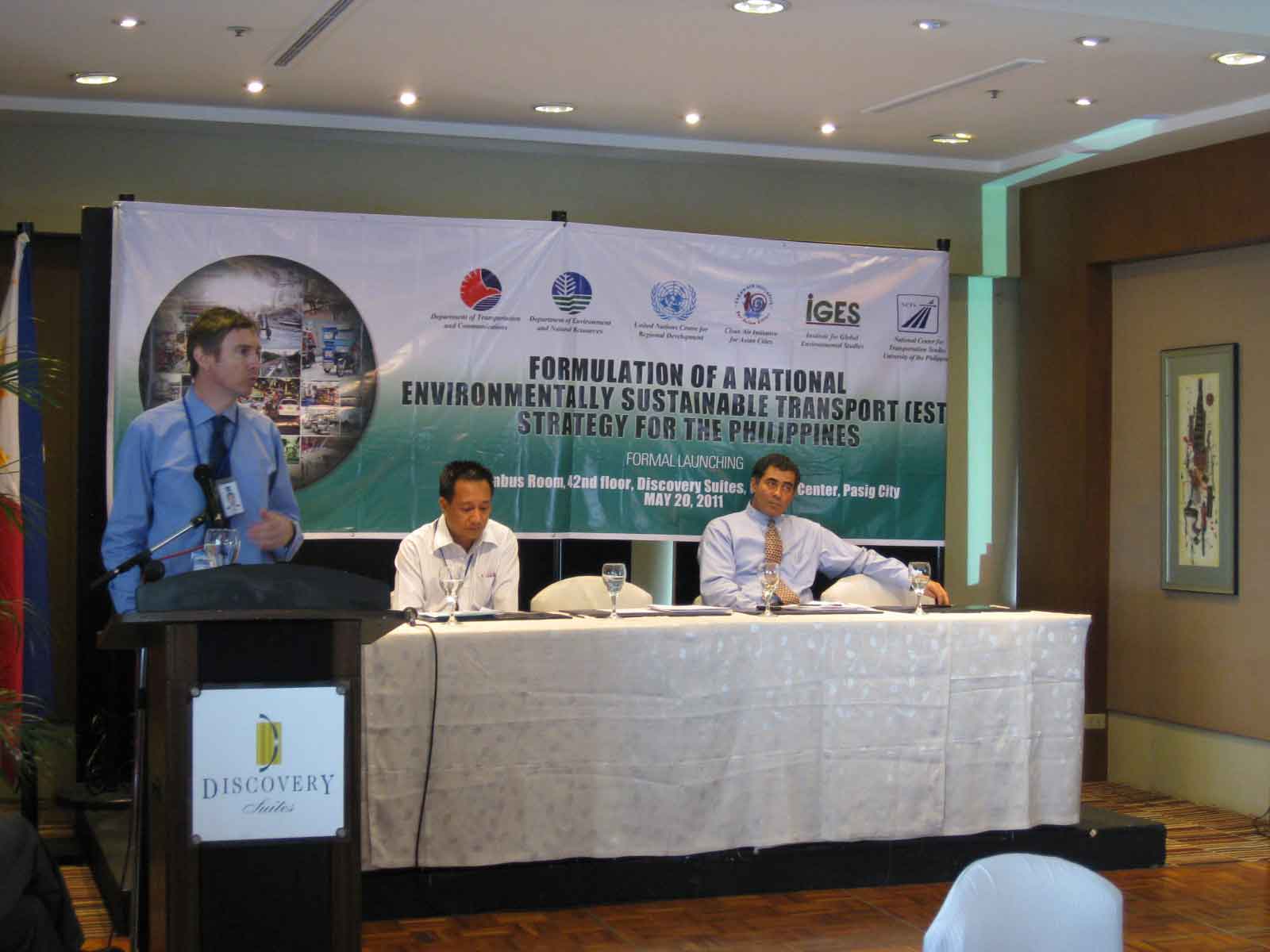
The National Environmentally Sustainable Transport (EST) Strategy of the Philippines was formally launched yesterday, May 20, 2011. The formal launch event was held at the Columbus Room of the Discovery Suites along ADB Avenue in Ortigas Center, Pasig City. It was graced by the presence of top government officials including Secretary Jose “Ping” P. De Jesus of the Department of Transportation and Communications (DOTC) and Presidential Assistant on Climate Change Elisea “Bebet” Gozun, who was a former Secretary of the Department of Environment and Natural Resources (DENR). The DOTC came full force with Undersecretary for Planning and Policy Ruben Reinoso, Assistant Secretary for Planning George D. Esguerra, Office of Transport Cooperatives Chair Leticia Z. Gorrospe, consultant and former Assistant Secretary Alberto Suansing, and senior technical staff of the DOTC and its line agencies including the Land Transportation Office (LTO) and the Land Transport Franchising and Regulatory Board (LTFRB). The DOTC and the DENR are the national focal agencies for the project and will be expected to lead in the operationalization of the national strategy.
The supporting agencies and organizations were represented by Mr. Choudhury Rudra Mohanty of the United Nations Centre for Regional Development (UNCRD), Ms. Sophie Punte of the Clean Air Initiative for Asian Cities (CAI-Asia), and Mr. Akio Isomata, Minister of the Embassy of Japan to the Philippines, who represented his country’s Ministry of Environment. Development agencies and banks were also present with representatives from the World Bank (WB), the Asian Development Bank (ADB) and the Japan International Cooperation Agency (JICA). Also present were stakeholders led by the Partnership for Clean Air (PCA), Philippines – Global Road Safety Partnership (PGRSP), and the Firefly Brigade, and participants from local government units led by Quezon City and Marikina City. The national collaborating center was well represented by the study team from the National Center for Transportation Studies (NCTS) of the University of the Philippines Diliman.
The formal launch even began with the Opening Remarks from the UNCRD delivered by Mr. Mohanty and was followed by a Message from DOTC Sec. De Jesus. The formal messages were followed by a presentation of the highlights of the national strategy by D. Jose Regin F. Regidor, NCTS Director. Afterwards, a panel discussion with the theme “Operationalization of EST in Support of Sustainable Development in the Philippines.” The discussion was facilitated by Ms. Punte and Mr. Herbert Fabian of CAI-Asia. Panel members included DOTC Asst. Sec. Esguerra, WB Lead Transport Economist Baher El-Hifnawi, ADB GEF focal person Bruce Dunn, and Mactan Cebu International Airport Manager Nigel Paul C. Villarete, who is also a former City Planning Coordinator of Cebu City and who is an advocate of Bus Rapid Transit (BRT) in the Philippines. The formal launch event concluded with congratulatory messages from the Government of Japan and the Presidential Assistant for Climate Change, followed by a photo op for all in attendance that day.
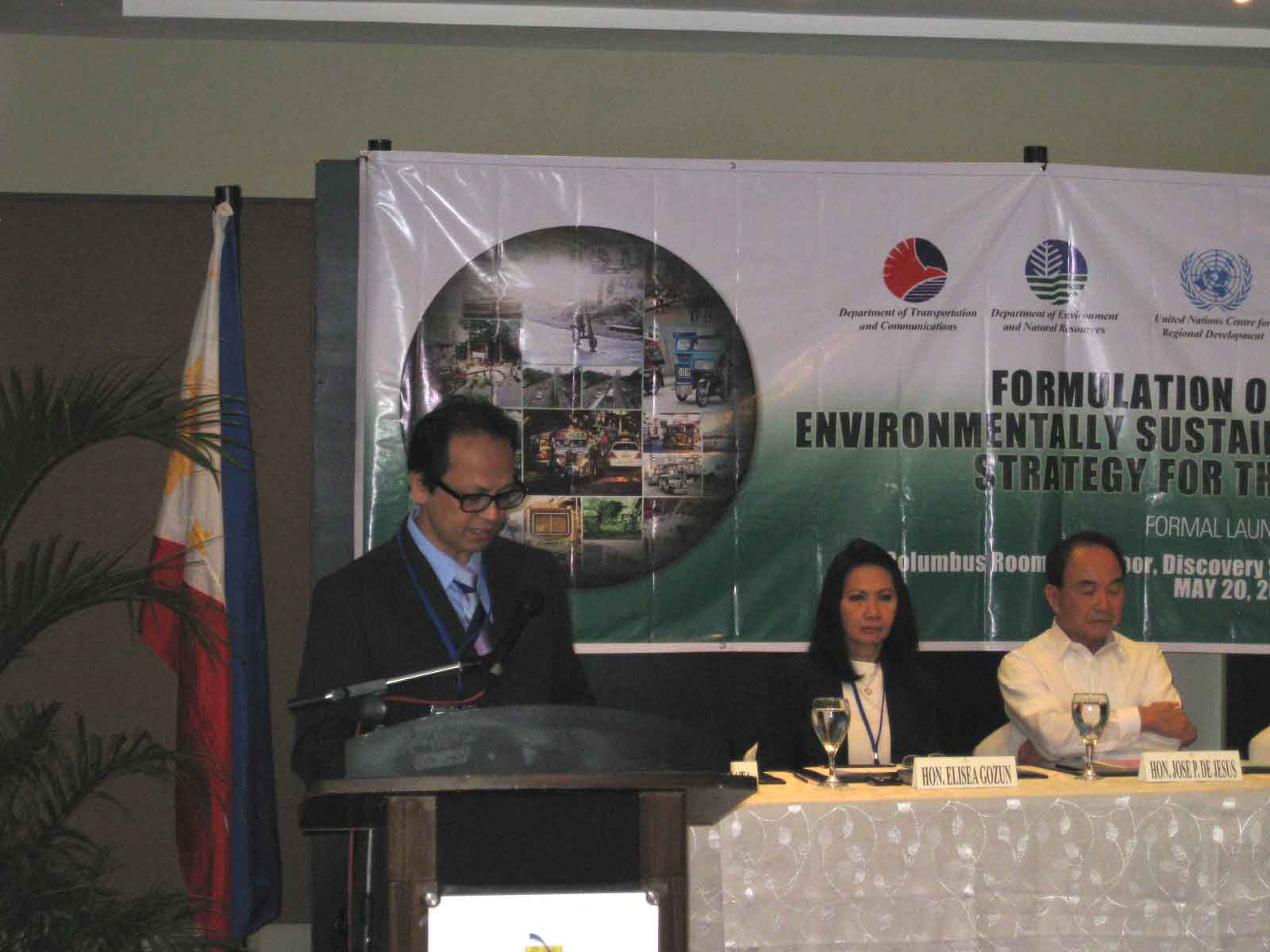 Mr. Mohanty of UNCRD delivering the Opening Remarks
 DOTC Sec. Ping De Jesus delivering a message from the Department
 NCTS Director Regidor presenting the highlights of the national EST strategy
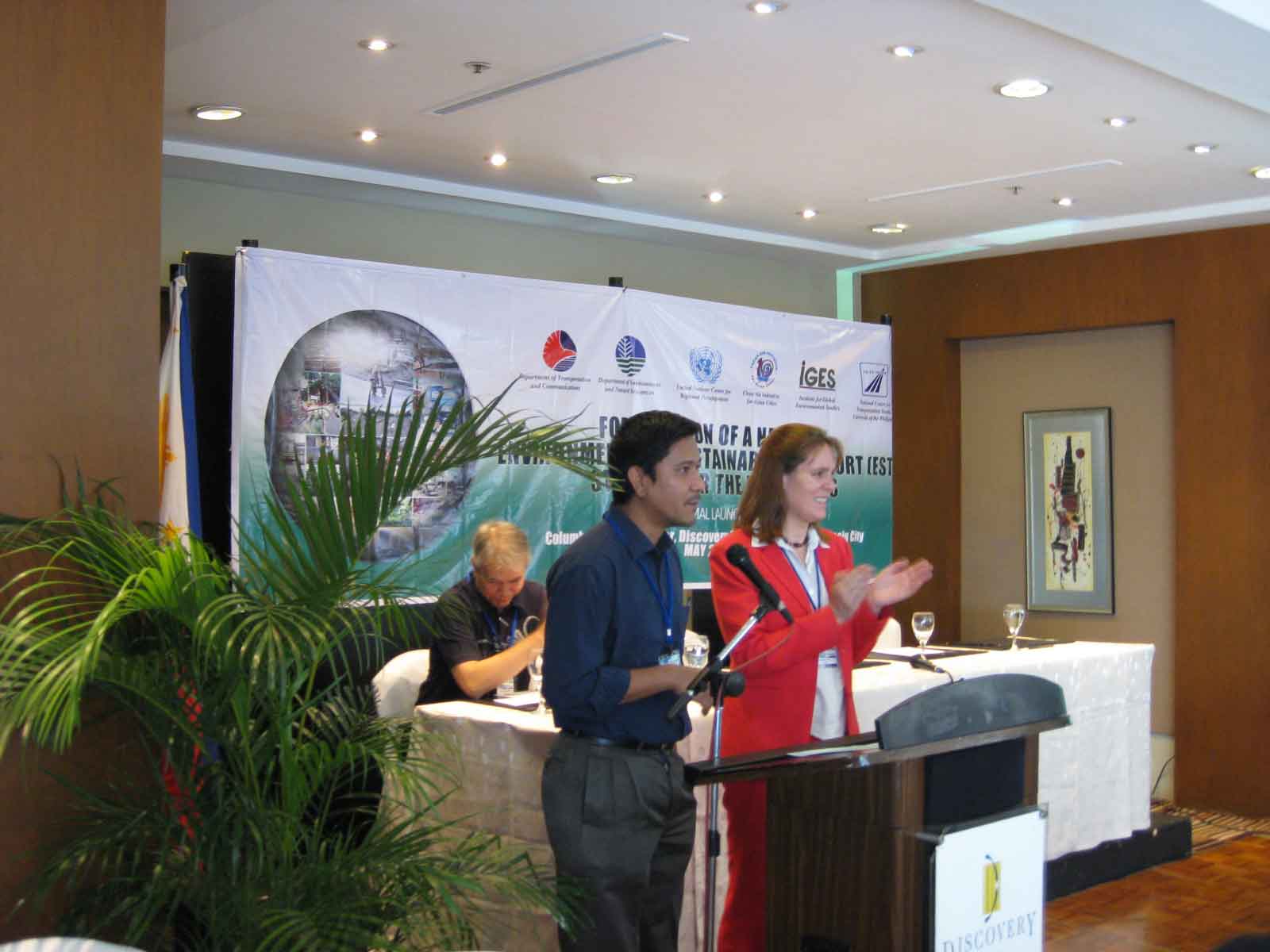 CAI-Asia’s Bert Fabian and Sophie Punte facilitated the panel discussion
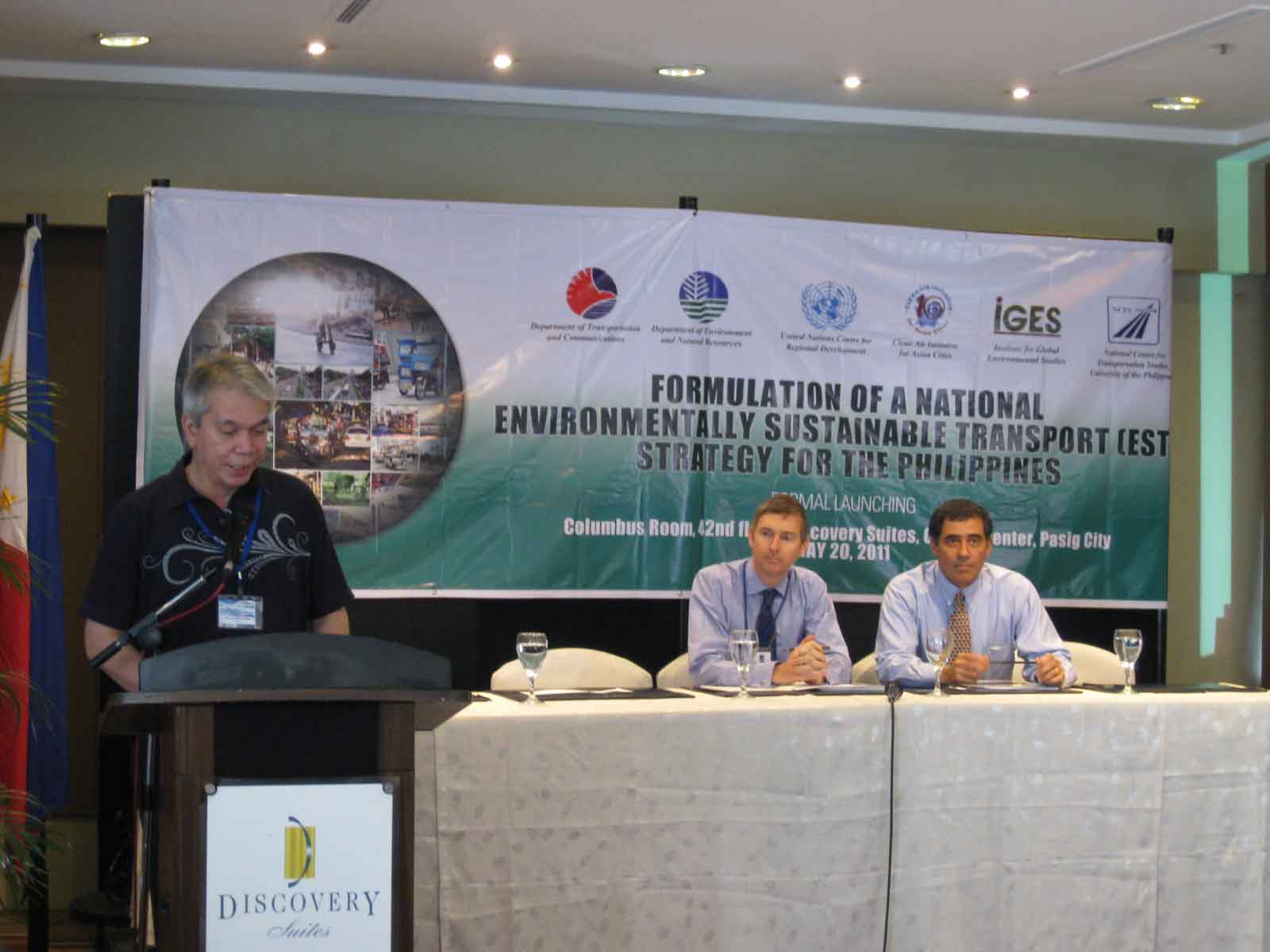 DOTC Asst. Sec. George D. Esguerra responding to the key questions during the panel discussion
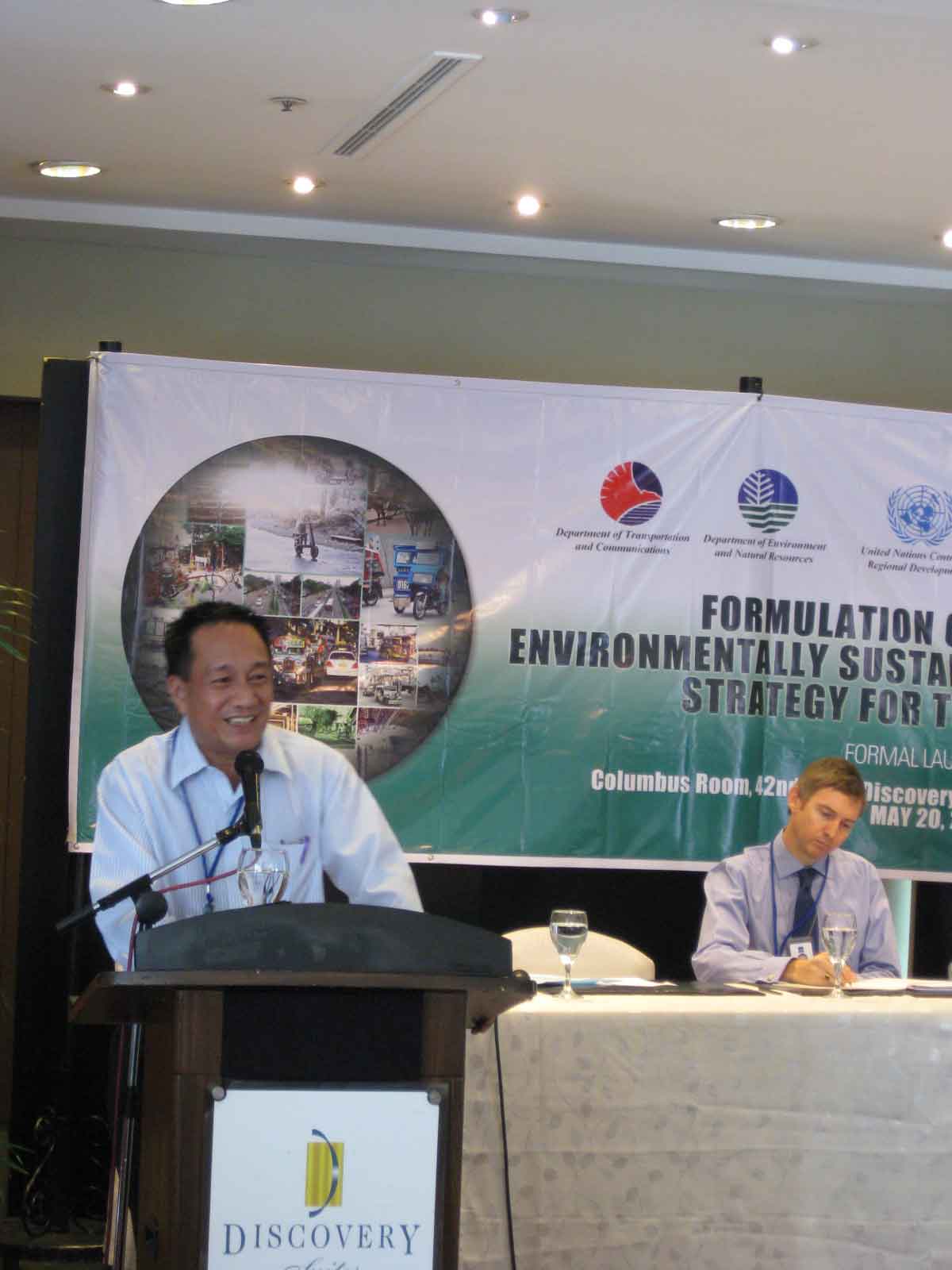 MCIAA’s Nigel Paul Villarete making his comments during the panel discussion
 Bruce Dunn explaining about the ADB’s initiatives
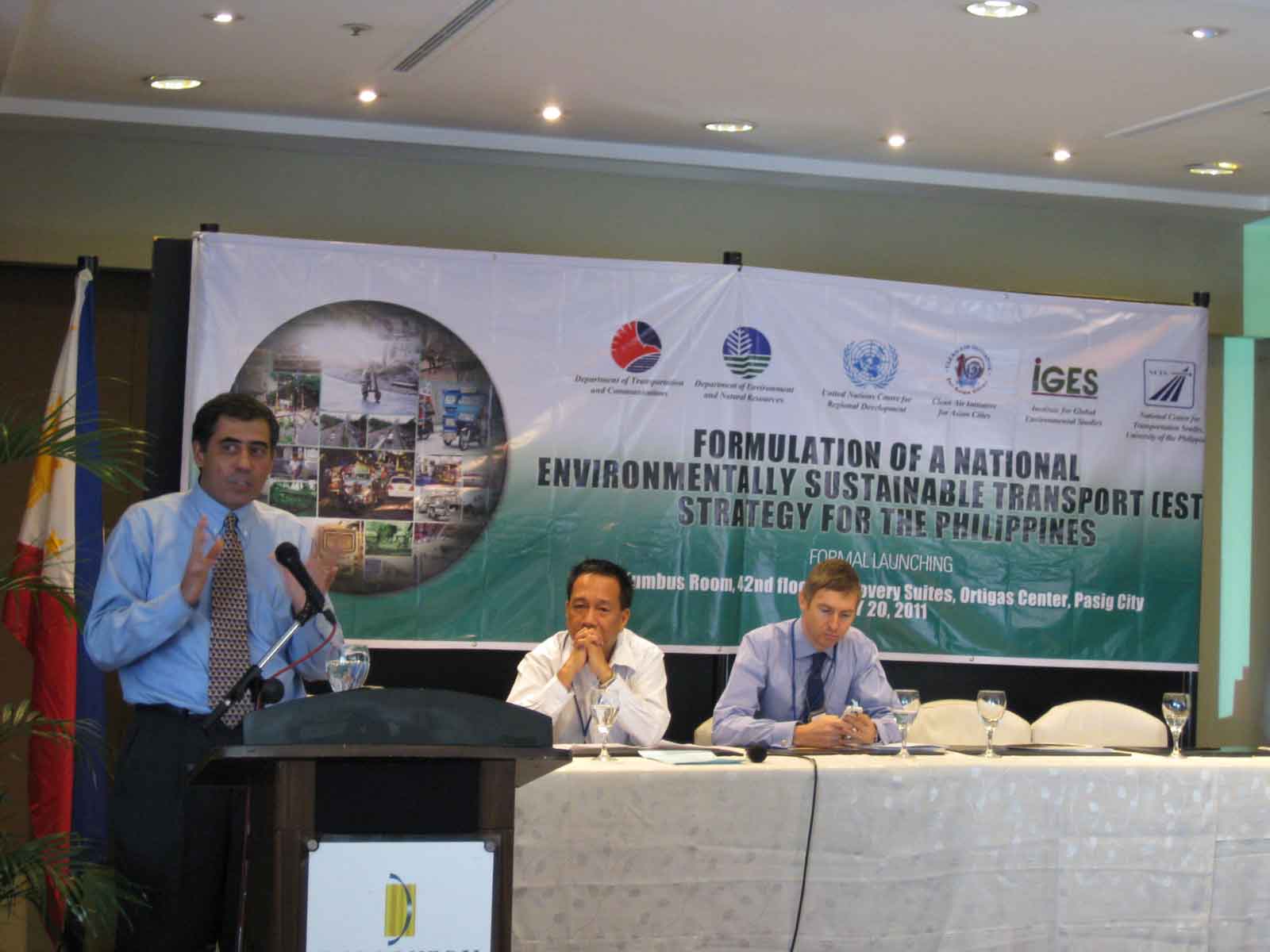 The WB’s Baher El-Hifnawi stressing a point during the panel discussion
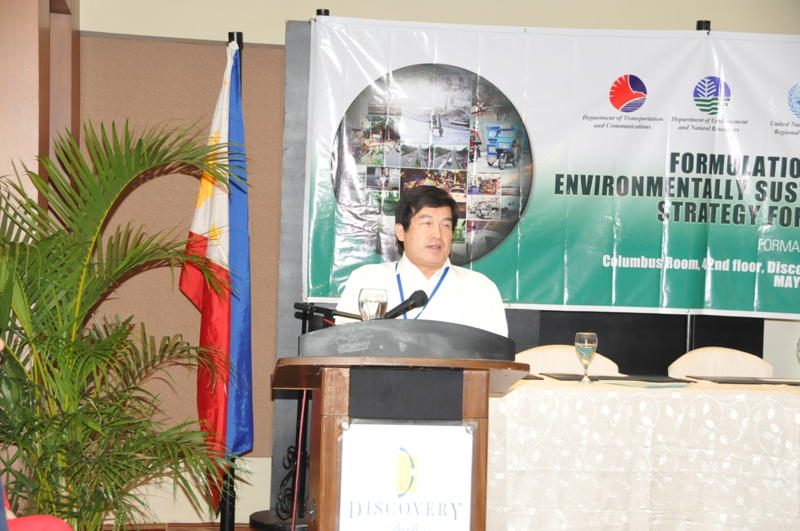 Embassy of Japan Minister Isomata delivering a congratulatory message from the GOJ
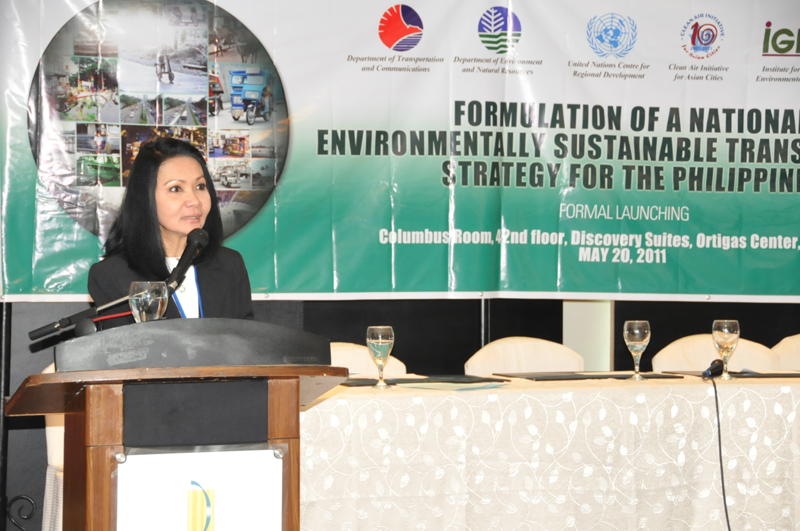 Presidential Asst. on Climate Change Bebet Gozun delivering the concluding message
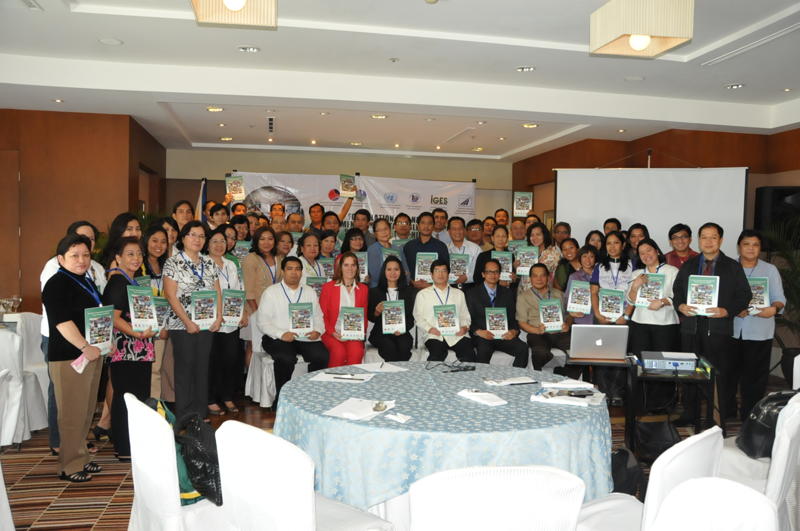 Group photo showing participants to the national EST strategy formal launch
The messages and the panel discussion were one in conveying a challenge to all stakeholders to use the framework provided by the national strategy to come up with action plans and implement these in order to realize sustainable transport in the country. It was also clear from the proceedings of the event that there should be a strong, collaborative effort among national agencies, local government units, NGOs, and development agencies if EST is to be operationalized and for programs and projects to succeed. Significant impacts would then be realized and perhaps lead to the alleviation of transport and traffic problems and their derivatives. It was emphasized that everyone should carefully consider the co-benefits that may be reaped from the implementation of EST.
For more on the national strategy including the reports and other resources, all these are available from the NESTS Web Portal hosted by the NCTS.
Going electric in the Philippines
The Asian Development Bank (ADB) hosted and co-organized a forum on electric vehicles with the Department of Energy (DOE) today. The forum was divided into two parts where the first part included remarks from the DOE Secretary and two presentations from invited speakers. The second part included mainly presentations of experiences in the deployment of electric vehicle technology around the country and a presentation by the ADB on their program to support electric vehicle deployment in the Philippines.
In the first part, the DOE Secretary was very clear in his message in support of electric vehicles. He emphasized the importance of addressing concerns pertaining to the use of fossil fuels, mentioning the need for fuel efficiency and our transport system’s (over)dependence on fossil fuels. He also expressed concern over environmental aspects, recognizing the direct association between emissions and fuel consumption. His remarks was followed by two presentations on experiences on electric vehicle applications abroad. One presentation was mainly on the infrastructure for charging e-vehicles and included material on the experiences in China. Another was on battery technology but included also the different e-cars that are currently available in the market (e.g., Volt, Leaf, Tesla, etc.).
I must admit, modesty aside, that I was disappointed with the presentations as they were both mainly on private vehicle applications including electric motorcycles and electric cars. I was unimpressed, as were others, with the presentations that had material one could easily pick out of the internet. Even information on battery technology did not provide any new knowledge to most participants that included proponents/advocates of electric vehicles in the Philippines. The comment of one participant said it all when he mentioned that in the Philippines the focus was on public transport applications of e-vehicles.
The second part was more interesting, although two presenters tended to stray away from the topic of electric vehicles. The first presentation of the second part of the forum was delivered by the Congressman representing Taguig City. He did not use any slides but chose to make a rambling speech on Taguig’s experience during his time as mayor of the city. He explained his administration’s push for the e-trikes in Bonifacio Global City and made it appear as if his administration was progressive in its push and that the private sector (i.e., Ayala Land, which had a say on transport at BGC) did not have foresight. In truth, the question that needed to be answered at the time of their push was if the e-trike was the appropriate transport mode at the Fort. Ayala knew it was not but it was clear that Taguig insisted on the deployment of e-trikes at BGC rather than take the more progressive (radically) yet risky push of replacing conventional tricycles in the old Taguig east of C5. His speech was really more a conscious delivery of soundbites and I must say, was quite pretentious and self-serving. It was, for me, simply lip service and a waste of time. In fact, one person near us was already snoring by the time the Congressman finished his speech.
The second presentation was delivered by a representative of the Puerto Princesa Mayor. It was straightforward and wasted no time in explaining PPC’s programs and clearly showed their efforts in deploying environment-friendly transport systems. He also mentioned the incentives that the city has so far offered and proceeded to ask those present to partner with them in promoting e-vehicle use.
The third presentation was on Makati’s experience on electric vehicles. The presenter was city’s traffic consultant and I was expecting him to focus on the electric jeepneys now operating along three routes in that city’s central business district. Instead, he took up much time presenting on Makati’s transport plan including the proposed Bus Rapid Transit (BRT) system and its extensive pedestrian facilities that included walkways connecting buildings and to the shopping district. Nevertheless, his presentation had its saving grace in that it mentioned how the e-jeepney could serve as feeders to the BRT and how the pedestrian facilities complemented public transport services.
The fourth presentation was by a representative of Mandaluyong City, which is the first recipient of the incentives being granted by the ADB in support of e-vehicles. This was another straightforward presentation and clearly covered the main points of the e-trike application in that city including the infrastructure they put up for charging. These charging stations represented an innovation that can be picked up by entrepreneurs in coming up with a business model for charging stations. It was not clear though if Mandaluyong has set out to replace conventional tricycles as my impression was that the e-trikes they acquired will be on top of the existing tricycles plying routes around the city.
The fifth presentation was from Ateneo De Manila University, and focused on that school’s efforts to pilot e-vehicles for the use of their students and staff. The presentation mentioned their rationale and the apparent marching orders from their newly installed president, who is an acknowledged expert on environment, to address air quality in the vicinity of the campus. I found their presentation awkward and at the very least hypocritical of the fact that the problem they have to face is the overwhelming number of private vehicles the school generates and their continuing coddling of tricycles whose phase out along Katipunan is long overdue. Perhaps I will expound on this and other issues when I write about Katipunan transport and traffic in the future.
The last presentation was a quick one from the ADB. It was mainly on the ADB’s program supporting e-vehicle promotion. It was also explained why ADB chose to focus on tricycles and was unapologetic in their argument that tended to generalize the problem on transport in the Philippines. There was no mention of rationalization considering that there is actually an oversupply of tricycles and this too needs to be addressed.
While it is commendable that the ADB has extended assistance in the form of grants incentives to promote e-vehicles, there are still questions on the sustainability of this effort given that they chose to focus on tricycles. Of course, the statistics on the number of tricycles and their environmental and energy impacts clearly argue for addressing this problem pertaining to conventional motor tricycles. However, the ADB must realize that local government units (LGUs) can be quite fickle-minded or hard-headed in their approaches to public transport regulations. This is a fact given that there are few LGUs that have been successful in regulating tricycles and particularly in restricting their numbers and their operations along routes or areas where they are suitable. If we take a look at many cities, we will find tricycles running on national roads and causing congestion in CBDs. We would also see that many of these cities, among them highly urbanized cities (HUCs), have a need to graduate from these low capacity modes into middle or even high capacity vehicles.
It was noticeable that there were no representatives from the Department of Transportation and Communications (DOTC) nor its attached agencies like the Land Transportation Office (LTO) and the Land Transport Franchising and Regulatory Board (LTFRB) at the forum. Despite pronouncements by the DOE Secretary that the DOTC and the Department of Science and Technology (DOST) were on-board in the former’s push for e-vehicles, experience has shown that DOTC and its attached agencies have been the bottlenecks in the forward movement of e-vehicles. This includes the absence of clear policies pertaining to e-vehicles including their registration as well as the lack of direction pertaining to their mainstreaming as public transport modes (i.e., franchises). Also, lest we forget, all the talk on e-vehicles while being spearheaded by the DOE, is very much the province of the DOTC since we are, after all, talking about transport. It is the main responsibility and the mandate of the DOTC to see the e-vehicles through and lead in the mainstreaming of these vehicles in the context of environmentally sustainable transport. It is a pitch for e-vehicles that would go a long way into ensuring that a critical mass can be realized and that the tipping point for the shift to electric would be reached in the near future.