
Home » EST (Page 37)
Category Archives: EST
National EST Strategy Update
The Third Draft (Draft Final Report) of the National Environmentally Sustainable Transport (EST) Strategy (NESTS) formulation study for the Philippines has just been completed. The report is available online via the NESTS Web Portal on the NCTS website. The project is concluding in May 2011 after more than 2 years of developing strategies covering twelve (12) thematic areas as defined by the Aichi Statement of 2005.
The report articulating strategies, indicators and key result activities is written in general terms to allow for flexibility in the further development of strategies and action plans to realize EST. The document is envisioned to be a guide for both national agencies and local government units, as well as for other stakeholders such as non-government organizations (NGOs) and private entities seeking to take on EST as an advocacy.
The National EST Strategy will be formally launched on May 20, 2011.
Airport parking
I’ve been to Metro Manila’s airport terminals quite frequently lately. It’s only March but I’ve traveled to Singapore twice, once using NAIA Terminal 2 for a Philippine Airlines flight in January, and again last February but using Terminal 3 for a Cebu Pacific flight. I’ve gone to Terminal 1 several times as I either dropped off or fetched the wife who flew in and out via either Singapore Airlines or Tiger Airways. Every time I went to any of the three airports, and especially when I was fetching someone, I couldn’t help but make some observations about the parking.
I’ve been to many airports including the huge modern ones in our neighboring countries. I must admit that I haven’t had the chance of using their parking facilities first hand. Most of the time I use public transportation from and to the terminals like when I use Changi or Suvarnabhumi. I have seen their parking buildings from the outside though. And I can say that my impression is that they are sufficient for their purpose whether their users be well wishers, people fetching relatives or friends, or travelers opting to leave their vehicles to return for them on their ways back.
I must say that the parking facilities of the three NAIA terminals can be viewed as a progressive case considering that there have been steady and obvious improvements when comparing features from Terminal 1 to 3. I won’t get into the technical aspects as qualitative assessment from fellow users like friends and colleagues point out that NAIA 1’s parking seem to be always full as with Terminal 2’s. The latter is quite unusual as it is used exclusively by PAL. Terminal 3 should have the largest capacity and this was expected for a terminal whose designers should have learned from the lessons of Terminals 1 and 2. However, in my recent trips to all three airports, my experiences have been quite the contrary in terms of finding a parking slot that is convenient enough; that is, not so far a walk from the respective terminal buildings.
It was surprising for me to find good parking slots in my most recent trips to NAIA 1 and 2. Meanwhile, parking at Terminal 3 seemed to be laborious especially considering the linear layout of the open parking facility. In that last sentence, allow me to emphasize open and add to it “outdoor” since Terminal 3 is supposed to have a multi-level parking building. This was supposed to be one of its features distinguishing it from 1 and 2. The problem is that airport officials have not given the go signal for this multi-level facility to be operational. This causes problems to airport users considering that there is a significant number of vehicles left by their owners for their return trips. These include overnight parkers who probably took a local trip with a schedule that prevented them from returning the same day. All these vehicles are parked along what should be a lane dedicated for traffic circulation. In fact, the line of parked vehicles extend all the way to the ramp leading to the entrance to the parking building.
Perhaps it is already time to open the parking building to the general public. It doesn’t take a genius to see that parking at NAIA 3 is already insufficient given the travel characteristics of its users. Operational costs including maintenance and security should not be a problem since users will be charged fees according to their parking durations. Also, a variety of services may be offered to users including cleaning like the ones offered in shopping malls and even quick repairs for those encountering some trouble with their engines or tires. It shouldn’t be so difficult to come up with a system for parking management that would enhance NAIA 3’s services. And it should be done now and not later.
I have other impressions of parking in the other terminals I have had the opportunity to use across the country including those of international airport in Mactan, Cebu and Davao. But these terminals do not generally serve as many people as Manila’s three terminals do so their assessments would have to be tempered against this backdrop.
Upgrades: the Ayala BRT
The Ayala Land Inc. (ALI) has been issuing press releases about their plan to put up a Bus Rapid Transit (BRT) system for the Makati CBD and the Bonifacio Global City. The system will serve both the old financial center in Makati and the rapidly emerging one in Taguig, connecting the two via Ayala Avenue-McKinley Road and Gil Puyat (Buendia) Avenue-Kalayaan Avenue corridors. It is a project that is long overdue although the buses serving the Fort have shown us at least what a higher capacity mode of transport can do if managed properly.
The Fort Buses load and unload passengers at designated stops. They follow traffic rules and regulations enforced more strictly inside the Global City. Many of the newer bus units also happen to have layouts that are more appropriate for city operations. The Mercedes Benz coaches are designed such that they can accommodate more passengers as they have ample standing space and there are only enough seats for passengers who may actually need them like the elderly, pregnant women, persons with disabilities, and perhaps those who are burdened with heavy bags or packages. The doors of these units are also designed for more efficient fare collection and discharging of passengers, with the narrower front door accommodating boarding commuters who are already queued at bus stops and the wide two door rear egress allowing for efficient alighting. Surely, an automated fare collection system such as those using smart cards or other machines will be in place in the near future and greatly improve the operations of these buses. But the most significant feature, it seems, of the Fort Bus is the compensation scheme for its employees, particularly its drivers. Unlike most bus companies, Fort Bus drivers are given a regular monthly salary and reportedly enjoy benefits much like regular employees in typical companies or offices. This feature, I believe, is what makes it work in the first place and what is required for a transformation in public transport services as it does away with the rabid competition that is the derivative of a commission-based or “boundary” system compensation scheme that is used for both buses and jeepneys.
Considering the calls for more efficient as well as more safer public transport systems, let this Ayala BRT be a test case for what to do with transport systems that should have been phased out a long time ago (jeepneys) along corridors or routes that demand higher capacity vehicles. Public utility vehicles with low capacities and perhaps low quality of service should be replaced by more efficient modes especially along arterials. Also, all the elements are there for a potentially successful PPP in transport. You have a major player from the private sector (Ayala) offering to put up a system that it has studied and designed over the past few years. You have two CBDs in Makati and Taguig that currently serve as the present and future financial centers. And you have the challenge of doing away with an inefficient transport system. Though there sure will be compromises that are not necessarily palatable (e.g., re-routing PUJ and PUB lines) the government should start realizing that it should be more deliberate and even unforgiving when it deals with the issue on PUJ and PUB franchises here.
The local governments of Makati and Taguig should cooperate with Ayala to make this work for these LGUS should put aside certain interests including those pertaining to PUJ and PUB operators and drivers, many of whom may be their constituents and comprise a significant part of their voting populations. The LGUs should facilitate discussions including those dealing with livelihood and othe social issues that are the province of local governments. The Land Transport Franchising and Regulatory Board (LTFRB) should get out of its shell and make a stand now considering the opportunity for public transport transformation. And its mother agency, the Department of Transportation and Communications (DOTC) should support this stand, all out, if only to show that it is indeed committed to reforming and modernizing public transport systems in this country.
A BRT finally being realized for Makati and Global City will indeed be a showcase. We just hope that it will be a showcase of an efficient transformation of a public transport system from an outdated to a modern and efficient one rather than a showcase of futility and ineptness on the side of those in government. As they say, something has to start somewhere. A modern, efficient public transport system that is deserved by Filipinos may just start in Makati and Taguig, and with a BRT that may actually mean “better rapid transit.”
Discipline along a killer highway
Commonwealth Avenue in Quezon City was given a tag as a killer highway due to the frequent occurrence of road crashes along the road, many of them resulting in fatalities. Only last December, a retired judge was about to cross the highway on his vehicle, his wife (a retired teacher from a prestigious science high school) with him as they were heading to church. It was very early in the morning since they were going to the Simbang Gabi or night mass – a tradition in the Philippines during the Advent Season leading up to Christmas Day. Despite probably signalling and their being cautious enough, their vehicle was hit by a speeding bus. The driver of the bus was to claim later that he used his lights and horns to warn the judge against crossing. There was no mention if the bus driver attempted to slow down, the safest thing to do when driving at night and knowing that there are many crossings along the road he is traversing. In fact, this should be the first thing on the mind of anyone aware and conscious about safe driving.
There are many incidents like the one above and not just along Commonwealth or other Metro Manila road. Road crashes occur along many of our national and local roads everyday and the casualties just pile up, and many are often just treated as statistics especially when nothing is done to address the issue. Such road crashes occur due to many factors that are usually categorized into human, vehicle or environment-related. Most often, as findings in the Philippines indicate, it is the human factor that results in a road crash.
Driver error, poor maintenance of vehicles, and ill-designed roads can all be traced to human shortcomings. Environmental factors are also ultimately rooted on the human element. Speeding is one thing and aggressive driving is probably another but altogether general driver behavior along Philippine roads are clearly a manifestation of a lack of discipline and not necessarily the lack of skill, although the latter is also a significant factor if one is to focus on public transport and trucks.
There are few exceptions and it seems “few” is a relative term often leading to the example of Subic. At Subic, we always wonder how and why drivers seem to be disciplined. Some say it is because of the fines or penalties for traffic violations. Others say it is psychological and a legacy of the base being previously under the US military. I would say it is more of the traffic rules and regulations being enforced firmly and fairly in the free port area. I would add that motorists and pedestrians have embedded this in their consciousness such that there is something like an invisible switch turning on when they drive in Subic and turning off once they are out of the free port.
For a corridor like Commonwealth, perhaps the best example to emulate would be the North Luzon Expressway (NLEX). Along that highway, its operators the Tollways Management Corporation (TMC) have established a strict regimen of enforcement and have applied state of the art tools for both monitoring and apprehension. These tools include high speed cameras equipped with speed radars that detect speeds and capture on photo cases of overspeeding. Photos are used as evidence upon the apprehension of the guilty party at the exit of the expressway.
The current campaign along Commonwealth is premised on the strict enforcement of a 60 kph speed limit along the arterial and the designation of PUV lanes (e.g., yellow lanes) along the length of the corridor. The initiative would be manpower intensive and features novel tools such as the use of placards, loudspeakers and public relations in order to encourage motorists and pedestrians to follow traffic rules and regulations. The results as of today look promising and there has been a significant reduction in speeds and general compliance for PUVs serving the corridor. The numbers might be misleading if we attempt to conclude about the success of the program now. Perhaps the more reliable statistics would come out after the campaign has been implemented and the effort sustained over a month’s time. Nevertheless, it gives us a nice feeling to see less speeding and less weaving among vehicles that were once observed as though they were driven along a race track. It would be nice to once and for all kill the “killer highway” tag and make Commonwealth an example of how traffic management should be implemented. We are always searching for examples of good if not best practices that can be replicated elsewhere. If we succeed in the “Battle of Commonwealth” then perhaps we could eventually win the “War Against Irresponsible Driving and Jaywalking.”
Simplify
I still remember what our calculus teacher told us while discussing a problem in integration. At the time, I believe he was setting up the working equation for a problem involving trajectories. He was reminding us that in problem solving it was very important to remember how to “kiss.” As we were practically in awe of him, he followed up by asking us what “kiss” meant. He called on one of our classmates and then another, all the while smirking like a child who thought he alone knew the answer to his question. “Kiss,” he said, meant – keep it simple, stupid. Of course, the last word was intended to drive home the point with a little sarcastic humor to a class of sophomores, most of whom were engineering students. Years later, perhaps its time we realize and accept that we do indeed need to “kiss.” This time, we need to apply the same principle to public transport.
In the past few weeks as I and my colleagues pondered the development of public transport planning support system that would include, among others, a franchising module specifically for Mega Manila and generally for other Philippine cities, I came to the obvious conclusion – “kiss.” It seems that based on the secondary data we got from the LTFRB and the DOTC, and the primary data derived from field surveys validating routes and allowing us to estimate both supply and demand that Mega Manila public transport has become so complicated due to the overlaps and tangles that are the bus, jeepney and AUV routes in this mega city. Through the years and despite opportunities to untangle the mess of routes, there was no strong effort to do so and today, there seems to be little interest in rocking the boat that is the current state of public transport in this country.
It is often asked why, despite having EDSA-MRT, have the numbers of buses along EDSA seemed to have increased instead of the logical decrease as the rail system covered much of the demand along its corridor of operation. One answer seems to be related to provincial buses since continuously increasing populations outside Metro Manila coupled with better roads have led to more economic activity that translates into more travel (and person trips).
The same is true for origins and destinations within the National Capital Region and thereby affects the supply side for buses for city operation. Yet, there is always the specter of colorums or illegally operating buses that are often difficult to catch and to distinguish from the legitimate units. There are even allegations that some unscrupulous operators allow colorums among their ranks in order to generate more revenue.
However, such situations are not exclusive to EDSA. There are the similar questions pertaining primarily to jeepneys along corridors already served by LRT 1 (since 1984) and LRT 2 (since 2004). Why have authorities allowed most jeepneys to continue plying routes along these two lines? Why are there no strong efforts to rationalize (a word very much abused when referring to public transport in Philippines) routes to complement established mass transport systems rather than to compete with them? Is it really a matter of political will among our leaders especially those in-charge of our transport agencies? Are there conflicting interests, some probably vested, among politicians, transport groups and operators themselves? And are we dead serious about addressing, once and for all, the challenges of putting in place a public transport system that is both modern and sustainable?
Why is it that transport systems in cities such as Tokyo, Singapore, Hongkong and those in Europe and the US appeal to us? What is different about the transport systems in these countries especially those cities that have similar if not larger populations and sprawl? Is it their high tech attributes? Is it their fare systems? Or, if we look close enough, is it their simplicity? It should be noted and emphasized that these cities follow closely the ideal hierarchy of public transport services. In a nutshell, this is where high capacity modes form the backbone of the transport system while lower modes complement these, acting as feeders from the main lines. This is simplicity as applied to public transportation.
Mathematicians, scientists and chess grandmasters then and now have often invoked the principle of simplification to solve problems of different magnitudes. It is quite a common approach for the most complex predicaments since it is also believed that a system that is too complex and requiring so many inputs is impractical and unmanageable – precisely the descriptions for public transport systems in this country. Perhaps one city should show the way in coming up with a proof of concept for simplicity. Maybe that will be Cebu once it builds what is touted as the country’s first BRT line. Maybe that will be Davao should it implement possible recommendations pertaining to sustainable transport from an ongoing study. But I hope it will be Metro Manila, not necessarily at a grand scale but something that will show signs of life in an otherwise deteriorating system.
Replicating success
In his inaugural speech, P-Noy stated his disdain for “wang-wang,” referring to the abusive of the sirens by certain people. “Wang-wang” then symbolized how these people practically claimed privilege over other people haplessly caught in traffic jams. The mere reference to “wang-wang” and the marching orders for the PNP-HPG and the LTO to crack down on the abuse led to an aggressive, fast and effective campaign that resulted in the confiscation of illegal sirens. In effect, the campaign brought back the sirens to its original purpose. And that is to get the attention of motorists for them to give way to emergency vehicles such as ambulances and fire trucks.
I’ve always wondered after that successful campaign why our agencies can’t replicate this for other traffic violations as well. Surely, a similar campaign will go along way in establishing firm enforcement of traffic rules and regulations – something that has been cited time and again as what needs to be done to bring order to the traffic mess we experience everyday.
Perhaps we can start off by listing something like a Top Ten rules that are violated and apply the “wang-wang” campaign to these. I nominate the following to be included in the Top Ten:
1. Counterflowing
2. Use of illegal license plates
3. Speeding
4. Jaywalking
These combined with another aggressive campaign but this time on the environment side (i.e., no-nonsense emission testing and anti-smoke belching) should help ease traffic in many major thoroughfares. These could all be under the banner of a Traffic Discipline Zone (TDZ) or corridor and if implemented properly may help bring respect back to our traffic enforcers. I am optimistic that enforcement will go beyond just being a motherhood statement and that its contributions would be very significant.
Capacity Building
We’ve been quite busy at the National Center for Transportation Studies during this month of September. So far, we’ve conducted 3 training programs in the during each week of the month. Each program was conducted over a period of 5 days. We held the 3rd offering of the Traffic Administration Course (TAC-3) from September 6-10, 2010. That was followed by a Road Safety Audit training course for sister companies the Manila North Tollways Corporation (MNTC) and the Tollways Management Corporation (TMC) from September 13-17, 2010. And only yesterday, we completed the first offering of the Advanced Traffic Administration Course (ATAC) for participants from the Metro Iloilo-Guimaras Economic Development Council (MIGEDC) and sponsored by the Japan International Cooperation Agency (JICA). Also last week, I was among the a handful of participants for a special training on Eco-Driving conducted by Dr. Taniguchi of the Eco Drive Promotion Division of The Energy Conservation Center, Japan. Hopefully, the knowledge and experience gained from the training will allow me and my colleagues to share Eco-Driving to other drivers and enable the promotion and application of Eco-driving in the Philippines.
Next week, we will be resuming the Public Utility Vehicle Drivers’ Training Program, which is offered in cooperation with the Land Transport Franchising and Regulatory Board (LTFRB). This is a 3-day course that was formulated for PUV drivers in order for them to have a re-education of sorts. In the course, the fundamentals of traffic rules and regulations, road signs, ethics and customer service are taught by select lecturers from the DOTC, the PNP and UP. Such education is a necessity considering that most PUV drivers have not undergone any formal training considering how most of them were able to get their licenses. There is a tremendous amount of actual and anecdotal evidence out there pertaining to how most PUVs are driven. Hopefully, this course will benefit them and influence them to drive safely and prevent the loss of more lives as a result of crashes they may become involved in.
Motorcycle lanes
There have been proposals to have exclusive lanes for motorcycles along major roads. The rationale for such proposals is the increasing number of road crashes involving motorcycles. It is assumed that having exclusive lanes will result in a significant decrease in motorcycle involvement in crashes since it is further assumed that with exclusive lanes, there will be fewer interactions among motorcycles and other motor vehicles. There are evidences to support these assumptions.
Anyone observing traffic along our roads can easily see that the biggest reason for the rapidly increasing number of road crashes involving motorcycles is the behavior of motorcyclists. Motorcyclists have the propensity to weave in traffic, heavy or not, often splitting lanes and catching drivers unaware. This behavior frequently results in crashes, most of which involve only damage to property and thus are usually relegated as minor incidents that are not newsworthy. However, crash statistics with both the MMDA (for Metro Manila) and the DPWH (for national roads) indicate that motorcycle crashes with fatalities are alarmingly increasing, and therefore require intervention. Motorcycles’ notoriety are now the among the pet peeves of many drivers, regardless of whether they drive cars, public transport or even trucks.
There are still many riders who do not wear helmets. And not a few bring their gear but choose not to wear these; a habit that has led to jokes about helmets being for elbows or shoulders rather than for heads. This is despite a Helmet Law stipulating penalties that are supposed to discourage non-compliance. The practice significantly increases the chances of having fatalities in crashes, especially considering that there are no restraints for riders or other protective devices for motorcycles like seatbelts and airbags that are already standard features for many other motor vehicles.
There is a bill filed before the Senate, SB 871, which stipulates the delineation of one-meter wide lanes for exclusive use of motorcycles. The bill has a provision directing the DPWH and local government units to designate motorcycle lanes, presumably for both national and local roads. SB 871 proposes fines (i.e., not more than six (6) years of imprisonment or a fine of not less than Five Thousand Pesos (PHP 5,000.00) but not more than Twenty Thousand Pesos (PHP 20,000.00), or both, at the discretion of the court) for motorcyclists using other lanes. There is no mention of penalties for drivers of vehicles encroaching on lanes designated for motorcycles.
While the bill is well meaning, it begs the question of whether its provisions are enforceable once the bill becomes a law given the extent of our national road system. After all, there are many laws that are not effectively enforced but were also designed to instill road discipline among drivers and riders, and to ultimately make roads safer for all users. And motorcycle riders are among those commonly seen as violators of road traffic rules and regulations.
In urban areas, for example, where many roads have multiple lanes, space for motorcycles may be derived from existing lanes but may lead to congestion due to the decrease in road capacities. In some cases, motorcycle lanes of at least one meter may be constructed by taking part of medians (e.g., islands) or shoulders. However, along roads where there are no medians, motorcycle lanes from shoulders may lead to conflicts with public transport vehicles that operate along the outer lanes of the road. Further, it is noticeable that there are no shoulders in most urban roads in the Philippines and there are also many instances where roadside parking is allowed or tolerated. And deriving motorcycle lanes from pedestrian rights of way such as sidewalks is definitely not recommended.
In the case of most national roads including rural highways, there are only 2 lanes and shoulders on either side that are most likely unpaved. Road rights of way are often unsecured, with structures such as houses and shops encroaching within the RROW and leading to shoulders being utilized for parking or other purposes. The DPWH Highway Planning Manual does not stipulate motorcycle lanes or even pedestrian walkways as standard specifications for typical national roads. And it is supposed that a law emanating from bills such as SB 871, should encourage if not mandate a review of road design standards to include provisions for motorcycles, and perhaps more importantly, for pedestrians and non-motorized transport (NMT) as well.
Other countries such as Malaysia have already incorporated in their road design manuals lanes that are for the exclusive use of motorcycles, bicycles and other NMTs. These have reportedly improved safety so much that their governments approved the budgets for implementing the provisions for roads where there is significant motorcycle traffic. Perhaps the Malaysian example is proof of the concept that having motorcycle lanes will indeed improve road safety. It should only be emphasized that road design improvements can go only so far if a key element, enforcement, is lax or nonexistent. Without this key element, motorcycle lanes in this country will just be destined for the ningas cogon hall of shame.
–
For more information about motorcycle lanes and road safety, one may refer to the website of the International Road Assessment Program. They also have a Flickr account showing their activities in Southeast Asia.
The pitch for electric public transport
Electric vehicles have been in operation as public transport modes in the Philippines since 2007 when electric three-wheelers were introduced at the Bonifacio Global City in Taguig City, Metro Manila. At the time, the City Government of Taguig bought the pitch by the proponents of the E-Trike and supported their trial operations that have since expanded but are yet to be legitimized due to the vehicles not being registered with the Land Transport Office. These could not “legally” charge their passengers since they also did not have franchises with the Land Transport Franchising and Regulatory Board (LTFRB) nor with the local government (i.e., like conventional tricycles).
 E-trike in Fort Bonifacio
Meanwhile, around the same time, another electric vehicle was introduced in the Visayas. In this case the vehicle was in the form of a national icon – the jeepney. Electric jeepneys were first built out of China and directly imported as a “proof of concept.” What were initially launched in Bacolod and Silay Cities in Negros Occidental were examined by local partners based in Manila, and eventually a locally manufactured E-jeepney came out in 2009, care of the Motor Vehicle Parts Manufacturers Association of the Philippines (MVPMAP) and Motolite with assistance from the Dutch Stichting Doen. The project quickly gained proponents including two very influential mayors and their cities – Binay of Makati and Hagedorn of Puerto Princesa. It is to the credit of the cooperation between the Institute for Climate and Sustainable Cities (iCSC, the original proponents of the E-jeepney) and Makati City that there are currently two E-jeepney lines in that city. But while the vehicles have been registered with the LTO (using the conspicuous orange plates), they have yet to be granted franchises by the LTFRB. The vehicle gained more attention when the newly elected Vice President Binay rode the vehicle to the inauguration. Currently, the E-jeepney is subject to studies at the National Center for Transportation Studies of the University of the Philippines and has gained interest from private firms as well as other researchers. Together, the E-jeepney and the E-trike represent the strongest cases for electric vehicle applications in public transport.
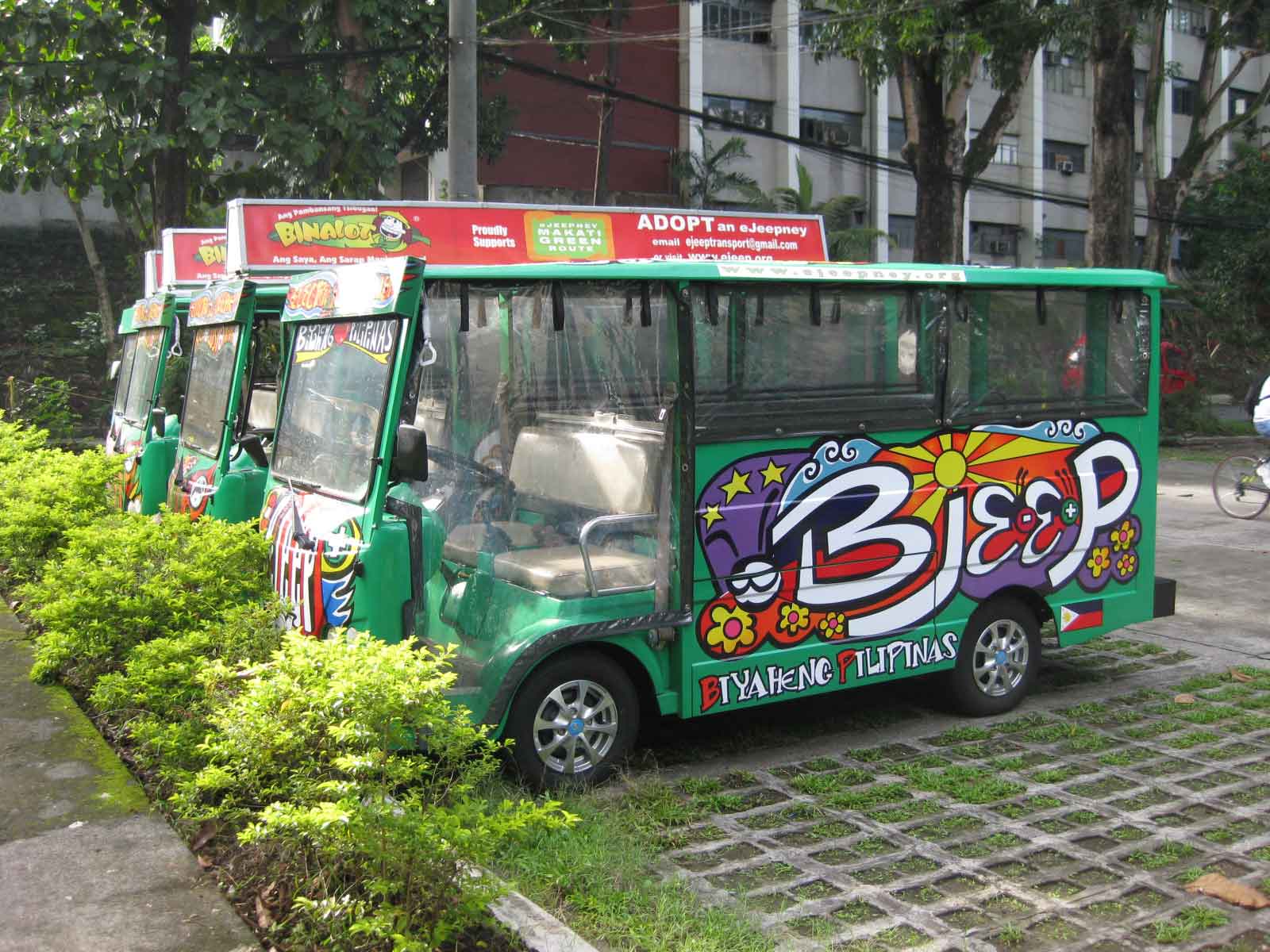 Electric jeepneys parked at UP Diliman – the Bjeep is the one used by Vice President Binay during the inaugurations
I reproduce below a news item from the GMA News website that features an initiative from the ADB that may finally push electric vehicles to gain a significant share of trips across the country:
The Asian Development Bank is offering as much as $280 million in loans for the Philippine government to finance a proposed re-fleeting program for tricycle drivers and operators shifting to electric motorbikes or e-bikes.
“The loan will be coursed through ADB conduit banks like Land Bank of the Philippines for re-lending to tricycle drivers who may want to shift into using e-bikes,” Environment Secretary Ramon Jesus Paje told reporters in a briefing Tuesday.
He said ADB will give 30 e-bikes as donation to city governments in the Metropolis.
“ADB wants to us to sample the bikes to see for ourselves that these machines are totally pollution-free. No emissions, less pollution,” he said.
If all Philippine tricycles are e-bikes, the country can save much as 20 million metric tons of carbon footprints a year.
“We could go into carbon trading. That will earn us dollar equivalent which we can use to offset a portion of the loan,” said Paje.
Tricycle drivers can save up to P300 in daily fuel costs with the use of e-bikes.
“Four hours of charging would only cost P40 compared to P340 for fossil-based fuels. The acquisition cost is about 20 to 30 percent higher than fuel-fired motorcycles but the overhead cost is certainly lower,” Paje said.
Of the total 5 million tricycles in the country, 2.8 million are in Manila.
The department said that the shift to e-bikes would reduce pollution 25 percent to 30 percent in the country’s urban centers by 2011.
As of 2009, the country’s total suspended particulates – a concentration of micro pollutants in the air – in all cities and urban centers is 134 micrograms per normal cubic meters, which is 48 percent beyond the normal standard of 90 micrograms per normal cubic meters.
The major sources of these particulates are diesel vehicles and coal-burning power plants. Dust from unpaved roads and construction activities contribute to the rise in particulates especially during summer months.
Vehicles contribute as much as 80 percent to air pollution, while the remaining 20 percent are from industries.
Department monitoring shows that more than 50 percent of vehicles are registered without prior actual testing by accredited Private Emission Testing Centers.
“If all vehicles are tested for emission prior to registration, the 30 percent reduction in particulates will be easily realized,” Paje said. —With MR Gavin/VS, GMANews.TV
The ADB initiative comes at a critical time when the national government is still finding its way with regards to local public transport modes, particularly how the tricycle has established itself as the primary (sometimes, the only) public transport option in cities and municipalities across the country. It is inevitable that the issue of proliferation and regulation of tricycles will have to be addressed. National and local government would have to discuss the nuances of the Local Government Code in as far as public transport operations, franchising and fare setting are concerned. On top of this, the time is critical also because there is a strong call for environmental sustainability; one that is anchored on the increasing awareness for climate change and its impacts. The long-standing perception is that the conventional tricycles contribute to the continuing degradation of our environment as the collective emissions from these vehicles effectively suffocate our cities, and the key is for local governments to realize this and be a major player in transforming local transport into the environment-friendly kind. It is, after all, in the best interests of their constituents that clean air be pursued to ensure that there will be a bright future for their cities and this country.
Through Traffic – Part 1
As I was reviewing a paper concerning a study on vehicles utilizing residential streets as alternate routes to congested arterials, I couldn’t help but compare the circumstances described by the authors to the current situation at the University of the Philippines Diliman campus. It is a classic case of motorists who, having free access to roads regardless of the nature of the land use, will choose to take this roads in order to bypass what they perceive to be congested roads. The objective is simple, take the route where travel time is significantly less, thereby getting to your destination faster. Such traffic is often termed as through traffic mainly since they do not have any other purpose along the street.
While the paper I was reviewing focused on a single street in a residential district somewhere in Tokyo, the problem in UP Diliman is much more complicated. The UP Diliman campus occupies 493 hectares of prime land in Quezon City, the largest component of Metropolitan Manila. The campus is located between two major thoroughfares – Commonwealth Avenue and C.P. Garcia Avenue (more popularly known by its former name, Katipunan Avenue as well as its designation in the basic circumferential and radial network for Metro Manila, C5). It used to be that campus roads were fair game to general traffic bypassing the traditional connection of Commonwealth and Katipunan at Tandang Sora (where the intersect). The latter being a narrow 2-lane, undivided street often congested because of truck traffic and the operations of tricycles serving the dense residential areas at either side of the road. Many vehicles, particularly private cars because trucks were not allowed to use campus roads, came through the campus via its Main Gate along University Avenue and its other gate along Ylanan Road (along Commonwealth) and exit via gates along Magsaysay Avenue (Asian Center), Schuster Street (Narra Residence Hall), or Velasquez Street (NIGS), and vice versa.
Due to the increasing volume of through traffic, the University agreed to grant right-of-way to what was to become C.P. Garcia Avenue (later downgraded by the MMDA to C.P. Garcia Street), which practically separated the academic areas from the residential areas located in the south portion of the property. Traffic has since shifted significantly from campus roads to C.P. Garcia but there has been a resurgence of through traffic in the past 3 years mainly due to C.P. Garcia being congested during peak periods. Most through traffic in the morning are vehicles bound for private schools along Katipunan Avenue and these are clearly indicated in the stickers on the windshields of the vehicles as well as the characteristic uniforms of students on-board. There are also significant traffic from motorists bound for the Pasig/Mandaluyong (e.g., Ortigas CBD) and Makati/Taguig (Bonifacio and Makati CBDs) via C5. Such traffic have significantly and detrimentally imposed themselves on the University, affecting the community and more specifically its academic constituents.

