
Home » Governance (Page 12)
Category Archives: Governance
Article share: What’s Incomplete About Complete Streets?
The concept of road diets circulated in Metro Manila more than a decade ago. I recall the Metro Manila Development Authority (MMDA) picked up the concept and attempted to apply it in some parts of Metro Manila. Since there are no evidence of that endeavor surviving now, then we can assume that it was a failure. There is no wonder there as I also recall the effort to be half-hearted and more to get media mileage (cheap talk or lip service) out of it. Road diets eventually evolved into the complete streets (though the literature now will state road diets as part of complete streets). That experience and similar initiatives of varying success (or failure) rates are not unique to the Metro Manila but is actually happening elsewhere including cities in countries where the complete streets have been applied more comprehensively and yet somehow found to be lacking or not as effective a solution as expected. I am sharing an article here that discusses what seems to be lacking or ‘incomplete’ as it is referred to.
Source: What’s Incomplete About Complete Streets?
Quoting from the article:
“What’s missing? First of all, even the best Complete Streets policy can’t solve the problem of fiscal scarcity. Even in a city committed to Complete Streets, street redesign must fight for public dollars with other worthy goals such as education and public safety. As a result, Indianapolis’s improvements are a drop in the bucket. The city maintains 3,400 miles of streets and roads, so its 100 miles of bike lanes affect only 3 percent of the city. Similarly, 2,000 miles of the city’s roads still lack sidewalks.
Second, the quantitative benchmarks seem to focus on sidewalks and bike lanes (Sec. 431-806), and the policy doesn’t mention traffic calming or similar policies. So if the city had a six-lane road with traffic going 60 miles per hour, the Complete Streets policy would not affect that road except to the extent necessary to build a sidewalk or a bike lane.** Thus, even the best Complete Streets policies don’t really address some of the most dangerous features of American street design.”
—
Another look at NAIA Terminal 1 arrivals
I have not been to NAIA Terminal 1 since before the pandemic. Last May, I had the opportunity to go there to fetch the wife who was arriving from US. That meant an opportunity to take photos of the arrival areas including the well-wishers area and concourse at the main terminal building.
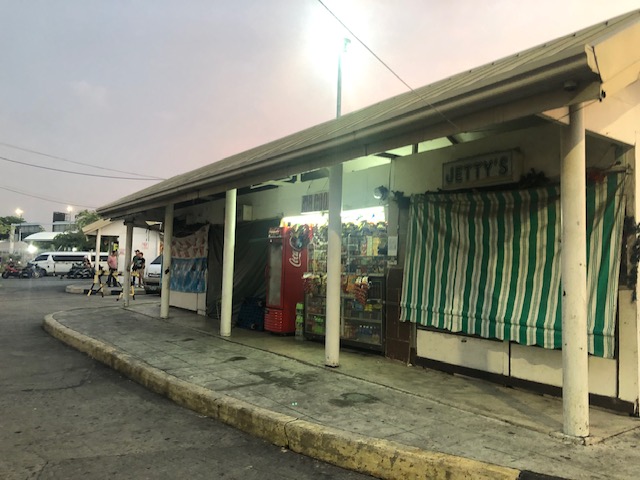 Kiosks are open basically at all times the terminal is operational or open. These usually sell or serve snacks or light meals including sandwiches and pansit (noodles). While I was not able to check the prices, items were usually priced significantly higher than if you purchased them elsewhere in similar stores.
 The well-wishers area is the same building with two levels. The ground level is open and the second level is air-conditioned.
 A single level building hosting stores selling food and drinks stands between the waiting area and the open parking lot.
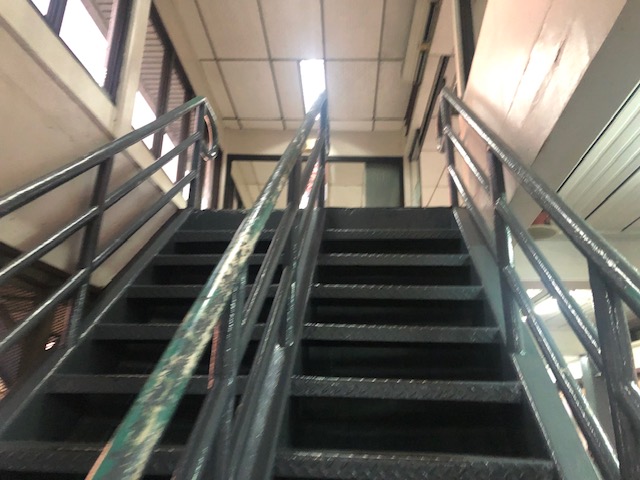 Stairs lead to the second level of the building for those who are waiting for arriving passengers (e.g., fetchers including relatives and friends).
 There used to be a Jollibee branch at the second level. I assume its closure was mainly due to the pandemic as it had a steady stream of customers before.
 There were few people at the second level. Either it was still very early or that there were fewer sundo these days. The parking lot is full of cars so I guess people just chose to stay near or in their vehicles or at the first level of the building.
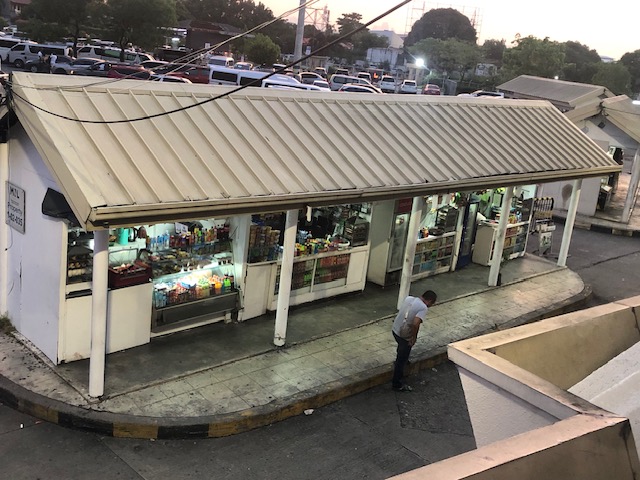 Another look at the kiosks behind the well-wishers area
 The driveway is still chaotic with drivers not following security and security often turning a blind eye to drivers taking their sweet time at the driveway.
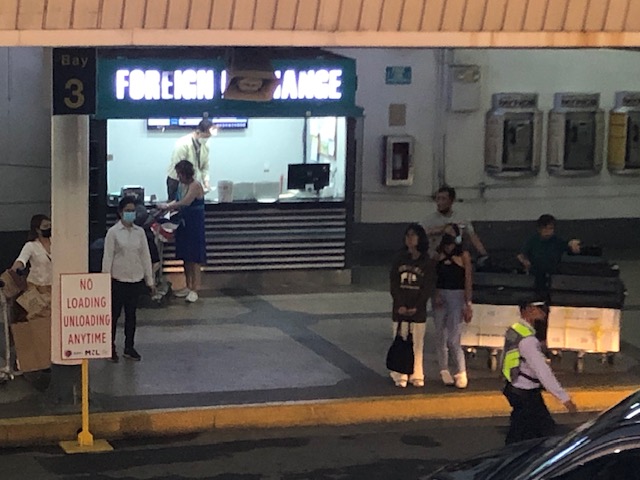 A foreign currency exchange stall at the arrival concourse
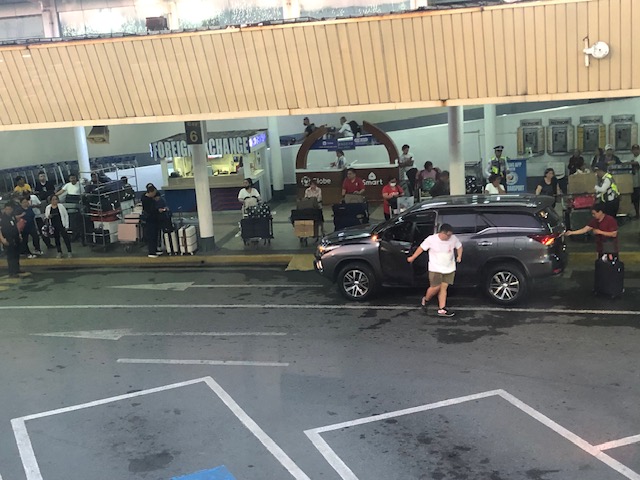 Here’s an example of a vehicle parked or standing along the concourse instead of at the designated slots marked along the middle of the driveway.
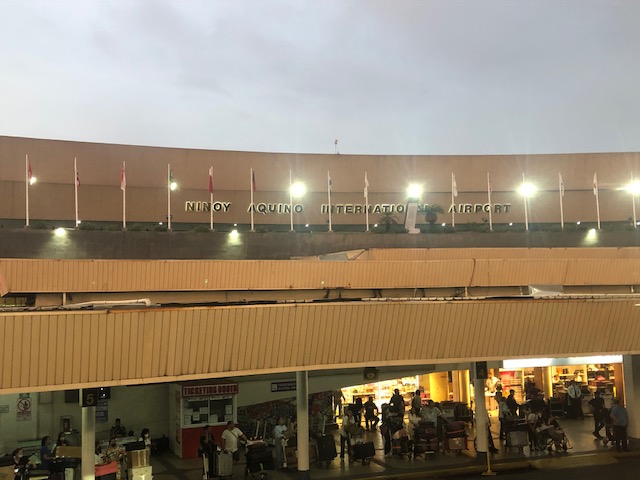 A view of the main Terminal 1 building from the waiting building. At the bottom of the photo is the arrival concourse along the driveway. At the top is the main driveway of T1, which is used by VIPs.
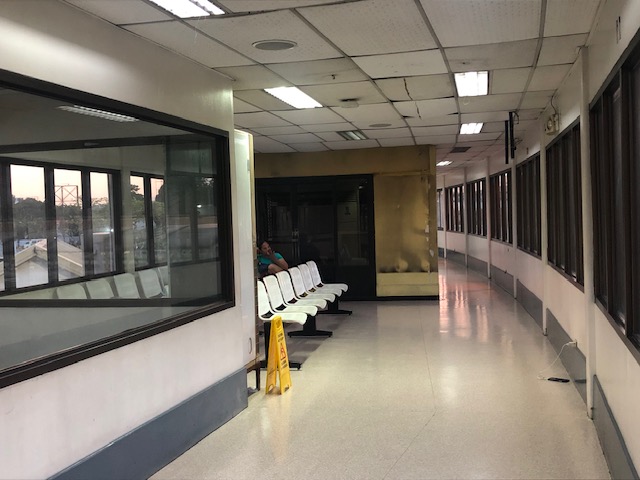 The other end of the second floor used to have a Kopi Rotti branch that became an ordinary . I guess it also became a casualty of the pandemic.
 Arriving passengers may cross from the terminal building to the well-wishers area before proceeding to the parking area.
 Crossing to the arrival concourse, here is the perspective of arriving passengers after descending from the terminal. There’s a duty free shop here for last minute purchases.
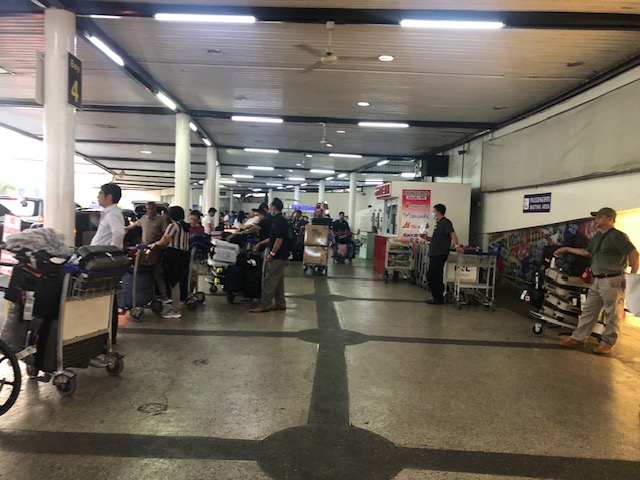 Another view of the concourse
It seems that little has changed at the arrival and waiting areas of NAIA Terminal 1. Everything appears to be back to pre-pandemic conditions. Security is very lax and there is no indication that the grand plans drawn up for the renovation of the terminal will push through in the near future.
–
Article on “Fair Share Transportation Planning”
I am sharing this new article from Todd Litman on fair share transportation planning. The content is relevant and very timely in the Philippines considering many people including and especially transport officials are struggling with the thought of allocating resources to provide or improve facilities geared towards more equitable transport systems (e.g., more facilities for active transport).
Here’s the summary as quoted from the article:
“To be efficient and equitable, a transportation system must serve diverse demands. A diverse transportation system allows travelers to use the most efficient option for each trip—safe walking and bicycling for local errands, efficient public transit when traveling on busy travel corridors, and automobiles when they are truly the most cost-effective mode considering all impact—and it ensures that people who cannot, should not, or prefer not to drive receive their fair share of public investments.
Current transportation planning practices are biased in various ways that overinvest in automobile infrastructure and underinvest in more affordable, inclusive, and efficient modes. It is time for planners to reconsider our analysis methods and funding practices to ensure that non-auto modes, and therefore non-drivers, receive their fair share of transportation resources.
This is not anti-car. Motorists have good reasons to support more investments in non-auto modes that reduce their traffic and parking congestion, reduce their chauffeuring burdens and crash risk, and provide better options when their vehicles are unavailable. Everybody wins from a more diverse and efficient transportation system.”
On sleepy drivers
I am sharing this article on sleep-deprived driving as there appears to be low awareness of the dangers of this behavior as opposed to the typical drunk driving or driving under the influence (DUI) cases that we often hear or read about in the news (mainstream or social media).
Britt, R.B. (April 18, 2023) “Sleep-Deprived Drivers Might as Well be Drunk,” Medium.com, https://robertroybritt.medium.com/sleep-deprived-drivers-might-as-well-be-drunk-887aab48c1c [Last accessed: 4/21/2023]
To quote from the article:
“A 2016 study by AAA linked lack of sleep in the past 24 hours to dramatically higher crash risk, in hour-by-hour increments:
6–7 hours sleep: 1.3 times the risk
5–6 hours: 1.9 times the risk
4–5 hours: 4.3 times the risk
<4 hours: 11.5 times the risk
The risk of a crash drops to zero if you simply stay off the road, of course. Otherwise, the bottom line is pretty clear:
“You cannot miss sleep and still expect to be able to safely function behind the wheel,” said David Yang, executive director for the AAA Foundation for Traffic Safety.”
So make sure you get your sleep because it is really important for you to function not just as a driver or rider. It also applies to other activities or tasks as well whether you’re working, studying or playing.
–
On bicycles and first responders
I am sharing this article on the use of bicycles by first responders, particularly the police for their work:
International Police Mountain Bike Association (April 11, 2023) “Why Bicycles are Great for Police and First Responders,” Policemag.com, https://www.policemag.com/patrol/news/15382905/why-bicycles-are-great-for-police-and-first-responders [Last accessed: 4/15/2023]
To quote from the article:
“The advantages of using bicycles in public safety include:
• Bicycles can easily penetrate crowds – in highly congested areas police, EMS, and security personnel on bikes can move around more easily than patrol cars and ambulances.
• Response time in heavy traffic is improved – during their trial period in Orlando, bike medics responded in less than one minute 55% of the time; less than two minutes 83% of the time; and less than three minutes 95% of the time; contrasted with an average of four minutes for motorized rescue units.
• Stealth advantage – bicycles give officers the “stealth advantage” – because they are silent. Cops on bikes can ride right up to the scene of a crime before they are noticed.
• Police, EMS, and security cyclists lead by example – promoting helmet use and bike safety to the community and its children.
• Bicycles are great for public relations – an officer or a medic on a bike is much more approachable than one in a patrol car or ambulance.
• Bicycle use promotes good health – and departments benefit from decreased healthcare costs.
• Bicycles are enjoyable – even occasional bike duty improves morale.
• Bicycles are cost-effective – the average cost per bike is approximately $1200, a fraction of the cost of a cruiser, an ambulance, or any other motorized vehicle – and the annual maintenance costs are low.
• Bicycles are environmentally-friendly – no fossil fuels or emissions, and less parking surface is needed.”
While there are no disadvantages mentioned in the article, the advantages are clear and can be assumed to outweigh the cons of using bicycles. This is especially true in an urban setting where the items mentioned above are applicable and surely gives police and other first responders an advantage. In the Philippines, where the image of a bad or corrupt police officer is one who has bulging tummy, more physically fit and approachable officers on bicycles will surely improve the image of the PNP and other traffic enforcers as well.
 Quezon City’s Green Transport Office Bike Patrol
–
Quezon City’s bike ramps
This is a very late post on bicycle facilities. I took a few photos of the bike ramps Quezon City installed on the stairs of pedestrian footbridges in the city. I am sharing a couple of these photos here for reference.
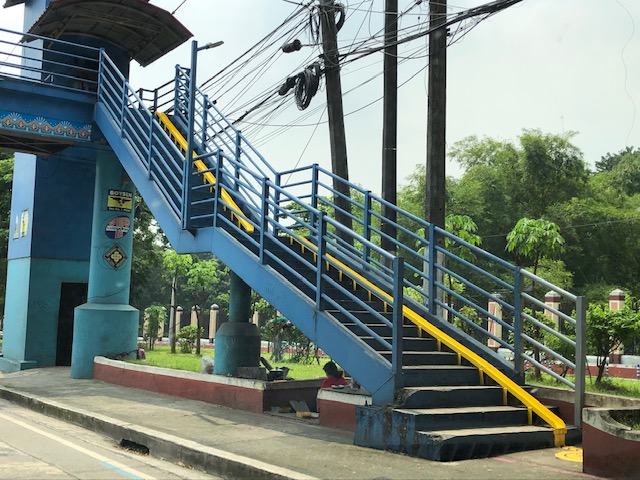 The bike ramp allows one to roll his/her bicycle with relative ease up and down the footbridge. Otherwise or without the ramps, cyclists would have to carry their bikes up and down the stairs.
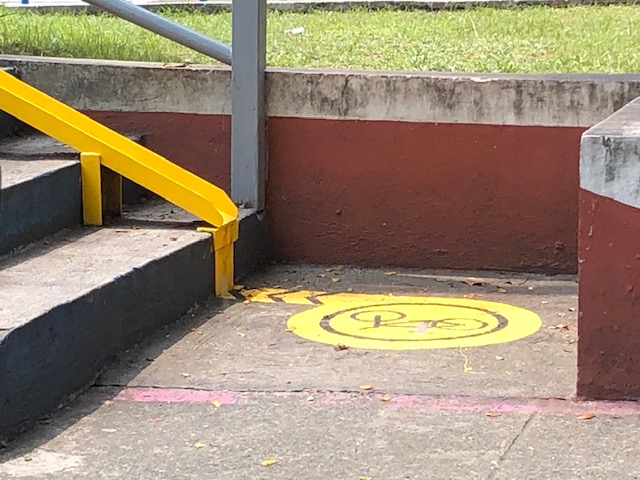 The landing for the the bike ramp at the foot of the stairs.
It’s quite obvious in the photos that the space along the stairs is quite constrained. Ideally, perhaps there should be two ramps – one for going up and another for going down. One ramp means one cyclist will have to wait for another or others to go up or down before proceeding to use the ramp. Perhaps this highlights the need to re-imagine the designs of footbridges. The current designs are not inclusive or equitable for all users. But whether footbridges are required in the first place is another matter.
–
A brief history of transport strikes – Part 4: impacts and implications
What was supposed to be a week-long transport strike by jeepney drivers and operators was called off yesterday. Frontpage news showed a photo of representatives of protestors with government officials. Government official statements also declare that the government will be talking with the transport sector to sort out issues and to try to address these in relation to the PUV Modernization Program (PUVMP). One day earlier, government was quick to state that the strike had no impact on transport. Were there really no impacts?
I think the fact that schools went back to online mode and offices allowed employees to work from home show the impacts of the transport strike. If you haven’t noticed, the government has been using the tactic of cancellation of classes for quite some time now. To reduce the impacts of transport strikes on commuters, classes on all levels were canceled, thereby reducing transport demand. The only difference now is that there is capacity for online classes due to adjustments made during the height of the pandemic. So instead of cancelling classes altogether, schools reverted to online mode. Meanwhile, for those who needed to go to their workplaces and did not have their own vehicles, there were various free rides (libreng sakay) services provided by national and local government agencies. Cities like Quezon City already operated their own bus services so people could take these instead of their usual PUV modes for commuting.
What are the implications of the shortened strike? The shortened strike has various implications. One is that it showed the protesters did not have enough resources to sustain the strike. It also showed that transport leaders appear to just want some attention from government. A colleague commented about this being something like a show or the strike being part of a game of “bad cop, good cop” among government officials and agencies. If you haven’t noticed, this has been going on for some time now. Government already knows how to reduce the potential impacts of protests like this. Suspending classes in schools significantly reduces the travel demand on a typical weekday. Offices giving their employees the option to work from home during the strike also adds to the reduction in travel demand. And libreng sakay vehicles are easier to deploy as agencies and LGUs have vehicles for this purpose. Meanwhile, the continuing rise in motorcycle ownership also contributed to people being able to still commute (i.e., having the motorcycle taxi option). At least for Metro Manila, once the railway projects are completed, there will be a railway option for commutes. Barring a simultaneous strike with buses and vans, protests from the jeepney sector will surely be diminished.
–
A brief history of transport strikes – Part 3: advocacy and bandwagon
You see a lot of posts on social media stating people supporting the current transport strike. There are cartoons and memes that dramatize if not romanticize the plight of drivers. One cartoon I saw has a girl asking her driver-father if he will join the strike. The father replies he is unsure as they won’t have any income to cover their needs. One panel shows the driver’s cash box with graduation photos of what appear to be his other children. Of course, this suggests that the jeepney driver was able to support his children in their education while also suggesting about the uncertainties for the other child (who is in the comic). The comic obviously appeals to the emotions of the reader. It is a fallacy but one that is very close to and appeals to the psyche of the Filipino.
Another cartoon appears to be comparing modernization with replacing office computers. It states that the government’s modernization program is like an office requiring its employees to replace their old notebooks with high end ones. Only, the office is not paying for the new units and will have these charged to the employees’ salaries. I thought that was an oversimplification. Jeepneys are public utility vehicles and not private. There are rules and regulations governing PUV acquisition, franchising and operations, unlike your typical office computer.
I think we should draw the line between advocacy and simply jumping onto the bandwagon that is supporting a transport strike without knowing and understanding the details about it. Otherwise, we end up giving unconditional support to what others will refer to as a backward public transportation system. There are always two sides to a coin and while there are good stories about the jeepney and how it has supported many families, there are also bad ones that have allowed them to remain practically unchanged over so many decades. The same applies to the opposition – those who call for a phase-out or outright modernization without understanding the terms given to drivers and operators and the overall context and situation regarding the modernization program. It is easy to take sides. The question is if you are aware and understand the details about the issues here.
–
A brief history of transport strikes – Part 2: reasons for a strike
The current transport strike is not about fare hikes or the rising prices of fuel. Those are the most common reasons for jeepney drivers and operators going on strike. It’s quite simple for these reasons: Drivers protest when government refuses to increase fare rates amidst rising costs of operations and maintenance. And they don’t when fares are reduced as fuel prices are going down.
The Department of Transportation (DOTr) through its Land Transportation Franchising and Regulatory Board (LTFRB) is tasked with evaluating operations and maintenance costs of public utility vehicles and prescribe the minimum and incremental fares for these services. Fare hikes (and reductions) are the consequence of fuel price increases (or decreases) but are not set as dynamic or automatic. Fuel prices, as can be observed, can fluctuate and currently change every week. Fares are not automatically adjusted whether fuel prices are increasing or decreasing and are heavily regulated by government in part to supposedly protect the interests of the riding public. As such, fare matrices or the structured fares according to the various routes and the distances covered by public utility vehicles
The reason for the current transport strike is generalized as a jeepney phaseout. The term ‘phaseout’ actually refers to the PUV Modernization Program (PUVMP) of the government that seeks to replace all conventional jeepneys with ‘modern’ or ‘modernized’ units. The latter include mini-bus types as well as those that retain the conventional jeepney form but usually larger and with newer engines and interior layout. This is not necessarily a phaseout like the one I described in Part 1 along the LRT Line 1 corridor.
Again, much of the opposition cites the high cost (and therefore unaffordable) of a modern jeepney. The financing schemes currently available as well as the requirement for jeepney operators and drivers to be part of a transport cooperative to avail of these financing schemes are still considered unacceptable by many. And yet, government seems unwilling to extend resources in order for operators and drivers to be able to afford a new vehicle. The old jeepneys would still have some value but definitely not near a substantial down payment needed for low monthly payments. These monthly payments cannot be covered by the typical boundary (basically rent) for operators or the daily income for drivers.*
What is the cost of replacing conventional jeepneys with new, ‘modernized’ vehicles? Well, let’s assume that a new vehicle costs 2.4M pesos. Also, perhaps cover only the ones operating in the urban setting (i.e., exclude for now those serving provincial routes especially those used also for freight (e.g., top loads)), say 50% of the estimated 250,000 units need to be replaced. That goes up to 300 billion pesos. If we were to replace only Metro Manila jeepneys, that will be 132 billion pesos. These numbers can be compared to the cost of major projects like the Metro Manila Subway (488 billion), the Bataan-Cavite interlink bridge (175 billion) and the New Manila International Airport in Bulacan (735 billion). Would it be worth it (benefits-wise) to invest in new jeepneys?
–
*Of course, this also indicates a flawed business model for jeepney operations. But that’s another story.
A brief history of transport strikes – Part 1: introduction
A nationwide week-long transport strike by jeepney operators and drivers From a CNN news report yesterday, it was stated that an estimated 4 out of 10 or 40% of jeepney drivers will be going on strike and halting operations for a week. These are supposedly members of the group Manibela, which claims to have over 100,000 members nationwide (Aren’t you curious how many jeepneys there actually are nationwide? There are supposedly more than 250,000 public utility jeepneys operating across the country with about 55,000 in Metro Manila.). The other 40% are certain that they will not be going on strike and these include members of the more established groups like PISTON, ACTO and Pasang Masda as well as those who belong to the many transport cooperatives that were formed the last so many years in part for the purposes of modernization. The remaining ones are undecided and include those also affiliated with those groups and those who claim to not have any affiliations.
If media companies like GMA, the defunct ABS CBN and even government station PTV have archives dating back to the 1970s, they will probably see that similar interviews have been conducted of jeepney drivers. Libraries like the National Library or perhaps those of leading universities like the University of the Philippines and Ateneo de Manila University would likely have archives of newspapers from way back. I remember UP Diliman having microfiche facilities but I am unsure to what year they have archives. You will likely read similar reports and interviews about jeepney operations during those times. The idea and initiatives for phasing out the conventional jeepneys is not a new thing or topic. It has been out there for quite some time but in different forms and contexts.
For example, there was a proposal to phase out jeepneys along the corridor of the LRT Line 1 in the Feasibility Study for the railway line as well as in the Metro Manila-wide studies that were conducted in the late 1970s and early 1980s. Jeepneys plying the Monumento-Baclaran and Monumento-Harrison Plaza routes were among those identified for phasing out. Careful reading of the reports though will also show that ‘phase out’ actually meant ‘rationalizing’ or ‘rerouting’ the jeepney services so they will complement the mass transit line. That never happened and the jeepneys still operate today (probably many are still the same jeepneys from the 1970s and 1980s!). Do passengers ride them from Monumento to Harrison (or vice versa)? Probably not as the travel will be too long compared to riding the train. They survive because of the short trips, usually less than 4 kilometers, by passengers who probably should be walking or cycling instead if we were in a Japanese, Korean, Singaporean or European city.
Fast forward today, the call apparently is for a phase-out in favor of the “modern” jeepneys (many are actually mini-buses). Jeepney operators and drivers are also being called to join or form cooperatives under which they can be part of programs that will replace their conventional jeepneys with a ‘modern’ unit. One issue here are the terms for the replacement or the acquisition of a new vehicle. The cost of a new vehicle varies and can be more expensive than a new SUV (e.g., more expensive if not as expensive as a new Montero, Fortuner or Everest) depending on the model and the size of the vehicle. This is apparently the most significant concern among others that is being cited by those opposing or resisting modernization, which they equate to a ‘phase out’.
 One of the ‘modern’ jeepney models currently operating in Metro Manila
More in the next article for this series…
–

