
Home » Governance (Page 11)
Category Archives: Governance
Tikling junction traffic
Easily a pet peeve along my commute is Tikling or Kaytikling Junction in Taytay, Rizal. I think traffic here is worse than two other major junctions in Rizal Province – Cainta Junction and Masinag Junction in Antipolo City. And that is because of the combination of traffic management (or mismanagement) by elements of the Taytay Municipal Government and motorists lack of understanding of how vehicles should position (or travel) at roundabouts. Of course, the volume of motor vehicle traffic converging at this junction would probably merit traffic signals over a roundabout but for most times when there are no enforcers here, traffic is somewhat more efficiently flowing as drivers and riders are forced to give way in order to not constrict traffic.
 Enforcers often employ the “buhos” system of prioritizing traffic for one leg at a time. However, instead of a quick transition from one leg to another, they tend to give more time to vehicles coming out of the Manila East Road and turning left and (west)bound for Ortigas Avenue Extension. The long time allocated to the latter means long queues for traffic coming down from Antipolo and those from Cainta.
 Enforcers are partial to outbound traffic from Taytay rather than make an effort to have more equitable ‘go’ time for all legs at the junction.
One wonders who is in charge of traffic for Taytay considering they mismanage traffic everyday. [Though I also wonder why the rest of Rizal including Antipolo and Cainta can’t seem to be bothered by the congestion emanating from Tikling.] As if to prove the point of incompetence, another problematic intersection is the Highway 2000 – Barkadahan Bridge – East bank road intersection, which is signalized and yet somehow always congested (or saturated). But that’s another story.
–
Incorporating bike lanes along local roads – an example in Taguig City
I have not used an old route that we usually take to go to BGC from our place in Antipolo. This is via the Manila East Road, Highway 2000, Barkadahan Bridge and C6. From C6, we usually take Ruhale instead of Seagull Avenue as the former provided a shorter route towards Levi Mariano Avenue and C5. So it was only last weekend that I was able to see the improvements along Ruhale Street and how bike lanes were incorporated along this road. I am sharing the following photos showing a two lane road and Class 2 bike lanes.
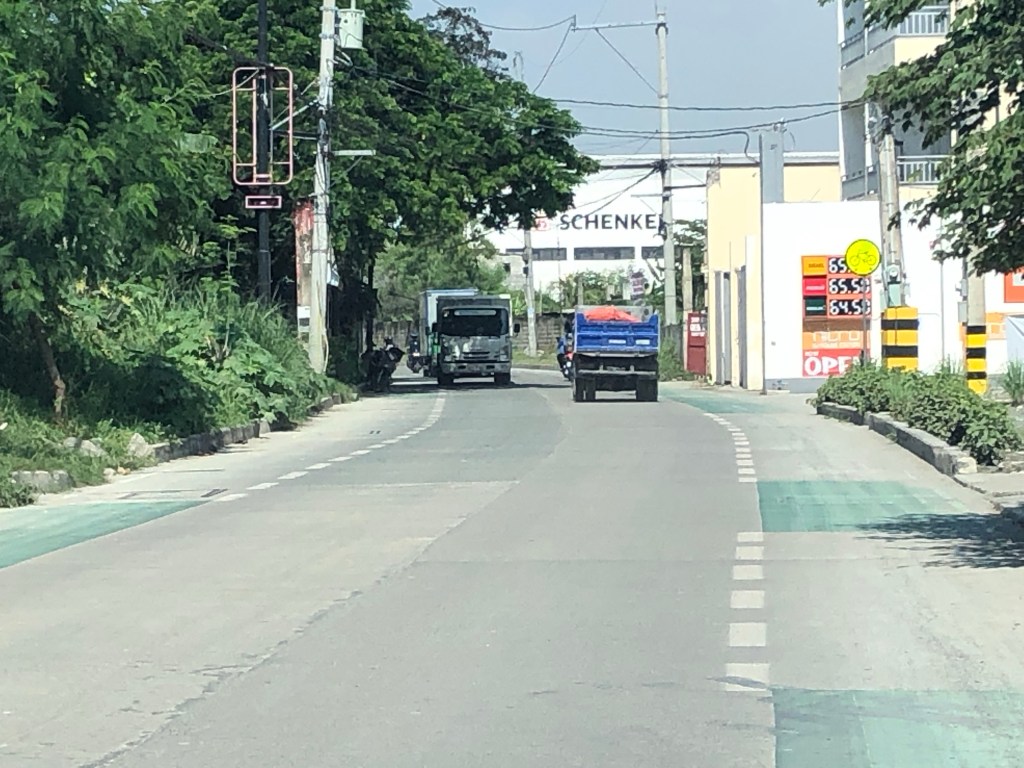 The green pavement markings indicate an intersection or driveway.
 Noticeable are the electric posts that remain along the bike lanes. These need to be transferred so they will not pose danger to all road users.
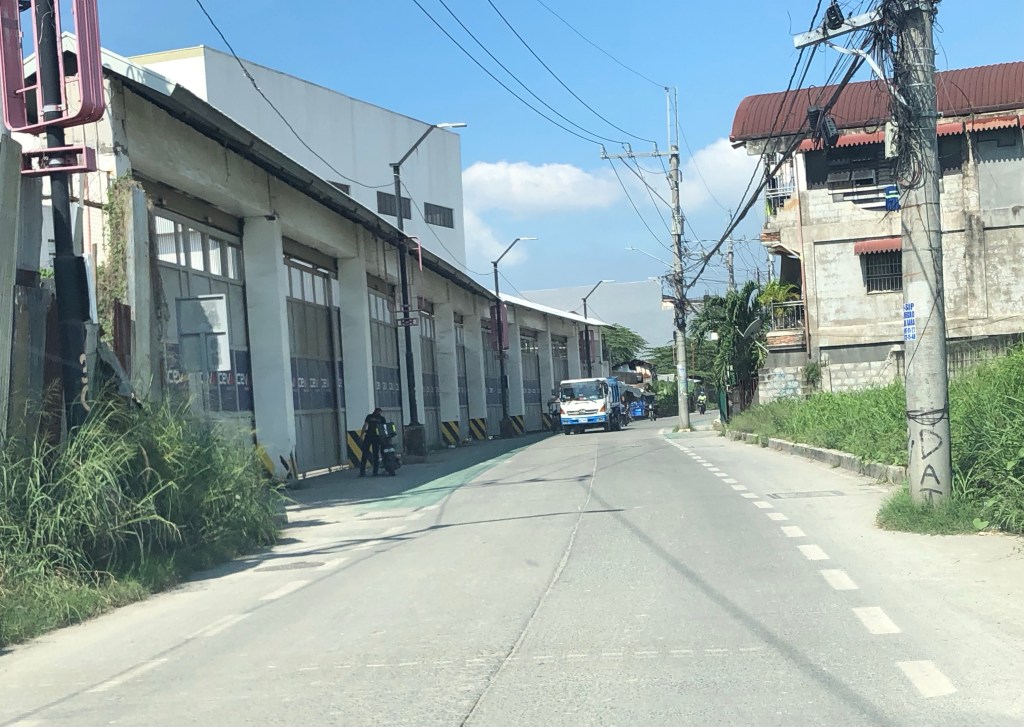 More electric posts along the bike lanes
 Bike lanes in front of an industrial establishment
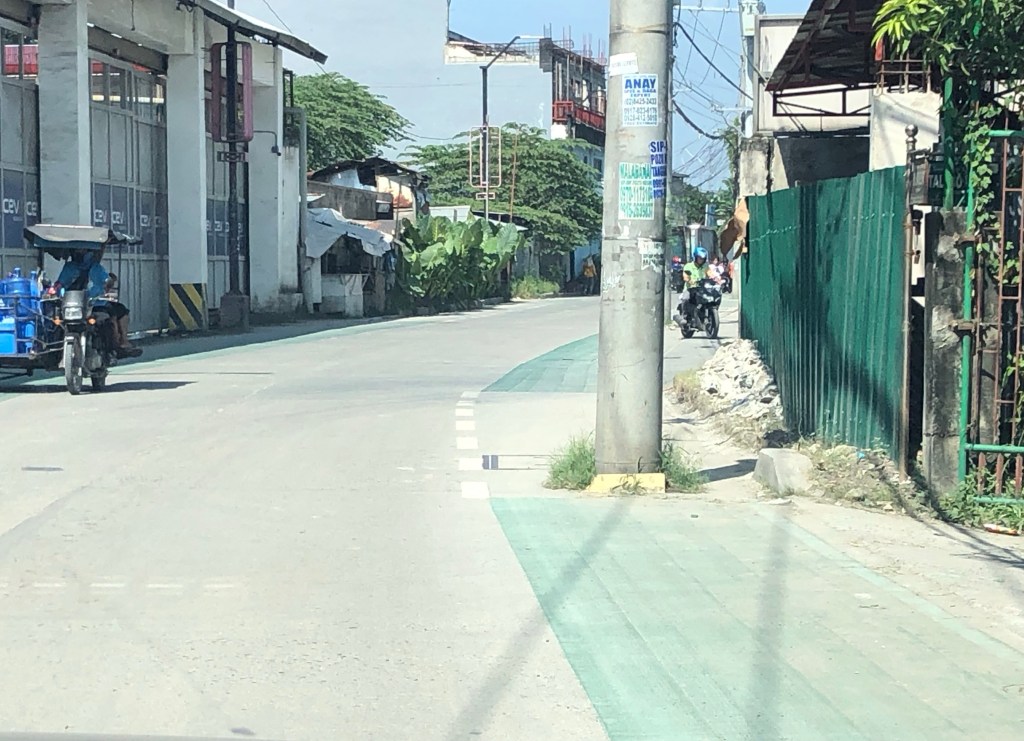 Close-up of a post in the middle of the bike lane.
 Bike lane across another industrial establishment. Again, note the green pavement marking across the driveway of the establishment.
 Bike lanes along a predominantly residential area along Ruhale.
I would consider this as a good practice example that can be replicated elsewhere. Of course, it is not perfect and as shown in the photos, there is much room for improvement including the transfer of electric posts that pose as hazards to all road users. The bike lanes are wide enough that installing bollards for the perception of physical protection vs. motor vehicles can be considered. Ruhale is generally a low speed, low volume road so perhaps the current state with no barriers would be enough for now. Also, we need to appreciate that these are already gains or wins in as far as active transport is concerned. A few years ago, this would not have been implemented by national or local governments.
–
Are transport strikes still effective?
There is supposed to be a transport strike today, after one group, Manibela, declared what they dubbed as a nationwide strike to protest versus the perceived jeepney phase-out and alleged corruption at the Land Transportation Franchising and Regulatory Board (LTFRB). I used the term ‘perceived’ to describe jeepney phase-out because what is actually unfolding or being processed is a rationalization of public transport services. There is also a modernization program where old jeepney units are supposed to be retired and replaced by vehicles that are low emission and higher capacity, among other characteristics. Perhaps one flaw, if you can call it that, is that the new vehicles look nothing like the conventional jeepney. They look like vans and buses. And so somewhat lost here is the classic image of the jeepney, which was heavily influenced by the old WW2 American Jeeps that were the base units that eventually became jeepneys.
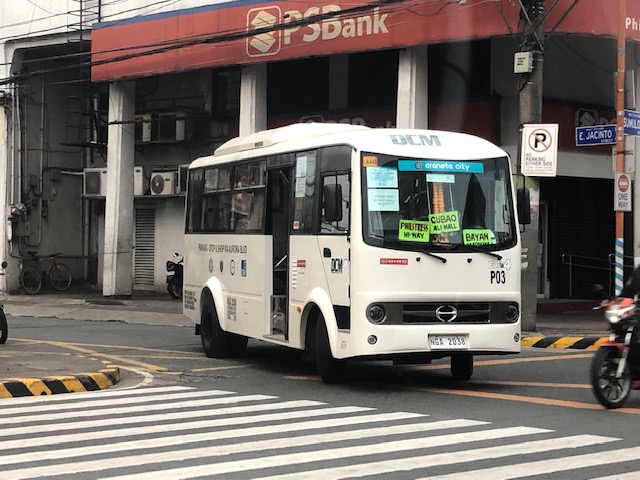 This does not resemble a classic jeepney
Fast forward to present and another declared transport strike fizzled out. It turns out that most transport groups did not want to take part for one reason or another. DILG Secretary Abalos even met with the heads of the more established groups and stated that 95% of jeepney operators and drivers will not join the strike. As many LGUs and schools already anticipated the potential impacts of a strike, they already suspended classes and reverted to online work (WFH) and study modes. In previous occasions, LGUs were prepared with a “Libreng Sakay” (free ride) scheme. That meant most people being able to get rides to go to work, school or home. Transport strikes now seem a thing of the past and further into the future, I don’t think they would be an option. The general public see these more as an inconvenience, and social media and a misinformation/fake news machinery at the employ of those in power means a transport sector with legitimate issues will be demonized.
–
Reference share – study on transport equity
Here is a quick share of a study report on equity in public transportation from the Mineta Transport Institute:
Defining and Equity in Public Transportation, https://transweb.sjsu.edu/research/2100-Public-Transit-Equity-Metrics-Measurement
Perhaps income, physical ability/disability, age and gender are the more applicable aspects of equity in our case. However, the concepts and methodology in the report may still be applicable and can be customized or contextualized for the Philippine setting.
–
A real battle of Katipunan – the search for a transportation solution
Is it obvious that I was alluding to the classic match-ups of the two major universities – Ateneo De Manila University and the University of the Philippines Diliman – that are located along Katipunan Avenue for the title of this article? That is deliberate on my part as there is a ‘real’ battle along Katipunan Avenue, and it does not involve sports.
Following is a recent article from the Philippine Collegian that reports on the current state of traffic along the corridor:
https://phkule.org/article/971/private-cars-mainly-to-blame-for-katipunan-traffic-transport-experts
I have written before and many times about transport and traffic along Katipunan Avenue. This road has been part of my daily commute since 1988 when I was admitted to UP Diliman as a B.S. Civil Engineering major. Back then Katipunan was not as wide as it is now, especially along the section between UP Diliman and the MWSS complex. That section only had 2 lanes then. What is not a wide center island with large, old acacia trees used to be the frontage of MWSS. So now you can probably imagine how much land was ceded by MWSS for road widening.
I also wanted to write about Katipunan in part as a sort of farewell to the former MMDA Chair and Marikina Mayor Bayani Fernando (BF), who recently passed away. Much of how Katipunan looks like and the traffic situation today can be traced to what transpired during his time at MMDA. I will refrain from writing about this and him for now. I am actually thinking of writing a series about BF and his time as Mayor in Marikina, as MMDA Chair, and his brief stint as DPWH Secretary. This short article will do for now.
Article share: On the benefits of sidewalk networks
Here is another quick share of an article by Todd Litman on Planetizen. The article contains a lot of information or data about why we should be investing in sidewalks or pedestrian facilities (i.e., for walking).
Litman, T. (August 6, 2023) “Completing Sidewalk Networks: Benefits and Costs,” Planetizen, https://www.planetizen.com/blogs/124999-completing-sidewalk-networks-benefits-and-costs?utm_source=newswire&utm_medium=email&utm_campaign=news-08142023&mc_cid=cd3b2e2ba5&mc_eid=9ccfe464b1 [Last accessed: 9/23/2023]
To quote from the article:
“Walking is the most basic and universal travel mode, and sidewalks are the most basic walking infrastructure, but they are often overlooked and undervalued in transportation planning. Completing and improving sidewalk networks can help achieve many economic, social and environmental goals.
Recent case studies indicate that typical North American communities spend $30 to $60 annually per capita on sidewalks, and would need to double or triple these spending levels to complete their networks. This is a large increase compared with current pedestrian spending but small compared with what governments and businesses spend on roads and parking facilities, and what motorists spend on their vehicles. Sidewalk funding increases are justified to satisfy ethical and legal requirements, and to achieve various economic, social and environmental goals. There are several possible ways to finance sidewalk improvements. These usually repay their costs thorough savings and benefits.”
–
On the benefits of walkable communities to pregnant women
I break the series on MCIA Terminal 1 to share this interesting article relating walkable communities to healthier pregnancies:
To quote from the article:
“The study, published in the journal of Economics and Human Biology, found that expectant mothers living in walkable counties tend to engage in more walking and exercise and have fewer issues with premature births, low birth weight, gestational diabetes and hypertension. Walking is often recommended as a safer, more moderate activity for pregnant women, so the authors reasoned that living in a more walkable area could have health benefits for them.”
If you’re interested in the details of the study referred to in the article, here is the link to the paper entitled “You’ll never walk alone – the effects of walkability on pregnancy behaviors and outcomes” in the journal Economics & Human Biology:
https://doi.org/10.1016/j.ehb.2023.101269
–
On home location preferences
There’s an interesting article on the preference of Americans for big houses even if these
(August 2, 2023) “Majority of Americans prefer a community with big houses, even if local amenities are far away,” Pew Research Center, https://www.pewresearch.org/short-reads/2023/08/02/majority-of-americans-prefer-a-community-with-big-houses-even-if-local-amenities-are-farther-away/ [Last accessed: 8/12/2023]
Quoting from the article:
“A majority of Americans (57%) say they would prefer to live in a community where “houses are larger and farther apart, but schools, stores and restaurants are several miles away,” according to a Pew Research Center survey conducted March 27-April 2, 2023. About four-in-ten (42%) would prefer a community where “houses are smaller and closer to each other, but schools, stores and restaurants are within walking distance.”
As general as that statement appears to be, as they say, “the devil is in the details.” The article goes to qualify the statistics according to partisanship, age, education, race and ethnicity, ideology, community type, and community type & partisanship. The resulting stats are quite revealing and helps one understand the survey results.
I wonder what would be the result of a similar survey if one were conduced in the Philippines. There is no partisanship factor here that is similar to the characteristics of Republicans and Democrats in the US. What will it reveal about our preferences? Do Filipinos prefer to have their own houses even if these are located far from workplaces and schools? Or do Filipinos prefer living closer to their workplaces and schools even if it means living in smaller homes? Certainly affordability, which was not mentioned in the article, is a major factor considering the cost of homes in cities compared to prices in the suburbs.
There is a link in the article for the methodology and questions used in the study. That means it would be possible to replicate or adapt these for the Philippine setting.
–
Tricycle policies in Zamboanga City
I forgot about these photos I took at the driveway of a shopping mall in Zamboanga City. The tarps state the penalties for erring tricycle drivers in the city under a couple of City Ordinances (185 and 485, series or year not stated in the tarp) and the fare matrix based on City Ordinance 416 (series or year also not stated).
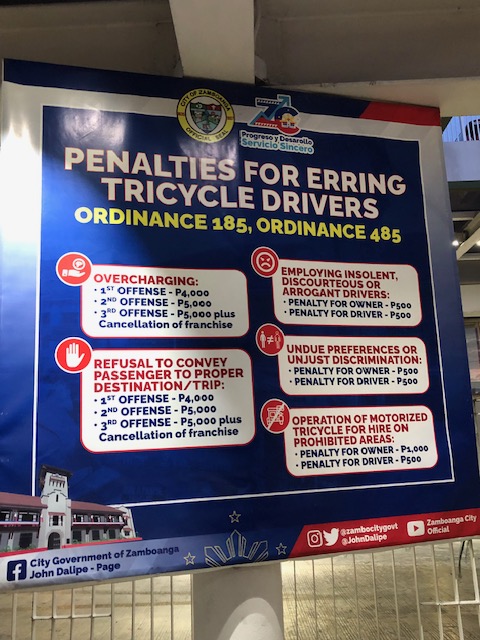 Penalties for erring tricycle drivers in Zamboanga City. As stated in the tarp, the typical offenses include: overcharging, refusal to convey passengers, insolent, discourteous or arrogance, undue preferences or unjust discrimination, and operation of motorized tricycle for hire in prohibited areas. It is also clear that the penalties are not just for drivers but the owners/operators of the trikes with erring drivers.
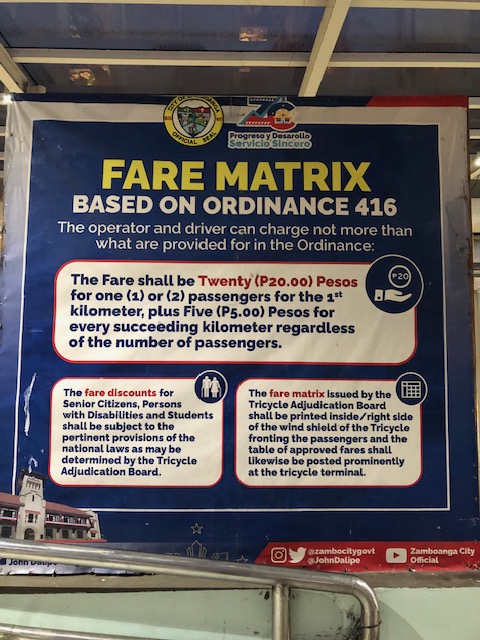 Simple fare calculation stated on the tarp. I assumed there were specific matrices posted in each tricycle but there was none since operations are free-for-all regardless of TODA in the city. That is, trikes in the city practically have no zones of operation where they are restricted or confined similar to what they have in other cities like Olongapo or Quezon City. In the latter, they can issue specific matrices or tables for the passengers’ reference much like what you have in jeepneys that have fixed routes. This can be confusing to passengers and creates situations that may lead to drivers taking advantage and overcharging passengers.
In a city like Zamboanga where there are many one-way streets, tricycle drivers can easily lengthen or appear to lengthen trips leading to overcharging of fares. Where tricycles do not have zones or areas of operations per TODA, this becomes the weakness or flaw even with ordinances in place for erring drivers and a simple fare matrix for passengers’ reference. Of course, regular commuters should be familiar with the usual fares they pay so perhaps that’s among the basis for knowing if you’re being overcharged. Visitors though will likely pay more if the driver consciously takes advantage of the situation. Again, this is a matter for enforcement of the ordinances passed by the city and an example of how such ordinances will be implemented.
–
Transport strike again?
There’s a 3-day transport scheduled starting tomorrow when the current President delivers the annual State of the Nation Address (SONA). The reason is reported to be to protest the government’s Public Utility Vehicle Modernization Program (PUVMP). I wrote a 4-part series on these strikes earlier this year and stated that such actions have been diminished over the years especially with government and its agents learning how to use conventional and social media to their advantage. That is, if you have a troll army at your disposal, you will definitely use it and take advantage of the commuting public’s growing perception (as influenced by government’s narratives) that the strikes are unnecessary and based on unfounded gripes. So the blame goes to the drivers and operators and the organizers rather than on the government agencies even despite the legitimate arguments by the former. In this case, it’s supposed to be about PUVMP but most commuters are indifferent about supporting the strike as it can be viewed as vs. modernization of public transport, which people link to improvement (i.e., modernization = improvement).
Here is the link to the last and concluding article in the series:
A brief history of transport strikes – Part 4: impacts and implications
I think my conclusion and the observations I presented in the series still holds. Given the resources and the alternatives to counter the potential impacts of a strike, going through with one presents a likely failure to get support from commuters in general.
–

