
Home » Governance (Page 21)
Category Archives: Governance
On the RFID fiasco
Early December 2020, Metro Pacific Corporation suddenly had to deal with jam-packed toll plazas and queues that affected roads connecting to the North Luzon Expressways. Fast-forward and Valenzuela City apparently had enough of it and revoked the tollway corporation’s business permit. Later, matters were resolved with the tollways reverting to mixed toll collection to manage the queues at the toll plazas.
Prior to this, tollways corporation scrambled to meet the deadline set and re-set by the Department of Transportation (DOTr) through the Toll Regulatory Board (TRB) for contactless, cashless toll payments. The question is if there was enough time for tollway operators to acquire the best (not just the minimum required) system for this endeavor. There are some opinions that this was basically required on short notice and for the government to get some brownie points for this.
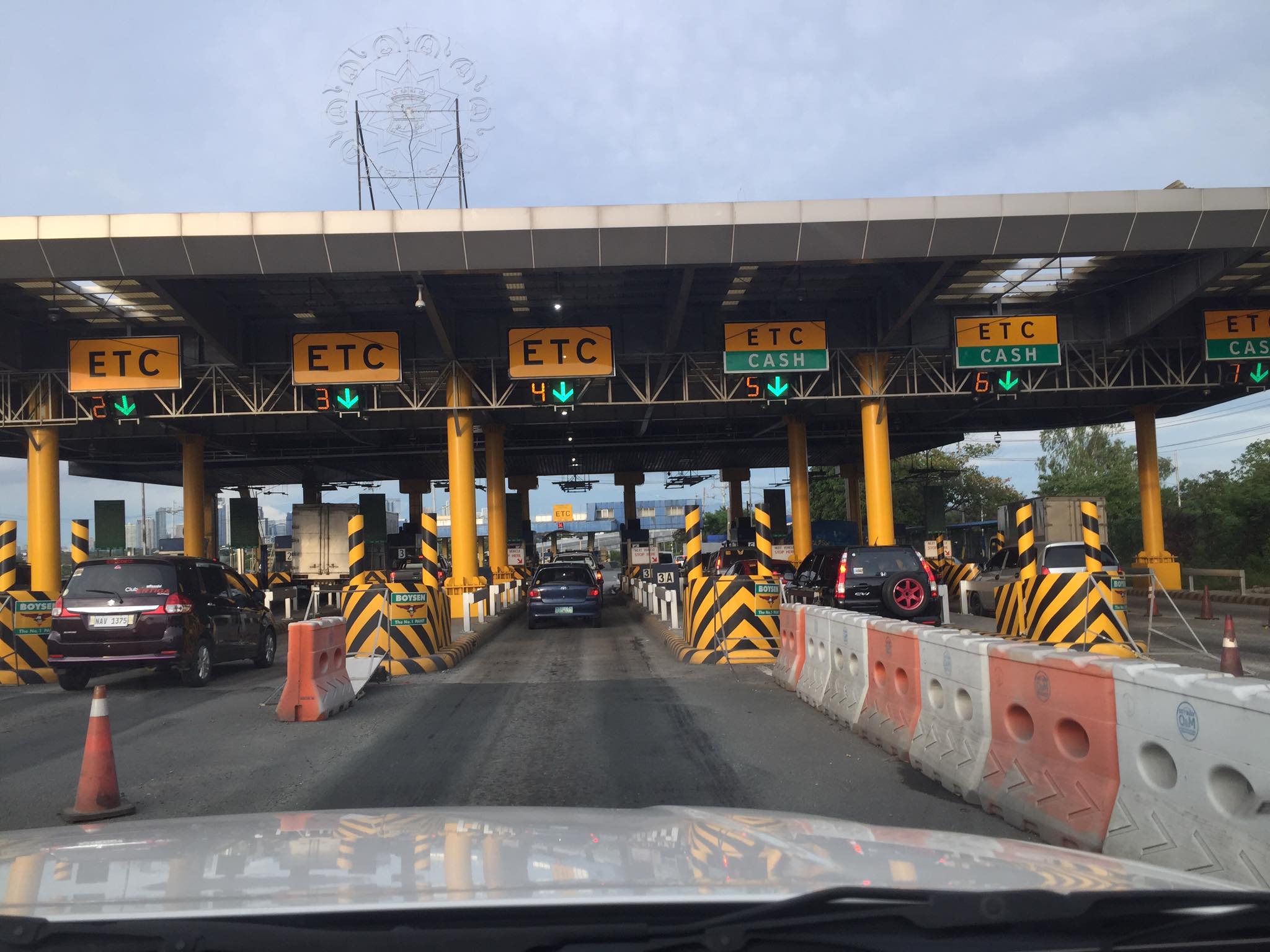
Were there issues about technology and the corresponding costs to the acquisition and deployment of the necessary devices for seamless, contactless, delay-free (in relative terms) transactions for tollways? Probably so. Those RFIDs and the readers installed at strategic locations along tollways (i.e., entries and exits) were certainly not state of the art or the best available out there. Singapore, for example, uses a more sophisticated system for their expressways where you no longer have toll plazas and you won’t have to slow down to be detected by the system. That system has corresponding costs but is perfect for the city state given that most roads are tolled anyway because of their road pricing policy. In the case of our tollways, not all travelers are actually going to utilize the tollways as frequently as it would necessitate them having to get either the Easy Trip or Auto Sweep tags. That is obvious from the relatively low penetration rates for electronic toll collection (ETC). So it still makes sense to have hybrid booths for those not availing the ETC option. Anyway, travelers will have to exercise disinfection protocols to ensure infections are prevented.
–
On cycling fatalities and the way forward
I’ve read a few articles and social media posts about how its become more dangerous or risky for cyclists during the pandemic. The statistics and observations show that there is an increase in the number of cyclists. I am not even considering here the recreational ones (and I have observed that there are a lot more of them). I focus rather on those who use bicycles to commute between their homes and workplaces; or those who cycle to market or do their groceries. The danger lies mainly from motorists who have little or no regard for cyclists and pedestrians; choosing to hog the roads for themselves. And there seem to be more of these motorists these days, too, as people owning cars have opted to use these instead of taking public transportation.
Here’s a recent article about safety in the US. Those stats and assessments can be replicated here given the availability of data on kilometers traveled and crashes that are usually employed for risk assessments.
Marquis, E. (December 22, 2020) “Cars have killed almost 700 cyclists in 2020,” Jalopnik.com, https://jalopnik.com/cars-have-killed-almost-700-bicyclists-in-2020-1845934793
The only solution for our case really is to put up protected bike lanes. Local standards or guidelines need to evolve and the people behind these should be of progressive thinking rather than relying on “what has been done” or “what they have been doing”. That attitude will only give us poorly planned and designed infrastructure for cycling and walking. The coming year offers some opportunities for active transportation as the DOTr and the DPWH (plus the MMDA in the case of Metro Manila, and perhaps the LGUs where applicable) are supposed to implement major projects intending to produce the bike lanes and walkways for Metro Manila, Metro Cebu and Davao. The budget is in the billions of pesos so much is expected about these projects. Will they become models for other Philippine cities and municipalities to follow? Or will these be like going through the motions just to appease those calling for active transport facilities?
–
On the burdens of car dependence
Here is a quick share today. This is another excellent article from Todd Litman who makes a great argument for why planning should move away from its being car-centric and contribute towards a significant reduction in society’s dependence on cars.
Litman, T. (December 15, 2020) “Automobile Dependency: An Unequal Burden,” Planetizen.com, https://www.planetizen.com/node/111535?utm_source=newswire&utm_medium=email&utm_campaign=news-12212020&mc_cid=e746a044a3&mc_eid=9ccfe464b1 .
Much have been said and written about this topic in many platforms including social media but in many of these, I noticed that the discussion often deteriorated into hating or shaming exercises rather than be convincing, constructive arguments for reforms in planning and behavior and preference changes in transport modes. Litman is always very fair and comprehensive and employs evidence or facts in his articles that should be clear for most people to understand. I say ‘most people’ here because there are still many who are among those considered as “fact-resistant”. Happy reading!
–
On experiments and crowd-sourcing for solutions
If you didn’t notice, the government (national agencies and local government units) has implemented and successfully employed experimentation and crowd-sourcing to find solutions for transport and traffic problems. In the case of experimentation with traffic, this has been going for a while now but not at the level of those conducted during Bayani Fernando’s stint at the MMDA. At the time, full scale experiments were undertaken as the agency dabbled with the U-turn scheme. The ultimate product of that time are the twin U-turn flyovers at C5-Kalayaan. I say ultimate because it involved both experimentations and traffic simulation, where the latter was used to justify the U-turn flyovers over what was originally proposed as an underpass along C-5. As I recall, the model was not calibrated or validate contrary to the agency’s claims. I say so because I personally saw how the model ran and the presentations were more like demonstration of the software used. Meanwhile, the DPWH at the time made their own simulation models and did the necessary calibration and validation to come up with sound models for other projects including the Quezon Avenue-Araneta Avenue underpass.
Crowd-sourcing, mainly through social media is a more recent approach. It is not an entirely new animal because prior to social media, there were a lot of inter-agency committees that included people from various stakeholders (some invited, some not) who were the primary “sources”. The crown now is larger and perhaps more diverse. Whether this is a conscious or unconscious effort is uncertain. And this can easily be denied or shrugged-off. But in this age of social media, there are just so many enablers or influencers for crowd-sourcing each of whom have their own agenda. Some mainly to promote or prop up the current administration. Some to mainly criticize without offering solutions. And others to invite constructive scrutiny or assessment while also providing options to address problems and issues. It is the latter group whose opinions and recommendations should carry more weight if indeed the administration is fishing for solutions from the so-called crowd.
Consider the following recent examples (not in any order):
a) Closing U-turn slots along EDSA
b) Requiring face masks for all who are outdoors including cyclists
c) EDSA carousel
d) Resumption of public transport with mostly air-conditioned vehicles
e) Bike lanes along major roads
f) Public transport reform (in general)
There are others but the six listed above have been discussed a lot on social media after government picked up an idea or two about them, and implemented each seemingly without conducting due diligence or paying attention to the details including potential glitches. They ended up with mixed results, many very costly (I wouldn’t say disastrous at this point). However, in all cases, they seem to welcome (though at times begrudgingly or feigning resistance) crowd-sourced solutions particularly those from organized groups who are only too happy for themselves to be in the limelight.*
One thing is for sure and that is that there is still a lack of capabilities among government agencies and LGUs when it comes to transportation. Don’t get me wrong. National government and many LGUs have the resources and capacity to address transport problems. However, their capabilities are in question here because they seem to be unable to harness their capacities and resources to come up with sound and suitable solutions. In the end, they appear to buckle under the pressure of their own crowd-sourced schemes only to emerge as manipulators after they are able get what they want with the willing assistance of the naive.
–
*Some of these are true advocates who have worked hard to make transport better for all while others are the bandwagon types (nakikisakay lang) who are content dropping key words that now sound cliche at every opportunity. I leave it up to my readers to determine which are which. 🙂
The FVR Road and Bridge after Typhoon Ulysses
This is a continuation of the feature on the aftermath of Typhoon Ulysses (Vamco). I am posting this here as part of my archives on the floods in the Marikina Valley.
There’s a road branching off from Marcos Highway that links to a bridge crossing the Marikina River and connects with the FVR Road along the Marikina Riverbanks. The following photos speak for themselves in as far as the mud and garbage that was left after the floods subsided.
 Descending from Marcos Highway, only one of two lanes are passable after heavy equipment moved tons of mud and garbage to the roadsides. The fences trapped a lot of garbage, too, as seen in the photo.
 Piles of mud and garbage at the service road leading to the east bank of the Marikina River and the SM Marikina access road.
 Under the Marcos Highway Bridge, garbage, mostly plastics, remain on the wire fences. This area was totally submerged during the height of the floods with water reaching the underside of the bridge. Fortunately, the bridge seems undamaged.
 Even lamp posts and electric poles caught a lot of garbage.
 The Olandes housing development was surely affected by the swelling of the river.
 The FVR Road leading to C-5 is already clear for 2-lane traffic but you can see the mud and garbage all around. The dried mud has turned into dust (alikabok) that blows away as vehicles pass through the road. There is also mud on the plants in the median planters as this area was also submerged during the height of the typhoon.
–
On transportation equity
Here’s another quick share of an article on transport equity:
McQuaid, H. (November 23, 2020) “Equitable Transportation Starts At Community Level,” CT News Junkie, https://www.ctnewsjunkie.com/archives/entry/20201123_equitable_transportation_starts_at_community_level/
How many times have I heard and read about people talking about the concept of “dignity of travel” or “dignity of transportation” referring to the quality of our commutes in terms of the quality of transport services available to us. The article also talks about societal exclusions and biases that sometimes we only attribute to America but in reality are also applicable here based on how we regard people from the rural areas or our being regionalistic.
–
On super-spreaders
This seems like a non-transport post but it is, actually. Since the start of the pandemic, one of the biggest concerns have been the so-called super-spreaders. These are people who are usually asymptomatic of the COVID-19 virus and as such have been going around seemingly oblivious to their impacts on other people who may not be as resistant (somehow) as they are. These people might not be aware of their being carriers of COVID-19 and yet exercise little or no restraint or care in their movements.
Cox, C. [November 10, 2020] “The Vulnerable Can Wait. Vaccinate the Super-Spreaders First,” Wired. https://www.wired.com/story/covid-19-vaccine-super-spreaders/?bxid=5bd6761b3f92a41245dde413&cndid=37243643&esrc=AUTO_OTHER&source=EDT_WIR_NEWSLETTER_0_DAILY_SPECIAL_EDITION_COVER_ZZ&utm_brand=wired&utm_campaign=aud-dev&utm_mailing=WIR_Daily_111020_Special_Cover&utm_medium=email&utm_source=nl&utm_term=WIR_Daily_EXCLUDE_PaywallSubs
One wonders how many super-spreaders are there among us in the Philippines considering many people have practically disregarded other people’s safety vs. COVID-19 by moving about without necessity and application of best practices like distancing and the use of masks and shields.
–
A bigger picture for the ‘new normal’
Here’s something different thought not totally unrelated to transportation. The article is about the emergence of super typhoons and their aftermaths:
Niiler, E. (November 4, 2020) What Is a Super Typhoon, and Why Are They So Dangerous? Wired. https://www.wired.com/story/what-is-a-super-typhoon-and-why-are-they-so-dangerous/?bxid=5bd6761b3f92a41245dde413&cndid=37243643&esrc=AUTO_OTHER&mbid=CRMWIR092120&source=EDT_WIR_NEWSLETTER_0_DAILY_ZZ&utm_brand=wired&utm_campaign=aud-dev&utm_mailing=WIR_Daily_110420&utm_medium=email&utm_source=nl&utm_term=list2_p2
With the typical influx of typhoons (i.e., during the wet season there are months that can be referred to as ‘typhoon season’) and the prospects of super typhoons becoming more regular, there is now a need to review infrastructure, building guidelines and standards for cities and municipalities to become more resilient vs. these phenomena. Not long ago, disaster resilience became part of the agenda for infrastructure development; including maintenance and retrofitting vs. the anticipated calamities from typhoons, earthquakes and volcanic eruption that are experienced in many parts of the country. Perhaps the transportation system can be structured to be more disaster-resistant. And, if these phenomena happen, the transportation system can survive and serve for relief operations.
–
New WHO publication on transport in the context of COVID-19
I’m just sharing the new publication from the United Nations (UN) World Health Organization (WHO) – Supporting healthy urban transport and mobility in the context of COVID-19:
https://www.who.int/publications/i/item/9789240012554
The brief document contains recommendations for travelers and transport service providers. It is a compact, concise reference for everyone as we continue to deal with the impacts of COVID-19.
What if Rizal today was the same province it was back in the day?
I write this as a super typhoon is bearing down on us this 1st of November. I found this map on the internet without attribution to the original source. It shows a still-born Metro Manila with only four local government units: Manila, Quezon City, Pasay City and San Juan.
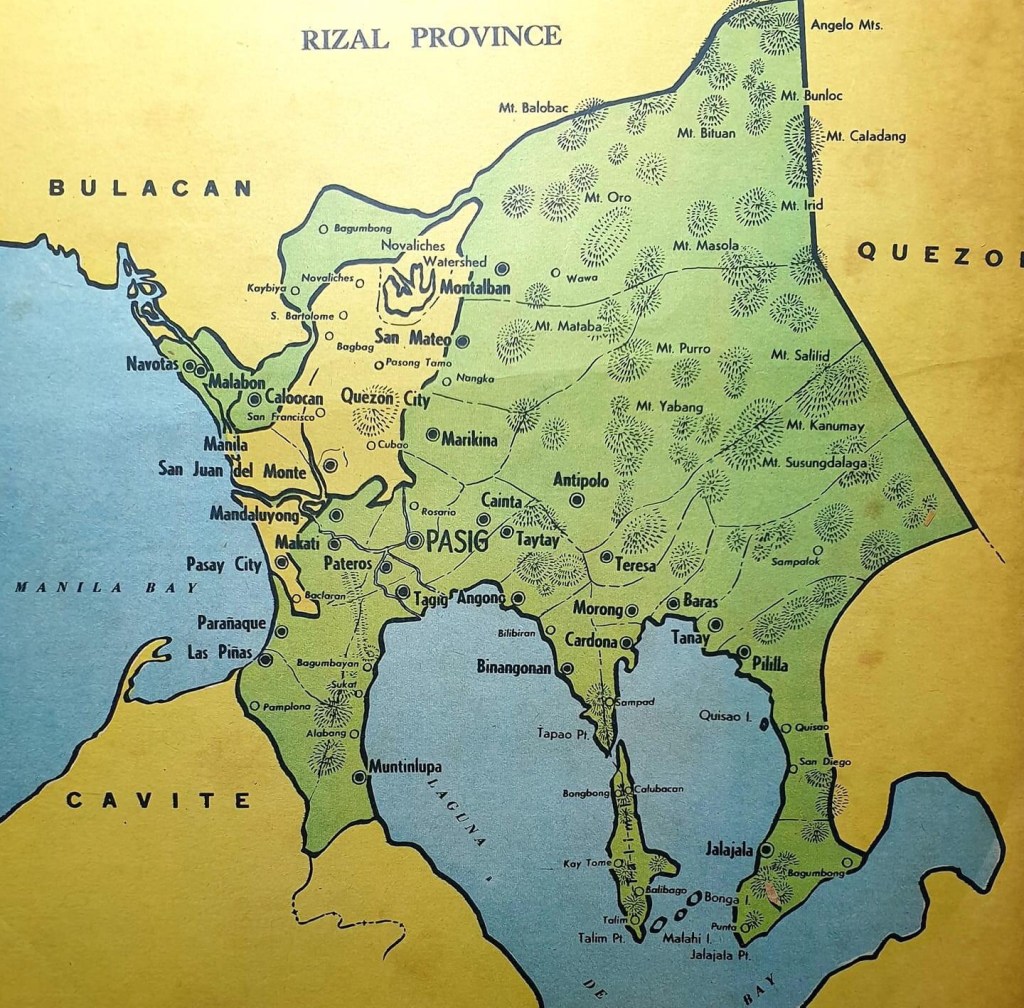
What if instead of the Metro Manila we have now, Rizal retained the towns (that eventually became cities) that were transferred to what became the National Capital Region (NCR)? These are Navotas, Malabon, Caloocan, Marikina, Pasig, Pateros, Mandaluyong, Makati, Taguig, Paranaque, Las Pinas and Muntinlupa. Valenzuela was taken from Bulacan Province. Pasig was the capital of the province (Yes, that’s why there is Capitolyo and the Rizal Provincial Capitol used to be in Pasig where you now have Capitol Commons. Surely, the political landscape could have been different though one could argue that certain families would have still held sway in cities/towns where they have their routes. Imagine, the governorship of the province would have been a coveted post but not by the the current holders but likely by personalities from the more progressive and densely populated cities. Governance would have been different, too, as Rizal would have both highly urbanized and rural areas. Perhaps certain undesirable politicians could not have emerged due to the dynamics of a province with highly urbanized cities? What’s your take on this “what if”?
–

