
Home » Governance (Page 24)
Category Archives: Governance
On the importance of trees in the urban setting
Having lived in two other countries and traveled in many others, I have seen and experienced for myself examples of tree lined avenues and streets in the urban setting. And I am not talking about small cities but big ones like Tokyo and Singapore. I have gone to many of the big cities in Japan to be able to say that trees should have their place in the so-called urban jungle and the benefits of having them are tremendous. Here is a nice article recently published in The Guardian that explains the advantages of green streets:
Balch, O. (2019) “Green streets: which city has the most streets?”, The Guardian, https://www.theguardian.com/cities/2019/nov/05/green-streets-which-city-has-the-most-trees [Last accessed: 11/08/2019]
Philippine cities should heed the advice from the author and city and municipal planners should make sure that plans incorporate trees and other flora. Obviously, they are not just ornamental but rather should be indispensable components of our towns whether it is highly urbanized or not. I guess the same concepts apply also to the roadsides of our national highways. The Department of Public Works and Highways (DPWH) clearly had little or no regard for greenery; chopping down even the elder trees along the way of their road widening programs. As such, they have contributed to blight along these roads and it would take some time and effort to bring back what used to be tree-lined, canopied roads in many provinces.
–
Cooperative work among LGUs to address transport problems along Ortigas Avenue Extension?
I saw a recent post about a meeting hosted by Pasig City. The Mayor of Pasig City recently held a meeting where he invited the mayors or Antipolo, Cainta and Taytay to discuss, among other things perhaps, transportation along Ortigas Avenue. Ortigas Avenue is a corridor shared by several LGUs most notably the Rizal towns of Antipolo (which is the provincial capital and a highly urbanized city), Cainta and Taytay. The latter two are among the richest municipalities in the country; a fact I underline here since that also should translate to them having the resources or means to help come up with transport and traffic solutions.
 Morning rush traffic starts very early these days. This photo was taken around 6AM on a Thursday along the westbound direction just after the Manggahan Bridge. The pedestrian overpass at C. Raymundo junction is shown and the dark colored buildings are at Robinsons’ Bridgetown development. Note the commuters along the right waiting for a ride.
Photos paint a thousand words. The Taytay Mayor attended the meeting. He has been under fire for the horrendous traffic caused by the mismanagement of Tikling Junction as well as the Barkadahan Bridge area that was and is supposed to be a major alternative route for Rizalenos heading to their workplaces in Makati and BGC. More recently, there were posts about the traffic signals installed at Tikling Junction that basically invalidates the roundabout concept for the junction. The result last Thursday, the first day of operations for the signals, was hellish traffic that backed up a couple of kilometers along the Manila East Road and Ortigas Ave. Extension (some reports say until Cainta Junction). This, even as the signal settings were supposedly done with help from the MMDA.
Antipolo was represented by its former Mayor and husband to the current one. He also happens to be a former Governor of the Rizal Province and likely to run again as his mother, the current governor, is on her 3rd term. It seems to me that the province is not so interested in solutions for Ortigas Avenue despite most of its constituents traveling through the corridor to get to their workplaces and schools. Marcos Highway is not the main corridor for Rizal towns as it basically carries only Antipolo and maybe some of Tanay (via Sampaloc) traffic. Ortigas Avenue Extension branches into two major roads from Tikling – Ortigas Ave Extension, which ends at the capitol, and the Manila East Road, which connects to practically all of Rizal towns with San Mateo and Rodriguez (Montalban) being the exceptions. It is time for the province to pay attention to this commuting problem experienced daily by her constituents.
The Mayor of Cainta seems not as interested as the others, sending a representative who appears to be not one of the top officials (the traffic chief with a rank of SPO1=Master Sergeant is lower ranked than a councilor) of the Municipality to such an important meeting. In fact, he is currently now embroiled in a controversial faux pas involving himself by not wearing a helmet while riding a motorcycle. What’s more is his downplaying this and appearing to be even justifying the act. He eventually apologized but not before stating his moves. He is not new to publicity (stunts?) and knows how bad publicity still translates to good publicity especially in this days of fake news and trolls (he apparently has many on social media). He seems to forget that transport and traffic solutions for Ortigas Ave will likely benefit anyone seeking reelection or higher office in Rizal. He is on his last term as mayor and the break-up with some of his allies including his former Vice Mayor who ran against him in the last elections shows the limits of his political career. What was rumored as plans to run for Rizal governor might just be downgraded to perhaps Vice Mayor? In any case, he should show more interest and effort in finding solutions beyond traffic management and not by himself but in cooperation with others with whom his jurisdiction shares the problems with. Perhaps the initiative of the Pasig Mayor presents an opportunity for such cooperative work? Many people are very interested in this and will be watching – and hoping.
–
Is there really a transport or traffic crisis in Metro Manila?
I was interviewed recently for a research project by students enrolled in a journalism class. I was asked by one in the group if we indeed have a transport crisis in Metro Manila. The other quickly added “hindi transport, traffic” (not transport but traffic). And so I replied that both terms are valid but refer to different aspects of the daily travel we call “commuting”. “Traffic” generally refers to the flow of vehicles (and people if we are to be inclusive) while “transport” refers to the modes of travel available to us.
“Commuting” is actually not limited to those taking public transportation. The term refers to all regular travel between two locations. The most common pairs are home – office and home – school. The person traveling may use one or a combination of transport modes for the commute. Walking counts including when it is the only mode used. So if your residence is a building just across from your office then your commute probably would be that short walk crossing the street. In the Philippines, however, like “coke” and “Xerox”, which are brands by the way, we have come to associate “commute” with those taking public transportation.
And so we go back to the question or questions- Do we have a transport and traffic crises? My response was we do have a crisis on both aspects of travel. All indicators state so and it is a wonder many including top government transport officials deny this. Consider the following realities for most commuters at present:
- Longer travel times – what used to be 30-60 minutes one-way commutes have become 60 – 120 (even 180) minute one-way commutes. Many if not most people now have double, even triple, their previous travel times.
- It is more difficult to get a public transport ride – people wait longer to get their rides whether they are in lines at terminals or along the roadside. The latter is worse as you need to compete with others like you wanting to get a ride ahead of others.
- People have to wake up and get out of their homes earlier – it used to be that you can wake up at 6:00AM and be able to get a ride or drive to the workplace or school at 7:00/7:30 AM and get there by 8:00 or 9:00AM. Nowadays, you see a lot of people on the road at 5:30AM (even 4:30AM based on what I’ve seen). That means they are waking up earlier than 6:00 AM and its probably worse for school children who either will be fetched by a service vehicle (e.g., school van or bus) or taken by their parents to their schools before going to the workplaces themselves.
- People get home later at night – just when you think the mornings are bad, afternoons, evening and nighttimes might even be worse. Again, it’s hard to get a ride and when you drive, traffic congestion might be at its worst especially since most people leave at about the same time after 5:00PM. Coding people and others not wanting to spend time on the road (instead working overtime – with or without additional pay) leave for their homes later and arrive even later.
- Less trips for public transport vehicles – traffic congestion leads to this. What used to be 6 roundtrips may now be 4. That affect the bottomline of income for road public transport providers. Given the increased demand and reduced rolling stocks of existing rail lines that includes rail transport.
To be continued…
—
Quick share: “The changing role of transport strategy”
Here is a nice article briefly discussing the evolution of transport strategy planning that have led to local transport plans:
Gleave, J. (2019) The changing role of transport strategy, Transport Futures, https://transportfutures.co/the-changing-role-of-transport-strategy-598fce17e9e9 [Last accessed: 8/24/2019].
More importantly, there is a very good discussion here of the recent developments and the need to change approaches in order to become more effective at the local level. The article explains that there should be an appreciation of the availability of resources including tools that allow people to be more engaged or able to participate in the planning process for their cities, municipalities or communities.
–
Dangerous situations for school children
We are currently implementing a project to improve the safety of journeys of children between their homes and schools. Ocular surveys of 25 schools in Zamboanga City revealed a lot of issues pertaining to their commutes. Critical locations include the main access roads (e.g., across school gates) and intersections. All schools have reported incidence of road crashes involving their students and mentioned that in many cases, drivers or riders do not slow down upon approaching the critical locations. These cases of speeding are despite the many countermeasures (including informal and creative ones) that schools and Barangay authorities have implemented to improve safety.
Here are some photos we took at Sinunuc Elementary School along the national highway in Zamboanga City:
 Children waiting to cross the highway and on-board motorcycles with their parents/guardians who fetched them from school
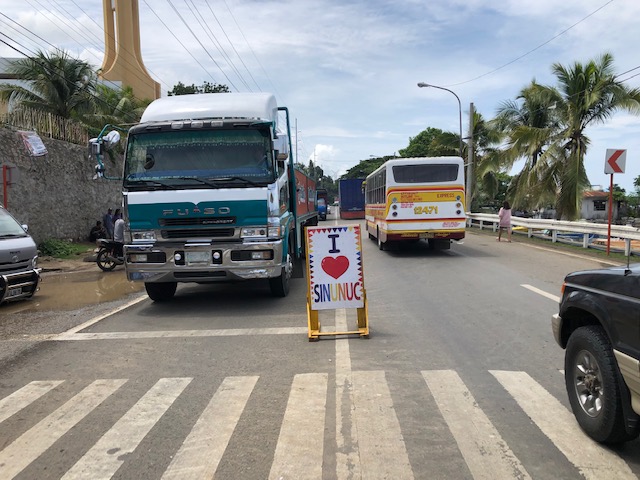 Large vehicles including trucks and buses traverse the highway and the signs offer little in terms of refuge or protection against these for students and other people crossing the highway.
 Child crossing with a parent/guardian
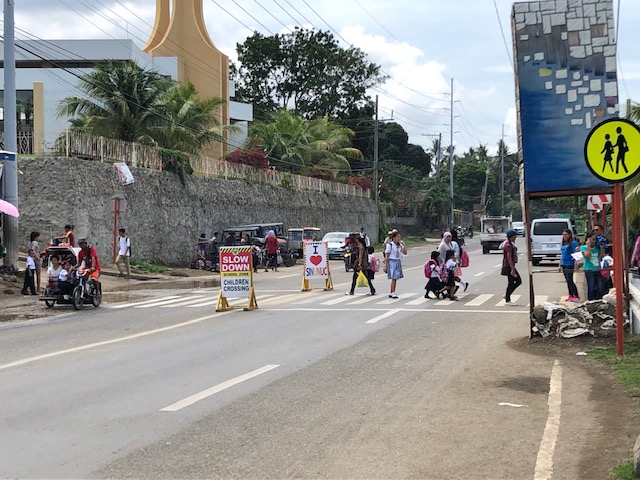 Children crossing the highway – photo also shows a pedestrian crossing sign at the road side along the direction towards the city centre.
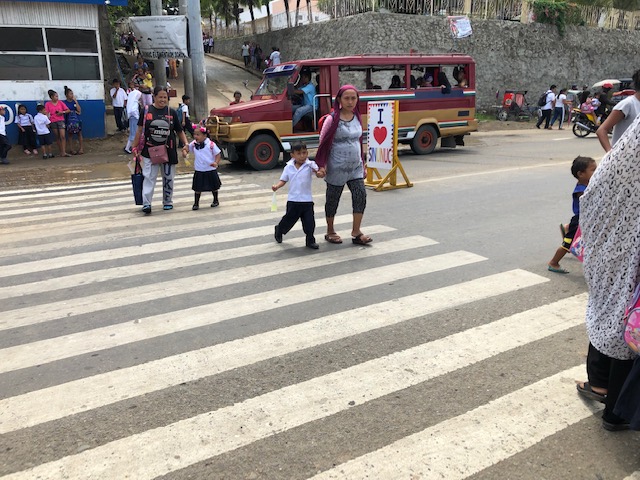 Children crossing with their parents/guardians as a jeepney is stopped right before the pedestrian crossing.
Though it may not be so obvious for some observers or viewers of the photos, these situations present high risks for students and others using the roads. And we hope our assessments in cooperation with the schools, agencies and city officials will be fruitful in improving road safety especially for the children.
–
Politics: Fresh Faces at the Local Level?
A major factor in shaping our cities and municipalities is the leadership in the form of local politicians, most especially the Mayors, who are the decision-makers for many aspects of their constituencies. Mayors have a hand in most if not all policies pertaining to land use (e.g., zoning, planning, etc.) and transportation (e.g., schemes, policies, franchises, etc.).
The likes of Vico Sotto, Isko Moreno and Francis Zamora are currently being praised for what seems to be their fresh and aggressive approach to addressing problems and issues in their respective constituencies. The three’s ascendance to mayor of their respective cities have also exposed the alleged graft and corruption of their predecessors. The dominance of the latter in the form of dynasties have all but assured that whatever anomalies passed on from one term to another are internalised and made unknown to their constituencies who are to remain blind to these abnormalities. Instead, the people are made to believe that progress is achieved with some worthwhile projects here and there to show that taxpayers’ money are spent well.
Prior to these personalities, there were others who sort of broke the dynasties in their respective towns. I can name at least two cases that I am very familiar with; both with the Municipality of Cainta – Mon Ilagan and Kit Nieto. Both ended long reigns with Ilagan making Cainta history by finally upending the Felix dynasty there. Previous to him, the only one who almost upset the then reigning dynasty was a woman – Eunice Fermindoza. Ironically, Ilagan’s attempt at a dynasty by making his wife run after his 3 terms was up was nipped by Nieto, an erstwhile ally who has come to represent not just the emergence but the establishment of people who have settled in suburban town in the various subdivisions developed over the course of the last 50 years. These are the middle class comprised of professional and office workers and their families who decided to reside in Cainta because of the town’s proximity to Metro Manila and homes their being relatively affordable.
Even before Sotto, Moreno and Zamora have embarked on their own programs, Nieto has shown that the efficient use of resources coupled with transparency and a genuine feel for the requirements of his constituents will get one re-elected and gain attention. Cainta has transformed and blossomed under this current mayor. For one, he has been able to complete many infrastructure projects and strengthened social and medical programs in the municipality. It is a wonder how Cainta is not yet a city considering its income and continued growth. One only wishes this growth is not sustained by poorly planned land use development where the town basically relies on developers (i.e., Megaworld and Filinvest) for the plans instead of being involved in order to avoid exacerbating the enduring traffic and flooding issues that are still the bane of this town. Unfortunately, Nieto is on his last term and it is unclear for now who might be competent and progressive enough to replace him. Among the current councilors in the current administration is a Felix and an Ilagan, scions of the two previous families that lorded it over Cainta. Will one of them rise again to reclaim what they probably regard as their right place? Hopefully not…Kawawa naman ang Cainta.
–
Safety guides for pedestrians and cyclists
Here are a couple of references/resources for pedestrian and cycling safety. These are guidelines and countermeasure selection systems that were developed under the Federal Highway Administration of the US Department of Transportation:
- Pedestrian Safety Guide and Countermeasure Selection System
- Bicycle Safety Guide and Countermeasure Selection System
These guides are designed to be practical and should be helpful to practitioners/professionals, policymakers as well as researchers. These would be people looking for references to use in designing or revising (correcting?) existing conditions or situations in order to enhance safety for pedestrians and cyclists who are among the most vulnerable of road users.
–
On unlocking the potential of shared transportation
Here’s a quick share of a very nice article that’s very informative and therefore useful to people seeking to tap into the potential of shared transportation to help alleviate transport woes in their cities and towns:
Miller (2019) “9 Ways Cities Can Unlock the Potential of Shared Transportation”, Medium.com, https://medium.com/frontier-group/9-ways-cities-can-unlock-the-potential-of-shared-transportation-66a53b2c841 [Last accessed: May 3, 2019]
So far, we only have few examples of shared transportation in the Philippines. These include a few bike shares in Metro Manila and does not count ride-hailing/ridesharing, which we now know is not really a sustainable form of transport.
–
Bike patrol
Wouldn’t it be healthier and more effective for law enforcers to have bike patrols? Many of them seem to be detached from the communities they’re supposed to serve when they aren’t on foot or pedals but instead go around on motor vehicles. It also seems a waste that the motor vehicles assigned to these people are being used to train them for driving. Thus, you often see patrol cars (even motorcycles) that are supposed to be recent model vehicles but seem so battered already. Do they really use these for chases? Or are they damaged due to their being used as “training” vehicles?
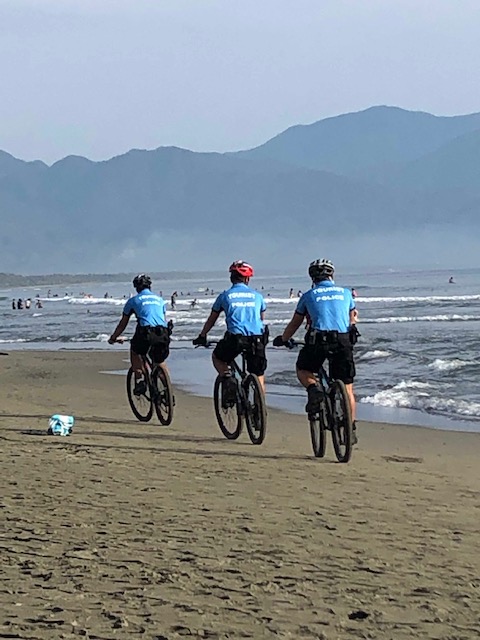 PNP officers on bike patrol along the beaches in Baler, Aurora
To be more effective, police officers should probably be roaming on foot or bicycles. They can be more in touch with the communities as there will be opportunities to mingle compared to if they were on cars or motorcycles. In one thread on social media, for example, there was a call for our local police to adopt the “Koban” style of the Japanese police where officers roam the communities mainly on foot and where many are recruited from the community for the latter and former to have some familiarity with the people and areas they are assigned to. Going around on foot or bicycle would also be a healthier option as surely they will be able to go more than the 10,000 steps (or equivalent) necessary to be classified as active.
–
Article on sustainable transport’s role in “saving the world”
Here is another quick post on another article I am sharing showing the importance of sustainable transport:
Milner, D. (2019) How sustainable transport can save the world, medium.com, https://medium.com/@djjmilner/how-sustainable-transport-can-save-the-world-f2f64517dc52 [Last accessed: 4/9/2019]
It goes without saying that sustainable transport has a lot of potential for helping mitigate climate change and other issues but much is expected of our leaders for policies and program & project development & implementation towards achieving sustainable transport in our cities and municipalities.
–
 Caught (up) in traffic