
Home » Governance (Page 27)
Category Archives: Governance
In memoriam of road crash victims
I wrote earlier this year about a beloved aunt who was involved in a road crash. She was hit by a jeepney driven recklessly as she was walking; on her way to church one early morning. She was in the hospital for weeks before she finally passed away. It was painful to see her in her hospital bed, unconscious but fighting for her life.
No, I don’t feel anger anymore whenever I recall the incident and note that if the driver were just careful then she would still have been alive today. I feel sad. I feel sad and frustrated that despite all the efforts a lot of people have put into road safety programs and projects, there seems to be little in terms of the reduction of recklessness on the roads. The recent weeks, for example, are full of reports of crashes that claimed the lives of many and injured more. These often involved trucks that mowed down everyone in their paths. Then, you see a lot of motorcycles weaving in and out of traffic, many ride like stuntmen and without regard for life, limb or property as long as they can get away with it.
Additional laws in the form of local ordinances or Republic Acts will not be effective in reducing road crashes and the death toll it has brought upon us. It is the enforcement, the implementation of these rules and regulations. Rules and regulations are just words that, if not acted upon, do not have any effectiveness. And so we get to the root of the problem and that is enforcement; the lacking if not missing ingredient in the road safety broth that is necessary to save lives and create a safer environment for all. Does it deserve more attention and resources from our national government and local authorities who are in-charge of most of the enforce aspects of road safety? I do think so. Statistics on traffic-related deaths, injuries and damage to property compare strongly with if not exceed those attributed to drug abuse. When you purposely drive recklessly and crash into another vehicle or person, one is practically murderous. You also destroy the lives of people related to the person you kill or injure (e.g., that person could be the sole breadwinner of a family). The comparisons and examples are plenty and I am sure a lot of people have their own personal experiences about this as well as their opinions. For now though, let us reflect on those who perished from road crashes and perhaps think not about “what could have been” but instead of “what can be done.”
–
Local Public Transport Route Plan Manual – Philippines
The Department of Transportation (DOTr) recently shared the Local Public Transport Route Plan (LPTRP) Manual that was the product of the collaboration among government and the academe. While the date appearing on the cover is October 2017, this manual was actually completed in April 2017. [Click the image of the cover below for the link where you can download the manual.]

I don’t know exactly why the DOTr and Land Transportation Franchising and Regulatory Board (LTFRB) were hesitant in releasing this manual. Perhaps they wanted to pilot test it first on a city? Yup, this manual has never been tested yet so we don’t really know whether it will work as a tool for planning public transportation.
With all the opposition to the government’s PUV Modernization Program, the DOTr and the LTFRB should be piloting the program first and show a proof of concept to dispel doubts about the program. The same essentially applies to this transport route plan manual. Only once these are piloted would we know first hand its flaws and allow us to revise or fine tune them. I would suggest that both the modernization program and the manual be piloted in cities that are perceived or claim to have strong local governance. Davao City comes to mind and perhaps Iloilo City. Can you think about other cities where the program and/or manual can be piloted?
–
Misinformation on the PUV modernization project
There was a transport strike today mainly involving jeepney drivers and operators who are protesting the proposed Public Utility Vehicle (PUV) Modernization project of the Philippine government. In this age of fake news, there’s also a lot of misinformation going around that gets shared even by well meaning people who probably just wanted to have it represent their opinion about the matter. Unfortunately, this only spreads more misinformation. Nagagatungan pa ng mga alanganing komento.

Following is the reply of the DOTr from their Facebook account:
“PAUNAWA | Isa-isahin natin para malinaw:
1. Hindi tataas sa P20 ang pasahe. Saan nakuha ng PISTON ang numerong ito?
2. Hindi lugi ang driver/operator. Kikita pa nga sila. Bakit?
– May 43% fuel savings ang mga Euro-4 compliant na sasakyan
– Mas maraming pasahero ang maisasakay dahil mula sa 16 persons seating capacity, magiging 22 na.
– Low to zero maintenance cost dahil bago ang unit
3. Hindi rin totoo na hindi kami nagsagawa ng mga konsultasyon.
Ang DOTr at LTFRB ay nagsagawa ng serye ng konsultasyon at dayalogo kasama ang mga PUV operaytor at mga tsuper sa buong bansa, kabilang dito ang mga organisadong grupo ng transportasyon at ang mga lokal na pamahalaaan.
Ang mga konsultasyong iyon ay isinagawa bago, habang, at pagkatapos malagdaan ang DO 2017-011. Sa katunayan, ang konsultasyon para sa paggawa ng mga local public transport route plan ng mga lokal na pamahalaan at ng mga kooperatiba sa transportasyon ay isinasagawa hanggang ngayon sa buong bansa. Maliban sa sector ng PUJ, nagsasagawa rin ang gobyerno ng konsultasyon sa mga operaytor at grupo ng Trucks for Hire (TH).
4. Hindi korporasyon ang makikinabang kundi mga:
– Local manufacturers na mag-didisenyo ng units
– Pilipinong manggagawa na magkakaroon ng trabaho at gagawa ng mga sasakyan
– Drivers at operators na lalaki na ang kita, uunlad pa ang industriya
– COMMUTERS na matagal nang nagtiis sa luma, hindi ligtas, at hindi komportableng public transportation units
5. Hindi anti-poor ang #PUVModernization Program.
Malaking bahagi ng Modernization Program ang Financial Scheme para sa drivers at operators. Sa tulong ng gobyerno, nasa 6% lamang ang interest rate, 5% naman ang equity, at aabot sa 7 taon ang repayment period. Magbibigay rin ng hanggang PHP80,000 na subsidy ang gobyerno sa kada unit para makatulong sa down payment.
Bukod dito, tandaan natin na ginhawa at kaligtasan ng mahihirap ding commuters ang hangad ng programa.
6. Walang phase out. Mananatili ang mga jeep sa kalsada. Pero sa pagkakataong ito, bago at modern na.
ANO ANG TOTOO?
Hindi na ligtas ang mga lumang PUVs sa Pilipinas. Takaw-aksidente na, polusyon pa ang dala. Hindi komportable at hassle sa mga commuters. Ang totoo, matagal na dapat itong ipinatupad. PANAHON NA PARA SA PAGBABAGO SA KALSADA.”
–
On the Uber and Grab predicament
A lot has been said and written for or against Uber and Grab. Social media made sure the more popular but not necessarily the truthful ones are spread. One popular personality associated with motoring has even led an online petition against the rulings by the Land Transportation Franchising and Regulatory Board (LTFRB). An objective check of the facts reveal that LTFRB is not solely at fault here. Uber and Grab should not have promoted themselves and took in additional drivers (nagpaasa ng mga drivers) after the agency issued a moratorium last year. Estimates vary but it seems they have taken in tens of thousands of drivers (20.000? 30,000? 40,000?) and earned revenues along the way to what is now an historic penalty levied upon Uber and Grab by the LTFRB.
Perhaps the most level-headed article I’ve seen online is the following:
The thing about Grab, Uber and the LTFRB [by Vince Pornelos, July 18, 2017, https://www.autoindustriya.com/editors-note/the-thing-about-grab-uber-and-the-ltfrb.html]
It seems all is well, for now, as meetings were held between the DOTr, LTFRB and the concerned parties (Uber and Grab). In one of the meetings, a couple of Senators seem to have brokered a deal to resolve what appeared to be an impasse that a lot of people on social media reacted to. There are definitely a lot of vested (and veiled) interests involved here including those by various “operators” in the transport sector on both the sides of government and private sector. One takeaway though that I observed is that many appear to be against LTFRB even though the agency was truthful about their statements regarding the illegally operating transport vehicles. They seem to have made up their minds about the LTFRB and this is not surprising as transport problems have been festering for decades with little progress in terms of improving transport, conventional or innovative. Most people seem to have lost their patience about transport services and regulation, and perhaps this is a good thing if it translated to demanding for mass transit, too.
–
Ortigas Center walkways under construction
Currently under construction at the Ortigas Center are elevated walkways that are part of the Ortigas Greenways Project. Following are some photos I took a few weeks back (they’re old!), and so the current state should show significant progress from what is in the photos.
 Elevated walkways are currently under construction at the Ortigas Center. This part can be seen along Julia Vargas Ave. at the intersection with Garnet St.
 Structure at F. Ortigas, Jr.
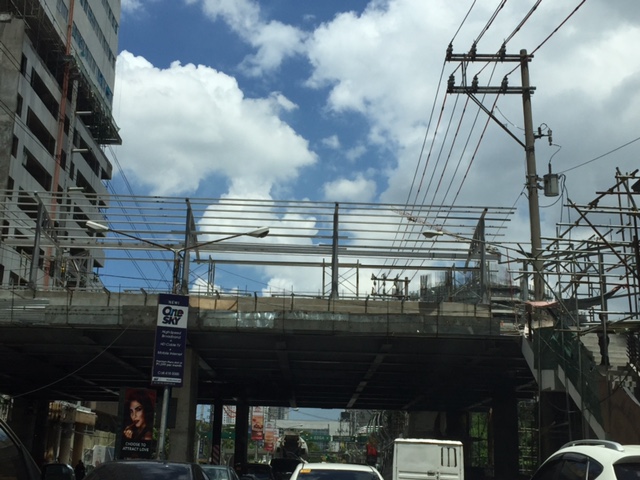 Close-up of the F. Ortigas part of the elevated walkways
 Walkway section under construction along the approach of ADB Ave./San Miguel Ave.
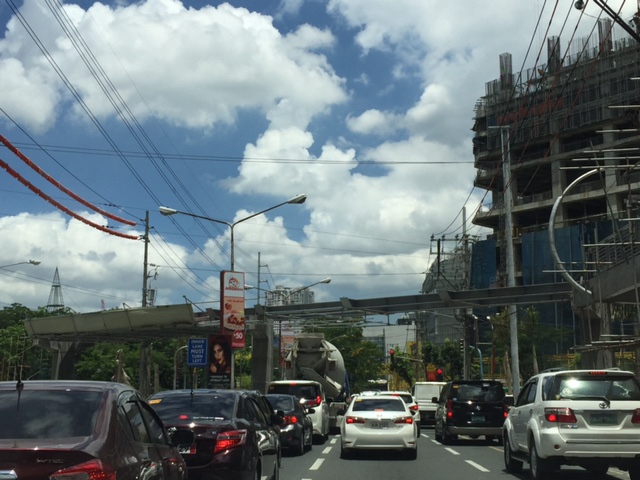 Crossing under construction at the intersection of Julia Vargas with San Miguel Ave. (to the left) and ADB Ave. (to the right).

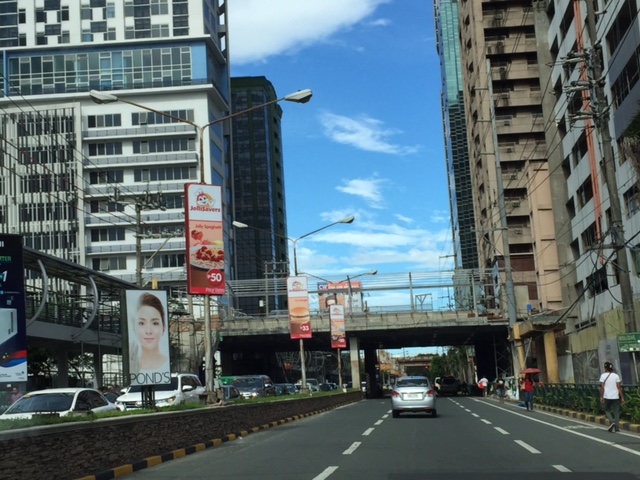 View of the F. Ortigas crossing walkway along the eastbound direction of Julia Vargas Ave.
This project is perhaps one of the most hyped pedestrian facilities in Metro Manila and if I recall right, the concept for this can be traced to workshops conducted during one of the Transport Forums organized by the Asian Development Bank (ADB), whose headquarters are located in Ortigas Center. It took a while to be realized but should be completed soon. This won’t be the first of its kind in Metro Manila as Makati already has one connecting office and residential buildings to Greenbelt and Glorietta. I really do hope it is able to reduce congestion in the area but this would require studies after the facilities are opened for public use. We need more of these around Metro Manila as well as other major cities. We direly need facilities to encourage walking as a preferred mode over motorized transport.
–
New ruralism, anyone?
I found this interesting article that tackles what to me is a new concept although it shouldn’t be. The concept of new ruralism to me is somewhat going back to the basics. While urbanization seems to be an unstoppable force, there is still the need to preserve rural areas and also the way of life as well as the industries that we need to sustain urban living. Food production, for example, is something that is being advocated or promoted in urban areas but hasn’t really caught on. Farming seems to have lost a lot of people as it is perceived as backward and yet it is essential.
New Ruralism: Solutions for Struggling Small Towns [by Jared Green in The Dirt, June 14, 2017]
What do you think about this concept of new ruralism? Is it something that’s also applicable to the Philippines or is will it be just a fad?
–
On the transportation aspects of Antipolo’s pitch for the senate to relocate there
I was browsing Facebook the other day and found an interesting post by the Antipolo City Government’s official account. They posted about the presentation made by the current mayor to the staff of the Philippine Senate, selling the idea for the Senate to relocate from its current location in Pasay City. There are currently two options known to us: Fort Bonifacio in Taguig City and Antipolo City in Rizal Province.
The Antipolo government’s post stated that it only takes 25 minutes between the the Batasan Complex and the proposed site, which is on land owned by the Antipolo City Government. This was probably based on travel time estimate using a tool such as Open Street Map. This though is inaccurate since travel times are affected by various factors and will vary according to time of day, day of the week and even month.
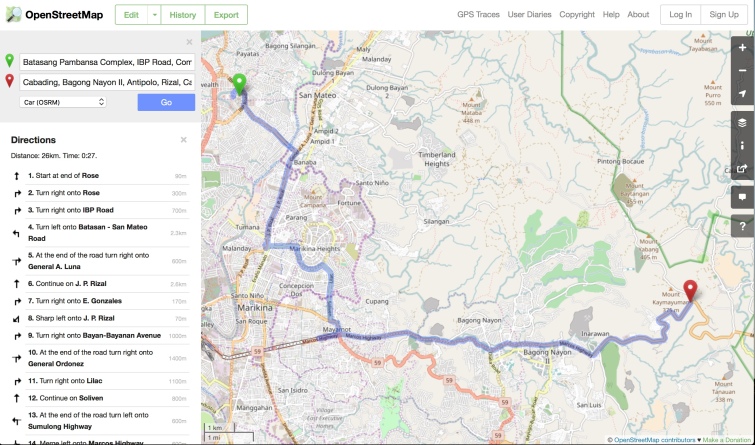 Open Street Map visualization of travel route and time between Batasan Complex and the proposed site for the Senate
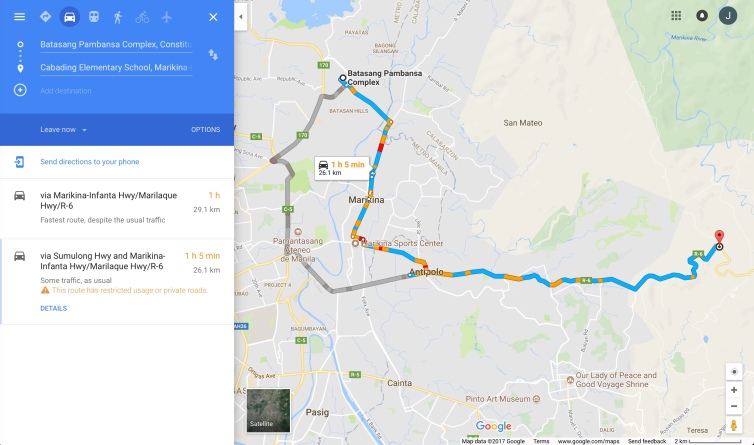 Google Maps visualization of alternative routes and typical travel times
I took the preceding screen captures at 10:00 AM on June 23, 2017 (Friday). Open Street Map’s version can be misleading because it states a travel time assuming practically no traffic (~26 km in 27 minutes or about 58 km/hr in terms of travel speed). Google Maps version is better as it accounts for typical traffic during a certain time of travel (i.e., 10AM). Thus, there’s the more realistic 1 hour travel time for the same distance (about 26 km/hr travel speed). Google’s is based on crowdsourced data and can be customized based on the day and time of travel (e.g., 8:00 AM on a Monday). And I wouldn’t even want to get into the discussion of the accuracy of the claimed 40-45 minutes to/from the airport (i.e., NAIA). Again, anyone with Waze or Google Maps can get more realistic travel time estimates for such trips.
What would be the transport impacts of such a relocation. For one, employees of the Senate (and I am not even considering the Senators and their closest staff here) would have to travel from their residences to the proposed site in Cabading, Antipolo City. Where do these staff live? If they were from Manila and they take public transport, that probably means they would have to take the LRT Line 2 to Masinag and then take a jeepney from Masinag to the site. Line 2 would present the most efficient option in terms of travel time and cost compared to taking a jeepney or van via Cubao. I am not aware of any direct transport services for them although we can speculate that perhaps new routes can be established. The Senate has shuttle buses so these would also be an option for those taking public transport. Car owners will have to travel and converge along Marcos Highway. It is uncertain when the extension to Cogeo will be decided and constructed, if at all.
There is also mention of the plans for Circumferential Road 6 (C-6). However, the reality is that government is taking its time in upgrading the existing sections in Taguig, Pasig and Taytay. The Taguig sections are in a very bad state now after the onset of the wet season. Dealing with the ROW acquisitions necessary for planned C-6 sections is already a big challenge as the areas are already built up or developed (mostly residential subdivisions).
Having the Senate complex in Antipolo will have repercussions on land use/development as well as land prices and rent. It will be located at a relatively undeveloped part of the city and will likely encourage urbanization there. Antipolo should be careful in regulating land development so that the area will not become another Batasan with all the informal settlements and the low density developments around it. There are many opportunities here to develop the area into a showcase government center and that should include planned development for residential, commercial and institutional uses. The housing options should include affordable walk-up apartments as well as medium rise buildings like those by DMCI and Filinvest. It is important to emphasize that options for affordable housing near the workplace cannot be provided in Fort Bonifacio since land and residential unit prices there are already very expensive; forcing most Senate staff to live outside and away from their offices. Such a situation necessitates long commutes and contributes to congestion.
To be fair, there is a good potential for congestion reduction if the Senate relocates to Antipolo. Perhaps the concept of a “New Town” in the proposed site can be developed in more detail. But questions arise: Will this attract major schools, for example, as well as offices such as BPOs? What is definite is that Antipolo will not be the only LGU that will benefit (economically) here but perhaps much of the Province of Rizal, too, as well as the nearby cities of Marikina and Pasig.
Decongestion can happen if:
a) Senate staff decide to move to Antipolo and environs (e.g., Marikina, Cainta, Tanay, etc.).
b) A significant number of staff reside at the proposed dormitories during much of the weekdays, and go home only for the weekends and holidays.
c) Efficient public transport is provided for them and Antipolo constituents along the corridor to be served.
d) Sustainable transport facilities like walkways and bikeways be developed to reduce dependence on motorized transport especially for short distance travel.
In the end, though, I think it will be the Senators who will be making the decision on this matter. Will they be more practical, pragmatic, or insensitive to the consideration of their staffs? Abangan!
–
Give way!
Road courtesy can be a scarce thing in many Philippine roads. In many road crash incidents, it can be quite obvious even to the casual observer that one of the problems we have is drivers and riders not practicing common courtesy. Hindi nagbibigayan. This is the case in most intersections where no traffic signals are installed and operational. Congestion occurs as drivers and riders try to impose their right of way over others. The absence of traffic personnel, even those who have limited capabilities managing traffic, further exacerbates the situation as motorists tend to ignore traffic personnel. Based on my observations, the most guilty of ignoring traffic rules and regulations including the enforcer on duty are motorcycle riders, followed by public utility vehicle drivers.
Below is a scene that greeted me one morning during my commute to my workplace. Maj. Dizon is a secondary national road passing through a residential area in Quezon City and Marikina; connecting C-5 with Marcos Highway.
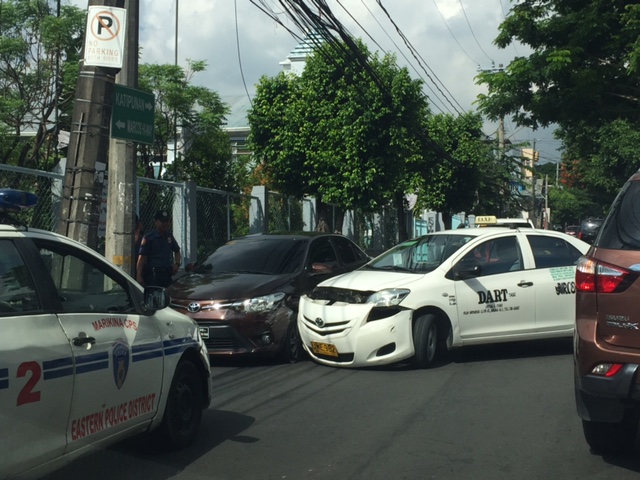
Who had the right of way here? Did the private car have the ROW and the taxi driver tried to impose himself (cut into the path of the private car) thinking that the private car driver will slow down to give way? Or did the taxi driver have the ROW but then the private driver decided to accelerate so as to prevent the taxi from completing the maneuver? Either are likely cases and are often the cause of crashes like this.
Other situations that are common are vehicles maneuvering (e.g., backing or turning) but tricycle drivers and motorcycle riders proceeding despite the clear ROW for the maneuvering vehicles. In certain cases, large vehicles like trucks have blind sides and have resulted in their inadvertently hitting motorcycles who riskily and recklessly maneuver with respect to the trucks.
How do we address such behavior? It likely is rooted from how drivers and riders learn to drive or ride so its starts with that stage. Many people learn to drive or ride from peers or their seniors (e.g., parent, uncle, family driver, company driver, etc.) while others learn via driving schools. Do they learn courtesy from their ‘teachers’? Are driving schools imparting this or just teaching people how to operate a vehicle? Then there is the licensing stage. The Land Transportation Office (LTO) is also responsible for assessing whether those applying for licenses are qualified. Both the written and practical exams should contain elements related to the practice of courtesy. And then there is the enforcement aspect, which has the burden of educating drivers and riders by accosting and reminding (lecturing?) motorists about proper driving and riding etiquette. Of course, you have to have capable enforcers in the field whether they be traffic aides or police officers.
–
On distracted driving vs. other, more urgent, traffic issues
Much has been written and said about the new law against distracted driving. The people who crafted the law, Senators and Congressmen, are in agreement that their intention was mainly to address the rampant use of gadgets including cell phones by motorists. Yet, when the agencies in-charge of implementation drew up the implementing rules and regulations (IRR), their interpretation was the subject of a lot of complaints. Many opined that the IRR didn’t take into consideration actual vehicle dashboard designs or that the definition of the term “line of sight” was open to interpretation. This necessitated another round of consultations with stakeholders leading to the infographic below:
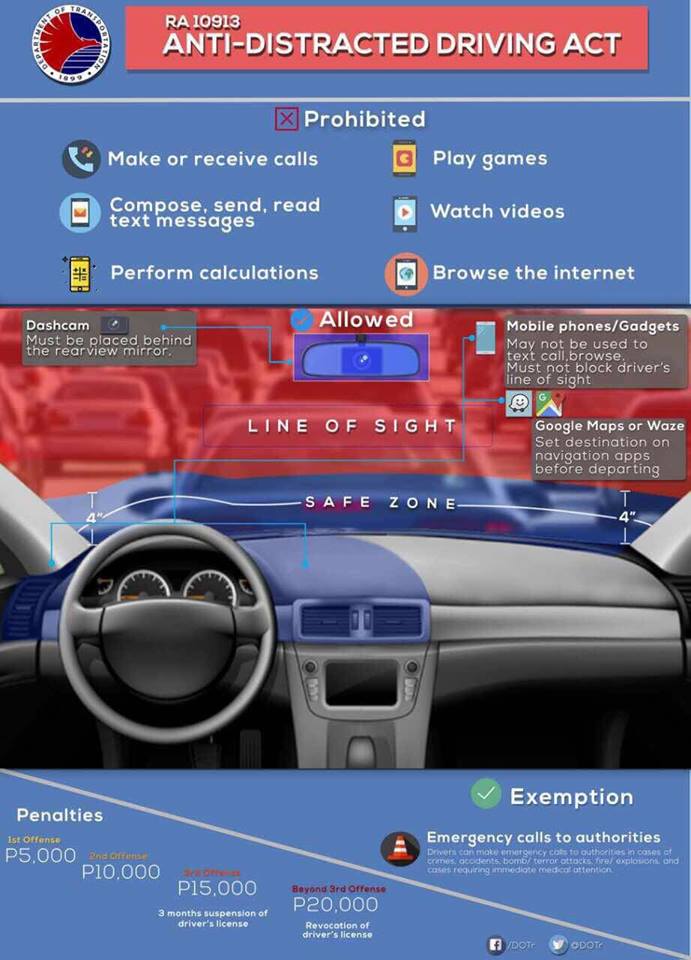
Frankly, I am more concerned about speeding, counter flowing and reckless weaving in traffic. These are equally if not more dangerous than many aspects of the distracted driving law. Quite serious would be the combination of distractions with any of the three behaviors mentioned. More disturbing would be the deliberate (definitely not distracted) or conscious acts of speeding, counter flowing and reckless weaving that are often the cases if one observes the incidence of these three driving behavior. We can only wonder about the likelihood of crashes due to these behaviors.
–
Back to school – concerns about congestion and safety
Many roads again are expected to become more congested as school resumes in most parts of the country especially in cities. But while congestion is usually the top issue along roads near many schools, one concern that usually takes a back seat to congestion is safety. Many public schools in the provinces are located along national highways. Many if not most of their students walk to and from school, usually on the carriageway when the shoulders are too rough, dusty or muddy. This situation for students increase the likelihood of their being hit by vehicles using the road. The risk increases because of their exposure to the dangers posed by motor vehicles. Following are a couple of photos showing typical cases at public schools along national roads. Both are in Antipolo City.
 Typical at-grade pedestrian crossing in front of a school. Students in most public schools often commute by walking or taking public transport like jeepneys or tricycles.
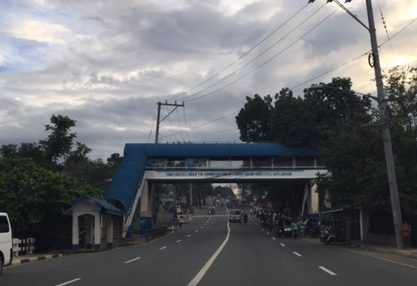 Despite this pedestrian overpass across a public school along Sumulong Highway, most students still prefer to cross on the road rather than go up and down the overpass.
Oftentimes, the seemingly obvious solution of constructing overpasses for safer crossings for students does not pan out as planned or intended. There are many underutilized pedestrian bridges since the natural way is still to cross at-grade. Then there is the issue of providing them safer walking paths or walkways. In both photos above, the sidewalks are only token (“puwede na iyan”) and insufficient for the pedestrian traffic supposed to use them. We need to plan, design and provide such facilities for our pedestrians, especially children, who are marginalized compared to those who have their own vehicles for travel.
–
 Caught (up) in traffic