
Home » Governance (Page 29)
Category Archives: Governance
Article on housing affordability and sprawl
There is a new article from Todd Litman that discusses the state of housing in the context of affordability and sprawl. While this is mainly based on the experiences in the US and Canada, there are many other cities from other countries involved. I noticed an interesting comment on his Facebook post about the elephant in the room being culture. I would tend to agree with this view and in the case of the Philippines is perhaps also heavily influenced by our being under a repressive Spanish regime that was succeeded by an American-style. I say repressive because although there was a semblance of planning during the Spanish period, the urban form revolved around the plaza where church, government, market and schools were located. Social class defined residential ‘development’ also followed this with the wealthier families having homes closer to the center while those in the lower income classes where farther and perhaps even beyond the reach of the sound of church bells. The Americans changed much of that and introduced a larger middle class and the incentive of becoming home and land owners, which during the Spanish period was practically non-existent except perhaps to the buena familias and ilustrados. Fast forward to the present, being a land owner is still very much a status symbol along with being a car owner. Homes in the urban centers (e.g., Makati CBD, Ortigas CBD, BGC, etc.) are very expensive and people would rather reside in the periphery (thus the sprawl) and do their long commutes.
Here is a link to the article:
Unaffordability is a Problem but Sprawl is a Terrible Solution
[Litman, T. (2017) Unaffordability is a problem but sprawl is a terrible solution, Planetizen, Retrieved from http://www.planetizen.com, February 17.]
What do you think?
–
Hazardous worksites along Sumulong Highway
There are hazardous worksites along Sumulong Highway. These are related to current drainage works and construction of pedestrian facilities (sidewalks) along the highway. Travelers can see the steel reinforcing bars (rebars) sticking out and posing risks to road users. Following are some photos we took as we traversed the stretch near La Montana, Palos Verdes and Cavaliers Village.
 Highway drainage works along Sumulong Highway
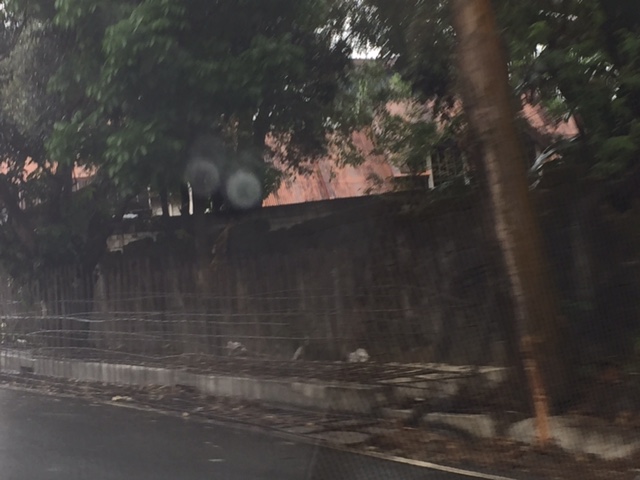 Steel reinforcing bars sticking out of the drainage works along the Masinag-bound side of Sumulong Highway.
 More hazardous worksites
 Unmanned and unfinished worksite along Sumulong Highway. Pedestrians, cyclists and motorcyclists seem unfazed by the hazard posed by the rebars.
These pose dangers to most road users and especially motorcyclists and cyclists who may experience a spill that can lead to riders being impaled by the rebars. The contractor definitely is violating safety codes in as far as construction sites are concerned and these are in plain view of the public. The DPWH as well as the local government of Antipolo City should act immediately and decisively in order to prevent untoward incidents concerning such worksites. There should be measures such as physical barriers that would protect road users against such hazards. There are currently none.
–
Some relief due to the number coding adjustments?
A friend asked me about my commute after the Metropolitan Manila Development Authority (MMDA) had implemented a tweak in the number coding scheme. To those not familiar with the recent adjustments to the Unified Vehicular Volume Reduction Program (UVVRP) or more popularly known as the number coding scheme, the MMDA has recently eliminated the window that was applied to many roads. The 10:00 AM to 3:00 PM window is no more and the MMDA also extended the coding period to 8:00 PM from the old 7:00 PM lifting.
My observation from my personal experience commuting in the mornings between Antipolo and Quezon City is that my travel times have somewhat improved. After Undas, I have enjoyed travel times of 45 minutes to 1 hour during the same morning periods when I choose to travel. This has improved significantly from the 1.5 hours I had spent prior to the adjustment. My usual route was mainly through Marcos Highway so perhaps its not just the coding aspect but also the fact that much of the construction work for the LRT Line 2 Extension have been completed and there have been less obstructions due to this project between Masinag and Santolan. My homebound trips seem to have improved too for the same reasons although not as significant as my morning commute. Another friend has similar observations and is very happy about the big improvements he says he now enjoys considering he has even longer commutes between Antipolo and Manila (Intramuros) or Makati (Gil Puyat).
But generally speaking, is it possible that there are significant positive impacts of the tweak in the number coding scheme? My assessment is that it is very possible and very likely especially if we see it from the perspective of vehicle trip reduction due to the adjustments made in the restraint policy. The number coding scheme is a travel demand management (TDM) measure designed to reduce vehicle traffic through vehicle use restraint. By introducing the coding window many years ago, the restrictions to vehicle travel were in effect relaxed and that encourage more people to use their cars.
The elimination of the coding window means people could not move their times of commute to later than 7:00 AM or earlier than 3:00 PM. It meant people whose vehicles were “coding” had to leave (forced?) early and go home late. Extending the coding period to 8:00 PM probably was probably a back-breaker to many people. And then the difference now compared to the 1990s and decade after that is the availability of the more reliable Uber and Grab vehicles that many car-owners had no option to use before. I’m not a psychologist but perhaps such factors have led to an improvement in traffic conditions. How long this would last shouldn’t be so difficult to tell given the experiences in the past and the fact that population and vehicle ownership continues to rise. Perhaps a year or two if no significant improvements in transport (e.g., mass transit projects) happen.
–
Starting November 14, the MMDA is also supposed to be clamping down (read: stricter implementation) on the motorcycle lane policy along EDSA, C5, Commonwealth and Macapagal Blvd. I’m not so sure how they will be doing this as enforcement along the stretches will require a lot of manpower.
–
Mobilizing sustainable transport for development
The United Nations (UN) has recently published a new report on “Mobilizing sustainable transport for development” authored by a High Level Advisory Group on Sustainable Transport formed by the UN. The report and other resources may be found at the following website:
Secretary General’s High Level Advisory Group on Sustainable Transport
This is under the UN’s Sustainable Development Knowledge Platform. You can check out the other materials at the website. The UN has many initiatives on sustainable transport and has been very active in promoting or advocating for sustainable transport for a long time now. It is through the UN Centre for Regional Development (UNCRD), for example, that the Philippines and other ASEAN countries were able to formulate their national EST strategies. The new report continues on the UN’s commitment to promote sustainable transport to improve people’s lives around the world.
–
Global Street Design Guide
Here’s another quick post. I just wanted to share this article with a link to a Global Street Design Guide that was developed by the National Association of City Transport Officials (NACTO) in the United States (US). It’s a nice guide that’s based on the experiences of many cities in the US including transformations that have made commuting more efficient, enhanced mobility and, most important of all, improved safety. Following is the link to a more direct link to the guide:
NACTO and the Global Designing Cities Initiative Release Global Street Design Guide
This will be a good reference in the Philippines where many cities are in need of transformation to address current and future challenges in transportation. Planners, engineers and students should read this and use it to make our streets safer and more efficient in terms of mobility for all. It would be nice to see fresh ideas on how we can improve our streets not just in Metro Manila but elsewhere across the country. Of course, it would be nice if city planners of local government units (LGUs) can adopt this design guide parallel with efforts to improve public transport services. It should be understood that simply imposing lane allocations and traffic flow policies (one way?), for example, will not solve problems but may create more. The approach should always be integrated, inclusive. In other words, complete.
–
Metro Manila public transport – addition is good but we need subtraction, too
The company providing the P2P bus services is very enthusiastic (aggressive?) in promoting their services especially via social media. Satisfied commuters have also shared their experiences and a lot of photos about the buses and their commutes through social and mainstream media. I have read some articles carried by the likes of Rappler and Inquirer as well as blogs relating about the buses features, what people liked about the service and their suggestions on how to further improve and expand services. These have provided commuters with a taste of how good public transport could be in terms of quality of service.
The operations and the operator seems to have the blessings of the Department of Transportation (DoTr) and not just the present administration but from the previous one when the P2P services started. The fact that they have expanded services further these past few months is a testament to their popularity and the demand for high quality public transport services in Metro Manila. I personally believe that the next step is to give these buses exclusive lanes along their routes. Such would allow for buses to travel faster and providing a significant decrease in the travel times of commuters. Current operations, despite having non-stop runs between origin and destination, run in mixed traffic so their impacts in terms of travel times are diminished. Also, with exclusive lanes, they can probably consider adding a few stops between the route ends and be able to simulate bus rapid transit (BRT) services of which there seems to be little appreciation so far in the Philippines.
While the new buses and routes are very welcome and provide attractive options for commuting, there is still a need to address what is perceived as an over-supply of buses, jeepneys and UV express vehicles in Metro Manila. The attractiveness and higher service quality of P2P buses can pave the way for reducing the numbers of buses, for example, along EDSA. A similar strategy of introducing high quality bus services along other corridors and then reducing bus, jeepney and UV express units there can be implemented but will require much in terms of political will. The latter is important when dealing with operators and drivers of displaced vehicles, who may oppose such transport reforms and probably throw in legal impediments including those pertaining to franchising. Whether such opposition can be addressed by emergency powers or not remains to be seen but hopefully, even without such powers, the government can engage the transport sector to effect reforms and improve public transport (and ultimately commuting in general) not just in Metro Manila but in other cities as well.
–
Mainstreaming e-trikes?
The big news on electric vehicles in the Philippines today is about what the City of Manila has announced as a phaseout of tricycles and pedicabs (i.e., motorized and non-motorized three-wheelers):
Manila will say goodbye to old school tricycles and pedicabs on October 15
According to the article, these will include conventional tricycles, kuligligs (bicycles fitted out with motors or generators + sidecar), and pedicabs. Manila has thousands (about 25,000 according to the article) of these plying roads where they are not supposed to be (tricycles and pedicabs are prohibited by law from traveling along national roads especially as public transportation). From the article, it seems to me that the date mentioned will be the start for a pilot in the Binondo area. No details are given as to how exactly the local government of Manila will be going about replacing 25,000 tricycles, kuligligs and pedicabs with 10,000 e-trikes, including how the e-trikes will be financed and what will happen to the phased out tricycles and pedicabs. We are, however, hopeful that Manila will be successful and perhaps be a model for other LGUs to emulate.
–
Is Antipolo ripe for high capacity and premium transit services?
About 5 years ago, I wrote about transport in Antipolo in another blog. The article was more about this old city being a major destination attracting people for pilgrimage (Shrine of Our Lady of Peace and Good Voyage) and tourism (e.g., Hinulugang Taktak). I am quoting from that article from 5 years ago and adding a few comments here and there. Note that for most of the article, nothing much has changed except perhaps that the Line 2 extension from Santolan to Masinag is now underway.
“There are now many ways from Metro Manila and its neighboring provinces to Antipolo, although several of these eventually merge into three main roads en route to the Shrine. One is via the old route along Ortigas Avenue, a second is the route via Sumulong Highway, and the third is through a “back door” via the Antipolo-Teresa Road. Routes from the general areas of Manila, Makati, Pasig, Mandaluyong, Taguig and the southern cities of Metro Manila and towns from Laguna, Batangas and Cavite will most likely merge to Ortigas Avenue. Meanwhile, people coming from Quezon City, Caloocan, Marikina, Bulacan, Pampanga and the northern Rizal towns of San Mateo and Rodriguez (Montalban) will likely converge along Sumulong Highway. Meanwhile, those coming from the east including the Rizal towns like Tanay, Teresa, Morong, and Jala-jala, the Laguna towns like Paete, Pakil, Pangil, the Quezon towns of Luisiana, Lucban, Infanta and General Nakar, and others will most likely take the Antipolo-Teresa Road that climbs from the east of Antipolo. People from Marikina, Cainta and Pasig generally may take either the Ortigas or the Marcos Highway/Sumulong Highway route.”
I didn’t mention there that another backdoor was via Marcos Highway if one were coming directly from Tanay instead of through Teresa. This route is now popular and traffic has been steadily increasing due in part to some additional attractions in that part of Antipolo and Tanay.
“Public transport to Antipolo these days include mostly jeepneys as the city is the end point of many routes – a testament to its importance even as a reference point for public transportation. One can easily spot the Antipolo-Cubao jeepneys in the Araneta Center in the Cubao business district in Quezon City. There are two lines, one via Cainta Junction (where jeepneys eventually turn to Ortigas Avenue) and another via Marcos Highway, turning at the Masinag Junction towards Sumulong Highway). Another terminal is at the EDSA Central near the Ortigas Center in Mandaluyong where Antipolo-Crossing jeepneys are queued. And still there is another, albeit somewhat informal terminal near Jose Rizal University (JRU, which was formerly a college and hence the old JRC endpoint), which passes through Shaw Boulevard, Meralco Avenue and eventually turns towards Ortigas Avenue. Other jeepneys from the Rizal towns all have routes ending in Antipolo Simbahan, referring to the shrine.”
There are also UV Express and shuttle vans (legitimate vans for hire or colorum operations) offering express trips between Antipolo and the same end points of Cubao or Crossing. Others go all the way to Makati in the Ayala financial district. These evolved out of the Tamaraw FX taxis that started charging fixed fares during the 1990’s and competed directly with the jeepneys. These are popular, however, with office employees and students during weekdays and the nature of their ownership and operations do make them serious competitors to the jeepneys even during the merry month of May (fiesta period) and the Lenten Holy Week.
“There was an Antipolo Bus Line before. These were the red buses that plied routes between Antipolo and Divisoria in Manila. These died out sometime between the late 80’s and the early 90’s probably due to decreasing profitability and likely because of its competition with the jeepneys. That bus company, along with the green-colored G-Liners, the red EMBCs (Eastern Metropolitan Bus Co.) and CERTs, and the blue Metro Manila Transit Corp. buses used to form a formidable mass transport system for Rizal and the eastern towns of Metro Manila. There were even mini-buses (one I recall were the Antipolo “baby” buses and those that plied routes betwen Binangonan and Recto with the cassette tapes stacked along the bus dashboard). Most of these, except the G-Liners eventually succumbed to the jeepneys.”
At present, there is another bus company operating along Ortigas Ave and the Manila East Road – RRCG. There is also a revival of the EMBC with buses providing transport services between Quiapo and Tanay. The only other bus is the inter-provincial Raymond Transit, which operates between Crossing, Mandaluyong and Infanta, Quezon via Antipolo, Teresa, Morong and Tanay.
“In the future, perhaps the jeepneys should give way to buses as the latter will provide a higher level and quality of service along Ortigas Avenue and Marcos and Sumulong Highways. Already in the drawing boards is a plan to ultimately extend LRT Line 2, which currently terminates at Santolan, Pasig, to Masinag Junction and then have a branch climb along Sumulong Highway and terminate near the shrine. This will bring back the trains to Antipolo and would surely make the church and the city very accessible to people. I look forward to these developments both in my capacity as a transportation researcher-engineer and a Catholic who also visits the Shrine to pray for safe travel for loved ones and myself.”
This proposition for rationalizing public transport to/from Antipolo and other towns of Rizal plus Marikina is all the more important as the Line 2 extension from Santolan, Pasig to Masinag, Antipolo is currently underway. There is an opportunity here to upgrade public transport following the hierarchy of transport modes. I have noticed, for example, electric and conventional tricycles providing what are basically feeder services but along Marcos Highway between Cogeo and Masinag. And a lot of people have been stranded or have difficulty getting a jeepney or UV express ride along the Marcos Highway corridor. I am aware that the DOTC in the previous administration was mulling an express bus service through Marcos and Sumulong Highways terminating and turning around at Robinsons Place Antipolo. That, of course, never happened but is something that I think is worthwhile and would be beneficial to a lot of commuters.
–
Motorcycle lanes along Sumulong Highway?
I noticed something along my commute and that is the newly marked pavement along Sumulong Highway at the section in Barangay Mambugan until Barangay Mayamot at Masinag Junction. I guess this is more likely part of Antipolo City’s initiative in managing motorcycle and tricycle traffic. In a meeting with the City Administrator, Robert Nacianceno, last year, he said that the city was moving towards improving road safety. That included addressing concerns about tricycle and motorcycle operations that has led to crashes and congestion. Motorcycle lanes designated by blue pavement markings are not new and likely was inspired by the MMDA’s initiatives along major roads in Metro Manila.
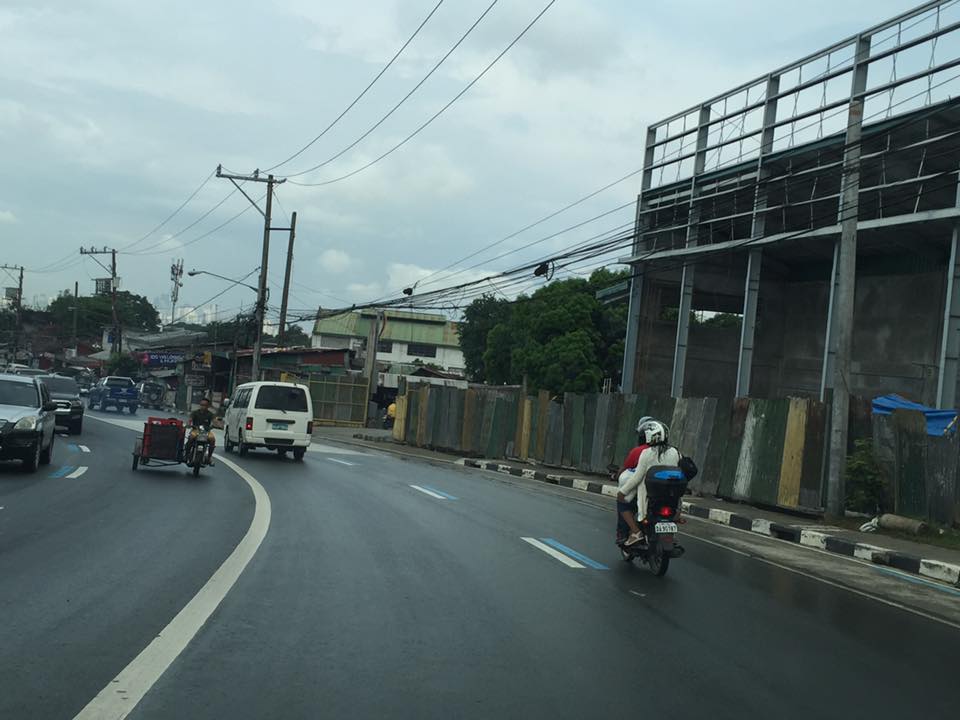 Motorcycle running along the designated lane
 The blue markings are present along both sides of Sumulong Highway
The real challenge with these motorcycle lanes would be on the enforcement. That is, how would the city be ‘encouraging’ motorcyclists and tricycle drivers to stick to the outer lanes of the highway. Such would require a tremendous effort for the city as they will definitely have to apprehend erring motorists and also clear the designated lanes of obstructions. Should this program be successful along Sumulong Highway, perhaps they should consider the same for Marcos Highway.
–
Emergency powers to solve PH transport problems? – A long list of projects
I am sharing the long list of projects submitted by the Department of Transportation (DoTr) to the Senate Committee on Public Services chaired by Sen. Grace Poe. This is a public document and I think should be circulated for transparency and so people will know what projects are proposed to be covered
List of sectoral projects that the Department of Transportation intends to implement and draft bill for emergency powers: dotr-list-of-projects-and-draft-bill
I leave it up to my readers to determine which among the projects listed really require emergency powers. Many I think do not require emergency powers especially since the period requested for such powers is 2 years and not the duration of the current administration’s term. Perhaps those requiring emergency powers would be programs and projects aiming to overhaul our public transport system, which is currently much dependent on road-based modes. Public transportation services do not follow the suitable hierarchy as seen along major corridors served by low capacity modes. An overhaul (i.e., rationalisation) will touch the very sensitive nerves of bus, jeepney, UV express and tricycle operators and drivers and could trigger an avalanche of TROs to prevent or discourage government from doing what should have been done decades ago to bring order to our chaotic transport. I believe emergency powers coupled with the current admin’s political capital (and the “action man” image of Pres. Duterte) can help bring about genuine reform (and change!) to transport in our cities.
–
 Caught (up) in traffic