
Home » Governance (Page 35)
Category Archives: Governance
Transport wish list for 2015
Last year, I opened with a very hopeful post on opportunities with certain mass transit projects that were hyped to be starting construction in 2014. The year 2014 went by and practically nothing really concrete happened (Yes, there were soil tests conducted for the LRT 2 extension but after that nothing else happened with the project.) with respect to these very critical mass transit projects that were already much delayed. It’s the same thing again this year so that same blog post from Jan. 1, 2014 applies this year.
I will not write down a list of New Year’s resolutions for the transport-related government agencies to adopt this 2015 though that stuff is quite tempting to do. Instead, I will just rattle of a wish list that includes very general and very specific programs and projects I would like to see realized or implemented (e.g., start construction) within the year; preferably from the first quarter and not the last. For brevity, I came up only with a list of 10 items. It is not necessarily a Top Ten list as it was difficult for me to rank these projects.
1. LRT Line 2 Extension from Santolan to Masinag
2. LRT Line 1 Extension to Cavite
3. MRT Line 7 from Quezon City to San Jose del Monte, Bulacan
4. Cebu BRT
5. People-friendly road designs
6. Integrated fare collection system for Metro Manila trains
7. Bikeways in major cities
8. Any mass transit project for Davao City or any other major city outside of Metro Manila or Cebu
9. Northrail or whatever it is that will connect Metro Manila with Clark
10. Protection of heritage homes and sites along highways and streets
The reader is free to agree or disagree with the list or to add to the list. I’m sure there are a lot of other projects out there that are also quite urgent that are not on my list but are likely to be equally important.
–
Some questions on a gloomy Saturday morning
On gloomy Saturdays like today, I often tend to sort of contemplate on some questions coming from events and articles the past few days. I don’t really want to answer these questions right now and immediately but would rather let these and the follow-ups play around in my mind. I would rather not do some shout outs on social media about these questions as some friends tend to be sensitive and I don’t really want to make a lot of effort carefully framing posts on FB just so they won’t appear to be offending certain persons who might be over-zealous about their advocacies or who would be so defensive of their organizations. Here are some questions running around in my brain right now:
1. Does DENR have the mandate to require sidewalks and bikeways along all roads? Design and implementation-wise, isn’t this supposed to be under the DPWH (for national roads) and the LGUs (for local roads)? Is this more a policy statement? But then shouldn’t this come from DOTC?
2. Is going out of your way really the way to get noticed and be awarded? Are there no points for people doing a great job at what they are supposed to be doing?
3. Shouldn’t an agency first check if they are doing what they are supposed to do and the outcomes reflect their objectives? Are emissions testings and monitoring successful or do we still have a lot of smoke-belchers on our roads? If they already have their hands full with their tasks according to their mandate, shouldn’t they first mind their business before even encroaching into another agency’s tasks?
4. Does media have to give so much airtime to a driver of a luxury vehicle who assaulted a traffic enforcer?
5. Why does it seem to be so much fuzz about Uber? Is it just on social media? Do most other commuters give a damn about it when they really can’t afford availing such services?
6. Are government engineers bereft of an appreciation for the arts, culture and heritage? Are they too mechanical or dumb to understand what planning and design really is all about?
–
To regulate or not to regulate: Uber vs taxis
To regulate or not to regulate. That seems to be the issue here in the case of Uber. One respected former top government official, offered his opinion on the matter through his newspaper column where he mentions a “regulatory overreach” by the Land Transport Franchising and Regulatory Board (LTFRB). Perhaps the agency did not exert all efforts or go the extra mile to assess the situation regarding Uber? Perhaps the agency acted in favor of taxi operators who have complained about Uber services? The information available states the affirmative. The LTFRB itself confirmed that it acted on the complaint filed by a group of taxi operators but they memo alone is unclear of how the board ended up with their decision. Maybe they did not really have a more exhaustive deliberation, looking at the Uber case from other (more progressive) perspectives.
One lawyer friend of ours gave an opinion that Uber should not be treated as a regular taxi whose services are available to everyone and therefore requires a franchise being a public utility. Rather, Uber can be seen instead as an exclusive club with members providing and/or availing of services. Membership in the club is not automatic but has to go through an application process with certain criteria to be satisfied by applicants just like any other exclusive organizations. In Uber’s case, the application process as well as the means to avail of services are facilitated by an app, a software available now through smartphones or tablets. Being an exclusive club, it can also charge for services rendered and fees can be agreed upon by members just like what is done in other clubs. This is an acceptable interpretation of how Uber can be seen though it still does not address liability issues in case a vehicle and its occupants are involved in a crash. However, this last concern is precisely what the LTFRB should be discussing with Uber and perhaps insisting for the service to address immediately. This would be the more progressive and proactive approach in handling this case.
I agree that there is a need to review many of our laws, not just on transport, in order to address the many changes that has happened over the years and especially in light of the rapid developments enabled by technological advances and innovations. Many years ago, we have worked with the DOTC to come up with an initiative to review road transport laws and regulations in order to determine, for example, which are outdated and which are conflicting with others. Unfortunately, this initiative seems to have evaporated with the change in the administrations of involved transport agencies back in 2010. So far, what we have read and heard are calls for reviewing laws and regulations specifically related to public utility vehicles in relation to taxis and consequently, Uber.
Meanwhile, taxi services in the country and especially in Metro Manila continue to be found wanting in terms of quality of service. Many continue to be shunned or turned down by taxi cab drivers who tend to be selective of their passengers’ destinations. The most common reason for this is perceived (or imagined) traffic congestion along streets leading to the destination. Then there are the more serious cases of swindling, holdups, abductions, and even murder. Modus operandi include taxi drivers collaborating with criminals to rob or kidnap passengers. News and social media are full of these horror stories that make one think twice about riding a cab, especially at night. Of course, not all taxi services are like this and there are examples of good taxi services in Metro Manila and other cities. On top of my very short list is a certain taxi company that’s popular in Iloilo City, Light of Glory. However, these examples are not enough to convince many that they should not have a more comfortable, more secure and perhaps safer option for transport, which is what Uber is claiming it provides. Ultimately, though, public transport services in Metro Manila and elsewhere in the country need to be improved and fast in the interest of most people who take public transportation everyday. That way, many people won’t really need to avail of other, more exclusive services, for their transport needs.
–
Let’s revisit the Marikina Bikeways
Calls for more walkable and bicycle-friendly cities and a lack of local data for these modes of transport got me thinking about Marikina. The city has its own bikeways office, the Marikina City Bikeways Office (MCBO), that was under City Planning and Development Office but borrowed staff from other offices of the city. The MCBO has gone through many challenges since the time of Bayani Fernando, who instituted the office, and his wife Ma. Lourdes under whose terms the office was downgraded. I’ve learned that the office has been strengthened recently and is implementing a few programs to promote cycling especially among school children. I wonder, though, if Marikina has been collecting and keeping tabs on cycling related data. I recall that during the conduct of the study for the Marikina bikeways network, it was established that there was a dearth of data on cycling and data collected pointed to cyclists primarily comprised of workers in factories or construction sites in the city and neighbouring areas. These are the regular commuters using bicycles instead of motorised vehicles. It would be nice to see if these increased in numbers (observations along major roads like Sumulong Highway seems to support the increase) and if there have also been shifts to motorcycles as the latter became more affordable in recent years. Enforcement is still an issue with regards to the bikeways as not all paths are segregated. As such, those lanes painted on the roads are more susceptible to encroachment by motorised vehicles. Still, Marikina is a very good example of realising people-friendly infrastructure and many LGUs could learn from the city’s experiences with the bikeways.
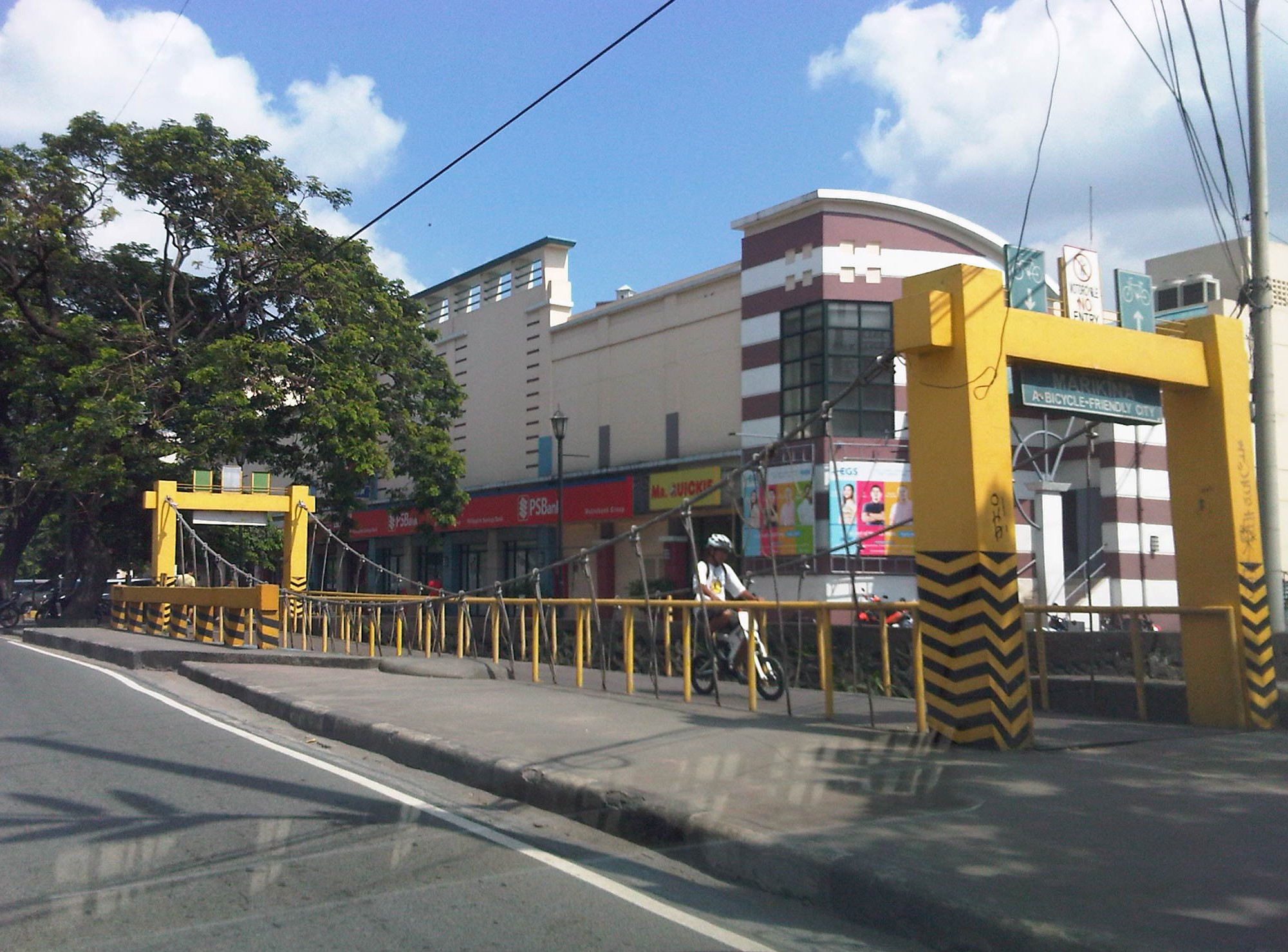 A bicycle bridge along Sumulong Highway in Marikina City
Recently, some students consulted about designing bikeways in other cities as well as in a bike sharing program being planned for the University of the Philippines Diliman campus. These are good indicators of the interest in cycling that includes what discussions on the design of cycling facilities and programs intended to promote bicycle use especially among young people. We strongly recommended for them to check out Marikina to see the variety of treatments for bikeways as well as the examples for ordinances that support and promote cycling.
–
The return of traffic signals at Katipunan
It’s been more than a decade since the MMDA implemented what was formally called the Grand Rotunda Scheme. To most, it will always be the U-turn scheme that was implemented all around Metro Manila. After seeing what seemed like success along roads like Commonwealth and Quezon Avenue, it was concluded that the U-turns were the answer to Metro Manila’s traffic woes or at least the part that’s blamed on signalized intersections. The perception by many at the time was that traffic signals were not working and caused so much congestion as evidenced by the long queues at intersections. This is not entirely false as intersections with in-optimal settings would definitely bring about congestion especially along corridors or networks where signals are not coordinated. It was, however, a generalization at a large scale and led to more experiments of opening and closing slots in order to determine which would be the most effective combinations. These experiments and their outcomes include drivers becoming more aggressive in order to maneuver ahead of others at the U-turn slots. Weaving has become the norm and in many cases have increased the risk of road crashes.
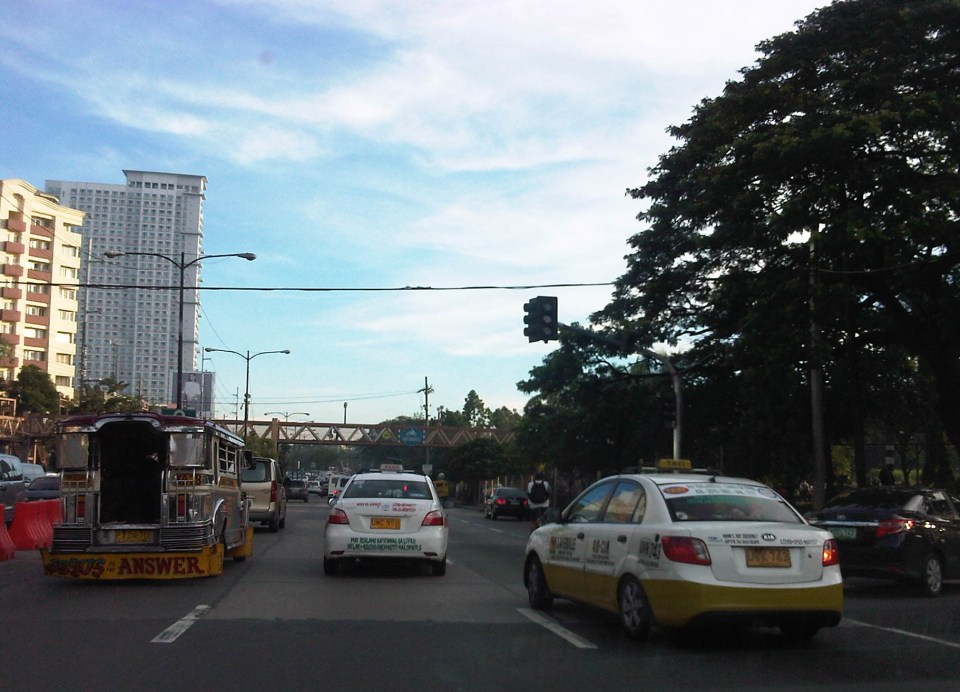 Traffic signals have been installed and the section of the median island has been removed across Ateneo’s Gate 3. This will become a three-leg intersections once again but I hope the signals will not favor Ateneo over through traffic along C5.
 Traffic lights are already installed along the southbound side of Katipunan at the approach to the junction with Miriam College’s Main Gate. This will be a four-leg intersection as across Miriam is B. Gonzales Street that connects to Esteban Abada.
The signals are supposed to be operational starting September 13, which is a Saturday. Perhaps this is to try it out first during that weekend and for the MMDA to do some tweaks before the real deal that is traffic on Monday. But then how can you simulate traffic generated by the two schools in the area except maybe if there is significant enough traffic on Saturday? Did the MMDA or its consultants do some simulation using their computers and the VISSIM software they acquired many years ago? Or will we see more of the experiments as signals are fine-tuned according to the conditions along Katipunan?
We are hopeful that the signals along Katipunan will help improve the traffic along this very busy corridor. The results for sections of C5 from Libis (QC) to Ugong (Pasig) are promising and many people I know have told me that traffic has improved. Of course, this may also be partly due to the one-lane policy the MMDA has implemented for trucks. It’s never just one scheme or measure that will work wonders for Metro Manila traffic. It will always be a combination that will alleviate traffic woes in the metropolis. We’ll soon know what will become of traffic along Katipunan. We should, however, temper expectations at least for the 6:30 – 7:30 AM period during weekdays when traffic peaks in the vicinity of Ateneo and Miriam. The sheer volume of vehicles generated by the schools will overwhelm any system that is put up in the area. Nevertheless, for the rest of the day at least traffic flow should improve when signals are operational once again for Katipunan.
–
EDSA: Taft to Tramo
The EDSA-Taft Ave. intersection was in the news a few weeks ago due to the MRT3 train that derailed and overshot the end of the line along EDSA. Being a major intersection for roads as well as for rail (MRT3 and LRT1), it is a very crowded area. Nearby, too, is the Redemptorist church in Baclaran that attracts a lot of people especially during Wednesdays. Following are a few photos of the area showing the conditions on the pedestrian overpasses and at street level.
 The pedestrian overpass at EDSA-Taft is also a mall of sorts given the merchandise being sold at informal shops at the overpass.
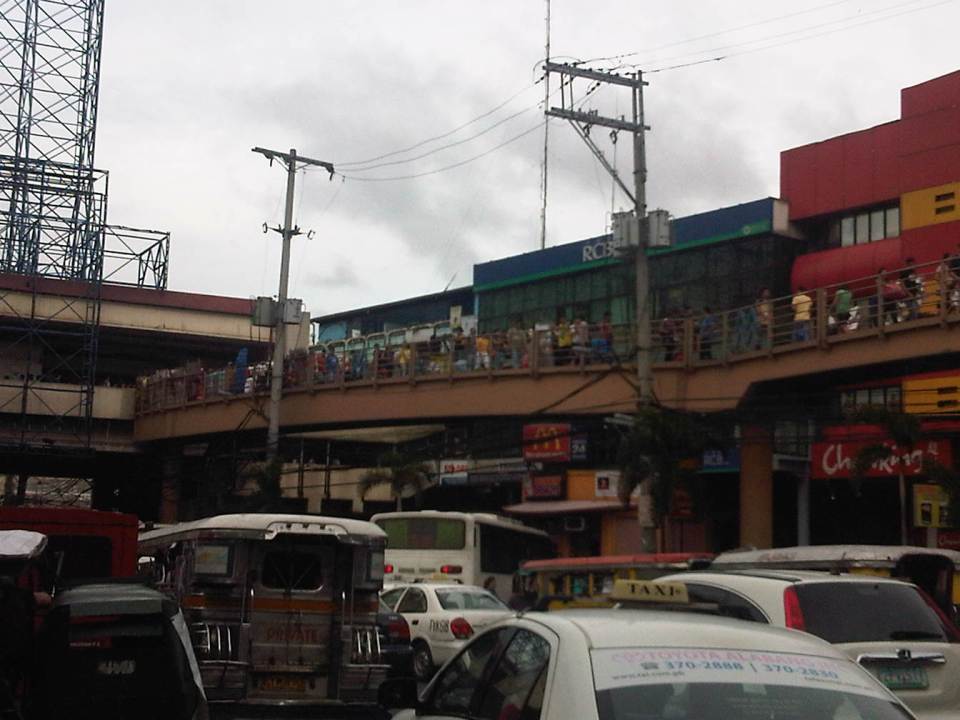 The overpass connects to the EDSA-MRT 3 Taft Ave. Station. This is the MRT 3’s end station and the overpass system connects the MRT 3 Taft Ave. Station with the LRT Line 1 EDSA Station. The connection was not and is still not a smooth one, which has been the subject of criticism from a lot of people.
 The overpass allows people to walk around this large intersection
 Pedicabs freely travel along this stretch of EDSA between Taft and Tramo on lanes designated for public utility buses and clearly violating regulations regarding what vehicles are allowed on EDSA. You can also see in the photo a cart full of merchandise being pushed along the curbside lane.
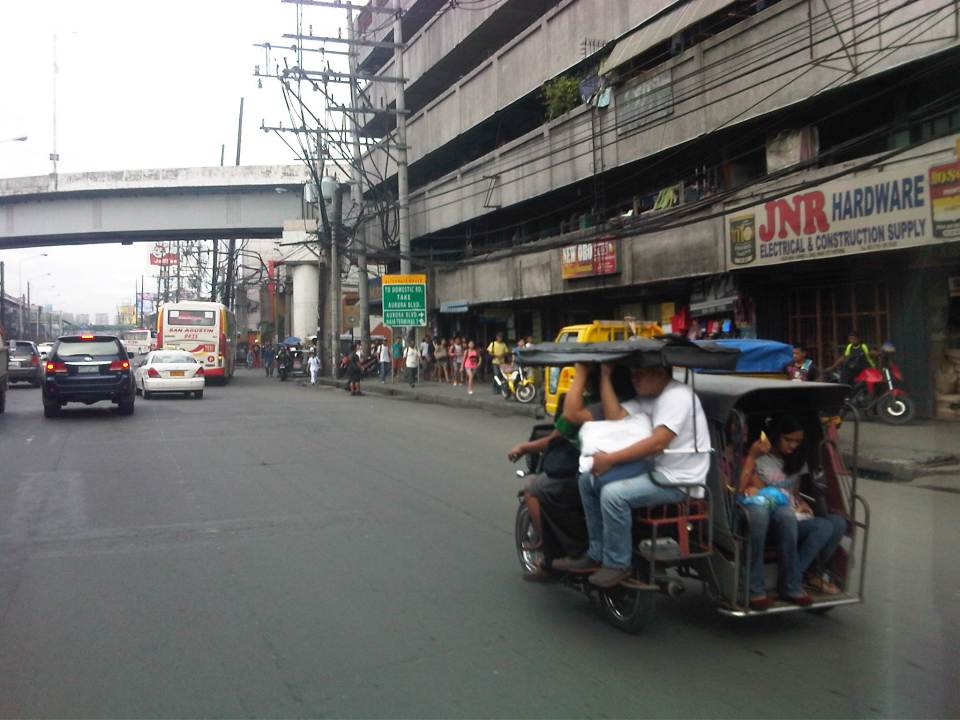 A motor tricycle ferrying passengers along EDSA just before Tramo (that’s the street above which is an overpass from EDSA southbound).
–
On logistics in the Philippines
I am not a logistics expert and will not pretend to be one. I have, however, been involved in several projects that included logistics as a major study component. These include a nationwide study on inter-regional passenger and freight flow and another for freight forwarders affected by vehicle restraint policies in Metro Manila. A more recent engagement has allowed me to take a look at logistics in the country from other perspectives including that of national agencies seeking to improve goods movement in the country and development agencies that have committed to help the country to do just that. There are local issues and there are regional ones. The regional ones often involve the need for infrastructure such as maritime ports and airports, highways and bridges, and other facilities such as those for storage and refrigeration.
For an archipelago like the Philippines, logistics is a bit more challenging than in countries whose territories are not separated by bodies of water. There is no lack for good practices though as there are other archipelagos that could provide good examples for connecting the islands such as Japan and the United Kingdom. Nearby, we share similar challenges with Indonesia and to a certain extent Malaysia. Of course, availability of resources is always an issue and particularly for the prioritization of infrastructure to be constructed aside from those that need to be maintained. The DOTC along with its attached agencies like the Philippine Ports Authority (PPA) and the Civil Aviation Authority of the Philippines (CAAP) are in the frontline when it comes to airports and ports planning, development, and maintenance are concerned. However, the DPWH plays a vital role for highways and bridges and the connections for these ports and airports including what is termed as “last-mile” connectivity that is often passed on as a responsibility of local governments. This is likely due to local roads often providing the connection between national roads (under the DPWH) and ports and airports. It is a good thing that the current DPWH has committed to a convergence program regarding national and local roads that has benefited a lot of sectors and industries like tourism and agriculture.
Rail transport is not mentioned here because there is practically none even for what remains of the once relatively extensive PNR main lines. The local issues are not simpler and can be a bit more complicated than the regional ones. The complications are usually due to more petty circumstances that may involve politics and local power plays. The basic ingredients though are related to traffic congestion and the damage to roads and bridges attributed to trucks.
Many cities and municipalities have implemented truck bans along their major roads. These are usually one or two routes in the smaller cities and towns, usually passing through the “bayan,” “poblacion” or central business district (CBD). These roads are usually national roads (e.g., McArthur Highway and the Pan Philippine Highway pass through many towns). As such, there are cases where bypass roads are constructed to alleviate congestion along these roads as well as to try to preserve the pavements in the town proper. Such traffic schemes targeting heavy vehicles are not new and are also a way to address the issue on overloading that is common in trucking in the Philippines. The bypass roads, however, generally invite development and unplanned development have often made these alternate routes more congested than the original ones.
Manila did a “power play” recently by implementing a more aggressive truck ban. This led to more severe congestion around the Port of Manila and a lot of delays that have cost a lot of money in part due to the limited alternative routes in the city and most roads are already constricted. The costs have repercussions on the economy in general as the movement of goods are affected by the impasse in Manila. Whether this was for more political or practical reasons is difficult to say because the mayor and vice mayor have invoked the very common issues of traffic congestion, road safety and pavement maintenance that got the attention, sentiment and agreement of a lot of people. Many of these people though do not understand the impacts of inefficient goods movement and likely are concerned only about passenger transportation.
More recently, a lot of containers were shipped from the Port of Manila to Subic. These are supposedly “overstaying” shipments or those that have not been claimed for a long time or have some issues regarding their release. This should ease congestion somehow but there remain the problems of shipping or logistics companies regarding freight transport in general that needs to be addressed. Both Subic and Batangas ports have been mentioned in many formal studies over the past few years including a more recent one supported by JICA. Still, there is a lot of hesitation if not confusion or uncertainty on how to go about with shifting goods movement to these ports, which are regarded to be underutilized. There are good roads connecting these ports with cities and towns but these might not be enough in the long run.
Perhaps there is a need to reconsider regional rail transport again especially for the islands of Luzon and Mindanao where long distance rail may have a tremendous impact for transporting goods over long distances. Of course, there are also issues pertaining to other ports and airports in the country including those in Mindanao (e.g., Davao, Cagayan de Oro, Phividec, Gen. Santos, etc.) and Visayas (e.g., Cebu, Iloilo, Tacloban, etc.). The RORO ports are among those that need attention as they are directly involve road transport aside from the ferries that carry them over the waters. These nautical highways are vital for goods movement around the country and require both national agencies and local governments cooperating for these facilities and services to function efficiently.
–
Sound opinions on transport and traffic
One of my favorite reads is the column by former NEDA Director General Cielito Habito on the Philippine Daily Inquirer (Inquirer.net). Regardless of whether he is writing about transport or any other topic, his articles are consistently clear and logical. Here are a couple of articles from his column “No Free Lunch” about the more recent transport and traffic issues.
Traffic dilemmas – which appeared August 12, 2014
More railways in our future – which appeared August 19, 2014
I’m not sure if those in-charge or responsible for planning and building our transportation system read his columns. They will learn a lot from these articles especially as the former NEDA DG is practically sharing his experience and wisdom – things badly needed these days especially at the DOTC.
–
Proof of concept
I recall a quote from the cold war era when Nikita Kruschev was supposed to have asked “how many divisions did the Pope had under his command?” This was basically a challenge to the Pope after the latter made some statements regarding the Soviet Union and its military action in Eastern Europe and elsewhere. A similar challenge could be made, albeit vastly reworded, for many advocates of various transport programs and projects to prove they had the numbers or the proof to support their calls for certain projects or programs to be implemented. Often, the proof comes in the form of examples or demonstrations of their proposals. Simplest perhaps would be to present examples of best or good practices in other countries (e.g., bicycle paths in Europe, transit in Singapore, walkways in Japan, etc.).
One that is still fresh in my mind is what has been said to be the “challenge” of Malacanan to the DOTC to present a “proof of concept” for BRT as a pre-requisite of the proposed project in Cebu to be approved. This “challenge” boggled the minds of many experts and advocates of public transportation as BRT is well established around the world and there are many cities with BRT systems worth emulating (To be accurate, there have also been failures but these were mainly due to compromises made that led to the systems not adhering to essential BRT requirements.). What’s stranger was the response from DOTC to do a demonstration via an experiment at Bonifacio Global City to simulate BRT operations. Obviously, this experiment could not be a really good approximation of BRT (something along Commonwealth would have been more suitable) given the conditions at the Fort.
With the recent approval of the Cebu BRT project, we now look forward to its construction and operation. I am aware of how much work was put into the non-technical aspects of this project (i.e., social and institutional) and so a lot of eyes will be on changes to Cebu City’s transport system once the BRT becomes operational and the expected rationalisation of the existing public transport routes and vehicles would take place. There will definitely be a transition period and it is not known how long this will be or how much opposition the change will encounter. Doing workshops and consultations, and getting commitments here and there is one thing. Having the BRT operational and actually affecting the operations (and revenues) of conventional road transport is another matter.
Many cities will look to Cebu’s experience and probably emulate it should the BRT be a success. Metro Manila is too complicated for other cities to identify with unlike Cebu, which likely has similar transport and traffic issues to cities like, for example, Iloilo, Bacolod, Cagayan De Oro or Legazpi. Of course, there will be exceptions and unique problems for each but density-wise, Cebu compares well with more cities in the country than Metro Manila. Here’s hoping that the BRT would finally have its true and actual “proof of concept” in Cebu and that this can demonstrate the benefits of such a system to other Philippine cities along with a necessary rationalisation of existing public transport modes.
–
Required reading on sprawl, transit and the poor
A friend recently posted an article on Facebook that I thought should be required reading for urban and transport planners in the Philippines whether they be with government or the private sector. There is a strong link between land use and transport, we need to be able to understand the complexities and subtleties in order to maximize the benefits to society. It is not a coincidence that the article specifically mentions the poor as it discusses opportunities lost due to flaws or inefficiencies in land use and transport. The article is found in the following link:
Suburban sprawl and bad transit can crush opportunity for the poor
I hope that this will be read and understood by officials at DOTC, LTFRB, LRTA and PNR, as well as those of the Housing and Urban Development Coordinating Council (HUDCC) and the Housing and Land Use Regulatory Board (HLURB). These agencies are responsible for planning and regulating transport and housing in the country. Of course, it is also important for local government units to be able to understand these challenges especially since they will be in the forefront of addressing issues on sprawl and the provision of suitable transport systems. Here’s a related article that I posted earlier this year on New Year’s Day:
Opportunities with the MRT-7 and LRT-1 Extension
–
 Caught (up) in traffic