
Home » Governance (Page 36)
Category Archives: Governance
What’s causing traffic congestion along Katipunan?
An article came out today on a popular online news site stating that the Metropolitan Manila Development Authority (MMDA) blames the Land Transportation Franchising and Regulatory Board (LTFRB) for the severe traffic congestion that is experienced daily along Katipunan Avenue (part of Circumferential Road 5). The article may be found in the following link:
MMDA: LTFRB to blame for Katipunan traffic
Reading the article, I would like to think that the MMDA likely misunderstood the advisory from the LTFRB extending the “non-apprehension policy” for trucks that have not renewed their franchises. This policy is not the same as the truck ban scheme being implemented in Metro Manila by the MMDA and LGUs. The trucks using Katipunan Avenue during the prescribed period that they are allowed travel along this and other roads are not violating any laws or regulations. Meanwhile, the increase in the volume of trucks can only be attributed to an increasing demand for goods that translate into freight movement. There are very limited alternatives to Katipunan Ave., which is a truck route (note: most of EDSA is not a truck route), and there are few wide roads that can accommodate the volume of trucks carried by C5.
I use Katipunan everyday as it is the main road between my home and my office. I can say that traffic has worsened along this stretch of C5 and one can always see the long queue of vehicles caught in traffic along the northbound side of Katipunan especially from the afternoon to night periods. There are many causes of traffic congestion along Katipunan Ave. and during times when trucks are banned from traveling, it is still congested due to the sheer number of private vehicles using the road. C5, after all, is a major road connecting Quezon City with Pasig, Makati and Taguig, which host major CBDs (Ortigas, Makati and Bonifacio Global City).
In the mornings, much private vehicle traffic is generated by the exclusive schools along Katipunan and the northbound side of the road is usually congested from C.P. Garcia all the way to Blue Ridge. Meanwhile the southbound side is full of vehicles from B. Gonzales (across Miriam College’s main gate) to Tandang Sora. In the afternoons and evenings, traffic congestion is caused mainly by traffic returning from Ortigas, Makati, BGC, etc. to Quezon City and elsewhere where their passengers reside. Road capacity is usually reduced by the parked and standing vehicles that usually occupy a couple or more lanes along Katipunan southbound.
I guess the MMDA would just have to do a better job of managing traffic along this corridor. However, they can only do so much given the sheer volume of private and freight traffic using Katipunan and the limited options for reducing traffic over the immediate to short terms. Only an efficient mass transit system (including walking and cycling for short trips) and a significant mode shift from private to public transport can provide a long term solution to traffic congestion along Katipunan. Until then, congestion along Katipunan will continue to worsen and this will further be exacerbated by the full development and operation of the U.P. Town Center and other high rise developments along the road. Good luck to all of us using Katipunan Ave.!
–
Discouraging walking?
We were looking for suitable sites for a traffic survey along Espana the other day and had chosen the pedestrian overpass across Ramon Magsaysay High School as a possible site for a camera to record traffic flow along the avenue. Data from the video will be used to calibrate measurements from other cameras that are part of an intelligent system under development and supported by the DOST-PCIEERD. Those cameras are currently installed at a post at the junctions with Lacson Ave. and Vicente Cruz St. The system will also utilise data from the ASTI’s flood sensors near Lacson and San Diego. What we saw on the footbridge was not exactly a shocker to us as we anticipated the conditions on the overpass. However, we all agreed that the conditions of such pedestrian facilities need to be improved significantly and in such cases as this footbridge, immediately!
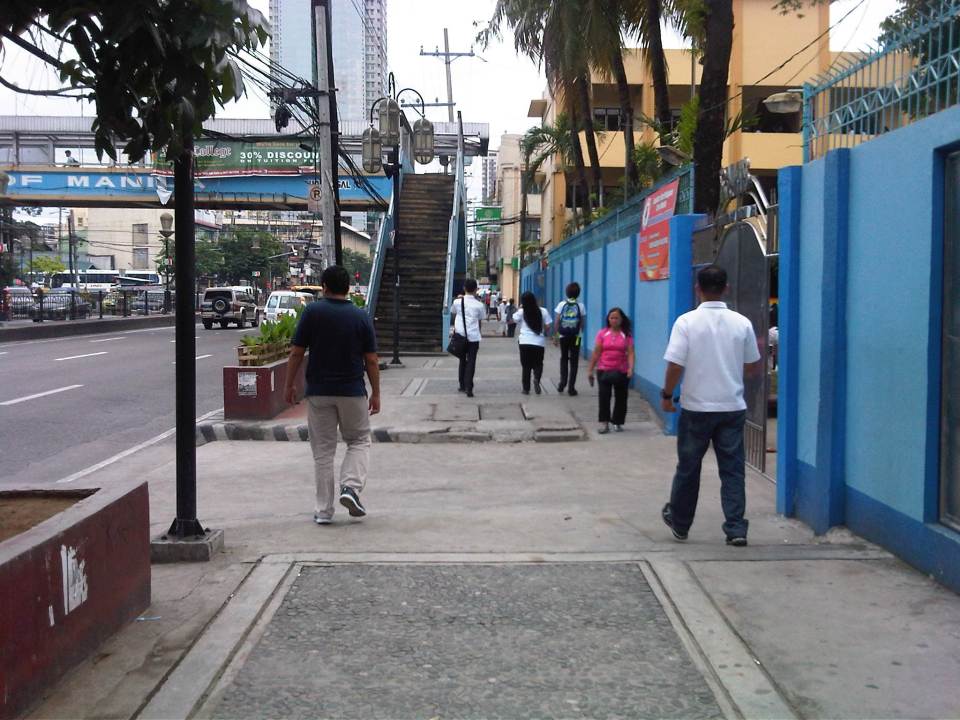 Walking to the overpass in front of Ramon Magsaysay with the school on the right.
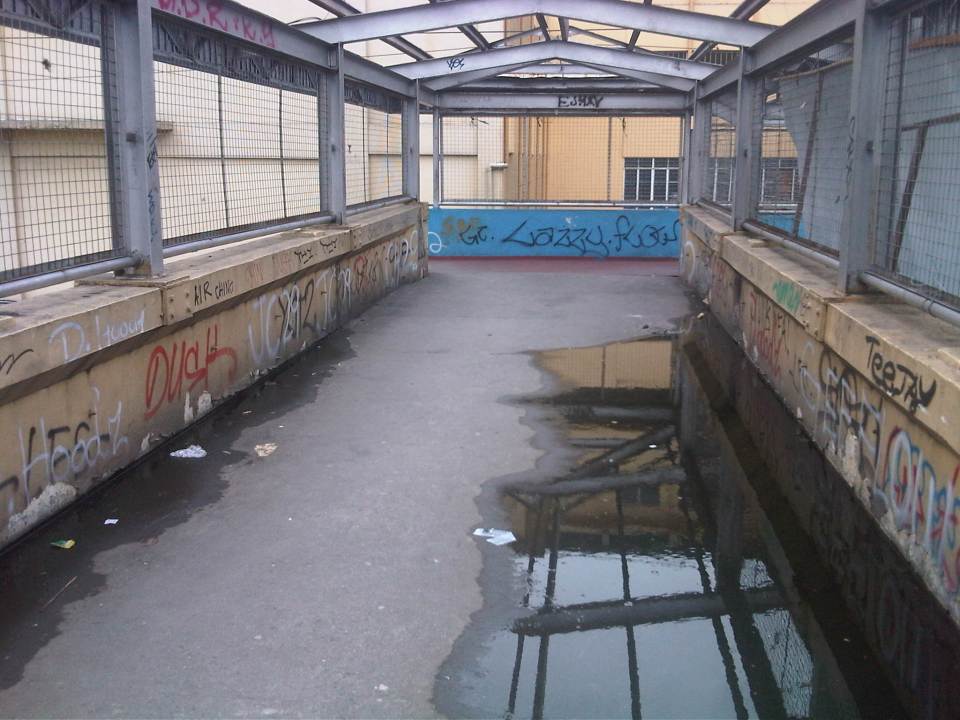 The overpass was partly flooded from the rains the past few days. The roofing only had the frame so anyone using the overpass on a rainy day would have to use their umbrellas for cover. The MMDA had removed the roofs of many overpasses to discourage vendors and beggars to set up on the overpasses. Spared from the campaign were overpasses that were secured by establishments like those along Katipunan with Ateneo and along Espana with UST. While there are no vendors or beggars on this overpass, it’s quite obvious from the photo that vandals have been busy defacing the facility.
 Many open overpasses like this are stinky because they are (ab)used as urinals. Who knows about the composition of these puddles aside from the rainwater during this wet season.
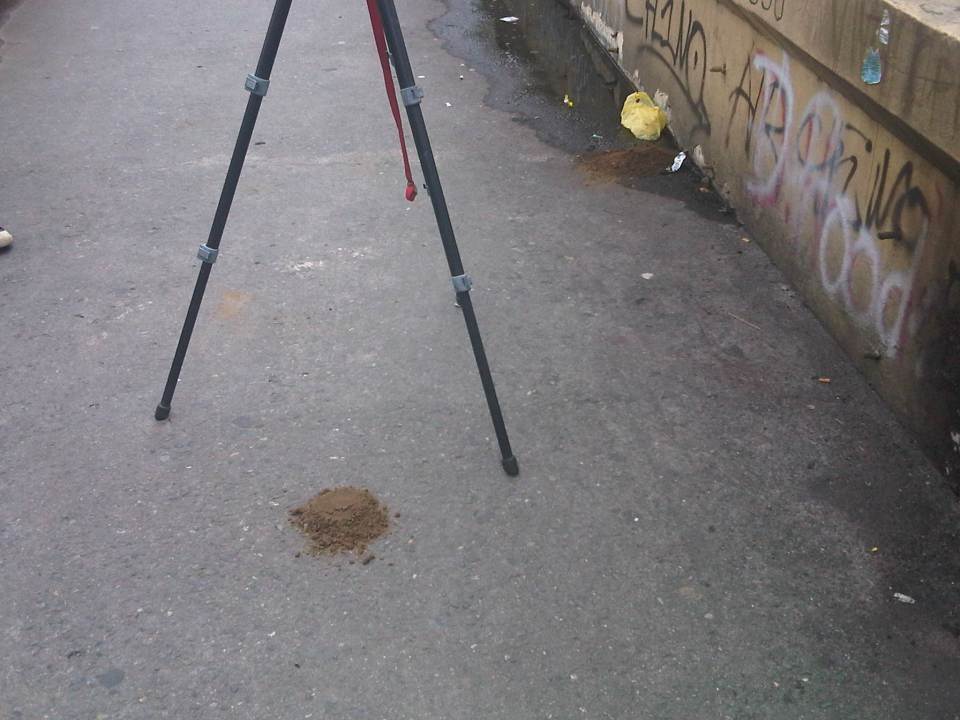 The overpass smelled of poop and that’s simply because there were poop scattered along the overpass. Neglected facilities like this, despite being used by many people (its right in front of a big public school) to cross busy streets like Espana, are often used by vagrants as toilets. Quick thinking and action by one of our staff reduced the stink when he got some soil from the (also neglected) plant boxes in the area to cover the feces that littered the overpass.
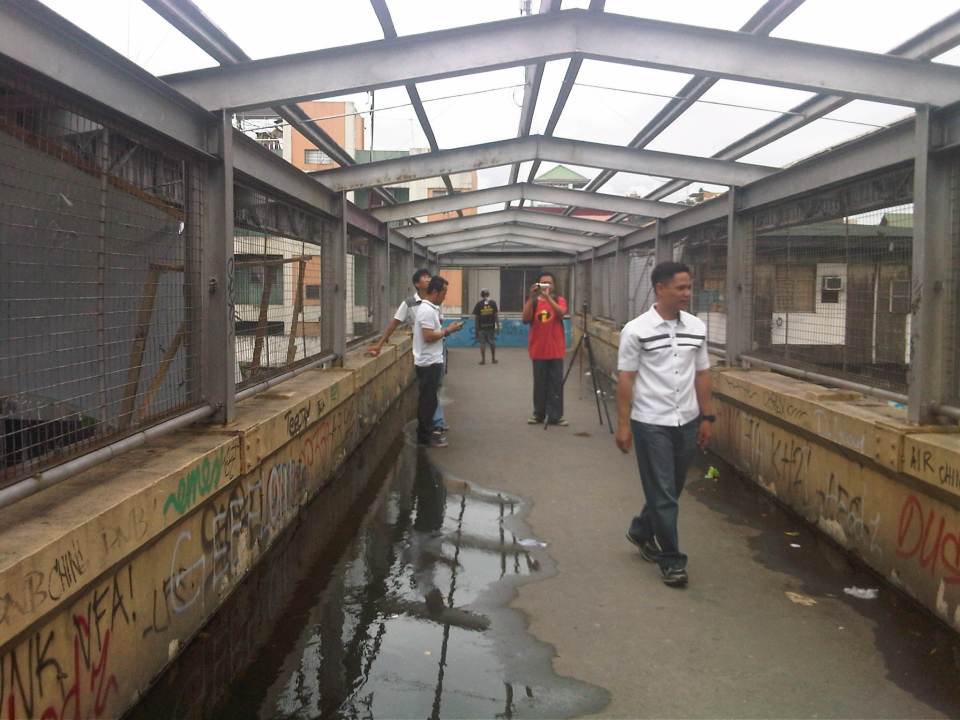 NCTS staff setting up a camera while also taking up the conditions at the footbridge.
 The stairways to/from the footbridge are quite steep. Such features need to be designed with senior citizens, children and PWDs in mind.
This overpass is located in Manila and is probably used by hundreds of students from the public school beside it aside from the other pedestrians that need to cross Espana Avenue. I think there is an opportunity here for the City of Manila and the specific barangay to improve the conditions of the facility and ultimately contribute to improving quality of life through the improvement of the quality of walking – the most basic of all modes of transport and certainly a strong indicator for a city’s health and vibrance.
–
Sunday smog
We were staying at a hotel over the weekend and our room afforded us a good view of the cityscape to the left and seascape to the right. We weren’t able to get a good view of the sunset as we were practically facing south-east and the orientation of the window prevented any, even slight view of what is always a nice Manila Bay sunset. We did expect to see the sunrise the following morning.
As the sun came up, we took this photo of the cityscape. Closer to us were buildings in Pasay City while those farther away were buildings in Bonifacio Global City. I remembered reading somewhere that what makes our sunsets so colourful or spectacular are the elements in our atmosphere. Air pollution tends to bring the most dramatic colors for sunsets and I believe that’s in a way also applicable to sunrises. I took a snapshot of the cityscape from our hotel window expecting the worst for what could be the equivalent of an exposed negative in the old days. Instead, I got the pretty decent photo below showing the sunlight reflecting off the haze around Metro Manila and giving the cityscape that eerie look on a Sunday morning.

There’s a joke that is often recycled concerning air pollution and air quality. According to this joke, the Philippines doesn’t need to worry about air pollution since every year it is visited by many typhoons. These typhoons passing through the country sweep away the pollution thereby making the air around us cleaner. This is actually true and one need only to get outdoors after a typhoon to smell the fresh air. Of course, it doesn’t take long before the smog returns and therein lies the punchline to the real joke. At the rate we are going in terms of vehicle emissions alone, we would probably need at least a typhoon every week for the entire year if we wanted clean air to breathe. The dry seasons would probably be the worst in terms of poor air quality. And so we must see that the joke is on us and air quality will only continue to deteriorate if we do not act now and do not pitch in for the fight for clean air.
–
The need for mass transit to the east of Metro Manila
I wanted to use a title stating “the demand for mass transit to the east of Metro Manila” but the word “demand” for me seemed a bit technical (I associated it with the supply and demand concepts for transport.) and would need some numbers to support it. So I settled for the word “need” instead of “demand” so I could be flexible (i.e., more qualitative) with the way I wrote this article. “Need” is a more pedestrian term that can easily be understood and imagined, and there is no lack for images of this need for more efficient and higher capacity modes along the main corridors to the east of Metro Manila. The main corridors are Ortigas Avenue and Marcos Highway, which have the highest road capacities among other roads (i.e., higher capacities than A. Bonifacio Avenue in Marikina, the Batasan-San Mateo Road, or C-6/Highway 2000). These are also the corridors along which most public transport services may be found. Such connects the eastern towns (e.g., Cainta, Taytay, Antipolo, etc.) to the transport hubs of Cubao and Crossing, which are major transfer points for many people taking public transport. Of course, there are UV Express services from these eastern towns that go directly to CBDs like Makati and Ortigas.
You can observe the crowds at Katipunan and Santolan Stations of the LRT Line 2 as well as the people waiting for their ride home along Marcos Highway. I have observed that there are also lots of people along Ortigas Avenue from Tikling Junction to C-5 who religiously and patiently wait for their rides to school, office or home. This happens everyday and this regularity seems to be a never-ending sacrifice of time and patience. These people do not have much of a choice except taking whatever public transport is available to them. Many probably can afford to have a car or already have a vehicle in their household. Unfortunately, that vehicle is not usually enough for their commuting needs and so they are captive users of an inefficient public transport system (there are some who question if what we have can really be called a system).
 People waiting for a ride in front of Robinsons Metro East along Marcos Highway in Pasig City – these have occupied 3 lanes of the highway as they position themselves for the next available jeepney. There is a UV Express terminal at the mall and another at the nearby Sta. Lucia mall but these are not for the destinations these people are going to.
News that the LRT Line 2 Extension from Santolan to Masinag would finally be constructed was initially met with speculation. Such news have been circulating for so many years but no actual work could be seen along Marcos Highway to convince people that the project was underway. Now, that the soil test samplings have been completed, people are anxious about the actual construction of the extension. I think this is a project long overdue and the question that needs to be answered is if the line needs to be extended further, perhaps until Cogeo. I believe there is a tremendous market for this mass transit system along this corridor where a lot of residential subdivisions and relocation sites have sprouted over the years. The DPWH recognised this as a high capacity corridor and is already widening the road from Masinag to Cogeo.
Hopefully, the Ortigas Ave.-Manila East Road corridor can also have its own mass transit line. The regular bus services along this corridor is no longer sufficient and operations are not so efficient despite what appears as competition among 2 bus lines. There had been a Bus Rapid Transit (BRT) Line proposed for this corridor but there seems to be no progress towards the realisation of that project. Whichever of rail or BRT would be the option for the corridor though, it doesn’t take a genius or too many consultants to determine the need for a good mass transit line along this corridor. When that will be is a question with an answer that is still up in the air. Perhaps the local governments of Rizal, especially the province, should push for such transit systems. The governor and mayors should champion such systems that will definitely benefit their constituents and translate into real revenues for their LGUs from the certain business that will come along these corridors.
–
We deserve better transport!
In the news lately are various problems pertaining to transport and the solutions authorities have come up with that they think are stop-gap solutions to alleviate the problems. The EDSA MRT Corp, for example, tried to experiment with a bus service to supplement the supply of transport for the tremendous demand for the MRT 3 trains. For some reason, the MRTC did not coordinate with the MMDA as well as the LTFRB for the experiment and this resulted in their buses being halted by the MMDA for being “colorum” or illegally operating public transport services. That quickly fizzled out even as they tried to convince queued passengers at stations to take the express bus instead.
More recently, this May, the MRT 3 experimented with what they called express trains. This was actually a “skip” train service where certain trains will not be stopping (i.e., skipping) certain stations. This was supposed to address congestion as well as improve travel times. It didn’t on both ends. Such services would have a chance if the MRT had the trains (rolling stock) for this kind of operation to be sustainable. Also, there’s the issue of the MRT tracks not being designed for trains to bypass stations with stopped trains (i.e., express trains bypassing local trains). That alone means there’s a limit to the number of trains you can deploy because there’s no way one can bypass the one ahead of it.
The MMDA recently re-introduced ferry services along the Pasig River. These are basically school buses loaded up on boats. While I’m sure the people behind this are well meaning, I couldn’t help but cringe with the idea that this seems to be the best we can do with the resources we have and agencies like the MMDA and the DOTC (especially the DOTC) seem content with their ideas for a solution to the transport/traffic mess we are in. Is it safe? So far, there have been no incidents yet so there are
The bottomline is that we do not deserve this low quality of transport services. The inefficiencies have directly or indirectly cost us a lot in terms of actual money or time that could have gone into more productive ventures. And the problem seems to be that many people have become manhid of their conditions and have taken transport matters in their own hands. Such comes in different forms like getting a motorcycle so they won’t have to take public transport or get caught in traffic jams. Another way is to get a second (even third or fourth) car so that the number coding scheme will not affect one’s trips. These examples, however, are more exceptions compared with the majority who cannot do anything about their plights except perhaps wake up earlier or stay at the office or school later so they don’t have to deal with traffic jams or difficulties of getting a ride.
I think we should voice out our displeasure with the current conditions and there are many ways to do this without going out in the streets to protest. That includes using social media to get the attention of those responsible for transport and traffic in your city or town. You just have to watch out for the trolls as there are many out there including those who seem to be working with the very same people responsible for transport and traffic. In such cases, you have to be careful how you react if someone heckles your posts. Actually, you shouldn’t mind them because otherwise, you would easily become frustrated or offended, which is what they want you to be. So you got to keep your cool and be patient with this social media approach. There are many advocacies out there that you can probably participate in and these include initiatives by competent NGOs who push for sustainable transport, inclusive mobility and clean air, among others. I like the term a friend coined from various experiences they had with their work on the Bus Rapid Transit (BRT) in Cebu and Manila – dignity of travel. We have to get back this dignity that has steadily deteriorated or degraded by the poor quality of our transportation systems.
–
Habal-habal in Metro Manila?
Habal-habal is the term used for motorcycle taxis that proliferate in many rural areas but are steadily making their presence felt in urbanised areas as well. In Metro Manila, there are already some reports and spottings of habal-habal operations at Bonifacio Global City and in the White Plains area in Quezon City. I’m sure there are other areas where these informal services are being offered and the easiest way to spot these are by way of observing if there are motorcycle riders waiting in an area with extra helmets. The usual excuse if they are accosted is that they are just going to fetch someone (perhaps a relative or a friend) so they bring along that extra helmet for that person. When they do engage a passenger, I would like to think that they just ask the passenger to play along with them should they be apprehended and asked about their business.
Checkpoints around Metro Manila and many other cities and towns routinely stop motorcyclists to check on their registrations (i.e., there are many unregistered motorcycles around the country) and to pre-empt crime involving those “riding in tandem.” Motorcyclists with more than one passenger are risky and have a higher likelihood for severe crashes. The provision of services in exchange for monetary compensation (i.e., payment) puts these informal transport under the category of colorum services. These are not covered by insurance as required for formal public transport and so there are issues of liability should there be a crash involving these vehicles. No insurance means that passengers cannot claim for anything except compensation they can demand from the service provider (assuming he survives the crash) or the other parties involved (if it can be established that the other party is also at fault). You can always sue people but in this case, the pre-condition is that they shouldn’t have been riding a habal-habal in the first place.
 Alleged habal-habal waiting in front of an establishment along Katipunan Road. These typically cater to employees of establishments or staffs of households in the exclusive villages along this road, which has no formal public transport service due mainly to its being a private road that happens to tolerate through traffic. You can find other motorcycle riders offering such services at the corner of Katipunan with Boni Serrano Avenue.
–
Green light for the Cebu BRT
The NEDA Board chaired by the Philippines’ President approved last week a number of major infrastructure projects. One project is particularly important as it seeks to introduce an innovative public transport system in the Philippines. The Cebu Bus Rapid Transit (BRT) project was finally given the green light and is projected to be completed and operational by 2017. I remember that the Cebu BRT was conceptualised while we were doing a social marketing project for Environmentally Sustainable Transport (EST) that was supported by the UNDP. That was back in 2006-2007 and right before we embarked on the formulation of a national EST strategy that was supported by UNCRD. I remember, too, that sometime in 2009, Enrique Penalosa, the former mayor of Bogota, Colombia who has championed the BRT cause visited the Philippines to give some talks in Cebu and Metro Manila about public transport and pursuit of better quality of life through good transport systems. From that time onwards, a lot of work has been put into the studies to support this system including social marketing for stakeholders to understand what such a system will require including its impacts on existing transport modes. It took sometime for this project to be approved but that should no longer be an issue and focus should now be on the detailed design and implementation of the project.
There are many detractors of this BRT project. While I respect the value engineering work that was supposed to have been conducted by NEDA, I would like to speculate that perhaps it was unclear to them how important a functioning, operational BRT in Cebu is as a strategic accomplishment in transport in this country. For most people, the idea of bus transport is what they have seen along EDSA in Metro Manila. The impact on commuting behaviour of a high quality public transport system like a BRT would be very hard to quantify and the criteria and metrics used would be quite tricky considering the strategic and behavioural aspects of the system. Such evaluations can also be tricky depending on who were doing the study in the first place as the outcomes could easily be affected by the biases of those who undertook the evaluation. Thus, it is important that value engineering exercises be done by open-minded, flexible if not disinterested parties to the project of interest.
Many of those who have expressed skepticism about the BRT are likely pining for a rail transit system that was earlier proposed for the city but which has failed to gain the critical support. For one, the LRT that was proposed for Cebu City was simply too expensive and financing would have been difficult for a system that would have been less flexible in operations compared to an at-grade bus system. The numbers supporting the LRT were also in need of much updating as the study on that system was already quite dated and had not considered the major developments in Cebu and its surrounding cities that loosely or informally comprise what people refer to as Metro Cebu. These realities would need a new and more robust study that could surely result in a recommendation for a rail system but upon close comparison with a BRT option should lead to a conclusion that Cebu will be better off with BRT at this point and in the foreseeable future.
The truth is that while rail transport remains as an ultimate goal for high demand corridors in highly urbanised cities, it is an expensive proposition and ones that will take more time to build. We don’t have that time in our hands as our cities are rapidly growing both in terms of economy and population. We cannot sustain this progress if our transport system remains primitive. And strategically, too, a BRT system may just pave the way for a future rail system in Cebu. This model for transport system development can be replicated in other cities as well including Davao, Iloilo, Bacolod, and Cagayan de Oro, to name a few. But we should always not forget that building this system requires holistic development of complementing infrastructure such as pedestrian walkways and bikeways, and the rationalisation of jeepney and multi cab services with respect to the mass transit system. I believe those behind the Cebu BRT project have these covered and it is now a matter of time before the country’s first BRT becomes operational in the “Queen City of the South.”
–
Bottlenecks and other traffic issues in Antipolo
Commuting between our home in Antipolo and my work place in Quezon City, I have noted a lot of issues on transport and traffic that needs to be attended to by the local government in coordination with other entities like the DPWH and Meralco. Here are some photos with my notes and comments.
 Much of Sumulong Highway have been widened to 4 lanes but many electric posts remain in the middle of the additional lanes and pose hazards to motorists and cyclists. These posts seem to have been here for quite some time now and the paint on them gives the message that they will be here for the foreseeable future. Paint or no paint, they are road hazards and have the potential to kill people on vehicles crashing into the poles. I think this is supposed to be the responsibility of the power company (Meralco) but there needs to be a firm request and coordination coming from Antipolo City Government to finally relocate these poles.
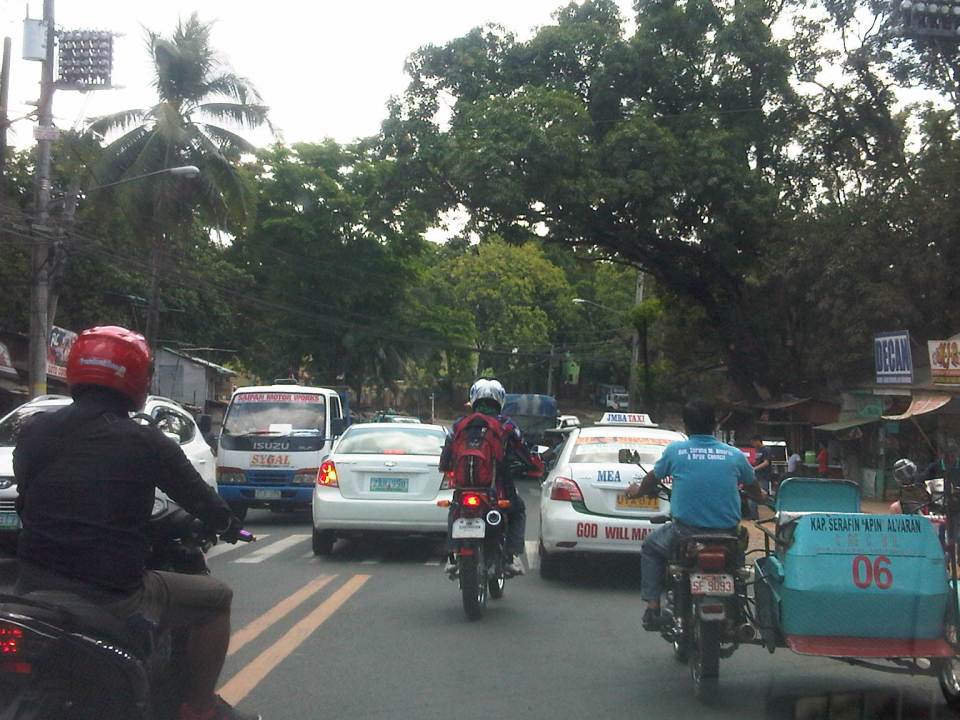 Congestion is often caused by counter-flowing vehicles forcing their way back into the right lane (like the car in the middle of the photo) upon encountering opposing traffic. It doesn’t help that there are motorcycles splitting the lanes to make for a very crowded road.
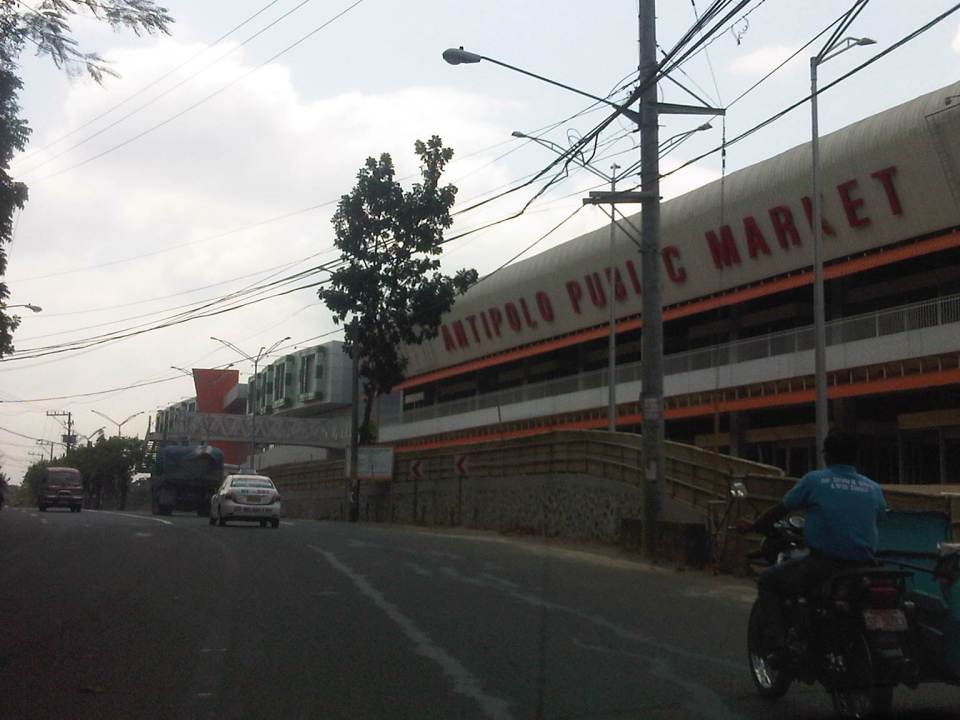 The new but still closed Antipolo Public Market along Sumulong Highway and near the intersection with Daang Bakal (the old railroad line that’s now a road). I wonder about the trip generation potential of this complex as it is not yet operational. Meanwhile, a huge Robinsons mall (looks larger than their Magnolia property) is currently under construction just across from it and will definitely be a major traffic generator in that area. The combined traffic to be attributed to these commercial complexes will surely have a tremendous impact on Sumulong Highway and other roads in the vicinity.
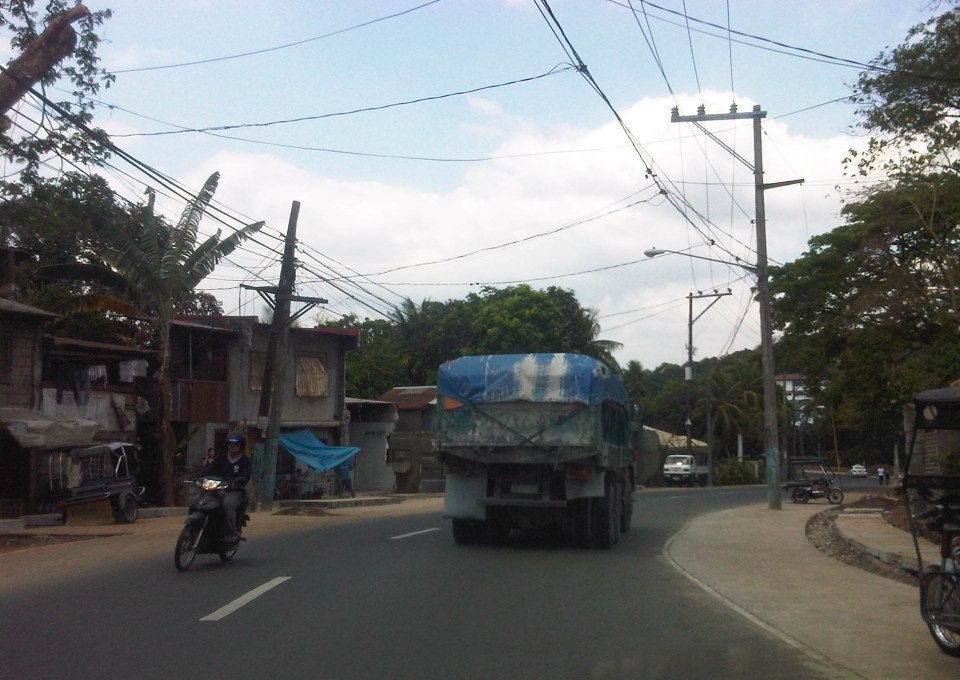 Both Sumulong Highway and Ortigas Avenue Extension carry significant truck traffic. These often cause congestion as they are slow going up to Antipolo and can block the entire road as Sumulong Highway and Ortigas Extension have some narrow sections where the shoulders could not provide enough space for other vehicles to pass the slower moving ones. In certain cases like the one in the photo above, there are electric posts in the middle of the shoulder lane.
 Tricycles occupy the outer lane of Ortigas Ave. Ext./Olivares Street. Such informal and on-street terminals are illegal along national roads and yet the city tolerates them. One explanation for this is that there are informal communities along the highway on shanties built along what is supposed to be a ledge along the mountainside (shown at right in the photo). These are where tricycle drivers and their families reside.
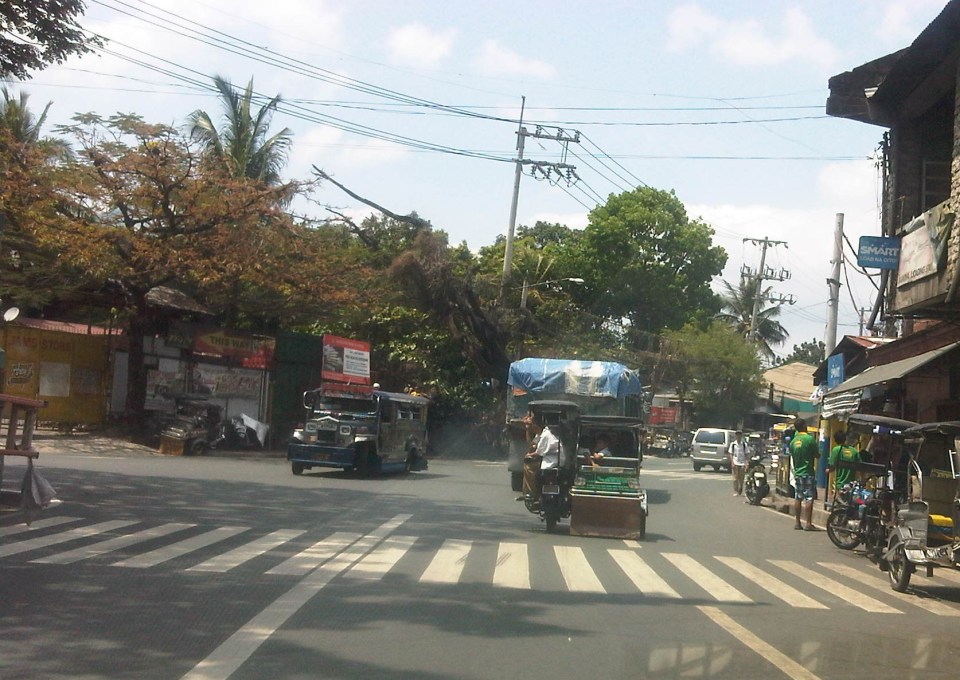 Tricycles from different tricycle operators and drivers associations (TODAs) seem to roam the entire city. This is contrary to the common practice in other cities and municipalities where tricycles are limited within a certain area or district that in many cases just overlap with others (e.g., UP Teachers Village-Philcoa-Krus na Ligas).
 Many tricycles serve as school service. However, the observation is that most tricycles tend to be overloaded with passengers. These are usually small children so the driver probably figured that they could cram more passengers than what is legally allowed.
 Sharing the road? Antipolo is very popular with cyclists and weekends bring a lot of them to the city as they come from all over via the main routes along Sumulong Highway and Ortigas Avenue (there should also be those coming from the east via the Antipolo-Teresa Road and Antipolo-Tanay Road). Most motorists are aware of these cyclists and give way to them. Most experienced cyclists are also aware of the ROW of other vehicles and so keep to the inner lanes. This mutual awareness and respect are vital to make roads safe for all. I think the only thing needed is to provide space for pedestrians as there are significant numbers of people walking, hiking or jogging along these roads.
–
Roads as solar dryers – Part 2
This is a continuation of an earlier post on roads being used as solar dryers. Our trip across Tarlac brought us to more of these facilities being used for agricultural purposes. The following photos are from San Jose and Mayantoc towns, which are obviously predominantly agricultural. The photos show lands devoted to agricultural as far as the eye could see and most are planted with rice.
A friend commented that something should be done to reduce if not eliminate such practices along roads. I replied that this is basically the responsibility of local government units including barangay officials who should be educated about the dangers posed to travellers as well as the deterioration in the quality of the rice as it gets compromised from the waste and grinding they get from vehicles. In terms of practicality and recognising the limitation in funds for solar dryers, roads seem to be the easier and versatile option. Basketball courts and other concreted spaces scattered around the countryside do not make sense where roads would have more use especially to address accessibility issues (e.g., farm to market roads).
Another friend commented on the earlier post that he almost had a collision with another motorcycle rider as the entire road was covered with rice being dried by farmers. I reasoned out that for rural roads with very low traffic, a single lane covered with rice could be tolerable but using the entire road width just is not right. Motorcycle can easily slip or skid along such rice-covered roads resulting in serious injuries if not fatalities. For most cases of what I’ve seen recently, the roads quality as having low traffic and rice is being dried only along one lane so we know at least that people are aware that one lane should at least be free of obstructions.
 1
1
 2
2
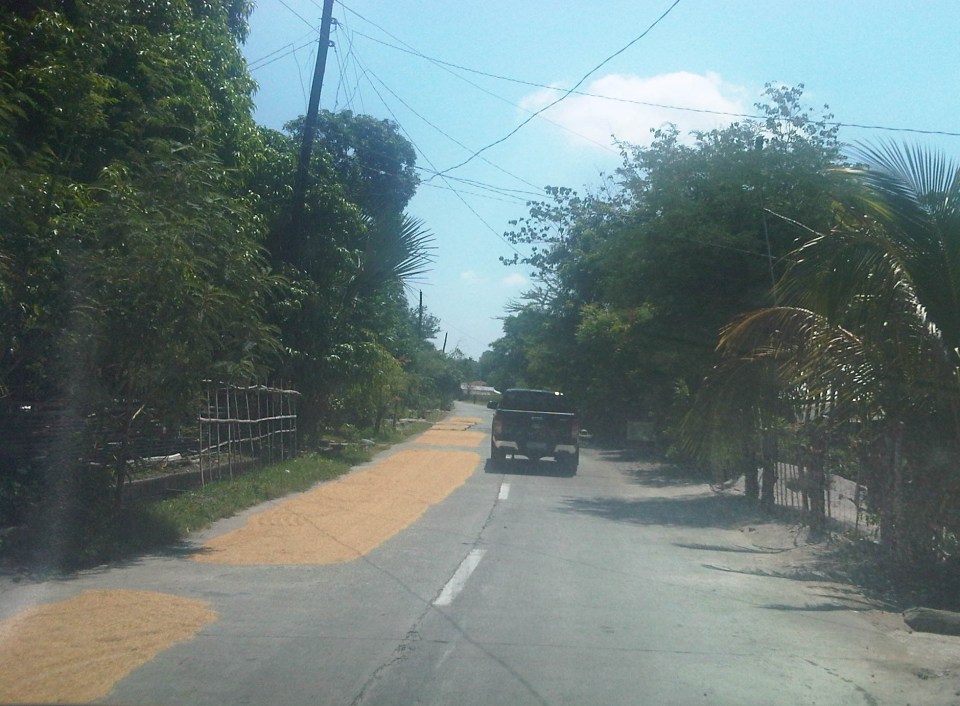 3
3
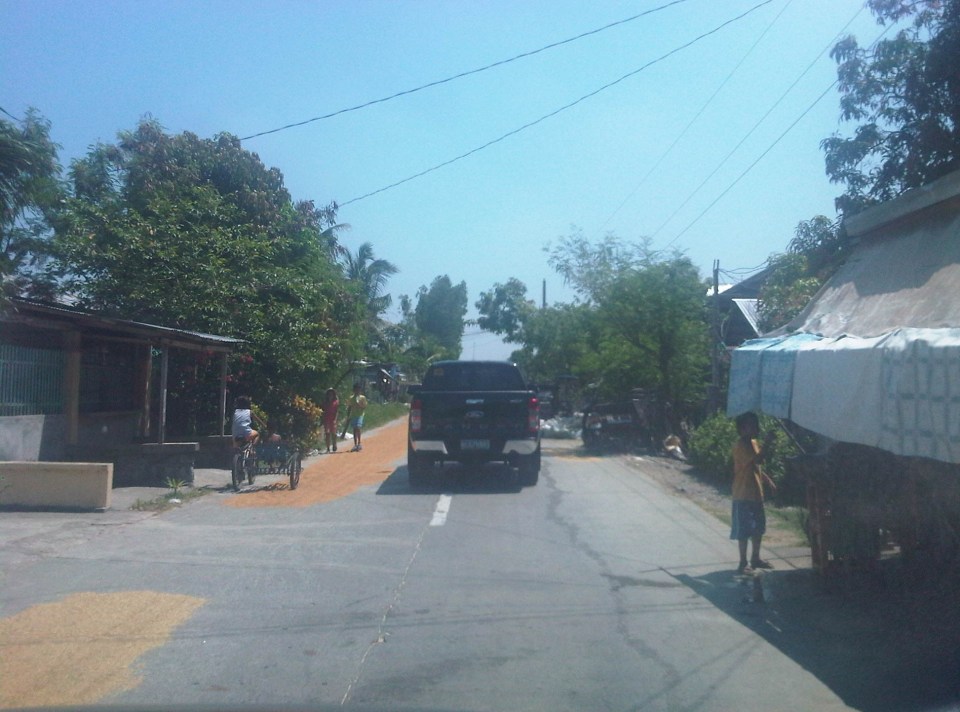 4 – That’s corn being dried just beside the pick-up truck in the photo.
 5
5
 6
6
 7
7
 8 – Bad practice of spreading the grains across the entire road carriageway
 9
9
The last photo is of corn kernels being dried on a basketball court. You can see the cobs piled near the stage, which shelters what looks like sacks of corn. As I mentioned earlier, it is possible to have such basketball courts or social facilities to be used as solar dryers. Even schools grounds can be used for this purpose but only for weekends or during the summer breaks. However, it would be impractical to have basketball courts and plazas scattered all over the countryside just for this purpose especially in places where there aren’t much people in the first place. Roads still offer the more flexible use (i.e., access/FMR and solar dryer) as long as traffic is not significant. Perhaps where traffic is significant (i.e., significantly populated areas) then such “off-road” facilities should be constructed. But again, the responsibility for making sure roads are clear of agricultural products would fall unto the LGUs.
–
Roads as solar dryers – Part 1
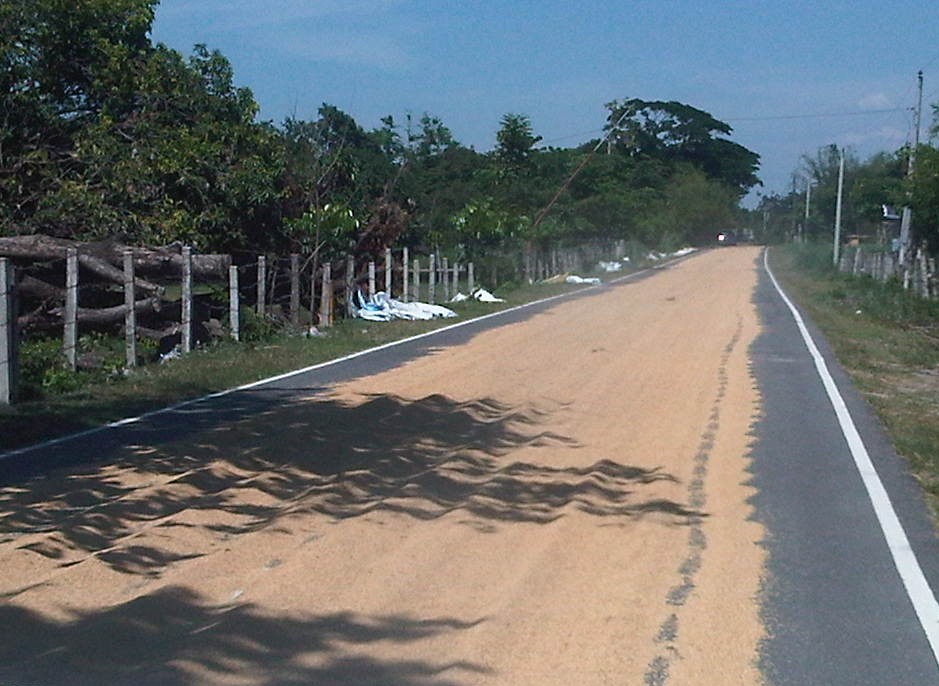
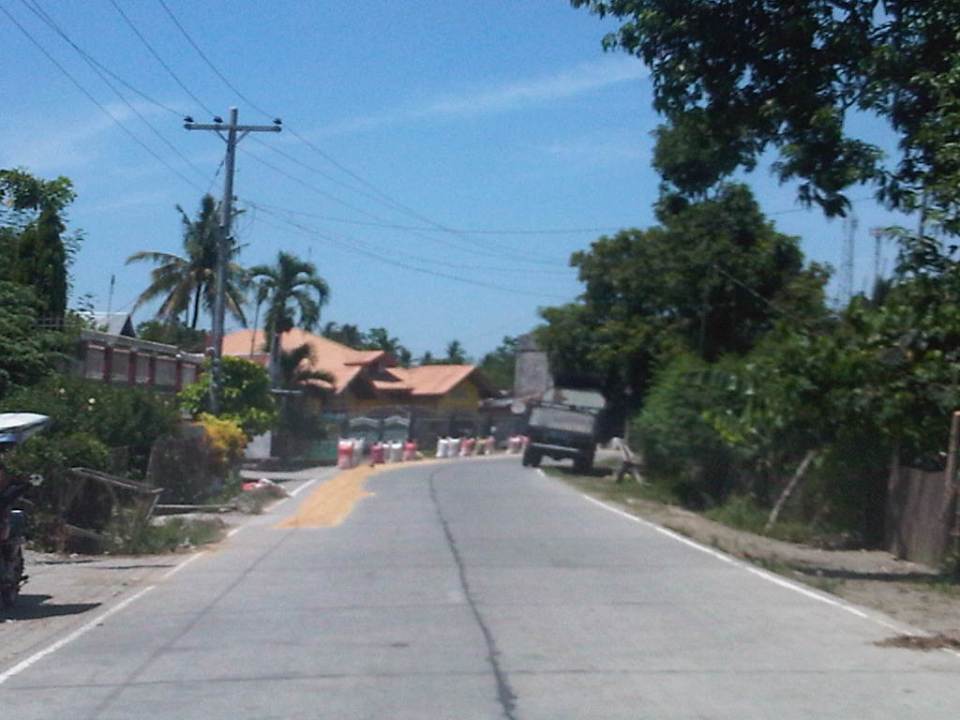
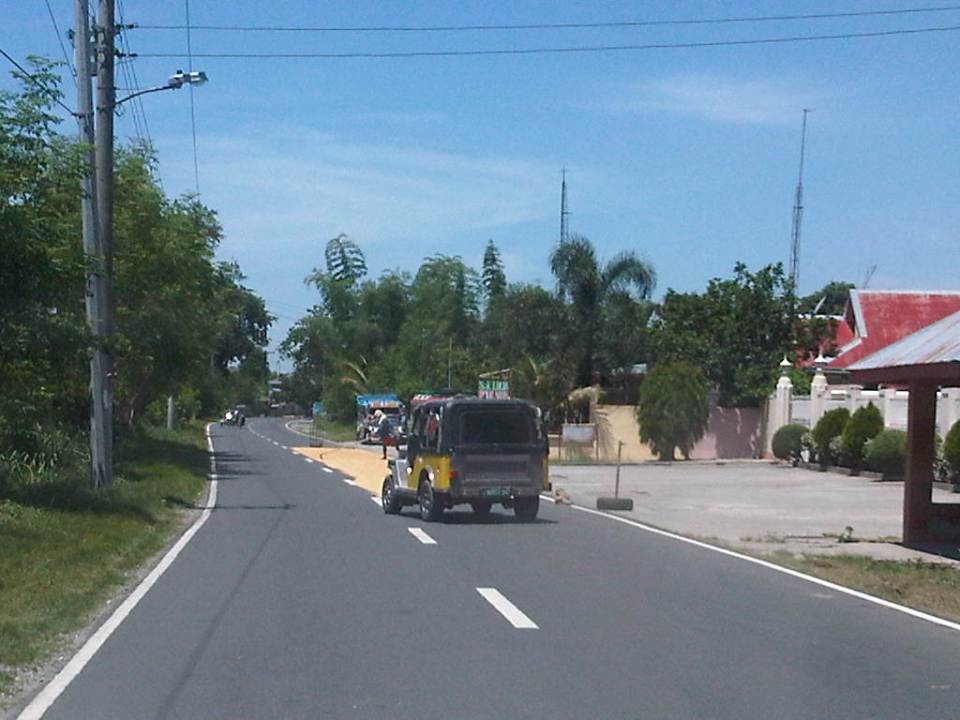
We are currently undertaking a project for the Province of Tarlac that looks into the safety along its rural roads (both national and provincial roads) including those providing access to tourism areas in the province. Along many rural roads are agricultural lands producing rice, corn, fruits, vegetables and other products. Often, travellers will encounter roads that serve another purpose other than transport – as solar dryers. Before rice is milled, it needs to be dried first so that it would be easier to remove the husk (i.e., separate the bigas from the ipa – together they are called palay). While it is possible to do this drying on mats (banig) spread over the land/soil this takes time. Meanwhile, portland cement concrete roads offer what seems to be the perfect surface for drying. As such, certain roads have been known to get justification for concreting despite low traffic volumes as they double as solar dryers. There are similar cases for basketball courts or village plazas receiving funding for concreting for the same reasons. Obviously, laying out rice on the roads have implications on the quality of the rice later on as vehicles will inevitably (even inadvertently) pass through the roads. I guess its even worse in cases when the road surface is of asphalt concrete. Following are photos I took along rural roads in Bamban, Capas and San Jose towns of Tarlac.
 1
1
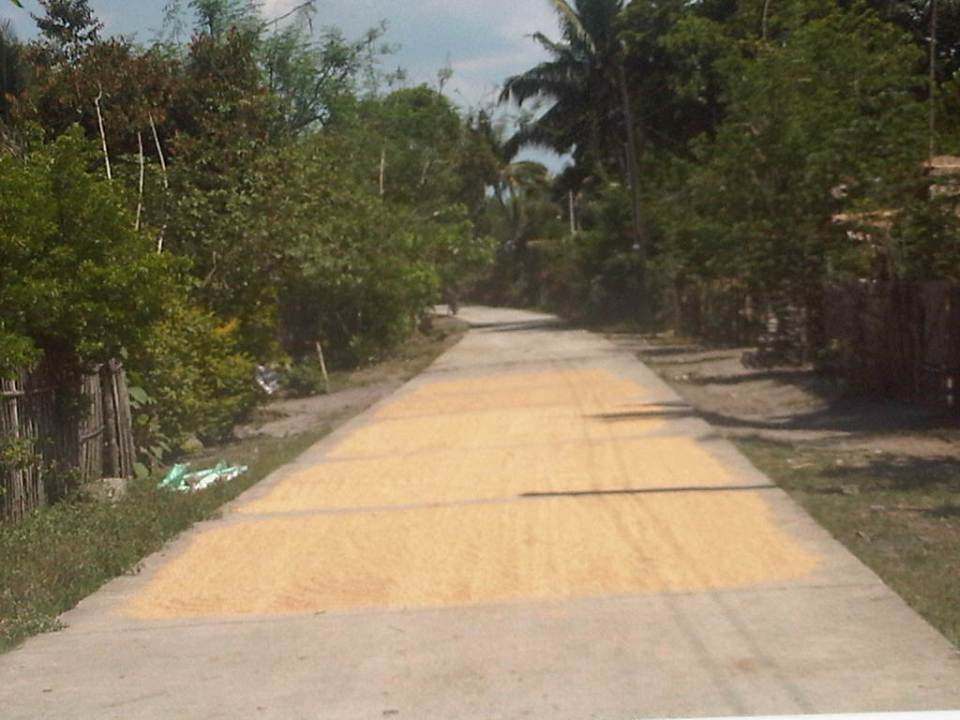 2
2
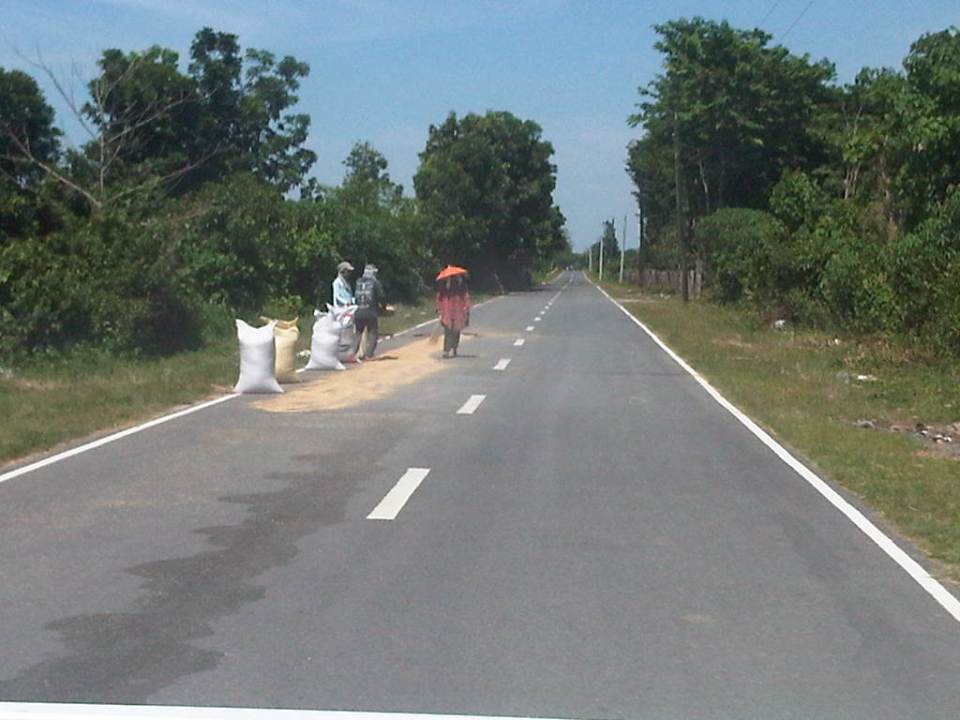 3
3
 4
4
 5
5
 6
6
 7
7
 8
8
 9
9
 10
10
Other items that are usually dried on the roads include tingting (the stems of coconut leaves that are used to make brooms – walis tingting) barbecue and fish ball sticks. I have also seen fish being dried on the road one time during a trip to Northern Luzon. Obviously, among the risks are the rice being grinded by the tires of vehicles (resulting in durog na bigas more suitable for porridge), fuel or oil compromising the rice, and the prospects of animals doing their thing on the road near or on the rice!
More on these solar dryers in the next post!
–
 Caught (up) in traffic