
Home » Governance (Page 38)
Category Archives: Governance
Habal-habal in Metro Manila?
Habal-habal is the term used for motorcycle taxis that proliferate in many rural areas but are steadily making their presence felt in urbanised areas as well. In Metro Manila, there are already some reports and spottings of habal-habal operations at Bonifacio Global City and in the White Plains area in Quezon City. I’m sure there are other areas where these informal services are being offered and the easiest way to spot these are by way of observing if there are motorcycle riders waiting in an area with extra helmets. The usual excuse if they are accosted is that they are just going to fetch someone (perhaps a relative or a friend) so they bring along that extra helmet for that person. When they do engage a passenger, I would like to think that they just ask the passenger to play along with them should they be apprehended and asked about their business.
Checkpoints around Metro Manila and many other cities and towns routinely stop motorcyclists to check on their registrations (i.e., there are many unregistered motorcycles around the country) and to pre-empt crime involving those “riding in tandem.” Motorcyclists with more than one passenger are risky and have a higher likelihood for severe crashes. The provision of services in exchange for monetary compensation (i.e., payment) puts these informal transport under the category of colorum services. These are not covered by insurance as required for formal public transport and so there are issues of liability should there be a crash involving these vehicles. No insurance means that passengers cannot claim for anything except compensation they can demand from the service provider (assuming he survives the crash) or the other parties involved (if it can be established that the other party is also at fault). You can always sue people but in this case, the pre-condition is that they shouldn’t have been riding a habal-habal in the first place.
 Alleged habal-habal waiting in front of an establishment along Katipunan Road. These typically cater to employees of establishments or staffs of households in the exclusive villages along this road, which has no formal public transport service due mainly to its being a private road that happens to tolerate through traffic. You can find other motorcycle riders offering such services at the corner of Katipunan with Boni Serrano Avenue.
–
Green light for the Cebu BRT
The NEDA Board chaired by the Philippines’ President approved last week a number of major infrastructure projects. One project is particularly important as it seeks to introduce an innovative public transport system in the Philippines. The Cebu Bus Rapid Transit (BRT) project was finally given the green light and is projected to be completed and operational by 2017. I remember that the Cebu BRT was conceptualised while we were doing a social marketing project for Environmentally Sustainable Transport (EST) that was supported by the UNDP. That was back in 2006-2007 and right before we embarked on the formulation of a national EST strategy that was supported by UNCRD. I remember, too, that sometime in 2009, Enrique Penalosa, the former mayor of Bogota, Colombia who has championed the BRT cause visited the Philippines to give some talks in Cebu and Metro Manila about public transport and pursuit of better quality of life through good transport systems. From that time onwards, a lot of work has been put into the studies to support this system including social marketing for stakeholders to understand what such a system will require including its impacts on existing transport modes. It took sometime for this project to be approved but that should no longer be an issue and focus should now be on the detailed design and implementation of the project.
There are many detractors of this BRT project. While I respect the value engineering work that was supposed to have been conducted by NEDA, I would like to speculate that perhaps it was unclear to them how important a functioning, operational BRT in Cebu is as a strategic accomplishment in transport in this country. For most people, the idea of bus transport is what they have seen along EDSA in Metro Manila. The impact on commuting behaviour of a high quality public transport system like a BRT would be very hard to quantify and the criteria and metrics used would be quite tricky considering the strategic and behavioural aspects of the system. Such evaluations can also be tricky depending on who were doing the study in the first place as the outcomes could easily be affected by the biases of those who undertook the evaluation. Thus, it is important that value engineering exercises be done by open-minded, flexible if not disinterested parties to the project of interest.
Many of those who have expressed skepticism about the BRT are likely pining for a rail transit system that was earlier proposed for the city but which has failed to gain the critical support. For one, the LRT that was proposed for Cebu City was simply too expensive and financing would have been difficult for a system that would have been less flexible in operations compared to an at-grade bus system. The numbers supporting the LRT were also in need of much updating as the study on that system was already quite dated and had not considered the major developments in Cebu and its surrounding cities that loosely or informally comprise what people refer to as Metro Cebu. These realities would need a new and more robust study that could surely result in a recommendation for a rail system but upon close comparison with a BRT option should lead to a conclusion that Cebu will be better off with BRT at this point and in the foreseeable future.
The truth is that while rail transport remains as an ultimate goal for high demand corridors in highly urbanised cities, it is an expensive proposition and ones that will take more time to build. We don’t have that time in our hands as our cities are rapidly growing both in terms of economy and population. We cannot sustain this progress if our transport system remains primitive. And strategically, too, a BRT system may just pave the way for a future rail system in Cebu. This model for transport system development can be replicated in other cities as well including Davao, Iloilo, Bacolod, and Cagayan de Oro, to name a few. But we should always not forget that building this system requires holistic development of complementing infrastructure such as pedestrian walkways and bikeways, and the rationalisation of jeepney and multi cab services with respect to the mass transit system. I believe those behind the Cebu BRT project have these covered and it is now a matter of time before the country’s first BRT becomes operational in the “Queen City of the South.”
–
Bottlenecks and other traffic issues in Antipolo
Commuting between our home in Antipolo and my work place in Quezon City, I have noted a lot of issues on transport and traffic that needs to be attended to by the local government in coordination with other entities like the DPWH and Meralco. Here are some photos with my notes and comments.
 Much of Sumulong Highway have been widened to 4 lanes but many electric posts remain in the middle of the additional lanes and pose hazards to motorists and cyclists. These posts seem to have been here for quite some time now and the paint on them gives the message that they will be here for the foreseeable future. Paint or no paint, they are road hazards and have the potential to kill people on vehicles crashing into the poles. I think this is supposed to be the responsibility of the power company (Meralco) but there needs to be a firm request and coordination coming from Antipolo City Government to finally relocate these poles.
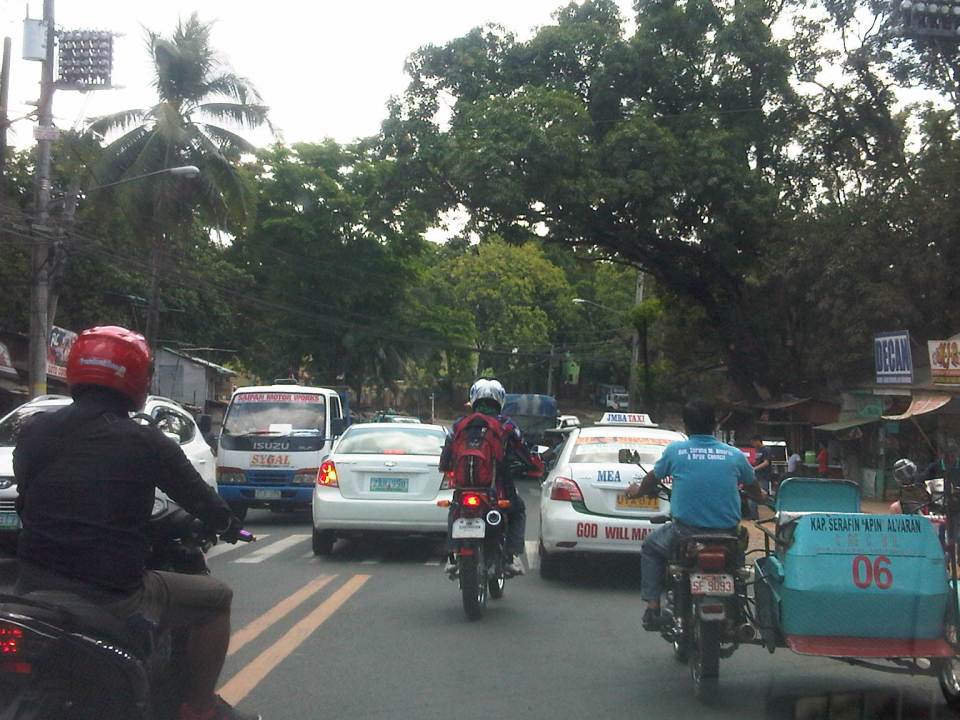 Congestion is often caused by counter-flowing vehicles forcing their way back into the right lane (like the car in the middle of the photo) upon encountering opposing traffic. It doesn’t help that there are motorcycles splitting the lanes to make for a very crowded road.
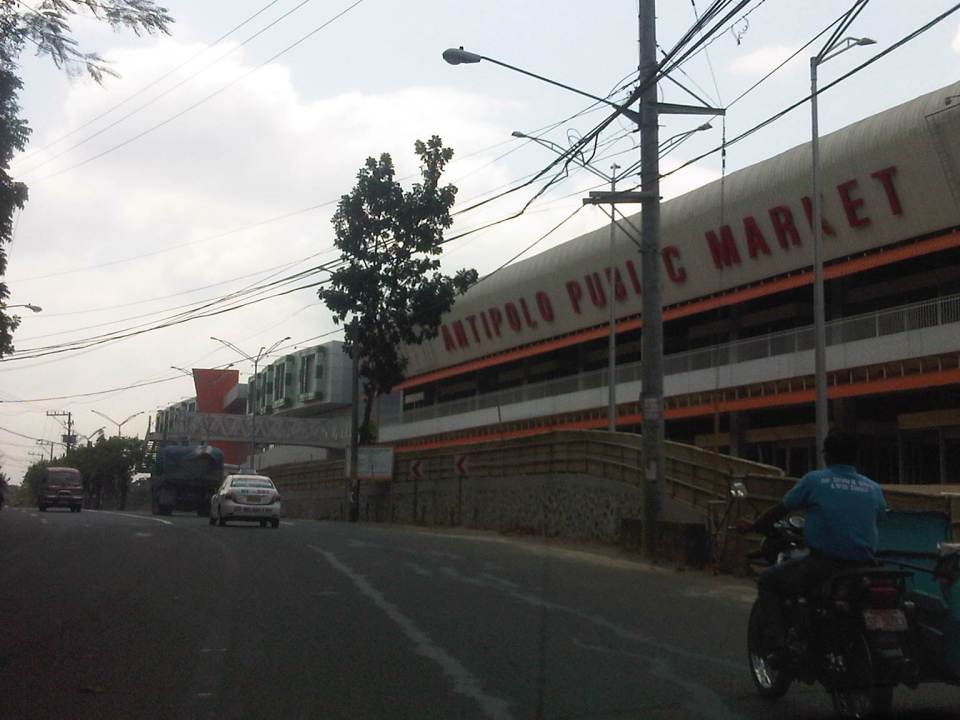 The new but still closed Antipolo Public Market along Sumulong Highway and near the intersection with Daang Bakal (the old railroad line that’s now a road). I wonder about the trip generation potential of this complex as it is not yet operational. Meanwhile, a huge Robinsons mall (looks larger than their Magnolia property) is currently under construction just across from it and will definitely be a major traffic generator in that area. The combined traffic to be attributed to these commercial complexes will surely have a tremendous impact on Sumulong Highway and other roads in the vicinity.
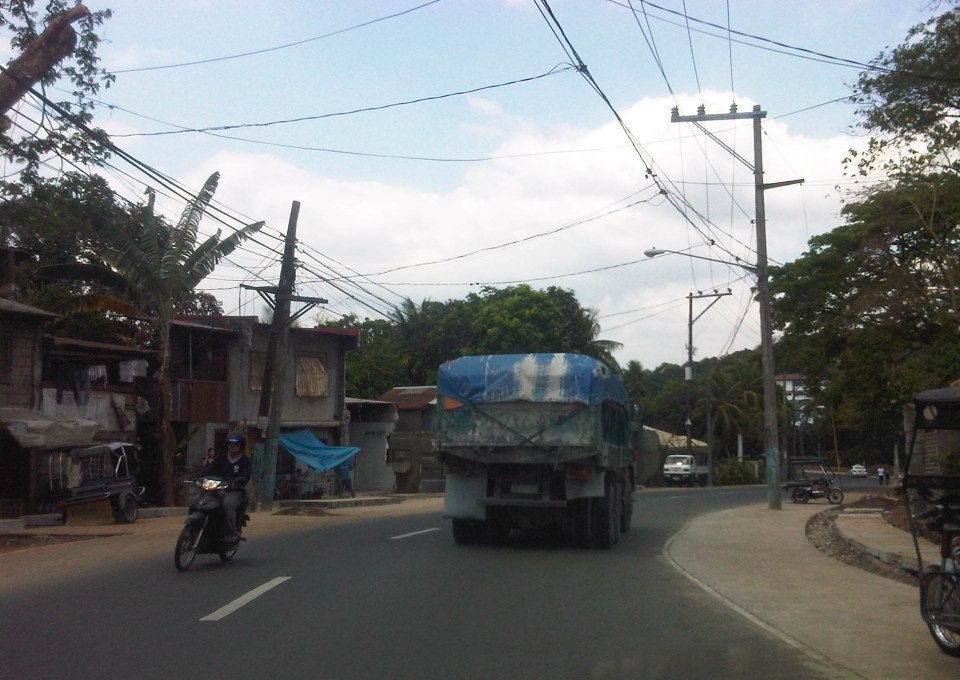 Both Sumulong Highway and Ortigas Avenue Extension carry significant truck traffic. These often cause congestion as they are slow going up to Antipolo and can block the entire road as Sumulong Highway and Ortigas Extension have some narrow sections where the shoulders could not provide enough space for other vehicles to pass the slower moving ones. In certain cases like the one in the photo above, there are electric posts in the middle of the shoulder lane.
 Tricycles occupy the outer lane of Ortigas Ave. Ext./Olivares Street. Such informal and on-street terminals are illegal along national roads and yet the city tolerates them. One explanation for this is that there are informal communities along the highway on shanties built along what is supposed to be a ledge along the mountainside (shown at right in the photo). These are where tricycle drivers and their families reside.
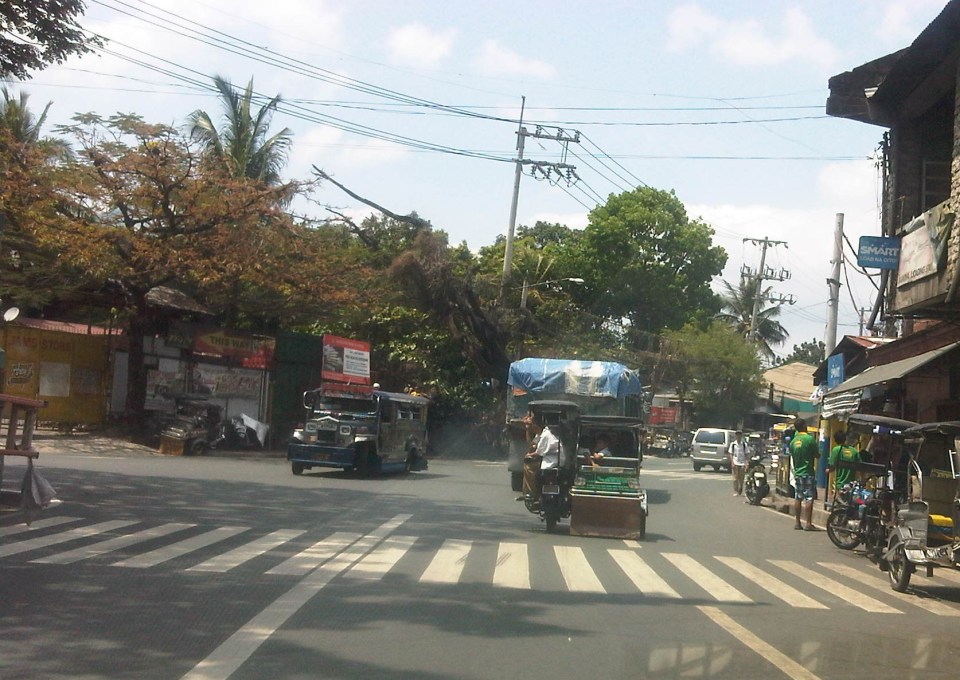 Tricycles from different tricycle operators and drivers associations (TODAs) seem to roam the entire city. This is contrary to the common practice in other cities and municipalities where tricycles are limited within a certain area or district that in many cases just overlap with others (e.g., UP Teachers Village-Philcoa-Krus na Ligas).
 Many tricycles serve as school service. However, the observation is that most tricycles tend to be overloaded with passengers. These are usually small children so the driver probably figured that they could cram more passengers than what is legally allowed.
 Sharing the road? Antipolo is very popular with cyclists and weekends bring a lot of them to the city as they come from all over via the main routes along Sumulong Highway and Ortigas Avenue (there should also be those coming from the east via the Antipolo-Teresa Road and Antipolo-Tanay Road). Most motorists are aware of these cyclists and give way to them. Most experienced cyclists are also aware of the ROW of other vehicles and so keep to the inner lanes. This mutual awareness and respect are vital to make roads safe for all. I think the only thing needed is to provide space for pedestrians as there are significant numbers of people walking, hiking or jogging along these roads.
–
Roads as solar dryers – Part 2
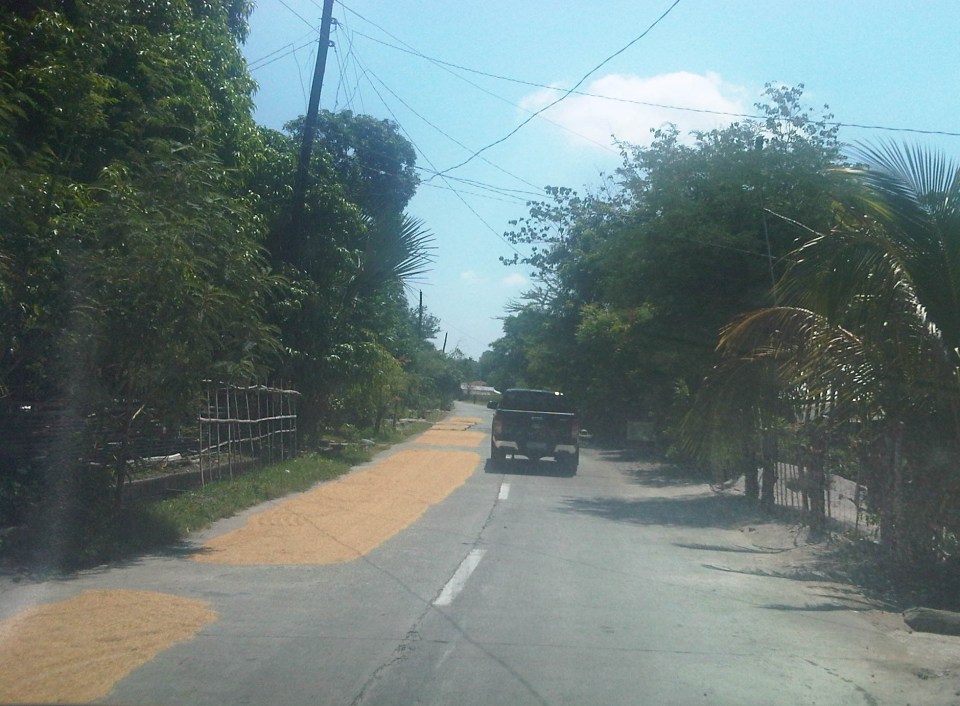
This is a continuation of an earlier post on roads being used as solar dryers. Our trip across Tarlac brought us to more of these facilities being used for agricultural purposes. The following photos are from San Jose and Mayantoc towns, which are obviously predominantly agricultural. The photos show lands devoted to agricultural as far as the eye could see and most are planted with rice.
A friend commented that something should be done to reduce if not eliminate such practices along roads. I replied that this is basically the responsibility of local government units including barangay officials who should be educated about the dangers posed to travellers as well as the deterioration in the quality of the rice as it gets compromised from the waste and grinding they get from vehicles. In terms of practicality and recognising the limitation in funds for solar dryers, roads seem to be the easier and versatile option. Basketball courts and other concreted spaces scattered around the countryside do not make sense where roads would have more use especially to address accessibility issues (e.g., farm to market roads).
Another friend commented on the earlier post that he almost had a collision with another motorcycle rider as the entire road was covered with rice being dried by farmers. I reasoned out that for rural roads with very low traffic, a single lane covered with rice could be tolerable but using the entire road width just is not right. Motorcycle can easily slip or skid along such rice-covered roads resulting in serious injuries if not fatalities. For most cases of what I’ve seen recently, the roads quality as having low traffic and rice is being dried only along one lane so we know at least that people are aware that one lane should at least be free of obstructions.
 1
1
 2
2
 3
3
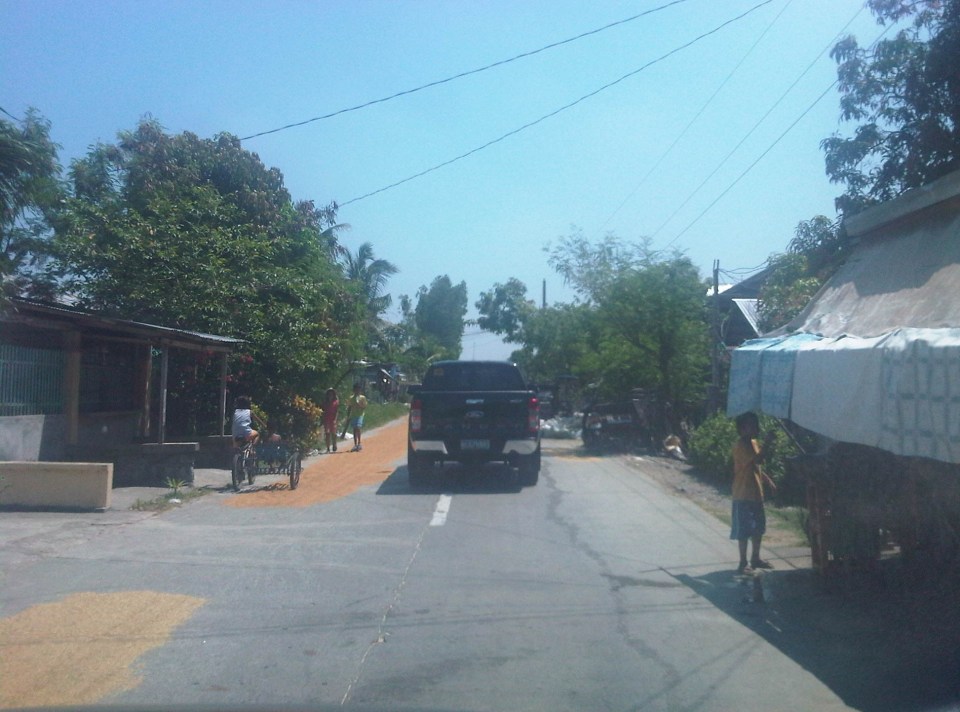 4 – That’s corn being dried just beside the pick-up truck in the photo.
 5
5
 6
6
 7
7
 8 – Bad practice of spreading the grains across the entire road carriageway
 9
9
The last photo is of corn kernels being dried on a basketball court. You can see the cobs piled near the stage, which shelters what looks like sacks of corn. As I mentioned earlier, it is possible to have such basketball courts or social facilities to be used as solar dryers. Even schools grounds can be used for this purpose but only for weekends or during the summer breaks. However, it would be impractical to have basketball courts and plazas scattered all over the countryside just for this purpose especially in places where there aren’t much people in the first place. Roads still offer the more flexible use (i.e., access/FMR and solar dryer) as long as traffic is not significant. Perhaps where traffic is significant (i.e., significantly populated areas) then such “off-road” facilities should be constructed. But again, the responsibility for making sure roads are clear of agricultural products would fall unto the LGUs.
–
Roads as solar dryers – Part 1
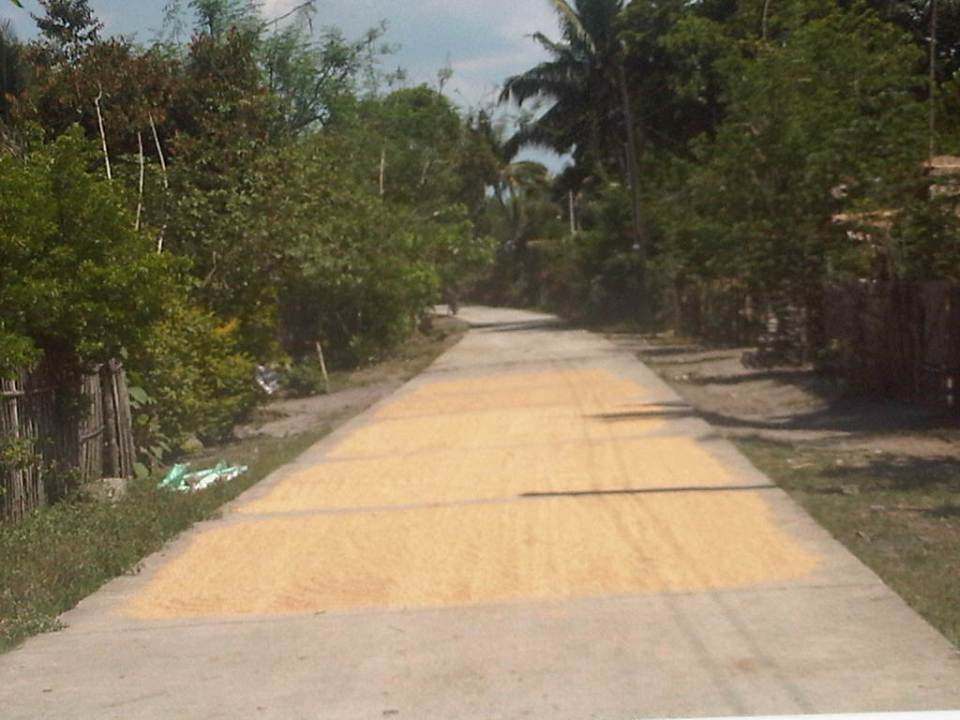
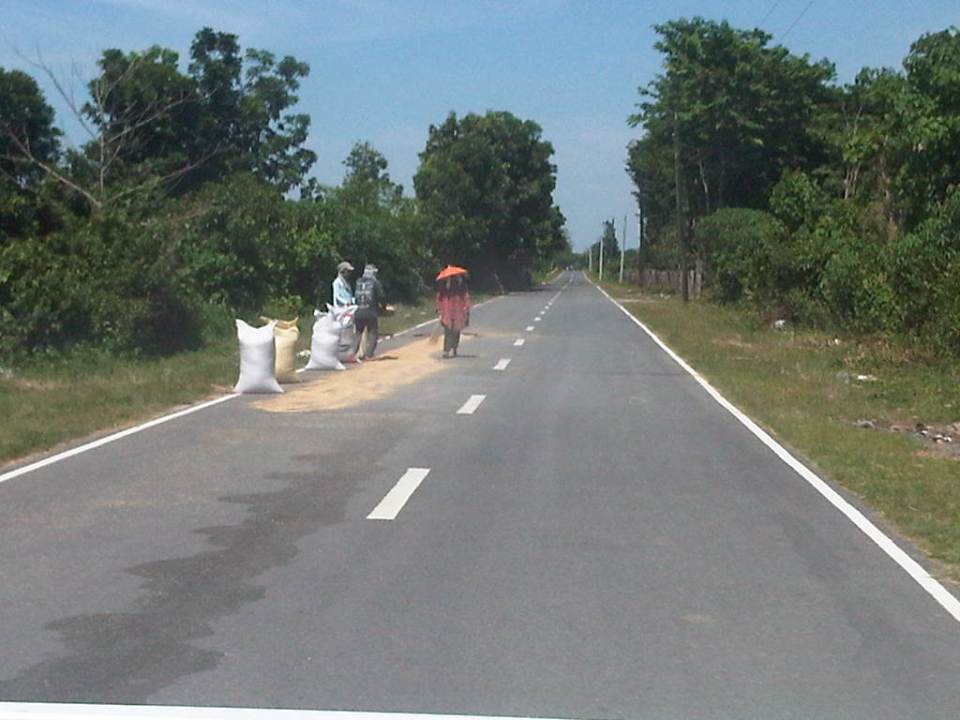
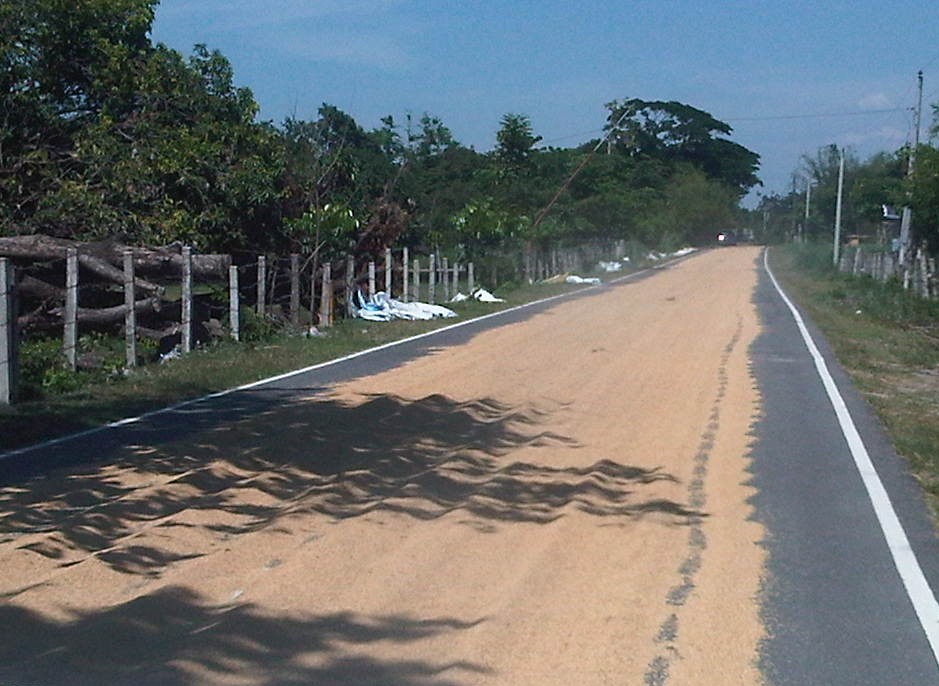
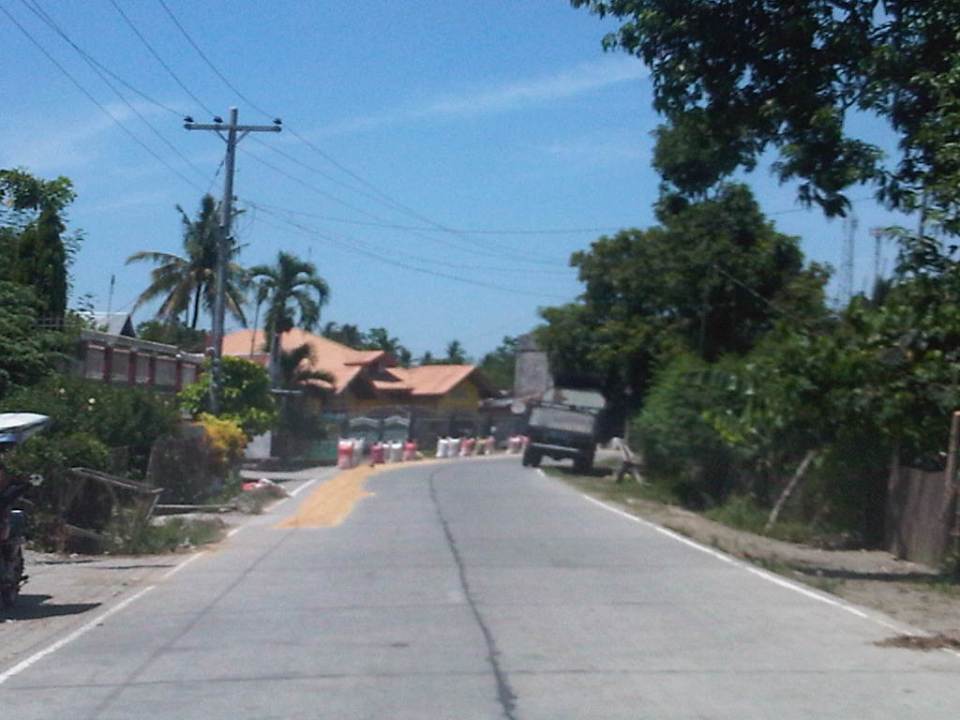
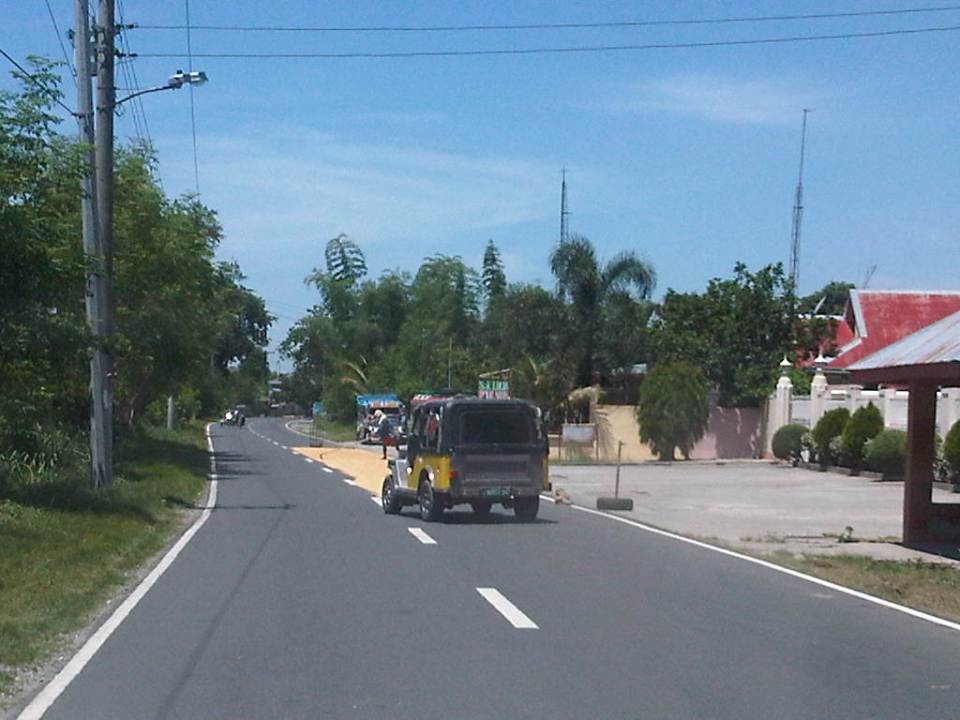
We are currently undertaking a project for the Province of Tarlac that looks into the safety along its rural roads (both national and provincial roads) including those providing access to tourism areas in the province. Along many rural roads are agricultural lands producing rice, corn, fruits, vegetables and other products. Often, travellers will encounter roads that serve another purpose other than transport – as solar dryers. Before rice is milled, it needs to be dried first so that it would be easier to remove the husk (i.e., separate the bigas from the ipa – together they are called palay). While it is possible to do this drying on mats (banig) spread over the land/soil this takes time. Meanwhile, portland cement concrete roads offer what seems to be the perfect surface for drying. As such, certain roads have been known to get justification for concreting despite low traffic volumes as they double as solar dryers. There are similar cases for basketball courts or village plazas receiving funding for concreting for the same reasons. Obviously, laying out rice on the roads have implications on the quality of the rice later on as vehicles will inevitably (even inadvertently) pass through the roads. I guess its even worse in cases when the road surface is of asphalt concrete. Following are photos I took along rural roads in Bamban, Capas and San Jose towns of Tarlac.
 1
1
 2
2
 3
3
 4
4
 5
5
 6
6
 7
7
 8
8
 9
9
 10
10
Other items that are usually dried on the roads include tingting (the stems of coconut leaves that are used to make brooms – walis tingting) barbecue and fish ball sticks. I have also seen fish being dried on the road one time during a trip to Northern Luzon. Obviously, among the risks are the rice being grinded by the tires of vehicles (resulting in durog na bigas more suitable for porridge), fuel or oil compromising the rice, and the prospects of animals doing their thing on the road near or on the rice!
More on these solar dryers in the next post!
–
“Pwede na yan” bikeways?
The recent clamor for bicycle facilities have led to several initiatives in Metro Manila and other Philippines cities (most notable recently is Iloilo) to support the demand for cycling facilities. While Marikina City already has a network of off-street bikeways segregated from motorised traffic, there are few other examples of such facilities elsewhere. The more recent initiatives in Metro Manila involved the Metropolitan Manila Development Authority (MMDA) establishing bikeways in several areas along major roads in the metropolis. I say establish because the MMDA did not construct new bikeways like the ones in Marikina or Iloilo. What the agency did was to designate sidewalks and other existing paths for cycling by painting these over. Unfortunately, these so-called bikeways did not take into consideration the needs of pedestrians with whom cyclists must share this limited space. And so few people use them despite a high profile launch that brought together government officials and NGOs including cycling and mobility advocates and enthusiasts. I guess the big test was really not whether advocates and enthusiasts would really use the bikeways (Don’t count on the officials to use them. They have chauffeur-driven vehicles.). Would the regular commuter use them instead of the roads, despite the risk or dangers posed by motor vehicles?
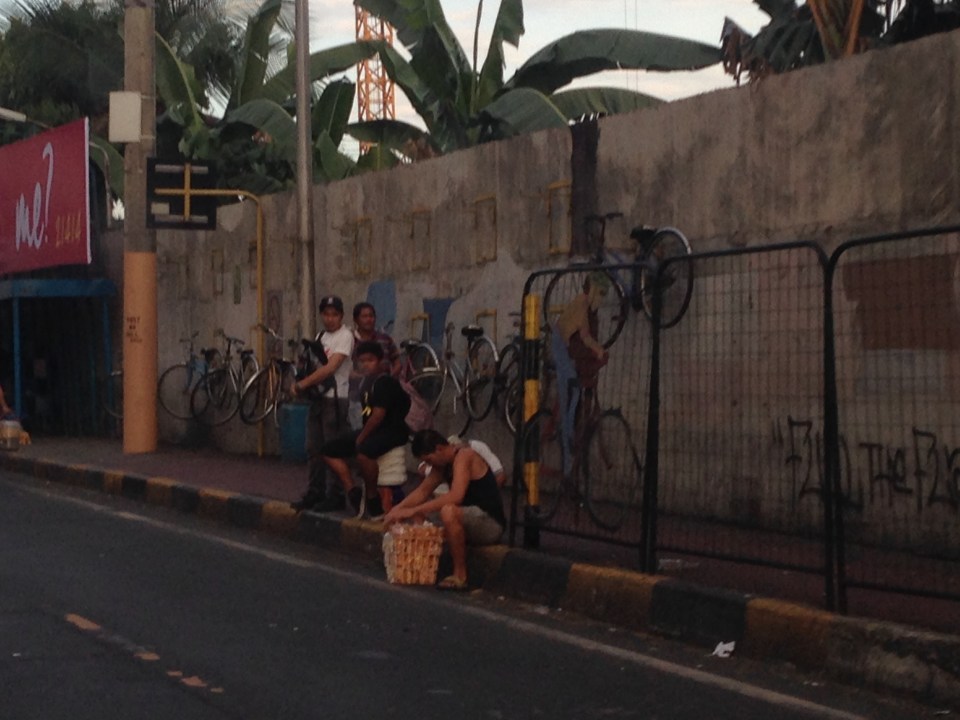 Commuters waiting for a bus ride along EDSA with suspended bicycle racks behind them. The sidewalks along EDSA have been painted red, designating them for bicycle use. The big question now is how cyclists will interact with pedestrians given the very limited space they should be sharing.
 Bicycles hanging on racks attached to the perimeter wall of an exclusive subdivision along EDSA.
 Cyclist using the curb side lane of EDSA – these people run the risk of being sideswiped by buses operating along the yellow (bus) lanes of this busy thoroughfare. It is quite obvious in the photo that there is no space on the sidewalks to accommodate cyclists and even pedestrians. Column for the MRT-3 stations are right on the sidewalks and makes one wonder how this flawed design was approved in the first place. MMDA enforcers usually appear as if they are only bystanders and seem to be generally helpless when it comes to managing traffic.
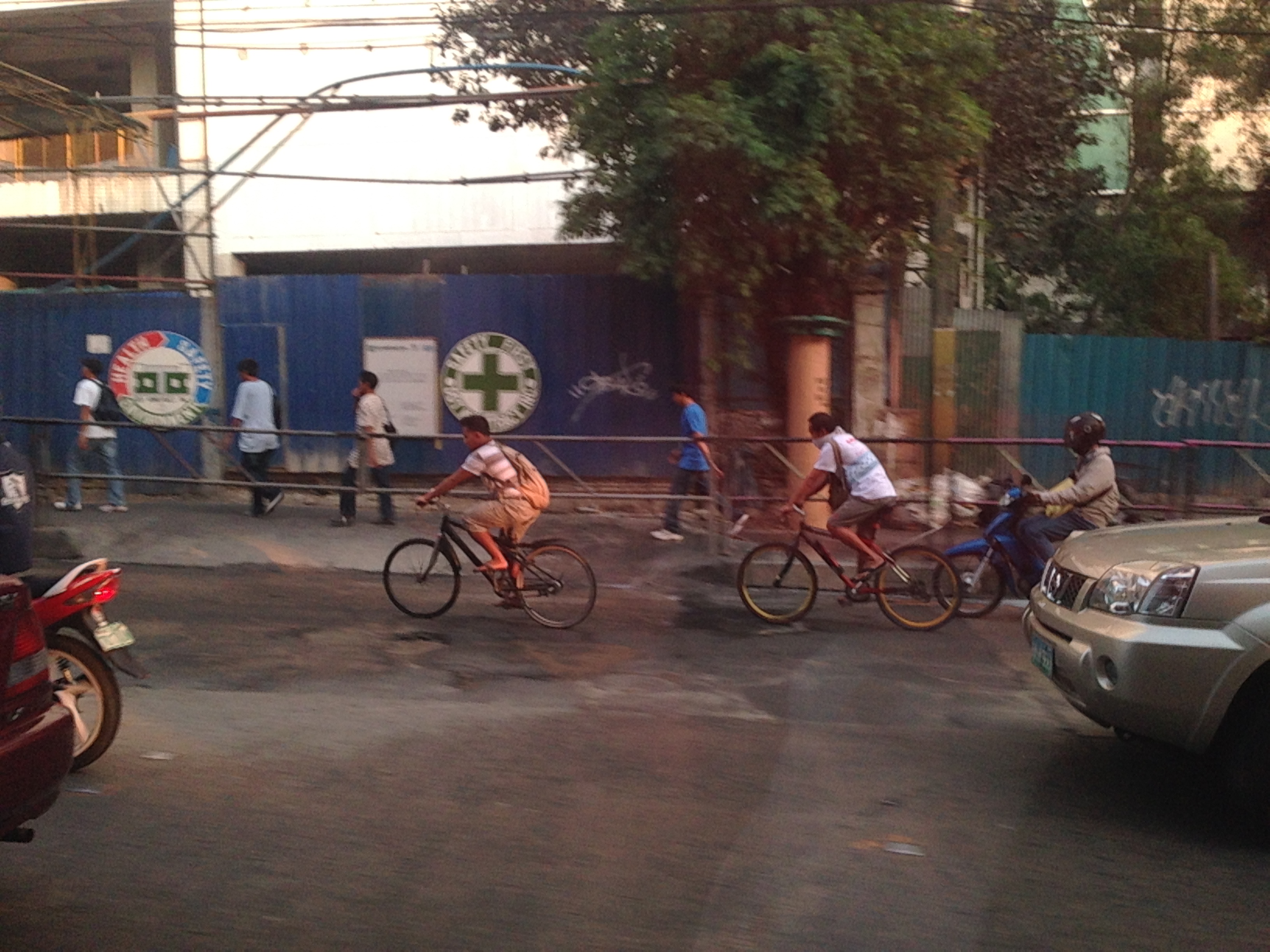 Workers cycling back to their homes after a day’s work. Many people have opted to take bicycles for their daily commutes even if they have to travel long distances in order to save money that would otherwise be paid as fares for buses, jeepneys, UV Express or tricycles. Note that the cyclists use the outermost lane of the road as the sidewalks pose many obstacles including pedestrians as shown in the photo. Some cyclists though want more than a share of the sidewalk or a lane of the road for their use regarding pedestrians and motor vehicles as nuisance for them. Surely, some pedestrians also regard cyclists as nuisance to walking and would prefer to have the sidewalks for themselves.
Cycling is in a way an emancipation from motorized transport commutes, and savings translate to money they could allocate for other needs of their families. While there are raw data for family expenditures from census surveys, there are few studies and publications focused on transport. It would be interesting to see how much a typical Filipino family spends for transport in absolute terms as well as a percentage of their total incomes. Such information would be essential for understanding the needs of travelers, especially for daily commutes for work and school (other trips include those for purposes of shopping, recreational, social and others). Long commutes are associated with higher expenses (e.g., in terms of fares or fuel costs) and reducing such costs through shorter commutes should free up money for necessities like food, housing and clothing. Ultimately, this would help solve issues relating to poverty and health, which can easily be related to commuting behavior and characteristics.
It is in that context that transport systems should be planned and implemented carefully along with the housing developments. This underlines the essence of the relationship between transport and land use that has been the topic of discussions for quite some time now that apparently, a lot of people in this country, especially officials and the private sector have chosen to ignore or apply selectively (i.e., according to their own advantage and not really for the general welfare of the public). A transport system is not cycling alone, or roads or railways alone. It is, by definition, a network, a set of interacting, integrated elements and each of these components of the system are essential for it to function well. It is the interaction and integration that are the key elements that we often forget as we advocate one transport mode over others as if they are independent from each other. They are not and we should complement rather than compete in our advocacies for transport so we can finally achieve an efficient, effective system for everyone.
–
Traffic mayhem in Antipolo
I had written earlier about traffic management in Antipolo City. My daily commute allows me to observe transport and traffic in this pilgrimage city east of Metro Manila. For a highly urbanised city (HUC), its traffic management is quite rural or provincial at best with enforcers trying to do their thing based more on gut feel rather than sound knowledge of traffic principles. Intersection traffic management, for example, needs a lot of improvement as enforcers are pre-disposed to apply the buhos approach to dissipating queues that actually lead to longer queues, tremendous delays to travellers, and therefore low levels of service (LOS) at the intersections. The signalised Masinag Junction is probably one of the worst intersections outside of Metro Manila with queues along the south approach (Sumulong Highway from Antipolo) stretching to Mambugan (about 2 km) even on a Saturday. Along the east approach (Marcos Highway from Cogeo) the queues can stretch all the way to Cherry Foodarama supermarket (about 1 km).
Masinag, of course, is a big intersection with heavy traffic due its being the junction for 2 major highways (Marcos and Sumulong) that collect much of traffic from Rizal and Marikina bound for the general direction of Quezon City and Manila. Marcos Highway is the main alternative corridor to Ortigas Avenue, which is itself a very congested road, between the eastern towns and Metro Manila. There are many other problematic intersections in the city, which are mostly unsignalized where traffic is managed manually by enforcers. I’m sure there are some minor intersections that are manageable at most times of the day and may not actually require enforcers if motorists give way to each other. However, there are those intersections that require stricter and more systematic (if not scientific) methods to manage traffic. For example, along roads leading to the Antipolo cathedral where there are a lot of people posing as parking attendants going over to aggressively engage motorists at the intersection. Enforcers routinely turn a blind eye to these people who pose as safety risks along the roads.
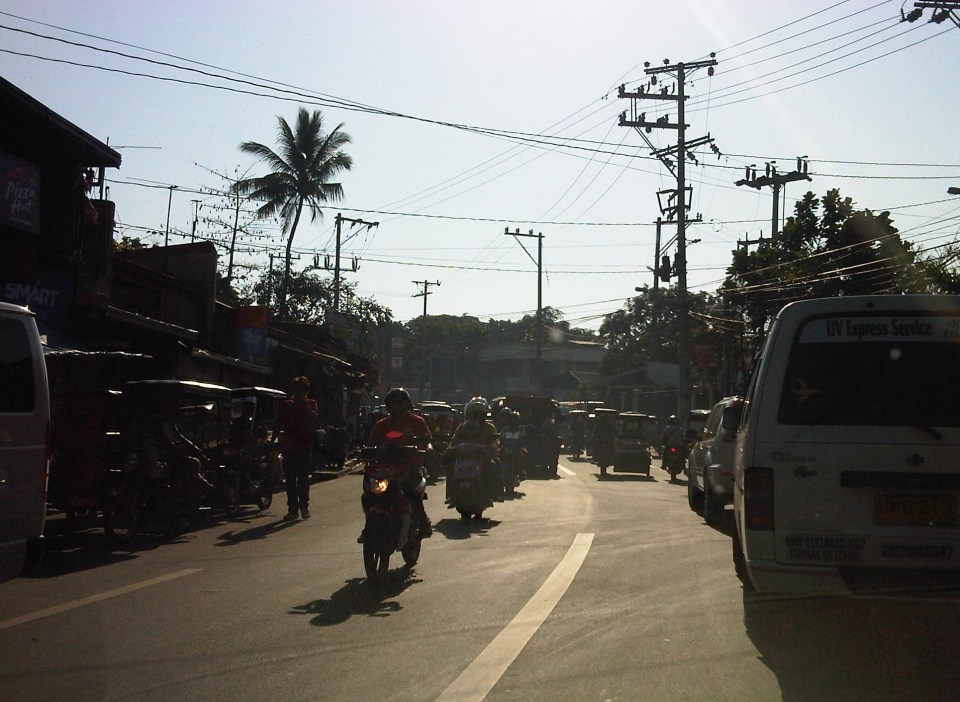 Tricycles occupying the outermost lane along Ortigas Ave. Ext. and Oliveros Street at the junction with Sumulong Memorial Circle and just across from the Rizal Provincial Capitol – to exacerbate the situation, jeepneys and UV Express vehicles usually stop in the middle of the road to load/unload passengers. Such informal terminals should not be allowed in these areas considering it is a chokepoint for traffic along these busy roads. So far, enforcers around the capitol seem oblivious to the mayhem caused by these terminals and turn a blind eye to the disruptive manoeuvres of tricycles in the area.
 Dangerous intersection along Sumulong Highway – there is road at the right (where a tricycle is coming from) that is used by trucks and other vehicles coming from Marcos Highway. Olalia Road connects to Marcos Highway and there are many residential subdivisions along this road that generate the traffic to and from Marcos and Sumulong Highways.
More on Antipolo traffic soon!
–
Scenes by the roadside at the port area in Manila
Traveling along Radial Road 10, you get to see how life in Manila really is. It is not the glitzy new developments that people try to present as the face of the city. The real deal is in places like Tondo, the Baseco compound and Smokey Mountain. The areas along R-10 starting from across from the North Harbor to Smokey Mountain (yes, it is still there) provide us with a peek into everyday life in this part of Manila.
 Carpenters working on the body of what would become karaoke machines. The TV or screen will be installed at the upper shelf and the machine and controls will be installed in the lower part. These are popular around the country and are often rented out for parties. The quality varies but I would say that there are really good quality karaoke machines with digital quality equipment providing crisp music and the correct lyrics to karaoke lovers.
 As these are informal communities, houses do not have water or electricity connections. As such, people purchase water from nearby establishments or houses, and many have illegal water and power connections for them to have water and electricity. Such illegal connections have led high losses to utility companies that translate to costs passed on to legitimate customers.
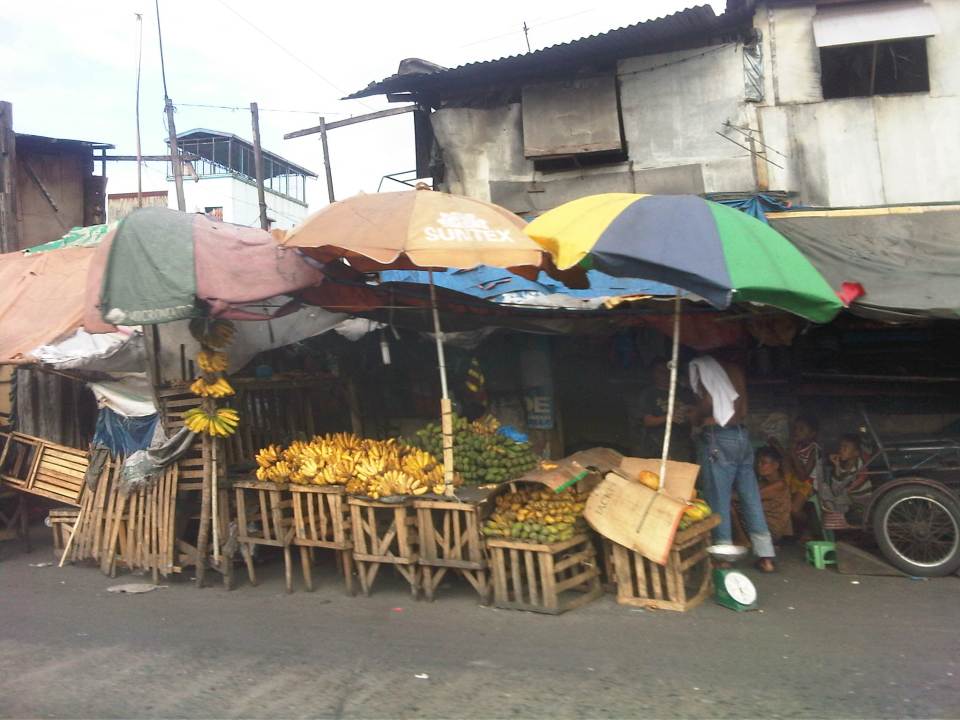 Many roadside stalls sell a variety of fruits like the bananas shown in the photo. It’s actually interesting to note that just across from the stalls is the port area whose walls don’t seem to be enough to discourage people from trying to pilfer the containers and crates containing various stuff shipped through the Port of Manila.
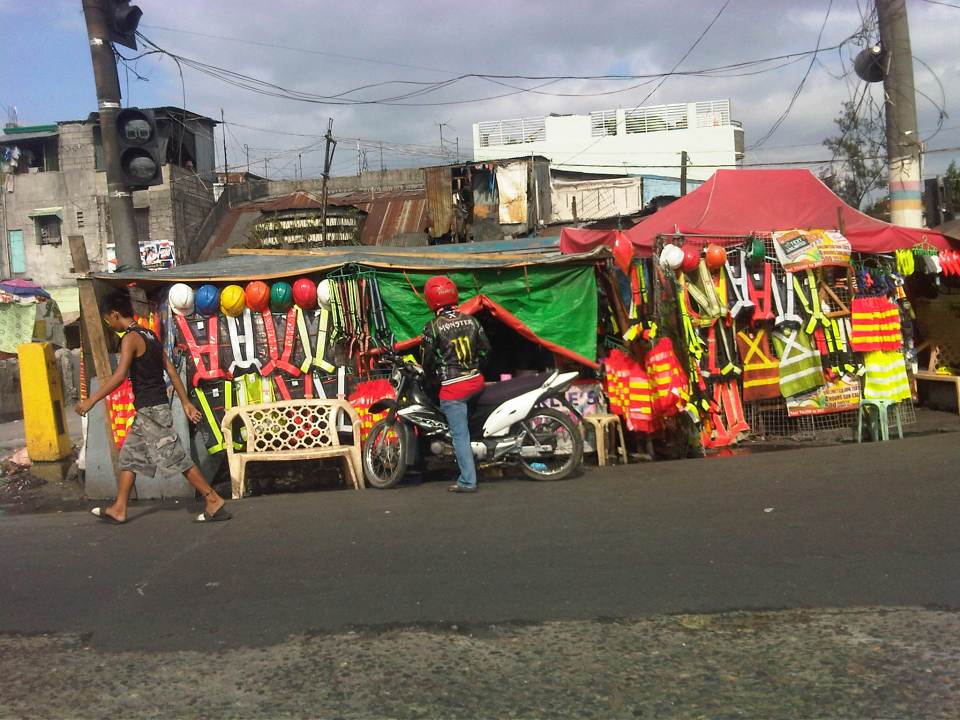 Roadside stalls selling practically anything and everything. This one is selling hard hats and reflective vests. These vests can be used by construction workers as well as traffic enforcers. Recently, motorcycle riders have been required to put on vests for them to be more visible to other road users.
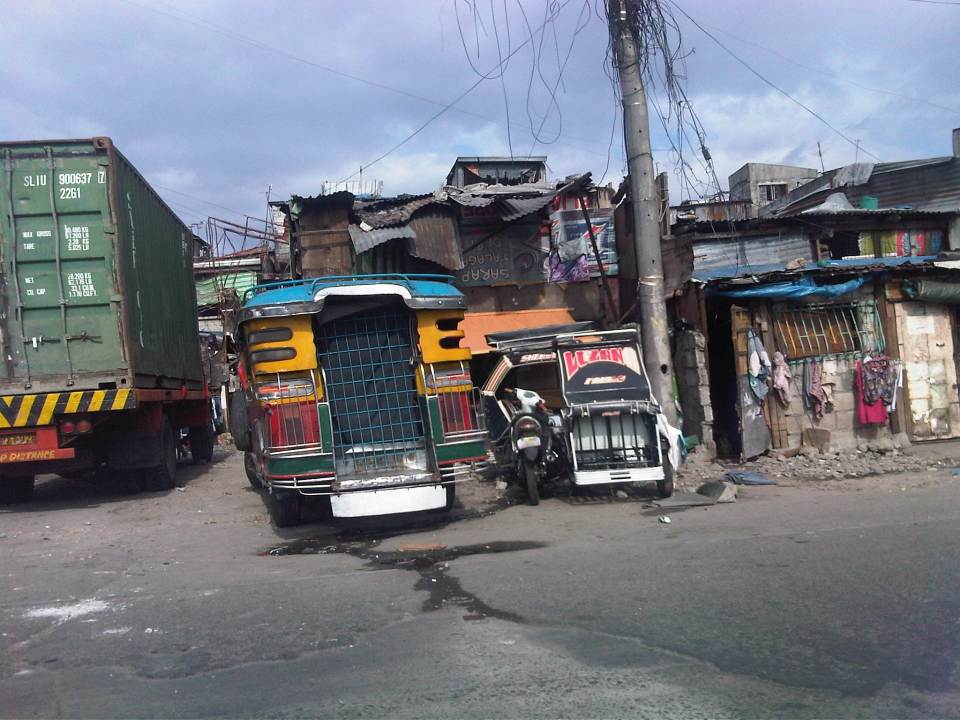 Shanties line up along the road, actually on the road as these were built on top of the space already allocated for R-10. Many sections have already been paved where shanties have been built. These shanties are now the subject of a program to remove them and open up the space for traffic to ease congestion along this road, which has much truck traffic.
 It seems that a lot of people have pedicabs as a means for livelihood. While there is nothing fundamentally wrong with this, the issue is mainly with regards to their excessive numbers and suitability as a public transport mode given their operations and propensity to go against traffic rules and regulations.
 The mass housing in the Smokey Mountain area are multi-storey apartments that look like they definitely have seen much better days. These buildings actually look like multi-storey shanties (similar buildings elsewhere including BLISS projects look much better or are better maintained). Many units have been extended and the structures now pose hazards (e.g., fire, earthquake, etc.). Alleys are not passable to emergency vehicles like fire trucks as residents have maximized occupancy of the spaces at the ground level. These look like the perfect cases for how NOT to develop mass housing.
–
More snippets of Manila streets
The City of Manila has always been fascinating from the perspective of transport and traffic due to the many peculiarities and contradictions you’ll find around the city. Here are a few more photos and some comments on the Manila’s transport and traffic.
 Pedestrian overpass along Espana Avenue right after P. Campa Street and just before Morayta Street. Most overpasses in Metro Manila are roofless so this overpass is an exception. Most roofless overpasses were constructed when Bayani Fernando was MMDA Chair and were made so to discourage vendors from setting up on the overpass. The roof, however, makes sense considering the high pedestrian traffic (mainly students) in this area, which is dubbed the University Belt due to the many universities and colleges located here.
 Another overpass in Manila, this time roofless, along Quezon Boulevard. Notice the large umbrellas in the photo? Under these are informal vendors who have set-up shop atop the overpass, effectively constricting pedestrian movement on the facility. Notice, too, the signboard bearing a message from the incumbent Mayor of Manila who happens to be a former Philippines President. The message in Filipino translates to “There’s hope for a New Manila.”
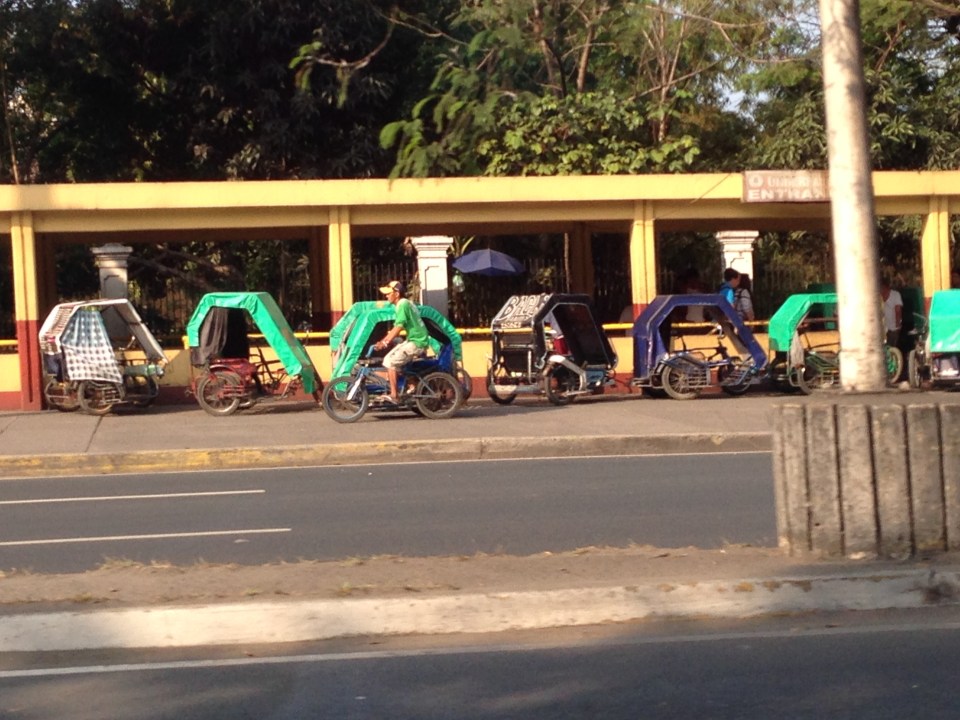 Non-motorized pedicabs proliferate in Manila and particularly in and around Intramuros, the historic walled city that was Manila during the Spanish period. There are just too many of these 3-wheelers in this city and most if not all drivers are oblivious to traffic rules and regulations. In Intramuros they have narrow streets and most destinations of interest don’t really require a vehicle. Walking is the most suitable transport within the walled city. These pedicabs are quite peculiar for a district that is supposed to be walkable and very accessible to public transport along its main streets. Manila has tolerated (some say spoiled) the operators of these vehicles and has made “livelihood” as the standard excuse for their existence and proliferation especially in low income areas of the city.
 There are a lot of “tambays” or people just loitering around or spending (wasting?) time in the open spaces near and at the Liwasang Bonifacio just across from the Manila Central Post Office and Manila City Hall. Many of these are homeless people that the city as well as the Department of Social Welfare and Development (DSWD) have not attended to. Their presence are just too obvious to passers by and mingling among them if not they themselves are snatchers, muggers and other unwelcome elements of our society. The tarpaulin is placed over a sign stating trucks are prohibited from using Roxas Boulevard. The new truck policies in Manila have been a hot topic since early this year but everything now seems to be back to “normal” after somewhat spirited reactions from truckers that again exposed issues pertaining to the traffic impacts of the Port of Manila.
–
Traffic consultants for Philippine cities?
I was driving to the office one morning, and as I was slowing down to stop at the Masinag junction I spotted a familiar face giving instructions to Antipolo traffic personnel. Robert Nacianceno was formerly the General Manager (Undersecretary level position) with the Metropolitan Manila Development Authority (MMDA) when it was chaired by Bayani Fernando, the first MMDA Chair to gain a cabinet level post (previously the MMDA Chair was not a Secretary level position). He was in an office barong while leading Antipolo staff in positioning orange traffic cones to mark the lanes for turning traffic along the Sumulong Highway approach from Antipolo.
Nacianceno is a cyclist so I would like to think that he can take that perspective in transport planning and traffic management for Antipolo. Unfortunately, his track record at the MMDA does not provide strong evidence as to his competence in transport planning or traffic management. Insiders say most policies and schemes during BF’s time was the latter’s ideas (e.g., U-turns, bike lanes, etc.) and he had his own consultant (and reportedly an inner circle) for various matters including traffic. In fairness to the man, Nacianceno probably has tremendous experience on the job but one has to note that there were other people with the MMDA who also dabbled in transport and traffic. Also, as GM he had other things to attend to during his stint including waste management and flood control.
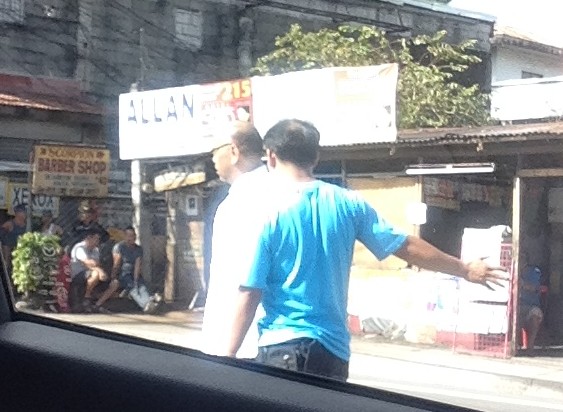 Remember this guy? He used to be the MMDA GM during BF’s stint at the agency.
I recall that the previous traffic consultant of Antipolo City was also a former MMDA official, Ernesto Camarillo. Unfortunately, I couldn’t say that Antipolo traffic improved during the last few years. Based on what I have seen in my daily commute, transport and traffic conditions have degenerated. Antipolo is overrun by tricycles and people generally do not follow rules and regulations. Informal terminals dot the city and you don’t have to go far to find inappropriate terminals as these are in plain view and across from the Rizal Provincial Capitol. Antipolo has a new mayor in the former Rizal Governor and his mother now sits as governor of the province. I’m crossing my fingers as to how they will improve transport and traffic in Antipolo if there is really a desire to do so. For starters, is there a transport and traffic plan for this Highly Urbanized City (HUC)? There should be one as the city needs it badly together with a land use plan to bring some order in development.
Antipolo is rapidly developing but at the same time conditions (including traffic) are also rapidly deteriorating. Hopefully, the LGU will address these issues and eventually make this city a modern one and fit for its being an HUC as well as a popular pilgrimage site for decades if not centuries due to the Shrine of Our Lady of Peace and Good Voyage (Is there some irony here?). Nacianceno’s work has just started and I hope he is up to the challenge of bringing order to Antipolo’s chaotic transport and traffic situation. I hope, too, that he will take note of good practices in other cities (Philippine or foreign) and won’t be relying purely on his experiences in Metro Manila. And hopefully, whatever improvements from the traffic schemes he will be introducing and implementing will be felt immediately by travellers. Good luck!
–
 Caught (up) in traffic