
Home » Health (Page 2)
Category Archives: Health
Let’s act on road safety crisis!
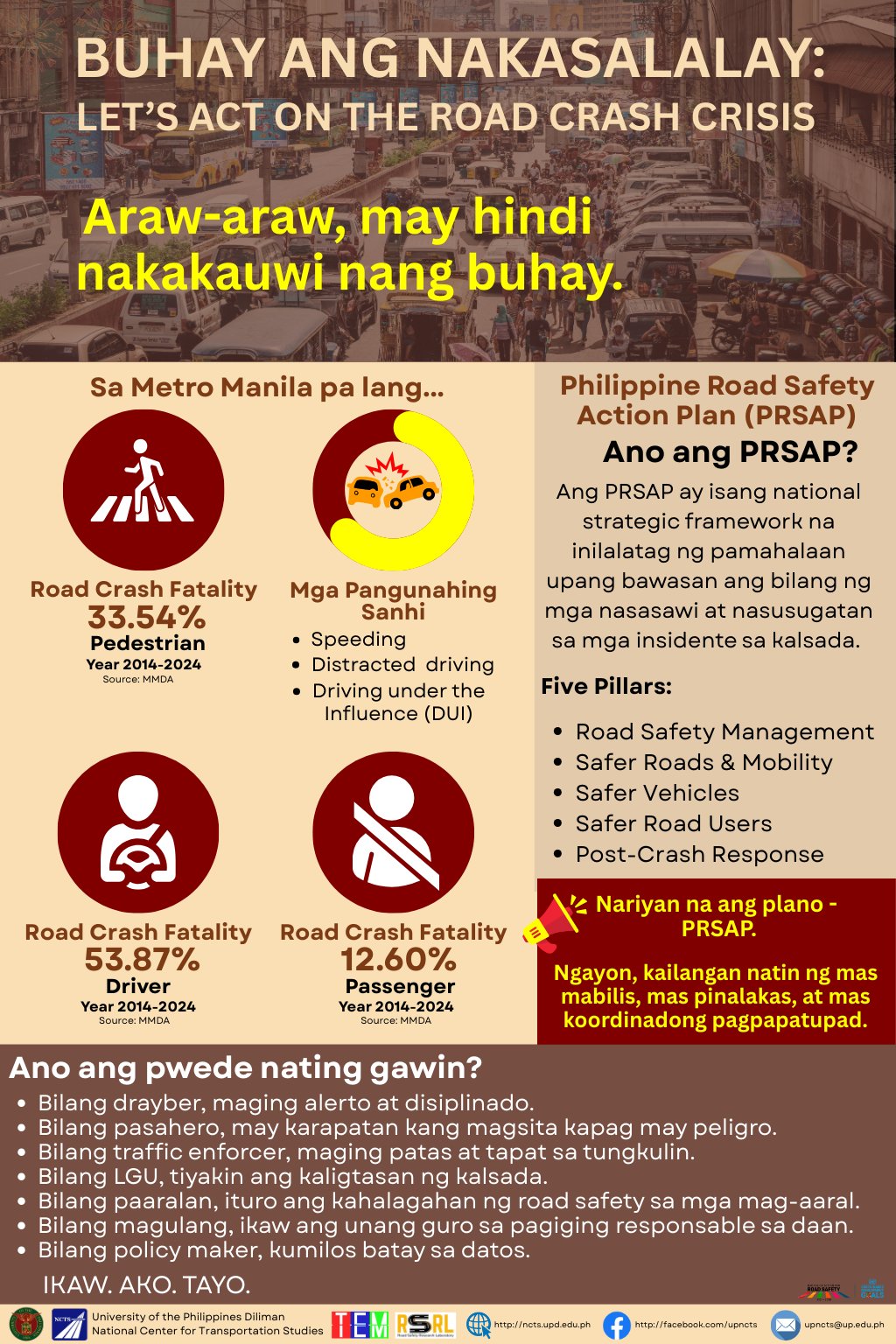
May is Road Safety Month. It’s quite ironic that we started the month with some of the most gruesome crashes including one at SCTEX and another at NAIA. There is indeed a crisis on road safety but many are in denial or perhaps insensitive to the impacts of these crashes. We need to act and only together can we be most effective in reducing the risks for all road users.
So what can one do? How can one contribute to making roads safer? Sharing this poster from the Road Safety Research Laboratory (RSRL) of the National Center for Transportation Studies (NCTS) of the University of the Philippines:
–
On the ‘silent walk’
My first post this May is an article share on what is referred to now as a ‘silent walk’. That means leaving your gadget at home or work to take walk whether in park, the city or your neighborhood. We all seem to be dependent on our gadgets these days, with many panicking when discovering they left their gadget. It’s as if their world has stopped without the gadget at hand.
Bull, M. (April 30, 2025) “The power of a “silent walk”,” Medium, https://blog.medium.com/the-power-of-a-silent-walk-93ffdd70dbcb [Last accessed: 02/05/2025]
To quote from the article:
“For many of us who rely on laptops, phones, and apps throughout the day, it can be easy to reach for those same devices when we need to relax — if they solve our productivity issues, the thinking goes, they must solve our stress, too. But just as spending the first hour of your day screen free will have an outsize effect on your inner peace, leaving the phone and headphone at home while you head out for a walk will return you to a saner place in record time.”
Granted that you bring your gadget for ’emergency purposes’, perhaps the key is not using it. Keep it in your pocket. Refrain from checking or glancing at the slightest temptation. It may be difficult at first but it will gradually build into your routine. And perhaps, too, you will feel a bit of liberation from these gadgets and reconnect with the world around you to help your well-being.
–
On safe school zones
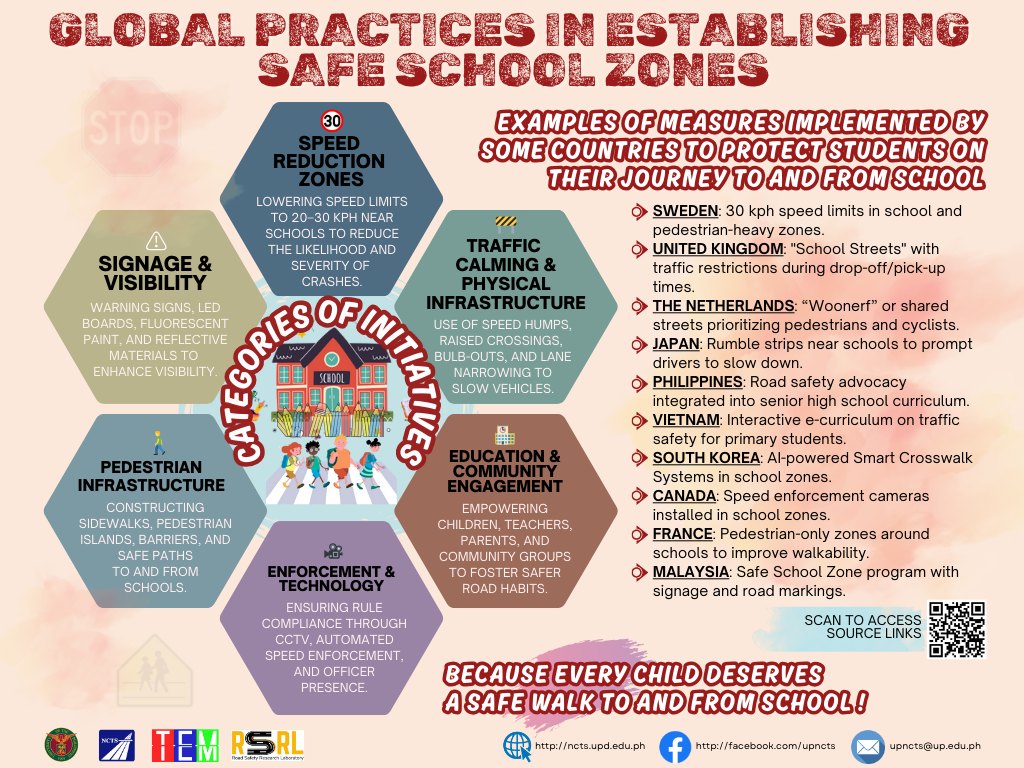
We’ve been working for safer roads since I started practicing as a transportation engineer/planner. Most recently, we were working on a program supported by UNICEF on Child Road Traffic Injury Prevention (CRTIP). The work towards safer roads especially for those who are most vulnerable is always challenging but it is something that is definitely worthwhile. As we approach May, which is Road Safety Month in the Philippines, I will try to write more about road safety.
Here is an infographic shared by the Road Safety Research Laboratory of the National Center for Transportation Studies of the University of the Philippines:
–
On understanding road diets
I’ve written and shared articles on road diets and complete streets before. Here is another article share on road diets
Johnson, R. (April 21, 2025) “Explainer: What is a Road Diet – And Why Should Cities Embrace It?,” Momentum Magazine, https://momentummag.com/explainer-what-is-a-road-diet-and-why-should-cities-embrace-it/ [Last accessed: 22/04/2025]
To quote from the article:
“The road diet isn’t about punishing drivers. It’s about creating streets that work better for everyone—from the parent pushing a stroller to the teenager biking to school, the delivery driver navigating a tight urban corridor, or the senior walking to the store.
As our cities continue to evolve, road diets offer a cost-effective, data-backed, and scalable way to make them safer, cleaner, and more livable. It’s not just about losing a lane—it’s about gaining a better future for urban mobility.”
Indeed, the first thing that usually comes to mind of motorists whenever road diets and complete streets are mentioned is that the road space (and consequently capacity) will be reduced. This reduction of capacity is actually from the perspective of the motor vehicle rather than the number of people traveling along a road as well as improving road safety for all. The article is spot on in its discussion on the resistance to road diets (and complete streets). Of course, context is very important here and it is important to identify which roads can be transformed for the transformation to be most effective.
–
On step counts towards health and wellness
I’m sharing here an article about step counts. I guess the jury is still out there so to speak when it comes to the number of steps per day. The key is really to be active rather than just sit or lie down for most of the day. And there are many ways to be active and be able to measure it so you can monitor your movement.
Loudin, A. (February 28, 2025) “Why step count remains the most impactful fitness stat,” WebMD, https://www.webmd.com/fitness-exercise/news/20250228/why-step-count-remains-most-impactful-fitness-stat [Last accessed: 4/14/2025]
To quote from the article:
“For decades, the goal was 10,000 steps a day — but further research has shown that step counts as low as 2,500 still deliver long-term health benefits that increase as your step count rises — even past 10,000. The bottom line, however, is that more movement is better for you and serves as the best measurement of longevity.”
You can walk to start your day. You can walk in the middle of the day (say lunch time). And you can walk after dinner. And that’s just walking. Of course, you prefer to jog, run or bike, even swim, then that should do it for you in terms of being active. Walking though is really for most people who are physically able. And you can do it outdoors or indoors (yes, even in a building). So that’s where you should start in terms being more active towards health and welnness.
–
On walkable spaces for senior citizens
Here is a quick share of an article on walking and walkability, and the relation with dementia:
Steuteville, R. (March 10, 2025) “Living in a walkable place reduces dementia,” , https://www.cnu.org/publicsquare/2025/03/10/living-walkable-place-reduces-dementia [Last accessed: 3/29/2025]
To quote from the article:
“When we live in a walkable place, we move more, naturally. Unsurprisingly, exercise is linked to better cognitive health. Regular exercise increases memory, and boosts hippocampal volume by 2 percent.
Also, walkable neighborhoods are more stimulating. They are built on connected street networks, which give individuals more choices on how to get around and reward those choices with diverse physical paths linked to spatial memories. And they are mixed-use.
“Street layouts with better connectivity and walkability are associated with a reduced risk of cognitive impairment. Access to local amenities, such as food stores, community centers, and healthcare amenities, supports cognitive health,” the authors note.
Social connections also probably help. When you walk to a destination, you are more likely to have friendly interactions, which have been shown to reduce the risk of depression, and walkable places also boost the sense of community.”
As there are many senior citizens in our village, the topic is quite relevant. Most seniors probably won’t take a walk if they felt it was dangerous or risky even inside residential subdivisions. In our neighborhood, there are a few of them going around using their motorcycles or scooters. Most I see walking around perhaps for exercise or leisure rather than to go to a store or restaurant in the area. But increased traffic due to customers of restaurants that sprouted around the village has increased the risk for those who walk. Hopefully, the induced motor vehicle traffic generated by these establishments can be managed and regulated for the overall welfare of residents.
–
Article on the evaluation of congestion pricing
I want to share this article on the congestion pricing zone in London. This is called the Ultra Low Emission Zone (ULEZ), which also met resistance when it was first implemented.
Selby, O. (January 16, 2025) “ULEZ expansion hasn’t hurt high street spending,” Centre for Cities, https://www.centreforcities.org/blog/ulez-expansion-hasnt-hurt-high-street-spending/ [Last accessed: 2/1/2025]
Quoting from the article:
“The benefits ULEZ has provided to public health have been studied extensively. The data is clear: London has the worst air quality of any UK city and the capital’s emission zone is helping to change this.
So far, card transaction data does not suggest that ULEZ is harming high street spend. This should reassure policy makers in London, who committed to the emission zone a while ago, and strengthen the convictions of policy makers in New York who are now following suit.”
The article is a nice reference not just for evaluation of similar congestion pricing schemes but can also be used for carless streets or zones. I wonder if there are similar work being done for Baguio’s congestion pricing scheme as well as the carless programs in Ortigas Center. Quezon City should also do this for the newly implemented program along Tomas Morato.
–
On the fatal Katipunan road crash
The vehicles involved in a recent road crash that killed at least 4 people are still there and parked under the Aurora Flyover. A truck apparently lost its brakes and control and the driver ended up plowing into other motor vehicles, likely trying to gain some control in order to stop the truck. It was reported in news articles that there were 4 immediate fatalities and many suffered serious injuries. We probably won’t know the final fatality count unless someone reports on those hospitalized for injuries.


The crash highlighted again the need for vehicles, especially trucks, to be roadworthy. This time of year, most of these trucks run busy schedules with the logistics requirements. But maintenance is just one part of the problem here as the truck was reported to be speeding. So driver behavior is also a factor and apparently there was no monitoring (having those CCTVs don’t count if they are only used in a passive manner such as for evidence after a road crash had already occurred) or enforcement versus speeding for these large vehicles. Also, was the truck overloaded? This practice may also lead to the deterioration of the truck’s brakes and the vehicle’s mass contributes to the severity of the crash including the damage to other vehicles. The MMDA and LGUs have their work cut out for them to address these road safety concerns.
–
Planning for True Transportation Affordability: Beyond Common Misconceptions
How much do we spend on transportation as part of our budgets? Is it 5% of your monthly budget? Is it 10%? Or is it eating up a substantial part of what you’re earning?
Source: Planning for True Transportation Affordability: Beyond Common Misconceptions
To quote from the article:
“This research indicates that many common policies favor expensive transportation and housing over lower-cost alternatives, which drives the cost of living beyond what is affordable, leaving too little money to purchase other necessities. The result is immiseration: growing stress, unhappiness, and discontent.
The solution is simple: planning should favor affordable over expensive modes and compact development over sprawl. This is not to suggest that automobile travel is bad and should be eliminated. Many people are justifiably proud of being able to afford a nice car, and automobiles are the most efficient option for some trips. However, automobile travel requires far more resources and is far more expensive than other modes, typically by an order of magnitude, so true affordability requires an efficient, multimodal transportation system that allows travelers to choose the options that truly reflect their needs and preferences.
Affordability requires a new economic paradigm; rather than trying to increase incomes or subsidies we need to increase affordability and efficiency so households can satisfy their basic needs consuming fewer resources and spending less money. Our planning should be guided by a new goal: how can we help families be poor but happy.”
I share this article because it provides a more complete narrative and assessment than those just focusing on transport. Home choice locations and affordable housing are part of the equation. Looking at transport alone can be myopic and leads us to think it is the only problem to solve.
–
Are transportation issues election issues in the Philippines?
Are transportation issues in the Philippines? Or are these issues at the local level? Here is an article about how transportation issues were brought to light and were actual topics in the ballot in Los Angele, California in the US:
Tu, M. (November 25, 2024 ) “Bike, Bus and Pedestrian Improvements Won the Vote in L.A. How Did Advocates Pull It Off? “ Next City, https://nextcity.org/urbanist-news/bike-bus-pedestrian-improvements-healthy-streets-los-angeles-ballot?utm_source=Next+City+Newsletter&utm_campaign=532838ef65-DailyNL_2024_11_18_COPY_01&utm_medium=email&utm_term=0_fcee5bf7a0-532838ef65-44383929 [Last accessed: 11/26/2024]
The three lessons in the article are:
- Build a coalition – “In the lead-up to the election in March, Streets For All successfully secured endorsements from unions, climate organizations and business groups that saw the vision for safer streets.”
- Safety wins – “We could make climate arguments, we could make equity arguments, but the thing that felt the most bulletproof to us and the most empathetic to the general Angeleno was just road safety,”
- Keep it simple – “…simple messages were the most effective. Vredevoogd fought for one billboard on Vermont Avenue that read “In 2022, more pedestrians died on Vermont Avenue than in the state of Vermont.”
Los Angeles or LA as many people fondly call the city is well known for being car-centric (as opposed to San Francisco to the north, which is more transit-oriented). Perhaps we can learn from this experience though I know there are already groups and coalitions lobbying for better transportation in the Philippines. Are they successful and to what extent are they succeeding? Granted there are different situations and conditions, even modalities, to engage politicians, there are also so-called party list groups claiming to represent the transport sector but none appear to be really standing up for issues like improving public transport or road safety. And so the challenge is still there for people to make transportation issues election issues in the country.
–
 Caught (up) in traffic