
Home » Highway Engineering (Page 9)
Category Archives: Highway Engineering
Readings for the new year
I wrote late last year about how the Christmas and New Year holidays allow me to catch up on some readings. These are mostly contemporary articles on transport and other topics rather than whole books (though I just finished one by George RR Martin during the semester). That post with three articles may be found in this link:
Some interesting readings on traffic engineering
I open the year with another post with a couple of interesting articles. One article reports on the newly opened bicycle ‘autobahns’ in Germany. ‘Autobahns’ basically refer to expressways or freeways. The new facilities for cycling represents what many will term as a paradigm shift for a country well known for its excellent automobiles. The concept of an expressway for bicycles actually makes sense in terms of safety and as a way to eliminate many if not all the factors that tend to discourage people from using bicycles for longer distance commutes. These do have the potential to reduce car usage (and traffic congestion) and ultimately also reduce pollution and fuel consumption. I am interested about the designs of these structures as the designs are also key to the development of similar infrastructure elsewhere including, hopefully, the Philippines.
Germany opens first stretch of bicycle ‘autobahn’
Another article is more thought provoking in the sense that it delves into labor and legal issues surrounding Uber and other ride sharing companies. These issues are valid and need to be discussed thoroughly not just in the US but elsewhere where ride sharing services have proliferated and profited. Many of the points pertaining to labor and compensation are valid, and I would like to think that these extend to the franchising issues that have been raised against ride sharing, which ultimately have implications on their business model. The legalese may be a turn-off to many who would argue that companies like Uber and Grab provide them with a good quality of service. But then that begs the question of whether they would have the same view if taxis were better than what they are now.
Road warrior: Is Uber ripping off its drivers?
Happy New Year and happy readings!
–
Some interesting (and required) readings on traffic engineering
Christmas breaks allow me to catch up on a lot of reading. The previous months comprising our university’s semester were spent preparing for lectures though I had to do some readings related to researches I am involved in. Browsing the net and social media, I came across 2 articles shared by an acquaintance. He is a very progressive planner who has extensively studied and written about the most relevant issues in urban planning, focusing on transport. A third article I found while reading one of the two. These were very interesting for me in part because they are thought provoking in as far as traffic engineering is concerned.
- What traffic engineers can learn from doctors
- As traffic deaths rise, blame engineering dogma
- The new science of traffic engineering
The author seems to call out traffic engineers in general but these articles should also be contextualized properly. The situations mentioned in the articles are to be found in cities in the United States and may not be applicable in other cities in other countries. Traffic engineers in Europe, for example, have been working on exactly the solutions being mentioned in the articles that would make streets inclusive and safe especially for pedestrians and cyclists. The same with Asian cities like Singapore and Tokyo.
In the Philippines, however, there is so much that we can learn from the articles. The mere mention of the design guidelines being used in the US betrays the flaws of highway and traffic engineering in the Philippines. The Philippines’ highway planning manual and other guidelines used by the Department of Public Works and Highways (DPWH) are heavily drawn from US references. Most highway and traffic engineers in the country are educated using curricula that use US textbooks and references. There are even civil engineering programs that use licensure exam review materials as their references! These exam materials are also known to be based on DPWH guidelines and manuals aside from problems “outsourced” or patterned after the Professional Engineer (PE) exams in the US. Few schools have progressive curricula that look to best practices that take into account the complexities of roads especially in the urban setting. Such ‘copying’ of American standards and practices in many cases do not consider Philippine (local) conditions and blind applications to our roads instead of proper adaptation often have lead to unsafe and inequitable roads.
–
Local papers presented at the EASTS 2015 conference – Xavier University
I almost forgot to post this article showing the technical papers coming out of Xavier University. Following is the list of papers from Xavier University. Xavier University is basically Ateneo de Cagayan De Oro and is a leading institution in Northern Mindanao in the southern part of the Philippines.
- Sustainable Paratransit: Best Practice Cases in Europe and the Philippines [Martin Smoliner & Anabel Abuzo]
- On-street Parking Evaluation Divisoria, Cagayan De Oro City [David Jorey Alfaro, Francis Camomot, Allison Cyril Escalante, Hipolito Bair & Anabel Abuzo]
- Pavement Distress Evaluation Using Pavement Condition Index around Agora Market, Barangay Lapasan, Cagayan de Oro City [Risa Gwen Martinez & Anabel Abuzo]
- An Analysis of Pedestrian Traffic Safety in Public School Zones in Cagayan de Oro City [Jefferson Vallente Jr., Ferven Cabugao & Anabel Abuzo]
- Agent-Based Mobility Simulation Model for Disaster Response Vehicles [Elvira Yaneza, Gerardo Doroja & Anabel Abuzo]
- A Traffic Congestion Study of Non-signalized Intersections along Yacapin-Capt. Vicente Roa, Yacapin-Osmena, J.R. Borja-Capt. Vicente Roa and J.R. Borja-Osmeña Streets in Cagayan de Oro City [Jude Añana, Kevin Calma, Carlo Flores, Dennis Tantoy & Anabele Abuzo]
Many of the papers are on local problems and very specific to certain streets or areas in Cagayan de Oro City with the exception of the first one in the list, which is on a comparative study of transport in the Philippines and in Europe. Transportation research in Xavier University basically is conducted through its Civil Engineering Department via Dr Anabele Abuzo who obtained her MSCE degree from the University of the Philippines Diliman and her doctorate from the Tokyo Institute of Technology.
–
Local papers presented at the EASTS 2015 conference – University of the Philippines
There were a lot of technical papers from Philippine universities that were presented in the recently concluded 11th International Conference of the Eastern Asia Society for Transportation Studies (EASTS 2015). In the interest of dissemination, I will be featuring a list of papers produced by leading universities in the Philippines that are doing studies on transportation. Following is a list of papers from University of the Philippines Diliman that were presented at the EASTS 2015 held in Cebu City last Sept. 11-13, 2015:
- Innovative Collection of Road and Traffic Data for Road Safety Audit (Aileen Mappala & Ricardo Sigua)
- Study on Safety of Railway/Highway Grade Crossings in the Philippines (Albie Clarito, Beverly May Ramos & Ricardo Sigua)
- Instantaneous Fuel Consumption Models of Light Duty Vehicles and a Case Study on the Fuel Consumption at Different Traffic Conditions in Metro Manila using Shepard’s Interpolation Method (Ernesto Abaya, Karl Vergel, Ricardo Sigua, Edwin Quiros & Jose Bienvenido Biona)
- Development of Drive Cycles and Measurement of Fuel Economies of Light Duty Vehicles in Metro Manila (Ernesto Abaya, Karl Vergel, Ricardo Sigua & Edwin Quiros)
- Selection of Metro Manila BRT Corridors Using Multi- Criteria Assessment (Ricardo Sigua & Cresencio Montalbo, Jr.)
- An Assessment of Walkability in a Medium-Sized Philippine City (Hilario Sean Palmiano, Sheila Flor Javier & Jose Regin Regidor)
- Traffic Noise Measurement, Perception, and Modelling in a University Campus (Hilario Sean Palmiano, John Carlo Villar & Michelle Monelle Quilatan)
- Assessment of Metro Manila Bus Fare Computation (Sylvia Chavez & Hilario Sean Palmiano)
- Estimating Road Roughness Conditions Using Ubiquitous Smartphones and Geographic Information Systems and its Application to Road Network Planning in the Philippines (Joel Cruz & Jun Castro)
- Fuel Economy and Public Utility Jeepneys Using 2% and 5% Coco-Metyl Ester (CME)-Diesel Blends (Edwin Quiros & Karl Vergel)
- Comparison of Fuel Economy of Fuel and Operating Characteristics of Diesel and Auto-LPG Jeepneys through On-Road and Vehicle Tests (Edwin Quiros, Karl Vergel, Ernesto Abaya, Ervin Santos & Jose Gabriel Mercado)
- Challenges of Urban Transport Development in Metro Manila: A look back at the last 40 years (Maria Sheilah Napalang & Jose Regin Regidor)
- An Assessment of the Public Necessity Concept for Estimating the Requirements for Public Transport Vehicle (Arnel Manresa, Karl Vergel & Jose Regin Regidor)
- State of Pavement Engineering in the Philippines and Implications on the Economic Life of National Roads (Maria Sheilah Napalang, Jose Regin Regidor & Nathaniel Diola)
- Planning Metro Manila’s Mass Transit System (Ricardo Jose, Daniel Mabazza, Jose Regin Regidor, Marco Stefan Lagman & Jonathan Villasper)
- Evaluation of Compliance of Dimensions and Selected Systems and Components of Customized Local Road Vehicles (CLRV) with Vehicle Regulations and Standards (Karl Vergel, Rachel Habana, Nonilo Peña, Loreto Carasi, Albert Mariño & Alorna Abao)
- An O-D Approach of Estimating Energy Demand and CO2 Emission for the Luzon Road Transport using Inter- Regional Passenger and Freight Flow Data (Marloe Sundo & Karl Vergel)
- Dignity of Travel: BRT Development in the Philippines (Cresencio Montalbo Jr & Colin Brader)
- Mending a Metropolis – Understanding Passenger Demand Across Metro Manila To Improve Road Transit (Nicholas Greaves & Cresencio Montalbo Jr)
- Accident Hotspot Mapping in Quezon City: The case of Katipunan Avenue (Jerome Ballarta, Nelson Doroy, Ishtar Padao & Cecil Villanueva)
Not included in the list are papers coming out of International Research Groups (IRG) as well as those where involvement by UP faculty were incidental to projects. Many of these papers will soon be posted on the official site of the International Scientific Committee of EASTS as part of either Proceedings or Journal of EASTS. Some may be nominated for the Asian Transport Journal (ATS), which is also published by EASTS.
Transportation research in UP Diliman is the most developed among schools doing research on these topics in the country. Papers came from a variety of disciplines and academic units including Civil Engineering, Mechanical Engineering, Urban Planning, Geography and History. These mostly were and are undertaken through the National Center for Transportation Studies (NCTS), which is with UP Diliman.
Next up: De La Salle University
–
EASTS 2015 – Cebu City, September 11-13, 2015
The 11th International Conference of the Eastern Asia Society for Transportation Studies (EASTS 2015) will be held in Cebu City this September 11-13, 2015. For information on the conference and program, check out their website here:
You can also download a brochure about EASTS here:
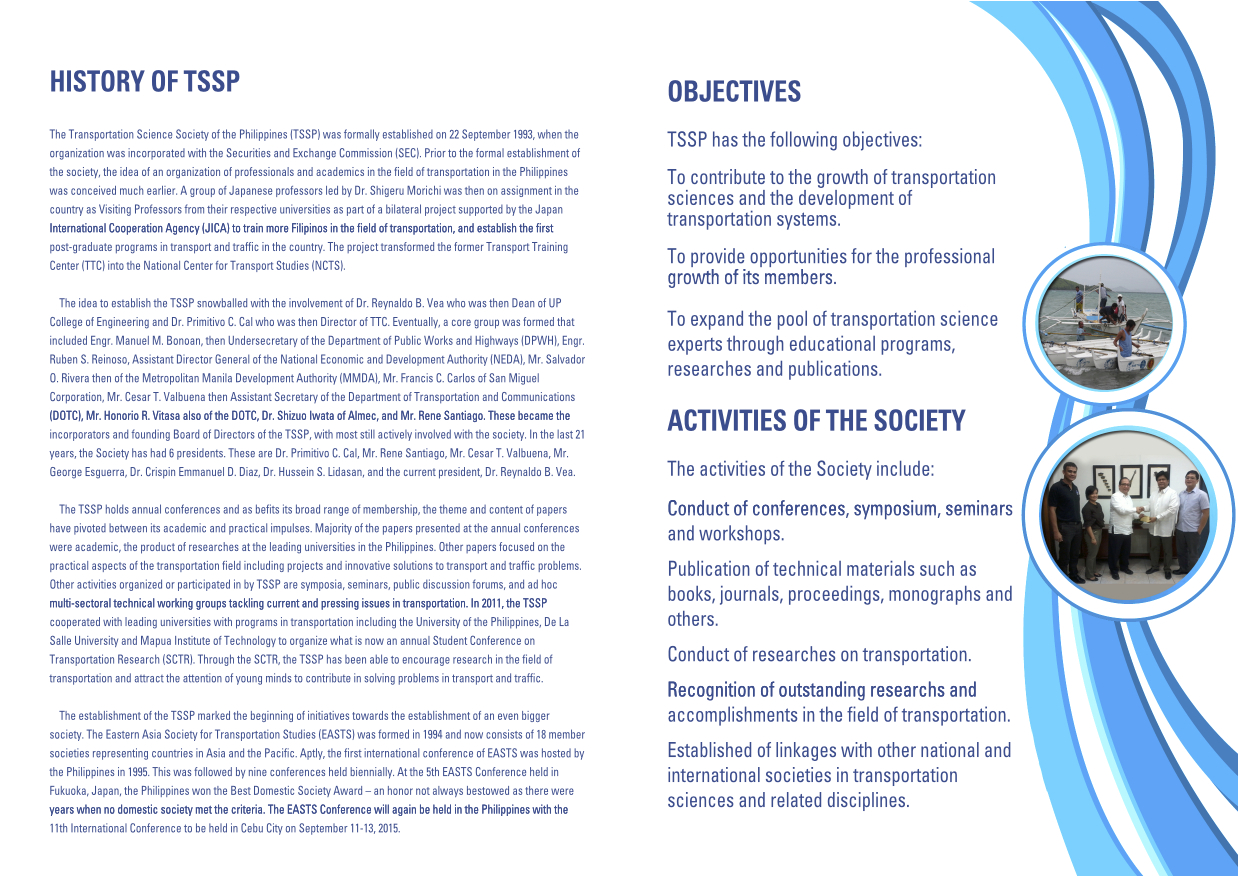
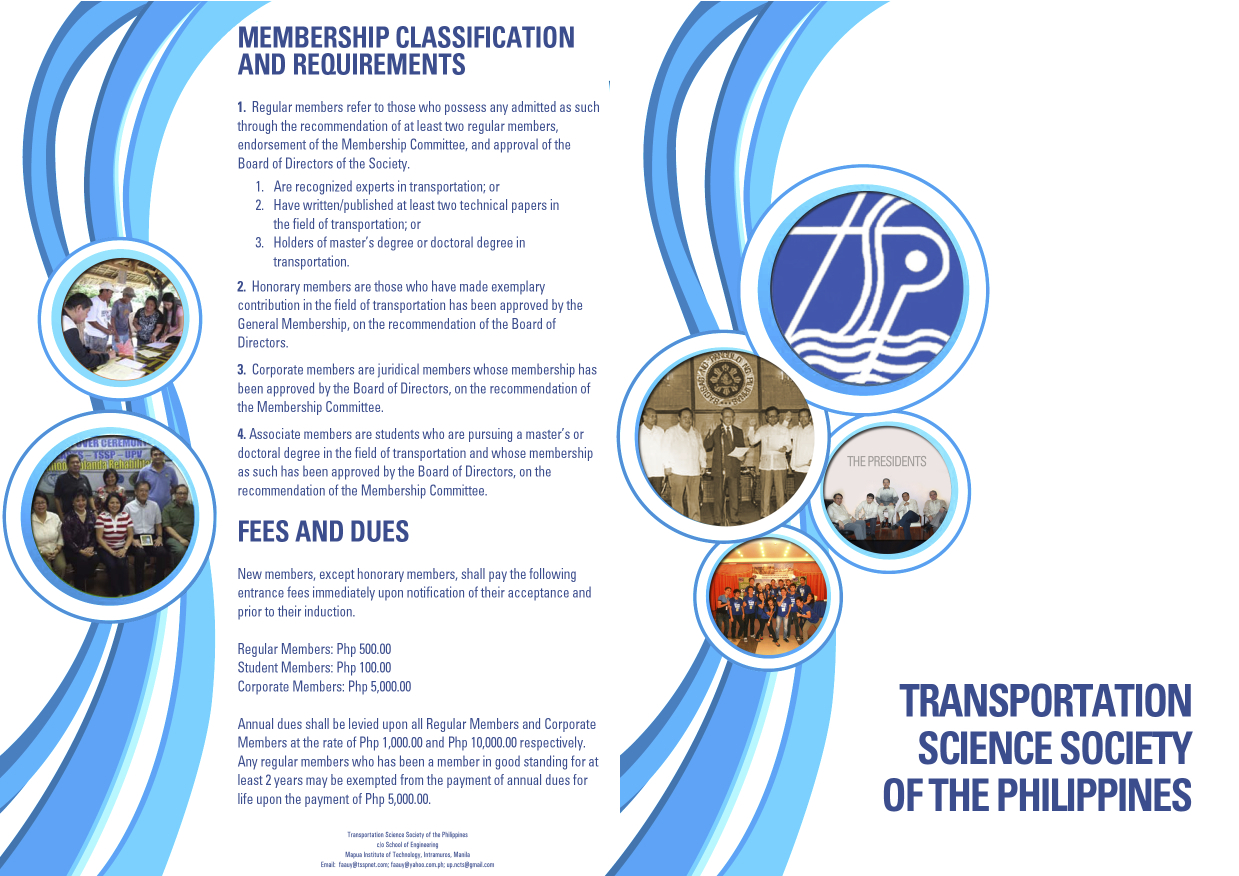
The conference is hosted by the Transportation Science Society of the Philippines (TSSP), which is the local affiliate of the EASTS. More information on the TSSP are found below:
–
Ortigas Avenue Extension Roadworks
Causing much traffic congestion the past weeks and especially these days are sections of Ortigas Avenue Extension. This is basically caused by roadworks between Cainta Junction and Valley Golf. The section between Brookside and Valley Golf is being raised. The section is a low portion of the road and is almost always flooded whenever there are heavy rains due also in part to the creek in the area. The westbound side of that section is completed and the contractor is now working on the eastbound side. The section is a wider segment of Ortigas and it’s possible to close one lane at a time while having 2 lanes usable for traffic along either side of the road.
The more severe congestion is along the westbound side where another contractor is working on drainage between Junction and Brookside. The section in front of the RRCG bus depot only has one lane usable by traffic and so westbound traffic is regularly backed up for hundreds of meters. How bad is it on a weekday? It took me 30 minutes to pass the area between 5:15 and 6:00 AM last Monday.
 Eastbound traffic splits into two lanes separated by roadworks
 The left lane is part of an already elevated westbound side of Ortigas Ave. Ext. The inner eastbound land has already been graded and ready for concrete pouring. The base course layer is visible in the photo.
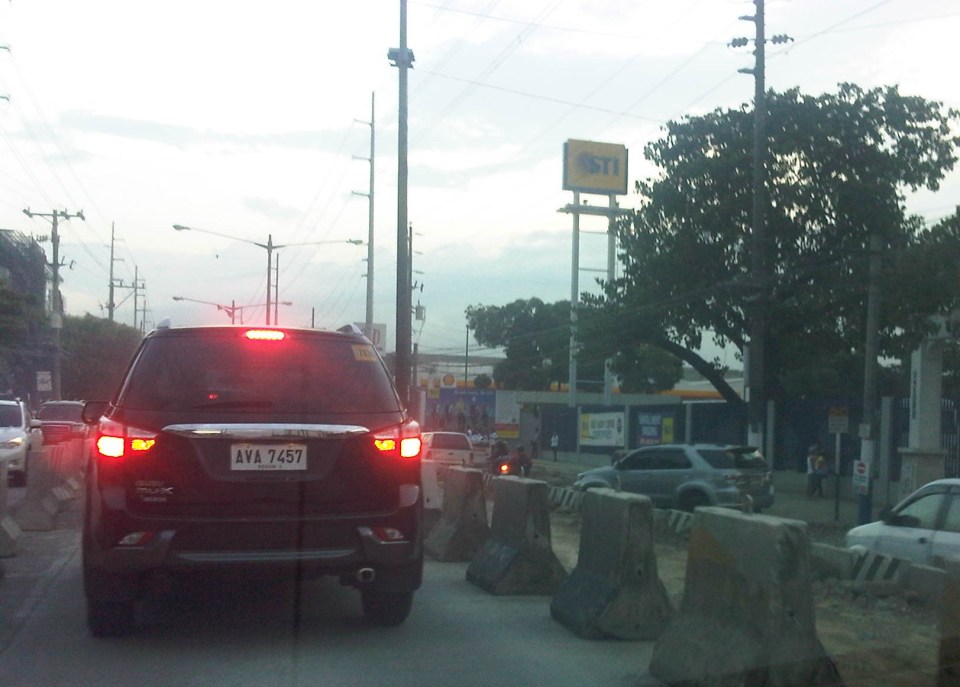 Section near Hunters ROTC Road (right where the grey SUV is coming from) and STI, and approaching Valley Golf.
 Past STI, the traffic lanes go back to normal just before the intersection at Valley Golf.
Traffic is so severe along Ortigas Ave. Ext. that I am sure a lot of people are looking for alternate routes. Those from Antipolo, Taytay and towns along the Manila East Road would likely take the routes utilizing the floodway including Highway 2000 and C-6. Others would find the longer route via Sumulong Highway and/or Marcos Highway to be worth the time and fuel. Hopefully, work will be continuous along Ortigas and roadworks will be completed before we are deep into the typhoon season this year.
–
Road widening along Sumulong Highway
Sumulong Highway is the main road connecting Antipolo City with Marikina City and ultimately to Cainta, Pasig and Quezon City via Marcos Highway. It is basically a 4-lane, 2-way undivided road with several sections that have 3 lanes total probably due to ROW acquisition issues when the highway was widened from the original 2-lane road. I came back from a trip recently to find road works along my commute and took some photos of what would definitely be an improvement to the highway. The uneven number of lanes along several sections of Sumulong has led to road crashes and surely many near misses among motorists and cyclists using the highway. There is also a need to provide space for pedestrians and others on foot considering the highway is one of the major routes to the Shrine of Our Lady of Peace and Good Voyage – a major pilgrimage site for Filipinos.
 Road widening for an additional lane along the inbound lane approaching Sumulong’s intersection with Olalia Road
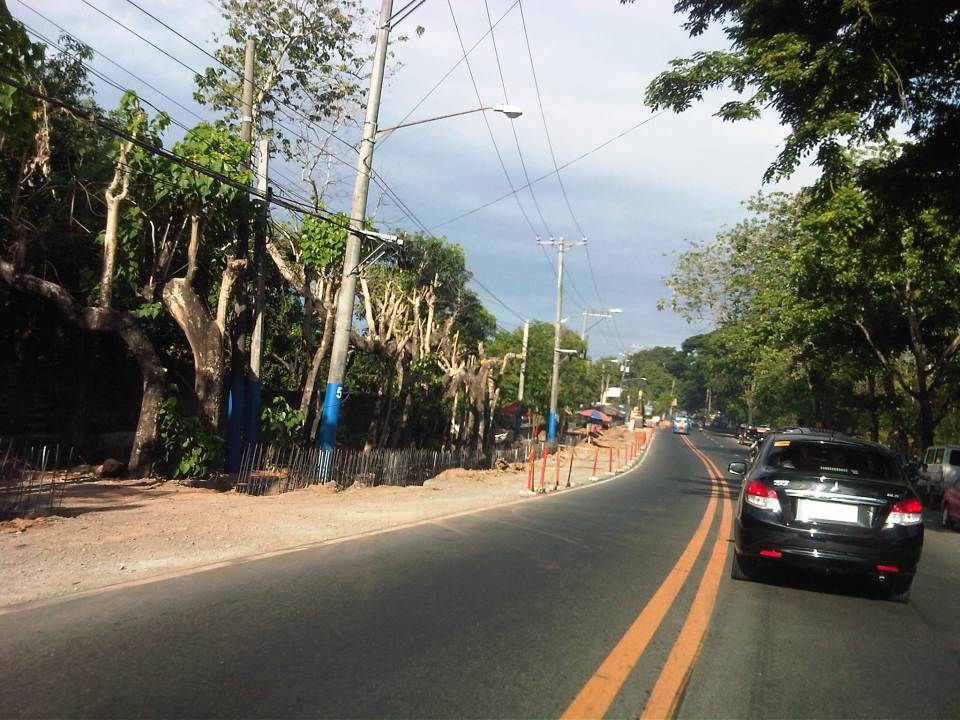 Construction along the inbound direction of Sumulong Highway include drainage works aside from the construction of an additional lane to make the number of lanes even (2 per direction). At present, there are 2 lanes along the outbound direction and a single lane (shown clearly in the photo) along the inbound lane. The section shown is near the Garden of Gethsemane and Palos Verdes subdivision.
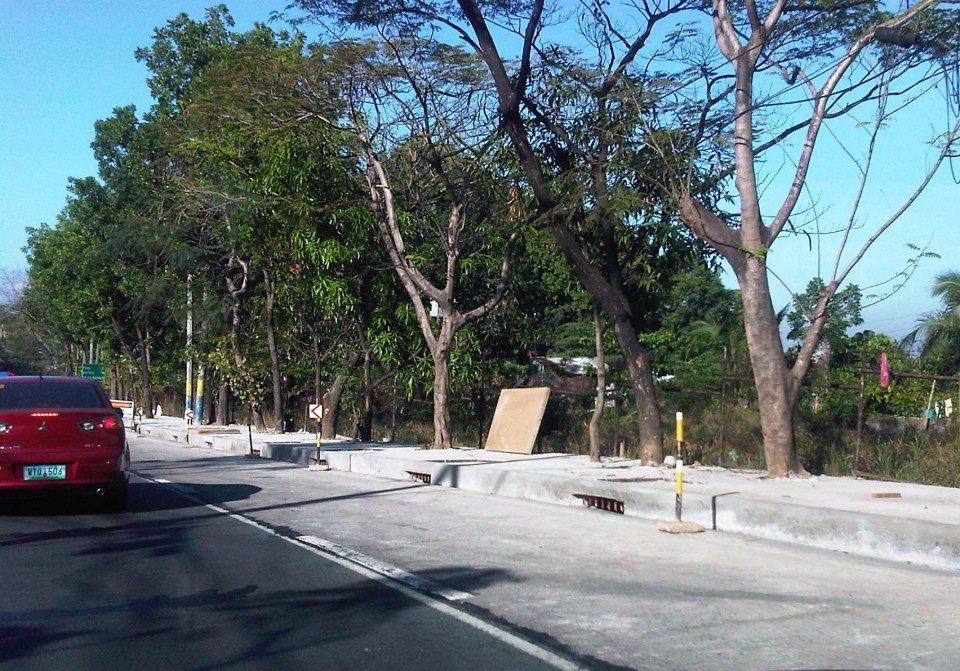 Completed lane, drainage and sidewalk along the outbound direction of Sumulong Highway right after Metro View subdivision.
 Widening along the outbound direction between Metro View and Valley Golf includes drainage works. There will be a sidewalk on top of the drainage that should enhance safety for walking/trekking.
 There are many informal settlers as well as formal ones encroaching on the RROW. Part of the project is to remove these and other obstructions. I just hope that the sidewalks and the curbside lane will remain clear of obstructions.
The completion of the road widening project is expected to improve the flow of traffic along Sumulong Highway as there will be a continuous 2 lanes available along either direction for safe and effective passing. The additional lane also means public transport may stop along the roadside without blocking through traffic. Trucks and slow moving vehicles (tricycles?) may also be required to take a designated lane. Moreover, since there is a significant volume of bicycle users along Sumulong Highway, there will be enough safe space for them to travel. The current volume of motorised vehicle traffic along the highway requires only 1 lane per direction (2 lanes total) and these are the innermost lanes of the road. Traffic slows down usually because of trucks or tricycle operations/maneuvers. In theory, the 2 outer lanes can be used only for overtaking, stopping and cycling. These should be clear of parked vehicles particularly along areas where there are communities and businesses (e.g., vulcanising, auto repair shops, etc.) along the roadside.
–
The engineering blame game and a need for some re-education
A prominent architect was always posting on his social media account about how much of what’s wrong with our infrastructure (especially transport-related) are due to engineers. It was a sad commentary particularly because he wasn’t mentioning anything about the involvement and responsibility of architects in the planning and design of infrastructure. For most projects that fall under the category of ‘planned development’ including mixed use developments like the Eastwoods, BGCs, Nuvalis, MOAs, and other similar projects are planned and designed mainly by a team of architects. Highways and streets are part of these projects and often, engineers are given the task of detailing and in certain cases, analyzing and ending up with the responsibility to justify designs provided to them. So for those types of projects funded or led by the private sector, its probably the architects who have much say in the plans and designs and who should be scrutinized for their shortcomings in as far as sustainable or “green” criteria are involved.
It is a whole different story, however, for public roads, especially those that are classified as national roads. The reality is that many DPWH engineers need to re-tool, learn and practice principles of sustainable infrastructure design. This includes incorporating green or environment-friendly design principles, which includes consideration of the landscape. We met some DPWH engineers in one seminar before on sustainable transport who thought environmentally sustainable transport (EST) was simply environmental impact assessment (EIA) and who proudly claimed they already knew about the topic. I think many engineers and planners in government need to unlearn many things and dissociate their minds from a lot of what they have come to accept as standard, acceptable or correct that are actually sub-par, archaic or flawed. Kapag nakasanayan na at matagal nang ginagawa o ginagamit ay napagkakamalang tama at angkop kahit na sa katotohanan ay hindi.
A good appreciation of history and heritage also appear to be scarce these days whenever the DPWH is involved. Proof of this are the road widening projects in Leyte and Iloilo that now threaten many ancestral houses that are located along the national roads. Many contend that road widening is unnecessary because congestion has not set in along many of the sections that have been widened or are candidates for such projects. It can be seen along many widened roads along Tarlac and Pangasinan, for example, that the problem is not really congestion but poor enforcement of transport and traffic regulations. Such include tricycle operations, roadside parking, and encroachments on the road right of way (RROW).
In most cases its pure and simple analysis that needs to be conducted first. Are roads really congested and requiring additional lanes? The evidence does not seem to support many cases of road widening as data on congestion from the DPWH Atlas itself requires validation on the ground. A recent World Bank study, for example, found that for many national road sections reported as congested in the Atlas, the opposite is true when validated on the ground. Such issues with data that are used as basis for decisions whether sections need to be widened are serious and lead to a waste of funds as well as negative impacts on heritage or historical structures.
The DPWH still needs to do some re-inventing and should actually take the lead in many initiatives. Among these are those pertaining to what are being referred to as “complete streets.” Last week, there was an article in newspapers where the DENR called for pedestrian and bike lanes along roads. The call was not specific to national or local roads but it is something that the DPWH should have already anticipated and working at for roads under it jurisdiction given the outcomes of the International Road Assessment Program (iRAP) project that covered several thousand kilometers of national roads that pointed to the need to improve roads to improve safety for pedestrians and cyclists. It is a matter of having progressive or dynamic rather than reactive or static stance at the DPWH and this requires more than just the rudimentary engineering background for the agency to take road planning, design and construction to another level.
–
Innovations for cycling and walking
I usually browse the net for the wealth of information now readily available on transport facility designs that are pedestrian and/or cycling friendly. In the Philippines, there has been an increased awareness lately for people-oriented systems encouraging cycling and walking. These have extended to calls for more bikeways and walkways to enhance mobility, with several projects being implemented to further the advocacies for non-motorised transport (NMT). Of course, there are already existing examples of both good and bad practices around the country including ideal and undesirable cases in Marikina City, which is the first (and only?) city in the Philippines to have a comprehensive network of bikeways.
Recently, I found this article entitled “Urban Innovations That Could Turn Your City Into a Bicycling Paradise” on one of my favourite websites io9.com. It contains some of the more prominent examples of bicycle and pedestrian-friendly designs that have been implemented elsewhere that we could probably take note of as good practice references when we do plan and design similar facilities in our cities. I’m sure there are many people out there, and not just architects or engineers, who would have good ideas for people-friendly infrastructure design. We need to encourage them to come out and propose these ideas that can be adapted into sound design according to architectural and engineering principles (i.e., the designs would still have to follow standards or guidelines, e.g., seismic, wind, etc. in order for these to be safe for use and last long.
Government agencies especially the DPWH and local government units should be open to new ideas or innovative designs to help transform our transport system to become more people-oriented than vehicle-oriented. There should be initiatives from within these agencies to come up with innovative designs while keeping the details up to standards or following established guidelines. So far, there have been no notable push for updating road designs, for example, despite road safety assessment findings and recommendations that should resonate more within agencies and LGUs if they are not comfortable dealing with NGOs or civil society groups advocating for people-friendly infrastructure.
I believe government engineers are competent and have the talent to come up with innovative designs and guidelines but there is a lack of incentive for them to do so and to think out of the box. The bottom-line is still to create an enabling environment for such design ideas to come out and be implemented. Perhaps the academe could lend a hand here with their strong linkages with government planners, architects and engineers. The schools could provide the environment for encouraging new thinking in as far as transport infra is concerned and the leading universities would have the resources that can be harnessed towards innovative designs.
–
Food for thought – a few articles on transport and traffic
This will just be a quick post for now and I just wanted to share a few recent articles on transport and traffic from a favourite magazine – Wired:
What’s Up With That: Building Bigger Roads Actually Makes Traffic Worse
Why We’re Sad the Best Airport in the World Is Getting Even Better
The Hidden Genius and Influence of the Traffic Light
These are very well written, easy to understand articles on things we encounter everyday (traffic congestion, traffic signals at intersections) and when we travel long distance (airports). They show different perspectives of things we take for granted or assume we understand. An example of the latter includes notions that road widening or road construction will solve traffic congestion problems. Much of what goes around regarding road widening or road construction as solutions do not account for induced demand, which is basically additional traffic generated or encouraged by wider or new roads. The second article talks about Changi Airport, arguably the best in the world, and the high tech approaches they have employed or will employ in order to ensure efficient operations there. Such tools, I think, should be used in our airports especially NAIA where the long standing excuse is the limitations of the runway(s) and the airport terminals. Certainly, there are other issues that need to be addressed and going high tech and employing sophisticated methods for airport operations should alleviate problems until we ultimately build a new airport elsewhere. The third article takes a look into behaviour and mentions a “social contract” we have agreed to in order to reduce mayhem in our roads. This “social contract” as well as others related to it should be revisited and understood as they are very much a part of how we behave when we travel and have a significant effect on others around us.
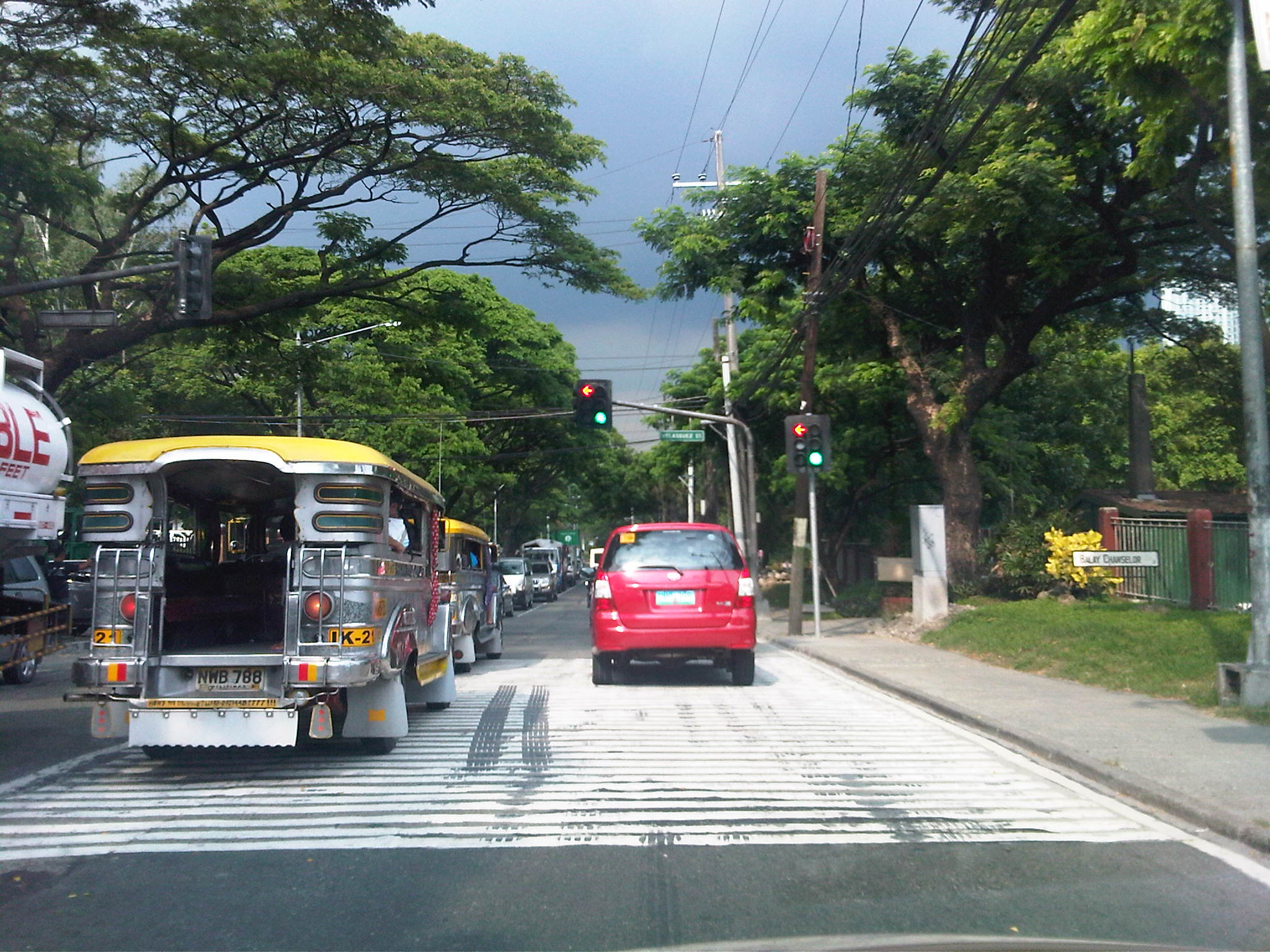 Traffic congestion and traffic signals along the 4-lane C.P. Garcia Avenue in UP Diliman
–
 Caught (up) in traffic