
Home » Highways and Streets (Page 24)
Category Archives: Highways and Streets
Quezon Ave. underpass at Araneta Ave.: some expectations and issues
The underpass along Quezon Ave. at its junction with Araneta Ave. is set to open to general traffic this coming week. I got this from a reliable source who was involved in the project as well as friends from the DPWH and the MMDA. If the opening pushes through, the underpass is expected, based on analysis, to ease traffic along both major roads with Quezon Avenue’s through traffic having the most benefit from the uninterrupted flow provided by the underpass. At-grade traffic management at the intersection will still be provided mainly by traffic signals but the substantial reduction of traffic attributed to the through movements along Quezon Ave. The reduction of congestion comes as a relief to a lot of travelers as well as businesses affected by the construction of the underpass in the last year. Fortunately, there has been little delay in the construction and so it seems that lost times due to construction-related congestion (translated here as sacrifices for those who had to endure daily traffic congestion and had to adapt to the situation) will finally be compensated for. Many, indeed, have been anticipating the eventual opening of the underpass, expecting the facility to solve congestion in the area.
The area has been subject to flooding considering its proximity to the San Juan River. Official data for flood occurrences in the area can be accessed through the Department of Science and Technnology’s (DOST’s) Nationwide Operational Assessment of Hazards website where it is clear that flooding will be an enduring problem for the underpass and surrounding areas. Recent reports (from last week until today) indicate that there is still the specter of flooding that will have to be addressed given that prior to the construction of the overpass, this issue had already been flagged by various stakeholders including the Quezon City Government. It is for this reason that the underpass will have pumps to ensure that water will not accumulate and lead to the closure of the facility in times of heavy rains resulting in flash or regular flooding.
–
Luzon Avenue: Unfinished business
Luzon Avenue stretches from Commonwealth Ave. near Tandang Sora towards the Congressional Avenue Extension and currently ends at Sampaguita Avenue near the Fairview area. It is supposed to be part of Circumferential Road 5’s northern alignment that will connect with NLEX and McArthur Highway. It took quite some time to complete the bridge crossing Commonwealth Ave. and connecting Luzon Ave. to Tandang Sora near the end of the Katipunan Ave. stretch of C5. Issues were mainly on informal settlers occupying the land where the southern foot of the bridge and service road were to be constructed.
While much of the area has been cleared of informal settlers now, the ROW for the area has not been sufficiently cleared to complete the construction of the approach to the bridge. As such, only the northbound direction of the bridge has been opened to traffic as there is no space available for two-way traffic at the southern end where the bridge will ultimately connect to an intersection with Tandang Sora. Following are photos showing the approach at the north end of the bridge.
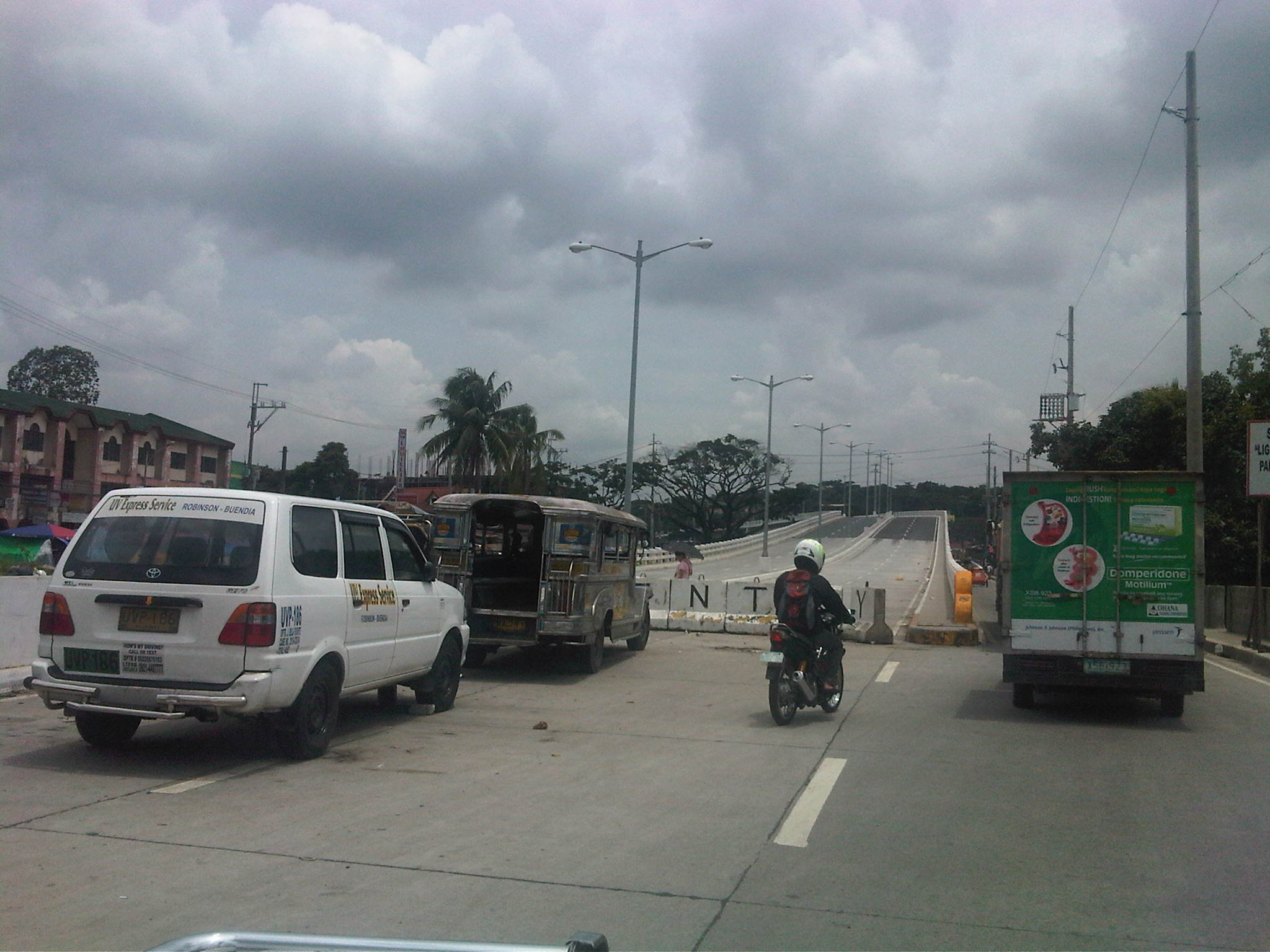 Approach at the north end of the bridge across Commonwealth Avenue – the south end connects to Tandang Sora Ave. near the University of the Philippines Diliman campus. The south end approach is partly finished and allows only right turns from Tandang Sora towards the bridge or to the one-lane service road that leads to Fairview-bound side of Commonwealth.
 Service road – southbound traffic would have to take the service road that leads to Commonwealth Ave. and a short drive to the intersection of the latter with Tandang Sora.
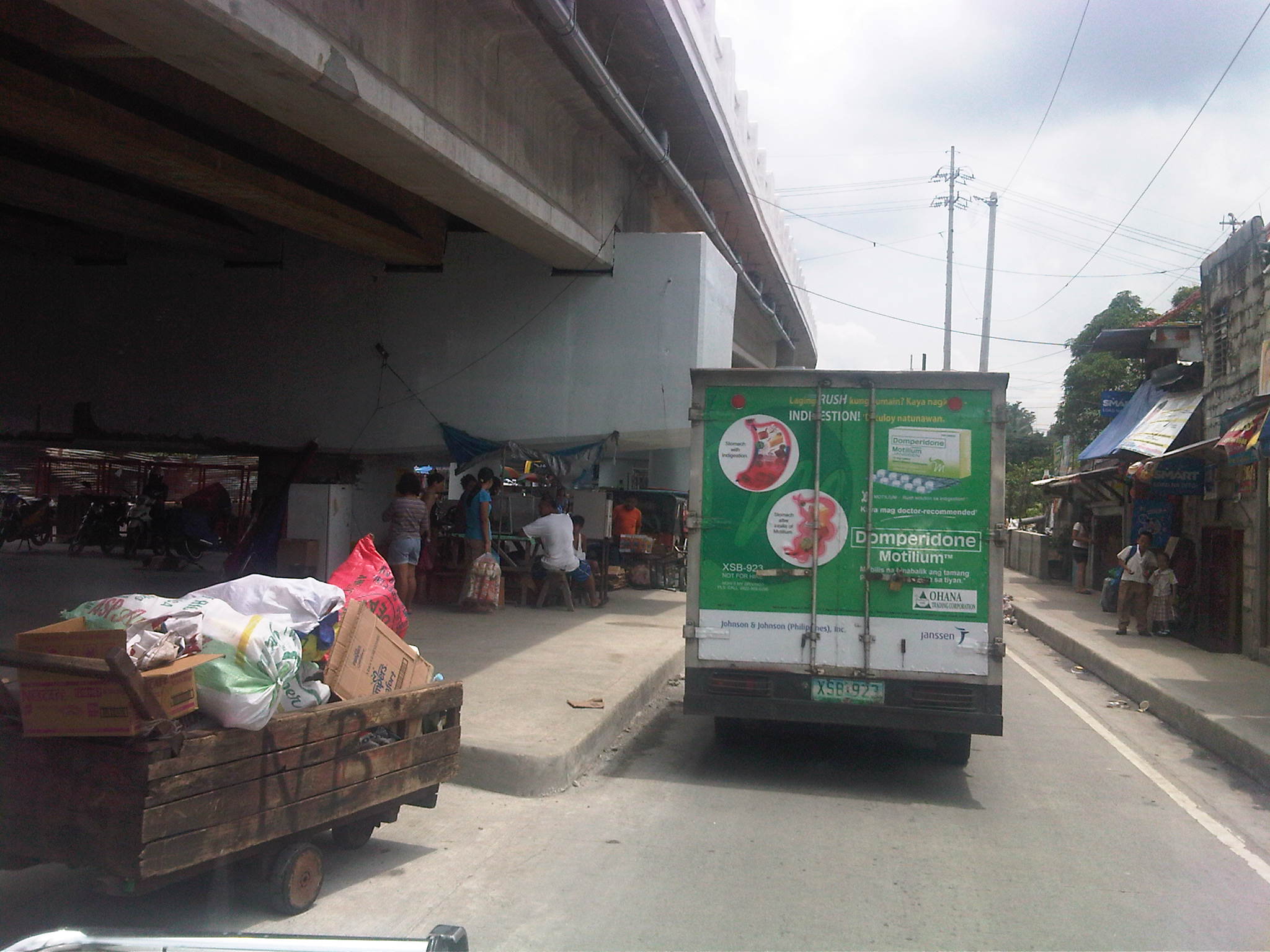 Talipapa? – this area under the bridge used to be occupied by informal settlers and there was a market here that usually spread to Commonwealth, with vendors and customers occupying the outer lanes of the highway during weekends and causing congestion for vehicles approaching Tandang Sora
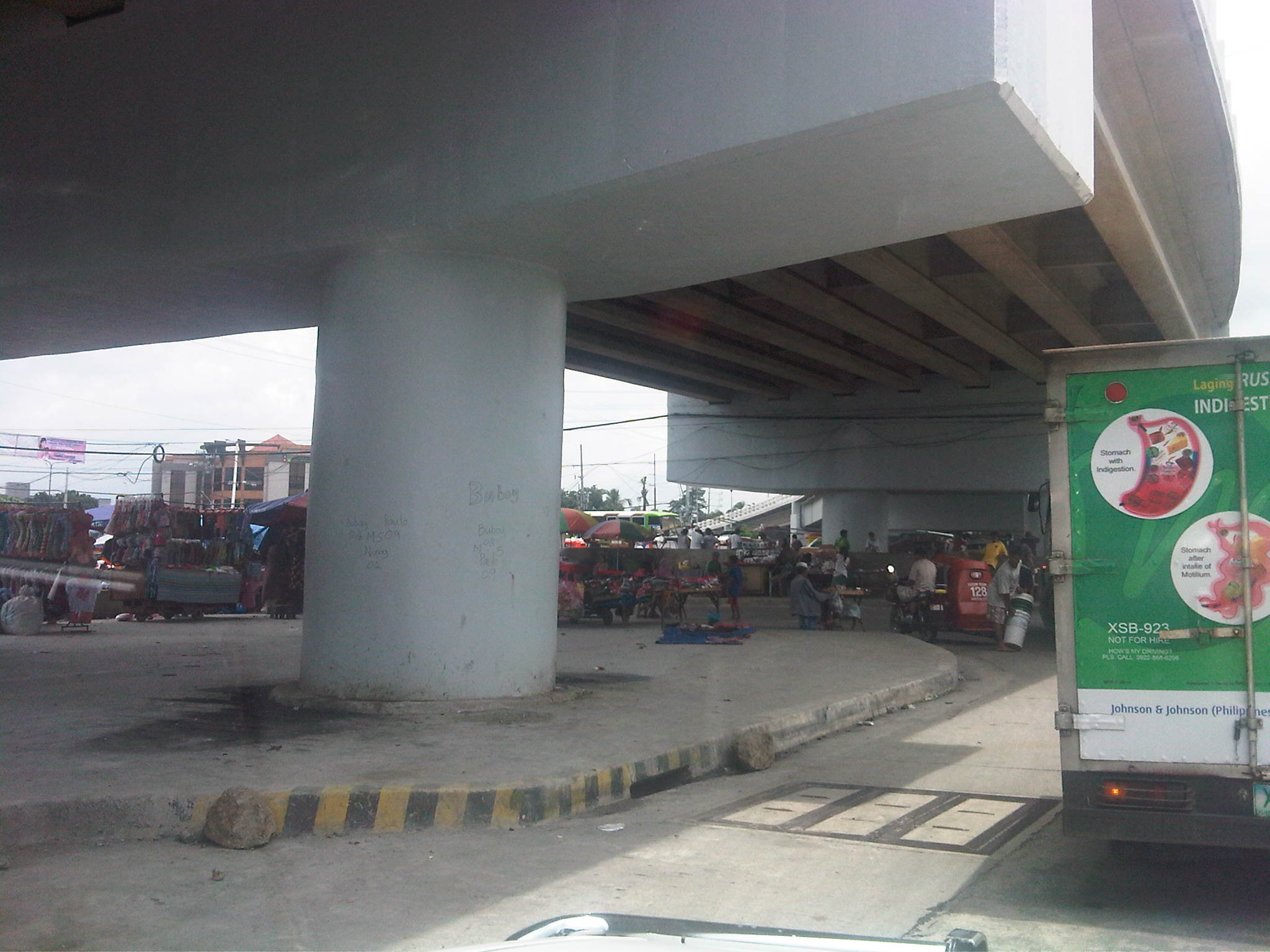 Remnants – there are still stalls, many of them mobile, selling a variety of goods including food, clothes, bags, plastic items and other commodities found in most wet and dry markets. There is a Puregold supermarket near the intersection on the left side and unseen in the photo.
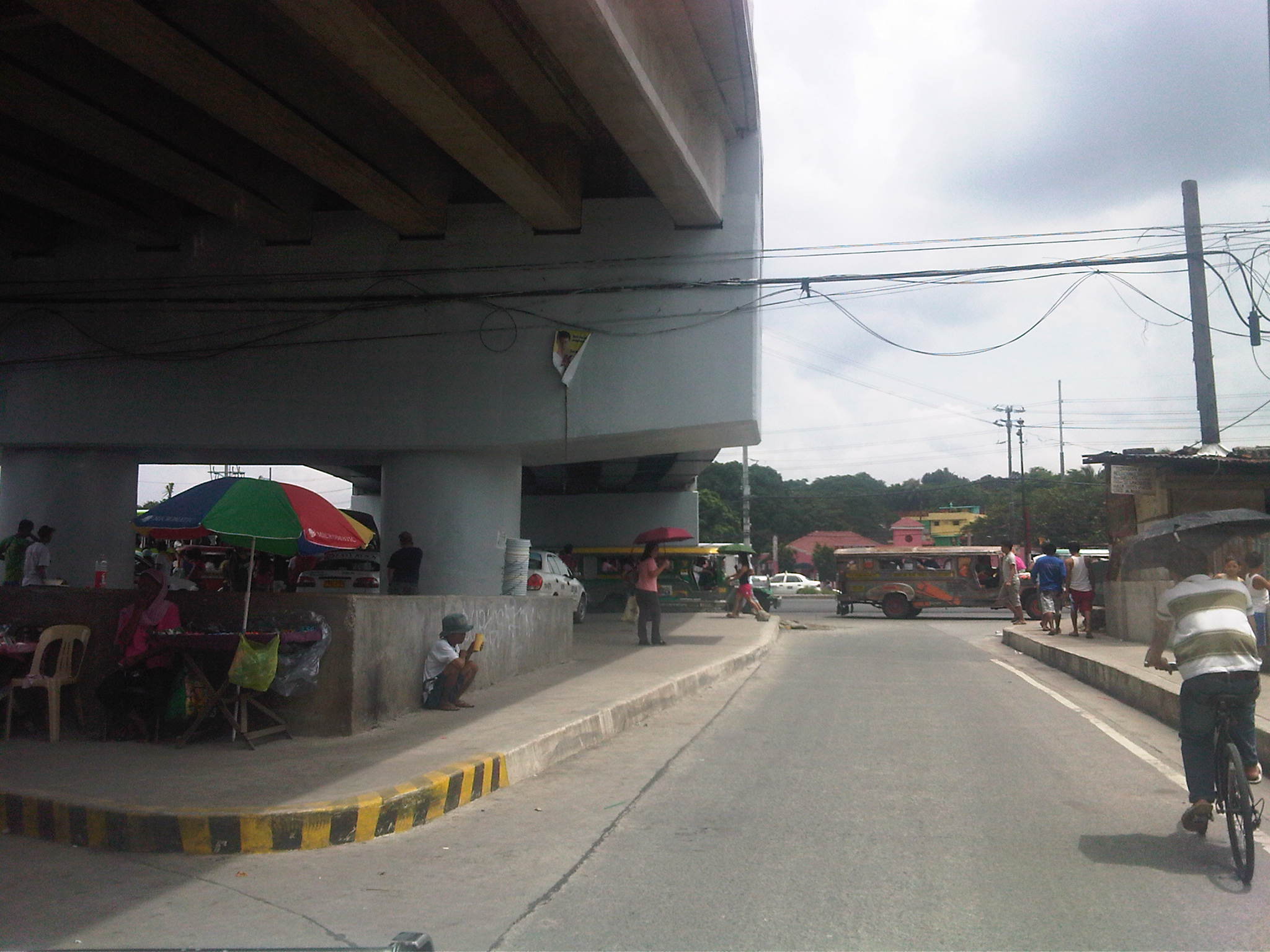 Exit to Commonwealth – the one lane approach to Commonwealth is sufficient now due to the light traffic but will not be enough once Luzon Ave and C5 is completed, bringing more vehicles to this area.
–
Views from a landing plane
I like taking photos when I am traveling and have always tried to get some clear shots when I’m on-board a plane, trying to identify certain landmarks like volcanoes and bodies of water or perhaps roads that I could identify from above. Aerial shots are quite tricky with a point-and-shoot even though one can have the benefit of zoom and other pertinent functions digital cameras have these days. On one particular trip I had the fortune of being able to take photos of Mayon Volcano while in another, I was able to take a photo of Taal Volcano. I missed one opportunity to take a photo of the Chocolate Hills of Bohol in one return flight from Mindanao.
The following photos were taken during one flight when the conditions were just right for some clear pictures of roads and then some familiar places as our aircraft approached NAIA.
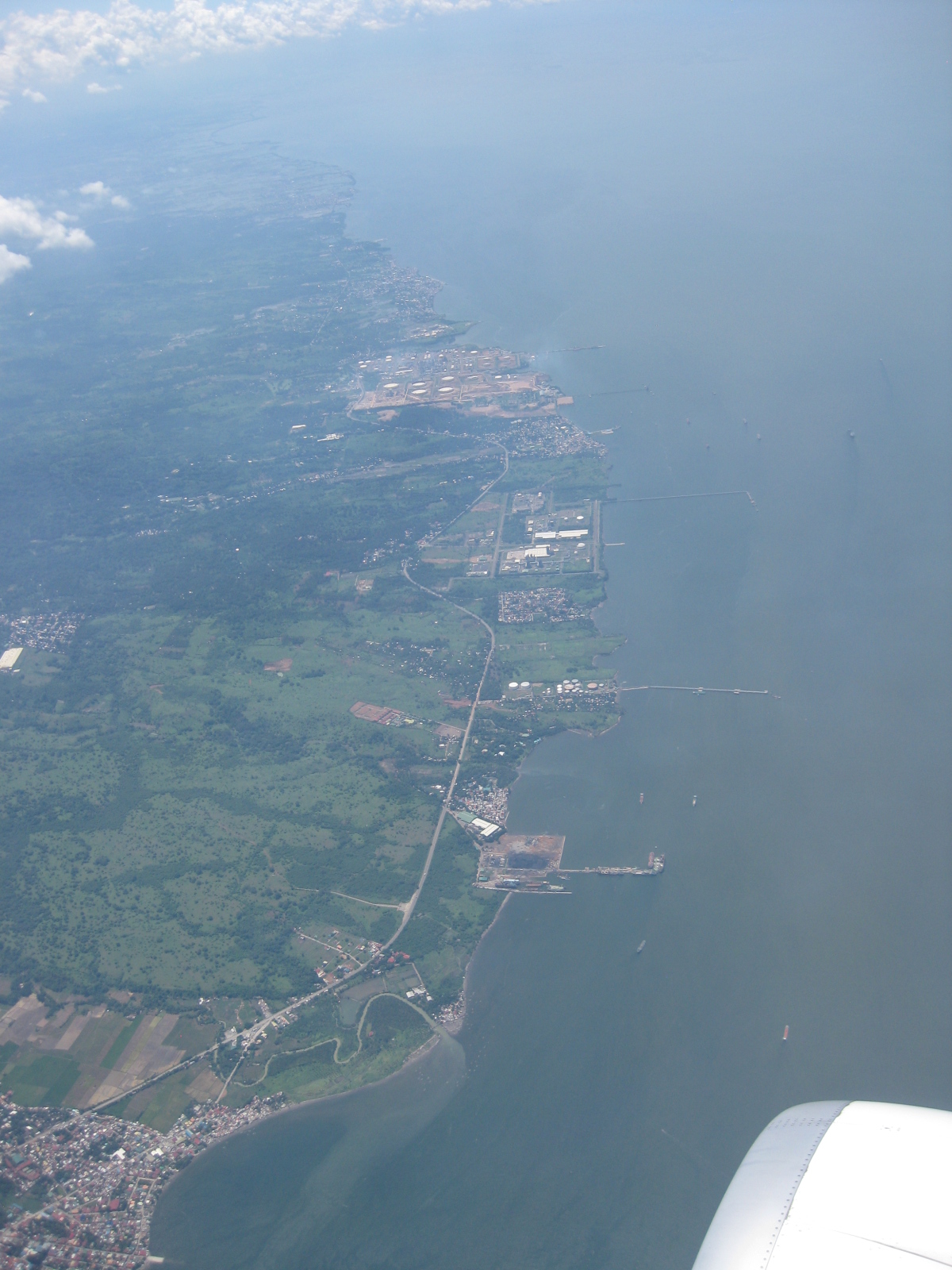 Roman Highway in the Bataan peninsula – there are many industrial estates and plants along the highway, most having their own seaports.
 Ortigas Avenue Extension with Cainta Junction on the upper left of the photo – one of the busiest roads connecting Metro Manila to the eastern province of Rizal, this avenue is often constricted due in part to varying road widths between Rosario and Junction and undisciplined public transport drivers stopping just about anywhere along the road.
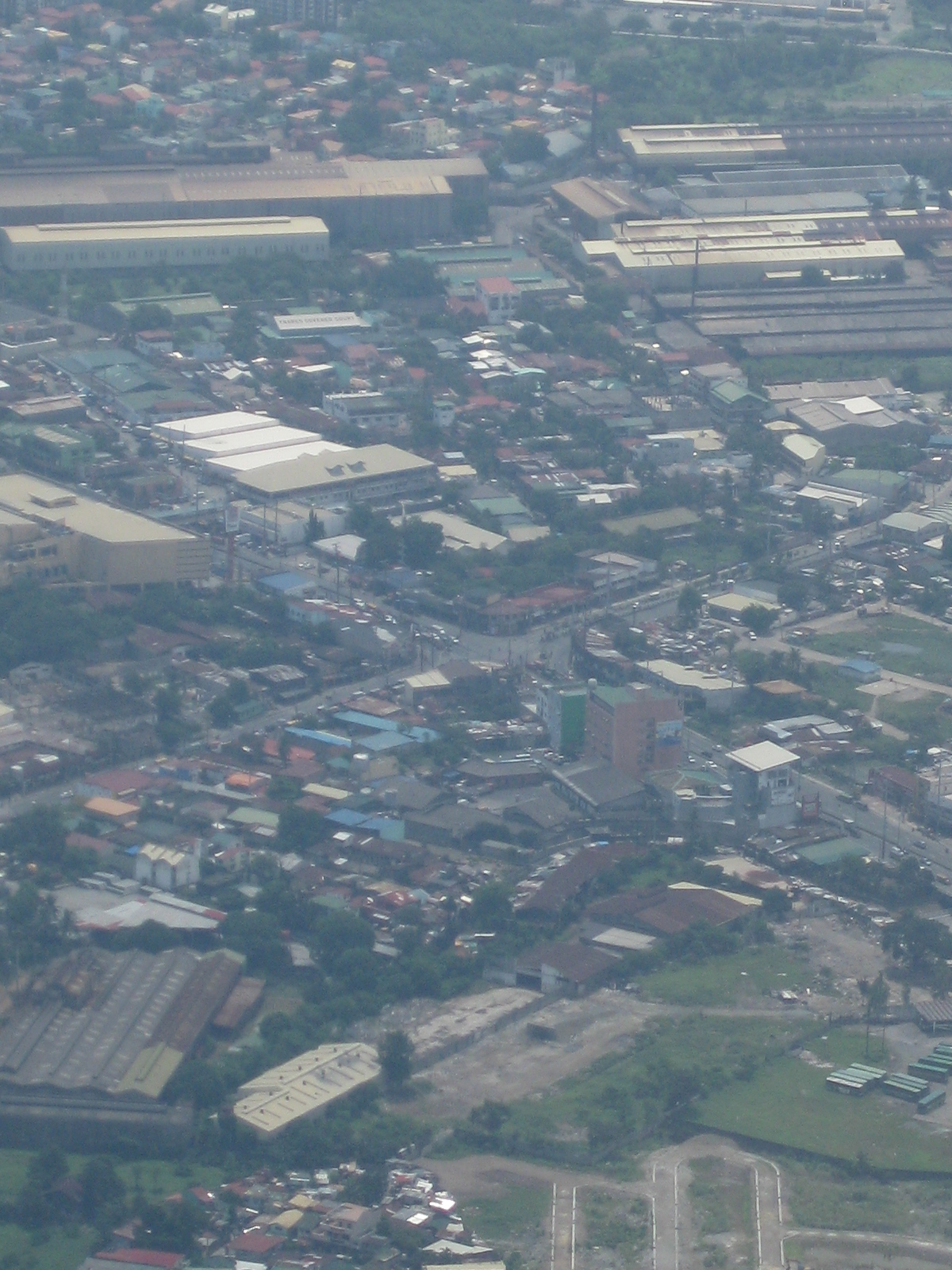 Close-up of Cainta Junction, the intersection of Ortigas Avenue and Imelda Avenue (formerly Felix Avenue) – this intersection is usually congested even during weekends as residents in Rizal with workplaces or schools in Metro Manila have steadily increased over the years.
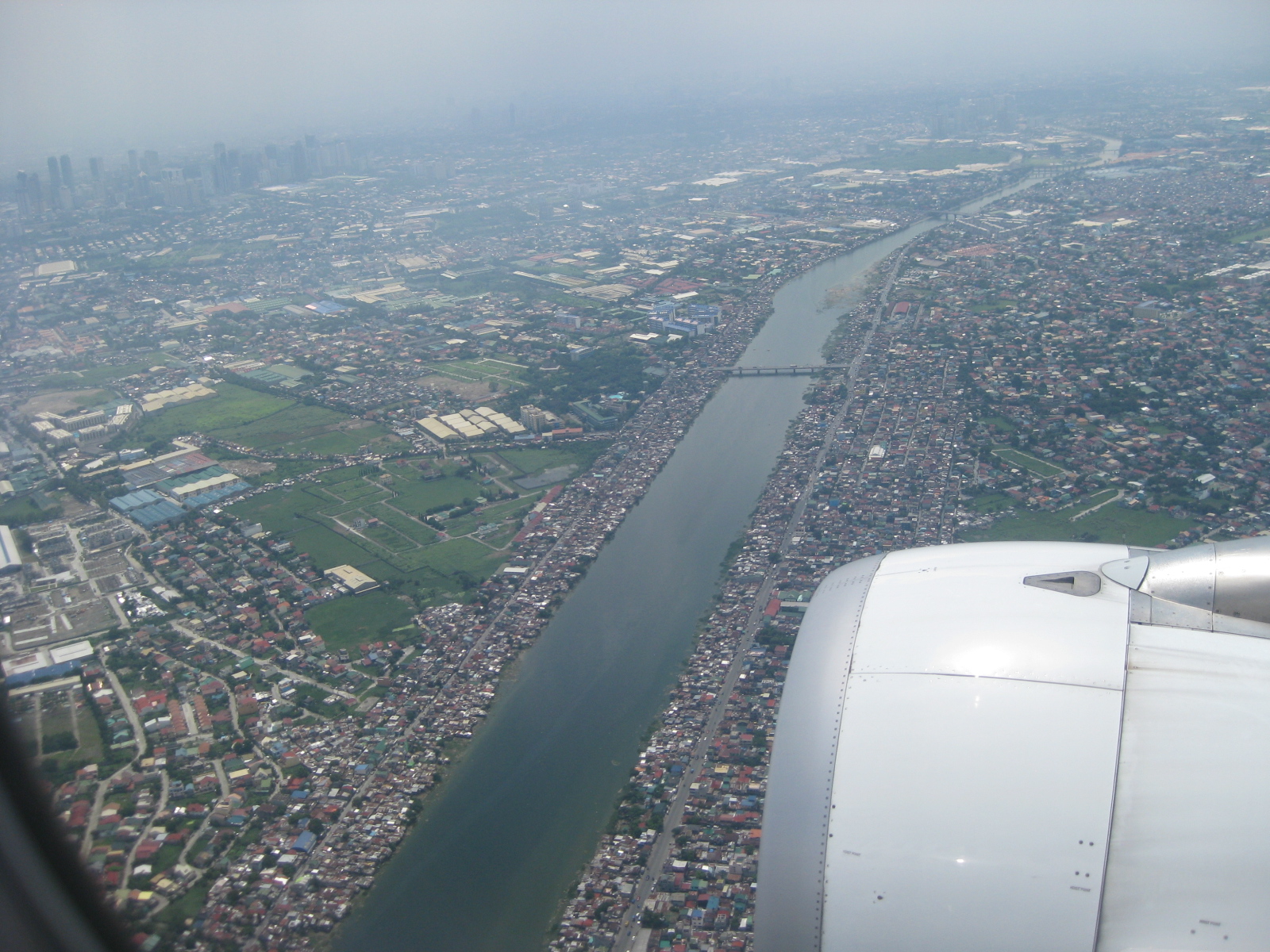 Manggahan Floodway – along the west and east service roads flanking the floodway are thousands of informal settlers. Notice the haze in the background?
 The high-rise buildings of Bonifacio Global City and the Makati CBD – Market! Market! is on the right side of the photo. While the photo seems clear, one can see the haze, probably from pollution, in the background and obscuring the buildings further away.
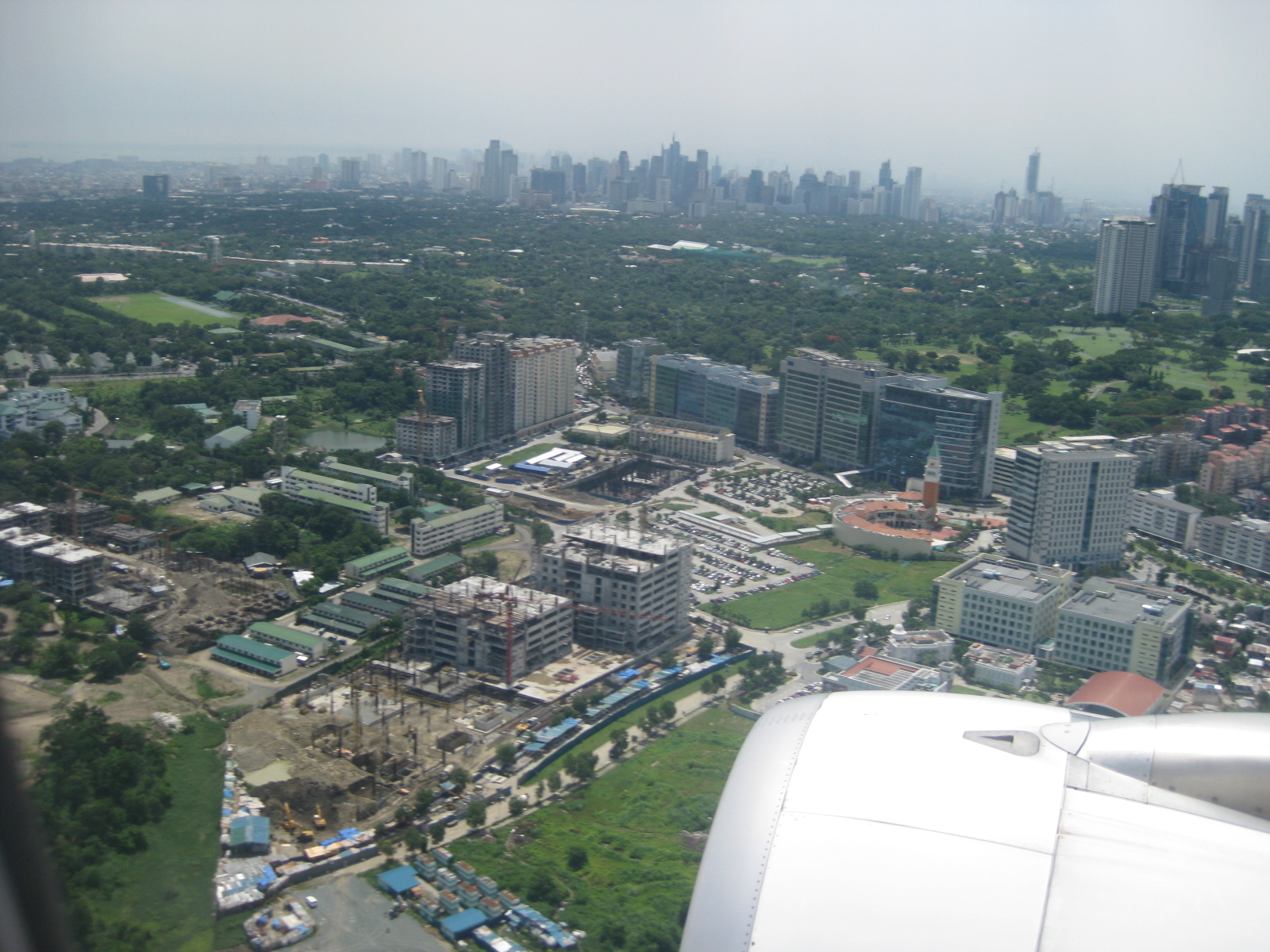 McKinley Hill – development west of Bonifacio Global City and beside the Philippine Army Headquarters. Buildings in the City of Manila are visible in the background/horizon despite the haze.
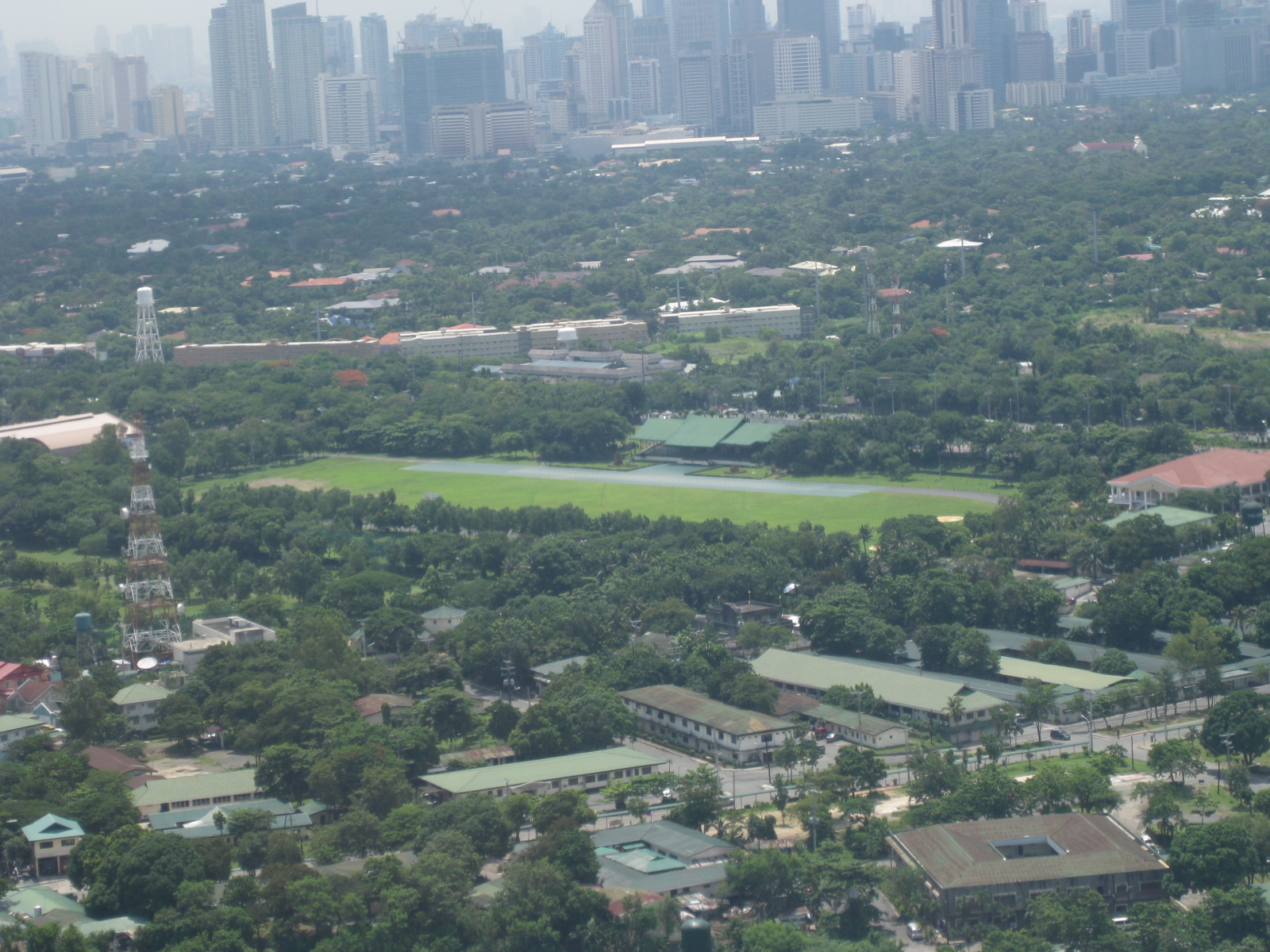 Philippine Army Grandstand and Parade Grounds at Fort Bonifacio. What looks like a wide green area between the Fort and the Makati CBD in the photo are actually parts of exclusive high-end residential subdivisions (i.e., Forbes Park and Dasmarinas Village).
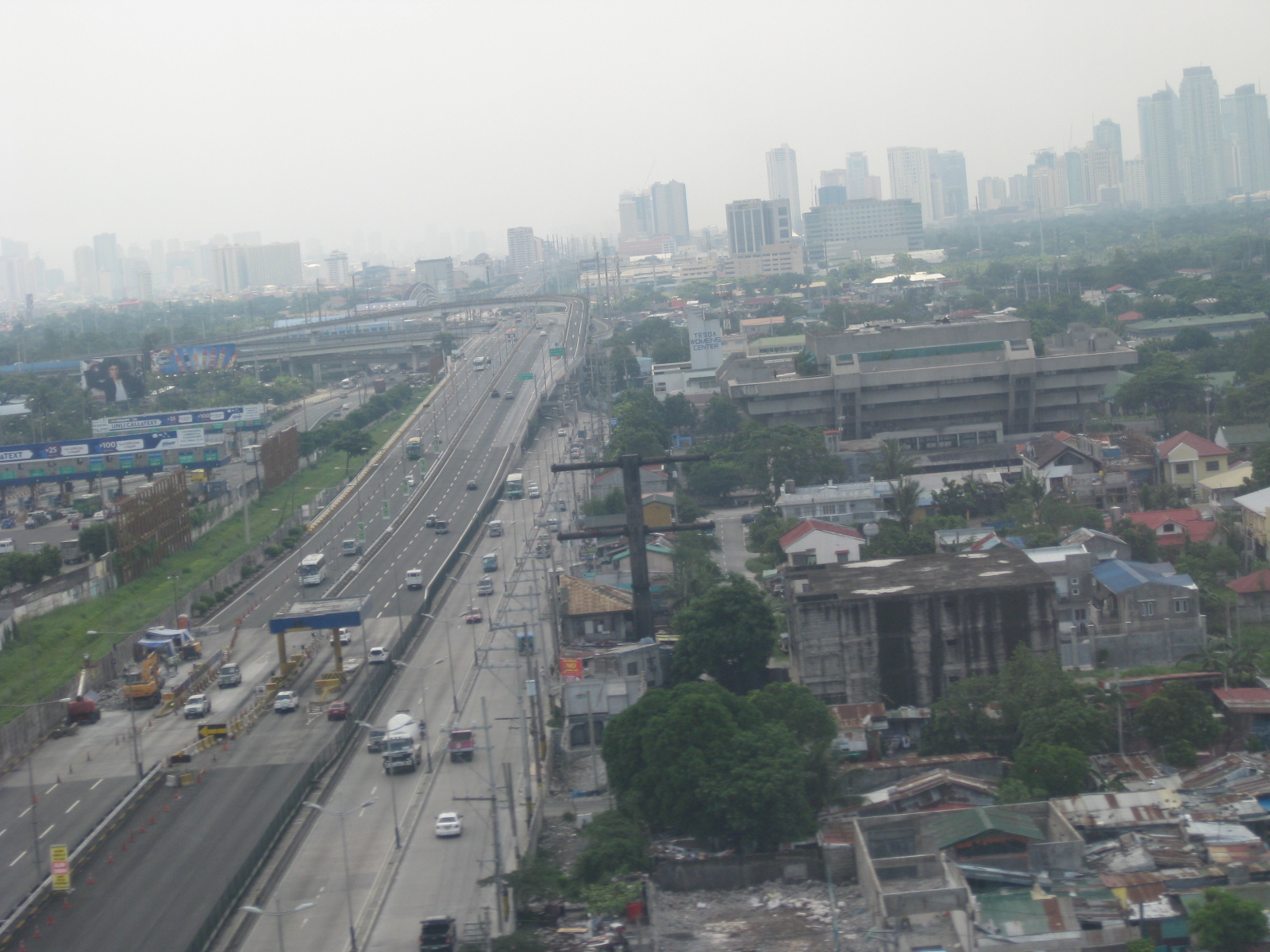 SLEX, Skyway, and the East Service Road – that’s the conspicuous TESDA building on the right with its inverted pyramid feature.
 View of the NAIA Terminal 2 upon touchdown – also known as the Centennial Terminal, this is used exclusively by Philippine Airlines for both international and domestic flight.
–
EDSA traffic: view from the top
Traffic along Epifanio Delos Santos Avenue (EDSA) or Circumferential Road 4 is quite infamous considering it being a if not the main artery of Metro Manila and carrying much vehicular and passenger traffic between cities like Pasay City, Makati City, Mandaluyong City, Pasig City, Quezon City and Caloocan City where it has major junctions with other major thoroughfares like Roxas Boulevard, South Superhighway, Ayala Ave., Gil Puyat (Buendia) Ave., Shaw Blvd., Ortigas Ave., Aurora Blvd., East and Timog Avenues, Quezon Ave., North Ave., Roosevelt Ave., NLEX and A. Bonifacio Ave., Rizal Ave. and MacArthur Highway.
Shown in the following photos are traffic conditions along EDSA during a holiday, and typical afternoon peak and evening on a weekday. The section featured is the stretch from the Ortigas junction to Camp Aguinaldo. Visible in the photos are the high-rise condominiums along Connecticut Street (upper left) and the developments at the Araneta Center including the Araneta Coliseum in the Cubao commercial district. The green area on the upper right is Camp Aguinaldo, headquarters of the Armed Forces of the Philippines (AFP), while the rooftops at the right are of houses located in an high-end exclusive subdivision (Corinthian Gardens). In the middle of EDSA is the MRT-3’s elevated tracks.
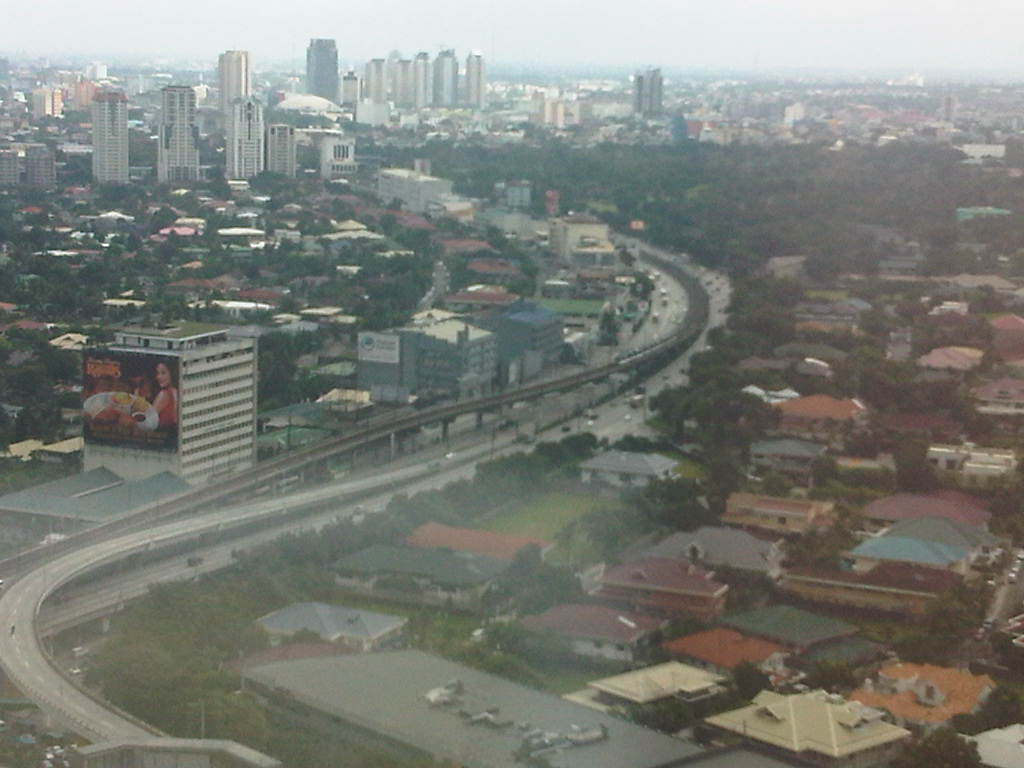 Photo taken from the 35F of the Robinsons-Equitable Tower shows light traffic along EDSA during a holiday. Traffic probably is similar during Sundays while such volumes may be observed on Saturdays only in the early mornings; before 9:00 or 10:00 AM when the shopping malls open.
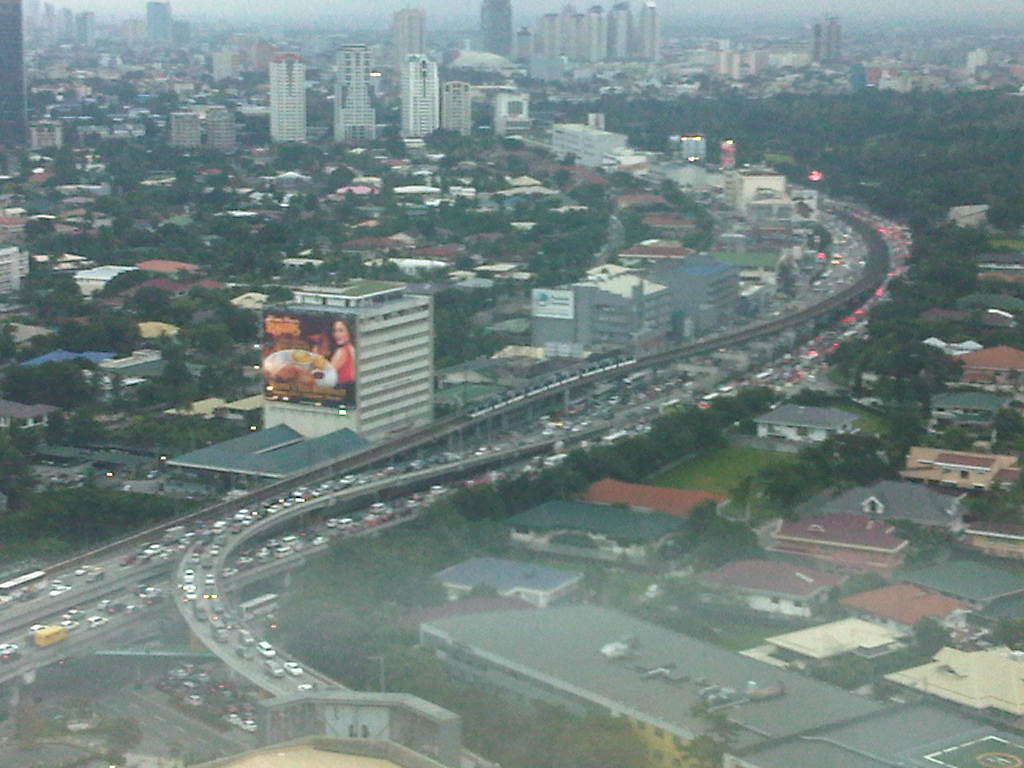 Photo taken at 5:44 pm showing traffic congestion on both directions (northbound and southbound) of EDSA including the overpasses at its intersection with Ortigas Ave. An MRT-3 train is visible in the middle of the photo.
 Photo taken at 6:16 pm with the headlights and taillights indicative of the traffic density during the early evening. Such congestion now usually extends past 8:00 pm with cases where EDSA is still congested near midnight. Such cases are more common now rather than exceptional.
–
Sumulong Highway: Marikina to Masinag
Sumulong Highway stretches from its intersection with A. Tuazon Ave. and A. Bonifacio Ave. in Marikina City, Metro Manila to the intersection with the Taktak Road or M.L. Quezon Ave. in Antipolo City in the Province of Rizal. It serves both as an arterial (for Marikina and Antipolo) and a feeder (with respect to Marcos Highway).
The following photos show the stretch from Marikina to Masinag that shows typical conditions along the highway. These conditions are quite different from those along the stretch from Masinag to Taktak Road in upper Antipolo City.
 Sumulong Highway has a total of 4 lanes (2 per direction) but a lack of pavement markings make it difficult to ascertain the center of the road and the space allocation for traffic. This makes travel less safe as motorists assume they are traveling along the correct space on the road.
 The asphalt-surfaced road has no lane markings but has very good pavement conditions. There is also significant on-street parking as most establishments along the highway have no adequate off-street parking spaces. The section shown above is right in front of a sabungan or coliseum for cockfights.
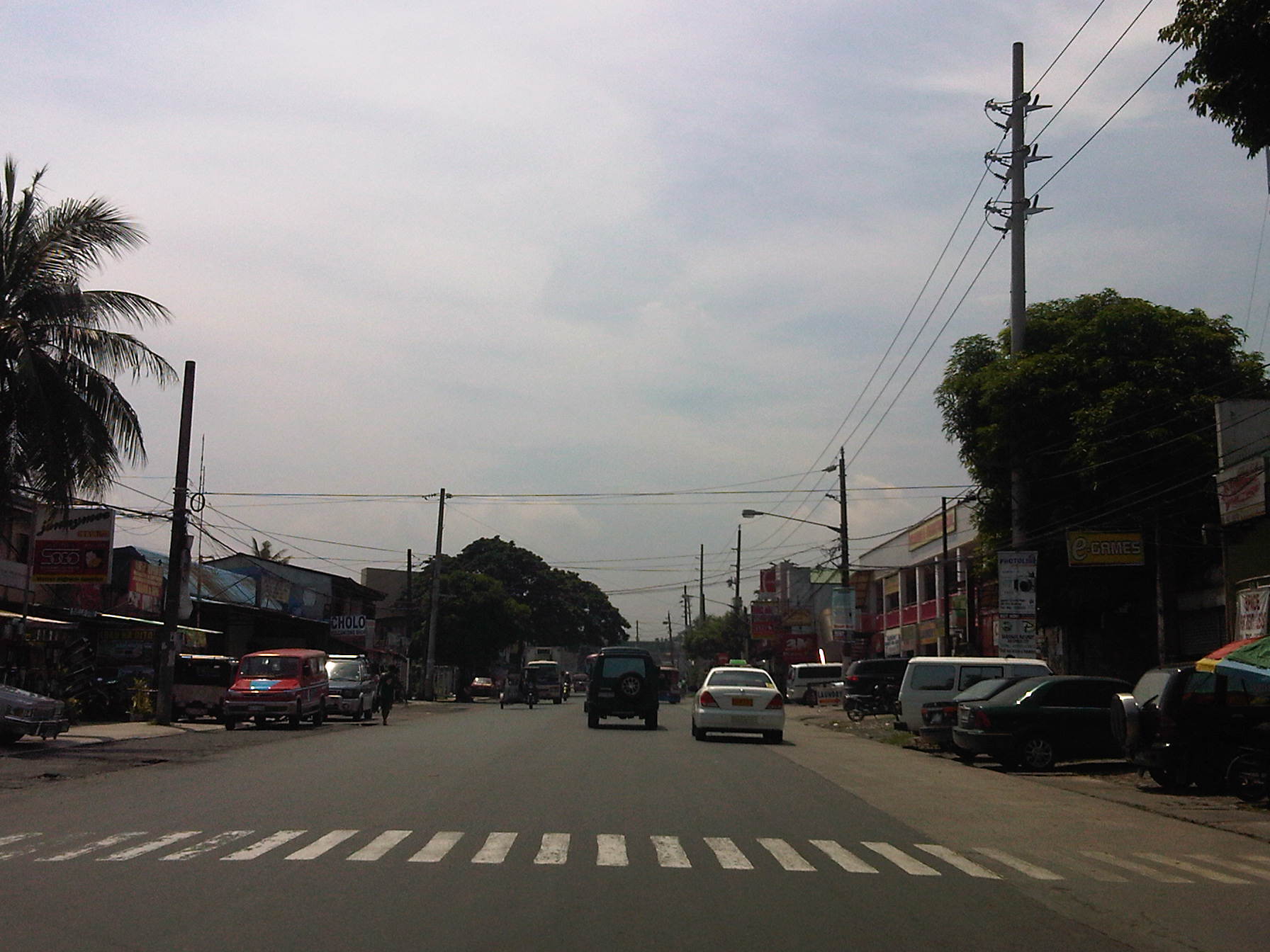 There are pedestrian crossings though, near intersections and where there are schools along the highway.
 Only the traffic lanes have asphalt overlay, the shoulders have the concrete surface exposed thereby distinguishing them from the traveled way.
 The shoulders are used as parking spaces for establishments along the highway as shown in the photo. Such practices are also common along national highways around the country.
 Even the barangay hall of Bgy. Mayamot utilizes road space for parking as shown in the left. The Mayamot Barangay Hall is see on the left in the photo. This effectively reduces road capacity leading to traffic slowing down at such sections.
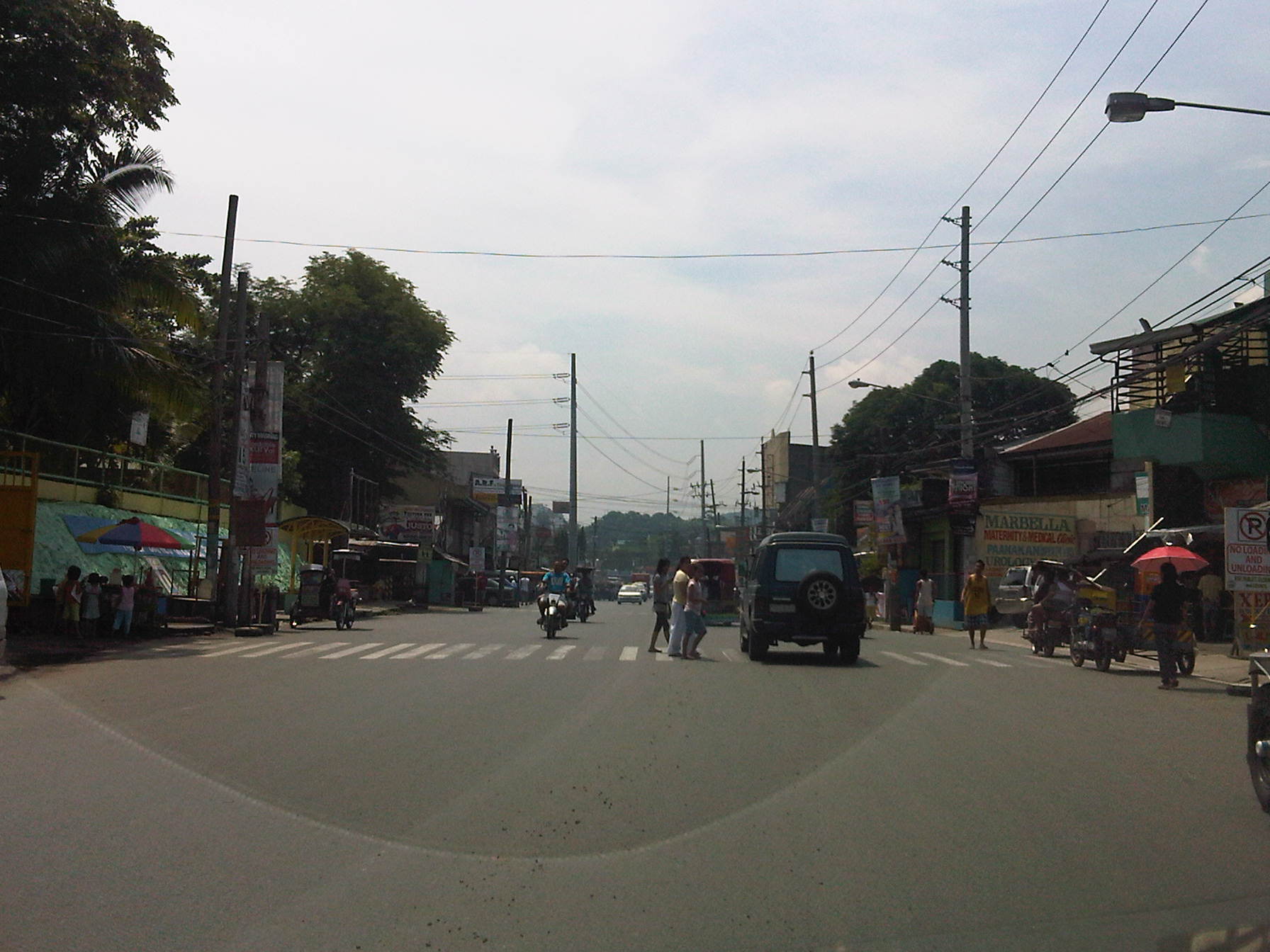 Another pedestrian crossing, this time in front of a public school right after the barangay hall.
 Some sections have sidewalks for people to walk along but these are also usually blocked or occupied by stuff from the establishments along the street.
 Waiting shed along the highway. I could not say its typical because the more recent ones usually have names or initials of politicians on them. This shed is likely to be old and uses clay tiles for roofing.
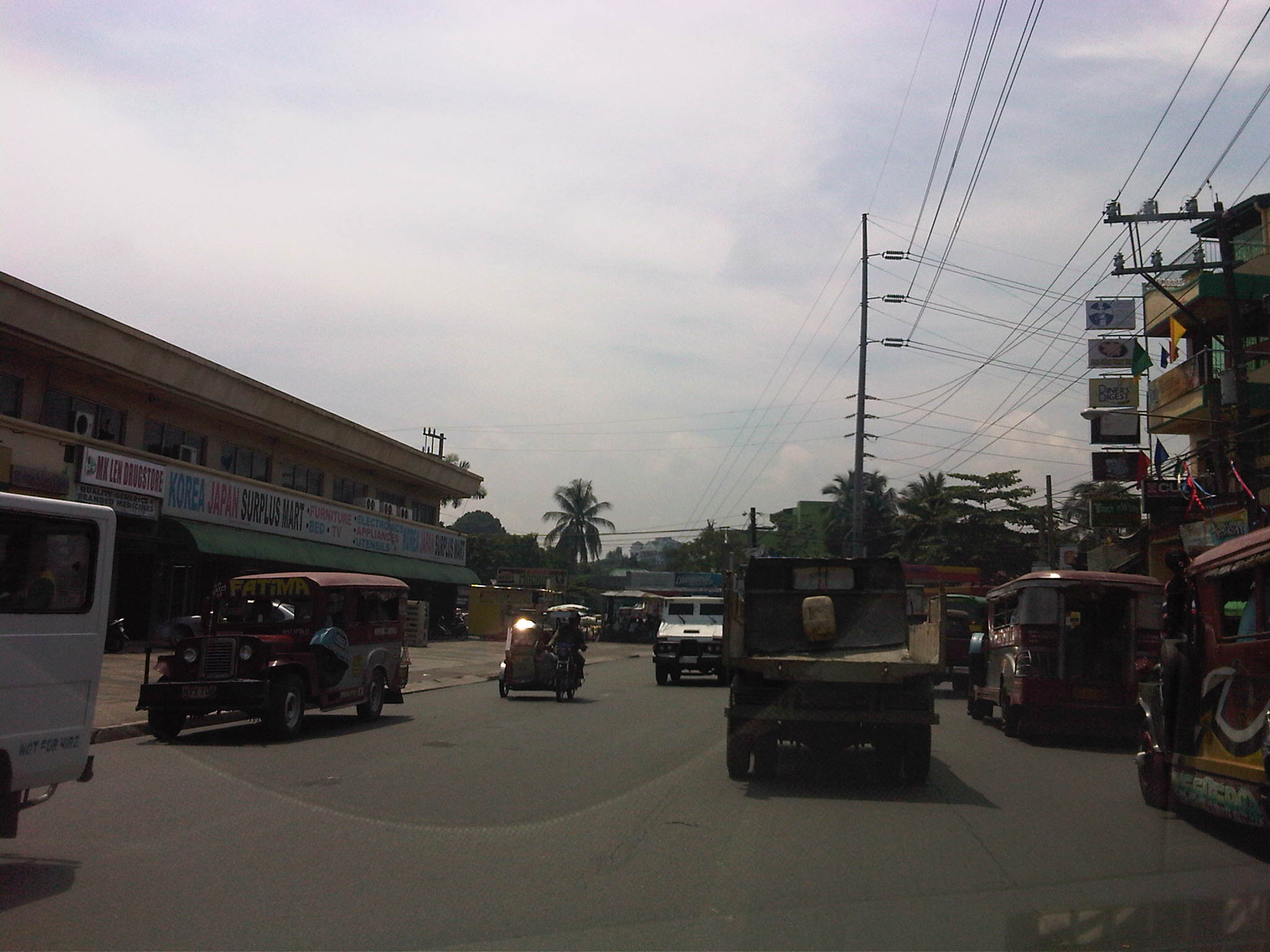 There are also tricycles along the road due to the sidestreets and subdivision entrances connecting to the highway. Public utility tricycles are supposed to be prohibited from using national roads but are common in most provincial areas and CBDs where they are the main mode of transport. In this case, tricycles should be prohibited from using the highway as they are already competing with jeepneys, serving larger areas aside from what should be individual subdivisions or residential districts.
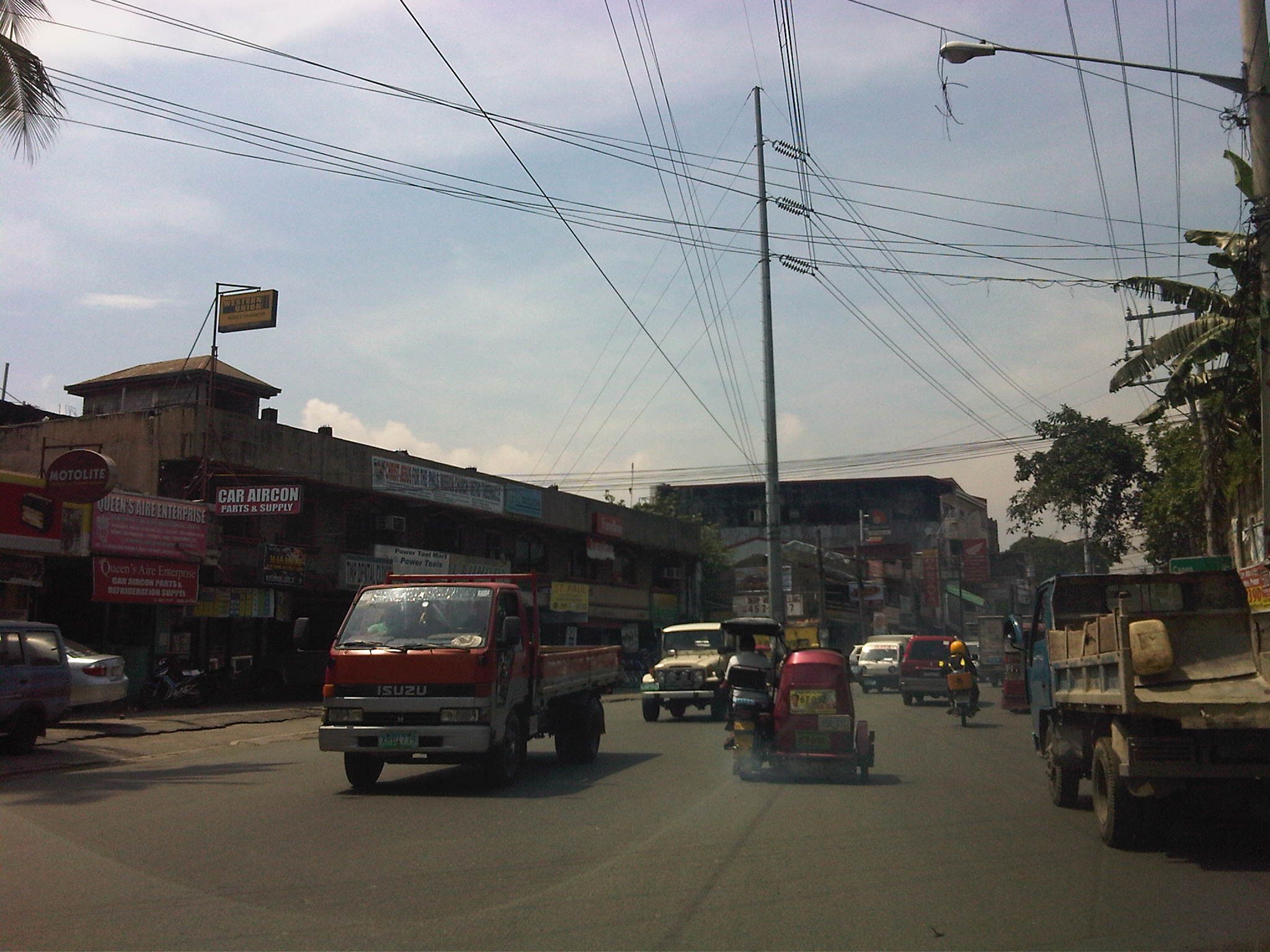 There are many auto repair and supply shops along this stretch of Sumulong Highway. Such shops typically have many customers who also park along the highway, often occupying road space and causing congestion.
 Approaching the Masinag junction, which is the intersection of Marcos and Sumulong Highways, one sees more commercial establishments on either side, mostly small stores or shops. At the junction is the Masinag Wet Market, which is now in decline after major commercial developments have been constructed in the area including the most recent SM City Masinag.
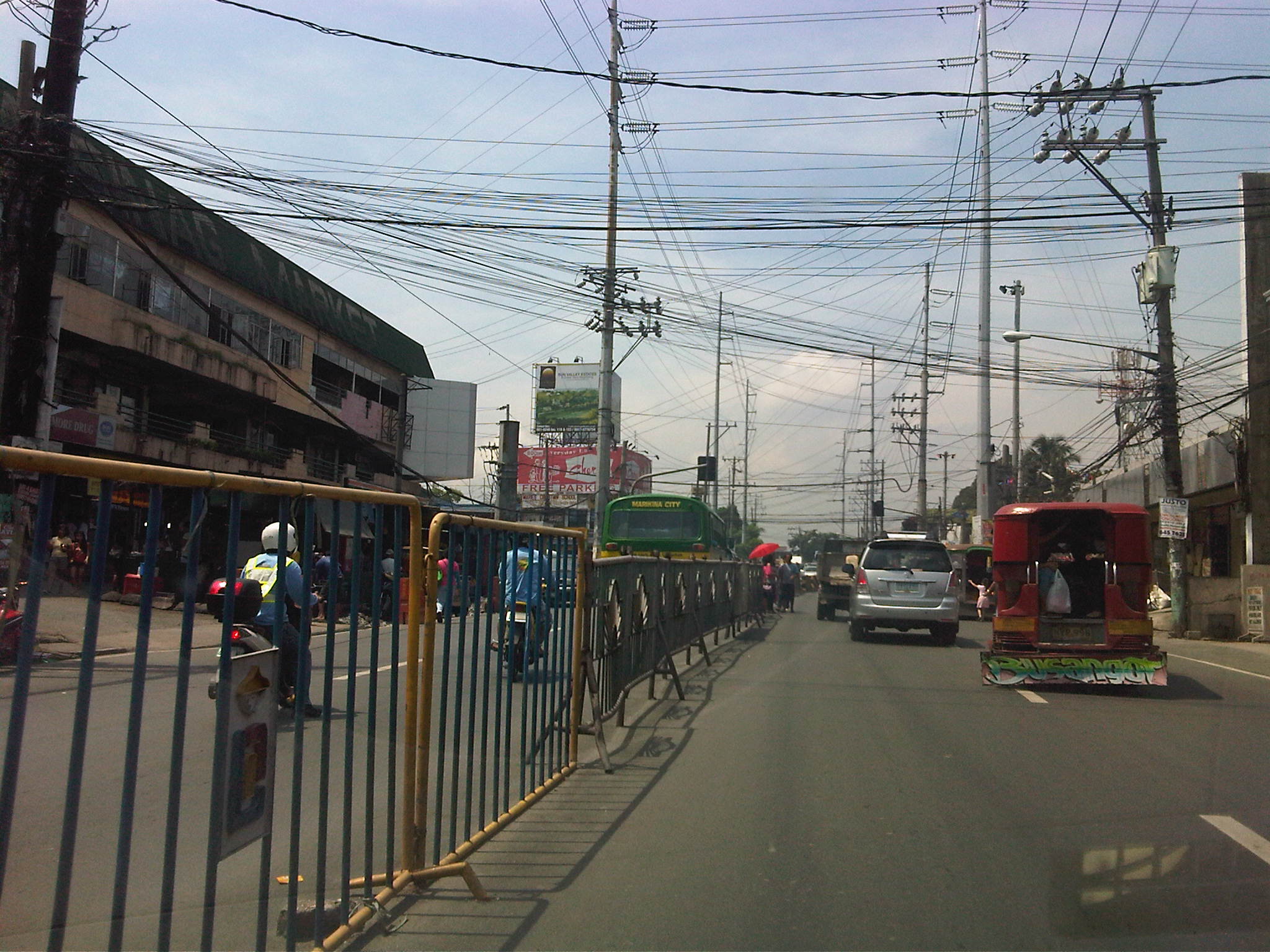 Steel barriers placed along the center of the highway to discourage jaywalking – some barriers have been moved by pedestrians to create space for illegal (and risky) crossings such as what is seen just downstream in the middle of the photo (notice the person with the red umbrella?).
 Barriers forcing all traffic to turn right to Marcos Highway – seen across is the approach of Sumulong Highway from Antipolo
Portions of this section of Sumulong Highway are prone to flooding including the intersection with V.V. Soliven Avenue, which leads to SSS Village and other subdivisions. The more recent floodings were due to the heavy monsoon rains from a couple of weeks ago that effectively isolated residential areas in Marikina and Antipolo as vehicles could not exit the subdivisions to major roads like Sumulong and Marcos Highways. It’s quite interesting to note that the drainage systems along these roads including Sumulong have not been upgraded to be able to accommodate run-off from what is turning to be heavier rains due to climate change. Thus, it may be expected that the same sections will be flooded should there be heavy rains particularly due to typhoons and other major weather systems affecting Metro Manila and its environs.
–
Floods along NLEX and SCTEX
Making a day trip to Olongapo City for a consultation meeting for a study we are doing for the city, we passed by several flooded areas in the provinces of Bulacan, Pampanga, Bataan and Zambales. The floods have been brought about by the heavy rains of the past few days due to a tropical storm that battered the Northern Philippines. It didn’t help that monsoon rains in the previous week, which have left much of Metro Manila and the same provinces already poured in much water, saturating the soils and prolonging the floods and misery for people living in these areas. Following are a few photos I took as we traveled along the North Luzon Expressway (NLEX) and the Subic-Clark-Tarlac Expressway (SCTEX).
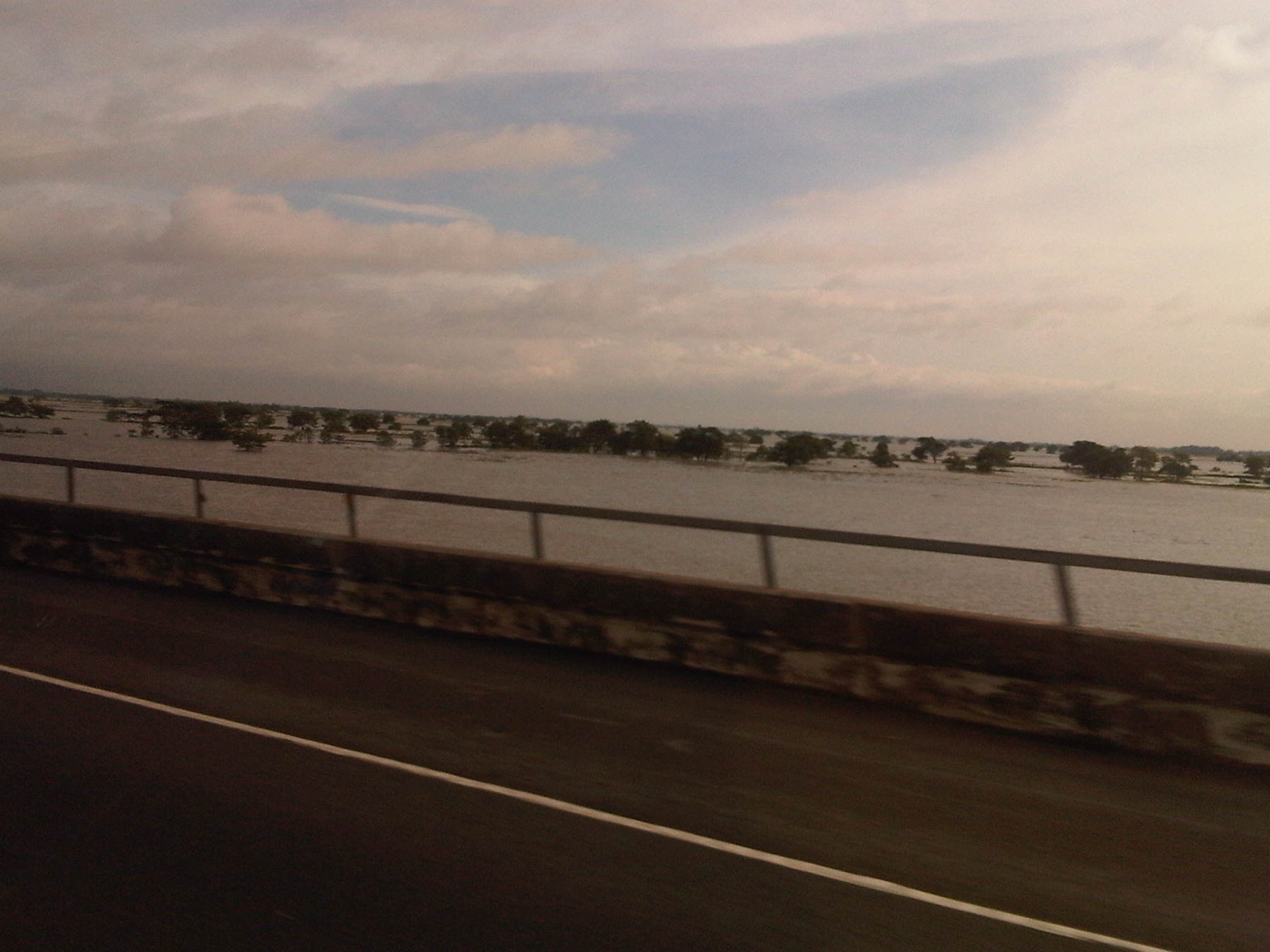 NLEX – Candaba Swamps of Pampanga
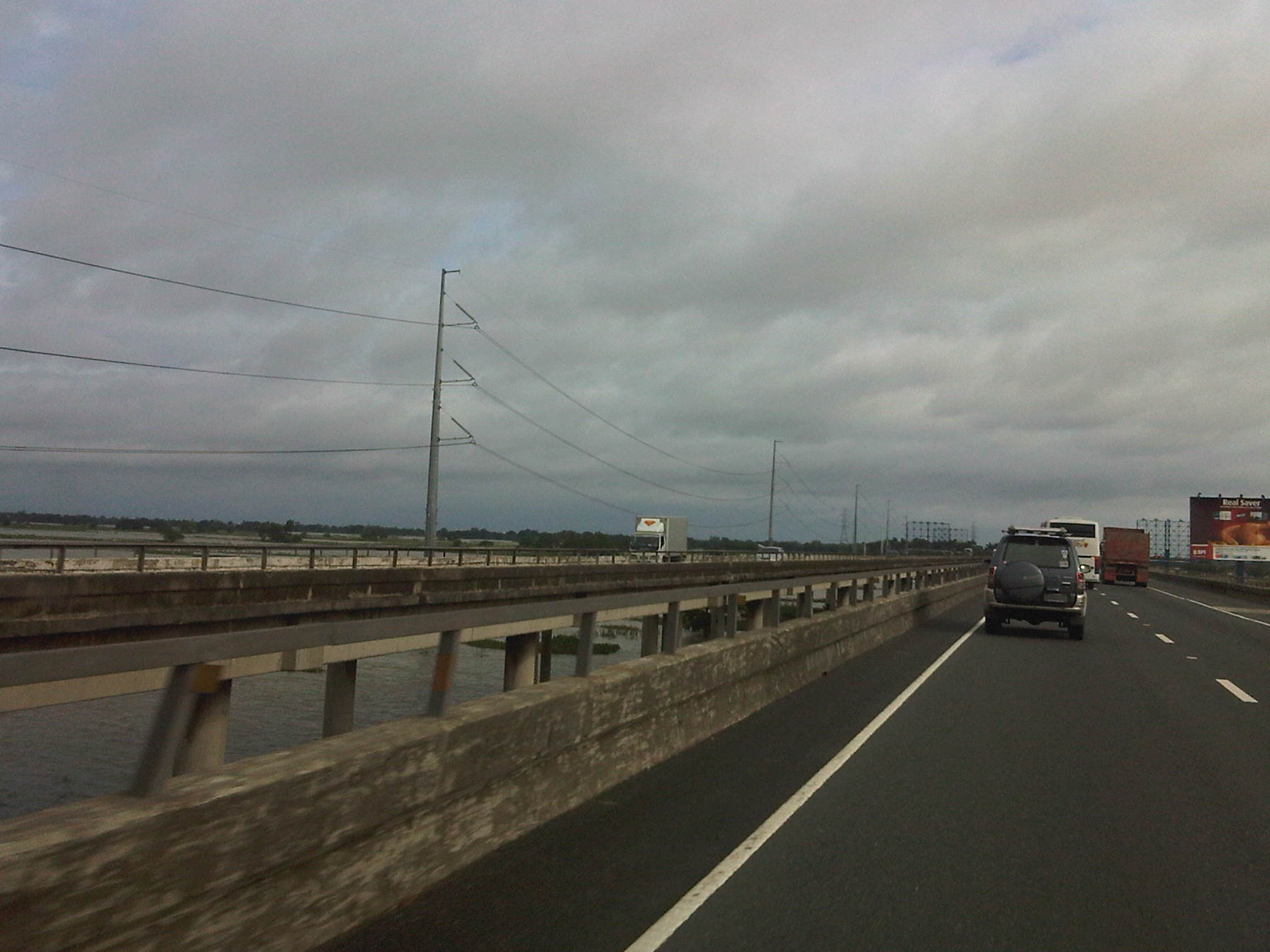 NLEX – Viaduct along the Candaba Swamps
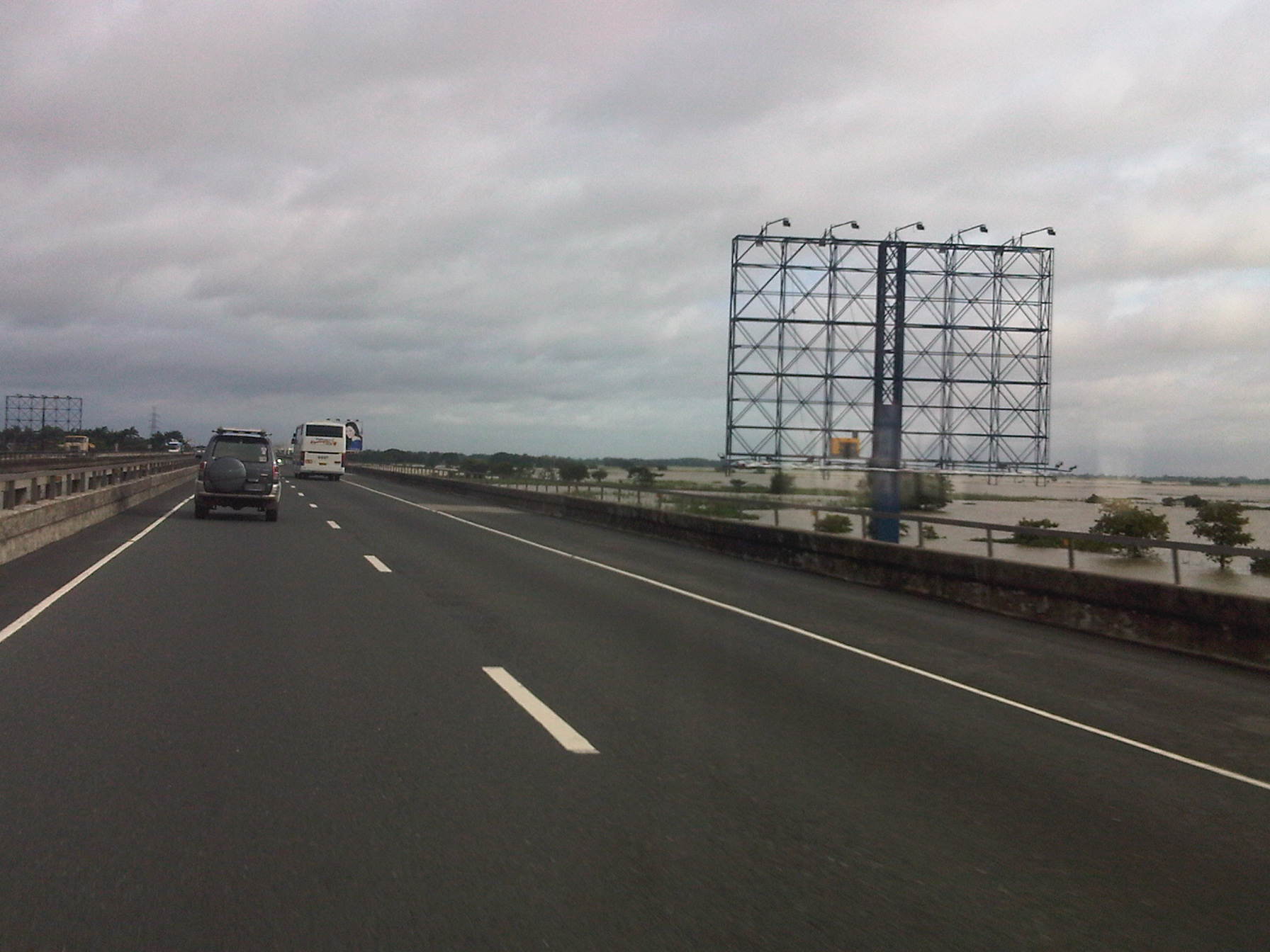 NLEX – Viaduct
 NLEX – swampland as seen from the viaduct
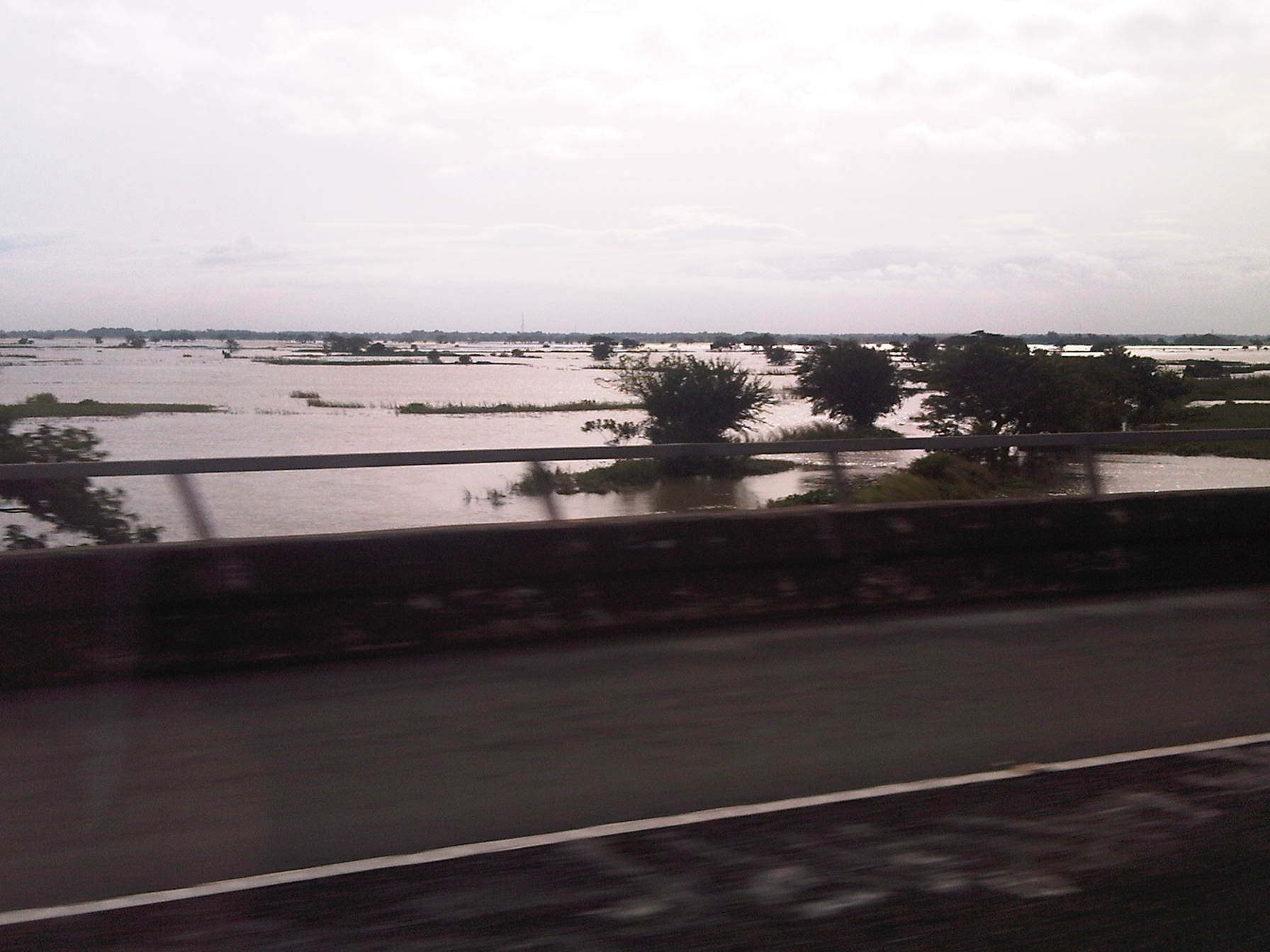 NLEX – large trees scattered across the swamp
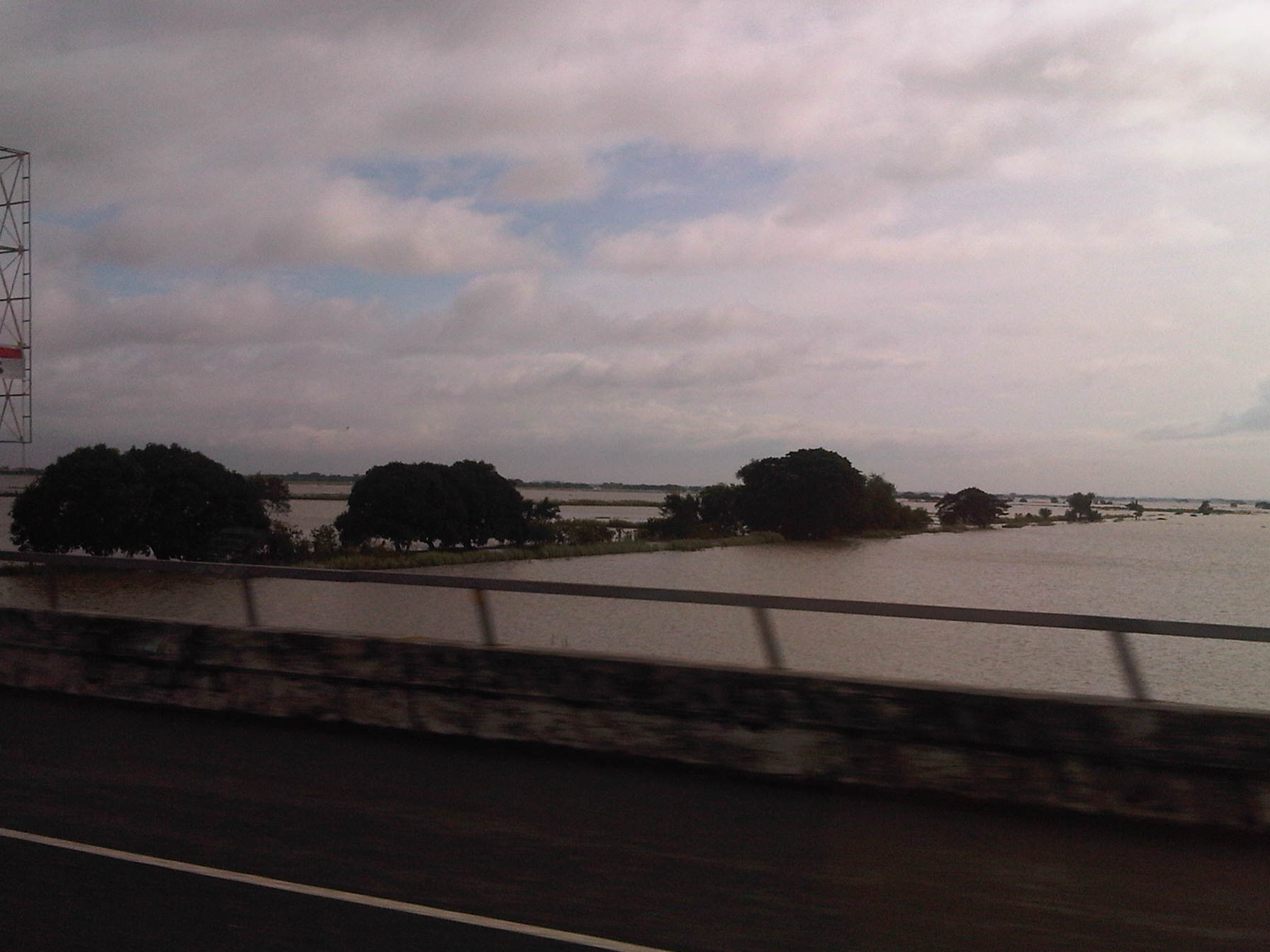 NLEX – a strip of land with large mango trees survives the flooding
 SCTEX – river flowing with muddy waters
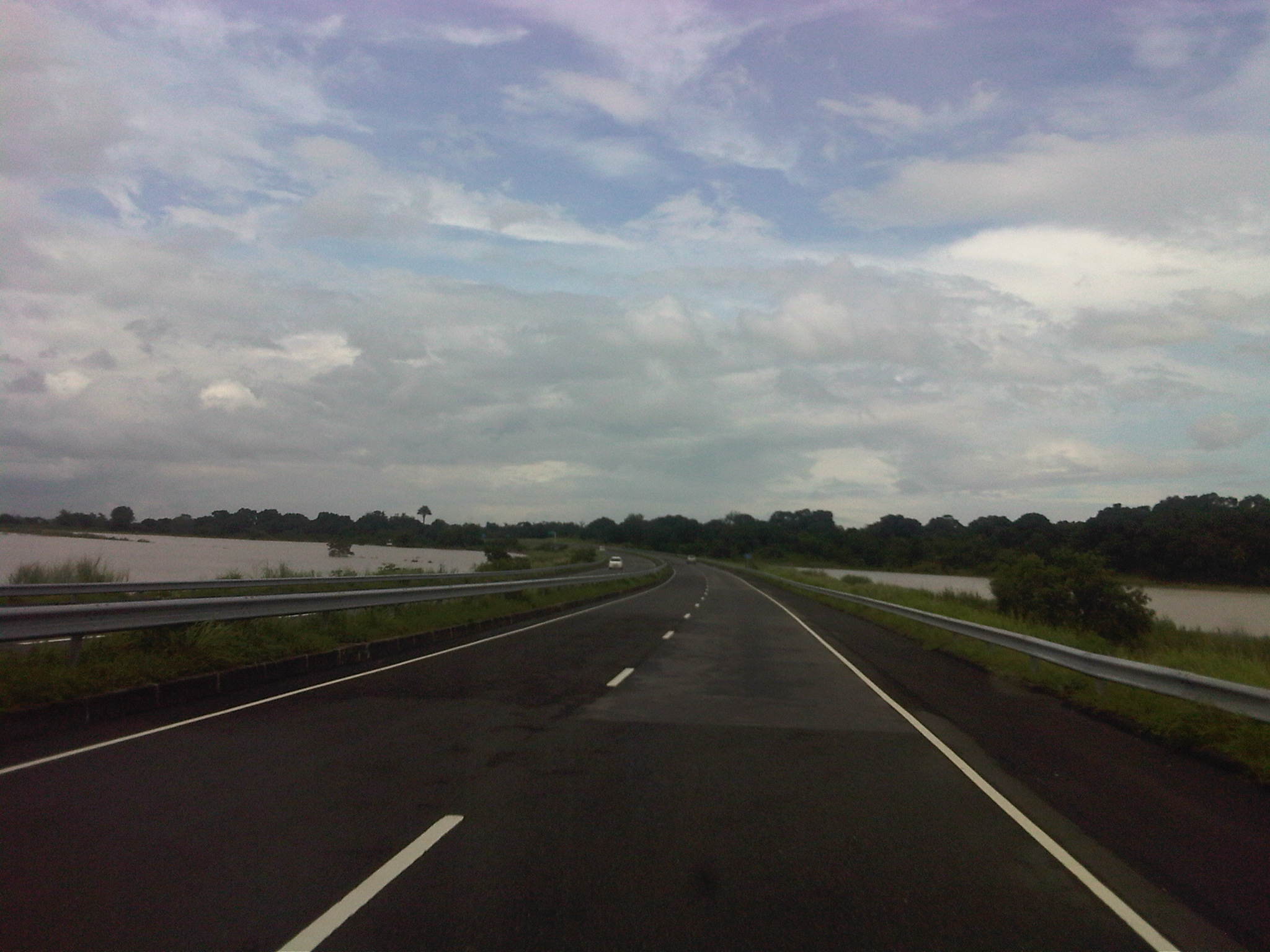 SCTEX – flooded rice fields on both sides of the expressway
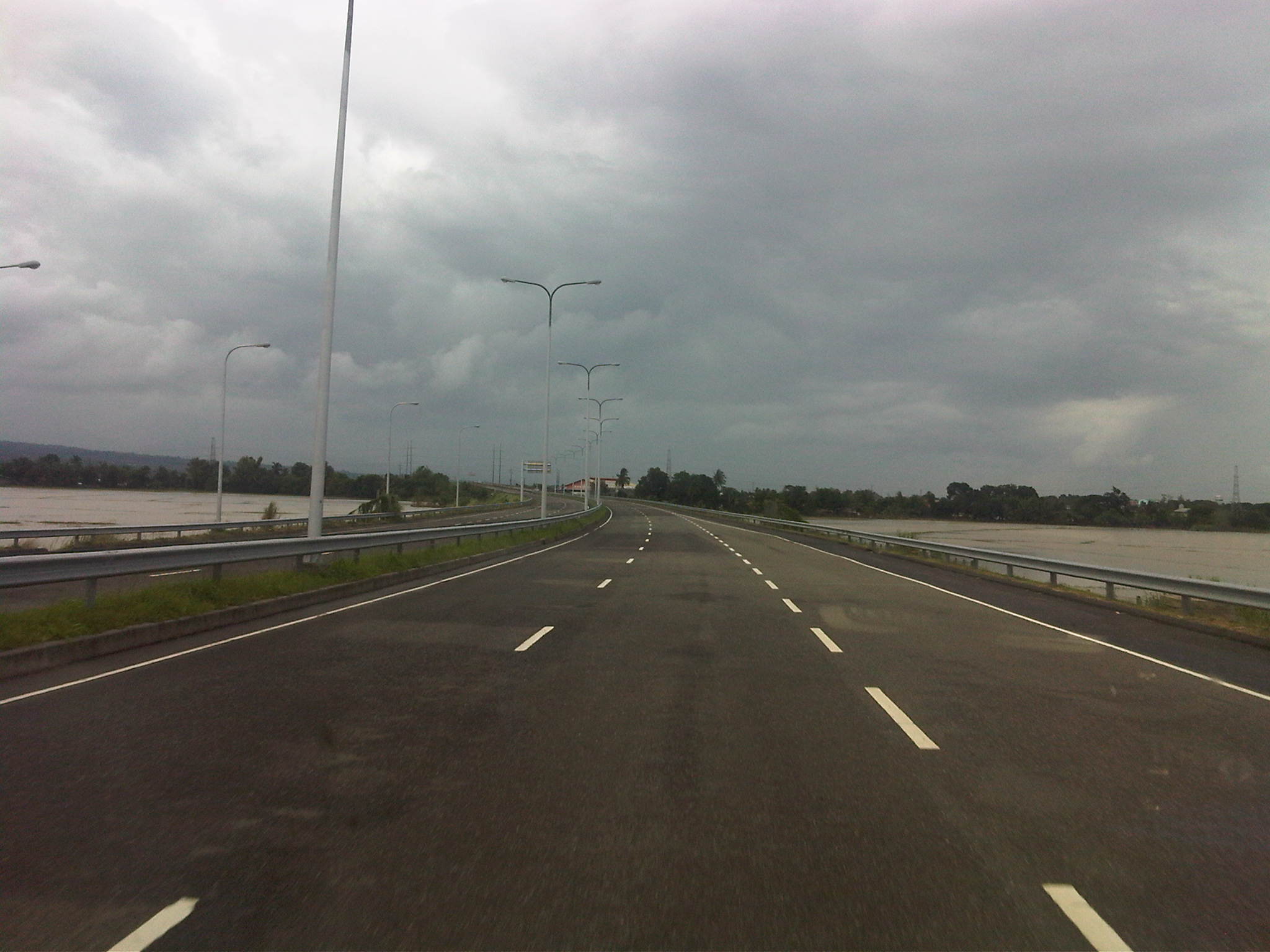 SCTEX – fertile farmlands have been inundated causing much economic losses
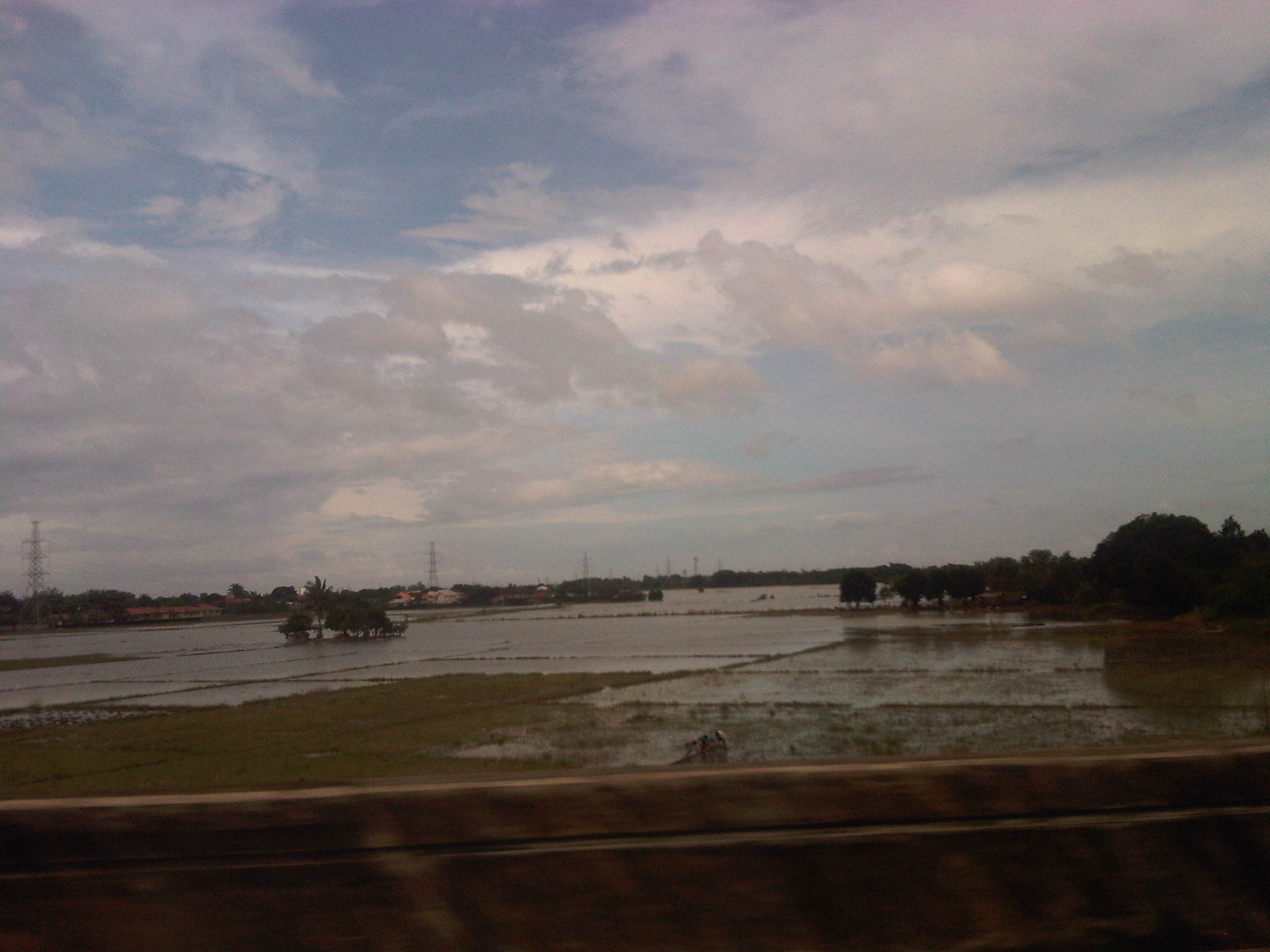 SCTEX – some fields have just been planted with rice when the rains came and flooded these fields
 SCTEX – more flooded fields
 NLEX – scenes are quite similar to those along the NLEX
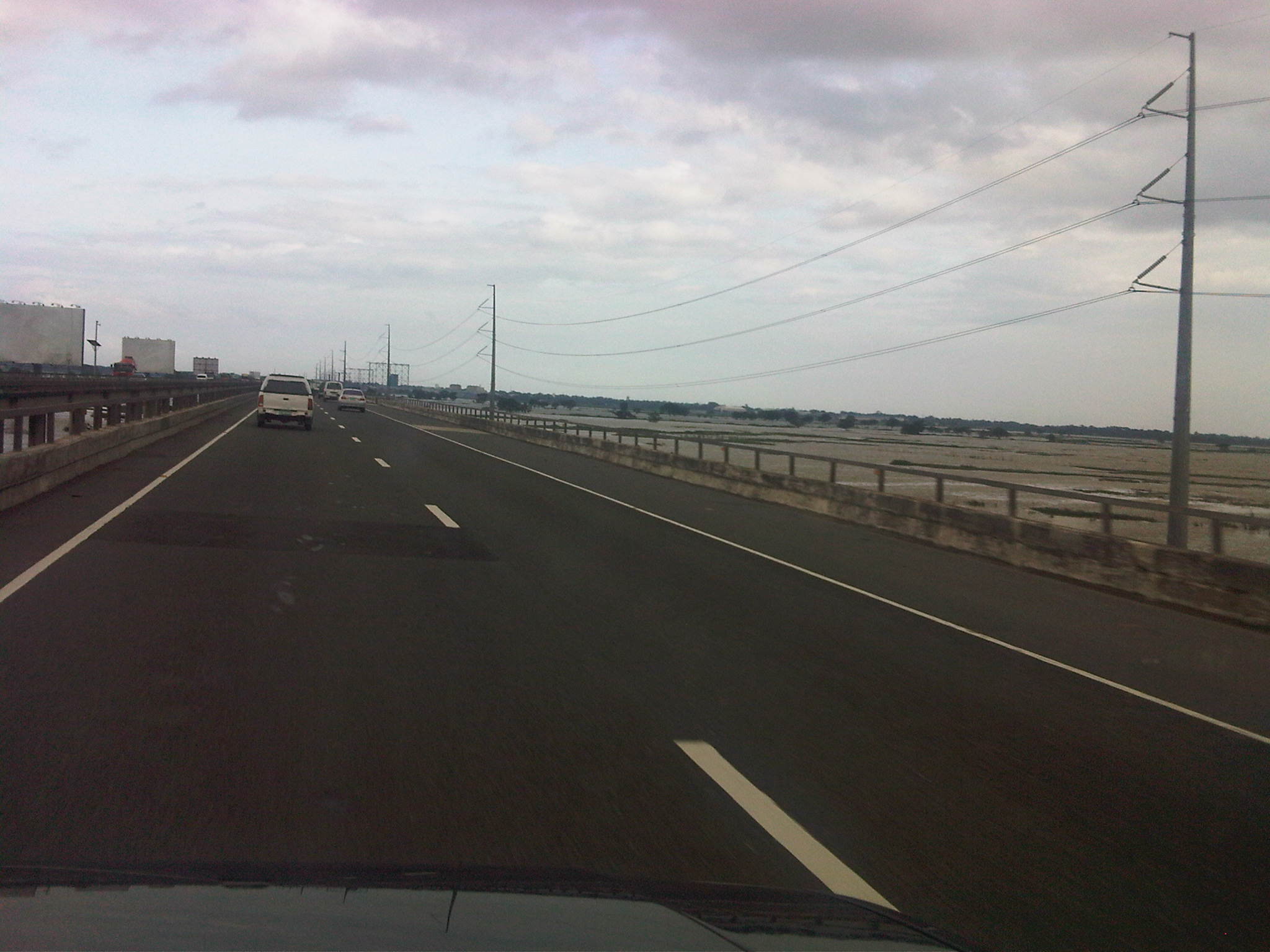 NLEX – flooded fields in Pampanga
 NLEX – Candaba Swamplands as seen from the southbound side of the tollway
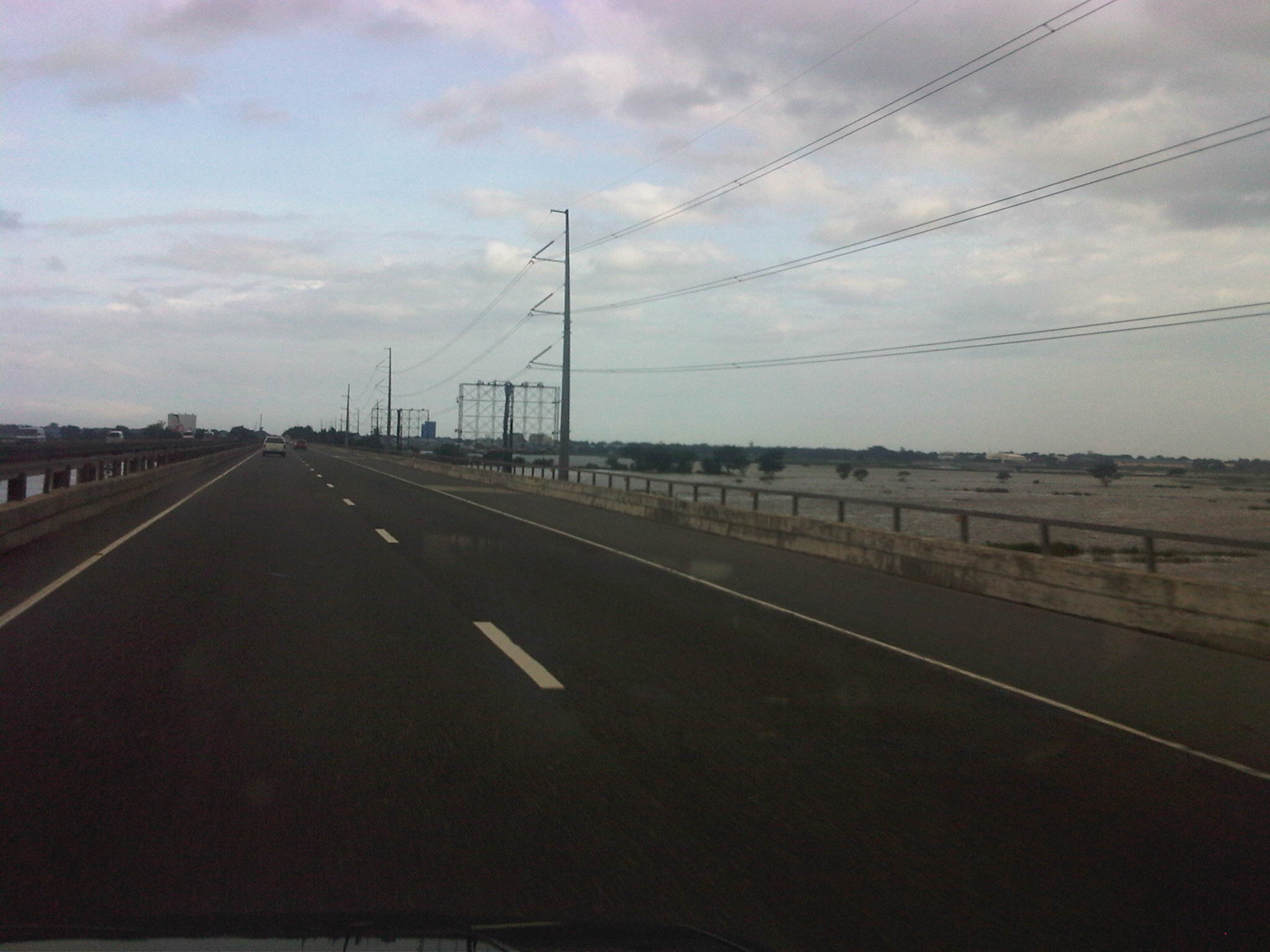 NLEX – floods everywhere in Central Luzon
–
Manila East Road
The Manila East Road is located in the province of Rizal to the east of Metro Manila. The section of the highway featured in this post connects the towns of Taytay and Angono in the province of Rizal while also in the vicinity of Antipolo City, Cainta and Binangonan. References will tell us that the road actually stretches all the way to Laguna where it passes through the towns of Pangil, Pakil and Paete along the east coast of the Laguna de Bay and continues through more towns of Laguna until Calamba.
The following photos were taken one rainy afternoon while we were listening to the radio about senators giving their individual verdicts on the first article of impeachment for the Chief Justice of the Supreme Court of the Philippines. While there are rain drops visible in the photos, these did not obscure the view of the highway allowing us to take good enough shots to illustrate the stretch of the road from Angono to Taytay (junction with Ortigas Avenue Extension (R-5) and just before the ascent to Antipolo). It is supposed to be part of Radial Road 5 or R-5 but other references also point to the continuation of Ortigas Extension through Antipolo and Teresa as also part of R-5. These roads eventually converge in the town of Morong, Rizal.
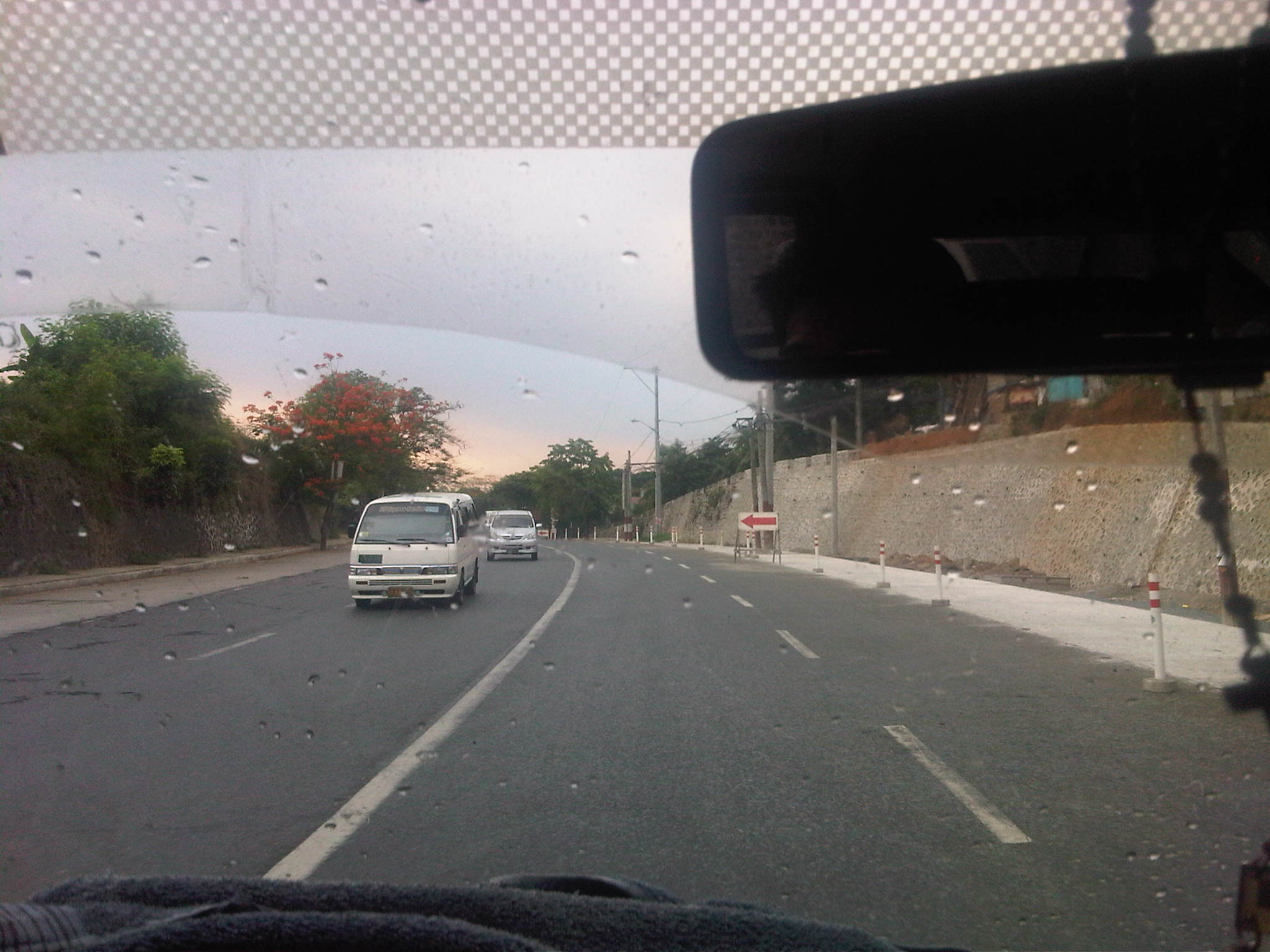 Descending from an exclusive resort where we just had a workshop hosted by a national government agency, we traveled along a section that was a 4-lane undivided road being widened to have 3 lanes per direction. While there’s a sidewalk on one side, the other side did not have pedestrian facilities.
 The section, it turns out, is a continuation of what was already a 6-lane highway as shown above.
 The 6-lane section, however, constricts into 4-lanes near the junction to the original road passing through Angono town proper. Pavement conditions were good but most markings have faded or non-existent.
 Typical of rural highways around the country, there is a proliferation of tricycles traveling along the Manila East Road. These often cause congestion due to their operations including having informal terminals along the highway.
 The lack of pavement markings can be a source of confusion for motorists who are not guided and would have the tendency to encroach into the paths of other vehicles.
 Rather simple sign to mark the boundary between Angono and Taytay. Elsewhere, there would have been an arch designed and put up by one of the towns and reflecting its character or showing off products or attractions.
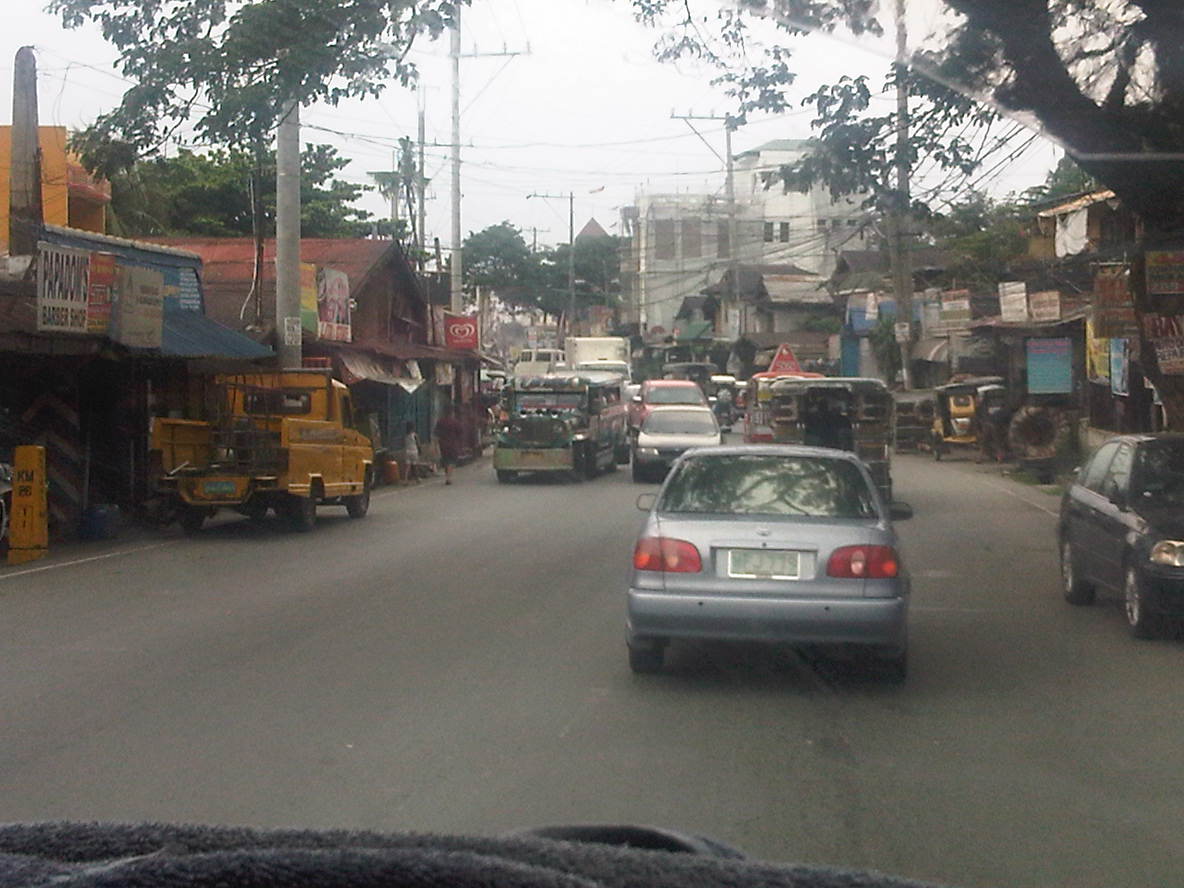 Shanties and other structures of informal settlers line up along this section of the road, effectively constricting traffic. This is supposed to be a 4-lane section (perhaps more if we check the RROW) but roadside friction including the presence of roadside parking and informal structures reduce space to about 3 lanes as shown in the photo.
 Most properties along the stretch of the highway seem unaware of building code provisions for pedestrian sidewalks and clearance in front of the building. These are matters that should have been inspected and ensured by local government.
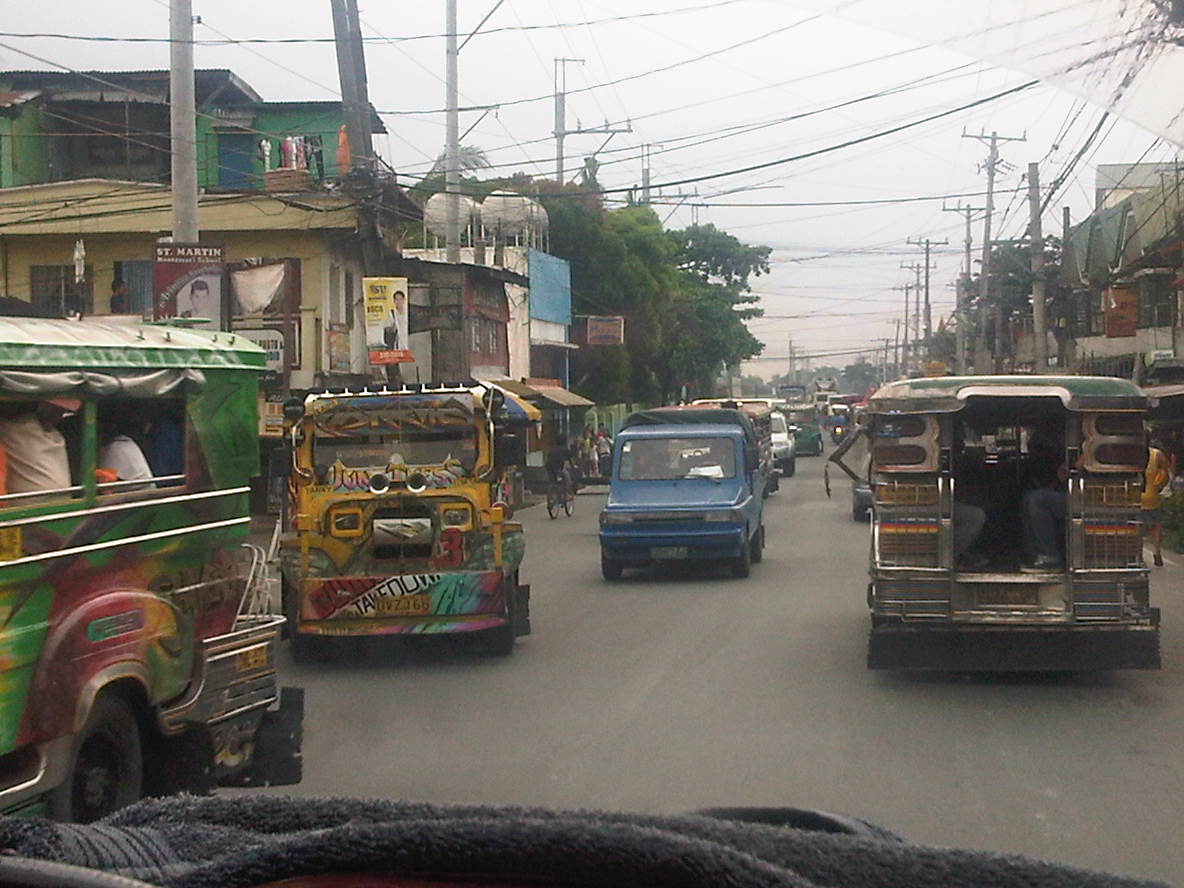 Taytay is one of the more densely populated towns of Rizal and would probably already qualify for cityhood ahead of many other LGUs that became cities in the last few years despite having shaky incomes among other qualifications. Land use planning, however, does not look like something that was undertaken for much of the areas adjacent to the highway.
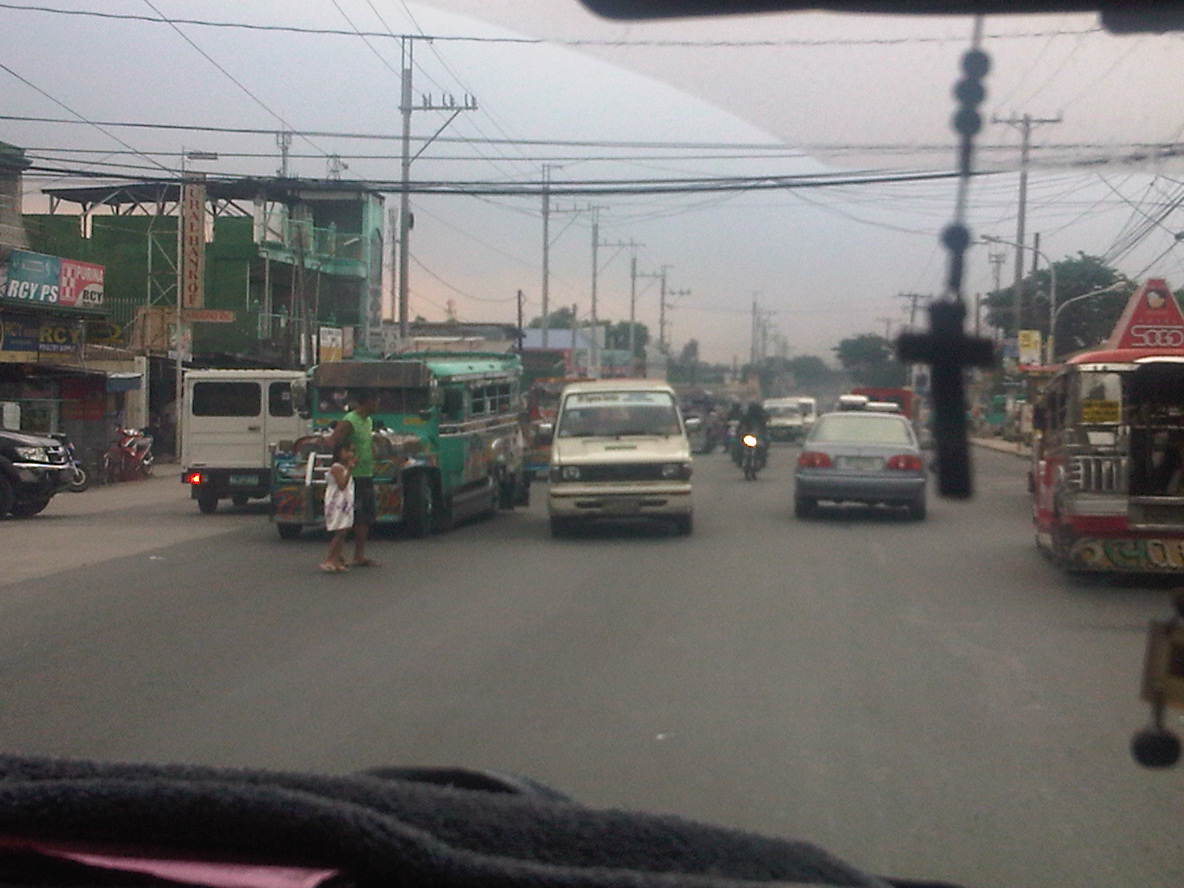 Pedestrians practically cross anywhere along the highway, with most like the man with a child in the photo seemingly uncaring about the risks posed by motor vehicles. In the case above, there are no pedestrian crossing signs or markings but in places where there are such designations people rarely follow the zebra crossings mainly out of ignorance and partly out of stubbornness.
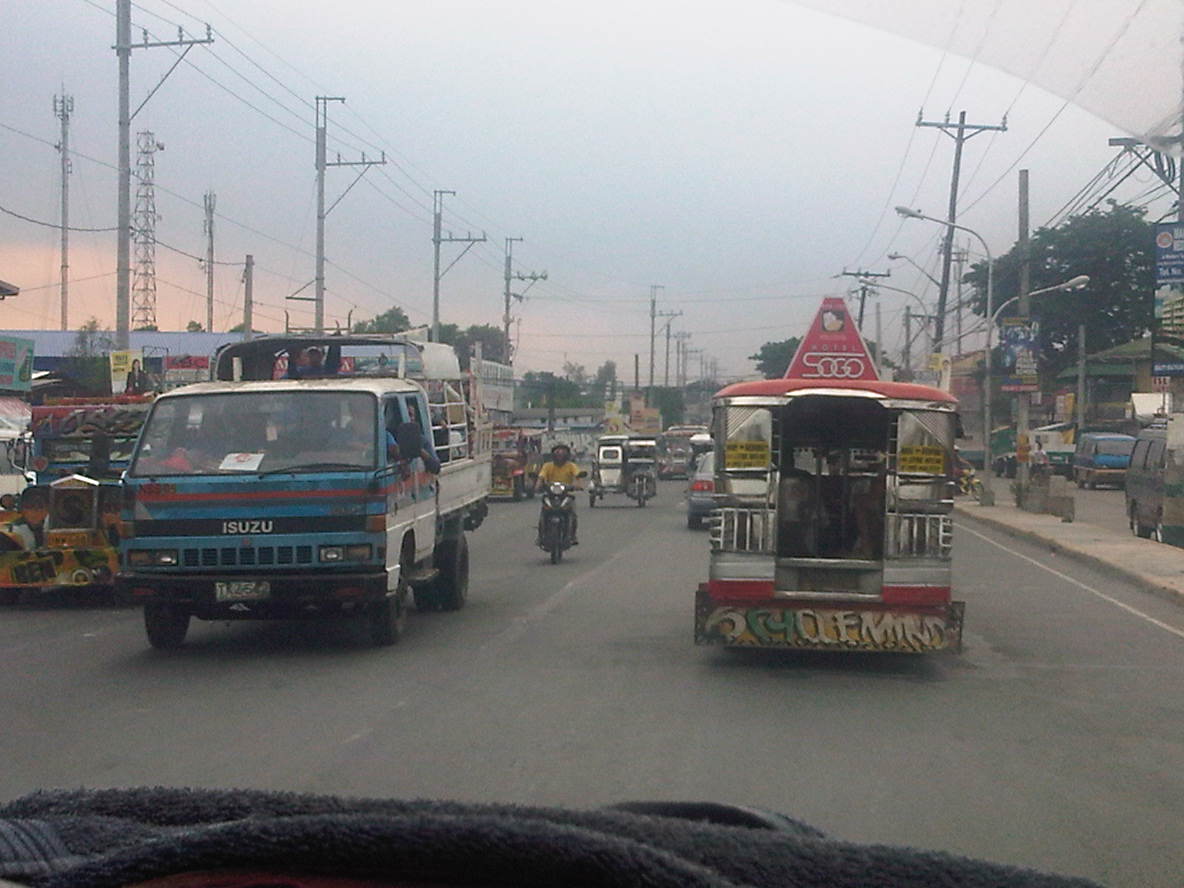 Along one section, the road widens and has along the Ortigas-bound side (right in the photo) a 2-lane service road separate from the main carriageway by a narrow concrete island. The service road is also plagued by parking though its purpose seems to be that for loading and unloading of passengers.
 Electric posts are located dangerously close to the road and would probably fall over if hit by a wayward vehicle. Such is probably the result of road-widening and shortcomings with coordination with the utility company as well as some fault, too, with the utility company as well.
 Another section with excellent pavement conditions but no pavement markings.
 There are short bridges along the highway due to the streams that run across the road from the mountains in the east to the general direction of Laguna De Bay and the Manggahan Floodway to the west. These bridges also tend to limit the width of the carriageway as shown in the photo.
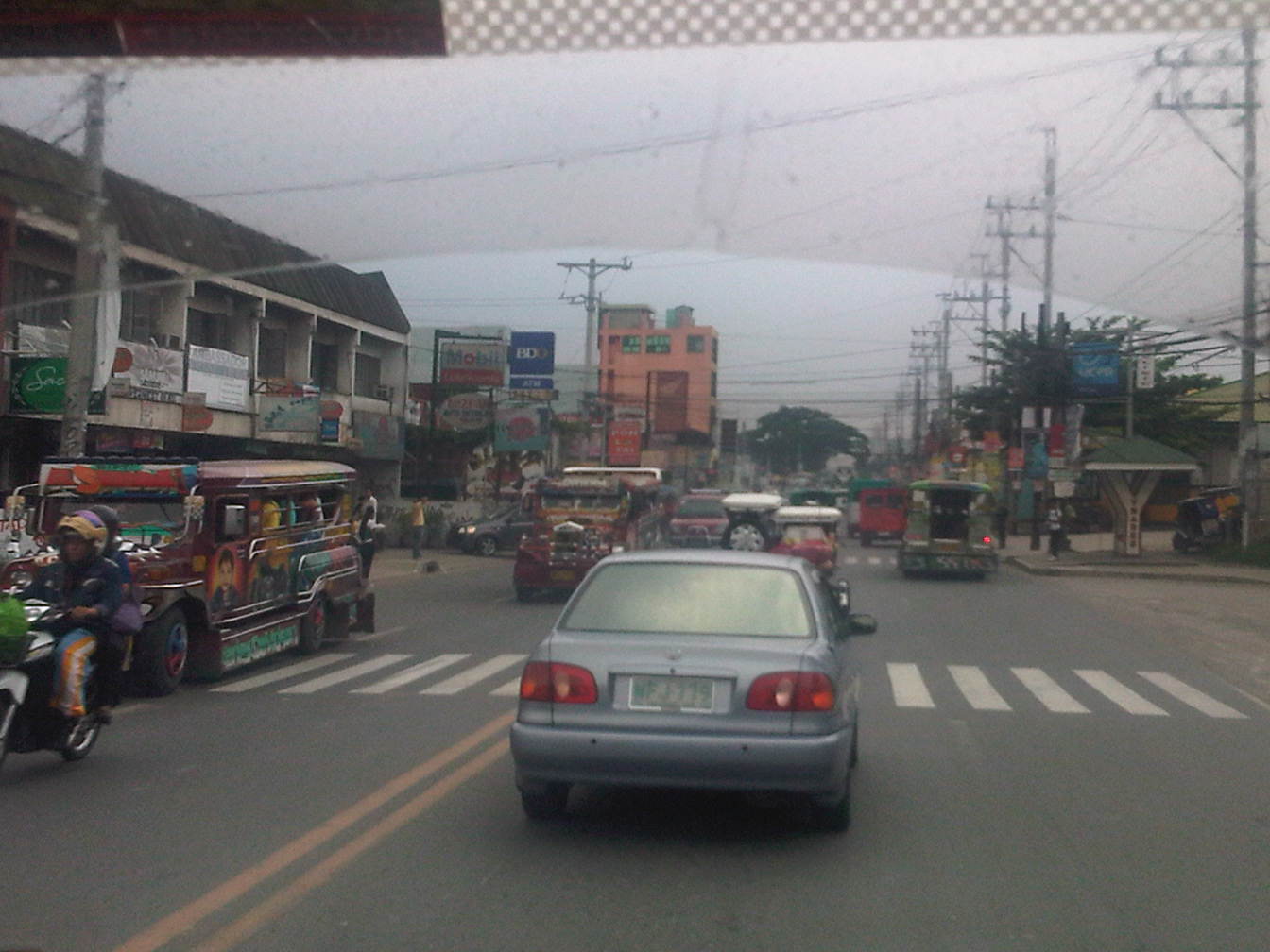 After the bridge, the road widens back to 4 lanes and complete with standard markings. For the entire length of the road from Angono to Taytay there is a trend, based on our observations, that sections alternately widen and narrow based on the developments on either side of the road.
 On-street mayhem is when you mix different kinds of vehicles and pedestrians on the road in the Philippines.
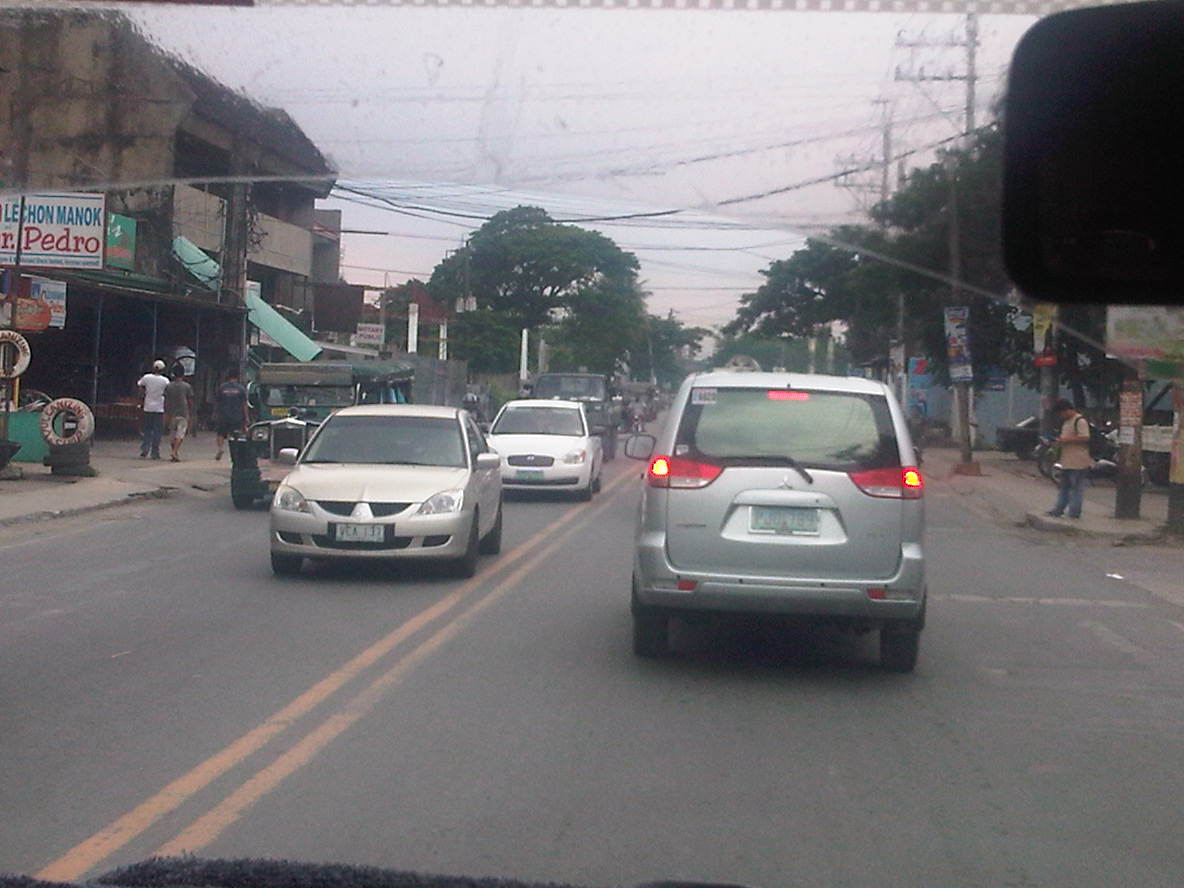 What is supposed to be a 4-lane road seems like a 2-lane carriageway because of some delineations missing and vehicle tending to hog the equivalent of 2 lanes like the vehicle in front of us.
 Junction with A. Bonifacio Ave (from Imelda Ave. and the Cainta Junction). A. Bonifacio passes through the town centers of Cainta and Taytay but is usually a very congested road having a narrow 4-lane carriageway that’s effectively a 2-lane road. The Manila East Road effectively bypasses that road. Notice that after the junction, the road markings are all there.
 Curve right after the junction
 This section has a total of 8 lanes based on the pavement markings but effectively has only 6 as the outermost lanes are often occupied by parked vehicles or used by pedestrians in the absence of sidewalks along either side of the highway.
 Pedestrian bridge between two buildings comprising the SM City Taytay. People have a tendency to cross at street-level so to force them to use the overpass, barriers were placed along the median. The barriers seem to be quite porous and I only wonder if anti-jaywalking policies are enforced in the area.
 An 8-lane stretch of the highway featuring a covered court with the name of a provincial politician stamped on its roof. This section used to have only 4 lanes with some shoulder space on either side of the highway. The DPWH and the local government had a measure of success in recovering land from encroachments and easing informal settlers off from the RROW, something that should probably be undertaken but which requires much more effort along sections shown in the previous photos.
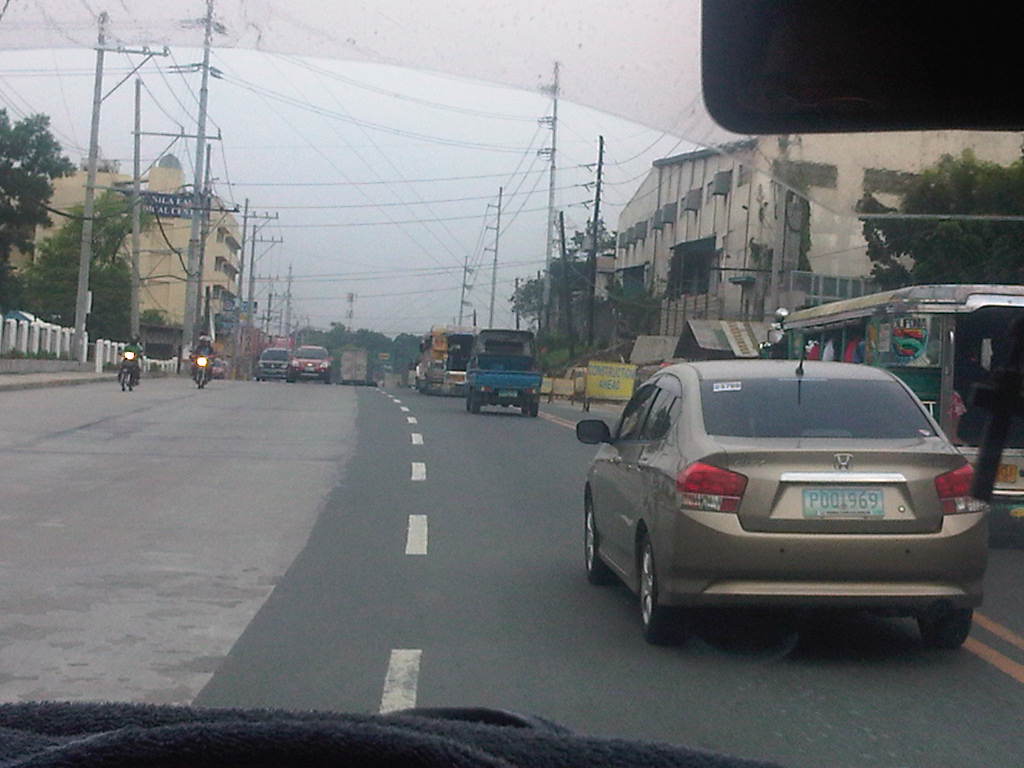 Road widening was still being implemented along the Ortigas-bound side of the highway when we passed through. There was no congestion though since the carriageway was wide enough to carry the light traffic during the early afternoon.
 The 8-lane section narrows to the equivalent of 6 lanes though the pavement markings seem to indicate only 4 lanes as shown in the photo. Already visible in the photo downstream of our position is the Tikling Junction – the intersection of the Manila East Road with Ortigas Avenue.
 Approach to Ortigas Avenue Extension and Leonard Wood Road (which is to the left just before the intersection with Ortigas)
 Junction with Ortigas Avenue Extension
–
Manila Gravel Pit Road – Litex Road
Among the more unusual names for a road is one that connects Quezon City in Metro Manila to Rodriguez (formerly Montalban) in Rizal Province – the Manila Gravel Pit Road. It is also known as Litex Road, which is referred to in many bus signboards plying the Fairview / Novaliches routes. The following photos were taken around the same time the other photos along the Batasan-San Mateo Road, Montalban Highway and Payatas Road were taken and so comprise a series of posts.
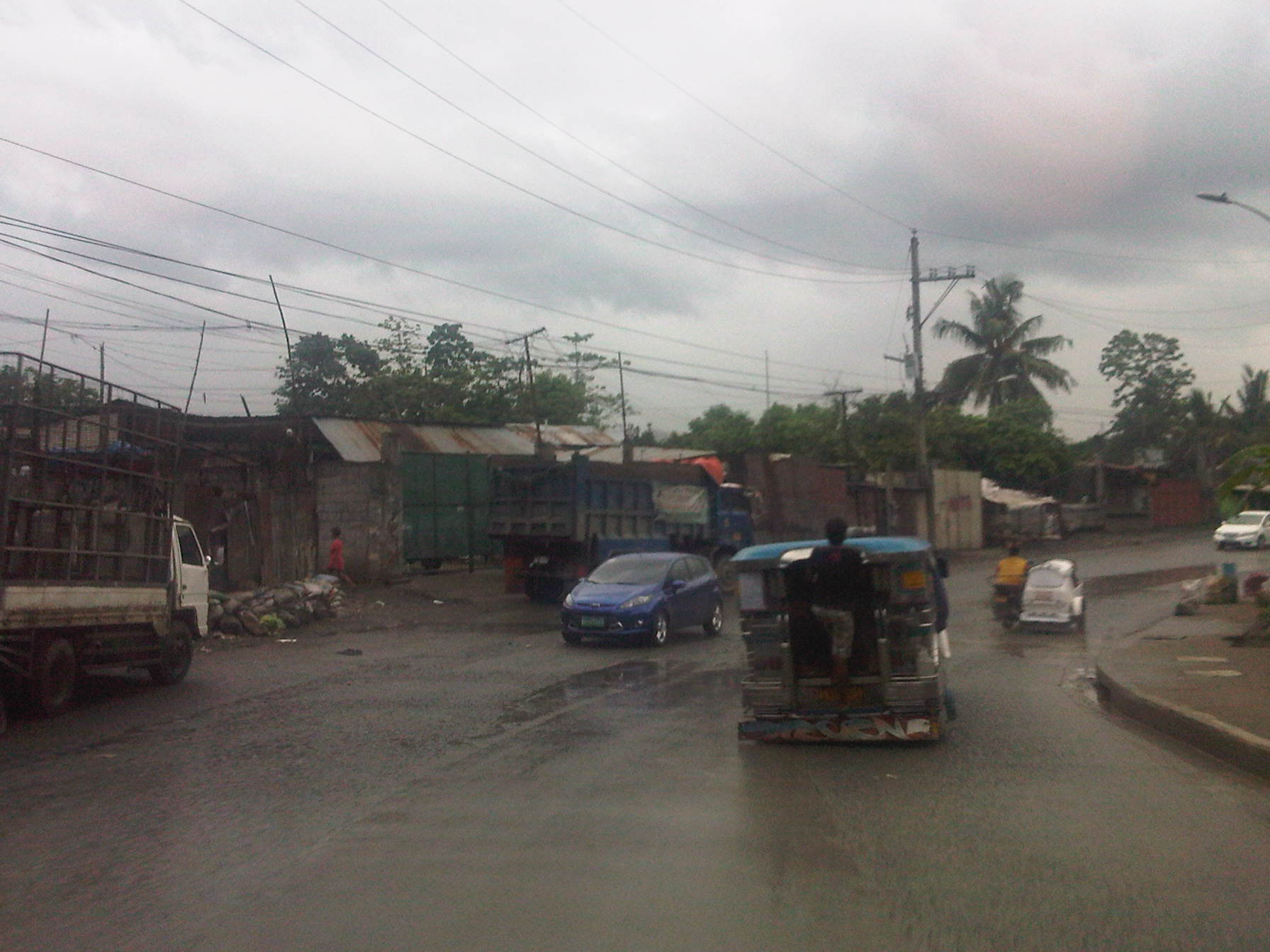 The road has 4 lanes along some sections but is effectively a 2-lane road due to significant roadside friction include parked vehicles along either side.
 There are many informal settlers encroaching upon the RROW like the shanties shown on the left side of the road in the photo.
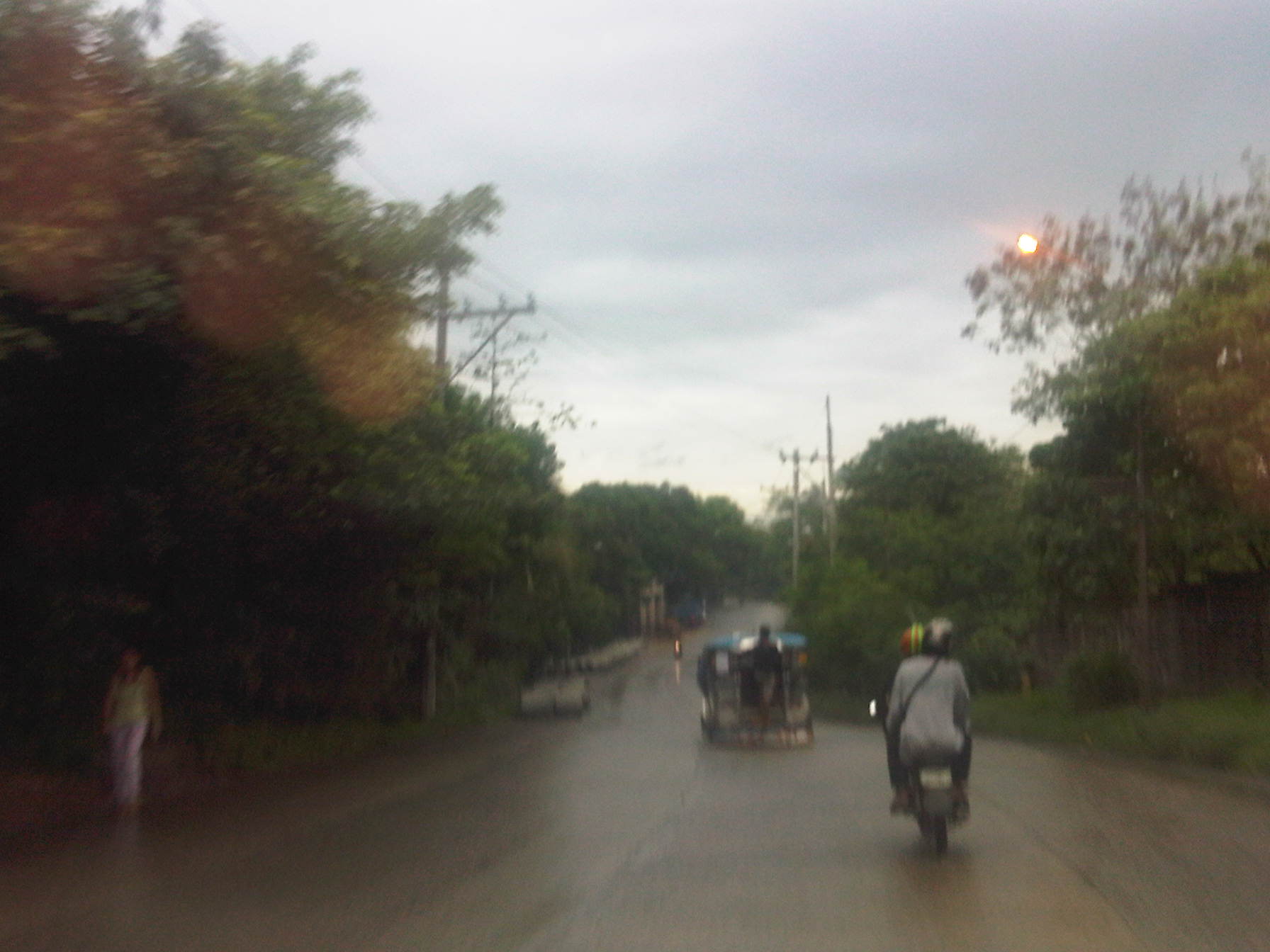 There are a few picturesque section of the road owing to the presence of greenery on both sides of the highway. There are also efforts here and there to improve drainage. One concern though is the lack of pedestrian facilities forcing people such as the woman on the left to use the carriageway instead.
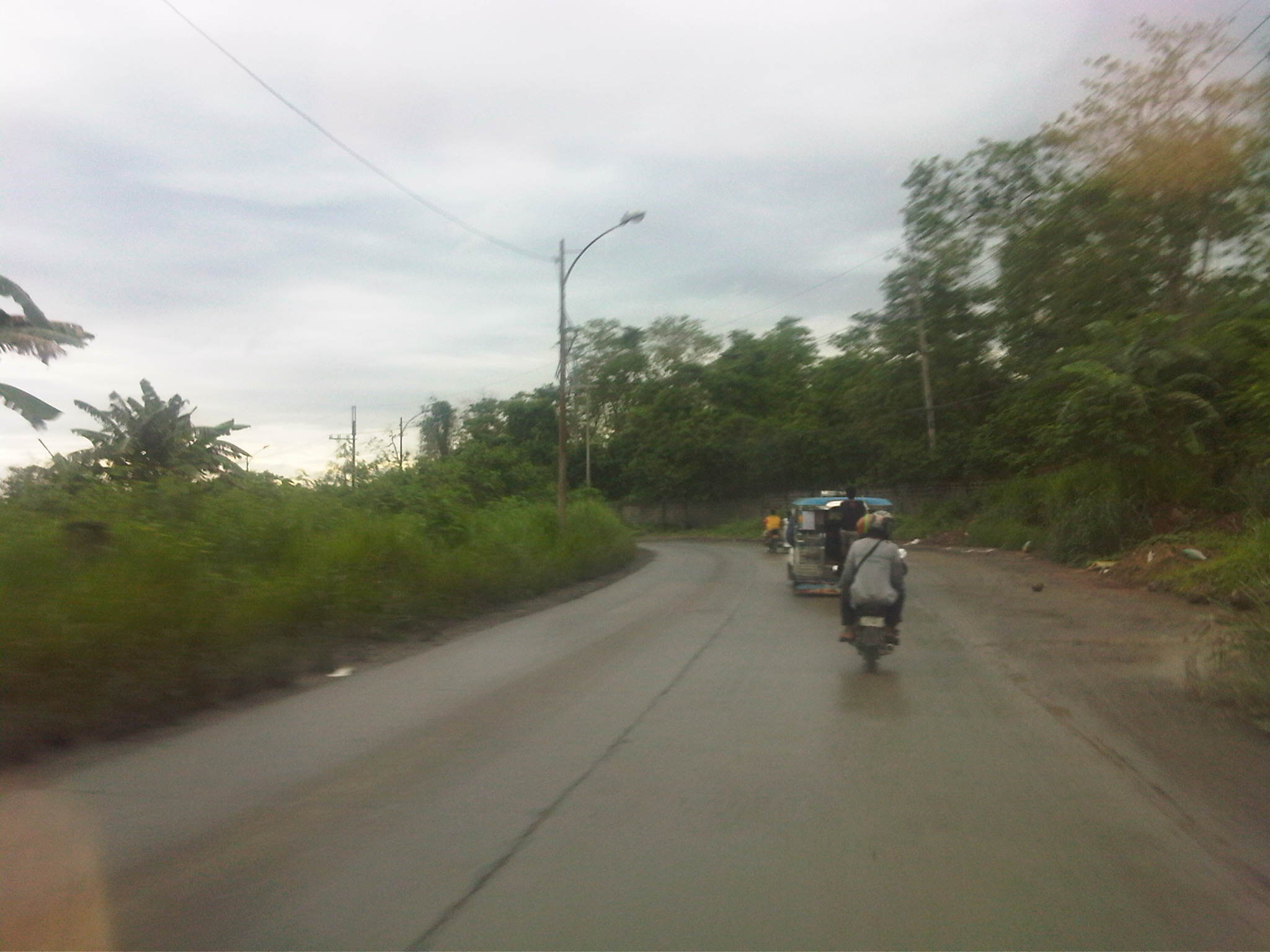 When I look at the photos now, I keep trying to keep in mind that the reason there is a fence made out of CHBs on one side of the road is because it demarcates the property of the La Mesa watershed.
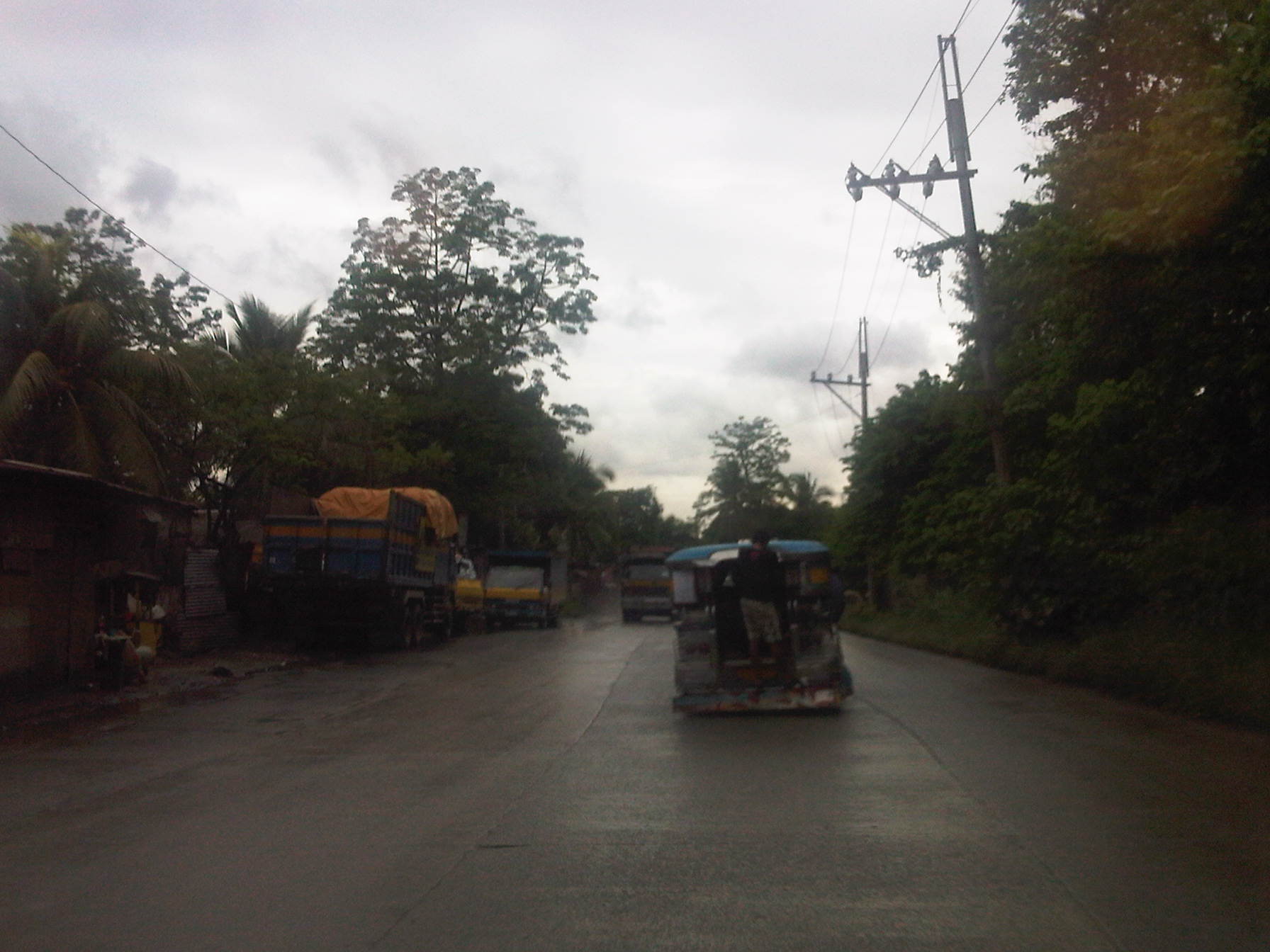 There is significant truck traffic along this road. In particular there are many dump trucks (the rigid 3-axe types) traveling along the road for the primary purpose of transporting garbage to the nearby Payatas dumpsite. Prior to the focus on the dumpsite, the road was named as it was because of it being used to haul gravel from the quarries in nearby San Mateo and Montalban.
 Section near a Manila Water facility (right) as only 2 lanes without sufficient shoulders on either side of the road.
 One can easily see the garbage trucks from afar due to the typical bright yellow color of most trucks hauling garbage to the dumpsite.
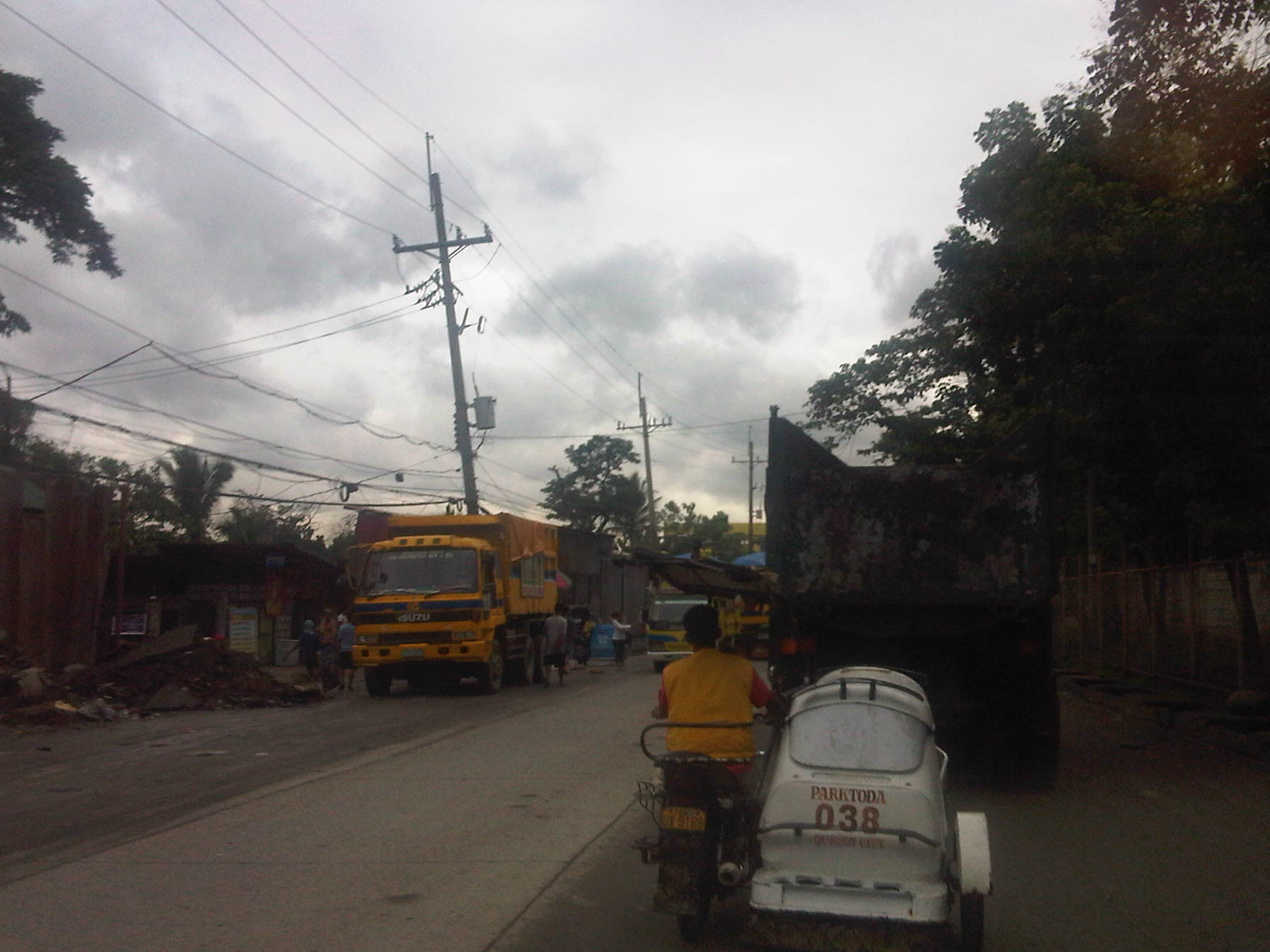 One will see many trucks parked along the road and still with their loads. Some truckers will try to salvage items they could sell to junk shops like scraps of metal, bottles and plastics that they are able to sort from their loads. What remains will be taken to the dumpsite where scavengers will have their chance to pick on whatever are left that probably has value.
 There are many garbage trucks traveling along or parked along this stretch of the road as the numerous side streets lead to the Payatas dumpsite.
 An elementary school building (name of school I forgot to take note of) with its typical yellow and blue motif used in the past administration of QC and retained with the current dispensation.
 One will encounter more trucks along the road heading towards the dump site or their suking junk shops.
 That’s the Cecilia Munoz Palma High School with the yellow and blue motif building. It is one of the better public schools in Quezon City considering the limited budgets for public education.
 From a road safety perspective, the road section fronting the school is unsafe for students as there are no pedestrian facilities, road markings (zebra crossing, rumble strips, etc.) and traffic signs (school zone, speed limits, etc.)
 More trucks parked along the road beside informal junk shops put up by informal settlers. Many truckers also live in the area where many informal settlers are tolerated by the local government. These allegedly translate into votes during election times.
 Trucks galore…need I say more?
 Approaching Commonwealth and the Fairview area, lands on either side of the road are occupied by informal settlers that hide the formal residential subdivisions in the area. Many structures have occupied what could have been pedestrian sidewalks and buffer zones between residential areas and the road. The situation is exacerbated by roadside parking.
 While there are semblances of sidewalks along some sections, pedestrians are eventually forced on the road because of obstructions and encroaching structures.
 The truck traffic and the lack of pedestrian sidewalks combine for an unsafe road.
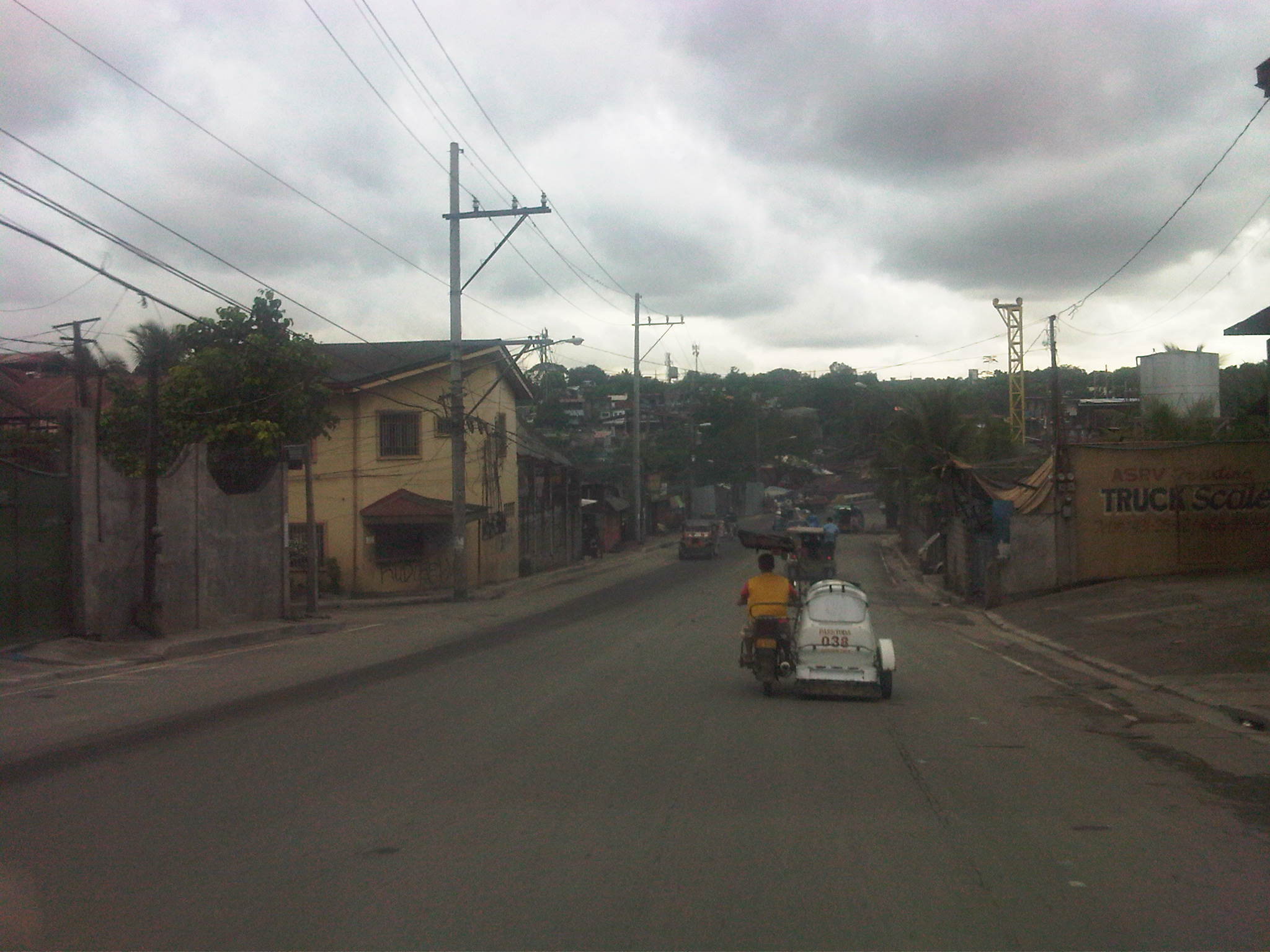 The higher grounds of the Batasan area is visible in the horizon. This road section is conspicuously wide (4 lanes) and we chanced upon passing through while there was light traffic. Note also the more formal structures on either side of the road though pedestrian facilities are still lacking.
 More junk shops along the road with some selling second (or even third) hand materials that can be used for construction. Many become the “building blocks” of shanties in informal settlements in the area.
 Most sections have poor pavement conditions due to truck traffic and the lack of a proper drainage system. Water eventually seeps beneath the concrete layer and weakens the foundation (sub-base) of the pavement.
 Further examples of bad practices – pedestrians walking on the carriageway, passenger hanging on a jeepney, lack of traffic signs and road markings, and tricycles along a national road.
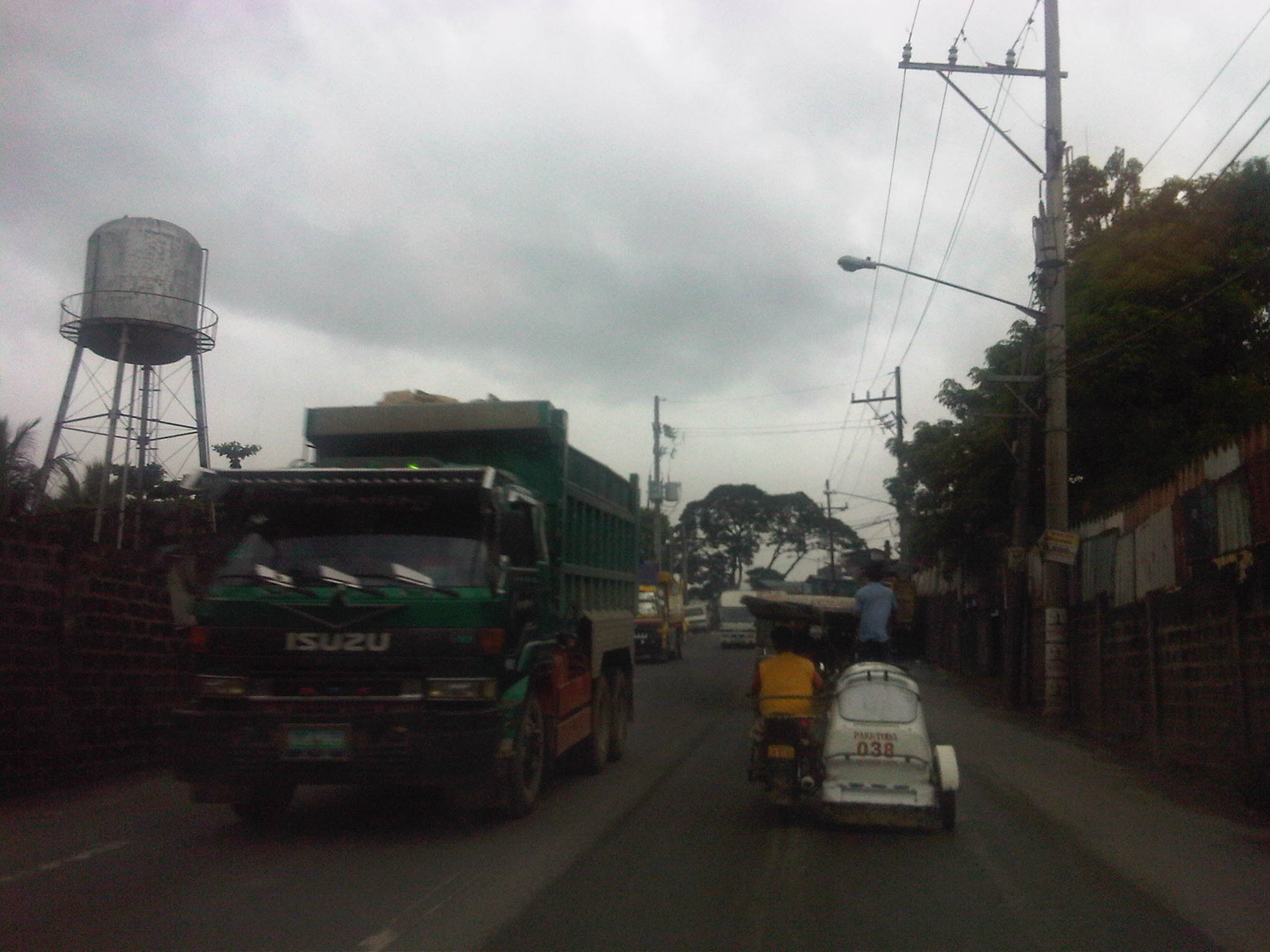 No sidewalks here, too, so pedestrians (if they dare to walk here) can be pinned between traffic and the walls on either side of the road.
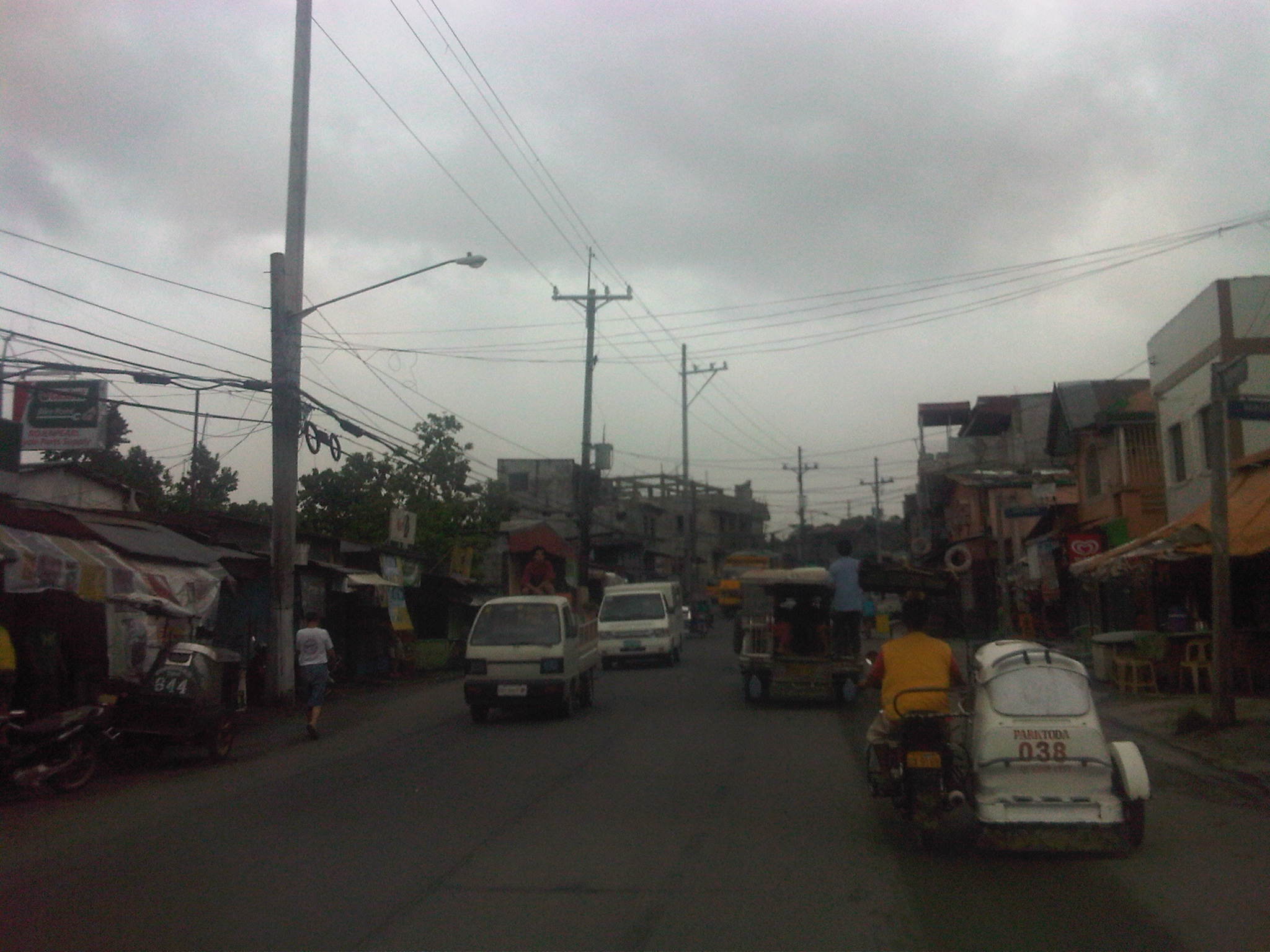 There are many informal settlers around the Payatas area and formal residential areas are often obscured by structures built along the roadside including stalls, stores and repair shops.
 A busy section complicated with parked vehicles along the roadside and the proliferation of tricycles and motorcycles in this densely populated (and vote-rich) part of Quezon City.
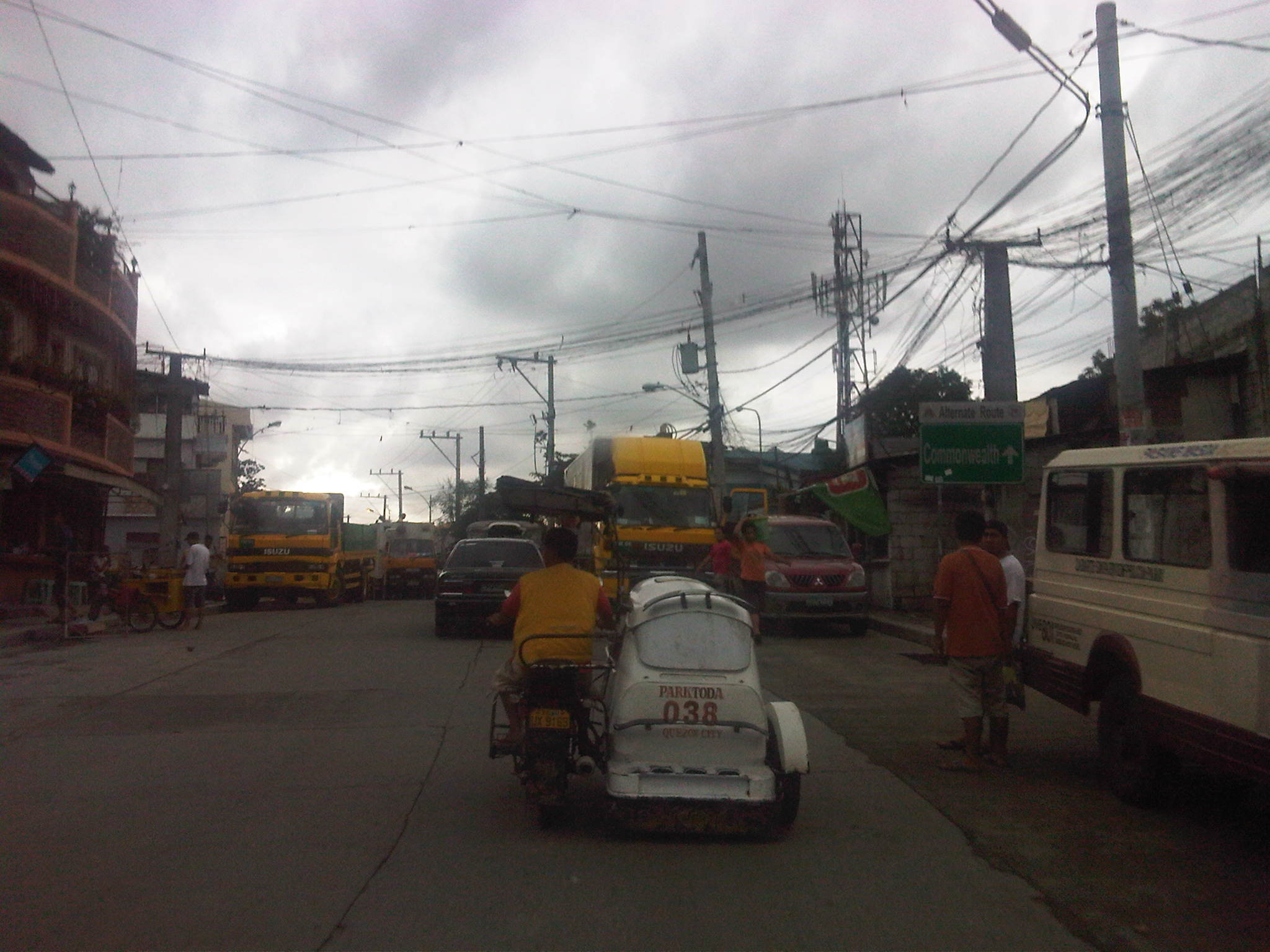 A sign that is not so easily seen informs travelers they are approaching Commonwealth Avenue. Also, have you noticed that the tricycle in this photo is also present in most of the previous photos? This is proof of the long ranges of such tricycles serving the area and competing directly with jeepneys with fixed routes. They are also among the many that violate a fundamental law that prohibits tricycles along national roads. Perhaps if this were a rural area, they could be excused but this is part of the urban jungle and so its obvious that the local government is at fault for not regulating their operations.
 The road intersects with the Batasan Road just before the junction with Commonwealth Avenue. Near the Litex-Batasan intersection are all sorts of vehicles (jeepneys, AUVs, trucks, cars) parked along the roadside or at vacant lots plus tricycles lined up along informal terminals right on the streets.

More efforts are obviously needed to improve road safety along this road, particularly to encourage walking along areas better suited for such rather than being dependent on tricycles or pedicabs. The road is used by a significant volume of trucks, most of which carry solid waste or garbage collected from different parts of Metro Manila. Such freight are themselves associated with risks including their potential spillage and could contribute to pollution due to leachate from the usually wet garbage collected and hauled by the trucks.
–
Payatas Road
We traveled along the section of Payatas Road from the junction with Montalban Highway to the intersection with the Manila Gravel Pit Road. A significant length of the road had the La Mesa watershed, Metro Manila’s main source of fresh water, along its right. This was an issue before and is still an issue today as more and more developments are made along the road with some already having impacts on the watershed due to encroachments, irresponsible waste disposal and other activities.
The following photos show various sections of the Payatas Road from its junction with Montalban Highway to the point it becomes the Gravel Pit Road (also known as Litex Road). The photos clearly show the road and roadside conditions of this important link between Metro Manila and Rizal Province.
 After turning left from the intersection with Montalban Highway, it is a two-lane road
 A few hundred meters away, travelers begin to climb towards Quezon City view a few picturesque areas along the road. The tarpaulin sign on the left indicates an ongoing roadworks project by the DPWH.
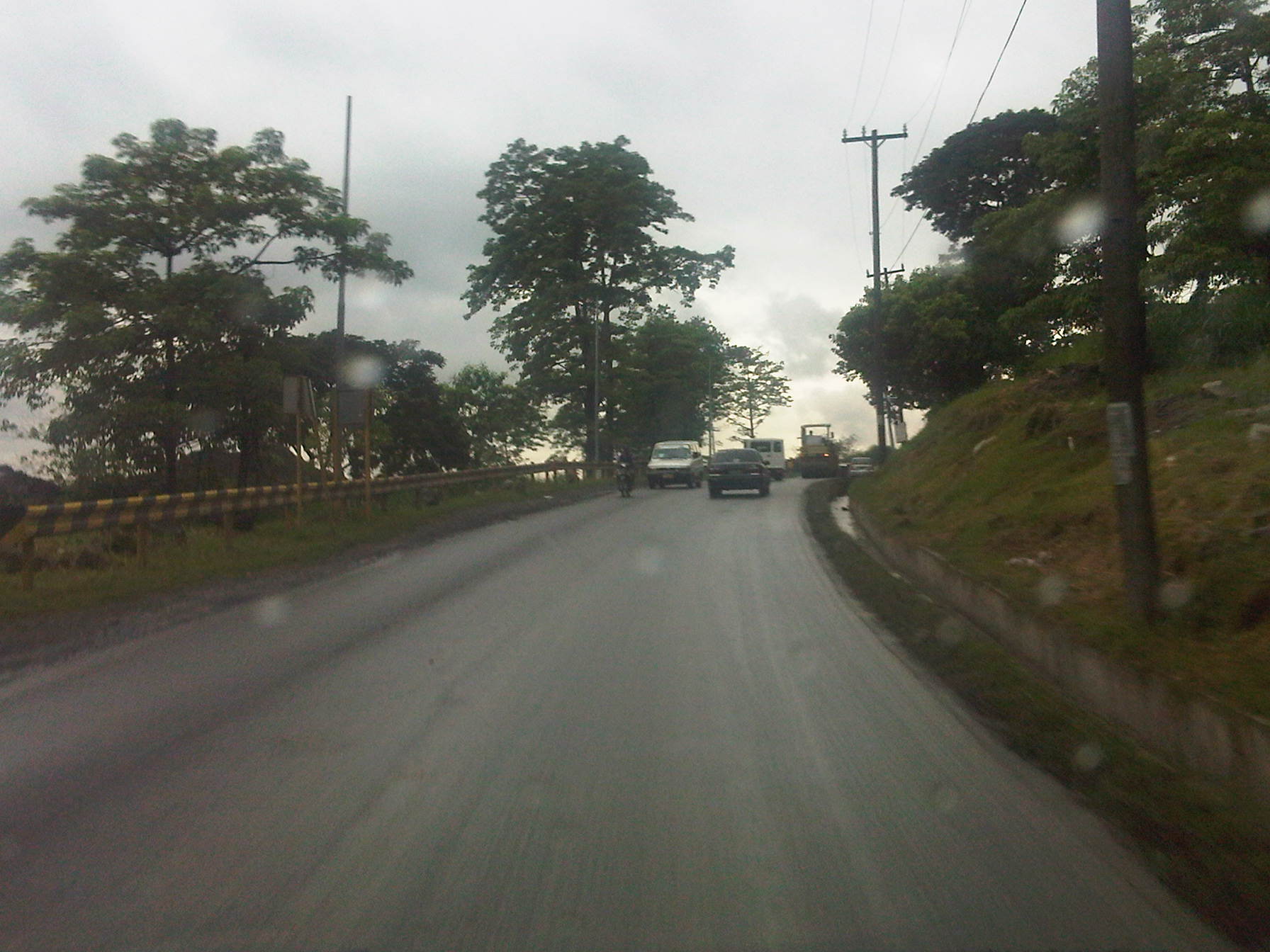 The canal on the inner side of the road keeps water off the carriageway, making the surface safer for motorists. These though are not easily seen at night-time without proper pavement markings and lights.
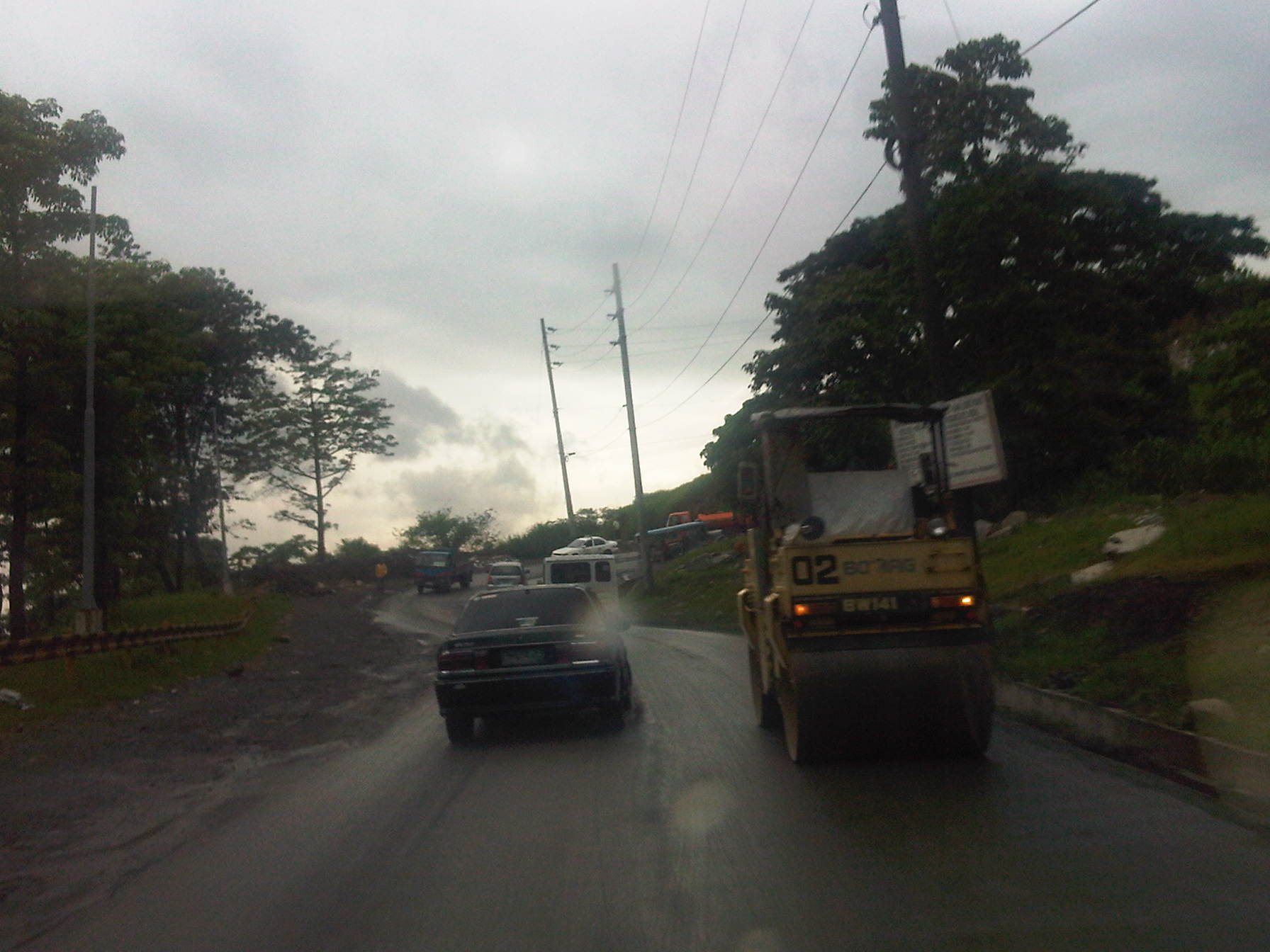 There were roadworks ongoing along the road as we ascended and heavy equipment like the one shown in the photo tend to constrict traffic flow.
 Going up the road, we became part of a platoon of vehicles whose speed was dictated by the road conditions.
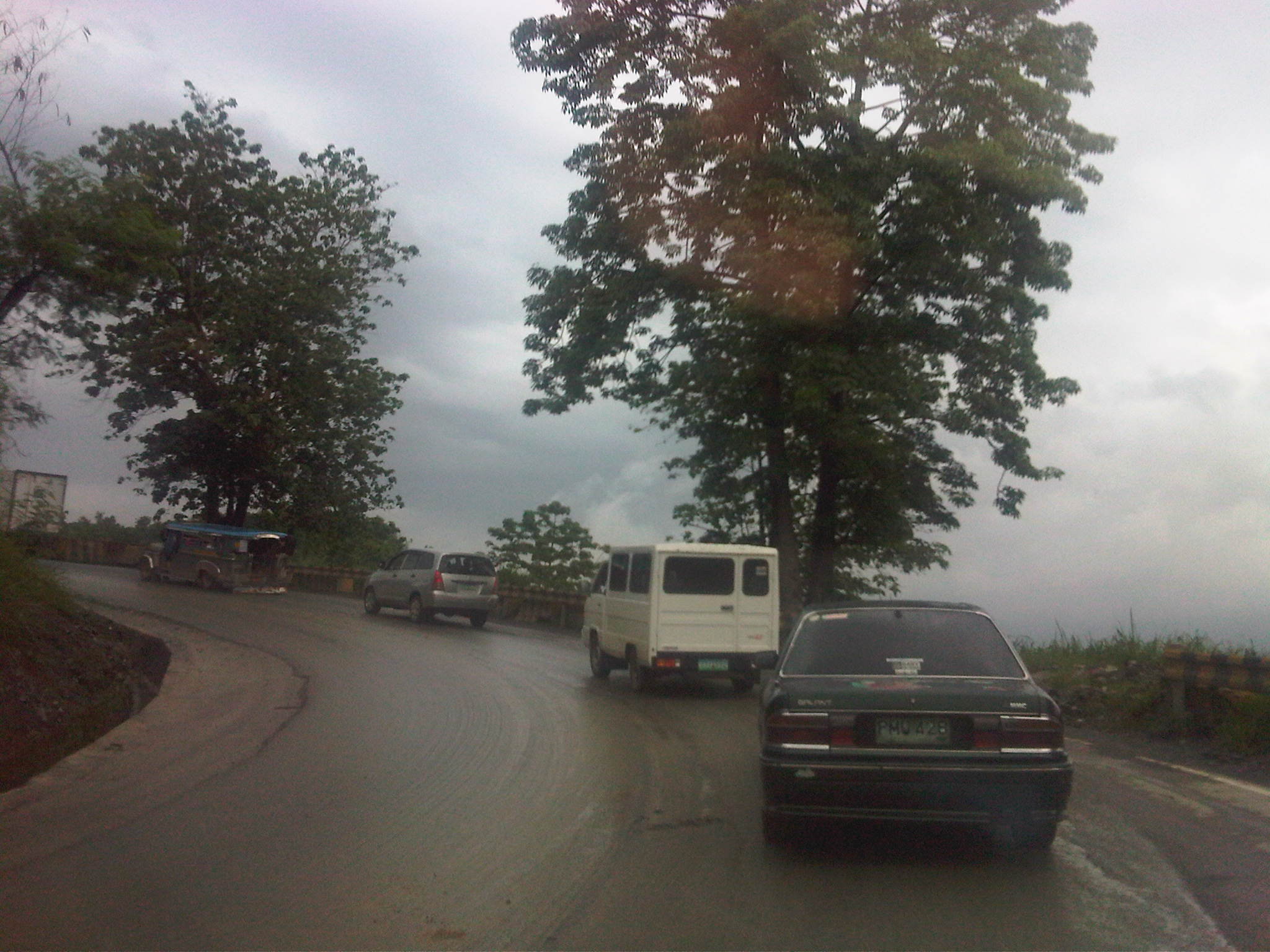 Trucks are usually the slower moving vehicles and will often dictate speeds on the ascent.
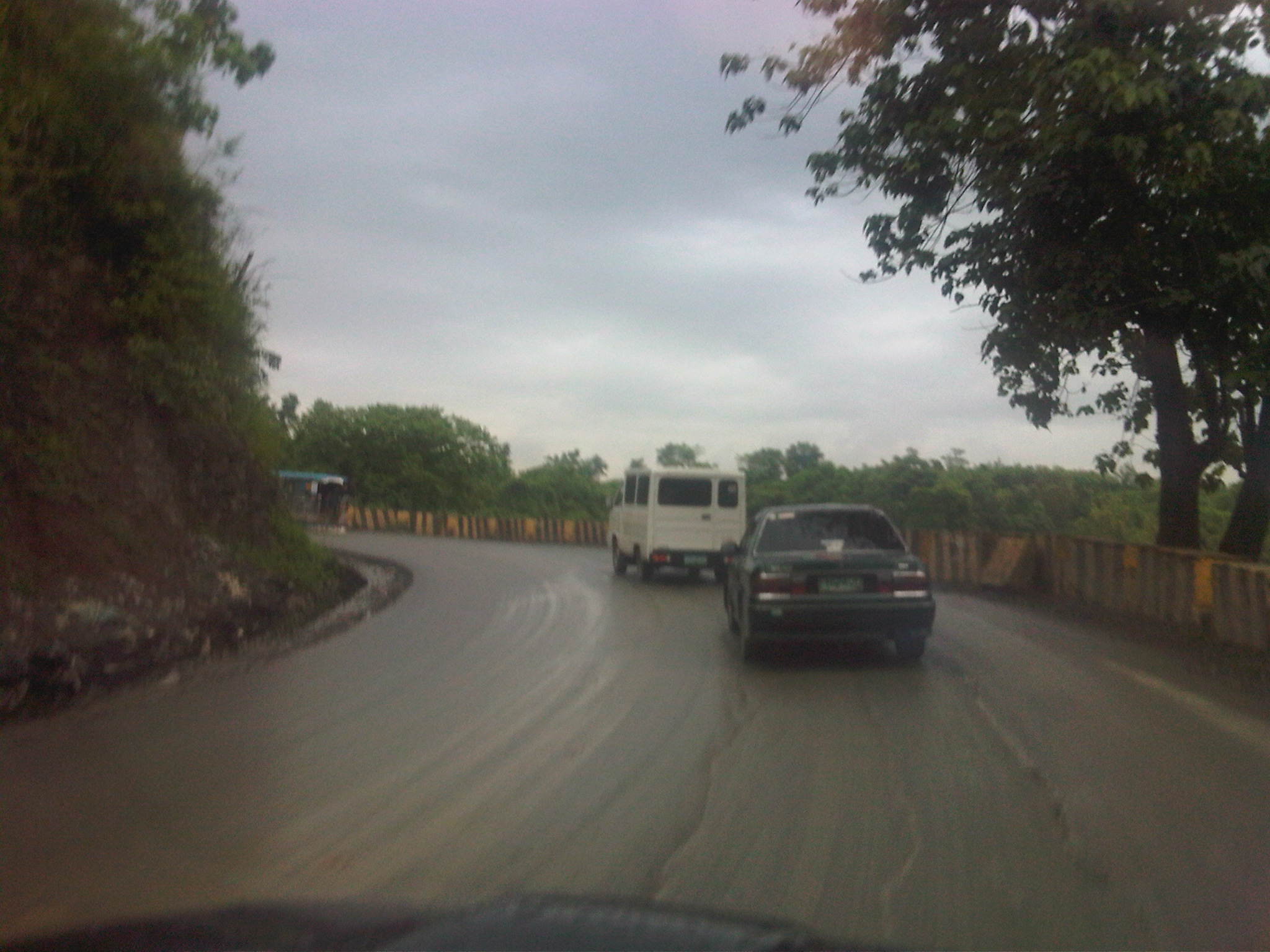 Concrete barriers prevented vehicles from flying off the road in case the driver or rider loses control of the vehicle.
 View of the Marikina Valley, which is the catchment area for a lot of water (from rains) that comes from the surrounding mountains of the Sierra Madre range.
 There’s significant truck traffic along this road and many carry garbage or junk.
 But traffic is usually light as this and other photos show. Many sections had no pavement markings and traffic signs to guide motorists.
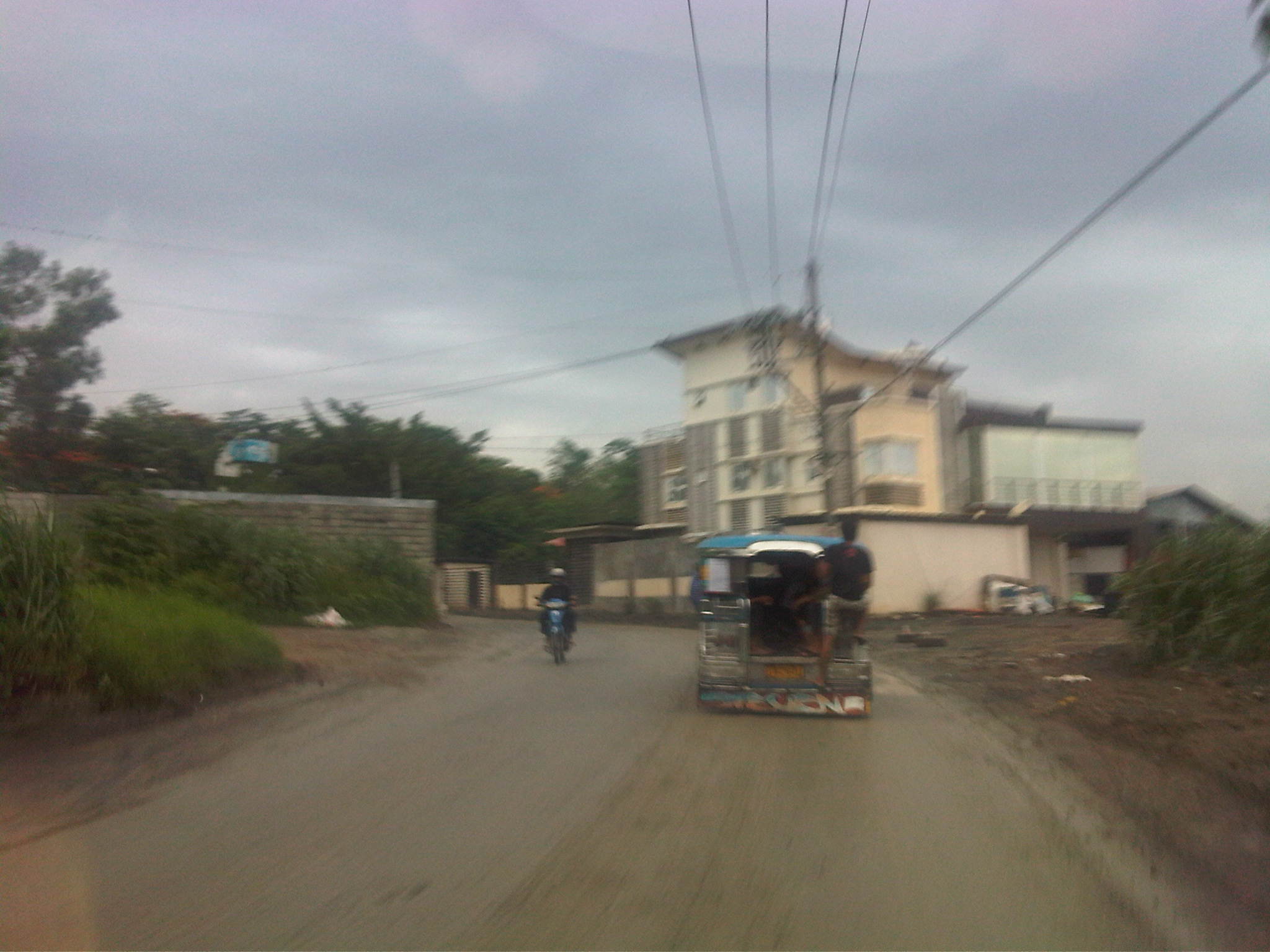 At the edge of one of the curves is a house with modern style architecture. A good landmark to guide travelers using the road.
 Some sections seem narrow due to the walls built to keep people out of the watershed area and the encroachments on the other side of the road.
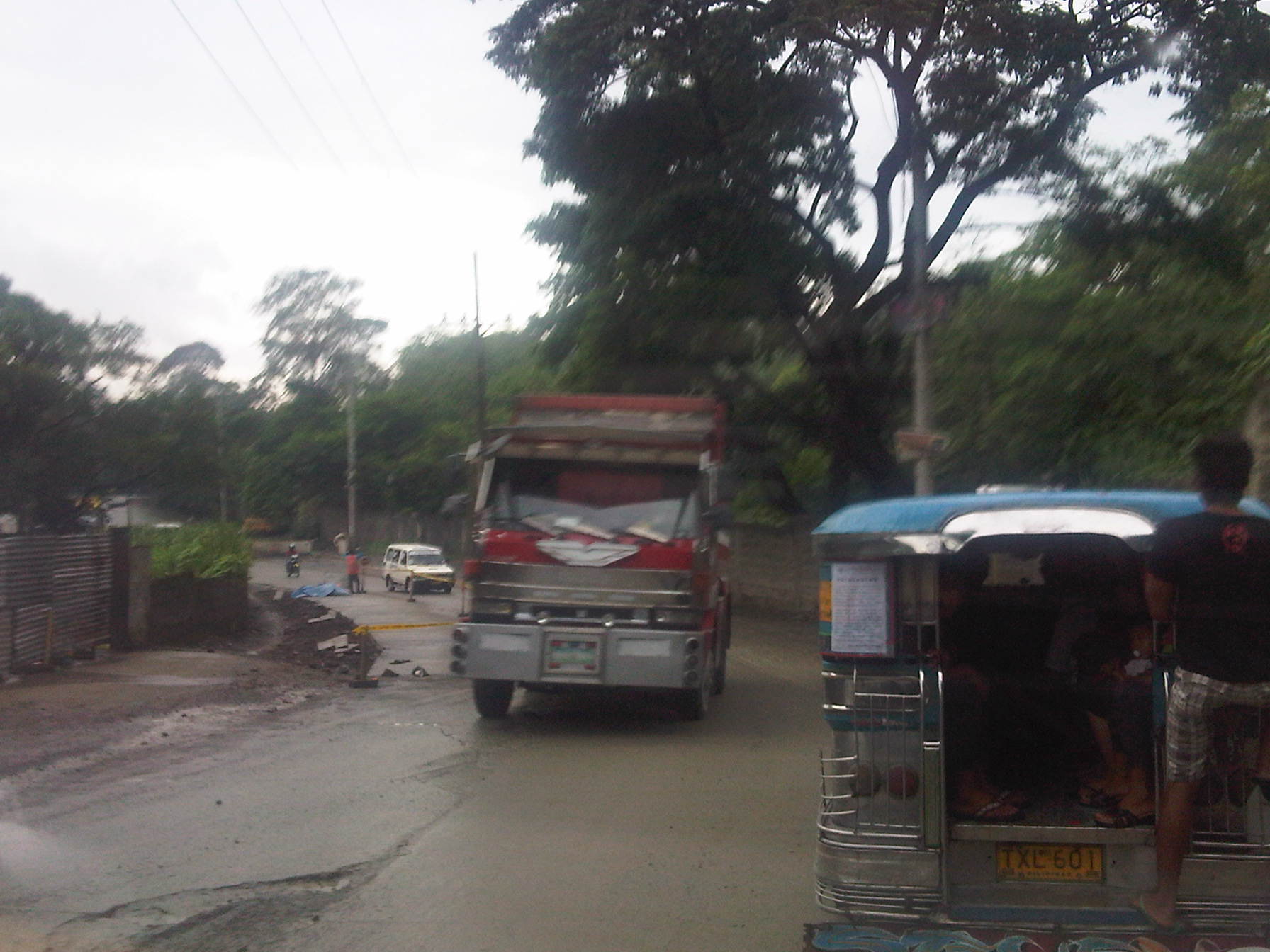 There were no proper drainage along the road and many sections have poor pavement conditions.
 What appeared as drainage works were actually part of the concrete “re-blocking” for the road.
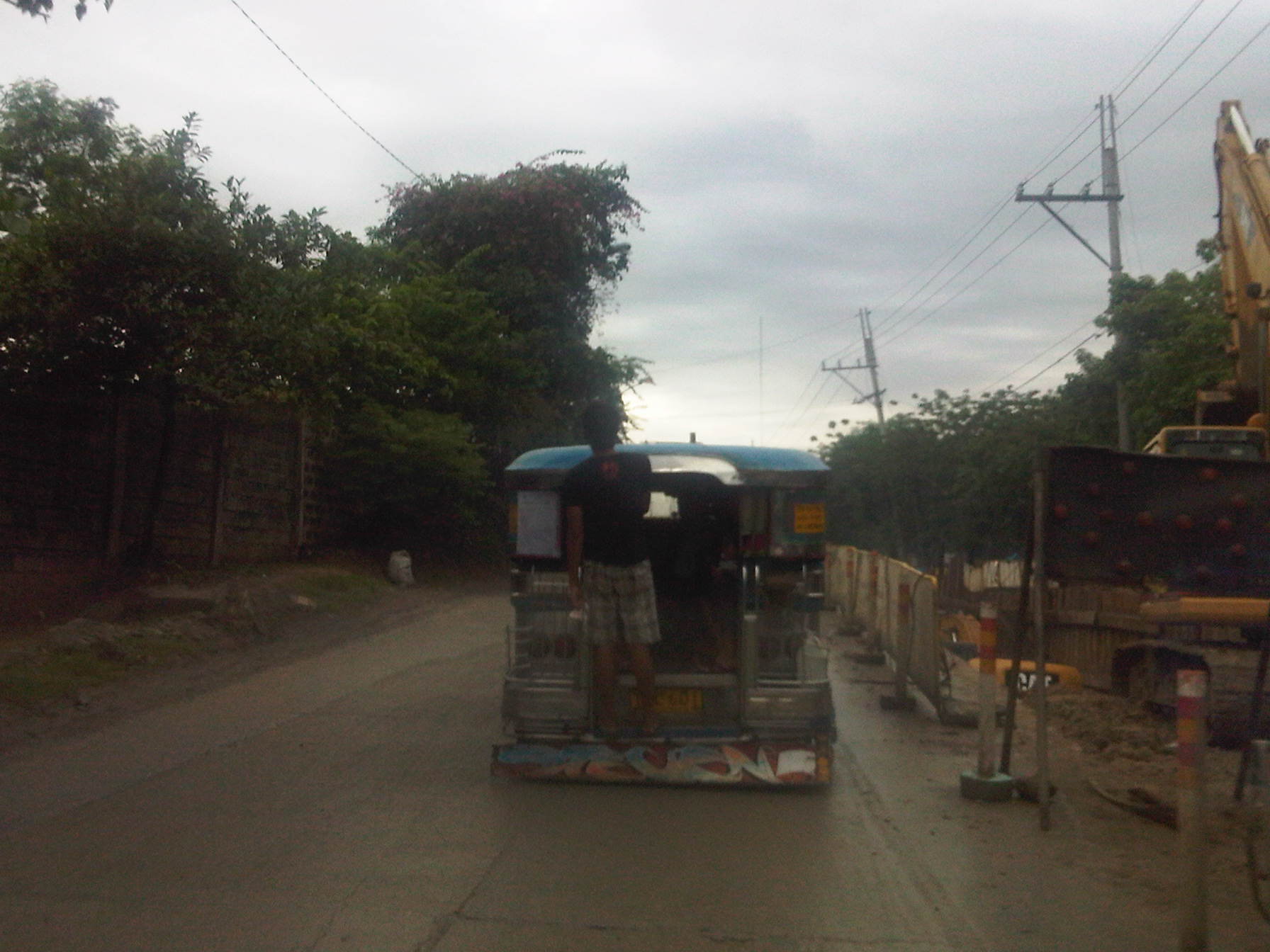 There were also waterworks along the road when we passed through.
 Such waterworks being undertaken often lead to traffic congestion as road space is constricted.
 The road has poor drainage along many of its sections including this section near a gas station where muddy water pools in the middle of the road. Such instances induce drivers and riders to encroach upon the opposing lane as shown in the photo above.
 There are many junk shops along the road owing to its proximity to the Payatas open dumpsite.
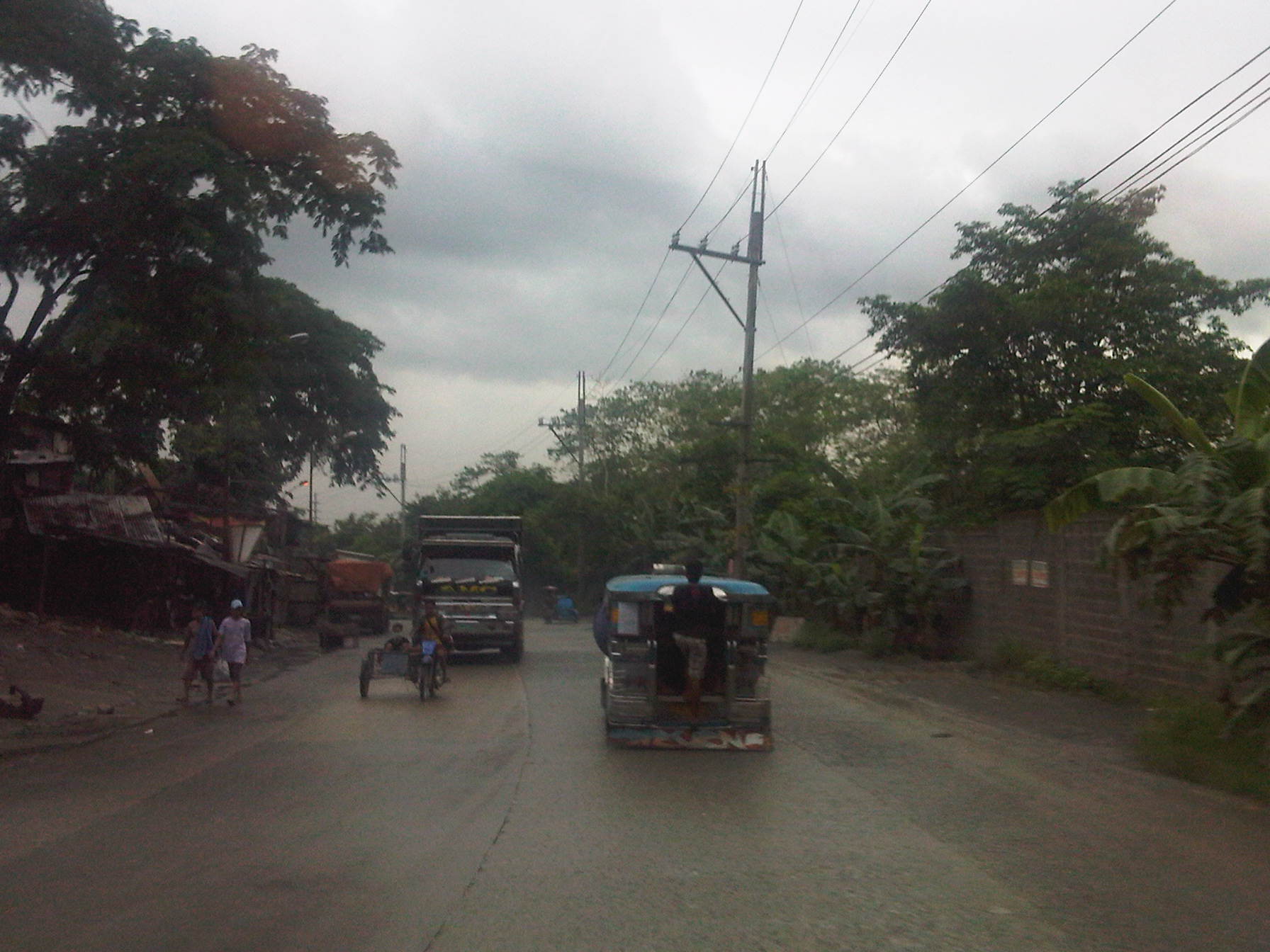 End of the road where Payatas Road ends and becomes the Manila Gravel Pit Road.
–
Batasan-San Mateo Road
The Batasan-San Mateo Road is one of two roads directly connecting Metro Manila (through Quezon City) to the northern towns (San Mateo and Rodriguez) of Rizal Province. One end of the road is at the junction with the IBP Road that is the main access to the Batasan Complex, where the Philippine House of Representatives is located. The other end is at the junction with Gen. Antonio Luna, which is also known as the Marikina-San Mateo-Montalban Road.
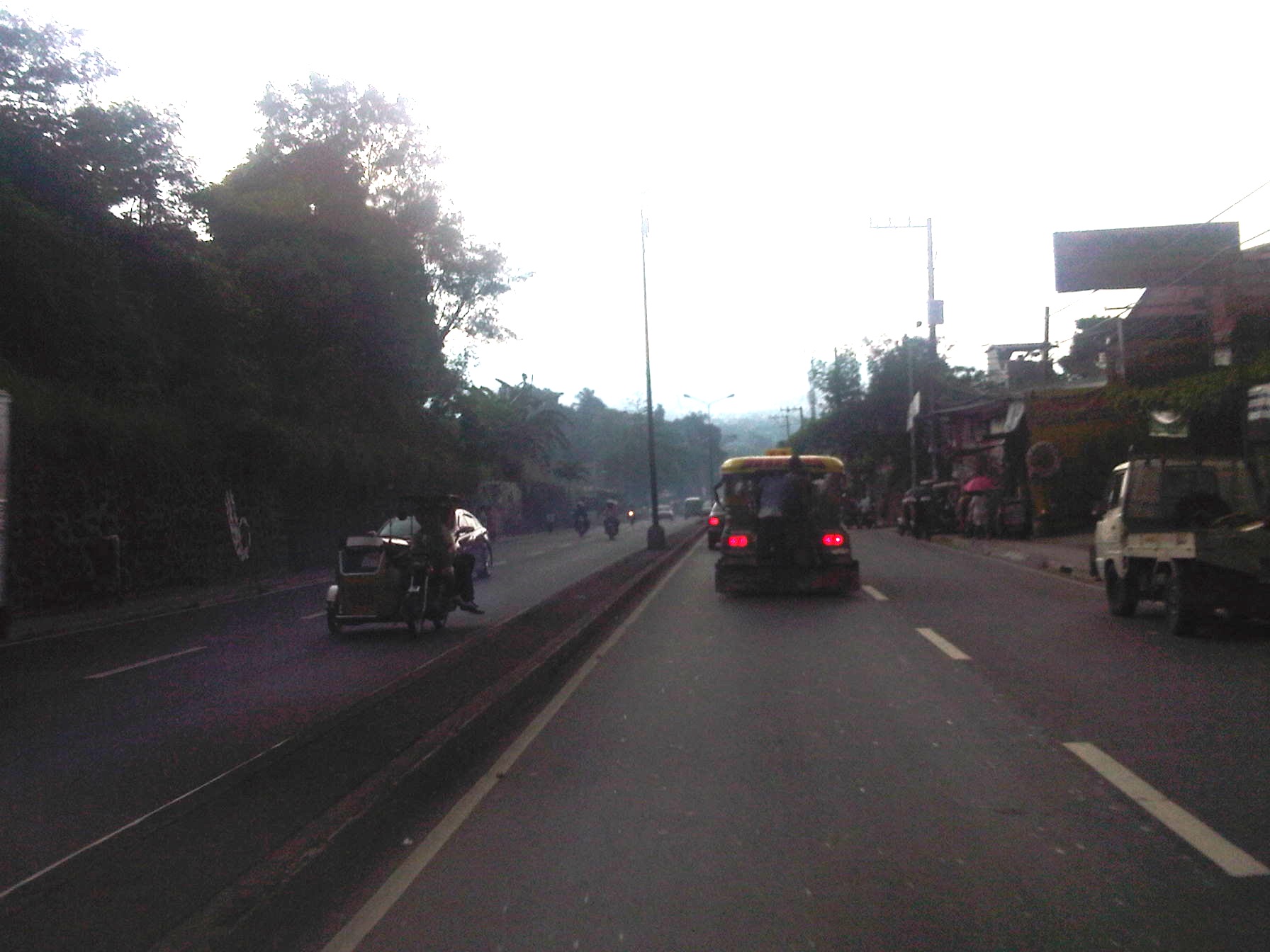 The road descends from the higher elevation hills of Quezon City and the Batasan area towards the Marikina River and the Marikina Valley.
 The road has 2 lanes along each direction and opposing traffic are separated by a narrow median island tht probably won’t stop larger vehicles should their drivers lose control and go towards the other side.
 Part of the road was carved out of the hill and this is clear from the sections where the rock or soil is exposed. This is similar to the way Ortigas Ave. in Pasig was constructed in the 1970’s out of the rock of the hills of Pasig and Mandaluyong.
 Traffic is generally light along this road but there are incidence of congestion uphill (to QC) due partly to the slope and in many cases due to trucks or tricycles.
 Lands on either side of the road are residential areas with a mixture of exclusive subdivisions, low income communities and informal settlers.
 A concrete bridge spans the Marikina River.
 The bridge is long and if traveling along the outer lanes, one can get a good view of the Marikina River and its flood plains. When traveling to QC, one would have a good view of the structures dotting the hills, which are mostly houses and shanties of different types.
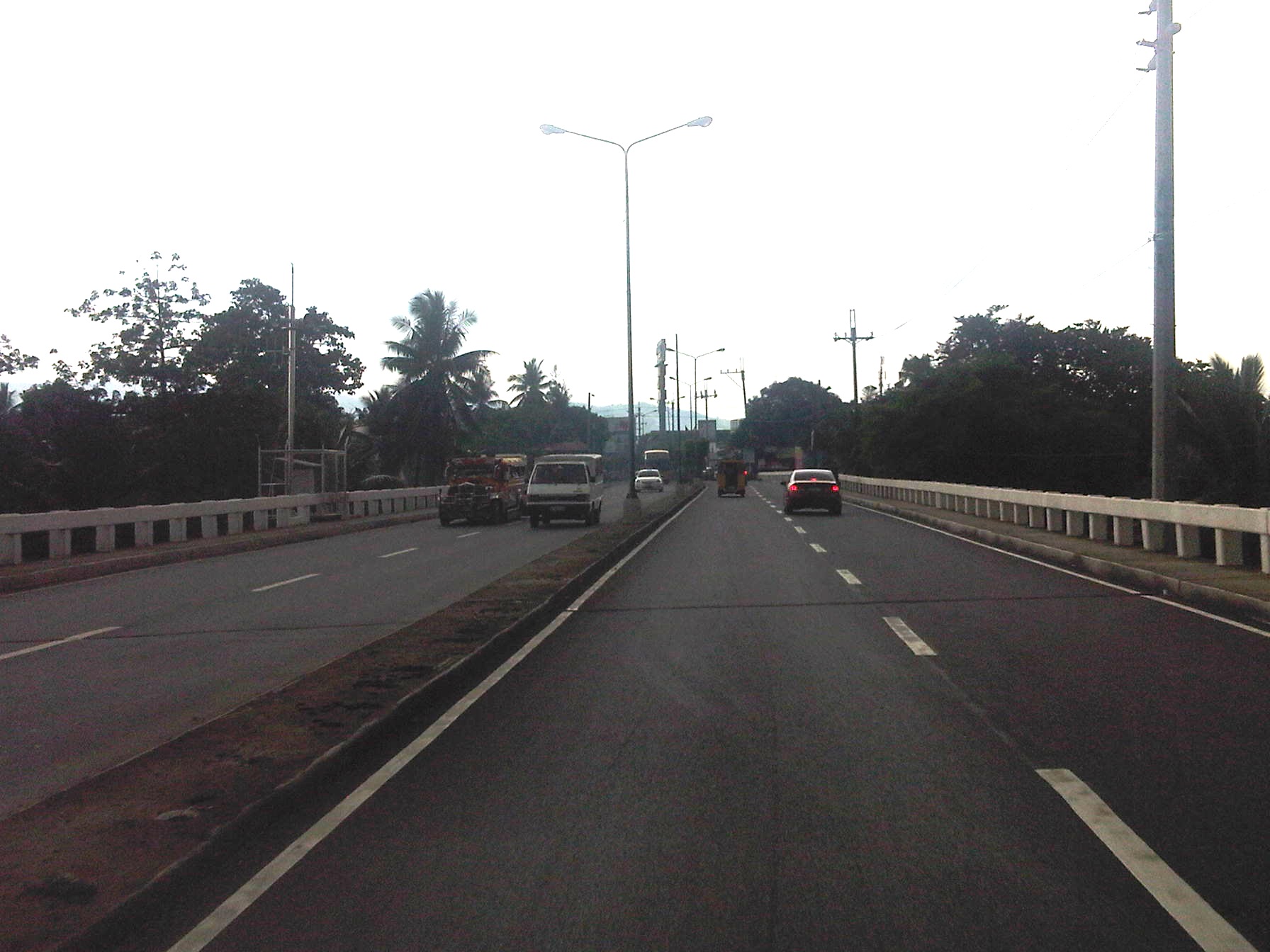 Jeepneys started plying routes along the road as it provided a shorter way between Metro Manila and the towns of San Mateo and Rodriguez as well as the northern barangays of Marikina. Travelers won’t have to pass through the traditional way via Marikina.
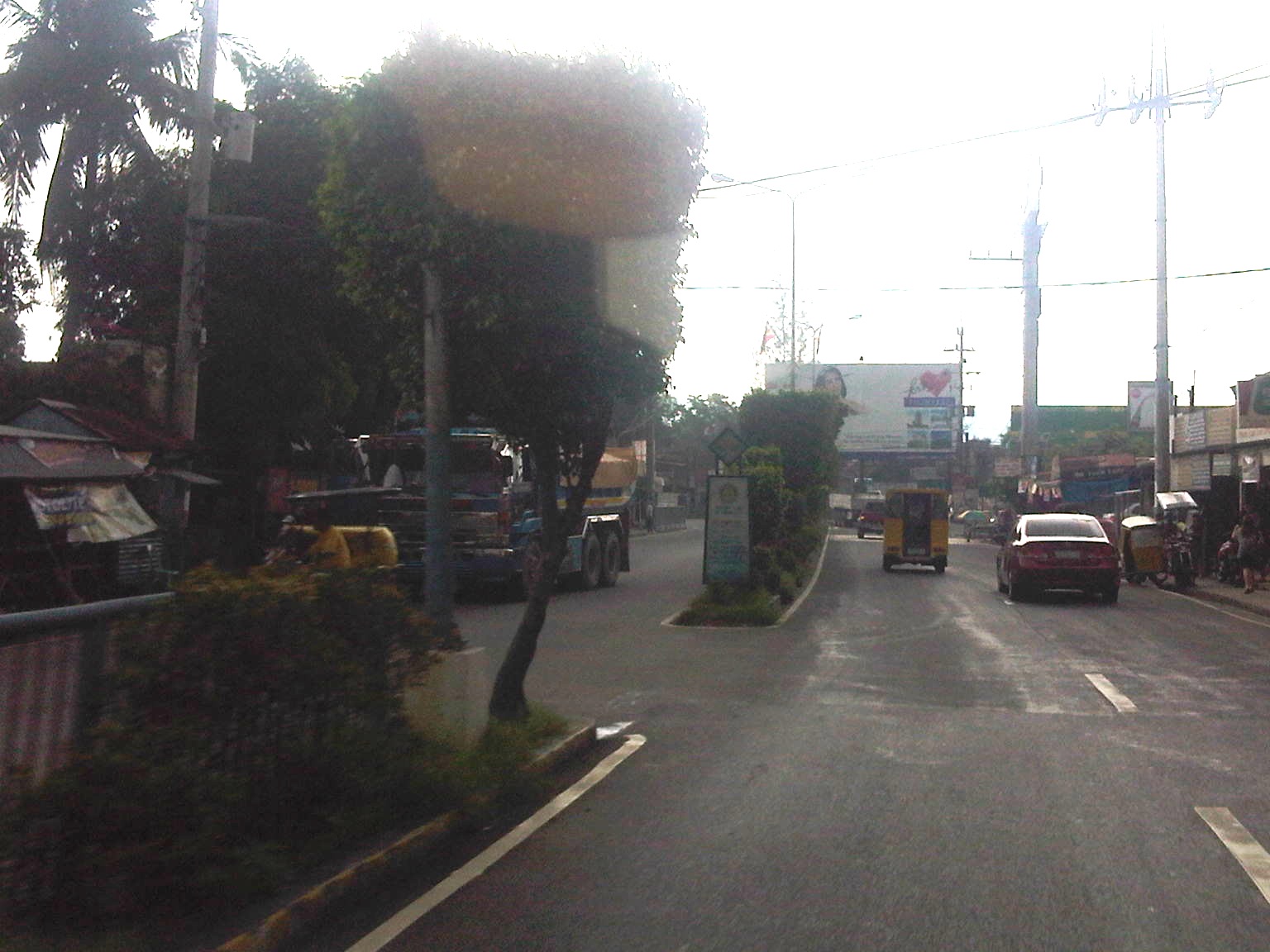 Median opening just meters away from the junction with Gen. A. Luna.
 End of the road – the junction with Gen. A. Luna, which is already in San Mateo, Rizal. Turning right takes the traveler to Marikina City while a left will bring one to San Mateo town proper and Rodriguez (Montalban) further on.
–

