
Home » Infrastructure (Page 31)
Category Archives: Infrastructure
Railways in Luzon – Main Line North
With the recent re-opening of the railway line from Metro Manila to Naga City in Camarines Sur, railway enthusiasts and old passengers alike have been quite excited about the prospect of finally having trains for travel between Metro Manila and the Bicol Region. I believe that the rehabilitation of the commuter line to the south as well as rail facilities all the way to Legazpi City, Albay should be prioritized especially considering that such services will provide a very attractive alternative to road-based or air transport. The recent donations of rolling stock from Japan are also encouraging developments though, of course, such trains are old models and may have already seen better days while in operation in Japan’s busy railway systems. Yet, with the way JR maintains its trains, these units should run for a few more years as long as PNR take care of them.
A good source for the railway history in the Philippines, including the time when it was still known as the Manila Railroad Company. is the Philippine National Railways where one can also research on old photos and maps. There are also old reports relating operational matters as well as plans for the railways. A handy reference would be the work of Arturo G. Corpuz entitled “The Colonial Iron Horse: Railroads and Regional Development in the Philippines 1875-1935,” published by the U.P. Press in 1999. Copies of the book are still available with the U.P. Press at U.P. Diliman.
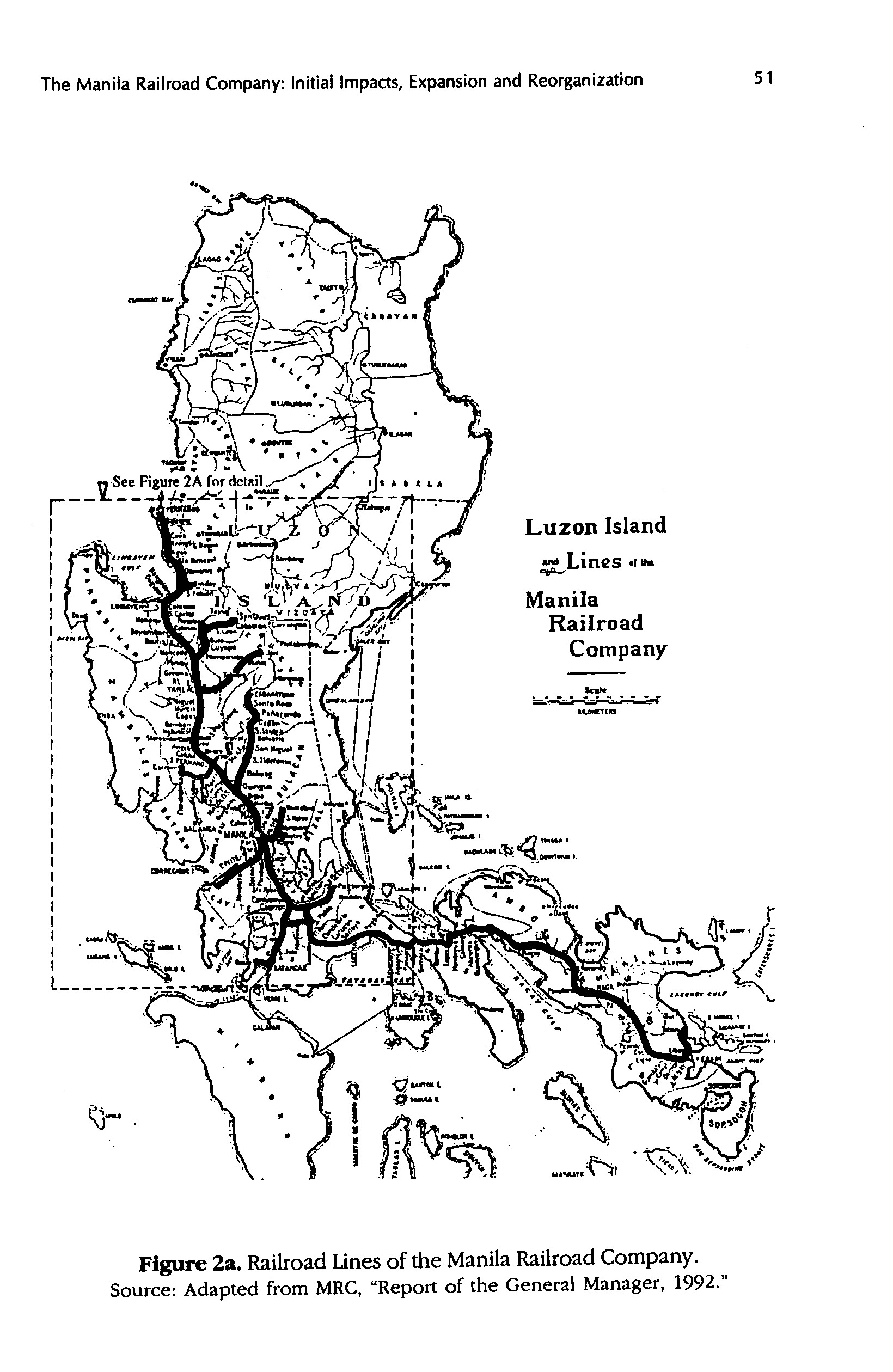 Railroad lines of the then Manila Railroad Company (source: PNR, 1992)
The entire network consisted of two main lines (Main Line North and Main Line South) and their branches. The railway lines to the north of what is now Metro Manila included the following:
- The Main Line North, which stretched from Manila to San Fernando, La Union for a total of 260 km, started construction in 1887 with the section until Dagupan starting operations in 1892. The section until San Fernando was opened in 1929.
- The Cabanatuan Line started from Bigaa, Bulacan and was completed in 1905 for a stretch of 9 km.
- The 7 km Stotsenburg Line from Dau, Mabalacat, Pampanga was completed in 1903. This served what was then known as Fort Stotsenburg that eventually became Clark Airbase (It is now the Clark Freeport.)
- The 6 km Camp One Line started from San Fabian, Pangasinan was opened in 1908 but was abandoned in 1914. It was reconstructed to Binday (now part of San Fabian) in 1937. The end of this line would have been a jump-off point for travelers heading to the “summer capital” of Baguio City.
- The Tayug Branch stretched from Paniqui, Tarlac to San Quintin, Pangasinan on the border with Nueva Ecija for a total of 29 km with the service to San Quintin opened in 1918.
- The Magalang Branch was a 9 km railway emanating from Dau and was opened in 1907.
- The Floridablanca Branch stretches from San Fernando, Pampanga to Carmen (now part of Floridablanca, Pampanga) over 20 km. The branch to Floridablanca opened in 1908 and the one to Carmen in 1919.
- The Arayat Branch also starts from San Fernando, Pampanga and ends the town of Arayat 20 km away. This opened in 1914.
- The San Jose Line was the last extension of the MLN from what is now Tarlac City to San Jose, Nueva Ecija through the town of Guimba and the now Science City of Munoz. The line stretched for a total of 55 km and was completed in 1939, just before World War 2 and the Japanese occupation.
Intelligent Transport for the Philippines
The development of an App by the MMDA for use by travelers in Metro Manila is definitely a step in the right direction and represents a breathe of fresh air for the otherwise stale and irritating smog derived from the traffic. Such tools allow for travelers to be informed of the traffic conditions The app is in a sense actually quite crude considering that it is dependent on the observations of MMDA personnel from live feeds from cameras installed along roads throughout Metro Manila, as well as inputs from motorists including Tweets or Facebook messages. The results are often subjective because of the interpretation though quite accurate due to verification made via CCTV. Thus, it employs a more basic approach than what is already being used in other countries such as Japan, the UK and Germany, where traffic conditions are determined using probe cars or systems that are no longer subject to human observation or interpretation.
Vehicles equipped with GPS and communications systems much like the ones already used by the leading logistics companies to track their vehicles now routinely send information about location and such data can be used to construct real-time maps that, if compiled for 24 hours and all throughout the year, may provide a more automated and objective approach to providing travel information. Only incidents like road crashes would then require special treatment. A variation of this type of application of ITS would have been implemented for the MMDA’s bus dispatching for EDSA a couple of years ago using RFID technology to monitor the progression of bus travel along the highway. Unfortunately, after meeting opposition from the transport sector and experiencing some glitches, the project never went underway. Sayang!
Intelligent Transport Systems (ITS) has been available for quite some time now with the 1st World Congress held in1994 in Paris, France. Since then, the developments in ICT have been quite rapid though costs seem to have only reduced significantly in the past 5 years. One reason why ITS has not been able to grab a foothold in many countries is the prohibitive costs of many systems that are supposed to have more significant impacts on transport and traffic in their cities. With more resources and tools becoming available, and with many people able to acquire or access some form of tech (e.g., cell phone, internet), ITS has become available to many people though it is not necessarily cheap (how much is an iPhone?). While Metro Manila could probably afford to make investments for ITS, other cities will not have the resources for such, opting instead to put their money where it is more needed (or so we hope and assume).
Wikipedia provides a pretty decent description of ITS as derived from several sources. Depending on the reference, ITS typically has four functional components:
• Advanced Traffic Management Systems (ATMS)
• Advanced Public Transport Systems (APTS)
• Advanced Vehicle Control Systems (AVCS)
• Commercial Vehicle Operations Systems (CVO)
A fifth one, Advanced Traffic Information Systems (ATIS), is supposed to be embedded or integrated with the four. The MMDA app falls under ATIS and has applications for ATMS and potentially APTS. Leading logistics companies including local ones already employ ATIS for CVO.
I had an opportunity last year to talk about ITS when I was invited to present at the Smarter Cities Summit sponsored by IBM Philippines in December. A pdf of the presentation is found below:
SmarterCities – Transport and Traffic
ITS applications in the Philippines include the very basic ones like the parking management systems now used by shopping malls to inform about the availability of parking spaces to the more comprehensive ones like the electronic toll collection systems of NLEX and SLEX, and the SCATS traffic signal control system of Cebu City. Vehicle manufacturers now routinely use ITS in many vehicles including those sold in the Philippines. These include information on fuel consumption displayed on the dashboard, proximity alarms, and many already have navigation systems as options when purchasing the vehicle.
The 18th ITS World Congress will be held in Orlando, Florida, USA later this month. It promises to again provide participants with a taste of what has been deployed so far and how effective these systems are in addressing traffic problems. Companies participating in the congress would also be displaying products under development and perhaps postulate what can be done in the near future using technology for leverage in solving issues on transport and traffic. It should be noted, however, that ITS remains a tool that would be effective only if both authorities and stakeholders also address the roots of the transport and traffic problems in this country. Dependence on ITS alone will have very limited impacts compared to more comprehensive programs for managing transport demand and supply. Nevertheless, ITS presents a powerful tool that can tremendously enhance traditional solutions. In fact, the “full potential” for ITS combined with traditional TDM and TSM is regularly on display in Singapore with its Electronic Road Pricing (ERP) scheme. But that’s another story.
Roads to Naga City – Lucena and its bus terminal
The national highway to and from Lucena are generally in good condition and appear to be quite wide, wider than you usual national roads even within the city proper. This is perhaps due to the provision of paved shoulders usually with widths the same as the carriageway lanes. I was also quite surprised that even in populated areas, there are few encroachments along most segments. There are also fewer parked vehicles taking advantage of the availability of space along the roadside. In the city itself, most city roads are also narrow but most
Upon reaching Lucena, we decided to make a stopover at the city’s central public transport terminal. The terminal, the largest in the province, is a very practical example of a centra facility that would allow for efficient services for travelers using various modes of transport including transfers among these modes. The terminal is located conveniently away from the city center and access roads are generous thereby minimizing the chance for congestion caused by public transport operations.

Typical highway section leading to Lucena from Tayabas – sections appear wide and there is generally little roadside friction due to few encroachments and parking.
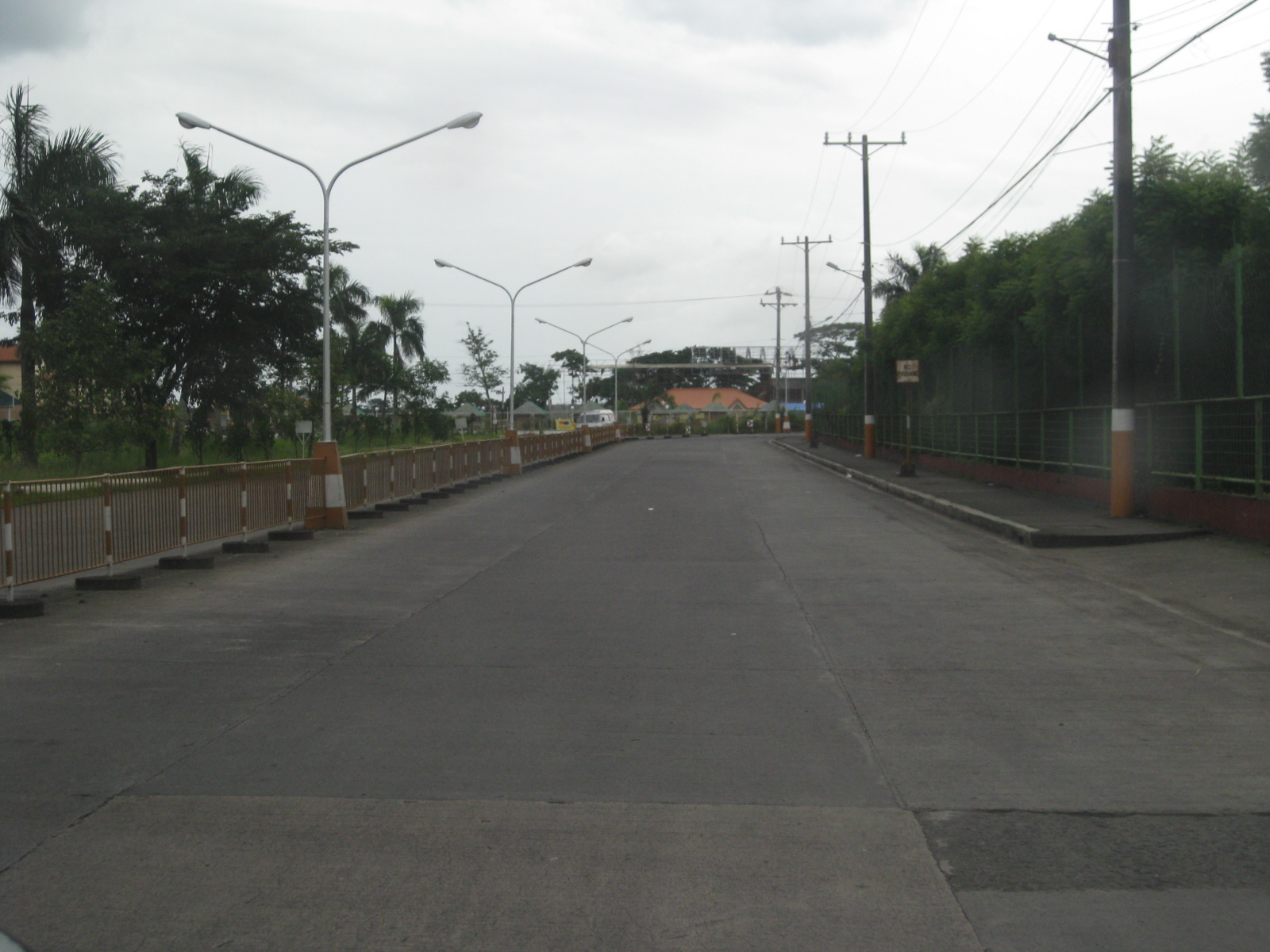
Access roads to the public transport terminal are wide and there is low traffic even during peak periods. Mostly, traffic is comprised of buses, jeepneys and vans that also call on the terminal.
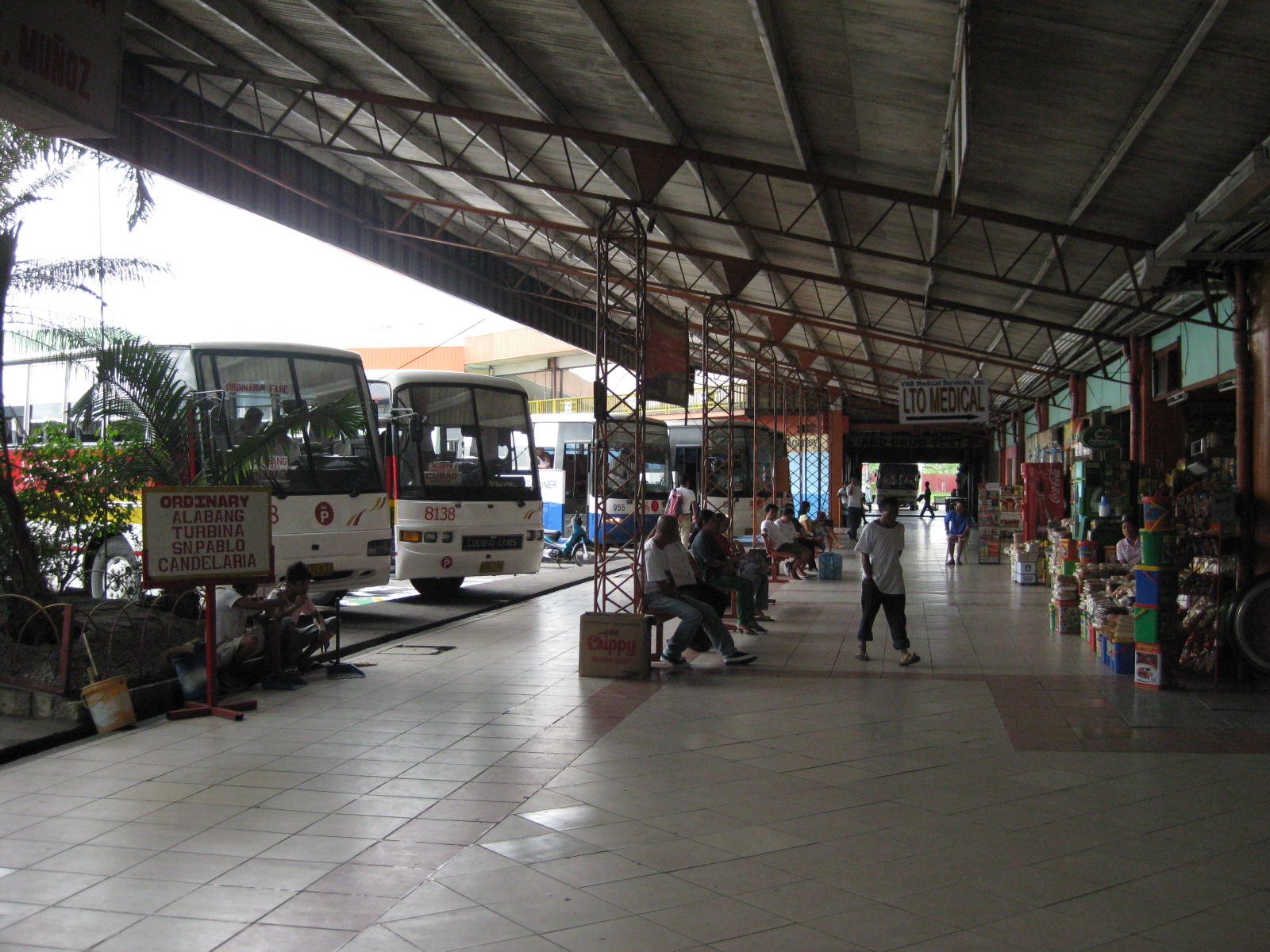
The terminal serves as a major stop for buses bound for Manila, towns in Quezon, the Bicol Region, and even those going to Mindanao via the eastern nautical highway. There is generous space for passengers and bus crews, including amenities such as toilets, stores, clinics, and eateries including some popular fast food restaurants.
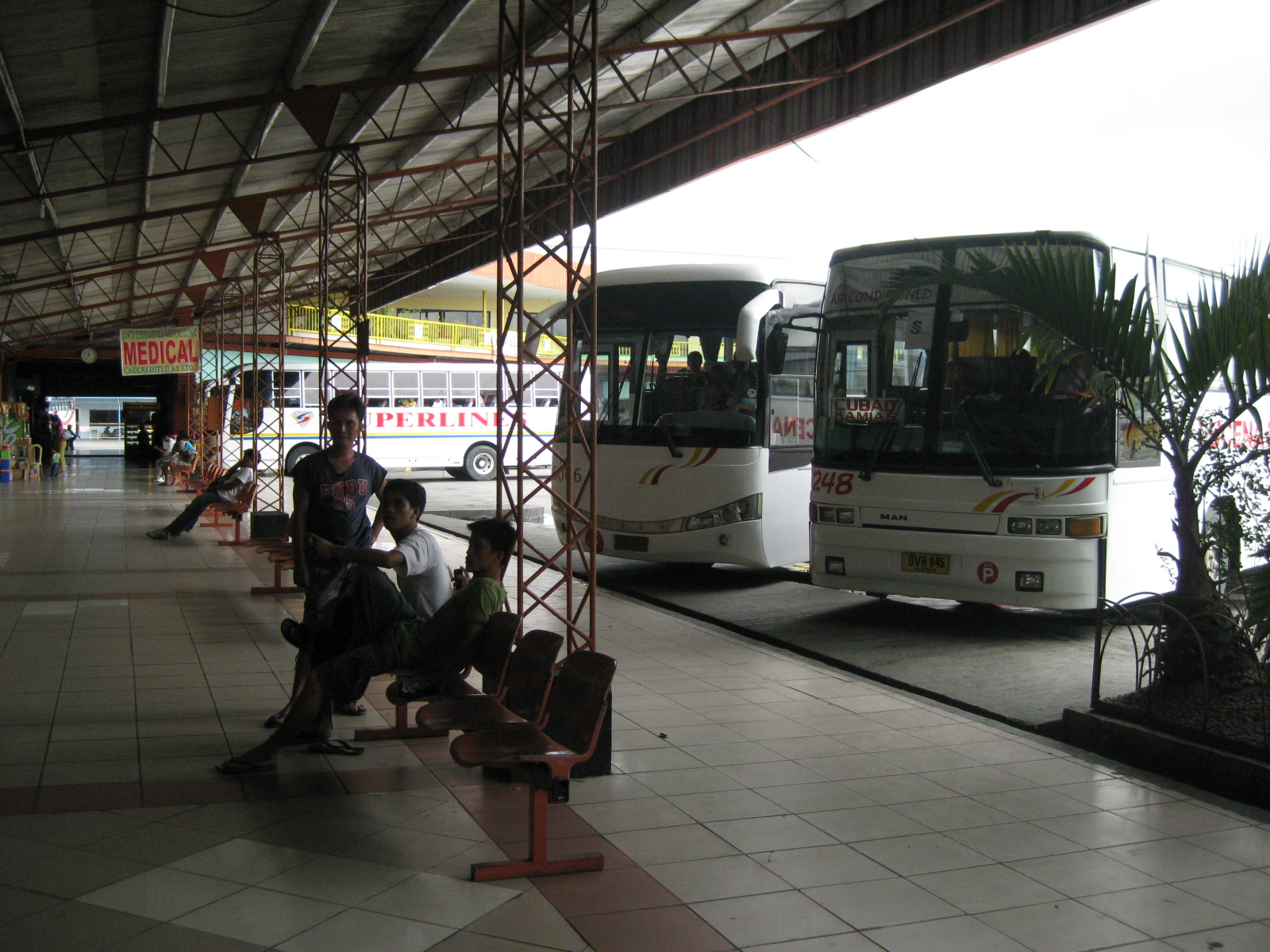
Passengers and bus crews may wait at the benches or designated areas maintained by bus companies. The ample space can be perfect for some stretching after long rides.

Another view of the terminal with passengers loitering around.

The terminal serves jeepneys and vans that provide both local and long distance transport services. The photo above shows berths for jeepneys bound for Lucena city proper (left), and Pagbilao town (center). Travelers may also take vans bound for destinations in Laguna and Bicol.
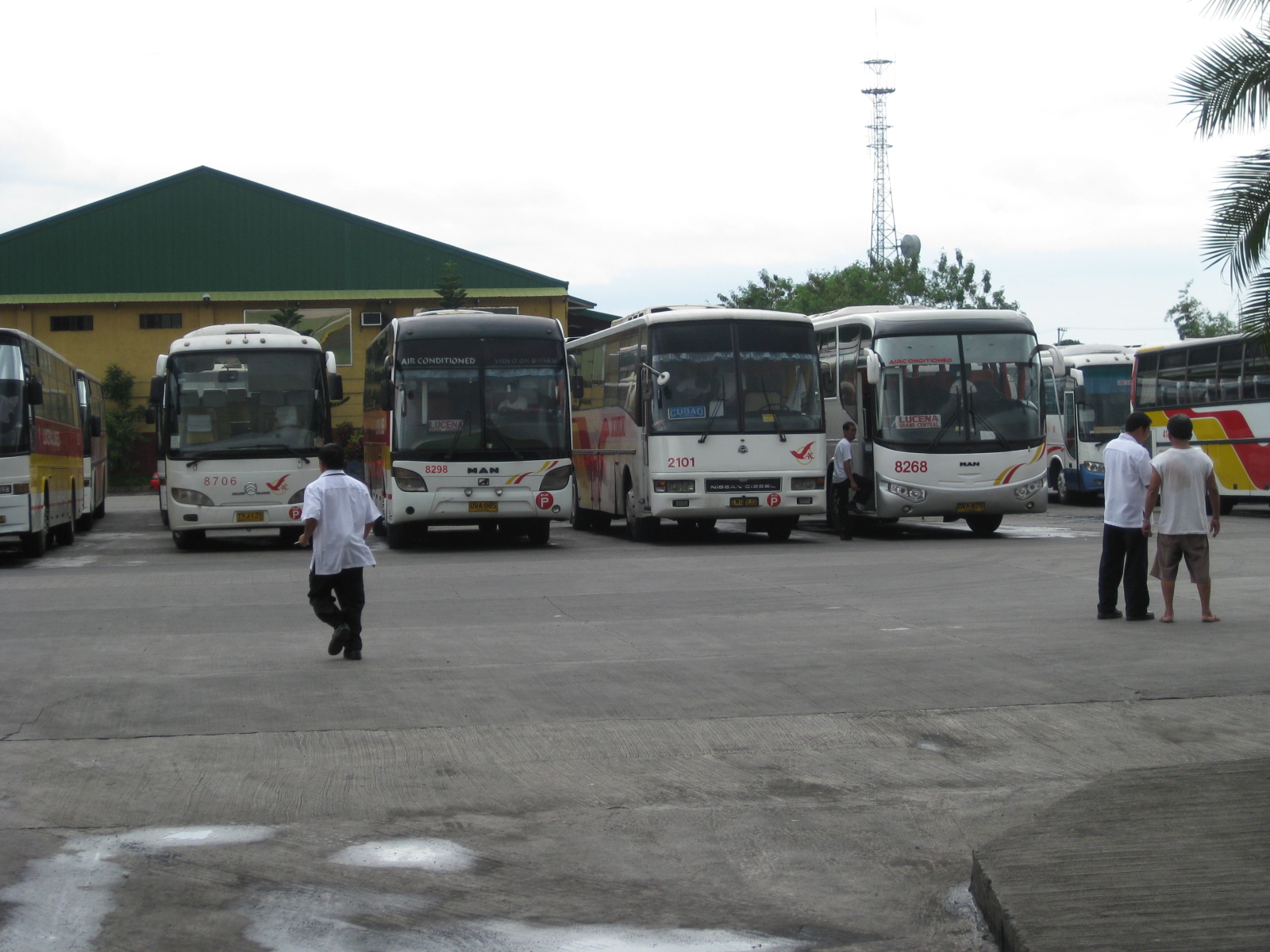
The large terminal area also has more than enough space to serve as a general depot for many bus companies from where they can deploy their buses or where they can conduct maintenance checks or repairs.

Some internal roads are not maintained well and there are potholes on asphalt sections. Most internal roads are generally of good condition though there is a dearth in pavement markings and road signs.
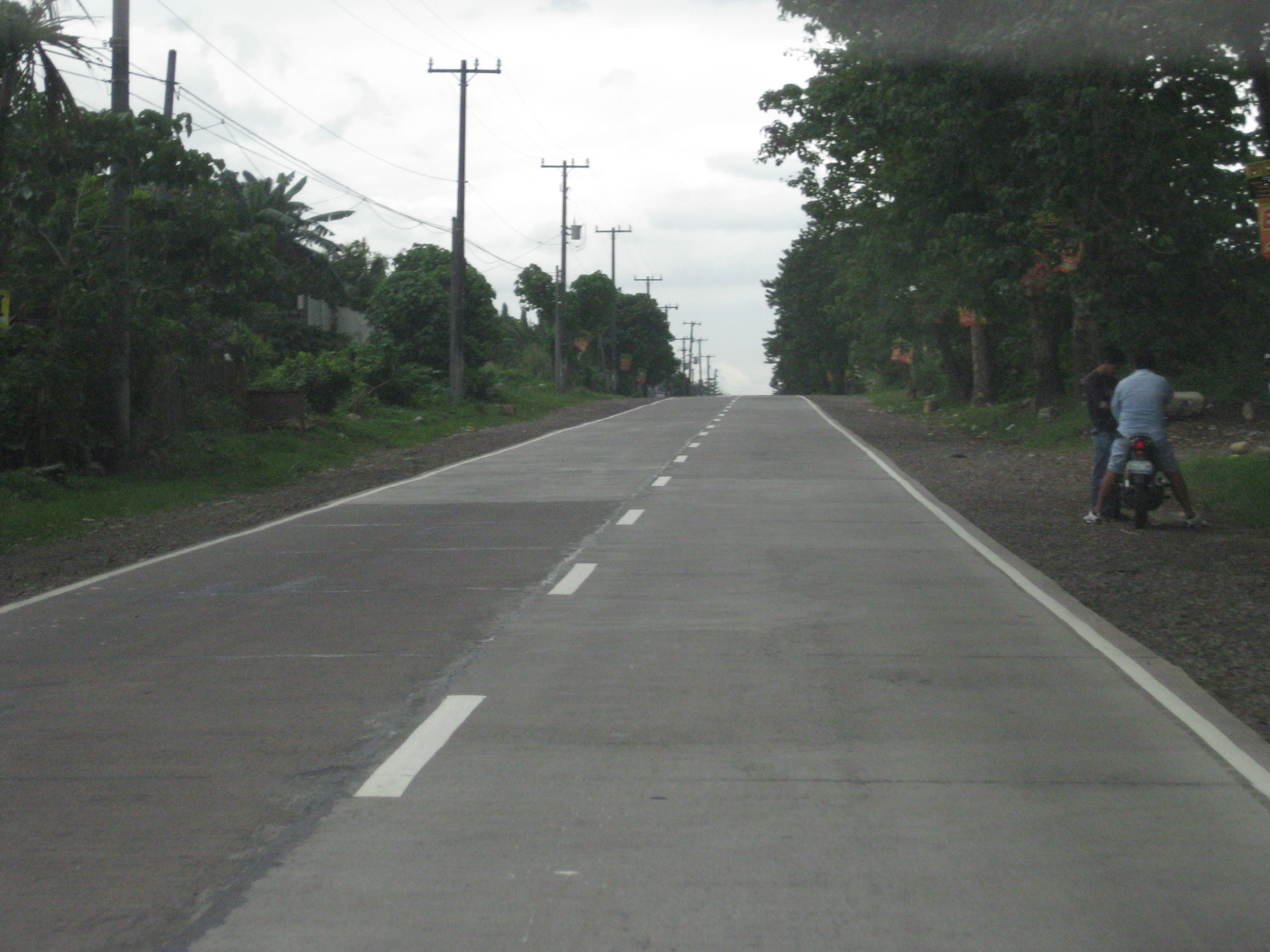
Leaving Lucena, one is again greeted by generally good highways. My impression though, is that the quality of the road generally deteriorates as we travel further from the capital city. This, of course, is something that can be attributed to the DPWH district office in-charge of particular highway sections as well as the respective local governments (including the province) and especially congressmen who also have a say in the allocation and actual use of road funds.
Roadway subject to flooding
The outbound approach to the bridge along Marcos Highway was quite congested this morning due to the closure of the underpass leading to C5 located just in front of SM City Marikina. The section was closed to traffic due to flooding caused by Typhoon Pedring (International name: Nesat). Pedring’s rains caused the Marikina River to swell up and inundate significant areas along its banks including what looked like the lower level parking area of the mall. Traffic bound for C5 from Marikina, Pasig and the towns of Rizal had to be diverted to the Riverbanks road via the service road after the bridge. The result was traffic congestion as 6 lanes of traffic tried to squeeze into what was effectively 4 lanes of bridge including the bypass structure fronting SM that eventually merges into 3 lanes of road on the other end.
Following are a few photos I took while en route to the office this morning:
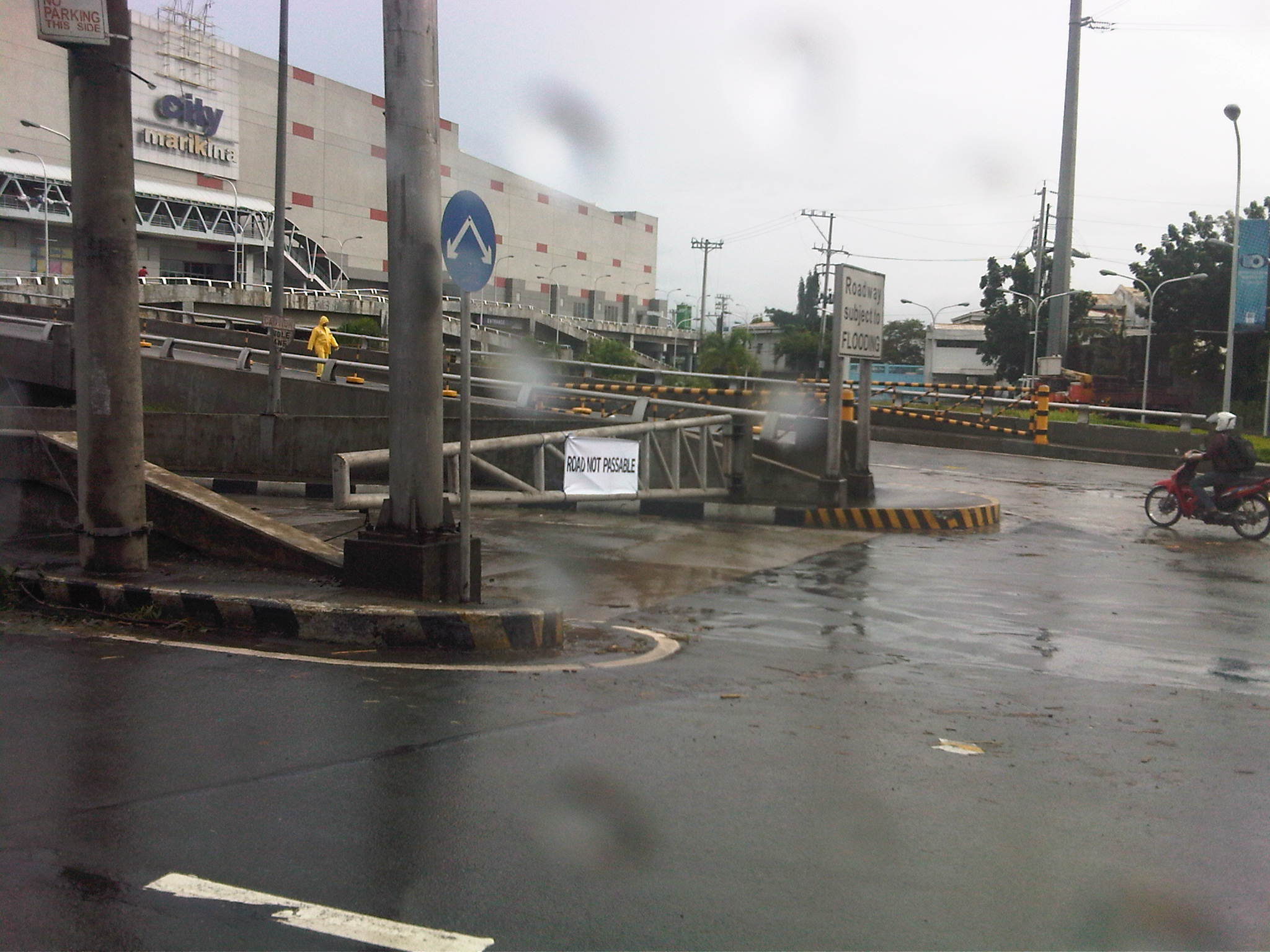
A gate bars access to the underpass connecting to a bridge leading to C5. The sign on the right states: “Roadway subject to FLOODING,” and is a permanent sign placed there to condition the mind of travelers about what may happen should there be inclement weather. This is supposed to be an example of a design where there’s no choice but to sacrifice according to the character of the area. Still, the question on many people’s minds probably is why were other designs that won’t be subject to flooding considered in the first place? Such would surely be worth it considering the frequency our climate and the probability of flooding?

Mud and muddy water on the underpass as seen from the bridge. Such is a scene reminiscent of the aftermath of Ondoy (International name: Ketsana) in 2009, exactly 2 years ago to the day.
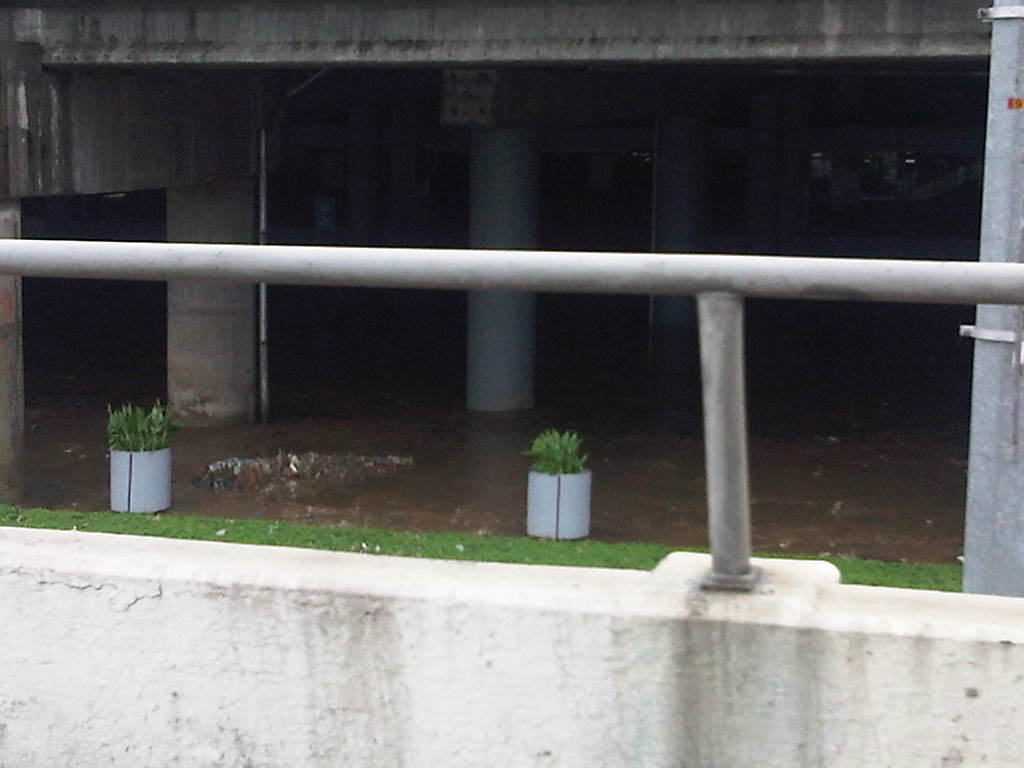 A peek into SM Marikina’s lower level environs show thick mud that settled on the service road and the mall’s lower parking area. The mall’s design already factored the anticipation of floods brought about by the swelling of the river during powerful typhoons such as Pedring and Ondoy. The mall was, after all, constructed on the flood plain, which is an unusual and uncommon location for such developments.
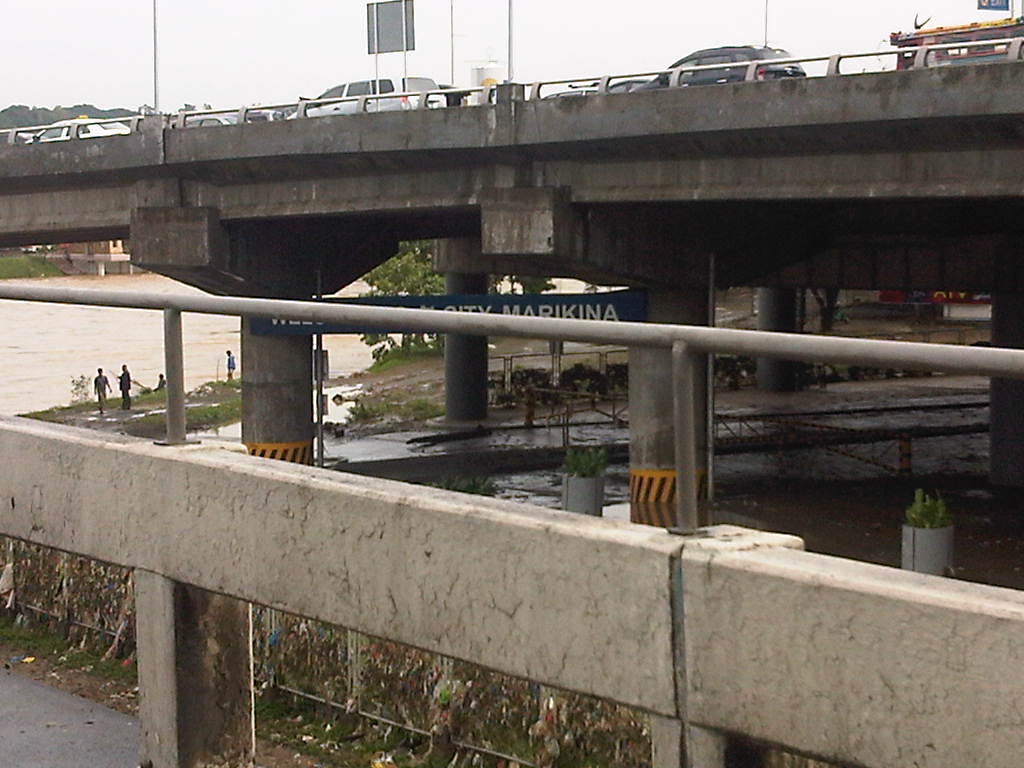
Garbage comprising mainly of plastic trapped on the SM screen fence. These were part of the flotsam and jetsam from the Marikina River. Such debris are evidence of the state of waste disposal and mismanagement in areas along the Marikina River. It is clear that people still have not learned from past experiences and government is partly to blame for this, particularly at the local level.
Roads to Naga City – via Rizal Province
A little more than two years ago before the onslaught of Ondoy (Ketsana), I had the opportunity of going to Naga City, Camarines Sur to talk before students of Civil Engineering in a regional conference. I took that opportunity for a road trip that allowed me to take photos of roads along a route that took us from Quezon City to Naga via Antipolo, Tanay, and other towns of Rizal. We proceeded through Pakil, Paete, Lumban and other towns of Laguna, as well as Luisiana, Lucban, Tayabas, Lucena and other towns of Quezon. We also took the zigzag roads of Quezon and Camarines Norte including the “Tatlong M” and “Bitukang Manok.”
Following are photos I took on the way to Naga City starting with a few along roads in the Province of Rizal.
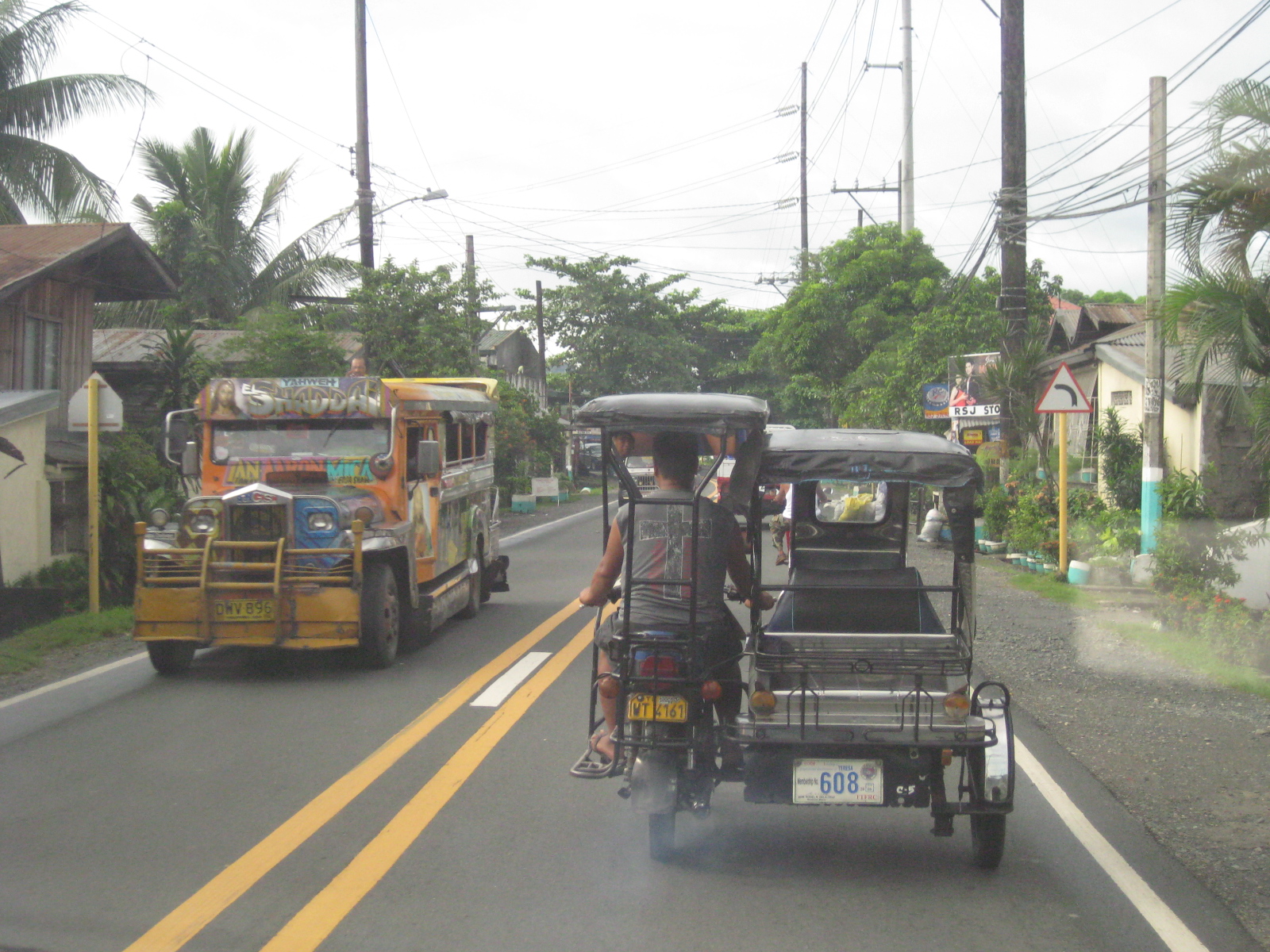
Jeepneys and tricycles remain the most common modes of transport along highways although the latter are supposed to be banned from using national roads. Most national roads pass through towns so it is somewhat inevitable for tricycles to used them. Adding to the problem is the fact that most national roads do not have shoulders or space where tricycles or pedicabs (non-motorized version of tricycles) can pull off from the road to let traffic through.
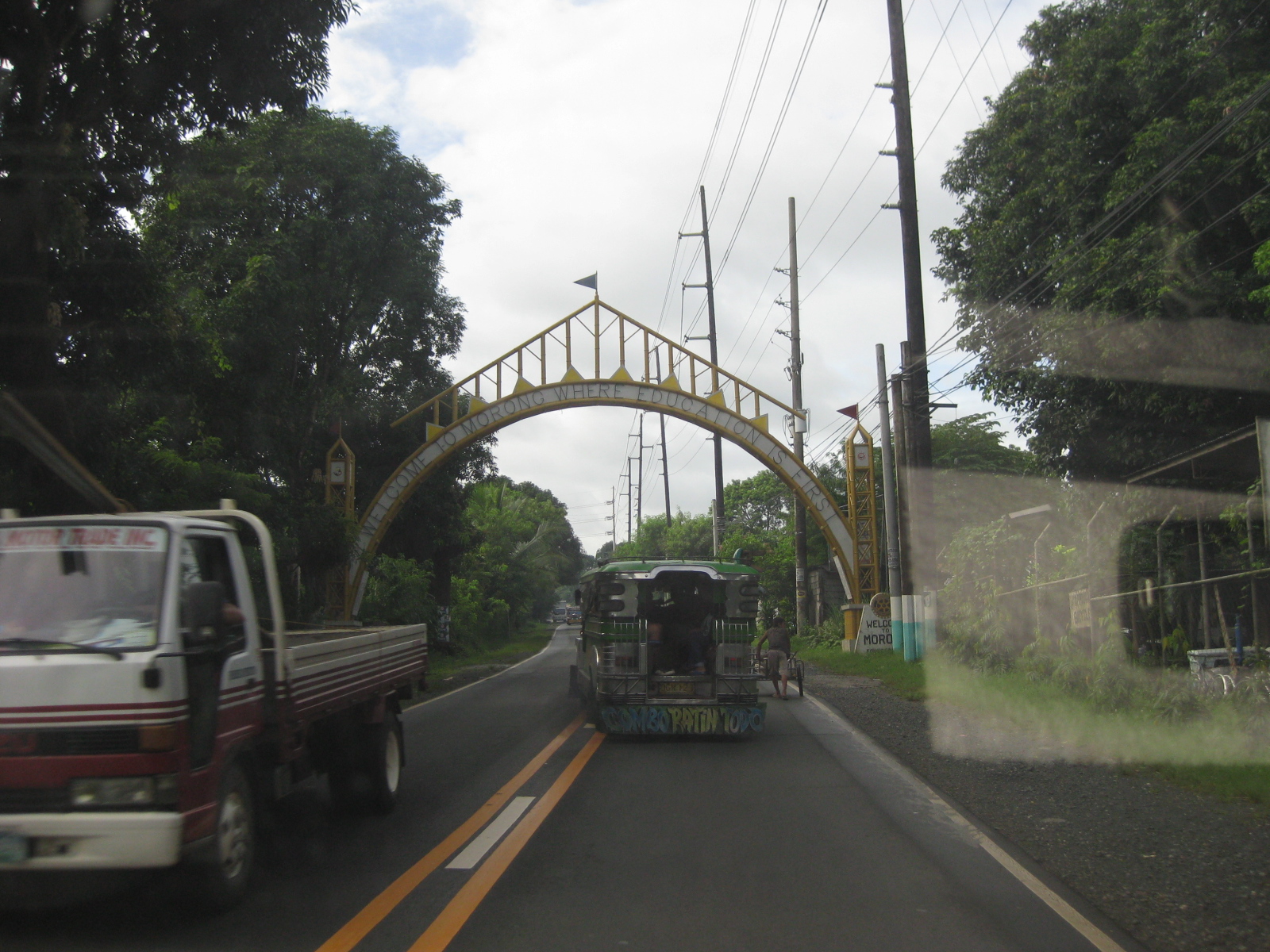
Like most highways in the Philippines, arches greet and say farewell to travelers as they cross town boundaries. Above is a simple arch at Morong, Rizal.
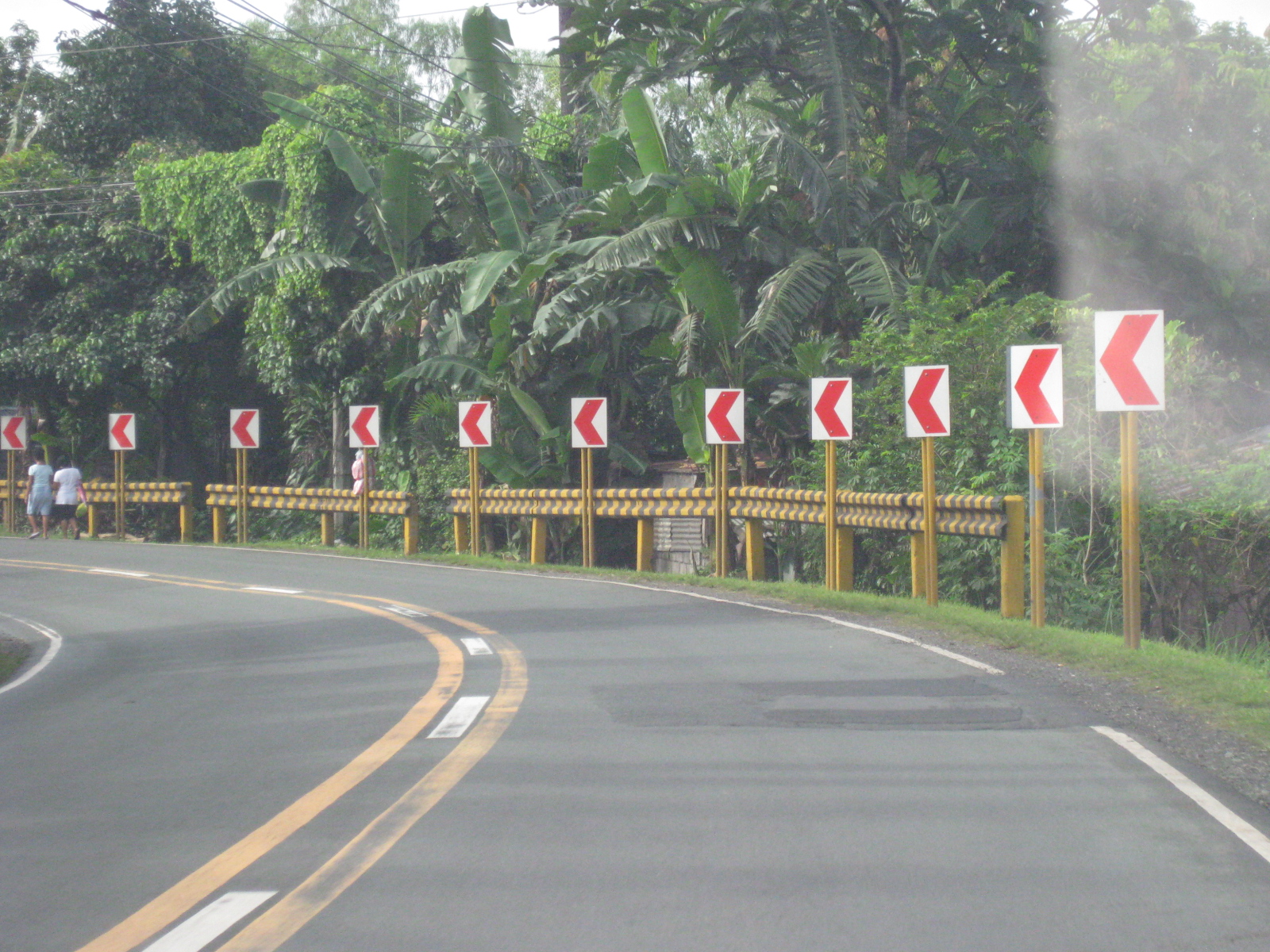
Chevrons along curve section – most Rizal roads have standard signs and road markings. As far as I could remember, these were adequate rather than excessive. The DPWH only needs to maintain these and make sure signs are not vandalized or stolen (Yes, there are cases where they are taken as trophies!), or obstructed by flora.

Most road sections have good quality pavement complete with markings signs and barriers where applicable. This tree lined section is somewhere along the road from Tanay to Baras.
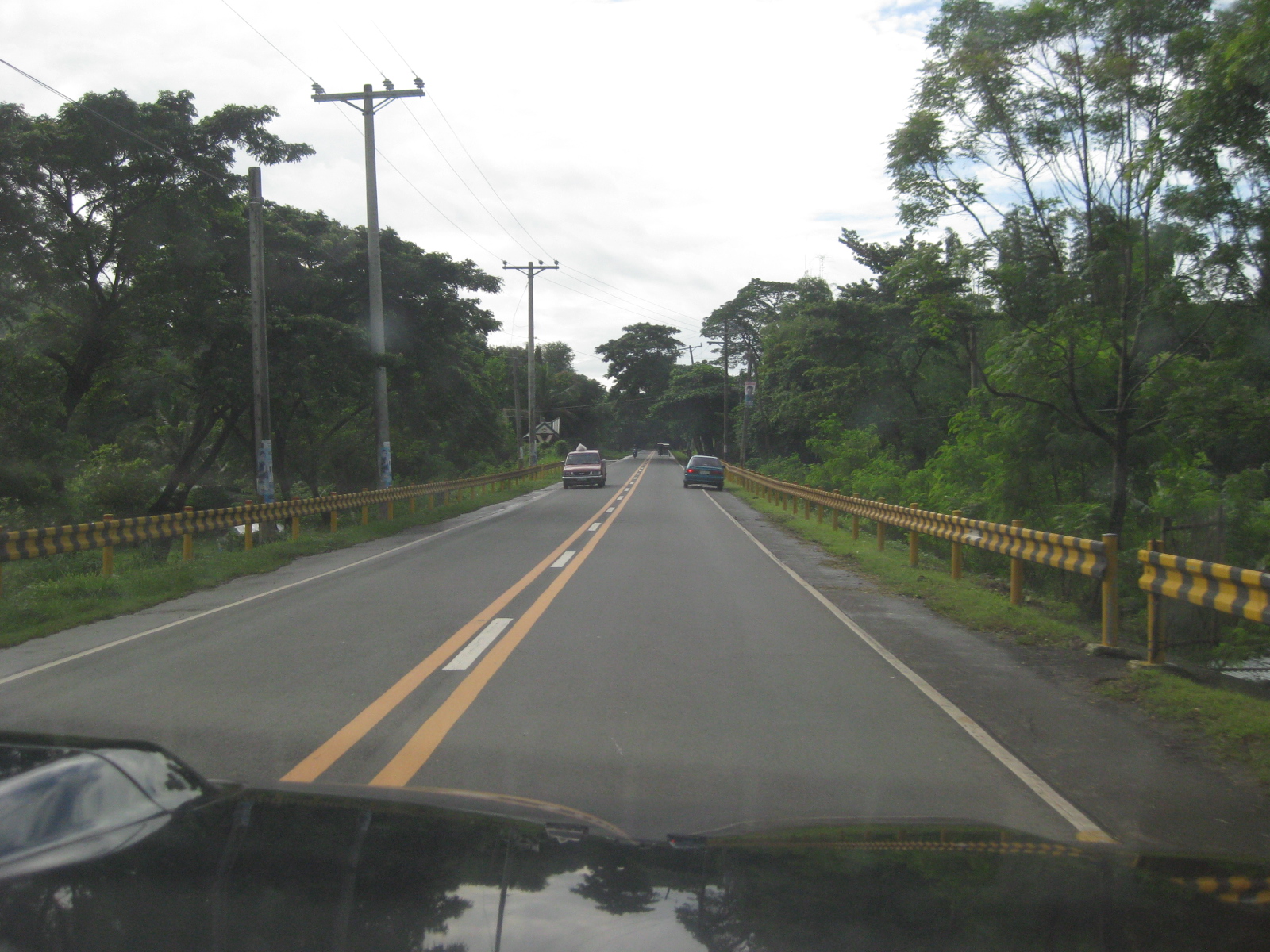
These roads often provide good sight distance allowing for drivers to ascertain whether they can successfully pass a slower moving vehicle. Despite the straight, level section in the photo above, however, pavement markings indicate a restriction for overtaking or passing. This is perhaps the result of road crash experience in the area. Note that such straight, level sections may have a negative effect on drivers as they may actually encourage speeding. The problem, of course, is how to enforce such regulations as indicated by pavement markings. Double yellows are strictly enforced in other countries where highway patrol are deployed strategically to enforce the rule and help curb the potential and actual crashes.
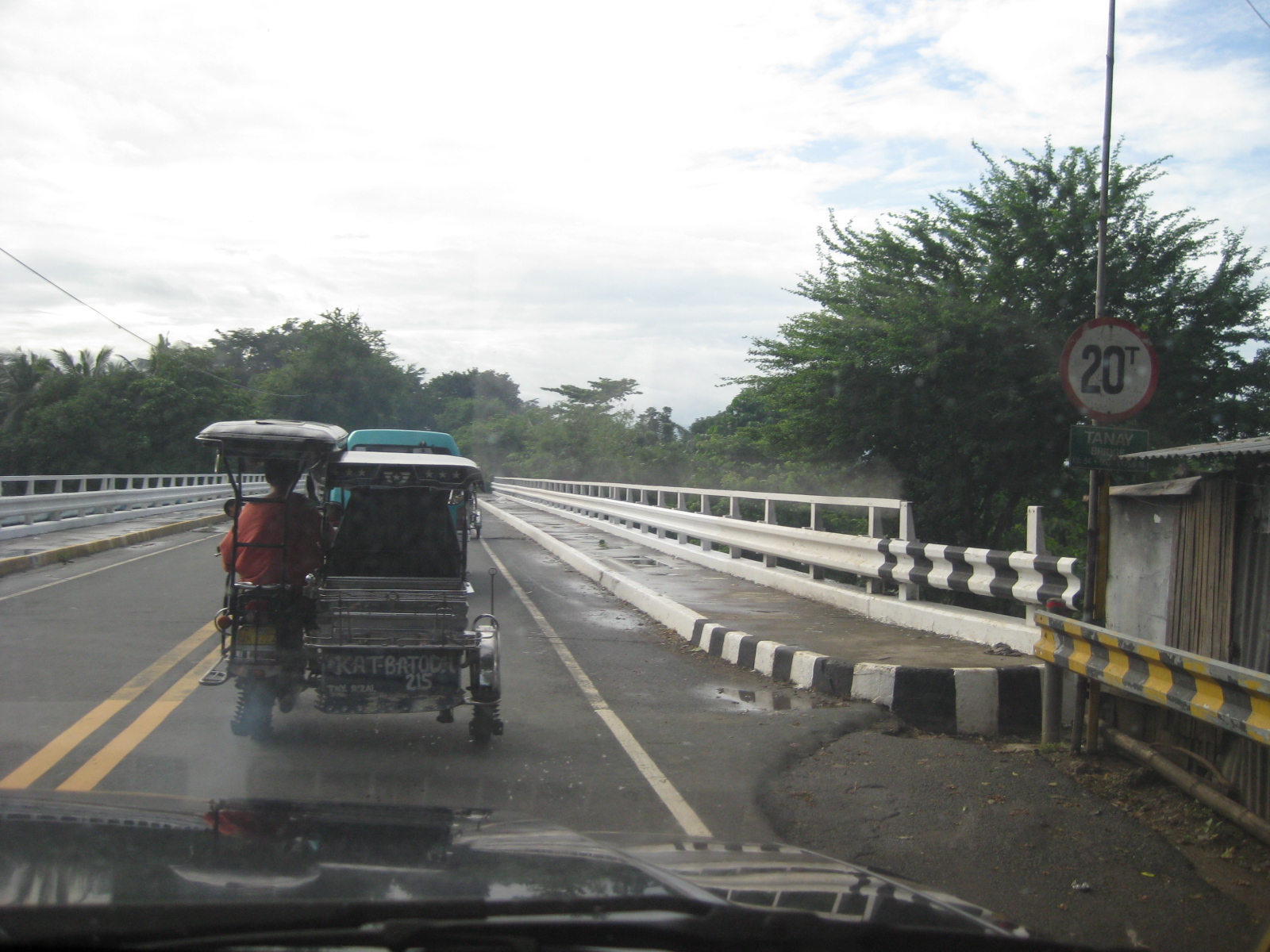
Bridges also have standard signs and markings. This one taken at the approach to a bridge in Tanay.
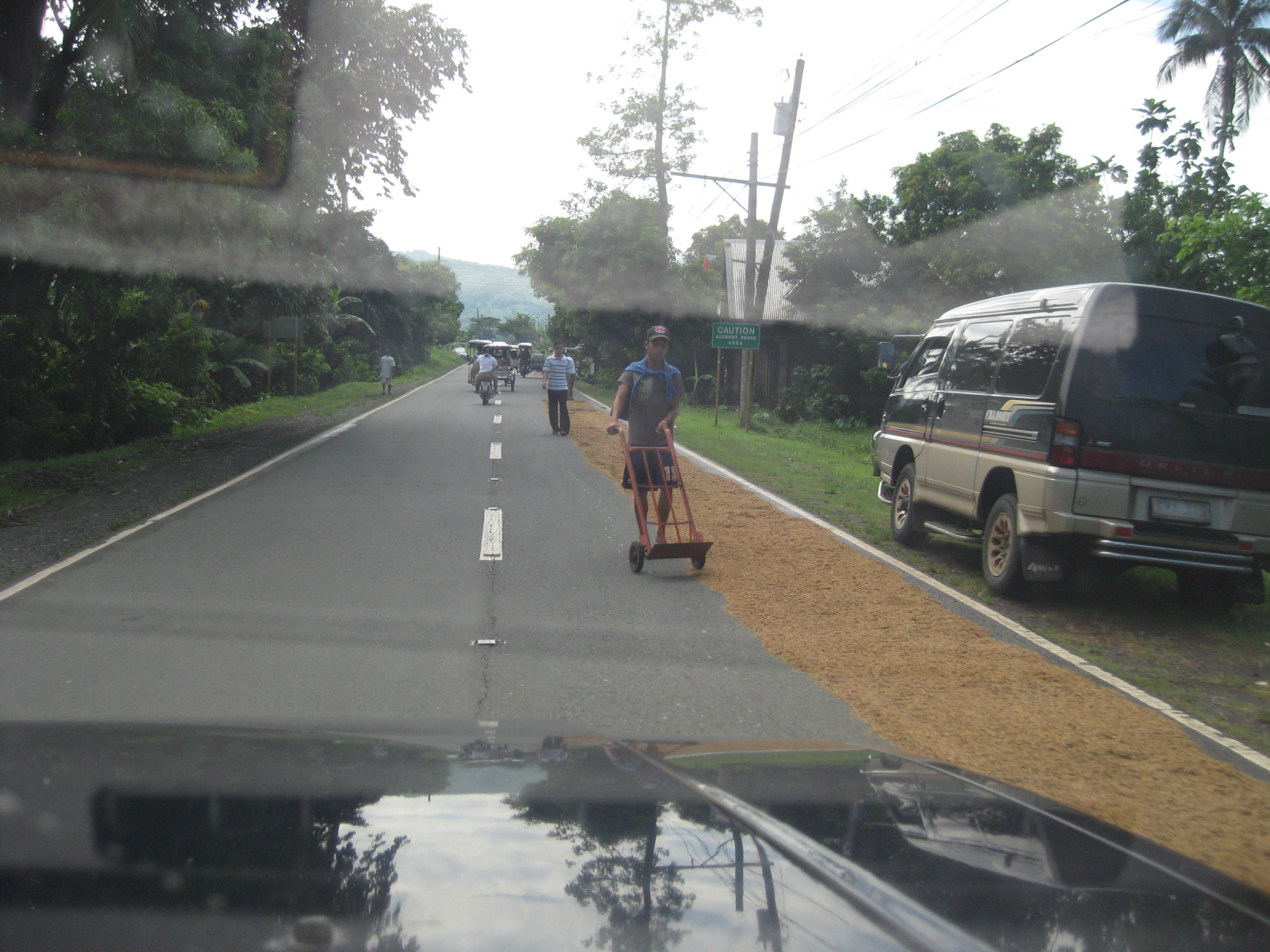
Many roads are used as solar dryers for products such as rice (palay not bigas), fish, and sticks (for barbecue, fishballs, etc.). While tolerated for highways with very low traffic, these are always hazards and often take up significant road space like what is shown in the photo above. A better set-up is found in other areas where shoulders are also paved and these are where farmers or fishermen lay out their products to dry rather than along the carriageway.
Next: Roads in Laguna
Pedestrian overpasses along Ortigas Extension
This post is a continuation of recent ones featuring pedestrian overpasses along major roads. These past posts include facilities along Commonwealth Avenue and Espana Boulevard. This time we take a look at similar facilities along Ortigas Avenue Extension, which stretches from C5 to Kaytikling Junction in Taytay, Rizal. Following is a photo journal of overpasses from Rosario until Cainta Junction.
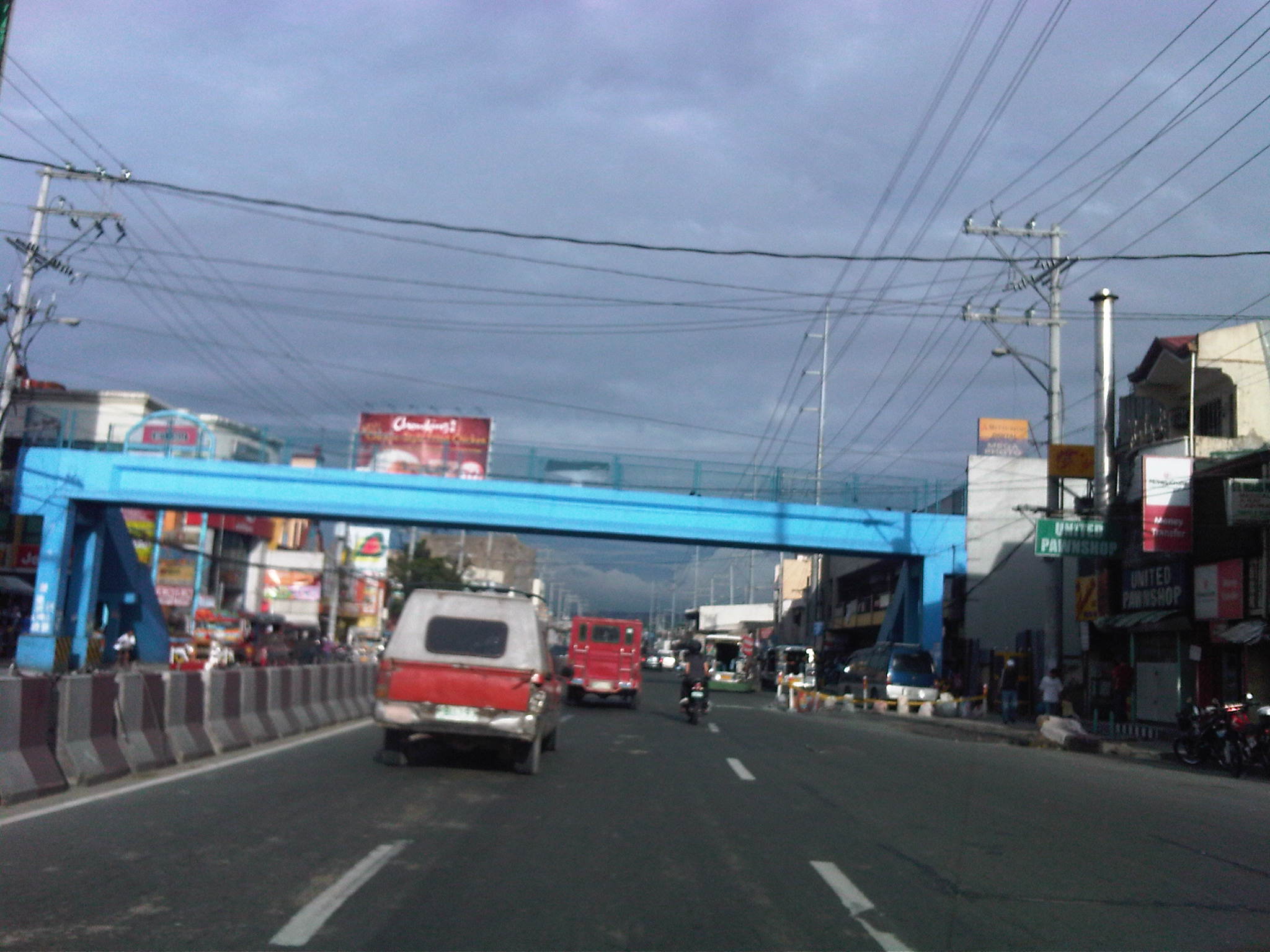 Concrete overpass at Rosario as viewed along Ortigas Ave. eastbound – it appears to be newly repainted but the design suggests it is an older structure of the more traditional design. There used to be no overpass here despite the volume of pedestrians crossing the street due in part to the Sto. Rosario Church on the left side of the road. At-grade crossings are still common with many jaywalkers hurdling/jumping over the concrete barriers.
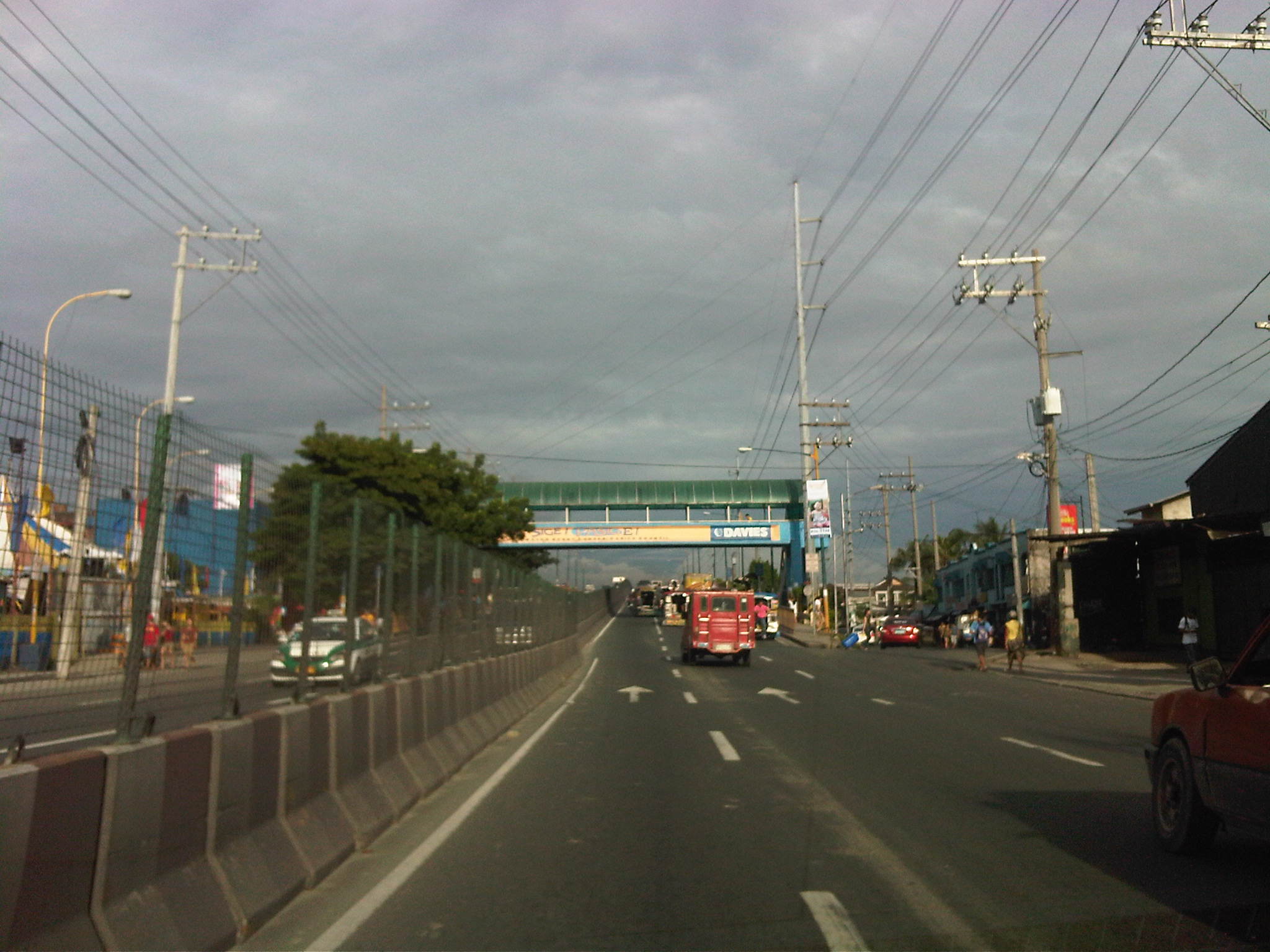 Overpass at the approach ramp to the Manggahan Bridge – seen from Ortigas eastbound, this is one of two overpasses found at either ends of the bridge crossing the Manggahan Floodway. There is a service road on either side Ortigas just beside the overpass that serves as access to the the West Service Road along the floodway.
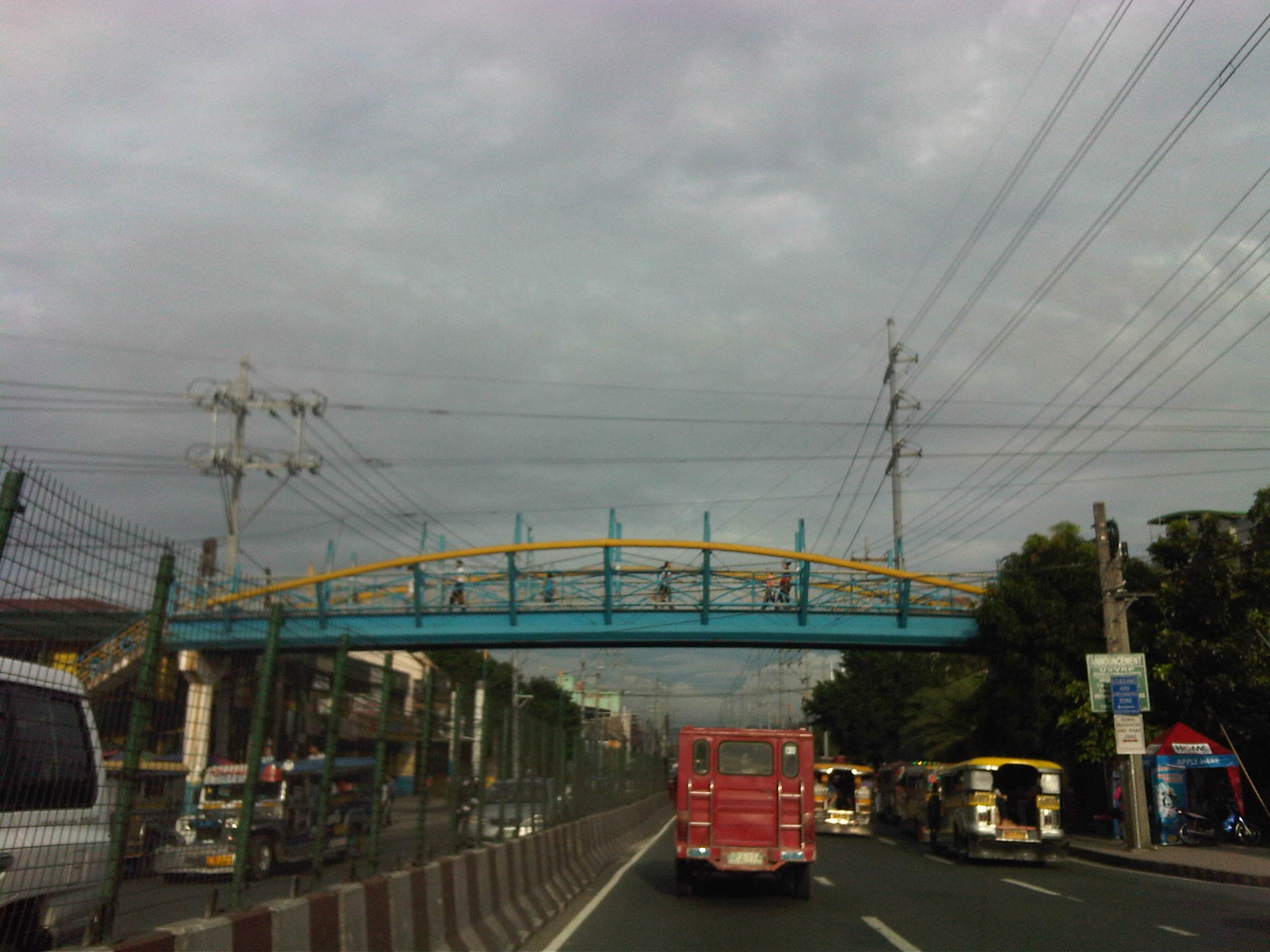 Second overpass at the exit ramp right after the Manggahan bridge – as viewed from Ortigas eastbound, the facility is similar to one found along C5. The steel structure comes across as a rather odd design that I’m sure my architect friends would have their own opinions about. As far as I am concerned, I think there’s just too much steel and is unnecessary though it can be claimed for aesthetics by the designer. Perhaps I am too concerned with functionality and safety rather than beauty?
 Overpass across Ever mall – the covered section of the overpass is concrete and similar to the Rosario overpass. The extension of the overpass is visible from this photo at the right side just above the minivan, and has the distinctive mark of the MMDA (the double M seen in the photo). The extension is a steel structure like most of the newer facilities constructed during the time of BF that allows pedestrians to walk overhead and straight to the mall. This section of Ortigas is quite unusual as outbound (MM-bound) traffic occupy all lanes of Ortigas at this area. Inbound (Rizal-bound) traffic are diverted towards a stretch fronting the mall that appears like a bypass road. Traffic eventually re-enters Ortigas right after the mall.
 Overpass across Cainta Public Market and Robinsons Cainta – this is a concrete structure that is covered and, surprisingly, is clear of vendors thanks to the efforts of Cainta enforcers and the mall security. The public market side (left side of the photo) is too crowded with the pedestrian immediately encountering informal vendors’ stalls upon descending the stairs. While there are no vendors atop the overpass, there are many tambays loitering about and the usual beggar sitting anywhere about the structure (usually at stairs along the public market side). The facility extends all the way towards the mall, which can be accessed via its second level.
Road and drainage improvements along Marcos Highway – Part 2
Previous posts on Marcos Highway road works and the resulting congestion did not include photos and discussions on a significant section of the highway. This is the stretch that runs from P. Tuazon/Imelda Ave. to Masinag Junction, where Marcos Highway intersects with Sumulong Highway. Some friends have pointed out the bottlenecks that include Masinag Junction itself and the uncompleted work in the vicinity of the newly opened SM City Masinag. Following are a few photos I took on a Saturday morning while traveling along that stretch of road and a few observations pertaining to some causes of congestion.
 Unfinished drainage and roadworks along eastbound direction of Marcos Highway approaching Golden Meadows gate – note that materials occupy practically 2 lanes of the highway.
 Construction along Marcos Highway eastbound in front of AMA Computer College just after Filinvest East Gate – only 3 lanes available to traffic, sometimes 2 due to heavy equipment maneuvers.
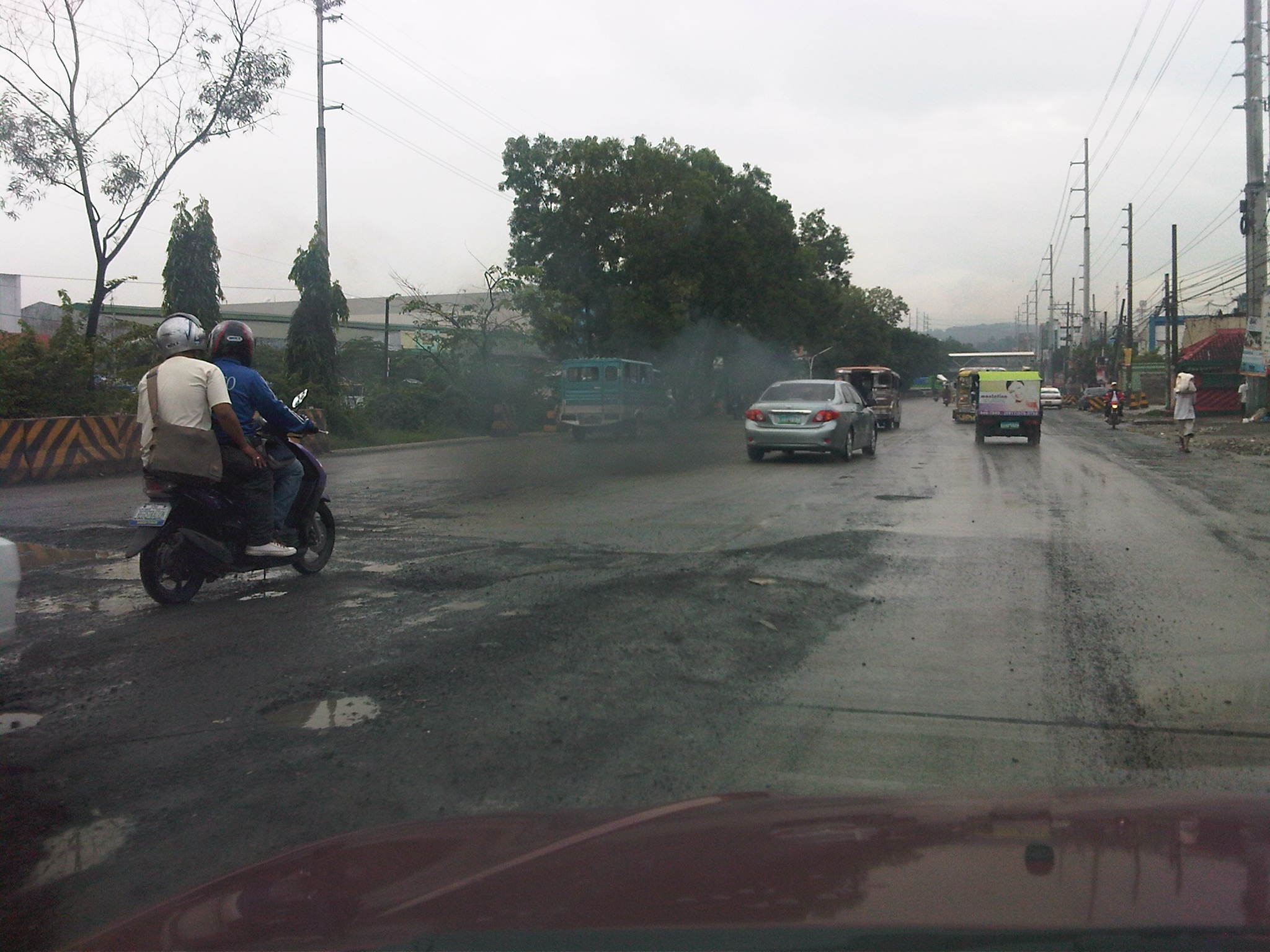 Unfinished road works near Kingsville Gate along Marcos Highway eastbound – bad road conditions lead to congestion as vehicles are forced to slow down due to the potholes and uneven pavement surface.
 Completed PCC pavement sections along Marcos Highway eastbound approaching SM City Masinag area – note that standard signs and pavement markings are still lacking along completed sections. Perhaps there is also a plan to have asphalt overlay as a protective or weathering layer for the concrete slabs?
 Completed section and newly constructed pedestrian overpass across SM Masinag – despite the overpass, many people still brave crossing the wide highway and risk getting run over by speeding vehicles.
 Jaywalking and risky crossing at Masinag Junction – I think traffic enforcers usually fail in managing pedestrians and cyclists crossing at the intersection resulting in the decrease in the throughput of the intersection. In any case, poor control may just lead to a road crash involving pedestrians and/or cyclists.
 More pedestrians crossing at Masinag junction – in this case, the only conflict is with vehicles turning right from Sumulong Highway.
 Another look at the new pedestrian overpass across SM Masinag along Marcos Highway westbound – this was a necessary facility for the safety of people (likely shoppers) crossing the 8-lane highway. The overpass would probably have to be modified later should LRT Line 2 be extended towards Antipolo City.
 Concrete barriers delineating lanes intended for vehicles making a U-turn along Marcos Highway just after SM Masinag – the barriers are also meant to reduce weaving caused by vehicles generated by the mall and intending to make the U-turn. These barriers, however, are also hazards as vehicles accelerating after Masinag will suddenly encounter these without adequate warnings. At present the lane is blocked right after the median opening due to uncompleted roadworks. Thus, erroneously entering the leftmost lanes will require a U-turn. Such barriers would have to be removed so traffic can still opt to pass through the section.
 Unfinished section along Marcos Highway westbound – the number of lanes are reduced from 5 to 2, drastically reducing capacity and causing serious queuing due to the shockwave resulting from the bottleneck.
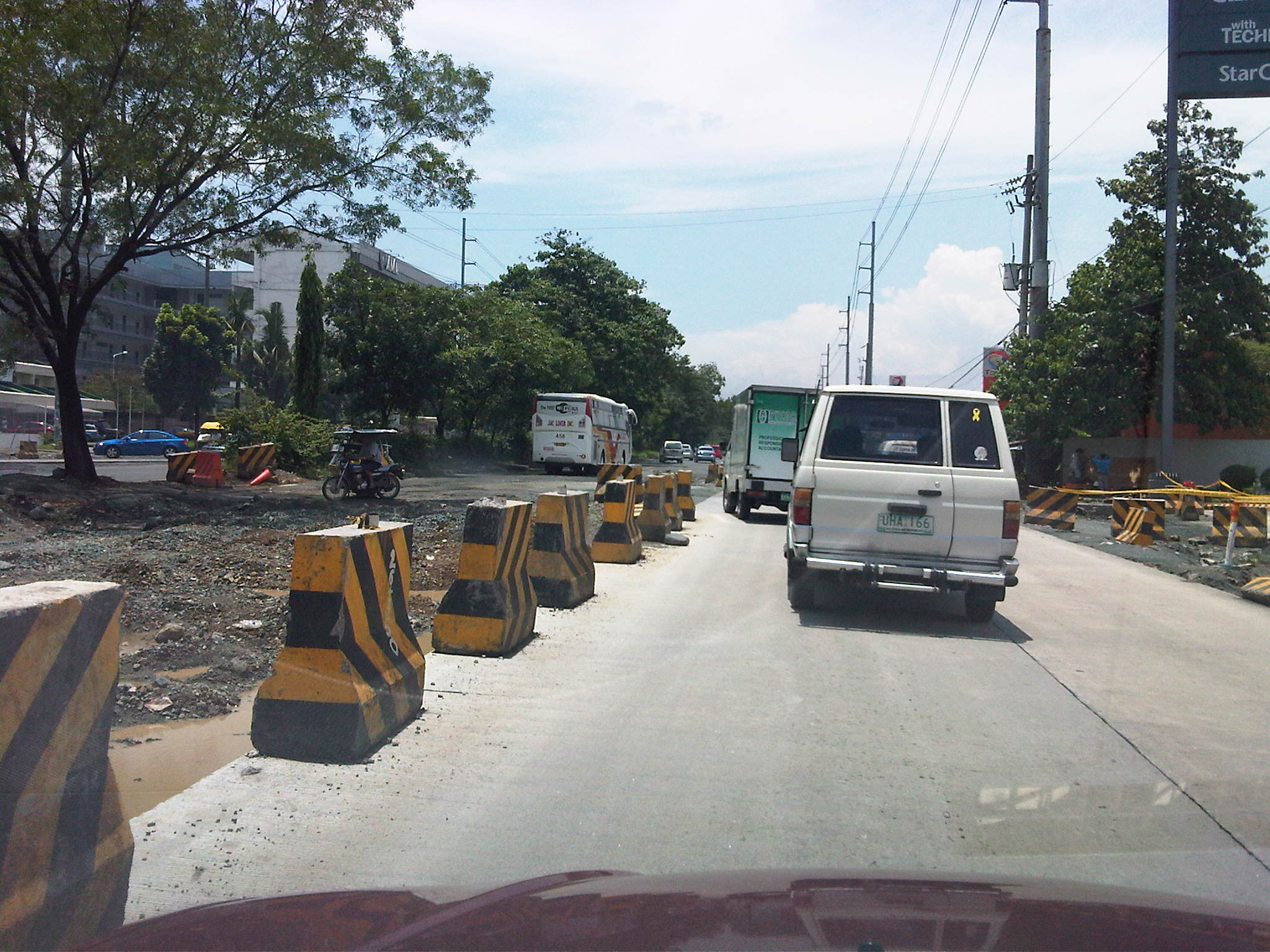 Unfinished drainage and roadworks along Marcos Highway westbound across the Caltex service station approaching the Filinvest East and Vermont Park gates – the section widens just before the subdivision gates and median opening but the inner lanes have not been paved at the time the photo was taken.
 Median opening (U-turn slot) for westbound traffic coming from Imelda Avenue – the old median opening across Burger King was closed and traffic was diverted to this slot located between the Shell and Phoenix service stations right after the Town & Country gate and CVC grocery. The result was less congestion due to weaving traffic between Imelda and this slot. This, however, came with a price – a longer trip for vehicles coming from Imelda Avenue.
With the completion of road and drainage works along Marcos Highway, it is expected that congestion will eventually be eased and the inherent costs will be reduced. Perhaps there will also be an opportunity to revisit traffic management and traffic control at critical junctions including Masinag, Imelda Ave./A. Tuazon, and A. Rodriguez/J.P. Rizal. So far, the perception of continuous movement due to the U-turn schemes along Marcos Highway have resulted in many adjustments to the locations of the slots while only producing congestion and perhaps encouraging aggressive driving behavior. Traffic signals should again be considered though traffic and travel behavior will surely be affected by a proposed extension of LRT Line 2.
Yurikamome – AGT in Tokyo
I lost a lot of photos and negatives to Ketsana. These included many about transportation systems in Japan during my 3 years while taking my doctorate. We loved to take pictures at railway platforms and I had a collection of photos of various trains approaching the platform including those taken by friends where I was in the picture as the train was approaching in the background. Fortunately, I have photos taken from more recent trips to Japan when I already had the benefit of having a digital camera for my shots. As I was browsing old photos, I came upon a set taken from a trip to Tokyo back in 2005. Following are a few photos I took when we went around the Odaiba district and used its popular Automated Guideway Transit (AGT) system called the Yurikamome or Seagull.
 Station platform – notice the doors that automatically open and close along with the AGT doors
 Another view of the station platform – notice the markings on the floor to designate queuing areas as well as standard guides for blind commuters (these are the yellow, dimpled tiles)
 Passengers’ waiting area with simple benches. The information boards for train arrivals are visible from this photo.
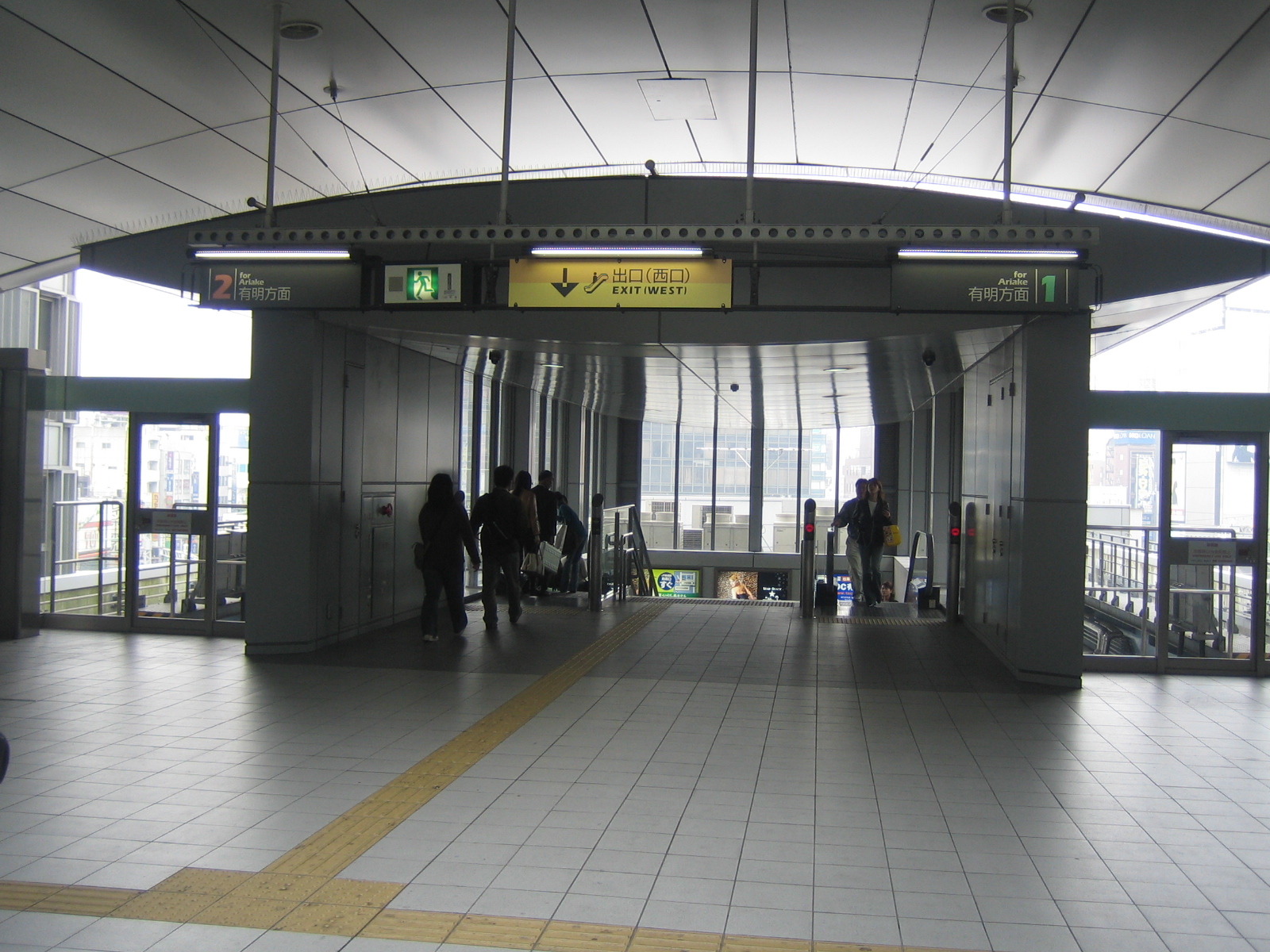 Entrance and exit to the station platform – both stairs and escalators are available to passengers.
 The Yurikamome’s guideway, which looks like a road. The AGT uses rubber tires much like road vehicles and employs a suspension system that ensures a smooth, comfortable ride.
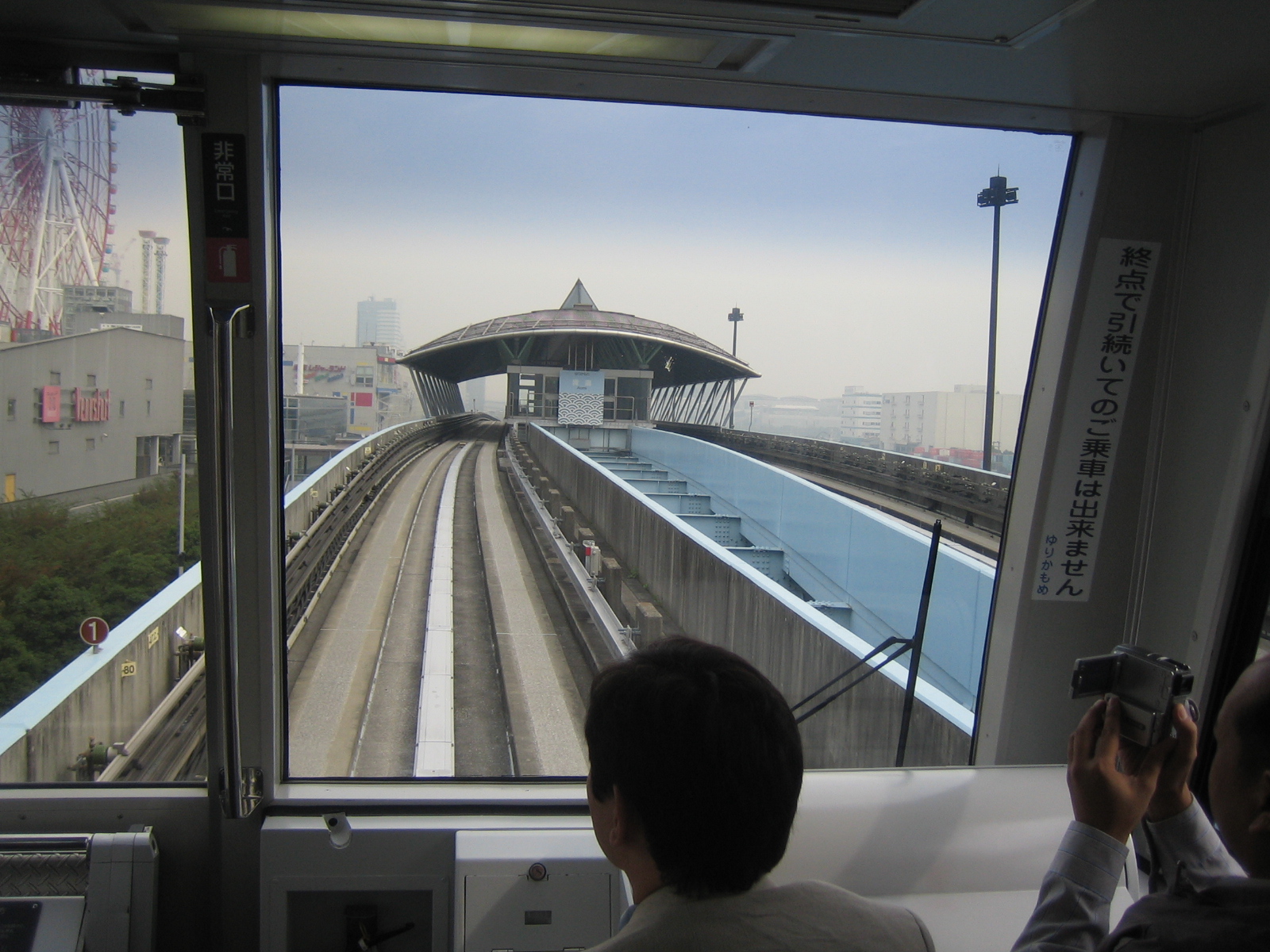 The Yurikamome is driverless (thus, automated). This is the view from the most coveted seats on the transit as the AGT approaches a station.
Pedestrian overpasses along Espana Blvd., Manila
I took some photos of pedestrian overpasses along Espana Avenue in Manila while en route to a meeting in Malacanang. I was hoping to capture the conditions along such facilities and maybe compare them with my observations along Commonwealth Avenue. Following are photos taken from my trusty Blackberry. I ask my readers to excuse the reflections due to the sun bearing down on the windshield of our vehicle.
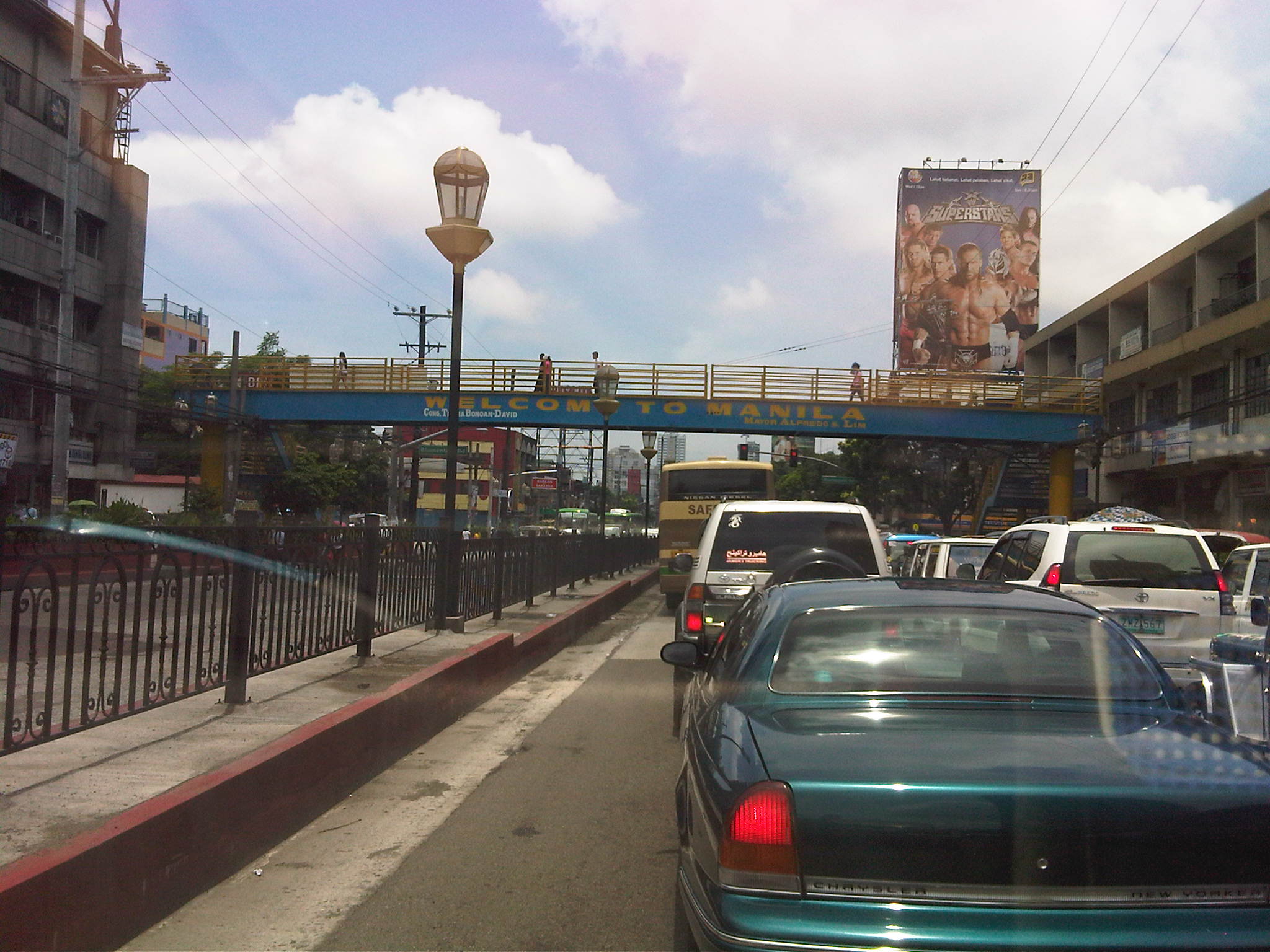 Steel overpass built during the last MMDA administration. Many pedestrian overpasses were constructed out of steel by the MMDA and this was attributed (allegedly) to the previous Chair having a construction and steel manufacturing outfit. True enough, many of these structures bear his initials that is also the name of his corporation. Many of these structures were criticized by the DPWH for not following standards (e.g., one can feel the deflection of the overpass while traversing its length) but the same agency seemed helpless in their case against such facilities.
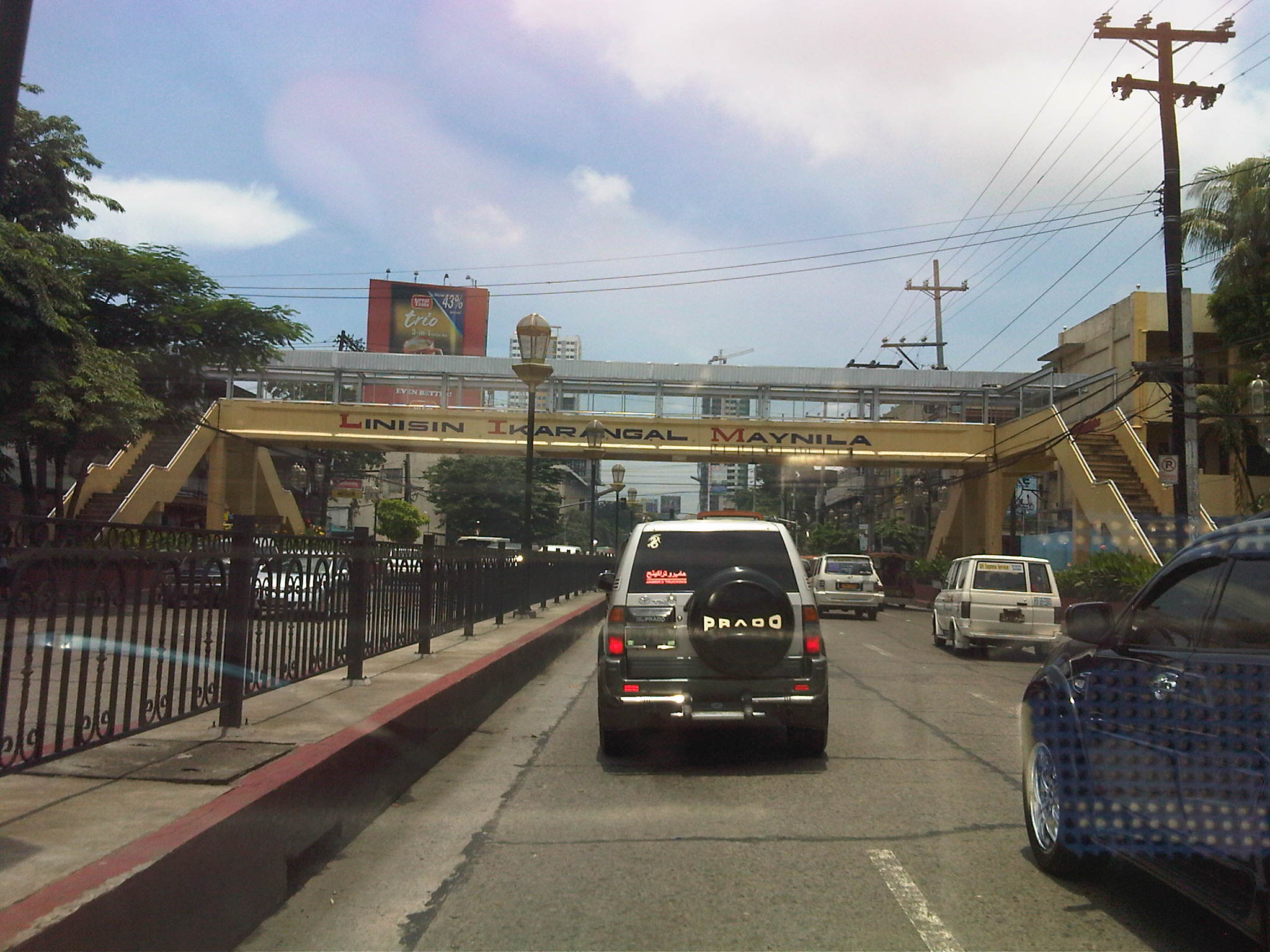 Older concrete overpass across Ramon Magsaysay School. This appeared to be clear of vendors while the roof structure is unfinished giving users no protection from the elements.
 Overpass across UST. This is one of the older and larger (widest?) pedestrian facilities along Espana considering it serves the students of one of the largest (in terms of population) universities in the country. There are vendors on this overpass but mostly those selling candies and cigarettes(!). I am not sure if UST has posted a guard along this overpass considering the safety and security interests of its constituents. Similarly situated overpasses along Katipunan Avenue are secured by personnel provided by Ateneo De Manila University and Miriam College. I would like to see this overpass retrofitted and re-designed to match UST’s heritage. The institution, after all, just celebrated its 400th anniversary.
 Overpass at P. Noval Street. It is not so clear from the photo but one can easily see vendors with their wares set-up along the overpass and clogging the flow of people. This is another relatively old structure as this is a major crossing point for people in studying or working in the University Belt.
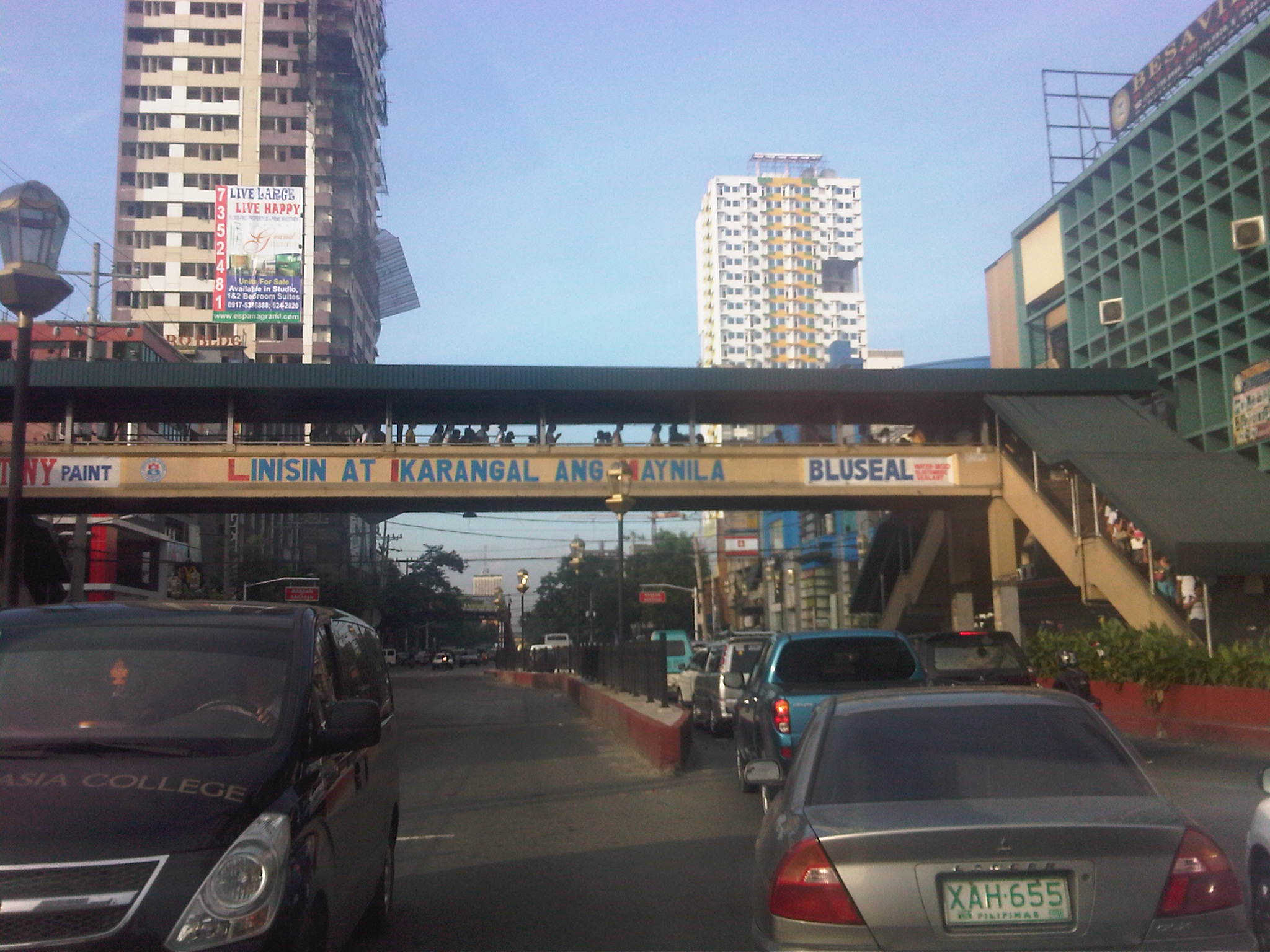 Another look at the P. Noval overpass from the Quezon City-bound side of Espana. Notice the high volume of pedestrians using the overpass? Most of these are students studying at one of the universities at U-belt or graduates reviewing for their respective licensure exams in one of the many review centers located in the area. There are many nursing and engineering review schools in the area.
If we are to encourage walking as a mode of transport and especially applicable to short distance trips, we would need to invest and build the necessary pedestrian facilities. Such facilities need to be structurally sound and therefore compliant with the standards set by the DPWH and properly located to encourage their use. Design, of course, includes capacity considerations since they should be able to accommodate volumes of pedestrians during peak periods. As such, overpasses would have to be clear of vendors or others that constrict flow. Ideally, pedestrian facilities should also be designed according to a criteria that includes aesthetics that adheres with the character of the area where it is located. It is understandable that construction of such facilities may have been rushed due to the urgency of the situation (i.e., like in the case of Commonwealth). Nevertheless, while the intent is good, the execution of the solution should still adhere with standards considering that these are often long-term investments for public infrastructure.
Congestion along Imelda (Felix) Avenue
Imelda Avenue was its original name and is taken from the first name of a former First Lady of the Republic. It was appropriate at the time considering it intersected with Marcos Highway, which was being developed as a main thoroughfare to the east and alternate to the older and established corridor of Ortigas Avenue. Imelda Avenue extends from the Cainta Junction where the road continues towards the town center of Cainta as A. Bonifacio Ave., up to Marcos Highway, across which, the road continues towards the Marikina City center as A. Tuazon Ave.
Imelda Avenue is basically a 4-lane, divided road with the division pertaining to the narrow island in the middle of the avenue than separates opposing flows of traffic. At some point in the middle of the avenue, from the Vista Verde subdvision main gate, two 2-lane undivided service roads appear on either side of the highway and continue until Karangalan Village, which has phases on each side of Imelda Avenue. Sometime in the 1990s, the avenue’s name was changed to Francisco Felix Avenue, in honor apparently of a former mayor of Cainta who was the first of a dynasty of three Felixes who became Mayor of the town. The current mayor is a former media personality on his third term and, who seems to be on the way to establishing his own dynasty by already advertising projects and accomplishments of his better half. But that’s politics and definitely another story that we will steer away from. Anyhow, the original name of the avenue was restored sometime ago as most people still referred to it as Imelda rather than Felix.
Adding insult to the injury that is congestion along Marcos Highway are the severe jams experienced by motorists and commuters passing through Imelda Avenue. The congestion is primarily attributed to the civil works related to projects of the Manila Water concessionaire whose pipes happen to be located in the middle of the road and not conveniently under one lane of the highway. Manila Water is not to blame as this was something they inherited from the MWSS who laid down the pipes, apparently without the benefit of foresight. The result of the project is severe congestion as only one lane has been practically available for Cainta-bound traffic.
But even without the project, congestion has been an issue due to the continuously increasing volume of through traffic plus the contributions in vehicle generation of the residential areas on either side of Imelda. These generators include the sprawling Vista Verde, Village East and Green Park subdivisions that have relatively high car ownership due to their mainly middle class residents. Jeepney operations along the highway where loading and unloading operations are indiscriminate and undisciplined. The two service roads offer minor comfort considering these are usually clogged by on-street parking due to commercial establishments. Tricycles operating along these service roads also contribute to slow traffic if one opts to bypass the sections affected by the water project.
The following photos were taken during a weekend trip where I had to pass through Imelda Avenue. Many areas along the highway are flood-prone (much of Imelda was submerged during Ketsana/Ondoy) so this eventuality is partly to blame for what seems to be a slowly progressing project that has already wasted a lot of valuable time and fuel. Hopefully, the project will be completed before the “ber” months arrive when traffic naturally starts to increase due to the anticipation for the Christmas season.
 Cordoned section showing only one lane of Imelda Ave southbound available to traffic. Other vehicles brave the west service road on the right.
 Pavement subgrade prepared for subsequent pouring for concrete at section approaching Vista Verde main gate. The pedestrian overpass downstream serves a national high school along the northbound side of Imelda Avenue and beside the Vista Verde gate. Notice the island on the right occupying space equivalent to 1 lane.
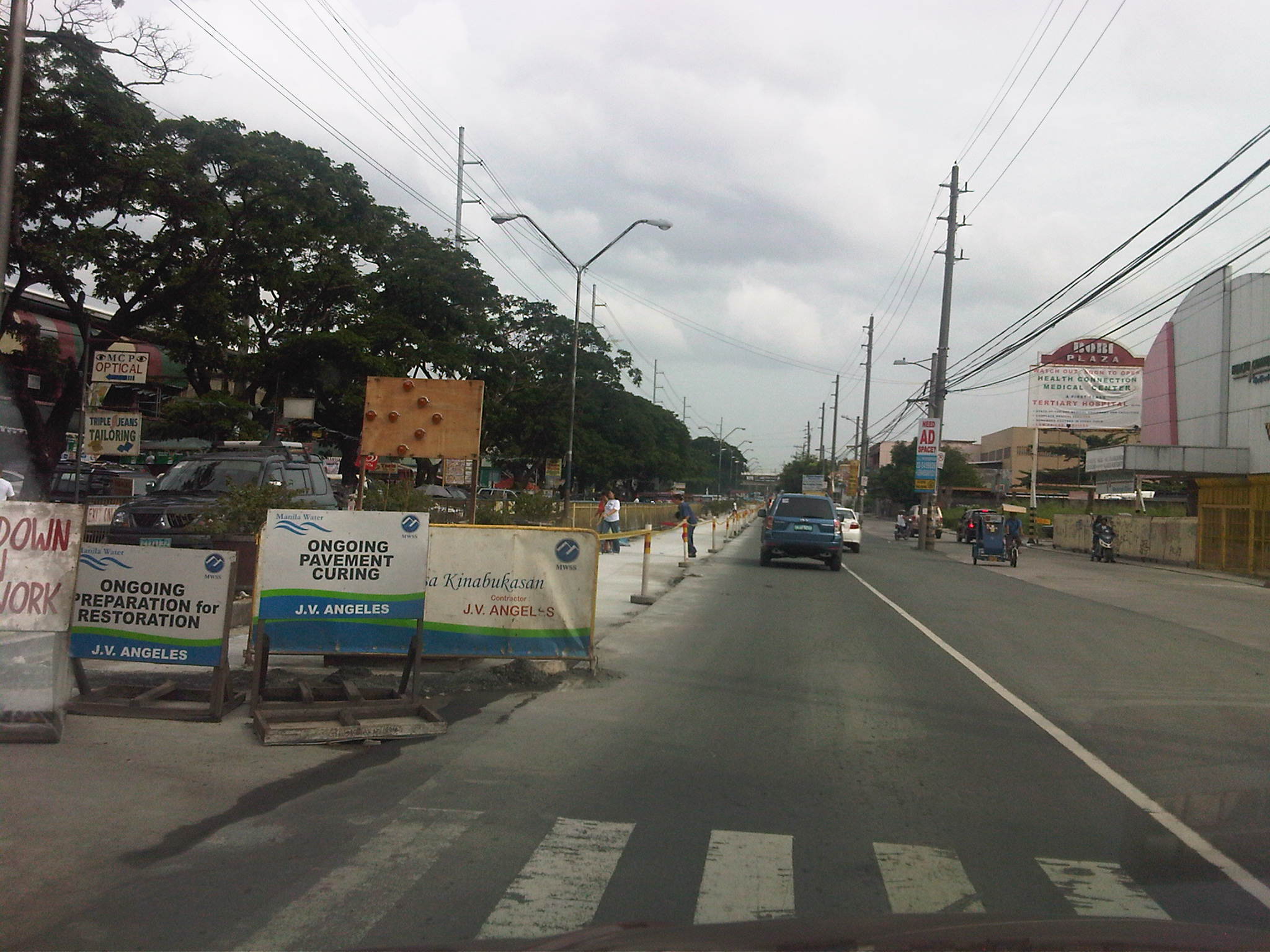 Newly paved lane along Imelda Avenue fronting the Karangalan market. The island separating Imelda from the west service road has been removed along this section to alleviate congestion and permit vehicle maneuvers in the vicinity of the market.
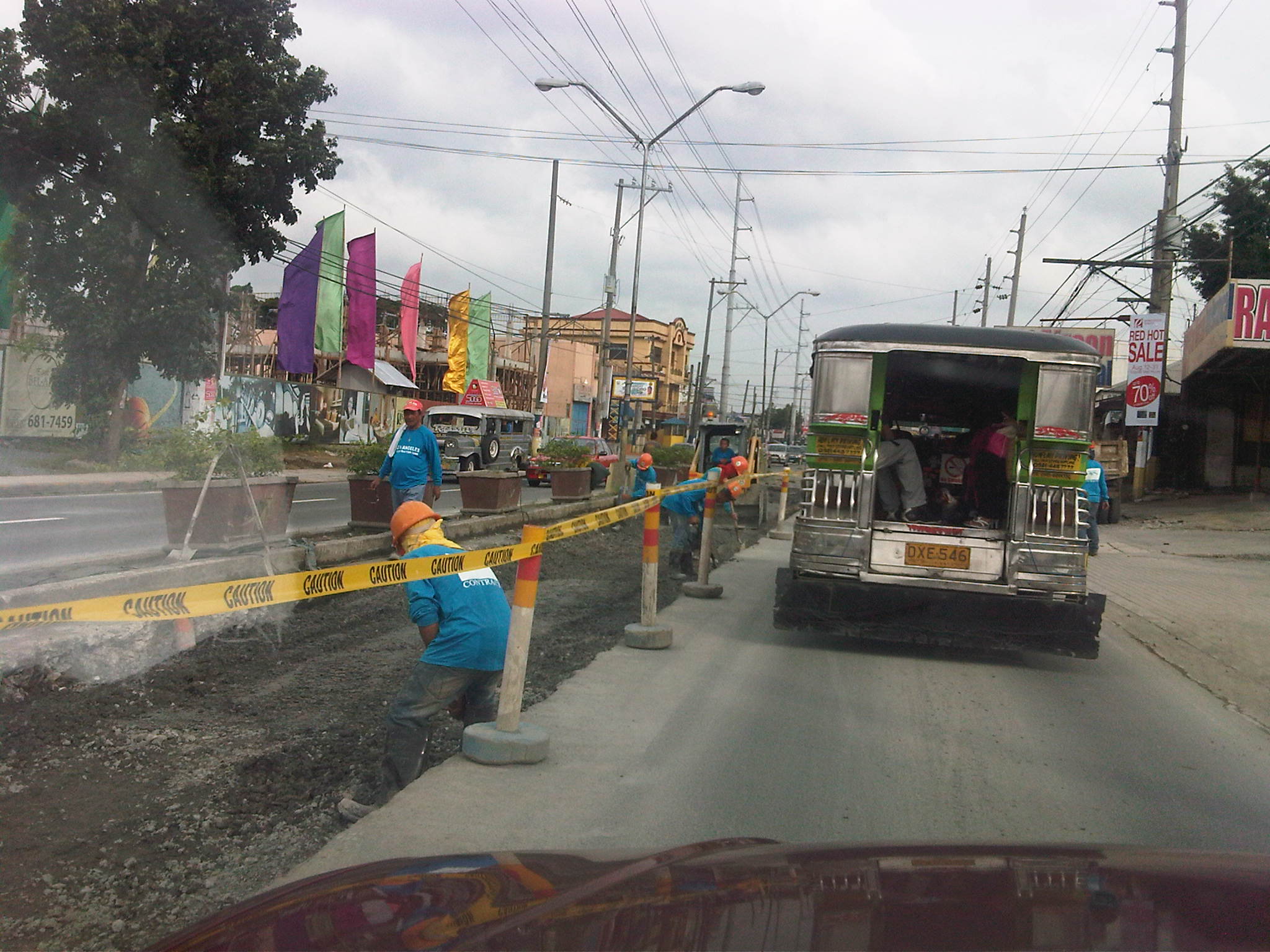 Manila Water contractor working on lane past Vista Verde main gate . Notice that there are no service roads along either side of Imelda from this point.
 Caught (up) in traffic