
Home » Infrastructure (Page 32)
Category Archives: Infrastructure
Road and drainage improvements along Marcos Highway
People driving or commuting from the eastern part of Metro Manila and the towns of Rizal Province have been experiencing traffic congestion for quite some time now due to the civil works associated with the improvement of Marcos Highway. The project is part of the Metro Manila Urban Transportation Integration Project (MMURTRIP) that finally pushed through after failed bids that caused significant delay to its implementation. The major components of the project include road widening and pavement rehabilitation, and the improvement of drainage along the highway. The latter component is quite important as the drainage system is supposed to contribute to the alleviation of flooding in areas along the highway. Who knows if the system could have prevented or at least mitigated the floods brought about by Ketsana (Ondoy) in 2009 if the project had been implemented according to its original schedule?
The photos below were taken during a regular commute along the highway and shows civil works in various stages of completion.
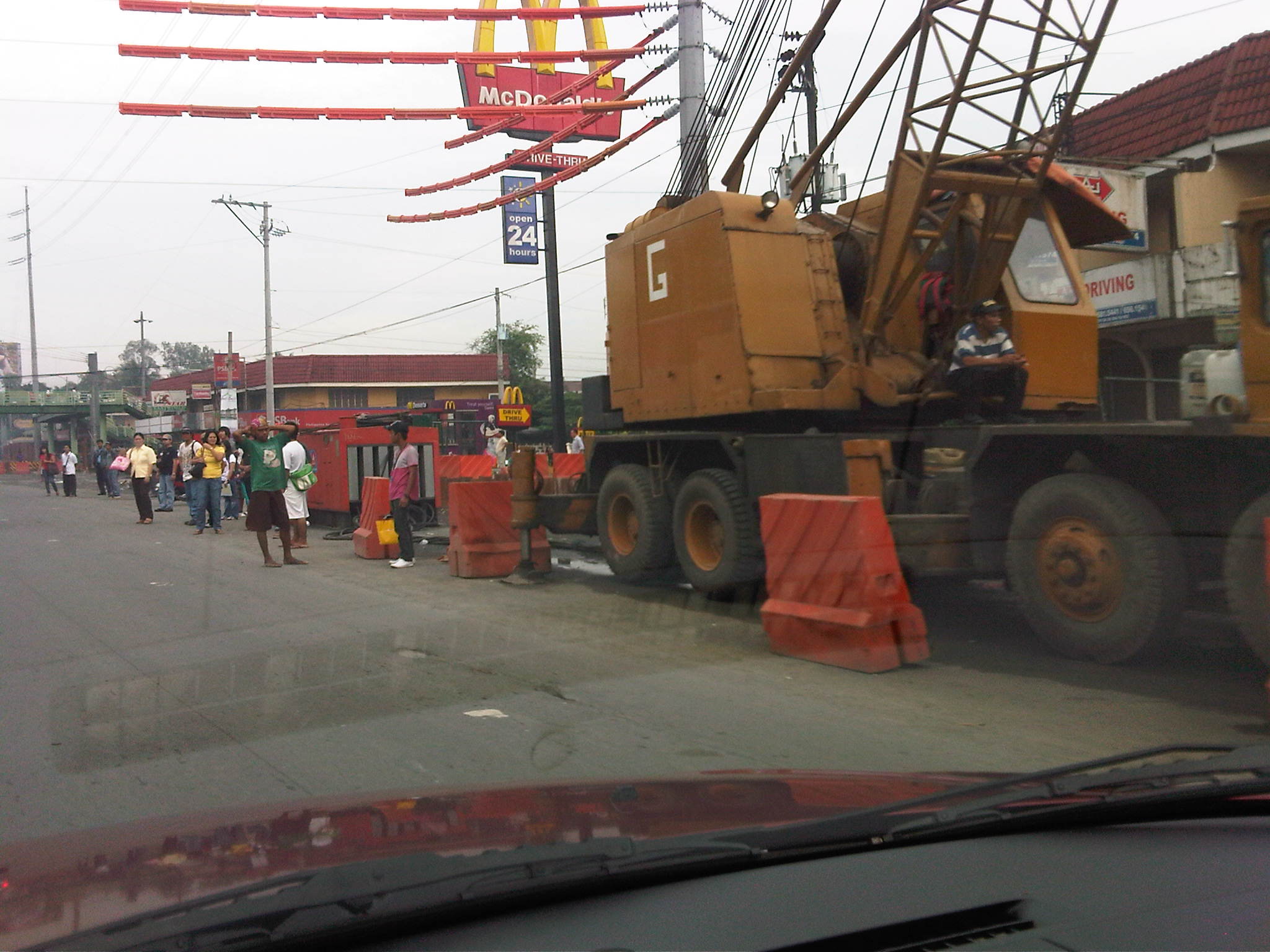 Crane deployed along westbound lane of Marcos Highway – Note the barriers and other equipment that effectively occupy about 2 lanes of the highway and the passengers waiting along the highway.
 Partly completed works along Marcos Highway westbound just after the junction with Felix Ave./A. Tuazon Ave. and across from Sta. Lucia Grand Mall
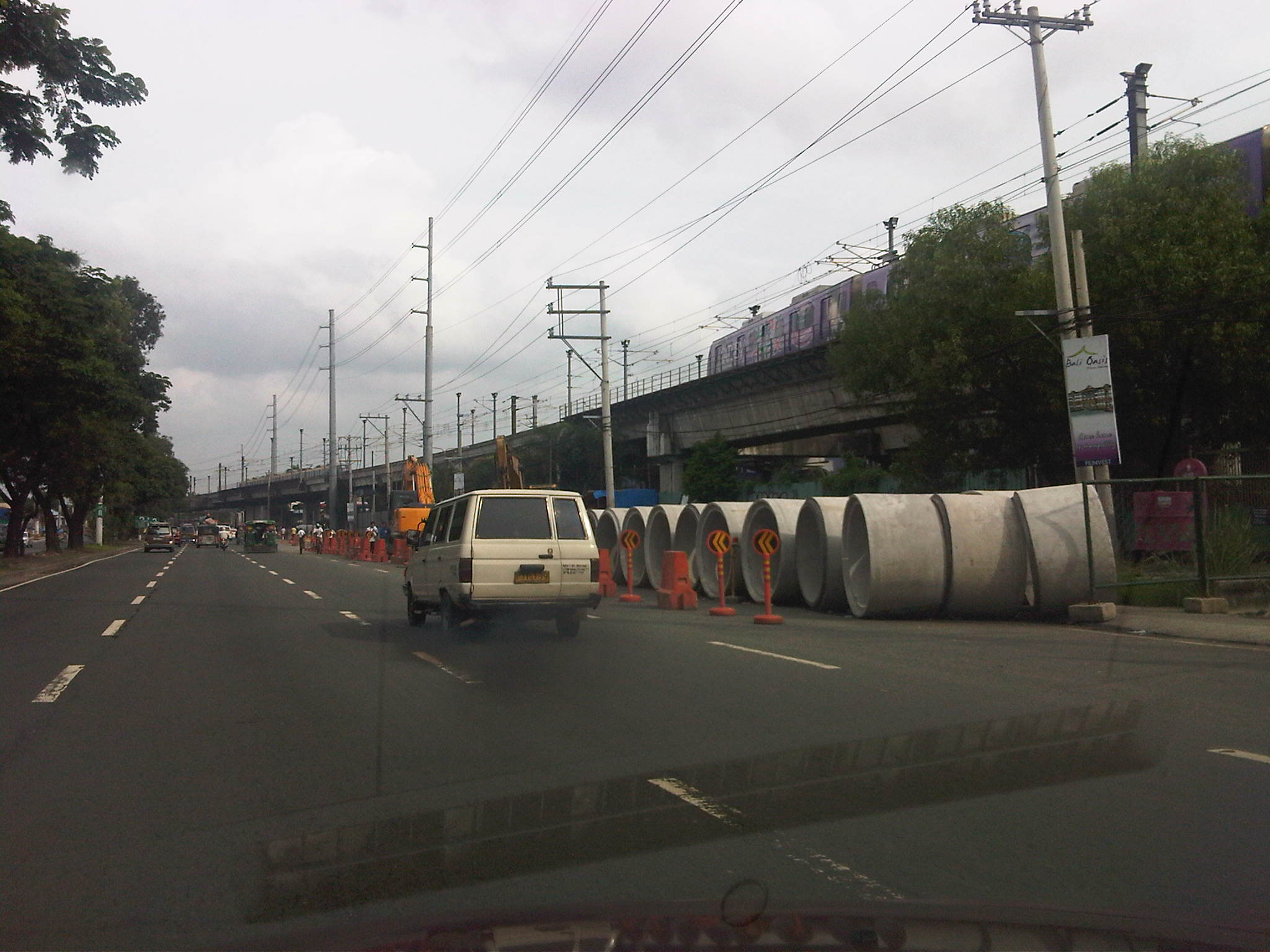 Civil works along Marcos Highway eastbound in front of the LRT2 Depot in Santolan
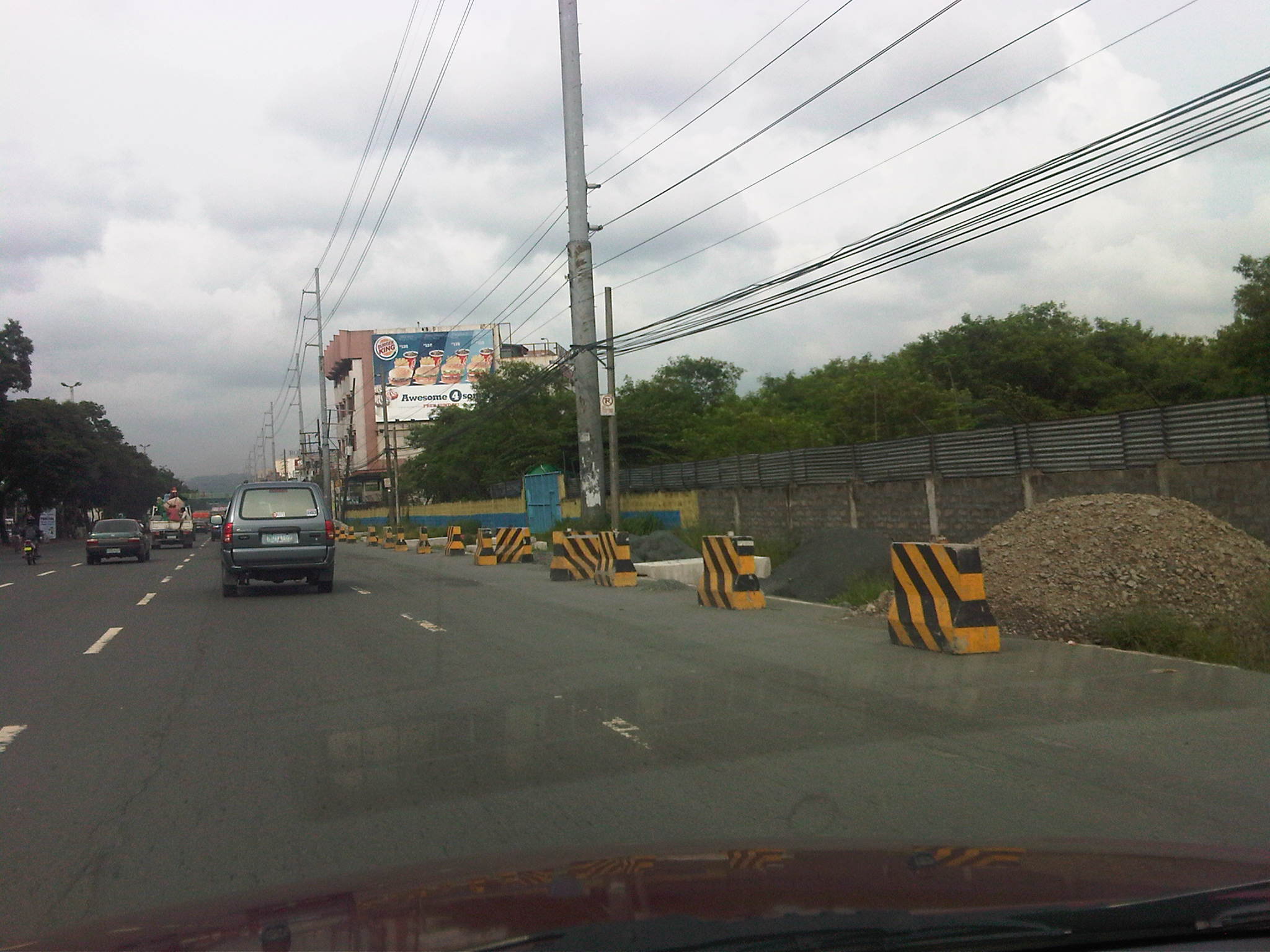 Partially completed works along Marcos Highway eastbound just after junction with A. Rodriguez Ave. (Ligaya)
 Project equipment and materials and informal barracks along Marcos Highway eastbound near the Barrio Fiesta/Slimmer’s World
 Excavations along Marcos Highway eastbound
Due perhaps to the magnitude of the project, traffic congestion along many if not most sections of the highway have been inevitable though prolonged. But partly responsible for the congestion is the Manila Water concessionaire that also did their own civil works at the same time as the DPWH project. As such, the capacity of the highway was significantly reduced with the outer lanes affected by the DPWH project and the inner lanes impacted by Manila Water works.
We should be hopeful though that once the project is completed, traffic flow will greatly improve and flooding may be alleviated along the highway and its catchment area. Works seems to be continuing although there seems to be less people working on the project these days compared to when the project started. Maybe they are just spread out along the highway? The following photos show examples of progress in the civil works.
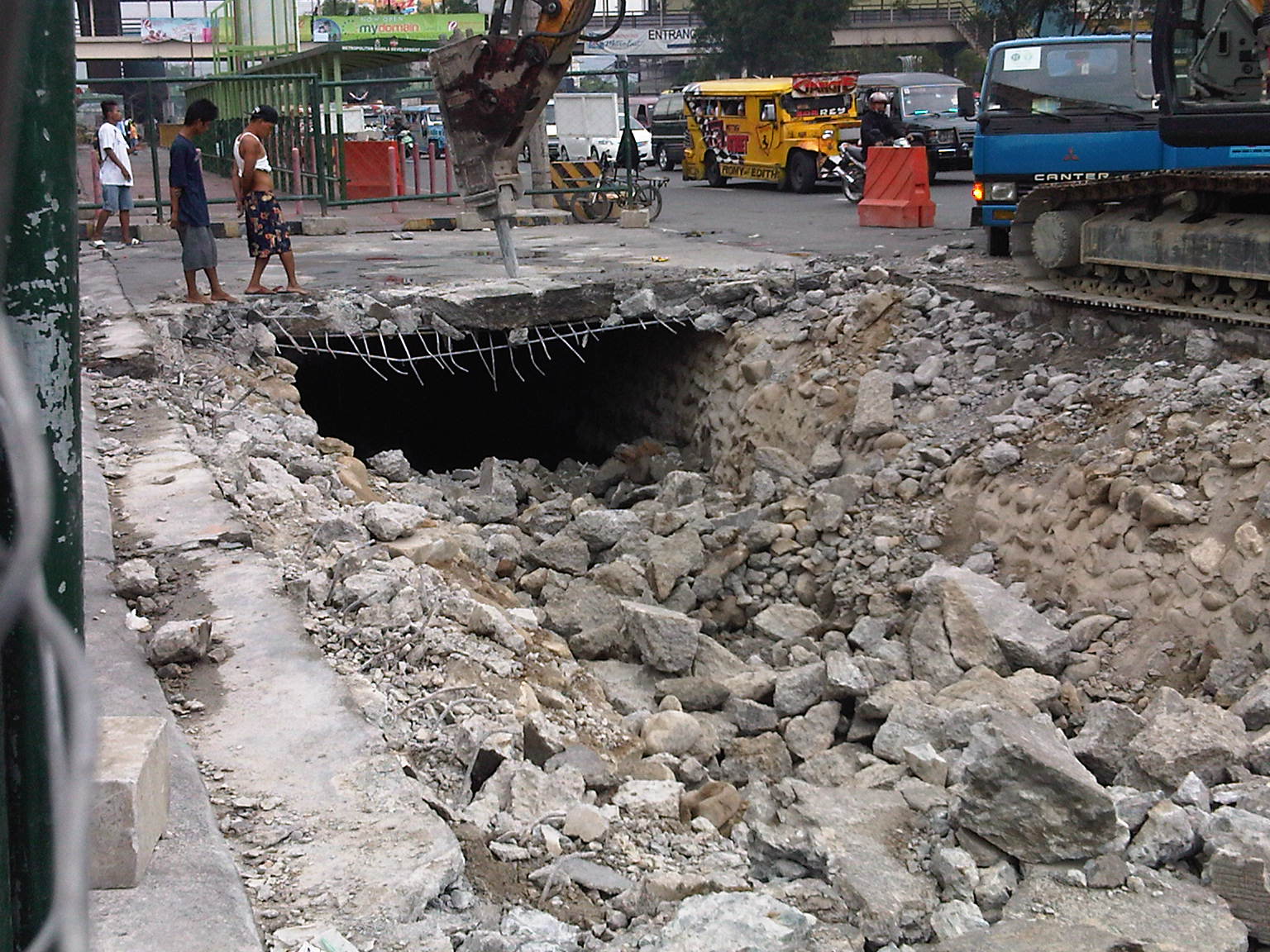 Demolition work of slab covering drainage along Marcos Highway westbound (before)
 Drainage canal covered and pavement engineering works (progress/after)
While it is expected that vehicle flow will be facilitated by the project, it can be said also that this may only encourage more vehicular traffic. As such, perhaps the next project that could be considered for this corridor is the also much-delayed extension of LRT2 towards Masinag.
Experiences and lessons on land use and zoning along Katipunan
Last Friday, a rally was held just outside the Ateneo De Manila University along Katipunan Avenue to protest the construction of Blue Residences, one of the SM group’s high-rise condominium projects that is located near the corner of Katipunan Ave.-Aurora Blvd. where a mini golf course and a few small shops used to be. The protesters wielded placards stating what could have been applicable to many of the developments now standing along Katipunan and just across from Ateneo and Miriam College. This is not really a new issue the protesters were dealing with but something that, dare I say, has festered for quite some time now.
The issue of land use and zoning along Katipunan is a continuing struggle against what the Quezon City government has maintained as its policy for “spot” zoning to accommodate high density residential and commercial development along a stretch of Circumferential Road 5 that used to be predominantly low density with small shops and restaurants lining the west side of the road and separated from the main highway by an island and a two-way service road where local traffic including tricycles flowed. This was the Katipunan I first started to be familiar with in the late 80’s when I entered UP as a freshman. Miriam was still known as Maryknoll at the time and was run nuns prior to it becoming the secular but still Catholic institution that it is today.
Traffic was more manageable along Katipunan then and a fleet of blue school buses served the Ateneans. It was a case of high occupancy transport that sadly has digressed to high vehicular volume, low occupancy traffic that Ateneo and Miriam are associated with today. Tricycles then were confined to the west service road and crossed Katipunan only at the intersections, which were strategically located just across from the main gates of Ateneo and Miriam. These intersections used to be signalized but the settings were often manipulated to favor Ateneo and Miriam traffic during the peak periods, much to the frustration of through traffic.
Fast forward to the present when the service road was removed along with the island to given way to what the previous MMDA dispensation referred to as a clearway policy to encourage faster traffic speeds combined with the much maligned U-turn scheme as applied to Katipunan. The smaller shops and restaurants have been replaced by condominiums and other establishments that have generated much traffic (not that Ateneo and Miriam have not been responsible for congestion) and which obviously do not have enough parking resulting in cars parked all over along the avenue and effectively reducing road capacity.
An article written by Randy David through his regular column at the Philippine Daily Inquirer came out today to speak about the Professor’s personal experience about Katipunan and his granddaughter’s views on development. Entitled “Katipunan Blues,” it presents a very honest and a very common observation of what Katipunan has become through the years and what different generations think about the development (or degeneration) along the particular stretch of the avenue. Its conclusion is something to ponder about and applicable not only for Quezon City and the rest of Metro Manila but for other cities across the country as well.
Is it too late for Katipunan given all the developments that have been permitted along this road? Did the universities do their part to prevent this in the first place? Or were they part of what Katipunan is today? Does Quezon City (or other local governments for that matter) even know what land use planning is about and what its policies on accommodating development have brought about in many other place? Could the DENR through its EIA process or the HLURB through its own instruments have prevented the deterioration of communities? There seems to be too many questions and we’re running out of answers for these.
Perhaps the answers were there but authorities and officials responsible refused to take heed of these or turned a blind eye to the issues. Perhaps the various developments and SM Blue were allowed because local governments became too eager for developments that also have been equated with revenues for the cities. Still, established systems and processes like the DENR-EMB’s and the HLURB’s are supposed to be there to ensure responsible and appropriate development.
We are often dumbfounded at what has actually happened and the outcomes clearly show our failures. Perhaps we are too blinded with the notion of development that we forget that it is also our responsibility to guide proponents. A lot of soul-searching should be undertaken to rethink how we plan and develop our cities. Such should properly incorporate principles of sustainability including those that address issues pertaining to transport and land use. We have a long way to go towards sustainable development as applied to city planning and development. But we need to start now if we are to even achieve a fraction of what we’d like our cities, our communities to become. We also need for champions to come forward among our current leaders and officials if only to bring order to what is perceived as chaotic development.
Is there a need for a transport infra master plan? – responses to comments and questions
Is there a need for a transport infra master plan?
The NCTS crafted an issue paper for Bantay Lansangan entitled “Is there a need for a transport master plan?” partly as an exploratory initiative to widen the perspective of the organization from its current focus on roads.
Master plans are supposed to be guides for both government and other interested parties such as the private sector for determining what projects are to be prioritized. They also should be able to provide the basic cost estimates and other requirements that should pave the way for more detailed planning and design for specific or particular projects. As such, the absence of master plans or perhaps outdated ones is considered as handicaps in the prioritization and implementation of projects.
However, despite the availability of master plans, there is the question of the acceptance of their recommendations. There are also questions pertaining to how comprehensive these plans are and how would be able to address social, economic, environmental and even political issues should certain projects be implemented and the plan realized. On the last concern on the political aspect there are also those projects that are altered, apparently according to the whims of national or local leaders. Such deviations can be unnecessary and may lead to increased costs for project implementation. As it there have been many master planning studies conducted for the Philippines, the main issue tackled by the paper is the lack of an integrative document, a master plan for all master plans so to speak, that will clearly show how each and every major project is linked with the others.
The paper aimed to:
- Situate what has been initiated in the past vis-à-vis infrastructure master plan;
- Discuss the present framework (if any) that guides government’s long-term investments, policies and projects in infrastructure;
- Highlight the key concepts and processes involved in the formulation of an infrastructure master plan;
- Identify gray and problematic areas; and
- Identify recommendations and ways forward.
I reproduce below the concluding section of the paper:
“Master planning studies are generally directed to the government and provide frameworks for where investments should go. These include recommendations concerning prioritization that is reflected in the implementation periods or targets mentioned in the plan. Projects where the private sector may invest in should seldom deviate from those included and proposed in a master plan. This ideal situation would presume that unsolicited proposals are generally classified among non-priorities. Otherwise, it would seem that the master plan is flawed and failed to identify projects that are attractive for investments. More often than not, private sector entities will also have their own views on which projects will be most profitable and therefore most attractive for them to venture into. It is the government’s responsibility to ensure that plans are implemented according to their importance or urgency.
There is a need for long-term infrastructure master plans. However, these should be updated on a regular basis and not premised on the availability of foreign funding support as the long-term eventually becomes part of the medium-term and ultimately the short-term. Infrastructure master plans should also be flexible as it serves as a guide not only for potential loan packages but the participation of the private sector in putting up the infrastructure essential for the sustainable progress of the country. Lastly, it is important that coordination be clear in the master plans should these be formulated according to the different transport sub-sectors. Elements must be integrated to ensure that the different transport infrastructure projects complement each other rather than appear as isolated or disconnected.”
The paper was presented last August 1, 2011 at the DPWH-BL Fair held at the DPWH headquarters at the Port Area in Manila. It was generally enthusiastically received based on the feedback I got from our technical staff who presented the paper before a predominantly DPWH audience. I will address questions and comments forwarded to me in the next posting.
Pedestrian overpasses along Commonwealth Avenue
Commonwealth Avenue is still regarded as a “killer” highway despite the efforts to reduce road crash incidence along this thoroughfare. Many of these crashes involve pedestrians who continue to cross the highway on at-grade or on ground level at many points of the highway despite this being prohibited or discouraged. To cross the avenue, pedestrian overpasses have been constructed at strategic locations along the highway including those at Fairview Market, at Ever/Shopwise and at Tandang Sora, at U.P. (2 overpasses – one at AIT/CHK and another at Technohub), and at Philcoa. Despite these facilities being constructed and possibly with a few more to be constructed in the future, many people still choose to jaywalk. Among the reasons cited are stairs being too steep and the long distances they have to walk to and from the overpasses.
Following are photos taken on a Sunday drive from Novaliches to UP showing the conditions on and around overpasses along Commonwealth Avenue. Noticeable are overpasses across Fairview Market and Ever/Don Antonio where vendors have set up shop and impede the flow of pedestrian traffic.
 Pedestrian overpass across Commonwealth at Litex and before Fairview Market (section is at Commonwealth southbound) – the overpass is surprisingly free of vendors despite its being well within the influence area of the market.
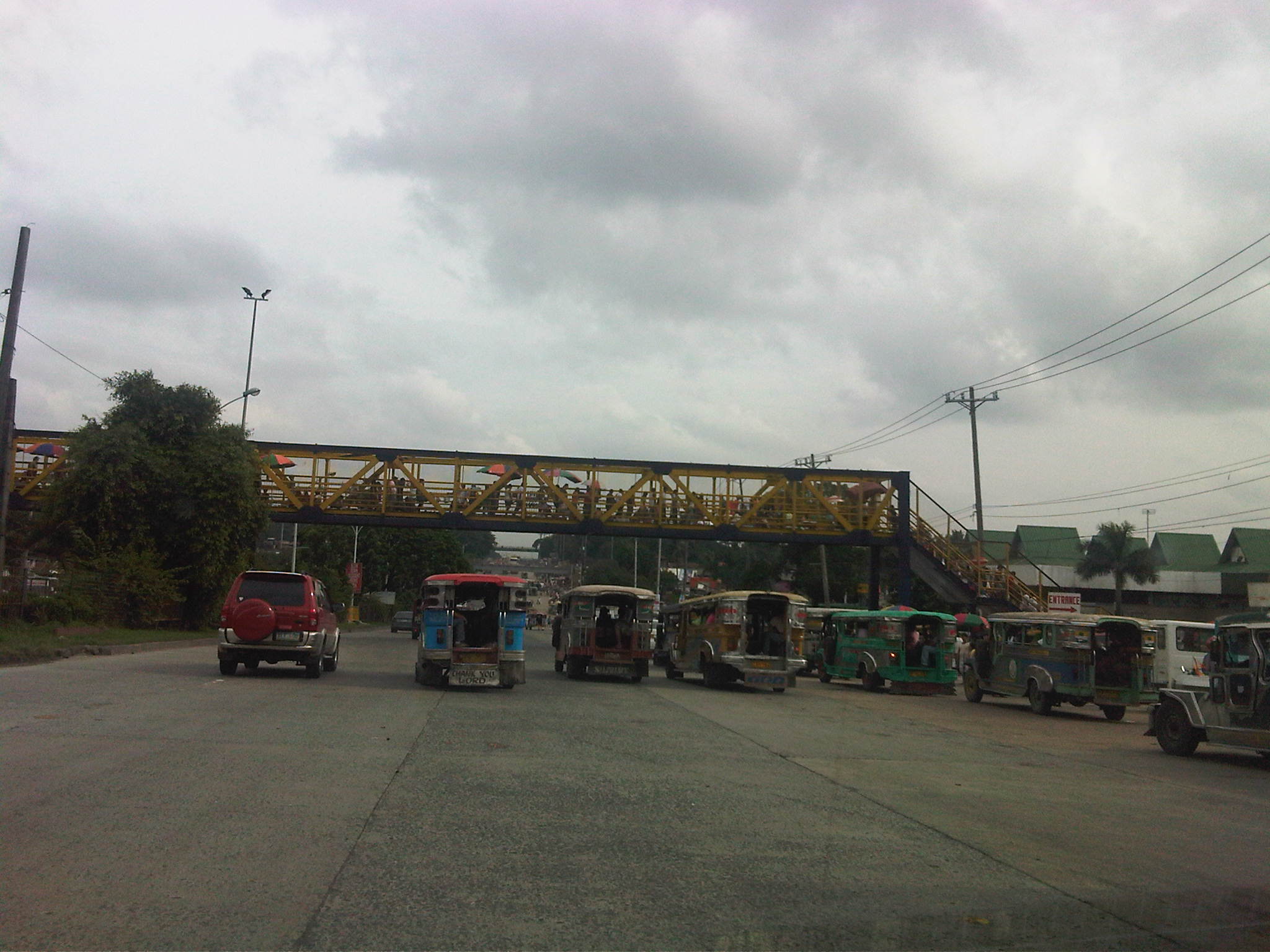 Overpass across Fairview Market (section is across Commonwealth southbound) where vendors have set up to sell various merchandise. Notice the umbrellas to shield vendors from the elements. Note, too, the jeepneys congregating under the overpass and taking up 2, 3 or even 4 lanes of road space and thereby causing congestion along the wide avenue.
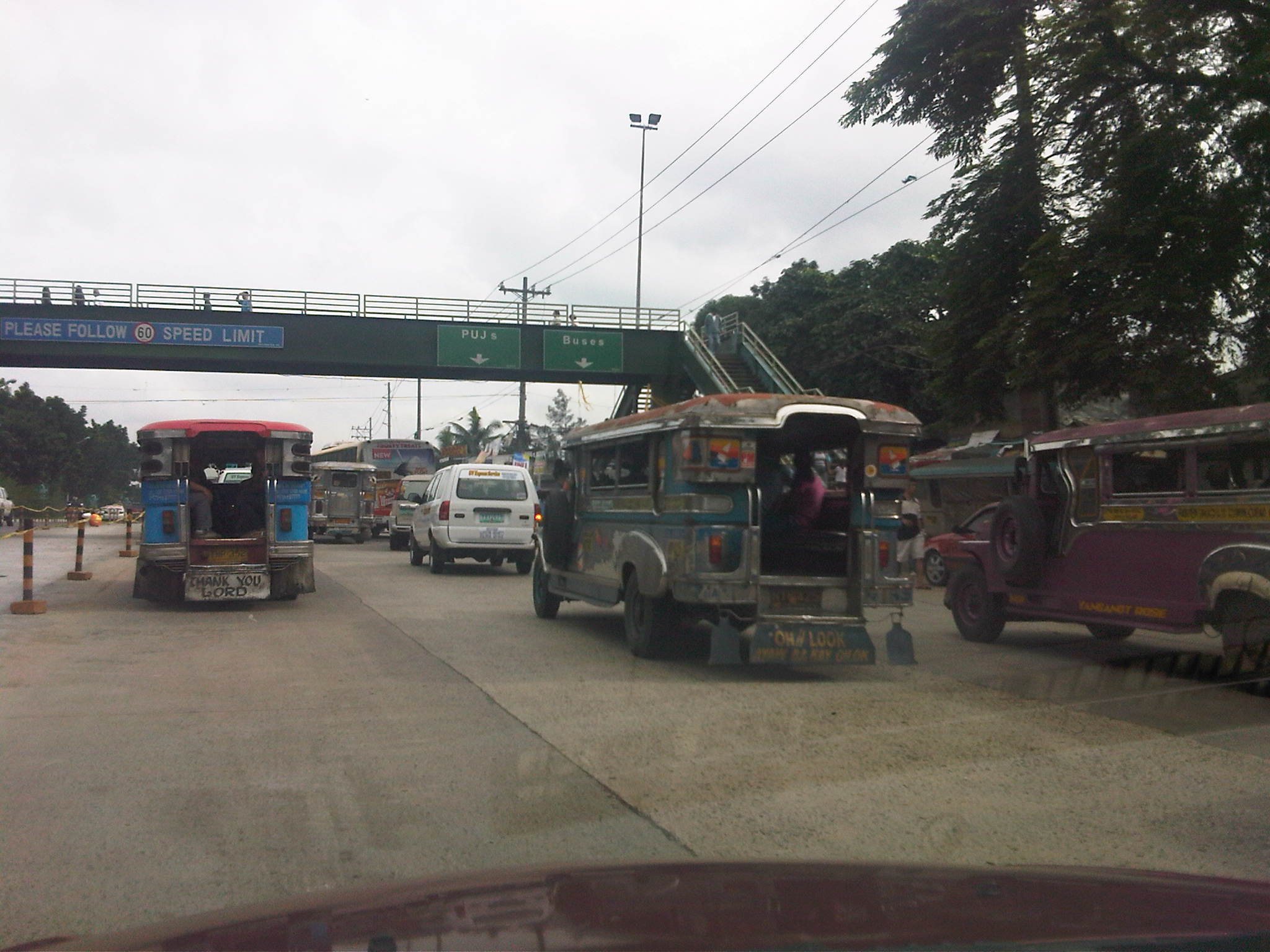 Overpass after Fairview Market and across densely populated areas that are mostly informal settlements. Jeepneys and buses usually congregate under this overpass and another downstream which is across from the Sandiganbayan. The bollards to the left are to segregate a lane with recently laid concrete (re-blocking of certain lanes along Commonwealth).
 Overpass across Ever Commonwealth where vendors have also set up to sell merchandise. The design evokes those of old steel truss bridges in Manila across the Pasig River like the Quezon and Ayala Bridges. Notice the congestion at the overpass at the left portion of the photo.
 Overpass across Tandang Sora where the middle portion descends under the T. Sora flyover in an unusual design that calls to mind the adjustments made for pedestrian facilities constructed across EDSA, and above or below the MRT3 alignment. Notice the countdown timer for the signals at this major intersection.
 Overpass across AIT and CHK of UP Diliman. The canopy is one of two set up atop the overpass for MMDA personnel taking random speed samples to enforce the 60 kph speed limits along Commonwealth. On most days I travel along Commonwealth, there is usually no one taking measuring speed along the NB direction of the highway.
The overpass across the UP Technohub is relatively new but it is free from vendors. In fact, the two overpasses across UP are free from vendors and are regarded as safe and secure because of guards (and even MMDA enforcers) posted at the overpasses to ensure the safety of users of the facilities, especially students and employees of UP and of the Technohub. However, the Philcoa overpass continues to be occupied by vendors despite its roof being removed by the MMDA a few years ago with reasoning that this would deter vendors from setting up atop the overpass.
The problem of vendors on the overpasses is an enduring issue and one that is quite easy to solve if authorities are serious about addressing it. In fact, it is so easy for enforcers or police to prevent or even apprehend/accost vendors as frequent as the latter attempt to set up on the overpass. The continued presence of vendors suggest that there is no sustained effort against these vendors. There are those who even suspect (and are perhaps correct in certain cases) that enforcers or police are being paid to turn a blind eye to these vendors. This is a story that is replicated in many parts of Metro Manila as well as in other cities across the country where overpasses become small time malls or shopping streets, thereby defeating the purpose of having these facilities in the first place. The challenge is for local government units to do what is right in such cases if only to ensure that facilities for pedestrians are safe, secure and unimpeded for efficient flow.
 Caught (up) in traffic
