
Home » Land use (Page 7)
Category Archives: Land use
On re-designing or re-imagining our transportation system for people
Here is another good read especially for those who advocate or even just beginning to appreciate the concept of people-oriented transportation:
VannPashak, J. (2018) “Design for humans as they are, not as you want them to be,” http://www.medium.com, https://medium.com/@jvannpashak/design-for-humans-as-they-are-not-as-you-want-them-to-be-ef95076c0988 [Last accessed: 11/23/2018].
In a recent symposium where I made a presentation about low carbon transport and visioning and re-imagining transport, I was asked how we can re-design our transportation to be more people-oriented than car-oriented. I replied that we have to do a lot of unlearning. That is, many planners and engineers would need to unlearn many things they’ve learned in school and those they got from their workplace. One convenient excuse for not coming up with a better design, for example, is that certain planners or engineers just followed what their offices or agencies have been doing. What if what their offices and agencies (and consequently their seniors at work) where wrong all these years and what was “ginagawa na” or “nakasanayan” have led to deficient outcomes? I even joked about whether these offices or agencies were “open minded” referring to a favourite by-line by networking companies. Being open-minded in the context of having people-oriented transport solutions would be difficult if everything was “nakakahon” because these were what you learned from school and/or the workplace. It is difficult to admit that something was and is wrong.
–
Article on housing and transportation
Here’s another excellent piece from Todd Litman about the dynamics of housing and transportation. This is a very relevant topic in many cities today and especially so for those like Metro Manila, which is struggling with issues pertaining to affordable housing and transportation infrastructure and services. Arguably, a lot of households are spending more than the 45% threshold of incomes mentioned in the article but people continue to get homes away from the city as these are relatively cheaper than those closer to their workplaces and schools. Unfortunately, transportation costs are on the rise and congestion and a lack of an efficient transport system are among the culprits for what many have already labelled as undignified and atrocious costs of commuting.
Litman, T. (2018) “Affordability Trade-Offs,” planetizen.com, https://www.planetizen.com/node/99920?utm_source=newswire&utm_medium=email&utm_campaign=news-08092018&mc_cid=e2a69b6eb4&mc_eid=9ccfe464b1 [Last accessed: 8/9/2018]
I envy the guy for being able to present these topics clearly. It is a complex subject and one that isn’t understood by many in government who are supposed to be responsible for crafting and implementing policies and programs to address issues pertaining to affordable housing and commutes. I wonder if Todd is coming over for the ADB Transport Forum. He’s make for a good resource person in some of the sessions there and perhaps can also be invited to speak about this and other relevant and urgent topics in a separate forum. Anyone out there care to sponsor him?
–
On EDSA transport and traffic, again
There’s a recent decision by the Metro Manila Council (MMC) comprised of the mayors of the cities and municipality of Metro Manila and chaired by the Metro Manila Development Authority (MMDA) Chair that vehicles bearing only one passenger (the driver) will be banned from travelling along EDSA. The problem with this is that by banning cars with one passenger from EDSA, you only succeed in making other roads like C5 more congested. It’s a simple case of transferring traffic and worsening it elsewhere since you’re not doing anything to alleviate congestion along those roads. Did MMDA run this and other scenarios using analytical or simulation tools at their disposal? If so, can these be shown and used to explain the soundness of this policy approved by the MMC? I suspect they didn’t and likely depended more on gut feel based on the data they have including what is often reported as 70% of vehicles traveling along EDSA having only one passenger. Meanwhile, the state of mass transit along EDSA still sucks.
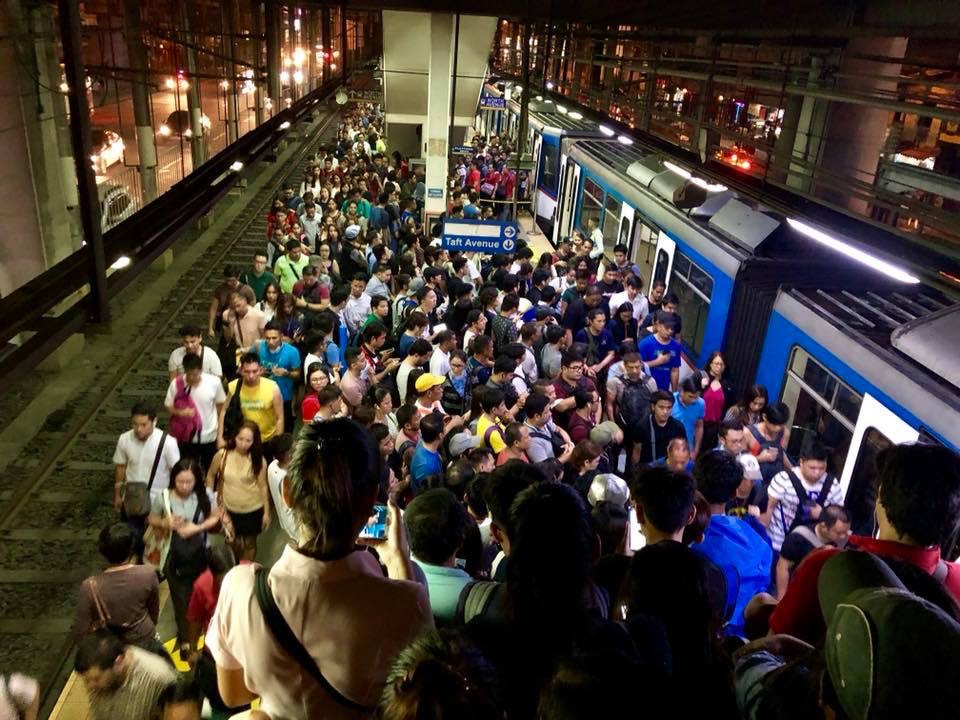 A very crowded Boni Avenue Station platform (photo courtesy of Mr. Raul Vibal)
Of course, the pronouncement from the MMDA launched quite a lot of memes on social media. Some people shared the typical quotes on planning (you know, like the ones about planning for people vs. planning for cars). Some offered their own ideas about how to “solve” traffic along EDSA. And so on…that only succeeded in showing how everyone had an opinion about transport and traffic. Everyone is an expert, so it seems.
Some thoughts and not in any order:
- The government can initially dedicate a lane each for express buses (a la Bus Rapid Transit or BRT). This idea has been circulating for quite some time now and has a good chance of succeeding. The DOTr is already deploying buses that they say are supplementing the MRT 3 trains (i.e., there aren’t enough trains running so passengers have the option of taking a bus instead). Running along the inner lanes of EDSA would mean, however, that they would have to find a way for passengers to cross the road and one idea would be for the stations to be retrofitted for this purpose.
- Those cars along EDSA are not necessarily for short trips so walking and cycling while needing space may have less impact in the immediate term for such a corridor. In the meantime, serious consideration should be made for bike lanes whether on the ground or elevated and improvements to walking spaces.
- But these efforts to improve passenger (and freight) flows should be a network-wide thing and not just along EDSA.
- It’s time to have serious discussions and perhaps simulations (even a dry run) of congestion pricing in Metro Manila. Congestion pricing for all major roads and not just one or two. Funds collected goes to mass transit, walkways and bikeways development. DOTr was supposed to have already discussed an Electronic Road Pricing (ERP) system like Singapore’s with the company and people behind the same in the city-state. That doesn’t seem to be moving along.
- Working and studying from home might work in terms of reducing vehicular traffic but then we generally have lousy internet services so that’s a barrier that needs to be broken down.
- How about legalizing, once and for all, motorcycle taxis? Many are opposed to this citing safety concerns but then we are running out of options outside the usual motherhood statements pertaining to building transport infrastructure. Think about it. Give it a chance. These motorcycles might just surprise us in a nice way; that is, helping alleviate congestion.
- Carpooling and lanes dedicated to High Occupancy Vehicles (HOV) would be good but the LTFRB made a pronouncement about these being illegal as they would be considered ‘colorum’. Such statements do not make the situation any easier and sends mixed signals as to the government’s being serious in considering all possible angles to improve transport and traffic particularly for commuting.
Do you have other ideas to share?
–
On healthier cities and encouraging walking
It’s a Sunday and the sun is up after days of rain so it would be a good time to be outdoors. Here is a nice article for the fitness buffs out there. Many of us have sedentary lifestyles and this has come as no surprise with the how we work and study as well as the influence of tech in our everyday activities. Even as I write this, I am sitting in front of my desk and have only my fingers and hands working. The rest of me is inactive except perhaps my senses and my brain. 🙂
Merle, A. (2018) “The Healthiest People in the World Don’t Go to the Gym,” medium.com, https://medium.com/s/story/the-healthiest-people-in-the-world-dont-go-to-the-gym-d3eb6bb1e7d0 [Last accessed: 8/1/2018].
I miss the times when I was living in Japan and when we were living in Singapore mainly because I was able to have a more active lifestyle in the cities where I lived. I walked and biked a lot when I was in Yokohama, Tokyo and Saitama, and later walked a lot around Singapore. I/we didn’t need a car as the public transportation was excellent and so were the pedestrian infrastructure. I recall walking between our laboratory at Yokohama National University and the dormitory, and later the Sotetsu Line Kami-Hoshikawa Station almost everyday. And then climbing up and down the hills of Yamate on Sundays. I can walk around Tokyo on my own and finding my way through shopping streets especially in Akihabara and Ueno. Of course, my favourite places would always include Kamakura, which can be reached via a train ride from Yokohama Station. The wife and I loved walking around Singapore and exploring places on foot. Indeed, you can be healthy and have a workout everyday without being too conscious about it!
–
On the future of city streets
Here is another article, this time on the future of city streets. I had been sharing many of the ideas related in the article in the Transportation Engineering courses that I handle including those pertaining to the Complete Streets concept and road diets. The article is good reading material for my students who need to get out of the box (so to speak) of traditional civil engineering thinking regarding highways and streets. That is, we need to do more people-centred rather than car-centric designs.
Davidson, J. (2018) “What Is a City Street? And What Will It Become?”. New York Magazine. http://nymag.com/daily/intelligencer/2018/01/what-is-a-city-street-and-what-will-it-become.html [Last accessed: 2/2/2018].
Here is a photo I took in Iloilo City a couple of years ago showing the bikeway along the Diversion Road. The facility then was underutilized but was supposed to represent, along with the Promenade along the river and the redevelopment of the old airport site in Mandurriao, the revitalisation of the city. Meanwhile, there have been little done for the downtown streets.

Iloilo City provides a good example of the need to have a more holistic transformation rather than have some exhibition or demonstration pieces for inclusive transport here and there.
–
Some recommended references for sustainable transportation design
We conclude the month of October with the following recommended readings:
- Designing Walkable Urban Thoroughfares: A Context Sensitive Approach, An ITE Recommended Practice, 2010
- Model Design Manual for Living Streets, 2011
- Smart Transportation Guidebook, Planning and Designing Highways and Streets that Support Sustainable and Livable Communities, 2008
While these are guidelines and manuals developed and published in the United States, the principles and much of the content and context are very much applicable here.
As an additional reference, here is the latest version of functional classifications for streets that is supposed to be context-sensitive:
- Stamatiadis, N., A. Kirk, D. Hartman, J. Jasper, S. Wright, M. King, and R. Chellman. 2017. An Expanded Functional Classification System for Highways and Streets. Pre- publication draft of NCHRP Research Report 855. Transportation Research Board, Washington, D.C.
–
Public transport’s importance to a city
I found an “old” article on public transportation and its importance to cities:
Public Transport is Worth Way More to a City Than you Might Think, [by Eric Jaffe in http://www.citylab.com, August 14, 2013]
While much attention has been on walking and cycling, which are essential modes of transport, I believe public transport has an even much more value especially given the land use in many cities. This is particularly true in the Philippines where land use planning is basically a term since implementation is generally weak. This is very much evident in the case of residential development and the limited choices for transport. Many people, for example, reside in the periphery of Metro Manila and its surrounding areas. They often commute over long distances and incur long travel times due to congestion roads. Mass transit infrastructure could have made commutes faster, saving precious time that translates into economic value.
–
New ruralism, anyone?
I found this interesting article that tackles what to me is a new concept although it shouldn’t be. The concept of new ruralism to me is somewhat going back to the basics. While urbanization seems to be an unstoppable force, there is still the need to preserve rural areas and also the way of life as well as the industries that we need to sustain urban living. Food production, for example, is something that is being advocated or promoted in urban areas but hasn’t really caught on. Farming seems to have lost a lot of people as it is perceived as backward and yet it is essential.
New Ruralism: Solutions for Struggling Small Towns [by Jared Green in The Dirt, June 14, 2017]
What do you think about this concept of new ruralism? Is it something that’s also applicable to the Philippines or is will it be just a fad?
–
List of infrastructure projects for the Philippines’ BuildBuildBuild initiative
I was looking for a list of projects said to be prioritized by the current administration in the Philippines and mentioned in the presentation made by government yesterday. Here’s one I found from GMA News:
Infrastructure projects lined up by the Duterte administration
Noticeable for me are the following:
1. No mention of major bridge projects that were heavily hyped both on mainstream and social media – these bridges include those that were proposed to connect the islands of Panay and Negros, Negros and Cebu, and Cebu and Bohol. It doesn’t mean, of course, that these have been abandoned but likely only sidelined for the moment.
2. Break-up of Clark Green City into several components – this seems to be a more realistic approach especially considering how big and complex this project is, and how many agencies or entities are and will be involved
3. Mass transit projects in Metro Manila – these include big ticket projects such as the proposed subway, BRT and the rehabilitation of PNR lines. These are all projects that should have been done a long time ago but for various reasons have been delayed. Say what you will about so much resources being poured into Metro (Mega?) Manila but it is the economic center of the country and efficient transport will go a long way in generating resources that can eventually be used in other parts of the country.
4. Emphasis on Clark Airport – it seems to me that the current administration is focused on developing Clark as the alternative (if not the main) gateway to the greater capital region. This is a departure from the hype we have received about a replacement for NAIA including one that was proposed at Sangley Point in Cavite.
5. Scaling down of Mindanao Railways – instead of pushing for a much grander (and unrealistic I think) railway project for the entire island, they identified a more realistic and perhaps practical line connecting Tagum, Davao and Digos. One colleague noted, however, that this corridor is already heavily serviced by buses and vans so rail ridership is at best threatened from the start.
What’s your take on the proposed projects and the list in general?
–
The Tagaytay transportation predicament
The title of this article is actually a bit tame and on the diplomatic side of trying to describe transportation and traffic in this city that was once relaxed a retreat for many. I had wanted to end February on a good note and so I decided to defer posting this until March.
We used to frequent Tagaytay and liked spending some rest and recreation time there to the tune of being there almost once a month at one time. Needless to say, at the time travel to Tagaytay from our home in Antipolo took us only about 2 to 2.5 hours excluding our usual stop at Paseo in Sta. Rosa, Laguna. We liked the city so much that we even considered making it a second home; even inquiring and looking at properties there.
Fast forward to the present and it has become an excruciating travel with the highways leading to the city already congested. It didn’t help that when you got there, you also had to deal with serious traffic congestion. This started not a few years ago when the city approved developments by major players including Robinsons, SM and Ayala. The developments by SM and Ayala proved to be the backbreakers with Ayala coming up with the first mall in the city and SM operating an amusement park beside its prime acquisition that is the Taal Vista Hotel. Now, there is another mall under construction by Filinvest and right at the corner of the rotonda where the Aguinaldo Highway terminates.
 Vehicles queue along the Tagaytay – Nasugbu Highway towards the Rotonda where Tagaytay traffic enforcers attempt to manage traffic but appear to create more congestion instead.
More on Tagaytay soon…
–
 Caught (up) in traffic