
Home » Mode Share (Page 3)
Category Archives: Mode Share
To B(RT) or not to B(RT)?
I kind of expected questions or comments from my ‘students’ after my lecture last Wednesday about “Traffic Congestion.” Among my slides were those featuring solutions to transport and traffic problems. I presented both soft and hard approaches including travel demand management schemes and infrastructure that we should have built decades ago. The uniformed officers who were there had a very simple take on congestion – it’s basically because of a lack of discipline. While theirs may also be valid observations based on their experiences, ‘discipline’ is not the most critical problem that we have especially considering the ever increasing demand for travel. One government official present was very direct in his question about what I thought about the MMDA’s pronouncement that they plan to remove the EDSA Bus Carousel. I thought my reply and the following explanation was clear – it was a wrong move.
The EDSA Bus Carousel is simple. Bus lang sa bus lane (Only buses along the bus lane). Pag may private or pa-VIP, bawal at huli dapat (If there are private vehicles or those who regard themselves as VIPs using the lane, then they should be apprehended. An HOV (high occupancy vehicle) lane is more difficult to implement. Mas pahirapan ang pag monitor and enforce (It is very difficult to monitor and enforce). So this proposal to phase out the EDSA bus lanes don’t make sense from this perspective. In fact, I don’t agree with a couple of more senior transport experts who say that the MRT Line 3 is sufficient and that it hadn’t reached capacity yet. It has but in the time that the carousel has been operational, the carousel had absorbed much of the demand along the corridor. There is also the fact that it will take much time before Line 3 is upgraded. Are the new train sets here? Are the stations designed for these trains and more passengers? If the answers are no, then MRT3 will not have its capacity increased in such a short time. That also means the carousel is very much relevant not just to supplement MRT3 capacity but as a needed alternative mode for commuters.
–
Planning for True Transportation Affordability: Beyond Common Misconceptions
How much do we spend on transportation as part of our budgets? Is it 5% of your monthly budget? Is it 10%? Or is it eating up a substantial part of what you’re earning?
Source: Planning for True Transportation Affordability: Beyond Common Misconceptions
To quote from the article:
“This research indicates that many common policies favor expensive transportation and housing over lower-cost alternatives, which drives the cost of living beyond what is affordable, leaving too little money to purchase other necessities. The result is immiseration: growing stress, unhappiness, and discontent.
The solution is simple: planning should favor affordable over expensive modes and compact development over sprawl. This is not to suggest that automobile travel is bad and should be eliminated. Many people are justifiably proud of being able to afford a nice car, and automobiles are the most efficient option for some trips. However, automobile travel requires far more resources and is far more expensive than other modes, typically by an order of magnitude, so true affordability requires an efficient, multimodal transportation system that allows travelers to choose the options that truly reflect their needs and preferences.
Affordability requires a new economic paradigm; rather than trying to increase incomes or subsidies we need to increase affordability and efficiency so households can satisfy their basic needs consuming fewer resources and spending less money. Our planning should be guided by a new goal: how can we help families be poor but happy.”
I share this article because it provides a more complete narrative and assessment than those just focusing on transport. Home choice locations and affordable housing are part of the equation. Looking at transport alone can be myopic and leads us to think it is the only problem to solve.
–
Are transportation issues election issues in the Philippines?
Are transportation issues in the Philippines? Or are these issues at the local level? Here is an article about how transportation issues were brought to light and were actual topics in the ballot in Los Angele, California in the US:
Tu, M. (November 25, 2024 ) “Bike, Bus and Pedestrian Improvements Won the Vote in L.A. How Did Advocates Pull It Off? “ Next City, https://nextcity.org/urbanist-news/bike-bus-pedestrian-improvements-healthy-streets-los-angeles-ballot?utm_source=Next+City+Newsletter&utm_campaign=532838ef65-DailyNL_2024_11_18_COPY_01&utm_medium=email&utm_term=0_fcee5bf7a0-532838ef65-44383929 [Last accessed: 11/26/2024]
The three lessons in the article are:
- Build a coalition – “In the lead-up to the election in March, Streets For All successfully secured endorsements from unions, climate organizations and business groups that saw the vision for safer streets.”
- Safety wins – “We could make climate arguments, we could make equity arguments, but the thing that felt the most bulletproof to us and the most empathetic to the general Angeleno was just road safety,”
- Keep it simple – “…simple messages were the most effective. Vredevoogd fought for one billboard on Vermont Avenue that read “In 2022, more pedestrians died on Vermont Avenue than in the state of Vermont.”
Los Angeles or LA as many people fondly call the city is well known for being car-centric (as opposed to San Francisco to the north, which is more transit-oriented). Perhaps we can learn from this experience though I know there are already groups and coalitions lobbying for better transportation in the Philippines. Are they successful and to what extent are they succeeding? Granted there are different situations and conditions, even modalities, to engage politicians, there are also so-called party list groups claiming to represent the transport sector but none appear to be really standing up for issues like improving public transport or road safety. And so the challenge is still there for people to make transportation issues election issues in the country.
–
On the general benefits of public transportation
Here’s another good read that has links to the outcomes of studies pertaining to public transportation’s direct and indirect effects on vehicle miles traveled or VMT (in our case we use vehicle kilometers traveled or VKT):
McCahill, C. (November 12, 2024) “The benefits of transit extend well beyond transit riders,” State Smart Transportation Initiative, https://ssti.us/2024/11/12/the-benefits-of-transit-extend-well-beyond-transit-riders/ [Last accessed: 11/20/2024]
To quote from the article:
“…good transit has a ripple effect on land use and travel behavior. For every mile not driven by transit riders, transit accounts for another six to nine miles not driven among the larger population. “
Note the potential reduction in VKT’s attributed to mass transportation or transit.
–
On whether bike lanes cause more traffic congestion
I previously share articles on whether bike lanes cause more traffic. This question has been asked so often as we have returned to the “old normal” levels of traffic and bike lanes that were put up during the pandemic have been neglected or removed in favor of motor vehicle traffic. The perception for those in-charge of traffic and transportation in local government units is that the space occupied by bike lanes take up the space demanded by motor vehicle use. Thus, the view that bike lanes cause congestion. Here is another article share in support of bike lanes:
Mortillaro, N. (October, 2024) “Do bike lanes really cause more traffic congestion? Here’s what the research says,” cbc.ca, https://www.cbc.ca/news/science/bike-lanes-impacts-1.7358319 [Last accessed: 01/11/2024]
To quote from the article:
“One would think that building more roads with more lanes for cars would reduce congestion, but research shows that’s not the case, thanks to something called induced demand. The more traffic lanes that are put in, the more it appeals to people who may not otherwise have chosen to drive, thereby putting more cars on the roads and increasing congestion.
“So for a short period of time, there might be a slightly improved [reduction], but within a year or two, or perhaps three, traffic is as bad or worse than it was before the lanes were added in the first place,” said David Beitel, data services lead at Eco-Counter, a Montreal company that collects and analyzes pedestrian and bicycle traffic data.
Conversely, if you put in more dedicated bike lanes, people tend to feel safer and demand for use increases, said Shoshanna Saxe, an associate professor at the University of Toronto’s department of civil and mineral engineering and Canada Research Chair in sustainable infrastructure.
“As soon as you build a bike lane, within a year, two years, the latent demand shows up,” she said.
Bike Share Toronto statistics show that ridership on its network of shared bikes has increased dramatically since 2015, when 665,000 bike trips were made annually. In 2023, that shot up to 5.7 million trips.”
I think many people here are already aware of the concept of induced demand. However, this is usually shrugged aside as realities in their situations (e.g., commuting options, locations of residences and workplaces, etc.) lead them to choosing private vehicles (i.e., cars and motorcycles) over public or active transport. The last paragraph there is significant though as there never was and so far a decent estimate of bike trips in any city in the Philippines. Granted that there are attempts to measure bike trips but the volumes published so far are not as reliable as we want them to be in order to be convincing decision-makers to put up more bike lanes. Of course, the convincing part is always challenging if decision-makers have already made up their minds in favor of the car.
–
Sharing the road with persons with disabilities
The wife took this photo as we were turning at the roundabout at Tikling Junction in Taytay, Rizal. I just wanted to share this here for everyone’s awareness that there are those of us traveling who have certain disabilities that may not be so obvious. We probably see people on wheelchairs or special vehicles like those you’d find along Cainta roads especially near or in the vicinity of Tahanang Walang Hagdanan. And then there are those with PWD stickers on their motor vehicles. But are we aware and sensitive to the needs of others like this deaf cyclist? There should be policies to ensure their safety as they should be able to travel for whatever purpose they may have similar to our senior citizens and children who are among the most vulnerable road users. And drivers and riders should have the training and the empathy to share the road with them.
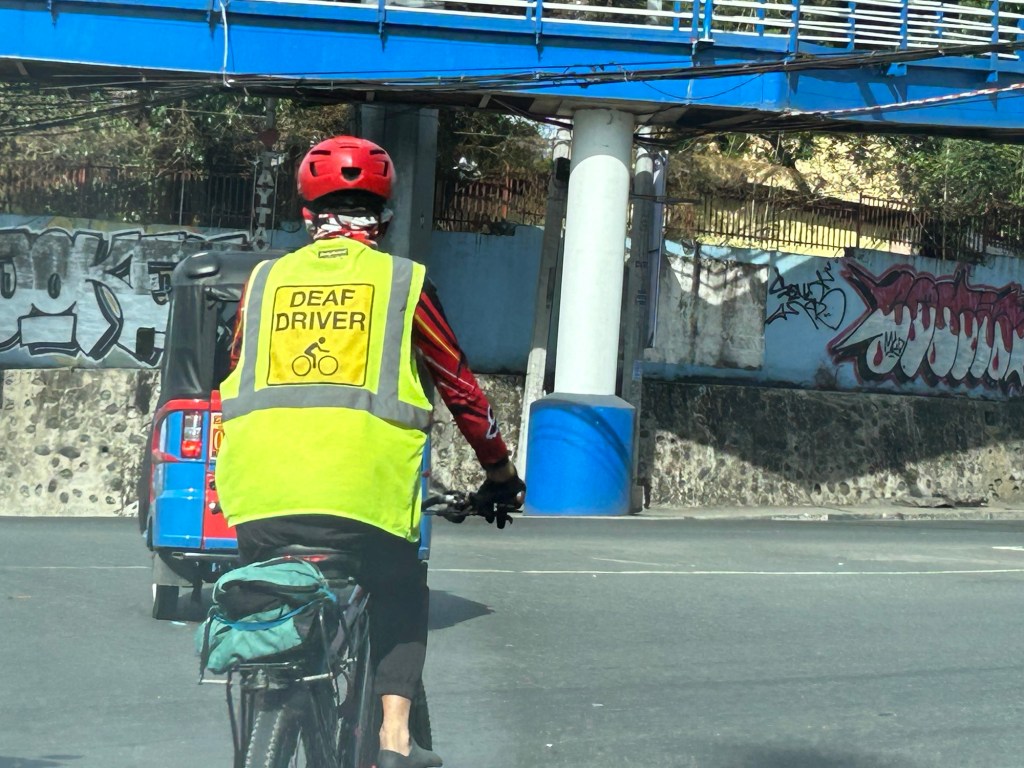 Deaf rider along Tikling Junction, Taytay, Rizal – not all would probably have a vest like this and motorists likely would be oblivious to their situation. There will also be pedestrians with similar circumstances who have natural disabilities. Irresponsible would those who are “deafened” by their gadgets like those wearing earphones or headphones while riding or walking.
 –
Is the MMDA’s coding scheme still effective?
That’s actually a title of a paper or article I co-wrote before. At the time, which was over a decade ago, we were revisiting certain travel demand management (TDM) measures being implemented in Metro Manila. We already concluded that the effectiveness of the number coding scheme has been reduced mainly as people bought a second, third or more vehicles to be able to use any vehicle on coding days.
Since then, coding’s effectiveness continued to be eroded by a combination of increasing vehicle ownership (including more vehicles operating as ride hails) and the rapid increase of motorcycles.
More recently, government decided to give push for electric and hybrid vehicles. The MMDA made these coding exempt, which perhaps is an example of instituting a policy with unintended consequences. I say unintended here because the agency seems oblivious to the fact that people will likely get that second, third or more vehicle. And that will be an EV or hybrid. Manufacturers are already marketing these as ‘coding exempt’ and they are making a good sales pitch here.
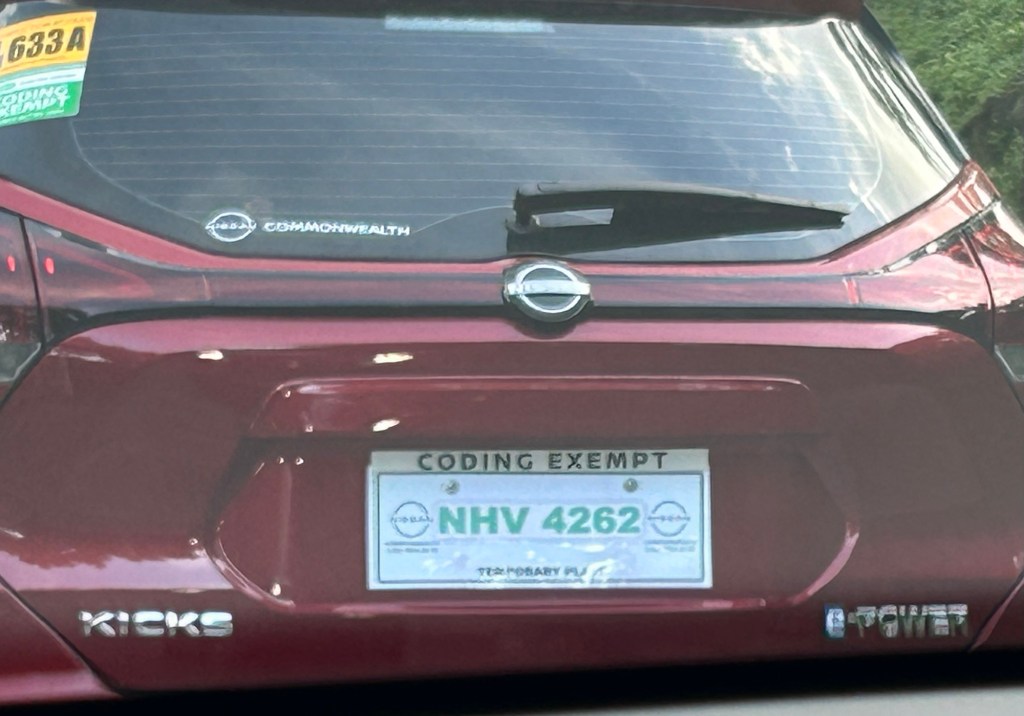
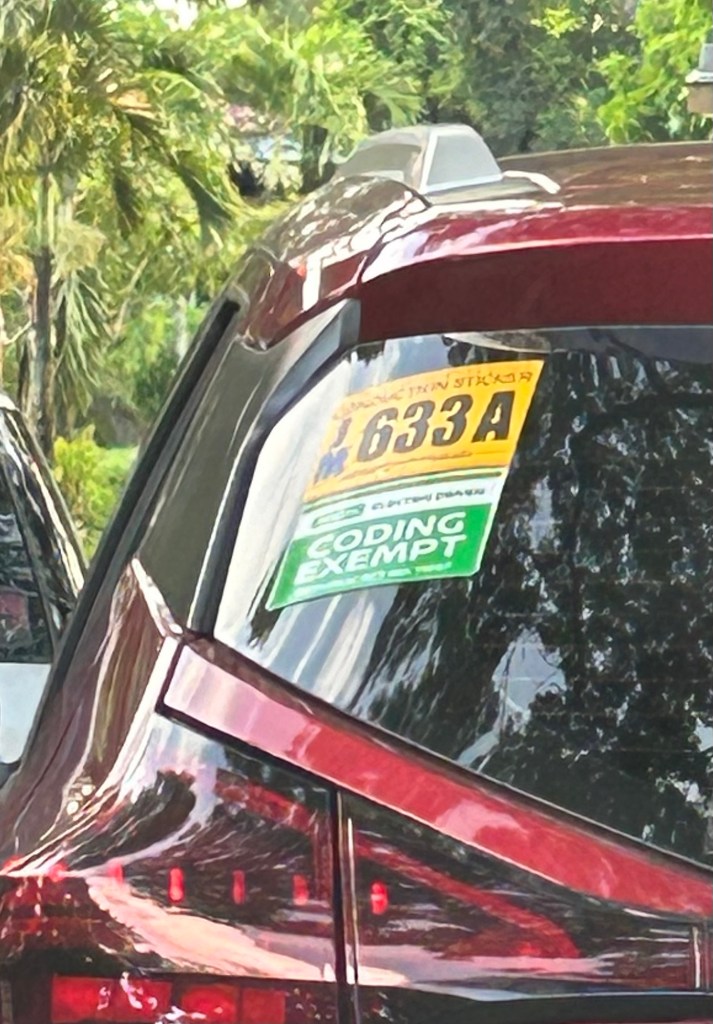
Maybe it’s time to revisit coding and re formulate it? But then coding wasn’t supposed to be sustained as long as it has. Government should be more aggressive and decisive for public transport in order to retain and increase mode shares that have also been reduced by more private vehicle and motorcycle use.
–
Increase in parking rates at NAIA
A friend shared this notice about the increase in parking rates at NAIA.
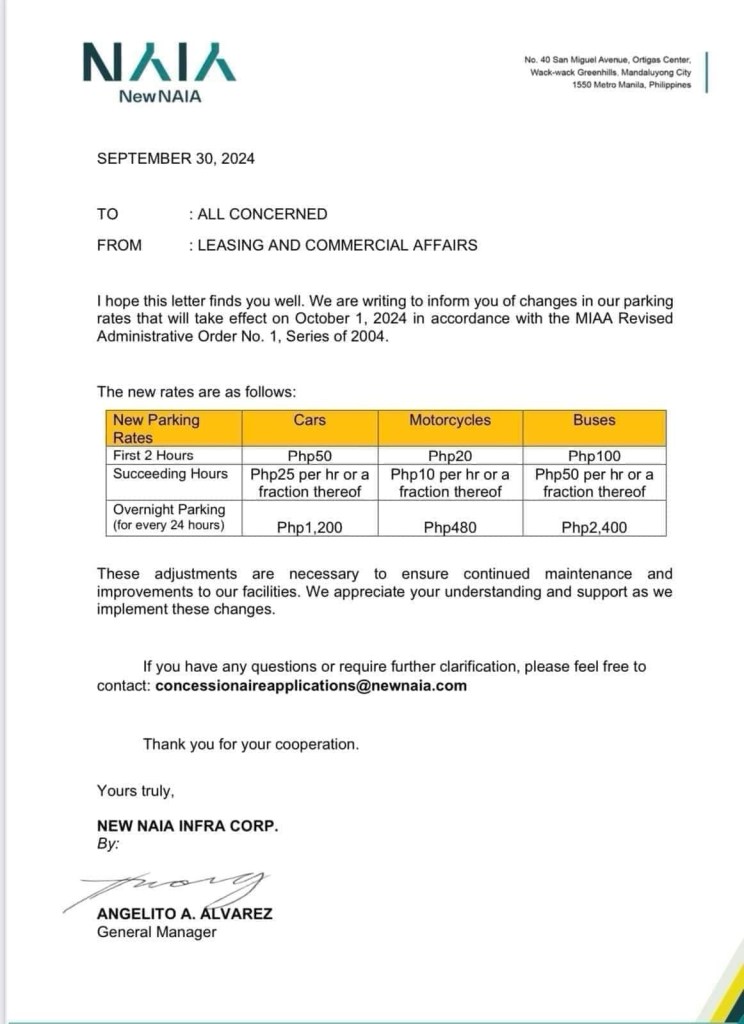
Parking at any of the terminals has been quite difficult if not horrendous. Everyone seems to be bringing their car to the airport for pick up and drop offs as well as leaving them for a night or more while traveling abroad or somewhere in the country. And then there are those who park there because the rates are supposed to be cheaper than the hotels and mall around the airport (e.g., the case of Terminal 3). Will the increase in the rates discourage unwanted or unnecessary parking? Perhaps not because people are still quite dependent on cars as their primary mode in and out of NAIA.
Access to the airport remains road-dependent. Granted there are many options like ride hailing, airport bus and taxis, these are all road based. They share the same roads that are often congested. The tollways are not enough to ease traffic in the area, which aside from airport generated trips include those from offices and industries in the area.
Too long has the need for a rail access for the terminals and government has failed to provide it. It would at least have engaged private sector for this provision but it took so long. Perhaps the Metro Manila subway will change that but we have to wait a long while to find out.
–
On congestion due to school drop-offs
I found this rather interesting article about congestion at school drop-offs in the US:
Hurley, K. (September 16, 2024) “How School Drop-Off Became a Nightmare,” The Atlantic, https://www.theatlantic.com/family/archive/2024/09/school-drop-off-cars-chaos/679869/?utm_source=copy-link&utm_medium=social&utm_campaign=share [Last accessed: 9/26/2024]
To quote from the article:
“Today, more parents in the United States drive kids to school than ever, making up more than 10 percent of rush-hour traffic. The result is mayhem that draws ire from many groups. For families, the long waits are at best a stressful time suck and at worst a work disruptor. Some city planners take the car line as proof of our failure to create the kind of people-centered neighborhoods families thrive in. Climate scientists might consider it a nitrogen-oxide-drenched environmental disaster. Scolds might rail at what they see as helicopter parents chaperoning their kids everywhere. Some pediatricians might point out the health threats: sedentary children breathing fumes or at risk of being hit by a car.”
The situation described in the article is actually already happening for quite a long time now in the Philippines and mostly at private schools. You have the same issues with the traffic congestion and road safety risks faced by schoolchildren in schools like Ateneo and LaSalle. The more ‘elite’ public schools like the science high schools may also have similar concerns. Can these be really addressed at the local level or is there a deeper, more complicated problem that needs to be tackled here (just to clarify that my questions are for our case here in the Philippines and not in the US)?
–
On ride hailing replacing more sustainable options for transport
We’ve long suspected that ride hailing or ride sharing is not as sustainable as their proponents and companies would project them to be. Here is more evidence showing how ride hailing has diminished other more sustainable transport options.
Kerlin, K. (August 28, 2024) “Half of Uber, Lyft Trips Replace More Sustainable Options,” UC Davis News, https://www.ucdavis.edu/news/half-uber-lyft-trips-replace-more-sustainable-options [Last accessed: 9/8/2024]
Quoting from the article:
“About 47% of the trips replaced a public transit, carpool, walking or cycling trip. An additional 5.8% of trips represented “induced travel,” meaning the person would not have made the trip were an Uber or Lyft unavailable. This suggests ride-hailing often tends to replace most sustainable transportation modes and leads to additional vehicle miles traveled. “
The article and the study by UC Davis is limited to their experiences with Uber and Lyft and perhaps others that employ cars. In our case, we have in addition motorcycle taxis or habal-habal that further takes away passengers from public and active transportation. Motorcycle taxis provide a very attractive alternative to conventional public transport modes as these are perceived to reduce travel times among other advantages they provide to users.
I will share some information later about the current mode shares in Metro Manila and how drastically public transport mode shares have been eroded post pandemic.
–
 Caught (up) in traffic