
Home » Motorcycles (Page 5)
Category Archives: Motorcycles
The other TNCs – Wunder and Angkas
The Land Transportation Franchising & Regulatory Board (LTFRB) recently issued a couple of press releases pertaining to two Transport Network Companies (TNCs). The issuances were for Wunder and Angkas to cease operations. Copies of the press releases were posted at the Department of Transportation (DOTr) Facebook page and are reproduced here:


Prior to these press releases, both Angkas and Wunder have been aggressively promoting themselves in social media. Wunder is the more established entity and is actually based in Germany. Its operations are basically carpooling and match drivers with passengers traveling about the same time and along their likely routes between homes and workplaces/schools.
Angkas appears to be a locally developed app. The big difference here though is that it is for motorcycle taxi services. While it is clear that tricycles (3-wheelers = usually a motorcycle plus a sidecar) used as public transportation are under the jurisdiction of local government units, their operations are governed by national laws. These include tricycles supposedly being banned from operating along national highways. Motorcycle taxis are regulated along the same lines with LGUs having the responsibilities over their operations (refer to my previous posts on habal-habal and Skylab) and are generally tolerated in rural areas where there is a lack of motorized transport services available. As far as the national government is concerned though, motorcycle taxis are prohibited and this is due primarily to safety concerns.

I don’t know where Angkas gets the “professional motor taxi” tag since it is most likely that riders offering their services are not at all trained or experienced to provide public transport services and on a 2-wheeled vehicles. Such operations are risky especially to passengers. Even in countries like Thailand and Vietnam where motorcycle taxis are generally legal, it is established that such transport modes are unsafe with motorcycles being involved in more crashes compared to other vehicles. Motorcycles also have a higher fatality rate compared to other vehicles.
I think Wunder is different and could actually be closer to the classic (or conventional) carpooling idea compared to ridesharing/carsharing leaders Grab and Uber. Wunder clearly states that its aim is to maximize the available seats for the two likely trips people make with their vehicles. These two trips are usually one in the morning (i.e., to the workplace or to school) and another in the afternoon or evening (i.e., to home). As such, the income derived from Wunder is limited to the 2 trips although a driver can maximize income by accepting multiple passengers. In contrast, many (not all) Uber and Grab drivers in the Philippines operate practically the whole day and are basically taxis. I would recommend that the LTFRB look into the operations and business model of Wunder and perhaps reconsider their decision against it.
–
Motorcycles as goods transport
Our study on motorcycle taxis revealed most if not all of these “habal-habal” and “Skylab” being used to transport goods as well. These include agricultural products, food, construction materials, fuel, poultry, and others you would not see your typical courier service motorcycles will carry.
[All photos courtesy of Mr. Sherman Avendano of the National Center for Transportation Studies]
 A motorcycle bearing what appears as goods for or from the market treading a muddy and puddle-full road.
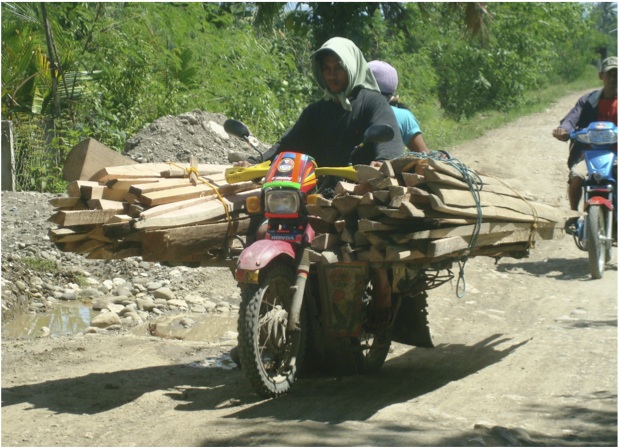 Motorcycle transporting what looks more like lumber than firewood.
 Skylab carrying what looks like 4 sacks of rice.
I was gifted by my wife with a coffee table book she got from one of her trips to Vietnam. The book contains photos of motorcycles in Vietnam being used to transport various goods including furniture, water bottles, crafts and even items like tractor tires, water tanks and roofing. I guess one can also compile a similar set of photos to come up with a Philippine version of that book.
–
Habal-habal in Agusan
The initial part of our research on motorcycle taxis has been completed last December 2016. We are currently drafting a paper for submission to an international conference to be held later this year. The paper contains the outcomes of the surveys undertaken in Surigao Del Sur, Agusan Del Norte and Metro Manila. These include a profile of motorcycle taxi drivers and vehicles that gives us a good idea of how much these people earn and the typical range and loads (passengers and goods) they carry.
Following are photos of motorcycle taxis in Agusan. I won’t post too much detail on the net income of drivers/operators but I guess they earn enough (some even more) given the typical cost of living in these areas where they operate. Motorcycle taxi drivers/operators actually are part of the so-called underground economy where, despite the work and income, people don’t pay their taxes like regular employees or professionals at various workplaces.
[All photos courtesy of Mr. Sherman Avendano of the National Center for Transportation Studies]
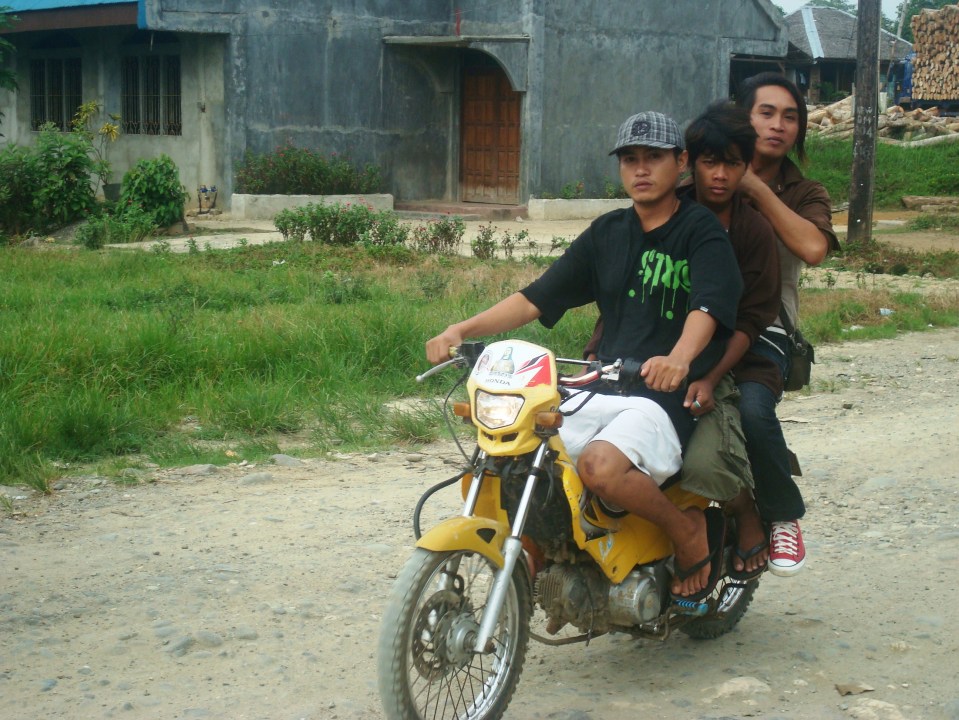 Typical habal-habal with 3 passengers
 “Skylab” with roof – the planks or extensions on either side of the motorcycle are the main features of this motorcycle taxi.
 Typical rural roads in areas served by habal-habal are unpaved. These are muddy during the wet season and dusty during the dry season. As such, it can be a rough ride for those using motorcycles and perhaps even rougher by car.
 Habal-habal passing by a puddle on the road – the passengers are obviously children likely on their way to school based on their uniforms
More on motorcycle taxis soon!
–
Habal-habal in Metro Manila
I posted about our ongoing research on motorcycle taxis. One of our subject areas are Pasig and Taguig in Metro Manila. These would likely represent the urban motorcycle taxi operations that we wanted to document and assess. One terminal I specifically asked our staff to visit as part of the recon/pre-survey activities is located at Pinagbuhatan, Pasig City near where the Pasig River connects with the Laguna de Bay. It is along Circumferential Road 6 and, based on my observation, has transferred locations several times since C-6 was being widened and paved.
 This is the terminal at Pinagbuhatan, Pasig City along C-6 and near the Napindan Ferry Terminal.
 The current terminal stands along what used to be the older C-6 lane. The newer paved section of the widened C-6 is shown in use. It used to be closer to the bridge that crossed the Pasig River and near the Napindan Ferry Terminal.
 The habal-habal riders and operators have an organization and are generally tolerated by the local government. Unlike their provincial “relatives”, they usually only take one passenger seated at the back of the rider. Two passengers are not unusual or irregular especially if one is a child.
I will post about the characteristics of habal-habal operations soon. However, I don’t want to preempt the research we are doing so I would also prefer that we submit our report first and maybe even submit a paper or two for publication before I post them here. Among the things we have obtained so far are video recordings of what its like to ride these motorcycles. We used an action camera mounted on the rider’s helmet for this purpose. Our staff also did a quick interview of the service providers and will be doing a full survey soon to get substantial information for our research.
–
“Semplang” – motorcycle self accidents
There is a Filipino word used for falling by yourself for whatever reason or factor – semplang. The term applies for those riding a bicycle or motorcycle where a person has basically no one to blame but himself/herself for falling. Of course, there will be factors like weather and road conditions. Wet, slippery roads can be very treacherous. So are roads with potholes and/or open manholes. In most cases, however, the rider’s skill more than the other so-called factors that could have affected his movement and balance.
 This is a case of a motorcycle rider losing his balance. I know because this happened as the motorcycle rider made a U-turn right in front of my vehicle at the slot across BF Steel in Cainta.
I am not certain about the condition of the rider in the photo above. While he looked shaken up (surprised?) by the incident, it did not seem to me as if he was moving abnormally (i.e., intoxicated or disabled). Perhaps its his skill that led to this? Such could not have been the case if he had sufficient training and experience and properly licensed to ride a motorcycle. Sadly, a lot of motorcycle riders are not well trained and gain skills only from experience. Yet, there are many who ride like they are stuntmen, often risking their lives and limbs as they maneuver (weave) through traffic.
–
Skylab – motorcycle taxi
We are currently doing research on motorcycles and a major part of the research is on motorcycle taxis. Motorcycle taxis are popular in many areas in the Philippines despite national and local government agencies have not sanctioned or legalized their operations. There are two popular versions of the motorcycle taxis – the habal-habal and the Skylab. Both are basically motorcycles with some add-ons to increase passenger capacity or to be able to carry more goods or cargo.
The habal-habal is carries all passengers or cargo on the motorcycle with some variants having a plank for extension to the back or a customized seat over the gas tank that is usually for children. The Skylab owes its name from the US satellite that fell to the earth in the 1970s. The shape of the satellite inspired innovative extensions along each side of the motorcycle. This enabled riders to take in triple the number of passengers they could with the habal-habal set-up. Both have variants with roofs.
The following video shows a Skylab in Surigao Del Sur care of a very good friend, Dr. Alex Ladaga of Surigao Del Sur State University, whom we are collaborating with in this research:
More on these motorcycle taxis soon!
–
Research topics for transportation engineering and planning for 2016-2017?
I observed from my site’s statistics that there have been a lot of interest on research topics in transportation engineering and planning. I regularly post on the undergraduate research topics our students have engaged in. At this point in the first semester of the current 2016-2017 academic year, topics have not yet been assigned and we have only learned how many students have been assigned to our research group. As such, we are still in the process of determining who takes on which topic. Following are topics we have identified in addition to those that had no takers the previous semesters:
Traffic engineering
- Anatomy of congestion along EDSA
- Anatomy of congestion along C-5
- Segregated lane for motorcycles
- Impacts of the MMDA’s truck lane policy along C-5
- Congestion study in the vicinity of UP Town Center
- Assessment of through traffic for the UP Diliman campus
Public transportation
- Connectivity study for UP AGT and MRT 7
- Feasibility of bus services beyond Masinag junction
- Characterization of Internal Public Transportation Operation in UP Diliman and Viability of Introduction of Electric Vehicles
- Modelling the Public Transport System of UP Diliman Campus Using CUBE Travel Demand Software
- Estimation of Passenger Demand for New Transit System for UP Diliman Using Discrete Choice Model
- Characteristics of motorcycle taxis in the Philippines [Habal-habal, skylab, etc.]
Road safety
- Severity of injuries of motorcycle riders (helmet and non-helmet users)
Pedestrian & non-motorised transport
- A study on walkability along Ortigas Avenue
- A study on the characteristics of bike share users in the UP Diliman campus
Transport & Environment
- Assessment of Roadside Air Quality along C.P. Garcia Avenue in the Vicinity of UP-ICE Compound
Other topics
- Study on the mobility of PWDs in Metro Manila
- Assessment of ridesharing in the context of sustainable transport
I’m sure there are other topics but I’m not aware of the specifics at present. Also, we welcome the ideas of our students should they already have topics in mind as long as these preferably fall under the research agenda of our Institute. The topics listed above may appear to be specific but these are still basically very general and can be refined after the students establish their scope and limitations. They can only do that once they have undertaken a decent enough literature review for them also to have a more firm appreciation of their chosen topics. I will post again on this later this year when students would have already put in substantial work on their research proposals (i.e., the objective for this semester).
–
Mainstreaming e-trikes?
The big news on electric vehicles in the Philippines today is about what the City of Manila has announced as a phaseout of tricycles and pedicabs (i.e., motorized and non-motorized three-wheelers):
Manila will say goodbye to old school tricycles and pedicabs on October 15
According to the article, these will include conventional tricycles, kuligligs (bicycles fitted out with motors or generators + sidecar), and pedicabs. Manila has thousands (about 25,000 according to the article) of these plying roads where they are not supposed to be (tricycles and pedicabs are prohibited by law from traveling along national roads especially as public transportation). From the article, it seems to me that the date mentioned will be the start for a pilot in the Binondo area. No details are given as to how exactly the local government of Manila will be going about replacing 25,000 tricycles, kuligligs and pedicabs with 10,000 e-trikes, including how the e-trikes will be financed and what will happen to the phased out tricycles and pedicabs. We are, however, hopeful that Manila will be successful and perhaps be a model for other LGUs to emulate.
–
Motorcycle lanes along Sumulong Highway?
I noticed something along my commute and that is the newly marked pavement along Sumulong Highway at the section in Barangay Mambugan until Barangay Mayamot at Masinag Junction. I guess this is more likely part of Antipolo City’s initiative in managing motorcycle and tricycle traffic. In a meeting with the City Administrator, Robert Nacianceno, last year, he said that the city was moving towards improving road safety. That included addressing concerns about tricycle and motorcycle operations that has led to crashes and congestion. Motorcycle lanes designated by blue pavement markings are not new and likely was inspired by the MMDA’s initiatives along major roads in Metro Manila.
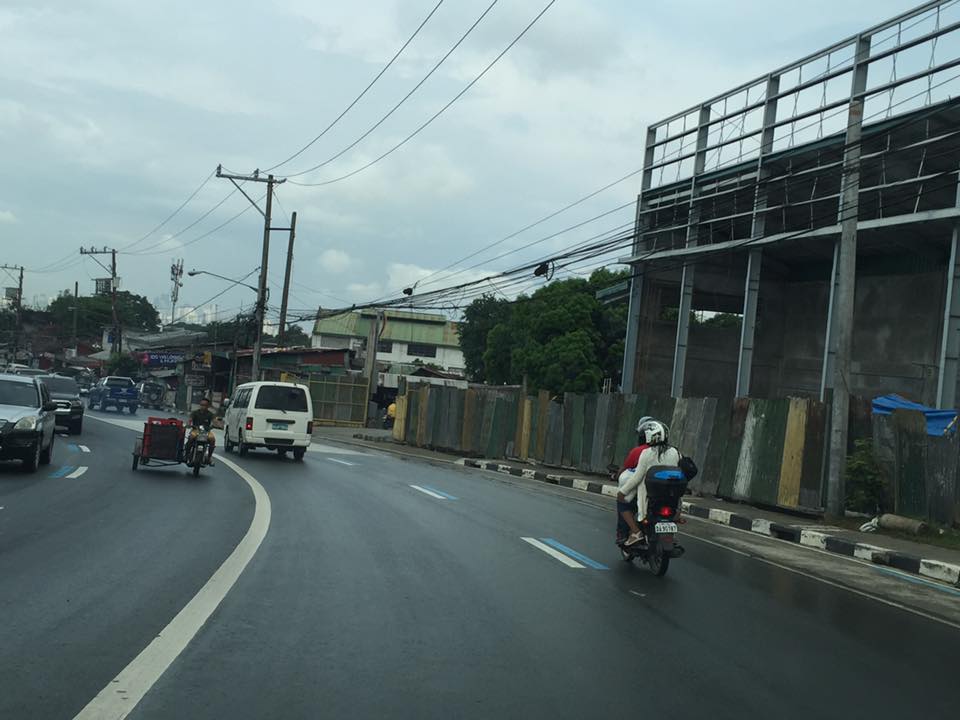 Motorcycle running along the designated lane
 The blue markings are present along both sides of Sumulong Highway
The real challenge with these motorcycle lanes would be on the enforcement. That is, how would the city be ‘encouraging’ motorcyclists and tricycle drivers to stick to the outer lanes of the highway. Such would require a tremendous effort for the city as they will definitely have to apprehend erring motorists and also clear the designated lanes of obstructions. Should this program be successful along Sumulong Highway, perhaps they should consider the same for Marcos Highway.
–
Mobility for persons with disabilities
I saw these two people traveling along Marcos Highway just after the intersection with Imelda Avenue. I think they came from Tahanang Walang Hagdanan in Cainta. The tricycle is actually modified to allow for a person with disability to operate the motor vehicle. The side car is also customized to carry a person on wheelchair. Note that back of the sidecar? It is actually a ramp that is locked when traveling but can be lowered for wheelchairs to roll-on or roll-off. Since there are two persons on the vehicle, the driver’s wheelchair is seen folded and loaded in front of the lady on her wheelchair.

Such vehicles allow PWDs to be more mobile. Unfortunately, most public utility vehicles do not have features to allow wheelchair-bound people to ride on them. Such features may be seen in city buses in more progressive cities including those in Japan, Europe and the US. Trains can easily accommodate PWDs including those on wheelchairs as their floors are the same level as the station platforms and there is space inside the cars for PWDs. While access for PWDs is already contained in Philippine laws, there is still much to be done in terms of implementing provisions of such laws especially with respect to road-based public transportation.
–
 Caught (up) in traffic