
Home » Motorcycles (Page 6)
Category Archives: Motorcycles
Electric vehicle deployment in the Philippines
Electric vehicles have been around in the Philippines for quite some time now. Most of these have been electric 2- and 3-wheelers with electric tricycles or e-trikes being the most visible. Of course, there are also electric 4-wheelers in the form of jitneys or e-jeeps. The electric vehicle wave has not caught on with private transport with the exception of those who bought electric scooters or motorcycles (but these are few and are not in significant numbers compared to those using conventional motorcycles).
The following map from the Electric Vehicle Association of the Philippines (EVAP), the organization of e-vehicle manufacturers, importers and advocates in the country. It shows where electric vehicles are operating, what kind of vehicles and the manufacturer for the model in use in those places.

This is not a comprehensive rendering of the presence of e-vehicles throughout the country as there are also e-trikes and e-jeepneys in many other cities and towns as well. Perhaps EVAP only illustrated where e-vehicles have made significant strides or presence. I believe that with the right conditions including policies, incentives and infrastructure, e-vehicles will continue their rise among transport in the Philippines. Energy mix aside, e-vehicles have a great potential to reduce air pollution and noise, reduce fossil fuel consumption, and also has a potential to reduce road crashes. Cheaper operating costs from e-vehicles can also help increase income (i.e., take home pay) of public transport drivers and operators. It would be nice to find champions for electric vehicles in the incoming government especially from the heads of agencies like the Department of Transportation and Communications (DOTC), the Department of Interior and Local Government, the Department of Trade and Industry (DTI), the Department of Environment and Natural Resources (DENR), and the Department of Energy (DOE), among others that have a direct hand in transforming our fossil fuel dependent transport sector to an environment-friendly one.
–
Curiosities of transport services in Metro Manila
There are a few interesting observations we can make out of transport services in Metro Manila and chief among them is the poor quality of service that we can generalize among most if not all modes of public transport available to commuters. This poor quality of service of public transport is what drives many people to aspire to own and drive or ride their own vehicle. Already there has been a surge in motorcycle ownership in Metro Manila and its neighboring towns and cities (collectively Mega Manila) and car ownership is also on the rise. These trends have led to increased congestion along many roads. And we will probably not see a significant improvement until the mass transit projects have all been completed. These include the Line 2 Extension to Masinag, the MRT 7 along Commonwealth, the Line 1 Extension to Cavite, and yes, the capacity improvement of MRT 3. Hopefully, there will also be BRT lines along C-5 and Quezon Avenue to complement the rail transport projects.
The UV Express is actually a response to poor public transport services as it evolved out of the FX taxi services of the 1990s that later mixed with informal van and AUV services. These are actually a precursor of today’s ride sharing modes. Only, in those days when the FX service was born, you didn’t have tools like apps to facilitate your ride. People had to agree about the fares and the destinations from terminals like those in Cubao (Quezon City) and Crossing (Pasig/Mandaluyong).
But let us focus on three services that would not have been attractive if only services by their conventional counterparts were (very) satisfactory and if there was a comprehensive and efficient mass transit network in the metropolis. These are Uber, P2P buses and airport express buses.
Uber offers services much like that of the conventional taxi. Its advantages are mainly having recent model vehicles (not dilapidated ones), a better driver (this attribute is quite subjective), and an app-based system for availing services. Fares are generally more expensive than those for regular taxis. And there is a surge pricing for when congestion is really bad. It has a very good feedback mechanism that allows passengers to evaluate their drivers. However, this wouldn’t have been necessary if taxi drivers in general were more disciplined and courteous to their passengers.
P2P buses operated by Froehlich Tours offers services much like that of conventional buses. Its current advantages over conventional buses are that it operates express services, buses are new, well-maintained, and with drivers that appear to be more disciplined than the typical public utility bus driver. A friend’s take is that P2P’s are the bus equivalent of UV Express. It is not at all necessary if the quality of service of regular buses were much better than it is right now. And I am referring to the practically stop anywhere, recklessly driven and poorly maintained regular buses.
Premium airport buses have recently been introduced and these are operated by Air21, which is a freight forwarding company. It is a service that’s long overdue given the many difficult experiences of people to and from NAIA’s passenger terminals. While an airport limousine bus service should have been provided many, many years ago it also is a reflection of the poor quality of airport taxi services. Airport taxis are expensive and according to many stories circulating can be predatory.
What I am driving at, if it is not yet so obvious, is that many ‘new’ services are actually borne out of crappy services of conventional modes. There are many lessons to be learned here in and lest I be accused of neglecting other Philippine cities, I should mention that Metro Manila presents so many lessons to be learned by other rapidly growing and urbanizing areas in the country. At this time we can mention Cebu, Davao, Iloilo, Cagayan de Oro and perhaps Clark/Angeles as metropolitan areas to watch in terms of transport system development. Hopefully, there’s a kind of reverse psychology in their approaches to address their transport needs in that they avoid what has been done in Metro Manila. Surely, transport services in these other cities can do better than Metro Manila’s.
–
Emergence of motorcycle taxis in Metro Manila and other cities
Motorcycle taxis operate in many Asian cities. In Southeast Asia, in particular, there are formal and legal motorcycle taxi services in cities like Bangkok and Jakarta. These motorcycle taxis are called “habal-habal” in many parts of the Philippines and are accepted modes of public transport particularly in rural areas where roads are not the same quality as those in urban areas. Motorcycles and motor tricycles are the most preferred modes of transport and their characteristics are usually most suitable for such roads.
In Metro Manila, there are motorcycle taxis operating in many locations including Bonifacio Global City, Eastwood City and White Plains. These are basically discrete operations and providers are low key so as not to attract the attention of authorities. Services though are worst kept secrets considering they have a steady clientele. In Pasig City, and I assume other Metro Manila cities as well, there are ‘formal’ habal-habal terminals. I took a photo of one in a low income residential area that was designated as a relocation site for many informal settlers around the metropolis.
 Habal-habal terminal in Pasig City near the Napindan Channel where the Pasig River meets Laguna de Bay
A friend at the Cebu City Traffic Operations Management (CCTO or CITOM) told us that there is a growing number of motorcycle riders offering transport services in their city. These are illegal but are being tolerated in many cases due to the growing demand for their services particularly during unholy hours late at night or in the early morning. I also saw many of these operating in Tacloban and even crossing the San Juanico Bridge to Samar Island from Leyte.
There are also many habal-habal in tourism areas including in island resorts where there is a lack of formal public transport services. This mode is a necessity and so far, there are only rare reports of these vehicles and their riders being involved in road crashes. This is the case despite their being perceived as unsafe modes of transport. I guess they will continue to be popular in rural areas and will quickly become popular should they be mainstreamed in urban areas just like their counterparts in neighboring countries in Southeast Asia. In fact, the demand is already there and just waiting to be tapped given the horrendous traffic jams that will drive people towards modes they think can allow them to escape traffic congestion.
–
EASTS 2015 – Cebu City, September 11-13, 2015
The 11th International Conference of the Eastern Asia Society for Transportation Studies (EASTS 2015) will be held in Cebu City this September 11-13, 2015. For information on the conference and program, check out their website here:
You can also download a brochure about EASTS here:
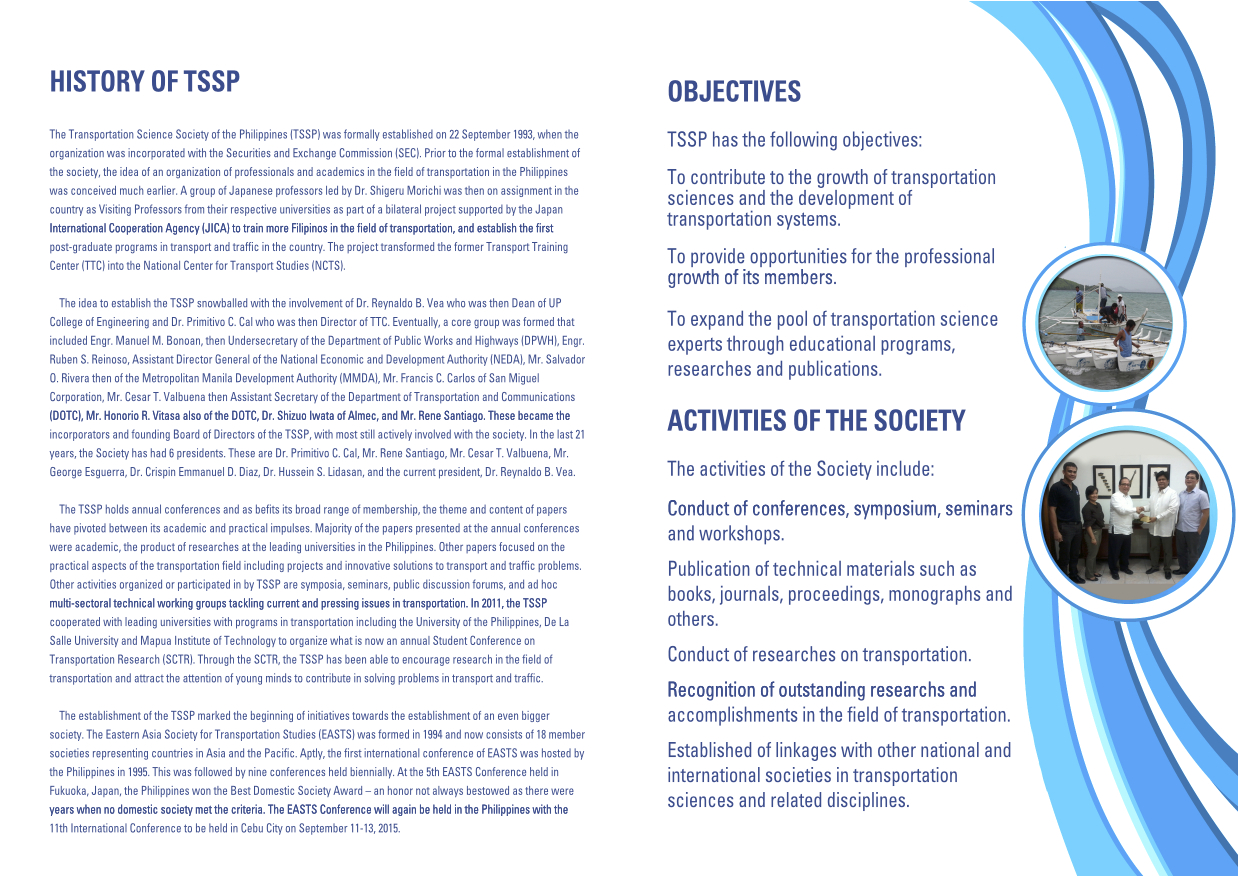
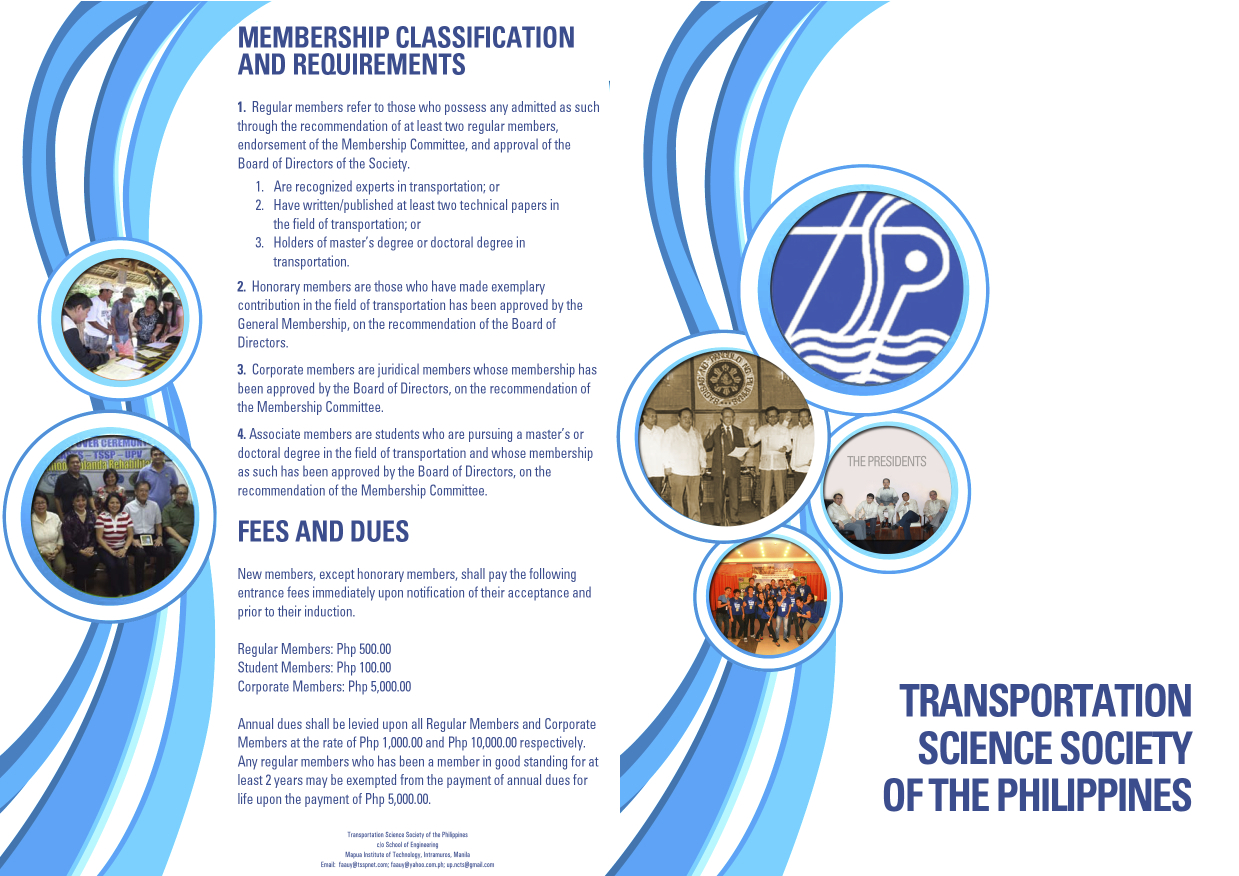
The conference is hosted by the Transportation Science Society of the Philippines (TSSP), which is the local affiliate of the EASTS. More information on the TSSP are found below:
–
On road crashes (again)
I was driving to work early this morning and despite today being the first day of school for public schools, I was surprised to encounter heavy traffic so early as I approached the Santolan Station of LRT Line 2. Most commuters using the station were university/college students and workers but most of the latter won’t have school until next week and it was too early (around 5:50 AM) for most workers to be at the station given that offices open either 8:00 AM (government) or 9:00 AM (private). It turned out that there was a road crash involving a large truck and a motorcycle. The motorcycle rider survived and was texting on the median island. A close look revealed that he was bloodied by the close encounter with the truck and that despite stopping, no one from the truck got down to check on the motorcycle rider. This has become a typical scene and fortunately (especially for the rider) it was not a fatal crash.
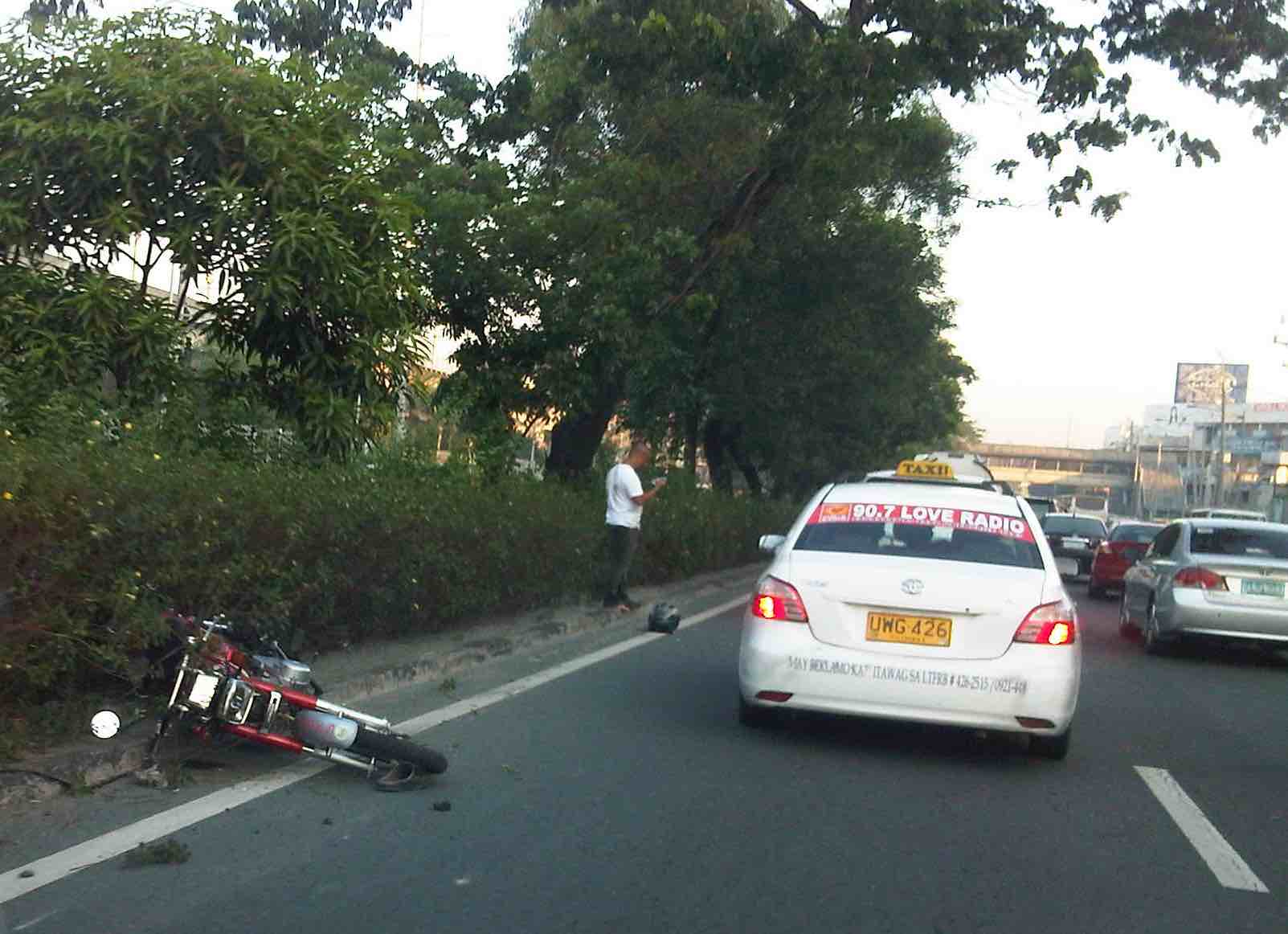 Motorcycle involved in crash with a large truck (covered by taxi in the photo).
Some quick recommendations are provided for different road users in order to avoid such situations leading to crashes:
a. For people driving large vehicles like trucks and buses: Always keep in mind that you are driving a large (and likely long) vehicle that has limitations in terms of manoeuvrability. Don’t drive as if your vehicle is a car and keep in mind that a slight mistake can lead to a fatal crash.
b. For people on motorcycles: Always ride along lanes assigned to motorcycles or refrain from aggressive weaving or lane-splitting. 2-wheelers require balance and so anything to distract the rider (e.g., using cellphones while riding) or aggressive behaviour (e.g., speeding, frequent lane changing, etc. and their combinations) lead to the high likelihood of being involved in a crash. No matter how minor these may be (e.g., dents on vehicles) the cumulative impacts are still significant in terms of costs.
c. For people driving jeepneys, UV Express and taxis: Always keep in mind that you are supposed to be driving safely as you are driving public utility vehicles carrying passengers whom you must convey safely to their destinations. This means you should exercise utmost care in driving and not doing because you simply want to earn money means you have no business providing public transport service.
d. For people driving private cars: Follow traffic rules and regulations. Common causes of traffic congestion and road crashes can be the simplest violations. The more dangerous behaviour include counter flowing, speeding and cutting (or aggressive lane changing).
e. For pedestrians: Cross at designated areas. If there are none or you choose to cross anywhere (i.e., jaywalk) make sure that you are alert and that there are clear gaps allowing for “safe” crossings.
f. For cyclists: People using bicycles should use assigned lanes whenever available. Admittedly, there is a lack or absence of bike lanes in most Philippine cities and the reality is that these will not be provided in an instant. And so cyclists should also be responsible and exercise care as they pedal along. “Sharing the road” also means cyclists need to follow road traffic rules and regulations. They are not excused, for example, from stopping at intersections when the red light is on disregarding one way streets.
With the onset of the wet season, roads will be slippery from rains and therefore add to the challenges of ensuring safe roads. We should not forget that every road user is a vulnerable person. Vulnerability is not limited to the pedestrian or cyclist though they may be the most vulnerable, often with little protection that will allow them to survive collisions with motor vehicles. Though valuable time can be lost by exercising extra care and discipline on the roads, the time cannot substitute or compensate the possible loss of life and limbs due to crashes.
–
Habal-habal in Metro Manila
Motorcycle taxis, called habal-habal in the many parts of the Philippines, are usually associated with rural areas where 4- or even 3-wheeled vehicles would have a difficult time traveling. Meanwhile, larger vehicles probably won’t fit in narrow rural roads, which can be more like a trail than a road. I saw this habal-habal station along Circumferential Road 6 in the Pasig City part of the road. The area is part of a large relocation area for informal settlers. The settlement is basically unplanned, with homes/buildings a mix of shanties and other design-your-own structures with narrow streets and alleys. The latter is most suitable to walking, bicycles and yes, motorcycles.
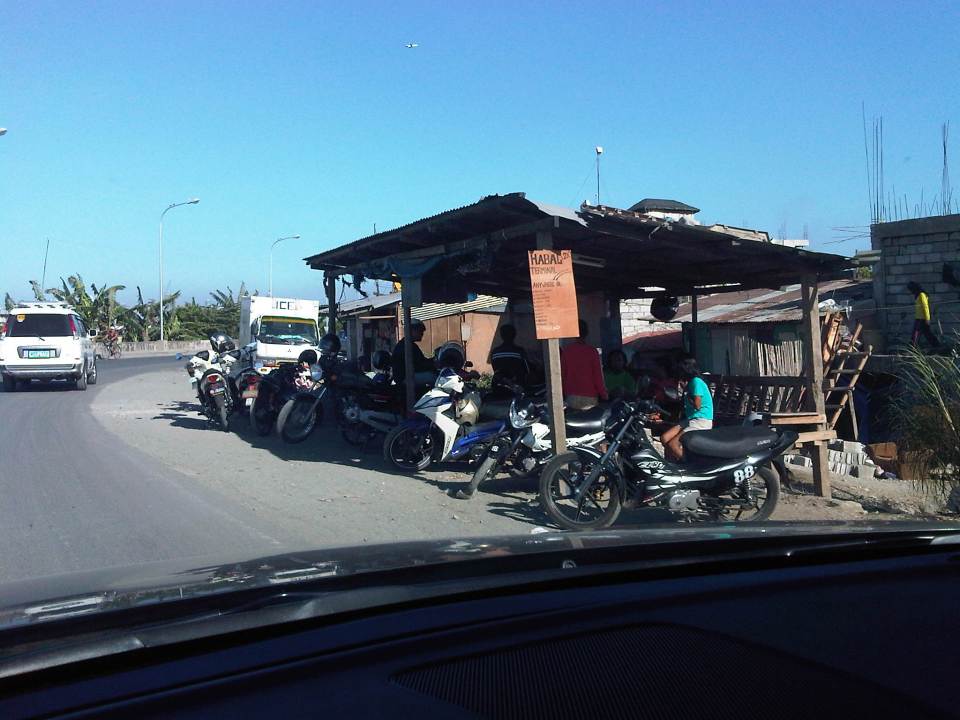 Habal-habal terminal along C-6 in Pasig City near the Napindan Channel
Despite the denial of many local governments including the MMDA, there are motorcycle taxis operating around Metro Manila. Many of these are in areas where there are no public transport services. Tricycles or pedicabs are not allowed or cannot access these areas (streets too narrow or in bad condition). Walking could have been an option but pedestrian facilities are probably even worse or walking distances are long and therefore inconvenient and uncomfortable to most. I don’t know about the fares for their services but I’m sure these are based on what people are willing to pay and established from what providers initially asked for such services. It is likely to that the operators of these services and their passengers know each other as the people in the communities served by habal-habal tend to know each other or another from other people (i.e., everyone knows everyone else).
–
Practicable road sharing in Antipolo
As there are increased calls for more bikeways, we try to look at some good examples of what I’d call “practicable” road sharing. I term it “practicable” because it is something doable or is already being done or practiced. I tried to find a few good examples of practicable road sharing to show that it can be done and usually if all road users respect each others’ right to use the road. This respect can be developed over time and requires some familiarity for each users behaviors. Of course, there will always be abusive or disrespectful people on the road including drivers of different types of vehicles. Reckless or unsafe driving is not limited to public transport or truck drivers. There are also many unruly private vehicle drivers who endanger the lives of others whenever they are on the road. Then there are the motorcyclists, cyclists and pedestrians – all road users and also with bad apples or “pasaway” among them.
Road sharing happens everyday in Antipolo City in the Province of Rizal. Along Ortigas Avenue and Sumulong Highway – the two main routes to and from Antipolo, you will see motor vehicles, bicycles and pedestrians sharing what are mostly 4 lane, undivided sections of the two major roads. Antipolo is a very popular destination for cyclists so even during weekdays you will find a lot of people cycling up and down the mountain roads even during the night time and very early mornings. While many are recreational riders, many, too, are doing this for health. I would bet that a good percentage might be biking to work or school but there are no hard statistics to show this (topic for research?).
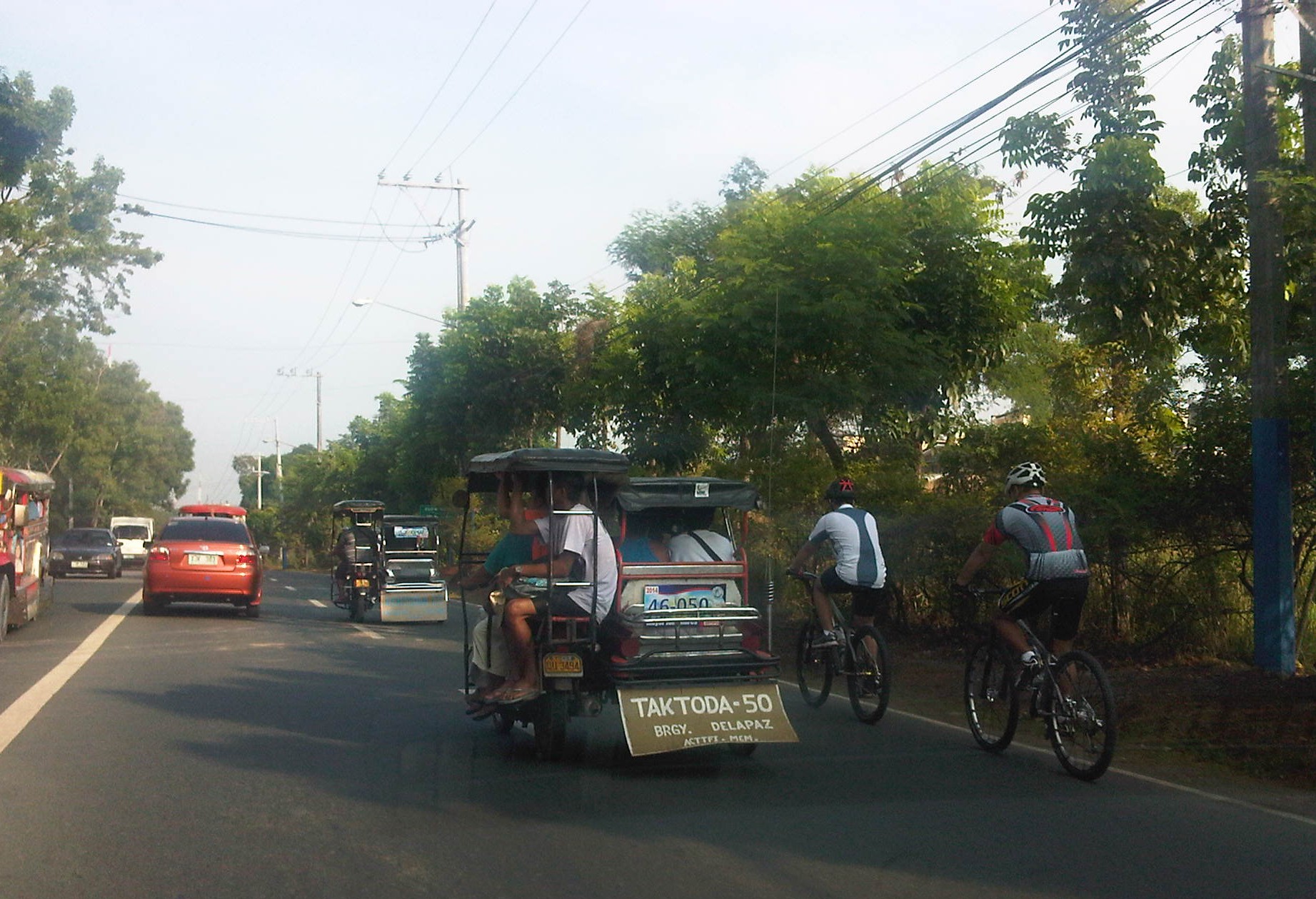 Motorists and cyclists “sharing the road” along Sumulong Highway
Sharing the road shouldn’t be too difficult. However, road users need to have respect for each other’s right to use the road. I have observed many instances where one or more road user types are guilty of “disrespect” and tend to hog the road as if making a statement that “i am king of the road” rather than “i have the right to use the road.” Here are among my pet peeves:
1. Slow moving trucks or jeepneys hogging two lanes and not giving way to other vehicles to pass them.
2. Jeepneys and private vehicles racing up or down the mountain roads and overtaking even in perilous sections (i.e., those already identified as prone to crashes).
3. Tricycles taking up the middle lanes and maneuvering anywhere.
4. Cyclists taking up the middle lanes or sometimes the entire two lanes of any direction preventing other road users to pass them.
5. People crossing anywhere along the road especially at blind sections (curves) where sight distance is limited.
There are practically no pedestrian sidewalks along most of Ortigas Extension and Sumulong Highway so pedestrians would have use the carriageway. As there are a significant number of people walking (e.g., students, workers, and even joggers or walkers), motorists and cyclists need to be careful not to hit these people. The same people, however, need to be aware of these vehicles and should exercise caution, always being alert as they use the road properly. Ultimately though, I would like to see walkways built along Ortigas and Sumulong especially since there is already an increasing demand for walking especially during the summer months when Antipolo holds its fiesta and a lot of people go on pilgrimages on foot to the Shrine of Our Lady of Peace and Good Voyage.
There is practicable road sharing in Antipolo because most road users are already familiar with each others’ behavior and accept each others’ presence and rights on the road. These road users are likely residents of Antipolo or nearby towns or regular visitors to the city. They are “nagbibigayan sa daan.” The “pasaway” people are likely the newer ones who seem to think that the way they drive or ride (i.e., unsafe) elsewhere is the norm. Of course, that goes without saying that familiarity with the roads and its users also breed risk takers who think they already know the road and have the skill and experience to drive like crazy. Here is where effective enforcement (e.g., timely apprehensions and reminders) and engineering (e.g., traffic signs and pavement markings) comes in to address the gaps in safety in order to reduce if not totally eliminate crash incidence along these roads.
–
Habal-habal in Metro Manila?
Habal-habal is the term used for motorcycle taxis that proliferate in many rural areas but are steadily making their presence felt in urbanised areas as well. In Metro Manila, there are already some reports and spottings of habal-habal operations at Bonifacio Global City and in the White Plains area in Quezon City. I’m sure there are other areas where these informal services are being offered and the easiest way to spot these are by way of observing if there are motorcycle riders waiting in an area with extra helmets. The usual excuse if they are accosted is that they are just going to fetch someone (perhaps a relative or a friend) so they bring along that extra helmet for that person. When they do engage a passenger, I would like to think that they just ask the passenger to play along with them should they be apprehended and asked about their business.
Checkpoints around Metro Manila and many other cities and towns routinely stop motorcyclists to check on their registrations (i.e., there are many unregistered motorcycles around the country) and to pre-empt crime involving those “riding in tandem.” Motorcyclists with more than one passenger are risky and have a higher likelihood for severe crashes. The provision of services in exchange for monetary compensation (i.e., payment) puts these informal transport under the category of colorum services. These are not covered by insurance as required for formal public transport and so there are issues of liability should there be a crash involving these vehicles. No insurance means that passengers cannot claim for anything except compensation they can demand from the service provider (assuming he survives the crash) or the other parties involved (if it can be established that the other party is also at fault). You can always sue people but in this case, the pre-condition is that they shouldn’t have been riding a habal-habal in the first place.
 Alleged habal-habal waiting in front of an establishment along Katipunan Road. These typically cater to employees of establishments or staffs of households in the exclusive villages along this road, which has no formal public transport service due mainly to its being a private road that happens to tolerate through traffic. You can find other motorcycle riders offering such services at the corner of Katipunan with Boni Serrano Avenue.
–
Bottlenecks and other traffic issues in Antipolo
Commuting between our home in Antipolo and my work place in Quezon City, I have noted a lot of issues on transport and traffic that needs to be attended to by the local government in coordination with other entities like the DPWH and Meralco. Here are some photos with my notes and comments.
 Much of Sumulong Highway have been widened to 4 lanes but many electric posts remain in the middle of the additional lanes and pose hazards to motorists and cyclists. These posts seem to have been here for quite some time now and the paint on them gives the message that they will be here for the foreseeable future. Paint or no paint, they are road hazards and have the potential to kill people on vehicles crashing into the poles. I think this is supposed to be the responsibility of the power company (Meralco) but there needs to be a firm request and coordination coming from Antipolo City Government to finally relocate these poles.
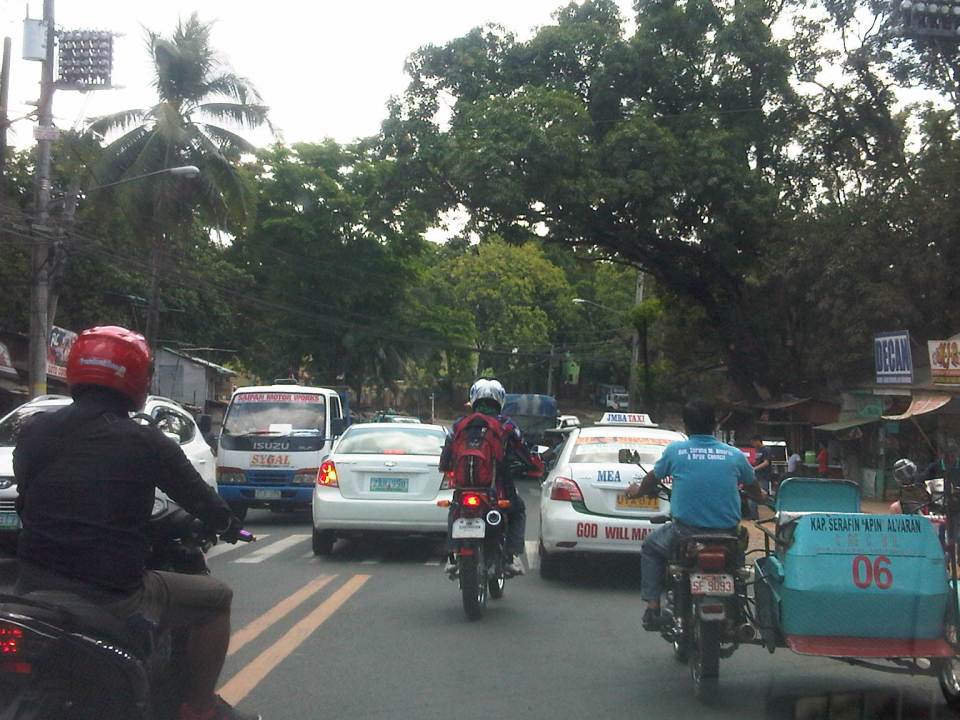 Congestion is often caused by counter-flowing vehicles forcing their way back into the right lane (like the car in the middle of the photo) upon encountering opposing traffic. It doesn’t help that there are motorcycles splitting the lanes to make for a very crowded road.
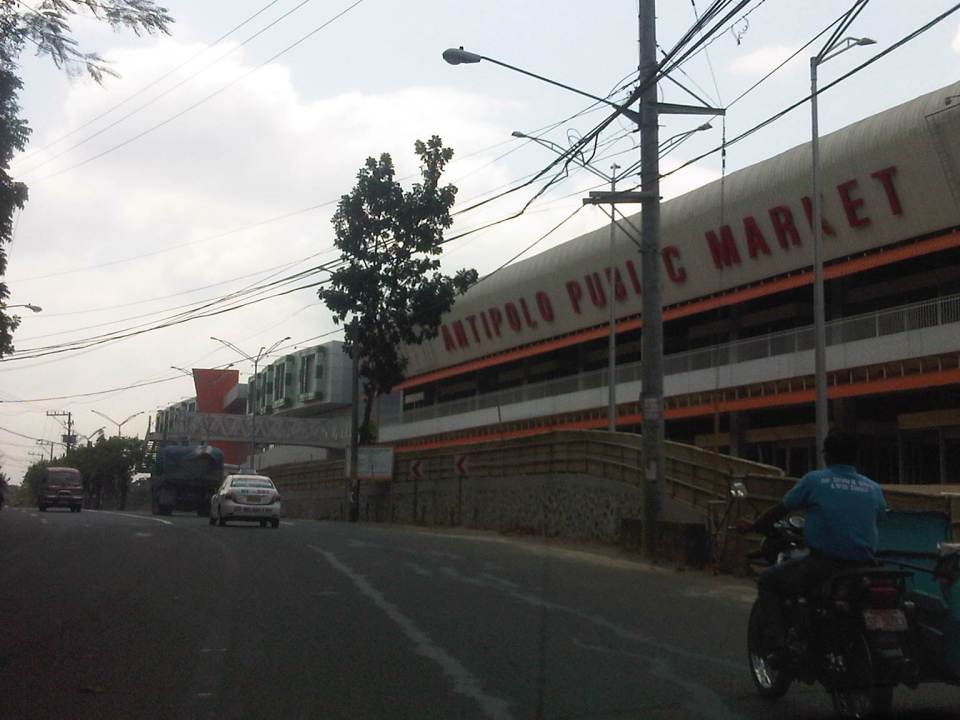 The new but still closed Antipolo Public Market along Sumulong Highway and near the intersection with Daang Bakal (the old railroad line that’s now a road). I wonder about the trip generation potential of this complex as it is not yet operational. Meanwhile, a huge Robinsons mall (looks larger than their Magnolia property) is currently under construction just across from it and will definitely be a major traffic generator in that area. The combined traffic to be attributed to these commercial complexes will surely have a tremendous impact on Sumulong Highway and other roads in the vicinity.
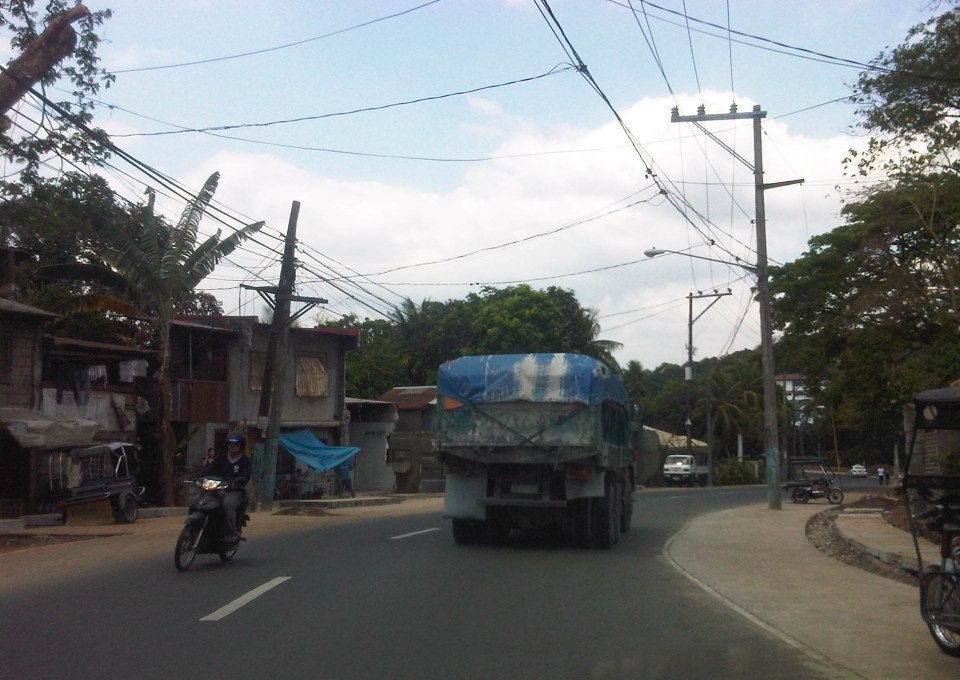 Both Sumulong Highway and Ortigas Avenue Extension carry significant truck traffic. These often cause congestion as they are slow going up to Antipolo and can block the entire road as Sumulong Highway and Ortigas Extension have some narrow sections where the shoulders could not provide enough space for other vehicles to pass the slower moving ones. In certain cases like the one in the photo above, there are electric posts in the middle of the shoulder lane.
 Tricycles occupy the outer lane of Ortigas Ave. Ext./Olivares Street. Such informal and on-street terminals are illegal along national roads and yet the city tolerates them. One explanation for this is that there are informal communities along the highway on shanties built along what is supposed to be a ledge along the mountainside (shown at right in the photo). These are where tricycle drivers and their families reside.
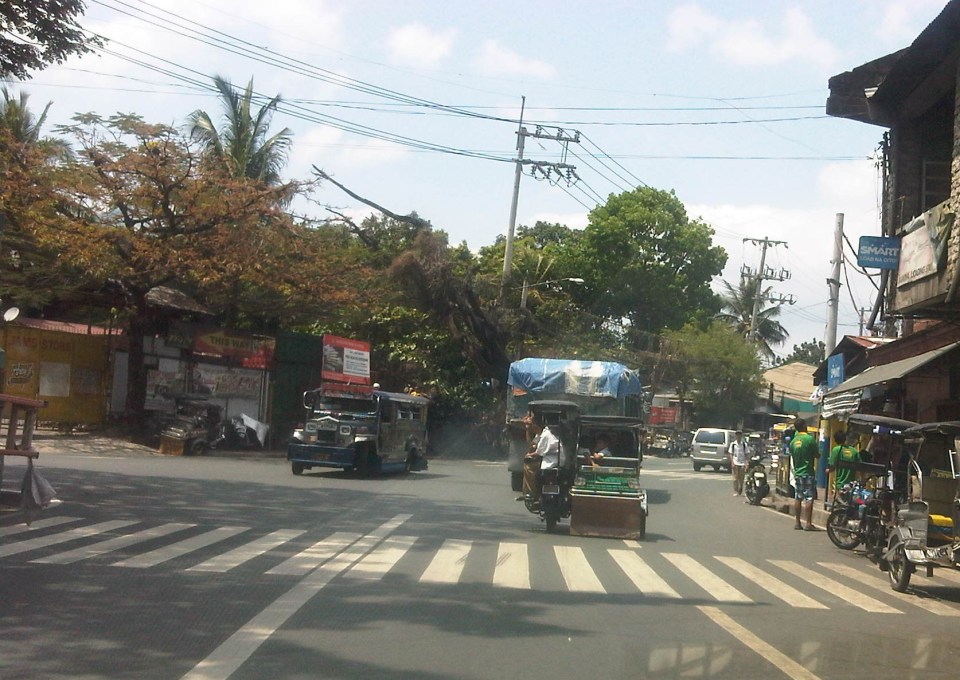 Tricycles from different tricycle operators and drivers associations (TODAs) seem to roam the entire city. This is contrary to the common practice in other cities and municipalities where tricycles are limited within a certain area or district that in many cases just overlap with others (e.g., UP Teachers Village-Philcoa-Krus na Ligas).
 Many tricycles serve as school service. However, the observation is that most tricycles tend to be overloaded with passengers. These are usually small children so the driver probably figured that they could cram more passengers than what is legally allowed.
 Sharing the road? Antipolo is very popular with cyclists and weekends bring a lot of them to the city as they come from all over via the main routes along Sumulong Highway and Ortigas Avenue (there should also be those coming from the east via the Antipolo-Teresa Road and Antipolo-Tanay Road). Most motorists are aware of these cyclists and give way to them. Most experienced cyclists are also aware of the ROW of other vehicles and so keep to the inner lanes. This mutual awareness and respect are vital to make roads safe for all. I think the only thing needed is to provide space for pedestrians as there are significant numbers of people walking, hiking or jogging along these roads.
–
Risky business with motorcycling
I spotted what appeared to be a family of four riding the same motorcycle as I was traveling to work this morning. While they were traveling slowly, likely to be careful considering there were 4 riders, I could’t help but imagine (not really wonder) what was going on in the minds of the adults here. The children were obviously oblivious to the dangerous situation and I even saw one child smiling and apparently enjoying the ride. I am sure that the father is trying his best to be careful as he is surely aware that a mistake would likely doom his entire family.
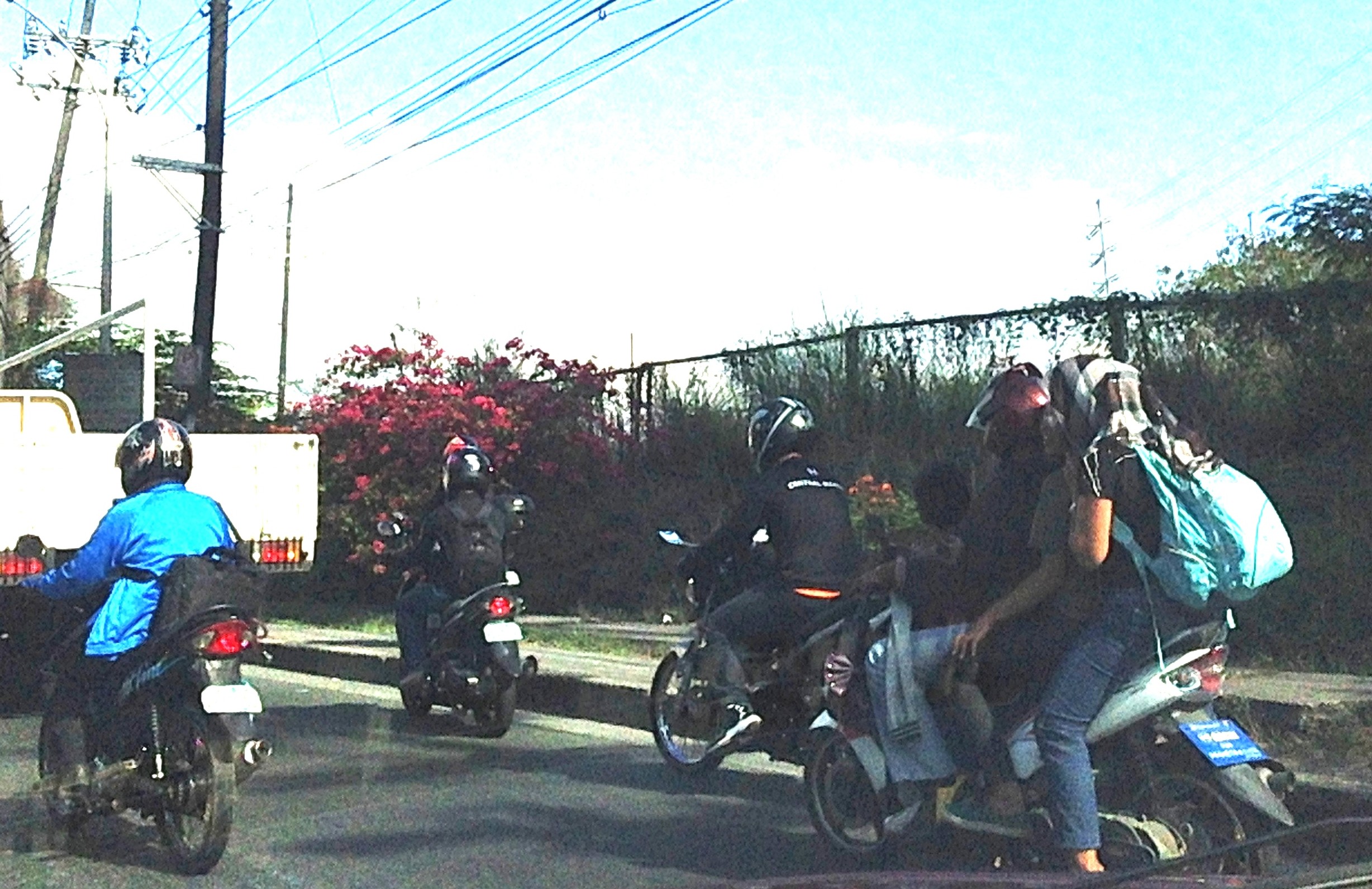 A family of 4 with one child (the younger one) in front and another child sandwiched between the adults riding a single motorcycle. The children didn’t even have helmets so if an untoward incident happens, there is a very high likelihood that the children will be killed in a crash.
These are common sights in Metro Manila and elsewhere in the country. Its worse in other places where there’s weak enforcement of road safety laws including the helmet law and the limitation in the number of passengers (yes, there is a law against passenger overloading for vehicles). I was actually wondering how these people in the photo were able to evade MMDA and LGU enforcers along major roads. And to think that there are many checkpoints to inspect those “riding in tandem.” Clearly, this is a violation of existing regulations and the only way to discourage such practices and effect behaviour change is for authorities to clamp down on such risky situations, even forcing them to discontinue travel in addition to issuing a ticket and fine for the violation. Are we really serious in promoting road safety and ensuring safety for everyone? If so, why the lax enforcement when it is perhaps, and arguably, the most important element in order to influence people’s mindsets regarding road safety.
–
 Caught (up) in traffic