
Home » NMT (Page 17)
Category Archives: NMT
Helmet or no helmet when biking?
We were at the Department of Science and Technology – Philippine Council for Industry, Energy and Emerging Technology Research and Development (DOST-PCIEERD) this morning to help defend our proposal for a bike sharing system. UP Bike Share is an initiative coming out of a group of students from various programs in their respective colleges at the University of the Philippines Diliman.
One question that was raised among the technical panel to whom the proposal was presented for evaluation was concerning safety of people participating in the bike share. One panelist asked if cyclists were required to wear helmets. We replied that those participating in the bike share were not required to wear helmets and that despite helmets being available few, if any, borrowed the available helmets. I mentioned that there was an article I came upon before that stated the requiring people to wear helmets discourage biking. It seems a coincidence that as I browsed my Facebook just now, I found a link to that very same article I mentioned in a meeting earlier today:
To encourage biking, cities lose the helmets [by Elisabeth Rosenthal from The New York Times, Sunday Review, September 29, 2012]
The article makes a lot of sense especially the observation that requiring helmets seem to send the message that it is dangerous to bike. People associating danger with biking with helmets tend to opt out of biking. I recall that in Japan before, I didn’t have a problem biking in urban areas and helmets were not required. Of course, drivers of vehicles in are very admirable by the way they drive safely and respecting other road users’ right to the road. Instead of having a campaign to require helmets for bikers perhaps efforts should be focused on how to make our roads safer for all users including bikers and pedestrians.
–
Towards safer roads: design, respect and education
Fatal crashes involving cyclists have been posted in social media including a recent one involving a mother of two who was run over by a garbage truck that encroached on the on-street/painted bike lane in, of all places, Marikina City. Emphasis on Marikina is made here because it is a city well-known for its comprehensive bikeways network. The network is comprised of segregated and on-street bikeways.
Following are some photos showing examples of good and bad practices pertaining to bikeways design in the Philippines:

Example of segregated bikeway at the University of the Philippines Diliman campus. Cyclists actually share the carriageway lane allocated from the Academic Oval with pedestrians and joggers. They are not physically protected from motor vehicles that can encroach on the bike lane.

Example of segregated and protected bikeway along Marcos Highway in Pasig City (similar design for the sections in Marikina, Cainta and Antipolo) – bikeway is on the sidewalk and cyclists essentially share space with pedestrians despite delineations.

Example of segregated and protected bikeway/walkway along EDSA in Makati City – note that space to be shared by pedestrians and cyclists is very constricted.

Example of poor design along White Plain Avenue – the MMDA seems to have designated the entire sidewalk space for cyclists.
Three examples from Marikina’s bikeways are shown below:
 Painted, segregated bikeways on the carriageway on either side of a two-way road [Note: This is basically the design along the street where the crash in Marikina occurred.]
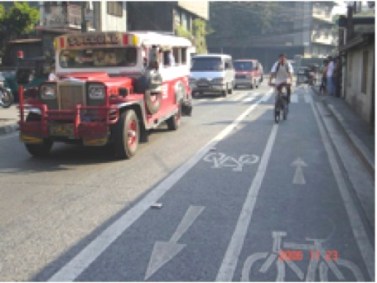 Painted, segregated bikeways on the carriageway along a one way road
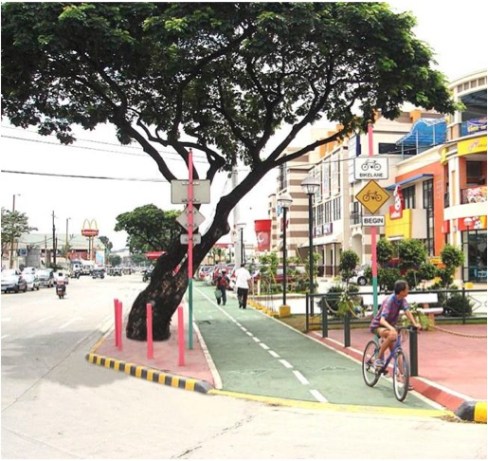 Segregated and protected bikeway off the carriageway along Sumulong Highway
Granted that the ideal set-up would have segregated or protected bikeways that are designed properly, we take a look at two other very important elements that are not at all as technical as design and planning of bikeways – respect and education.
Education is an important aspect of driving. Many Filipino drivers are poorly educated in terms of traffic rules and regulations, road design as well as local policies pertaining to transport and traffic. As such, there is a tendency for many drivers to disregard rules and drive/ride aggressively and recklessly. This must change and it starts with reforms in the way licenses are issued to all types of drivers including perhaps stricter certification systems for truck drivers and public utility vehicle drivers. Traffic education should also be integrated into the academic curricula of schools starting at a very young age. Road safety parks are one way to promote traffic education for kids.
Respect is partly derived from education but is also related to attitude. No matter how much driver or road user education or skill you get if you have a bad attitude, you will still have the tendency to be reckless or irresponsible with your actions on the road. One way to curb bad attitudes on the road and to educate road users (particularly errant drivers and riders) is strict traffic enforcement. Many cities already have CCTVs installed at major intersections that allow law enforcement units to be able to monitor traffic behavior and perhaps zoom in to determine driver and vehicle information including license plate numbers.
The crash that killed the single parent in Marikina is not so much as an issue one whether we need segregated and protected bikeways but is more an urgent need to assess the state of traffic education and enforcement in this country.
–
Articles on the crash and calls for reforms may be found in this link.
Common causes of crashes involving bicycles
I found a guidebook of sorts as I browsed one of my shelves for some references on public transport. It was something that I got from a seminar hosted by the Land Transportation Authority (LTA) of Singapore many years ago (I think in 2009.). The book contains tips for road users, whether motorist, pedestrian or cyclist. One page from the guidebook provided a list of common causes of accidents involving pedal-cyclists.

The page is practically a checklist for cyclists – reminding them of items that they need to keep in mind when traveling. In Singapore and elsewhere, there are rules for cyclists to follow in order to ensure safety on the roads. The assumption here is that other road users, especially motorists, will respect the right of cyclists. Each road user is expected to be responsible with his/her behavior whether as driver, rider, pedestrian or cyclist. Everyone is vulnerable and even the most safety conscious and careful road user may be involved in a road crash.
–
Readings for the new year
I wrote late last year about how the Christmas and New Year holidays allow me to catch up on some readings. These are mostly contemporary articles on transport and other topics rather than whole books (though I just finished one by George RR Martin during the semester). That post with three articles may be found in this link:
Some interesting readings on traffic engineering
I open the year with another post with a couple of interesting articles. One article reports on the newly opened bicycle ‘autobahns’ in Germany. ‘Autobahns’ basically refer to expressways or freeways. The new facilities for cycling represents what many will term as a paradigm shift for a country well known for its excellent automobiles. The concept of an expressway for bicycles actually makes sense in terms of safety and as a way to eliminate many if not all the factors that tend to discourage people from using bicycles for longer distance commutes. These do have the potential to reduce car usage (and traffic congestion) and ultimately also reduce pollution and fuel consumption. I am interested about the designs of these structures as the designs are also key to the development of similar infrastructure elsewhere including, hopefully, the Philippines.
Germany opens first stretch of bicycle ‘autobahn’
Another article is more thought provoking in the sense that it delves into labor and legal issues surrounding Uber and other ride sharing companies. These issues are valid and need to be discussed thoroughly not just in the US but elsewhere where ride sharing services have proliferated and profited. Many of the points pertaining to labor and compensation are valid, and I would like to think that these extend to the franchising issues that have been raised against ride sharing, which ultimately have implications on their business model. The legalese may be a turn-off to many who would argue that companies like Uber and Grab provide them with a good quality of service. But then that begs the question of whether they would have the same view if taxis were better than what they are now.
Road warrior: Is Uber ripping off its drivers?
Happy New Year and happy readings!
–
Some interesting (and required) readings on traffic engineering
Christmas breaks allow me to catch up on a lot of reading. The previous months comprising our university’s semester were spent preparing for lectures though I had to do some readings related to researches I am involved in. Browsing the net and social media, I came across 2 articles shared by an acquaintance. He is a very progressive planner who has extensively studied and written about the most relevant issues in urban planning, focusing on transport. A third article I found while reading one of the two. These were very interesting for me in part because they are thought provoking in as far as traffic engineering is concerned.
- What traffic engineers can learn from doctors
- As traffic deaths rise, blame engineering dogma
- The new science of traffic engineering
The author seems to call out traffic engineers in general but these articles should also be contextualized properly. The situations mentioned in the articles are to be found in cities in the United States and may not be applicable in other cities in other countries. Traffic engineers in Europe, for example, have been working on exactly the solutions being mentioned in the articles that would make streets inclusive and safe especially for pedestrians and cyclists. The same with Asian cities like Singapore and Tokyo.
In the Philippines, however, there is so much that we can learn from the articles. The mere mention of the design guidelines being used in the US betrays the flaws of highway and traffic engineering in the Philippines. The Philippines’ highway planning manual and other guidelines used by the Department of Public Works and Highways (DPWH) are heavily drawn from US references. Most highway and traffic engineers in the country are educated using curricula that use US textbooks and references. There are even civil engineering programs that use licensure exam review materials as their references! These exam materials are also known to be based on DPWH guidelines and manuals aside from problems “outsourced” or patterned after the Professional Engineer (PE) exams in the US. Few schools have progressive curricula that look to best practices that take into account the complexities of roads especially in the urban setting. Such ‘copying’ of American standards and practices in many cases do not consider Philippine (local) conditions and blind applications to our roads instead of proper adaptation often have lead to unsafe and inequitable roads.
–
Another look at Iloilo’s main bikeway
Much has been written and said about Iloilo’s bikeways and particularly about the grander one built along the main highway that is Ninoy Aquino Avenue. This bikeway is already usable but is being extended along with the road widening works for the national road that connects major towns in central Iloilo province including Sta. Barbara and Cabatuan, which host the international airport. Here are some photos and commentaries on the bikeway.
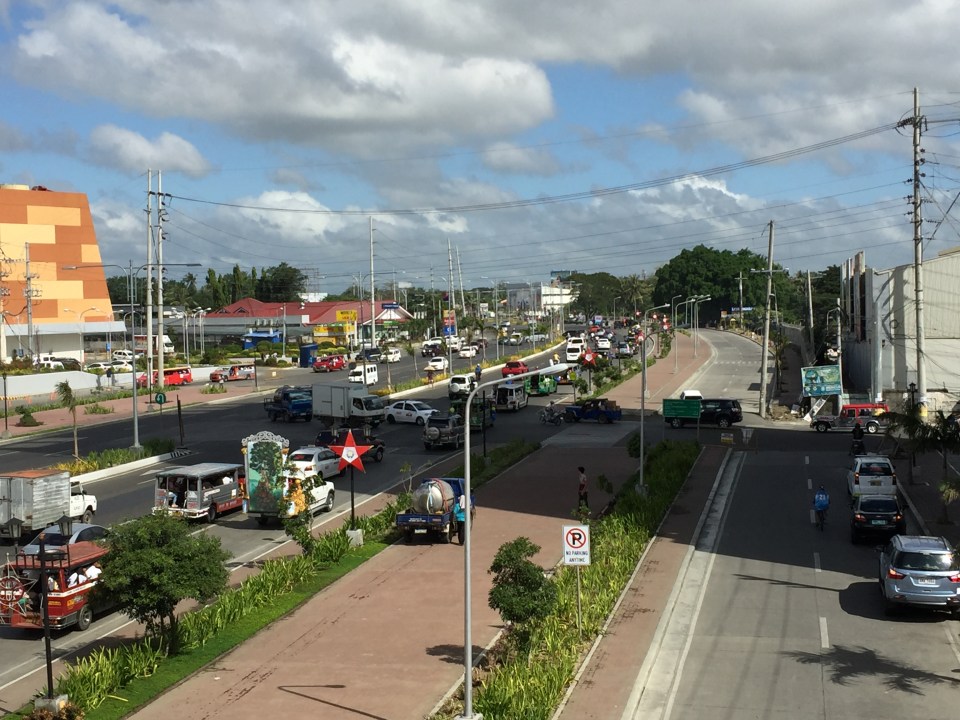 Iloilo City’s wide bikeway along Ninoy Aquino Ave (formerly the Iloilo Diversion Road) – the building on the left is SM City’s recently opened expansion. The photos were taken from the pedestrian overpass across the diversion road.
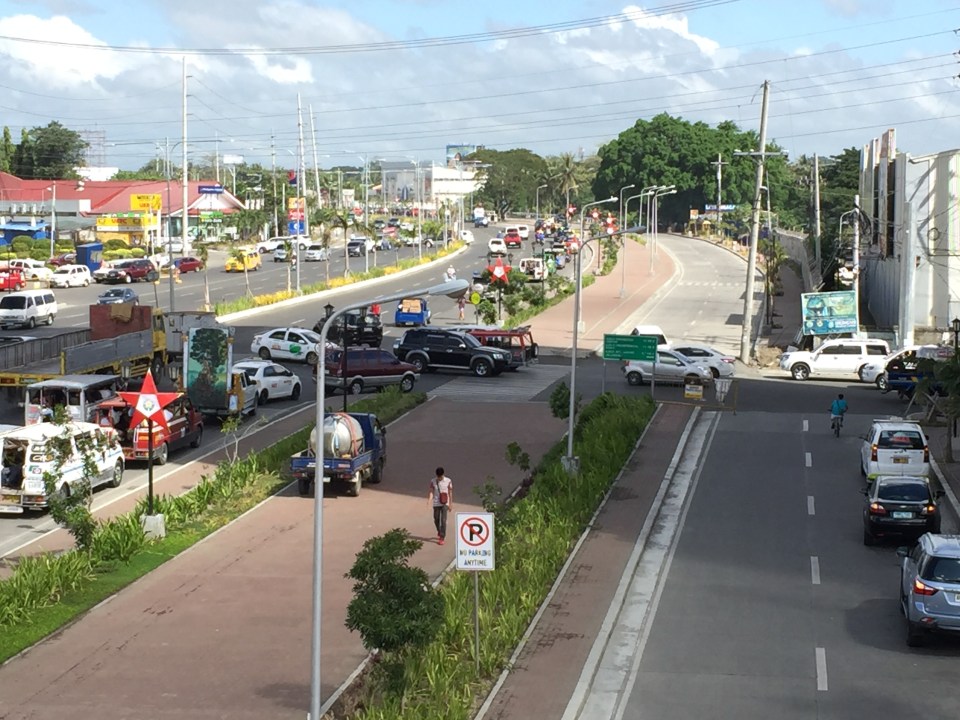 A closer look of the traffic conflicts at the intersection with Jalandoni Street – the 3-leg intersection is not as simple as it initially looks because of traffic coming from/going to the service road on the right. It is quite obvious in the photo that the alignment of the service road changes abruptly, affecting the trajectory of flow along the road.
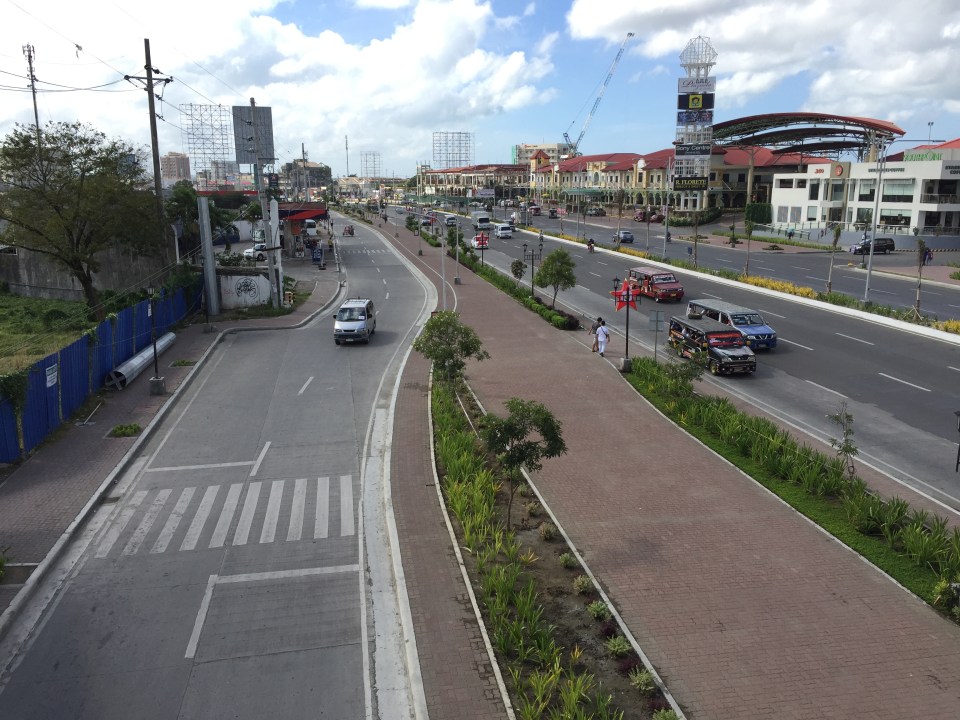 The photos were taken around 9:30 AM and there was practically no bicycle traffic to be seen. To be fair, perhaps there is significant bicycle traffic, particularly the commuting kind, earlier in the morning and later in the afternoon. Bicycle volumes need to be measured and monitored to determine if the bikeways indeed have encouraged more people to take up cycling as a mode for their regular commutes. That’s the Plazuela in the background on the right.
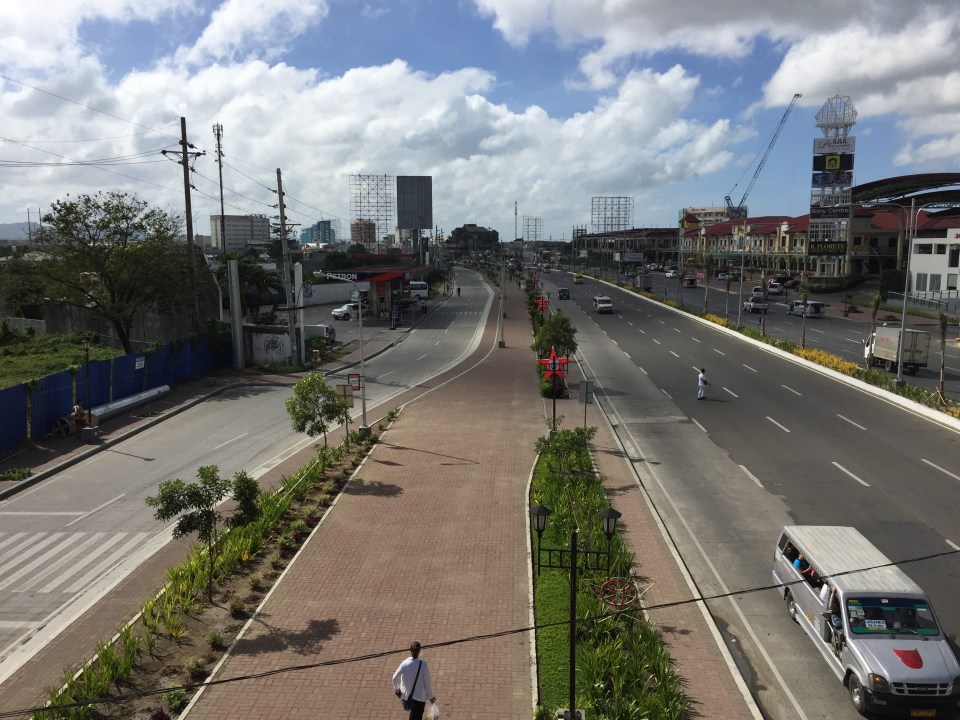 Another look at the bikeway shows it emanating from Iloilo City proper where it ultimately connects to the bikeways at the Promenade along Iloilo River. There are no bikeways within Iloilo’s CBD itself.
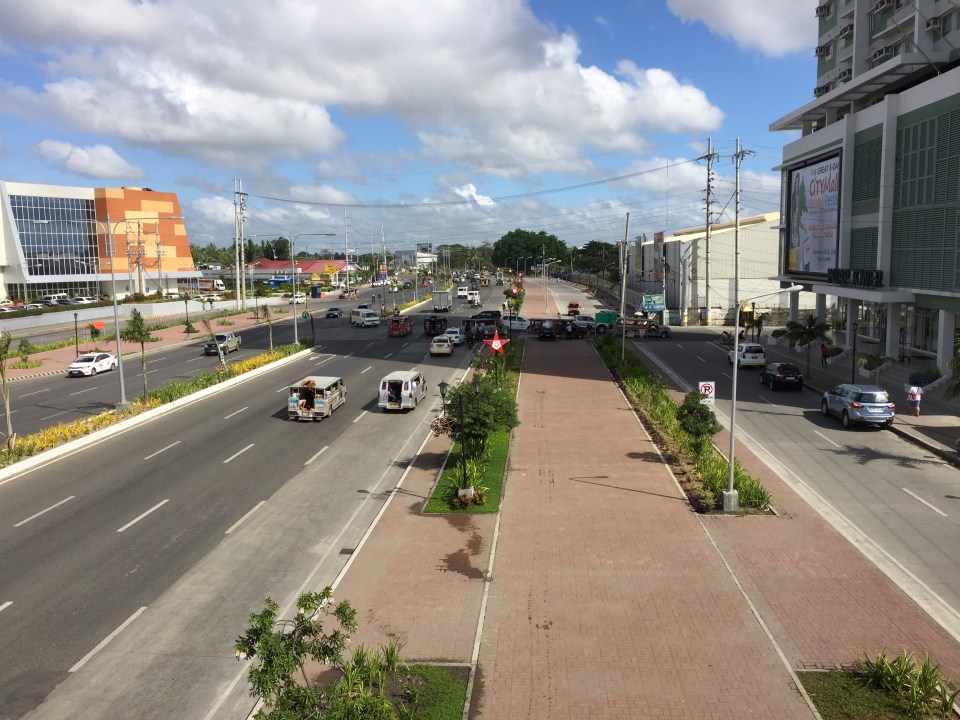 The photo above shows the bikeway and beyond (towards Jaro and Pavia) with the new SM annex at left and the Injap Tower Hotel on the right.
–
Unprepared and incomplete – realizations from the APEC transport experience
Before I forget about what transpired during the holding of APEC in Manila a week ago, here’s a couple of photos I found over the internet and shared via social media.
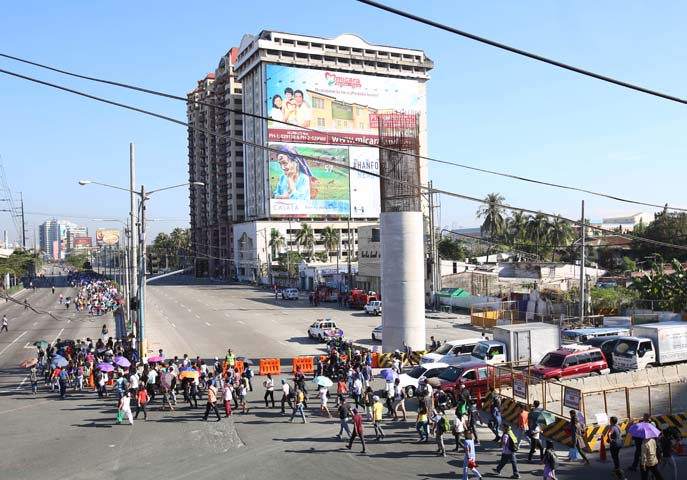 Commuters along Roxas Boulevard walk past a column of the unfinished NAIA Expressway, one of the transport infrastructure projects that has not been finished. [Photo from The Manila Bulletin]
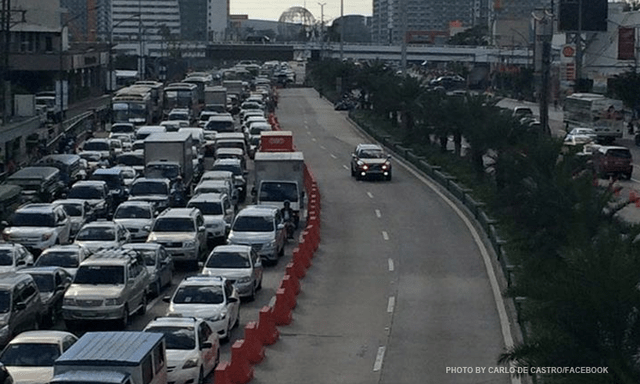 APEC lanes and severe traffic congestion along EDSA – there’s an opportunity here for a prrof of concept test for BRT. [Photo from Facebook]
I saw many memes and read some articles mentioning BRT specifically as one solution to Metro Manila’s transport problems. The second photo above was modified to replace the car travelling along the APEC lanes with a bus.
It is easy to imagine what could have been if the government decided to use the event and the lanes they allocated for APEC vehicles to do a ‘proof of concept’ run of BRT services or at least express bus services (what some DOTC people call high quality bus services). Perhaps what could have been done for part of the 10 billion PHP expended for APEC was to buy a fleet of brand new buses and provided these for free public transport for people who would need to commute during APEC. Services along two corridors would have sufficed – these two would have been EDSA and Roxas Boulevard. [The other option would have been to talk to bus operators and cooperate with them to organize express bus services along EDSA and Roxas Blvd.] Aggressively promoting these free services ahead of APEC would also have meant commuters, including those who usually used their own vehicles, could have opted for these transport services and not affected by the ‘carmageddon’ that ensued over that period. There should have been services to the airport terminals, too, but I will write about this in another article.
The dry run could have yielded essential data for assessing the feasibility of such bus services as an alternate to rail systems that would take much time to build. Incidentally, if the LRT Line 1 Extension to Cavite was built right after the current administration took over, that line could have already served tens of thousands of passengers from the south who regularly commuted to Metro Manila for work and school. The first photo above does not lie about just how many people could have benefited from that rail project. Meanwhile, MRT Line 3 remains dysfunctional and with its reduced capacity could not handle the demand for transport that it should have been able to carry if services had not deteriorated over the years.
–
Caught up in trAPEC
It’s a corny title to this post and perhaps is practically what people would call ‘click bait’. But then it is a very appropriate one considering it describes what happened last Monday and is still happening today and for the rest of the week affected by the Asia Pacific Economic Cooperation (APEC) forum hosted by the Philippines and held in Metro Manila. Yes, Metro Manila. And many people have been asking loudly or in their mind why the capital city when the government was supposed to be promoting and bragging about growth in other cities (inclusive growth anyone?). I would have thought and preferred to have APEC in either Subic or Clark, which have been touted as rapidly growing areas and as international gateways. In fact, Clark is being pitched as the location of a potential new city in the Clark Green City project as well as the aerotropolis currently being developed (slowly) near the airport and the SCTEX Clark South interchange.
Instead, we have the APEC forum and all its attendant activities in Metro Manila. And it seems that the forum has maximized its detrimental impacts on the economy as it practically shut (some people even say shat) down the capital because of severe traffic congestion and a lack of public transport infrastructure and services to carry commuters safely and efficiently between their homes and work places. The Manila Bulletin posted the following photo last Monday:
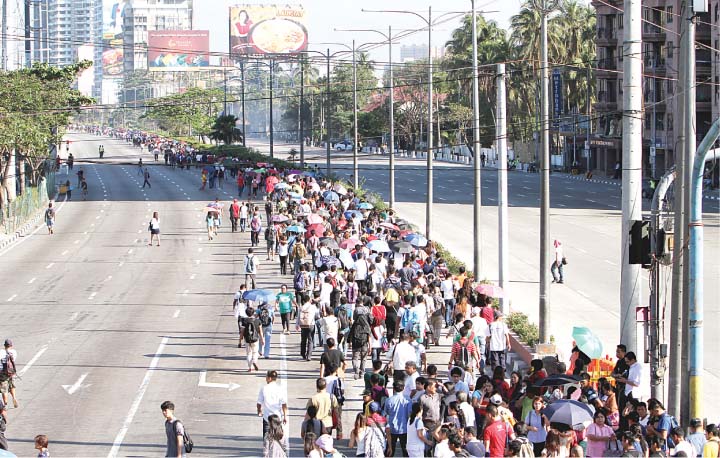 Commuters were forced to walk along Roxas Boulevard just to get to work.
Here are a few more photos courtesy of an old friend from high school:
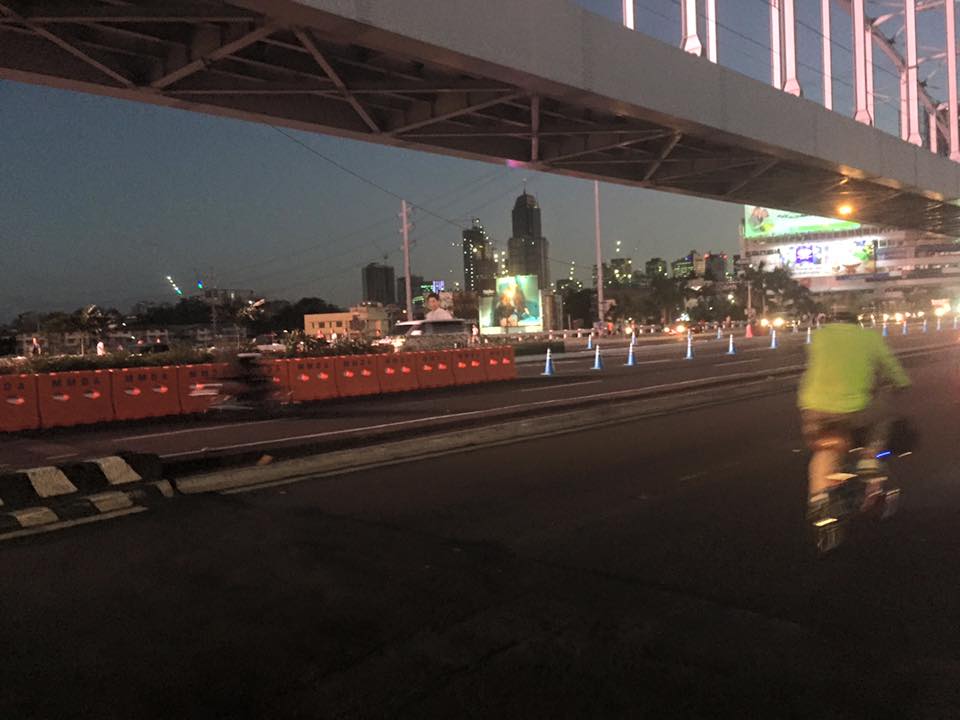 A lone cyclist pedaling along a practically empty section of EDSA (photo credit: Bong Isaac)
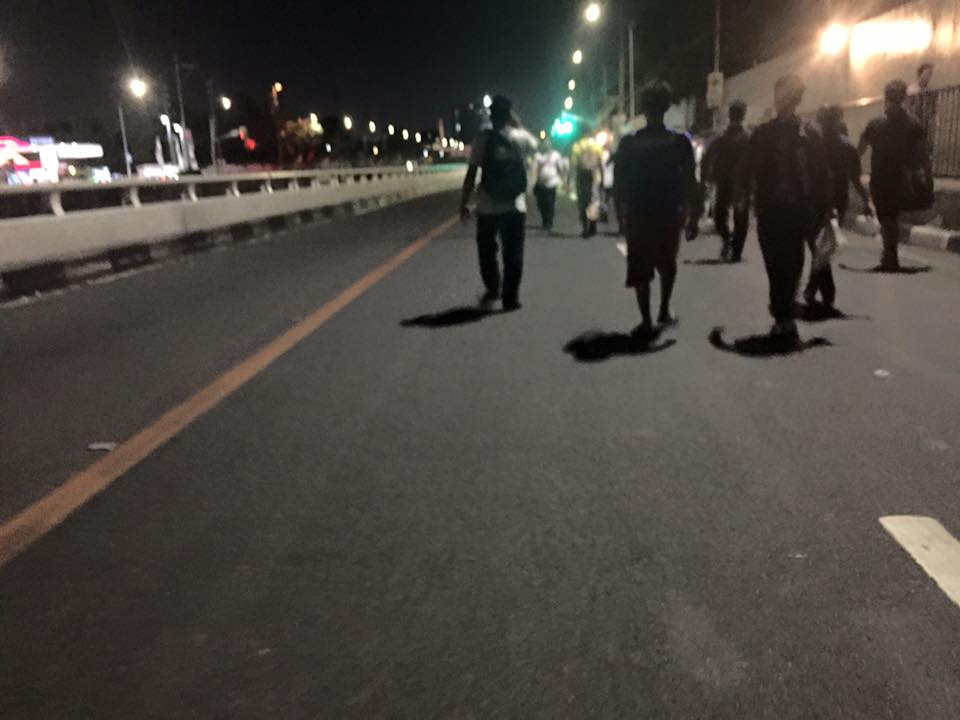 Walkers? – commuters took to walking along EDSA, one of the country’s busiest and most congested thoroughfares. I was amused of the memes about the ‘Walking Deadsa’ referring to people seemingly walking like zombies after a hard day’s work just to get home. (photo credit: Bong Isaac)
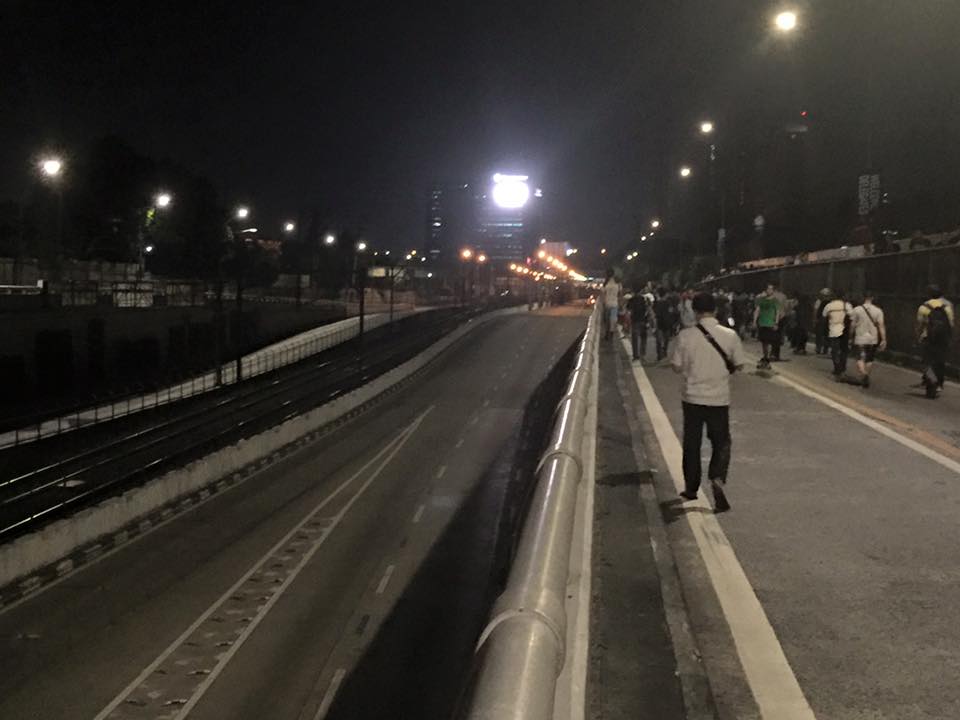 Commuters walking along a vehicle-less EDSA. The MRT 3 line at the left in the photo also seems to be ‘lifeless’ at the time (evening I was told) the photo was taken. (photo credit: Bong Isaac)
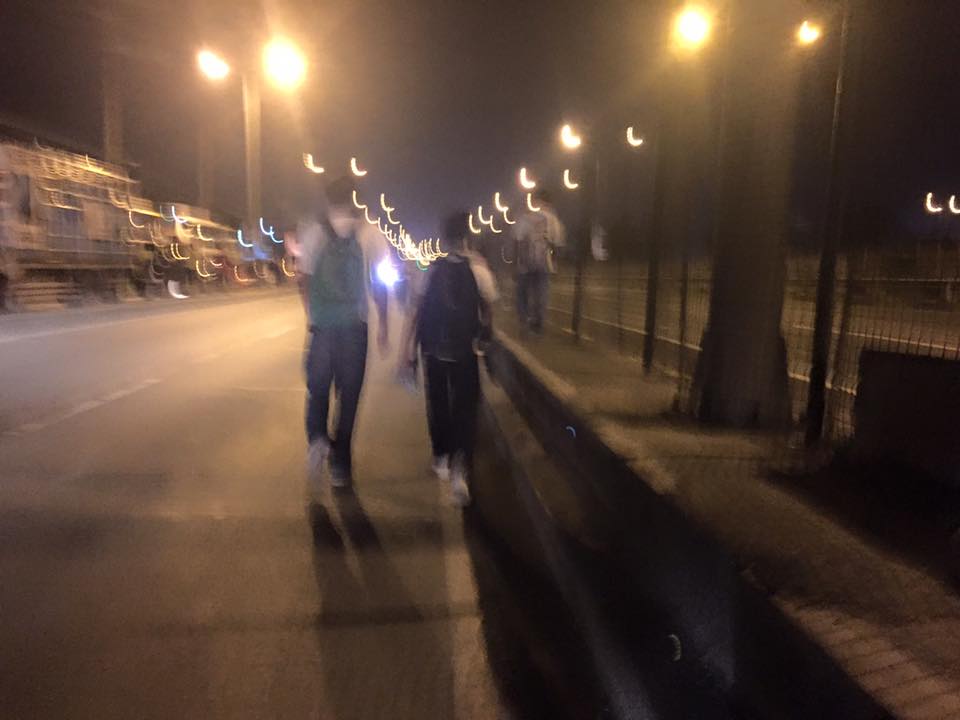 People walking along the service road along the SLEX – most affected of the road closures were people from the southern parts of Metro Manila including those from Laguna and Cavite. (photo credit: Bong Isaac)
I remember being asked once during an interview if it was possible to determine the cost of congestion due to a single event such as a road crash or perhaps a rally. I replied that it is possible given the available tools and expertise in making such assessments. What could be the cost of such a week-long event? Would the holidays for Metro Manila have lessened the economic impacts on traffic of the APEC? Or was it assumed that agreements and the media mileage we got from APEC more than enough to cover economic losses?
Could this disastrous traffic mess have been averted or at least mitigated despite APEC in Manila? Yes, perhaps, if the transport infrastructure particularly the LRT Line 1 Extension to Cavite, the upgrading of the MRT Line 3 and an airport access transit system were completed prior to APEC. These along with other major projects for Metro Manila were promised years ago and yet have not been realized. Add to this the apparent lack of contingencies (BRT-like express buses? bicycles?) that could have eased the pain of hundreds of thousands of commuters affected by APEC traffic schemes. Government has no right to tell people “I told you so” when government efforts for the benefit of its own commuting citizens have been deficient these past years.
–
Antipolo public market pedestrian overpass
I took some photos atop the pedestrian overpass connecting the New Antipolo Public Market and the Robinson’s Place mall. The overpass is across Sumulong Highway, which terminates nearby at the intersection with Antipolo Circumferential Road (Daang Bakal), which is currently being widened.
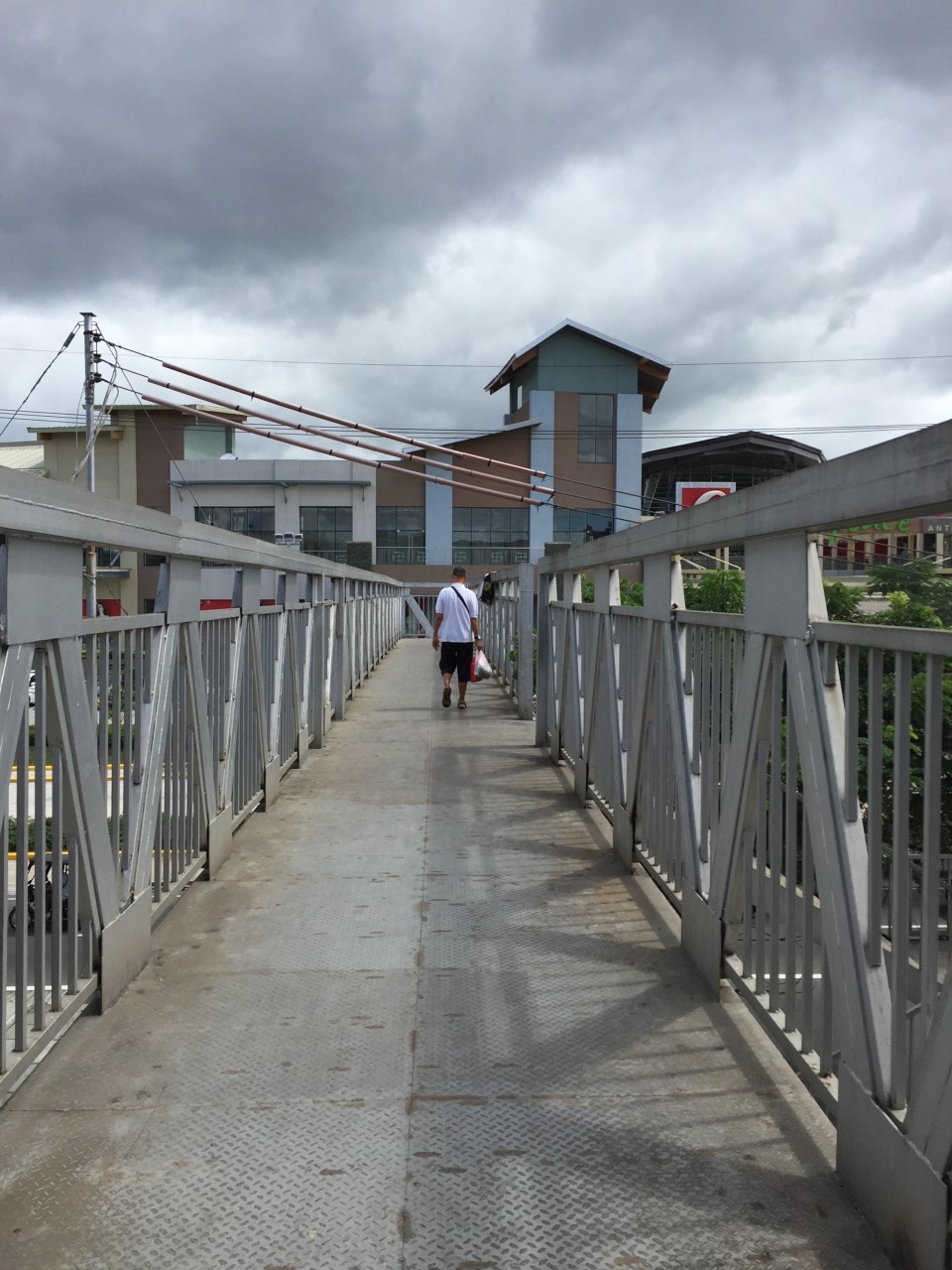 The overpass is a steel structure, including the flooring, which reminded me of factories. This industrial look is not new as there are other overpasses that have been constructed in Metro Manila similar to this.
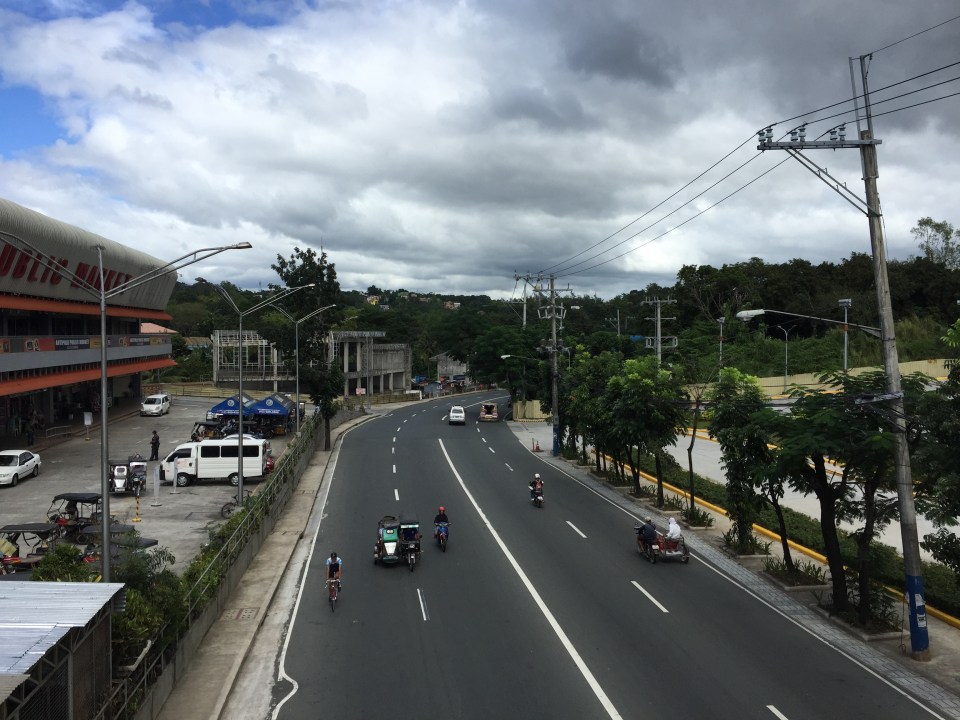 A look at Sumulong Highway towards Masinag. The highway has 4 lanes and at this section has sidewalks on either side of the road. There is no median island to separate opposing flows of traffic. The Antipolo Public Market is on the left side.
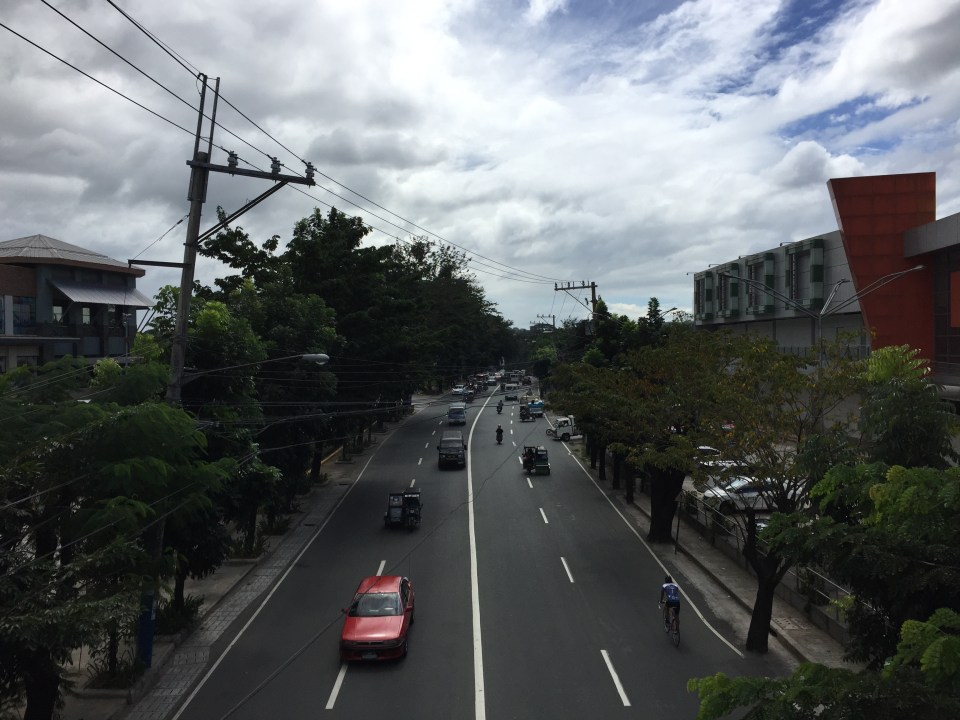 A view of Sumulong Highway towards the Antipolo Shrine of Our Lady of Peace and Good Voyage. The Public Market is at the right and the mall is at the left.
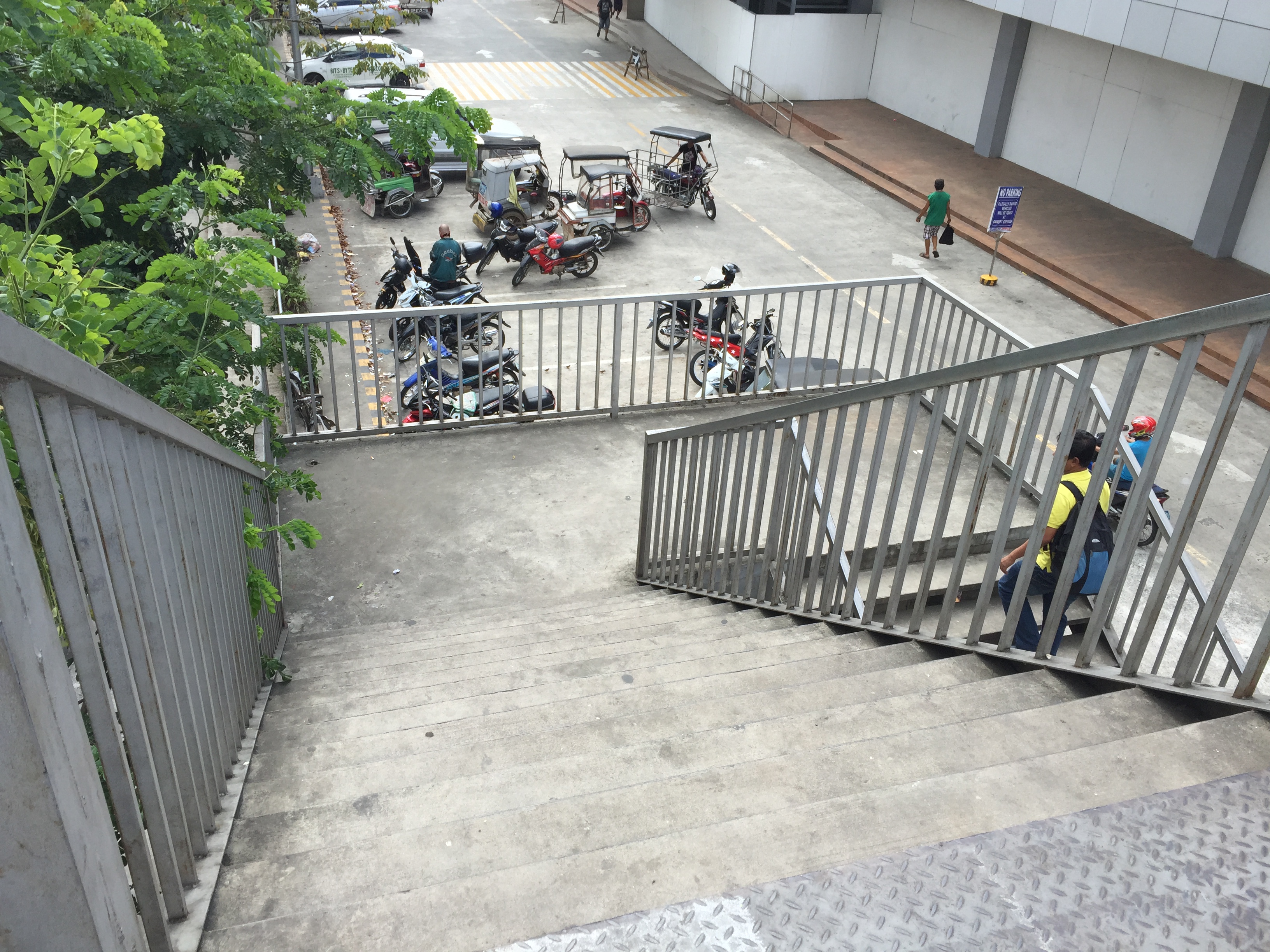 The overpass’ stairs are a bit steep and perhaps not so friendly to senior citizens. There should probably be a ramp for persons with disabilities or for cyclists to use as they carry their bicycles to cross using the overpass.
Despite calls from some advocacy groups for pedestrians to be prioritised and for them to cross at-grade, the reality is that we are still far from achieving safe roads for pedestrians given the way motorists run their vehicles. In the case of Antipolo, many jeepneys, UV Express and tricycles (freely roaming the city) are operated by reckless drivers. Private vehicle drivers are not so different and I have seen scenes of road crashes along Marcos Highway and Sumulong Highway where those involved are private vehicles including motorcycles. Clearly, many of these people should not have driver’s licenses in the first place given their mindset when driving. So until this improves, pedestrians are safer when they do use these overpasses. Of course, that goes without saying that the location and design of overpasses need to be thought over carefully so that these facilities will be used and not just become white elephants.
–
Local papers presented at the EASTS 2015 conference – Mapua Institute of Technology
Mapua Institute of Technology (MIT) has a relatively young program under its School of Civil Engineering. This is led by their Dean, Dr Francis Aldrine Uy, who is also active with the Philippine Institute of Civil Engineers (PICE). Mapua has been aggressive the recent years in presenting and publishing papers in transportation engineering and planning. Following are the papers from the MIT:
- Integrated Non-Motorized Transportation System For A Sustainability Oriented Intramuros [Francis Aldrine Uy]
- A Study on the Effectiveness of Eco-Mobility Component: E-Jeepneys in Makati City [Francis Aldrine Uy]
- Comparative Study of the Effects of Fuel Sources (Diesel, Gasoline and Autogas) in Public Transportation in Metro Manila on Price, Emission and Health Issues [Francis Aldrine Uy]
- Determinants of Demands of Pasig River Ferry Service [Francis Aldrine Uy]
- Determination of Cost Impact using Mathematical Model Comprising City Logistics to Quick Service Restaurants in Metro Manila [Francis Aldrine Uy]
- Development of Evacuation Plan by Utilizing Transportation Modeling in the City of Borongan, Eastern Samar [Riches Bacero]
- Operational Performance Analysis of Median U-Turn Intersections as Traffic Control Facility in EDSA [Riches Bacero]
- Community Perception on Trans-operability of Intramuros [Riches Bacero]
- Paradigm Shift Strategy of Inclusive Mobility: The Applicability of Bus Rapid Transit along Commonwealth Avenue [Riches Bacero]
- Evaluation of Strontium Aluminate in Traffic Paint Pavement Marking for Rural and Unilluminated Roads [Riches Bacero]
- Study on the Impact of the Construction Activity of Skyway Stage 3 on Traffic Conditions along Osmeña Highway and San Andres Street [Geoffrey Cueto]
- A Design for Silver Star Integrated Green Bus Terminal [Geoffrey Cueto]
- Proposed Diversion Road to Improve Traffic Movement of Commercially Developed Areas in Bacoor, Cavite [Geoffrey Cueto]
- Establishing the City Logistic Concept in Improving the Freight Distribution in Metro Manila [Geoffrey Cueto]
- An Analysis on the Accessibility Level of Public Transit for Persons with Disability: In care of Light Rail Transit (LRT 1) [Geoffrey Cueto]
- Design and Development of the Puerto Princesa Airport Passenger Terminal [Jocelyn Buluran]
- Design and Development of Passenger Terminal at Batangas Port [Jocelyn Buluran]
- Design and Development of Passenger Terminal Extension of Clark International Airport [Jocelyn Buluran]
- Determinants of “Travel with Dignity” of Passengers of MRT3 [Jocelyn Buluran]
- Integrating Sustainable Non – Motorized Public Transport in the City of Manila, Philippines Through Analytic Hierarchy Process (AHP) [Jocelyn Buluran]
My only comment about certain papers in the list is that many do not seem to be research papers and definitely more on the practice (i.e., design) side than the academic. I can say this based on the presentations made that I was able to attend as well as the papers themselves in the proceedings of the conference that I was able to browse. Still, Mapua has very good potential to come up with good papers from the prolific Dr Uy and his young faculty members led by Engr. Riches Bacero.
The current President of Mapua, Dr Reynaldo Vea, is also the current President of the Transportation Science Society of the Philippines (TSSP). Dr Vea was formerly Dean of UP Diliman’s College of Engineering and Officer-in-charge of UP’s National Center for Transportation Studies (NCTS). His specialty is on maritime transport as he has a degree in naval architecture.
–

