
Home » NMT (Page 8)
Category Archives: NMT
If you build the bike lanes, will people use them?
The obvious answer to this question is yes. It is not so clear, however, how many will really be using these bike lanes over time. That needs data. That requires counting. And such data will be useful in order to understand, among other things, why people choose to bike or why they don’t. The latter is important to determine what factors are being considered by people who can switch to cycling particularly for commuting. Of course, there are many references for this from other cities and countries but these still need to be contextualized from our (Philippine) perspective. Case in point is Marikina, which has the most comprehensive network of bike lanes in the country. What are the numbers and what are the constraints and misconceptions? Did the city do its part to promote and sustain cycling?
Here is an article discussing the experience in the US:
Penney, V. (April 1, 2021) “If You Build It, They Will Bike: Pop-Up Lanes Increased Cycling During Pandemic,” The New York Times, https://www.nytimes.com/2021/04/01/climate/bikes-climate-change.html?smid=url-share [Last accessed: 4/9/2021]
 Bike lane along Katipunan Avenue (C5) in Quezon City
Here is the link to the paper mentioned in the article:
https://www.pnas.org/content/118/15/e2024399118
–
On ‘high-tech’ bike tires
Here’s another recent article about tires developed by NASA for their rovers. Obviously, the objective was to eliminate flat tires when you send them out to explore other planets or moons. The applications here, however, will have a big impact on vehicles including bicycles that have increased popularity in the last year partly due to the pandemic. These might definitely become game-changers particularly for those who bike commute.
Golson, J. (March 23, 2021) “These NASA-developed bike tires could be the last you ever buy,” Inverse, https://www.inverse.com/innovation/these-nasa-developed-bike-tires-could-be-the-last-you-ever-buy [Last accessed: 3/25/2021]
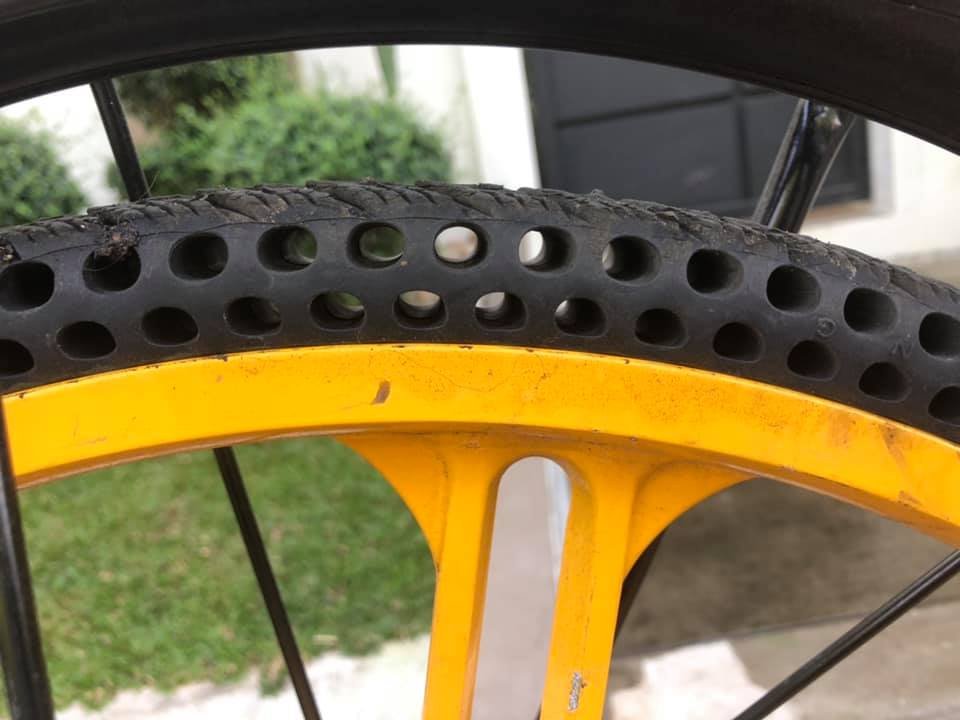
I had posted about the tires on my father-in-law’s newly acquired pedal assist electric bike. Here is what it looks like. Of course, rubber is still the basic material here so perhaps this will be replaced by more durable (indestructible?) material stated in the article above.
–
On a different view of the ’15-minute city’ concept
Here is an article discussing the downside(s) of the 15-minute city; particularly its adoption without understanding first and setting the context for the concept:
O’Sullivan, F. (March 3, 2021) “The Downside of a 15-Minute City,” Bloomber CityLab, https://www.bloomberg.com/news/articles/2021-03-02/the-downsides-of-a-15-minute-city [Last accessed: 3/20/21]
Some people are pushing very much the same concept for quick adoption in the Philippines without again contextualizing it. I feel these people are detached or choose to be so perhaps as they seek shortcuts to achieve what they believe should be the way cities and municipalities are laid out in the country. But wait…don’t we already have 15-minute cities in the Philippines? I will be writing about that soon…
–
On housing and transport
I am always amused about discussions and posts about transport and traffic where people appear to isolate the traffic as what needs to be solved, and where people criticize the latter and state that it is a transport and not a traffic problem. Both do not have the complete picture if that is what we want to start with. Land use, land development and the choices people make based on various other factors (including preferences) are among the other ingredients of the proverbial soup or dish that need to be included in the discussion. Remember land use and transport interaction? That’s very essential in understanding the big picture (macro) before even going into the details at the micro level. Why are there many car users or those who prefer to use private modes over public transport modes? Why do people prefer motorized over non-motorized modes? Maybe because people live far from their workplaces and schools? Why is that? Maybe because of housing affordability and other factors influencing choices or preferences?
Here’s a nice recent article on housing and transportation to enrich the discourse on this topic:
Litman, T. [January 7, 2021] “Housing First; Cars Last”, Planetizen, https://www.planetizen.com/node/111790?utm_source=newswire&utm_medium=email&utm_campaign=news-01112021&mc_cid=2985a82f48&mc_eid=9ccfe464b1 [last accessed: 1/13/2021]
–
On cycling fatalities and the way forward
I’ve read a few articles and social media posts about how its become more dangerous or risky for cyclists during the pandemic. The statistics and observations show that there is an increase in the number of cyclists. I am not even considering here the recreational ones (and I have observed that there are a lot more of them). I focus rather on those who use bicycles to commute between their homes and workplaces; or those who cycle to market or do their groceries. The danger lies mainly from motorists who have little or no regard for cyclists and pedestrians; choosing to hog the roads for themselves. And there seem to be more of these motorists these days, too, as people owning cars have opted to use these instead of taking public transportation.
Here’s a recent article about safety in the US. Those stats and assessments can be replicated here given the availability of data on kilometers traveled and crashes that are usually employed for risk assessments.
Marquis, E. (December 22, 2020) “Cars have killed almost 700 cyclists in 2020,” Jalopnik.com, https://jalopnik.com/cars-have-killed-almost-700-bicyclists-in-2020-1845934793
The only solution for our case really is to put up protected bike lanes. Local standards or guidelines need to evolve and the people behind these should be of progressive thinking rather than relying on “what has been done” or “what they have been doing”. That attitude will only give us poorly planned and designed infrastructure for cycling and walking. The coming year offers some opportunities for active transportation as the DOTr and the DPWH (plus the MMDA in the case of Metro Manila, and perhaps the LGUs where applicable) are supposed to implement major projects intending to produce the bike lanes and walkways for Metro Manila, Metro Cebu and Davao. The budget is in the billions of pesos so much is expected about these projects. Will they become models for other Philippine cities and municipalities to follow? Or will these be like going through the motions just to appease those calling for active transport facilities?
–
On the burdens of car dependence
Here is a quick share today. This is another excellent article from Todd Litman who makes a great argument for why planning should move away from its being car-centric and contribute towards a significant reduction in society’s dependence on cars.
Litman, T. (December 15, 2020) “Automobile Dependency: An Unequal Burden,” Planetizen.com, https://www.planetizen.com/node/111535?utm_source=newswire&utm_medium=email&utm_campaign=news-12212020&mc_cid=e746a044a3&mc_eid=9ccfe464b1 .
Much have been said and written about this topic in many platforms including social media but in many of these, I noticed that the discussion often deteriorated into hating or shaming exercises rather than be convincing, constructive arguments for reforms in planning and behavior and preference changes in transport modes. Litman is always very fair and comprehensive and employs evidence or facts in his articles that should be clear for most people to understand. I say ‘most people’ here because there are still many who are among those considered as “fact-resistant”. Happy reading!
–
Non-motorized logistics
The pandemic and the resulting lockdowns led to people rediscovering what is now termed as active transport modes – walking and cycling. Not that these modes were not being used for travel as usually they, especially walking, represent the last mile/kilometer mode for most people. With the absence or lack of public transportation or service vehicles (e.g., free shuttles for frontliners, office service vehicles, etc.), many people turned to cycling. Perhaps one area outside of commuting where bicycles have plenty of potential (and I use the word ‘potential’ here because it is not yet as widespread as motorcycle use) is for delivery services. It is the general perception that there has been a surge in deliveries for various items especially food from restaurants. Why not employ bicycles either to supplement or augment the usual motorcycles used for such purposes? I took the following photos showing an example of deliveries using bicycles.
 Jollibee delivery rider on a fat bike
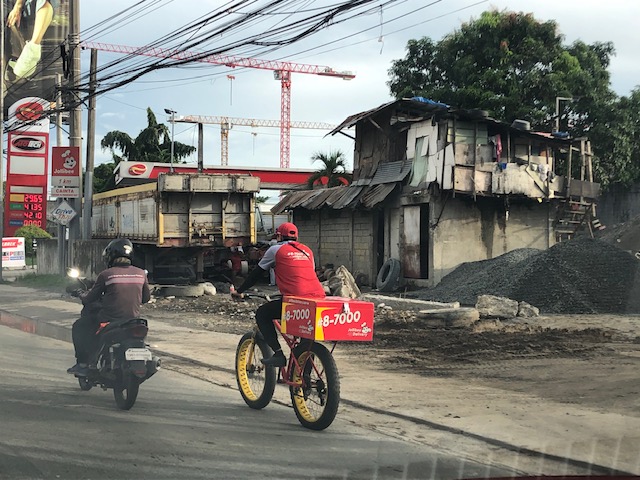 The bicycle rider compared to a motorcycle rider – the bike is just about the same size as the motorcycle, only higher/taller due to the large wheels on the bicycle. The carrier or box is also larger than the typical carrier as it is for transporting food that can be of a large quantity or even multiple orders if these are in close proximity to one another.
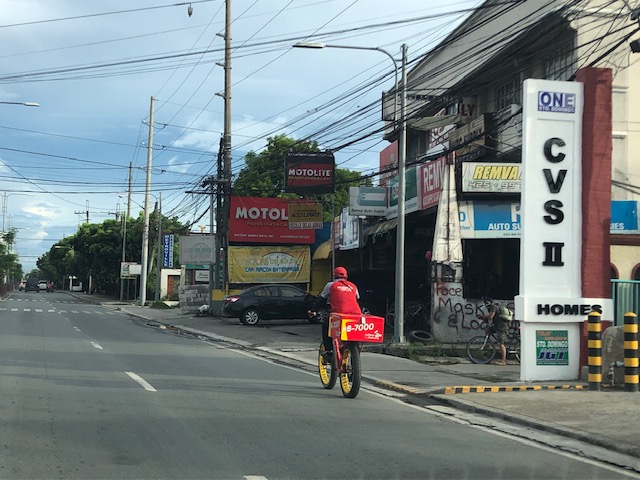 Fast-food delivery via bicycle along Felix Avenue in Cainta, Rizal
–
Pedestrians first!
The Institute for Transportation & Development Policy (ITDP) released a new tool for assessing walkability and presents good practice examples from many cities around the world. The tool can be used to assess and/or compare your city, a neighborhood or a street with others. Here is the link to the ITDP’s tool:
https://pedestriansfirst.itdp.org

There is an introductory article that came out recently from Planetizen about this tool:
Litman, T. (October 16, 2020) ‘Pedestrians First’ Measures Walkability for Babies, Toddlers, Caregivers, Everyone. Planetizen. https://www.planetizen.com/node/110876?utm_source=newswire&utm_medium=email&utm_campaign=news-10192020&mc_cid=1736ec624f&mc_eid=9ccfe464b1
–
On sharrows
The term ‘sharrow’ basically short for shared right-of-way and refers to lanes or roads that are ‘designated’ for all modes of transport including and especially non-motorized ones such as bicycles. It also refers to the lane markings. There have been some mixed experiences and opinions about sharrows; particularly referring to whether they are effective. Here’s an article from the director of technology of Smart Design, which is a strategic design and innovation consulting firm in the US that gives another opinion (an evidence-based one) about sharrows:
Anderson, J. (September 30, 2020) “Safer with sharrows?”, World Highways, https://www.worldhighways.com/wh12/feature/safer-sharrows
I guess the experiences in different countries vary according to several factors. Perhaps these include cultural factors that also relate to human perceptions and behavior? Education is also definitely a factor here aside from awareness. And we have to work harder on these and together, rather than play the blame game on this matter that relates to safety. How many times has the observation that Filipinos tend to regard road signs and markings as merely suggestions rather than guides and regulations?
–
On the transformation from car-oriented to people-oriented streets
I saw this article shared by a friend on social media and share it here as an interesting piece providing ideas and the thinking or attitude required if we are to transform our streets:
Jaffe, E. (2020) “4 ways to go from “streets for traffic” to “streets for people”, Medium, https://medium.com/sidewalk-talk/4-ways-to-go-from-streets-for-traffic-to-streets-for-people-6b196db3aabe [Last accessed: 9/30/2020]
It is actually interesting to see how this plays out in Philippine cities. The ‘honeymoon’ or ‘grace’ period from the lockdown to the ‘normalization’ (read: going back to the old normal) of traffic might just have a window and this is closing for active transport. National and local officials, for example, who seemed enthusiastic and quickly put up facilities for active transport have slowed down efforts or even stopped or reneged on their supposed commitments. The next few weeks (even months) will show us where we are really headed even as there are private sector initiatives for active transport promotion and integration.
–

