
Home » Policy (Page 18)
Category Archives: Policy
Another look at the ‘avoid, shift and improve’ framework
The transport and traffic situation during this pandemic has revealed a lot about what can be done and what needs to be done about transportation. Discussions about what and how people visualize their ideal or acceptable transportation system reminded me of the backcasting concepts and the tools. The following diagram is sourced from the SLoCaT homepage: https://tcc-gsr.com/global-overview/global-transport-and-climate-change/
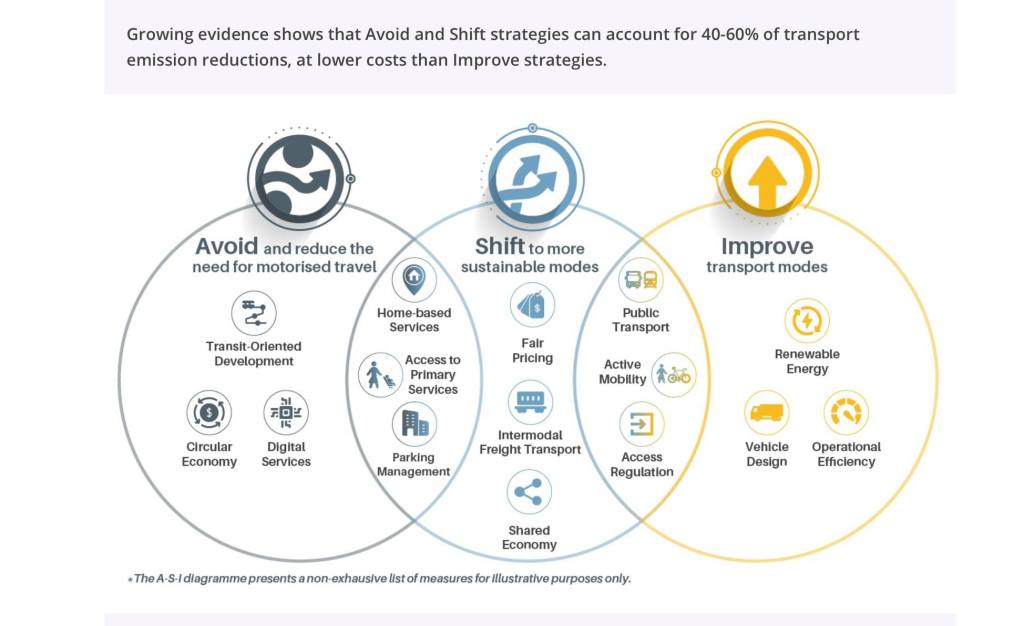
Note the overlaps among the three? Do you think its possible to have a measure that’s avoid, shift and improve at the same time?
Note, too, that if we contextualize this according to the Covid-19 pandemic, these measures even make more sense rather than appear like typical, ordinary measures we have about transportation. The pandemic revealed many weaknesses or vulnerabilities of our transportation system. We are presented with the opportunity to address these and implement certain measures that would have met with a lot of opposition before but can probably be rolled out now such as public transport priority schemes and protected bike lanes. “Work from home” is not really new since the concept has been proposed and implemented before but not as widely as was required by the pandemic situation. So perhaps we should take advantage of this forced reboot of sorts for our transportation system to be able to implement this A-S-I framework.
–
On the arguments vs. free transit
Here is a quick share of an article discussing about the idea of free public transport (no fare or minimal fares):
Grabar, H. (June 1, 2021) “The Problem with Free Transit,” Slate, https://slate.com/business/2021/06/free-transit-is-not-a-great-idea.html [Last accessed: 6/16/2021]
Apparently, “better transit, not cheaper transit” should be the mantra for both providers (operators including government) and users (commuters). It is a very sensitive topic for regulatory bodies though since higher fares are generally unpopular to the commuting public. One transport official recently stated that fare setting is a political issue. I tend to agree with this but only because the riding public is currently still largely ignorant or unappreciative of the benefits of efficient public transportation. Perhaps this is also because we’ve really had no efficient public transportation such as the ones we see in other countries including Singapore and Hong Kong? In Singapore, for example, the road pricing policies have educated people about the true costs of transport and that convinces most to take public transportation over private cars.
–
Guidelines pertaining to bike lanes in the Philippines
The Department of Transportation (DOTr) and the agencies under it are now promoting bicycle use. Part of the campaign is to improve the safety of cyclists, most especially those using bikes for commuting (e.g., bike to work). Recently, the agencies have posted infographics showing the guidelines for bicycle lanes. Here is one from the Land Transportation Office (LTO), which is in-charge of vehicle registration and the issuance of driver’s licenses:

These are still basically guidelines that apparently do not carry a lot of weight (i.e., no penalties mentioned) in as far as enforcement is concerned. As they say, these appear to be merely suggestions rather than rules that need to be followed or complied with. Perhaps local government units can step in and formulate, pass and implement ordinances penalizing people violating these guidelines? These penalties are important if behavior change among motorists is to be achieved.
–
Revising the DPWH Design Manuals
A friend posted about the current initiatives in the US as they embark on revising their Manual on Uniform Traffic Control Devices (MUTCD). This manual along with AASHTO’s Geometric Design of Highways and Streets and their Highway Capacity Manual are something like the holy trinity for Highway and Traffic Engineers. These are also the main references for our DPWH for the manuals and guidelines we use in traffic and highways.
Here are a couple of articles calling for the revisions to reflect recent designs mainly from NACTO, which itself publishes guidelines for roads to be more inclusive rather than car-centric:
NACTO (May 2021) Modernizing Federal Standards: Making the MUTCD Work for Cities, https://nacto.org/program/modernizing-federal-standards/
NACTO (May 11, 2021) A Blueprint to Update America’s Street Manual, https://nacto.org/2021/05/11/a-blueprint-to-update-americas-street-manual/
We don’t have to pattern revisions after the MUTCD but then that requires that the DPWH through its Bureau of Research and Standards (DPWH-BRS) do its part in compiling, reviewing, studying and adopting materials from various countries, and developing suitable standards and guidelines for roads in the Philippines. Do they have to reinvent the wheel? Not so and they can still refer to the US manuals as long as again these are localised for our conditions and situations.
–
Vienna Conventions on Traffic and Road Signs
There are two important international conventions or agreements that the Philippines is a signatory to. These are the
Vienna Convention on Road Traffic (November 8, 1968):
and the Vienna Convention on Road Signs and Signals (November 8, 1968):
These are important as signatories are bound but the agreements on road traffic rules and regulations and standard signs and signal. I included the links to each agreement as they also include the exceptions taken by different countries such as Thailand and Vietnam declaring they will not be bound by Article 44, choosing to classify mopeds as motorcycles. Apparently, the Philippines did not declare exceptions or objections to any of the articles.
–
Are roads really designed just for cars?
The answer is no. Roads were and are built as basic infrastructure for transport no matter what the mode. However, the standards for dimensions (i.e., number of lanes, widths, etc.) are based on the motor vehicle capacity, and structural standards (i.e., thickness, strength, reinforcement, etc.) are based on the weights they are supposed to carry over their economic lives. The pavement load as it is referred to is usually based on the cumulative heavy vehicle traffic converted in terms of the equivalent standard or single axles or ESA. An ESA is 18,000 pounds or 18 kips in the English system of measurements or 8.2 metric tons in the Metric system.
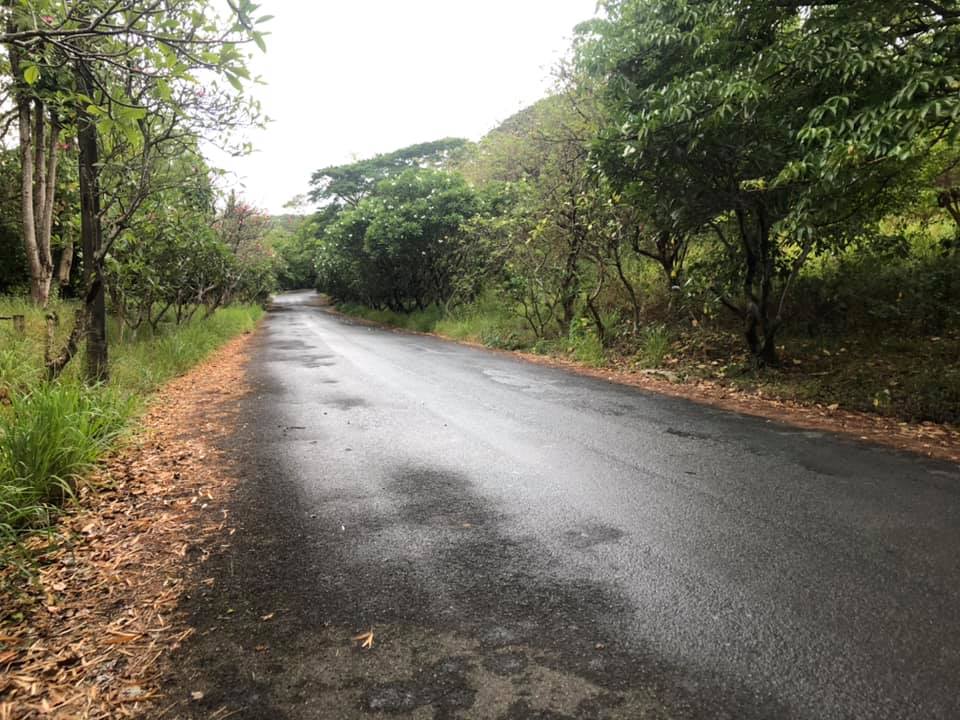 A typical local road – is it really just for cars or is it also for walking and cycling? Or perhaps animal drawn transport?
A colleague says many of the posts in social media pitting bicycles with cars are already quite OA (overacting). I tend to agree as I read how people generalize roads being car-centric. Roads have been built basically to serve a avenues for transportation. They were improved over time in order to have more efficient ways to travel by land. It didn’t hurt that vehicle technology also developed over time and bicycles somehow became less popular than the cars and motorcycles. The motorcycle itself evolved from bicycles so in a way, it is the evolved and mechanized form of the two-wheeler.
In a perfect world, people would be sharing the road space and it would be equitable among different users. In a perfect world perhaps, it won’t be car-centric as there would probably be better public transport options and transit will be efficient, reliable, comfortable and convenient to use.
The reality, however, is that we do not live in a perfect world and transformations like the ones being pitched on social media are nice but are also not as inclusive and equitable as their advocates claim them to be. I’ve always said and written that you cannot simply change transportation without also implementing changes in land use and housing in particular.
Why do we need wide roads connecting suburbs and urban areas? Why is there sprawl? Why do people live in the periphery of CBDs or the metropolis? It is not just about transport though it seems easier to focus on this. Even transportation in Japan, with Metropolitan Tokyo and its equivalent of NCR plus as a subject, needs to be properly contextualized for land use and transport interaction and development. It seems that even with a comprehensive and efficient railway network, there are still shortcomings here and there. We don’t have such a railway network (yet) so we need to find ways for easing the currently long and painful commutes many people experience on a daily basis. That means continued dependence on road-based transport and trying to implement programs and schemes to improve operations.
–
On the “safe system” approach in road safety
We kick-off the UN Global Road Safety Week with a road safety feature. Here is an excellent read from Johns Hopkins University’s Hub:
(May 13, 2021) “Safe system” approach could dramatically reduce road deaths while improving equity, Hub, https://hub.jhu.edu/2021/05/13/safe-system-roads-could-reduce-road-accidents-deaths/ [Last accessed: 5/14/2021]
To quote from the article:
“The Safe System approach engineers road systems so that they are safe when used intuitively, the way people tend to use them. A Safe System minimizes the chances for mistakes by drivers, pedestrians, and bicyclists, and reduces the intensity of crashes when they do occur.”
There are so many situations and locations around the country that could be improved using this approach. The safe system approach is actually embedded in the country’s current Road Safety Action Plan (RSAP).
 Road and traffic environment in front of the main gate of a high school in Zamboanga City
–
Article on sustainable mobility
Here is a quick share of an article from Cities Development Initiative for Asia or CDIA. The title may already be quite cliche by now (i.e., along the lines of the slogan “move people, not cars”) but the message is clear and cannot be emphasized enough especially as people grapple with the impacts of the pandemic on transportation. For the reader, take note of the avoid-shift-improve framework, which is quite useful in describing what needs to be done in order to address the climate impacts of transportation systems.
Cities Development Initiative for Asia (April 22, 2021) “Sustainable Mobility is About Moving People, Not Vehicles,” cdia.asia, https://cdia.asia/2021/04/22/sustainable-mobility-is-about-moving-people-not-vehicles/ [Last accessed: 5/2/2021]
–
On building the ideal city from a transportation perspective
There’s a not so old article that popped in my timeline of articles I’ve read the past years. I thought I would make a quick share of it here. It is a good read and something that will never be irrelevant for as long as we have not redeveloped our cities and municipalities for transport equity and sustainability. Here’s a takeaway from the article:
“The ideal city is a place where lots of different kinds of people with lots of different amounts of money can live and work. It has to be easy to get around without a car, even for people whose bodies can’t ride bikes or hop over potholes, and for people who have kids to drop off on the way to work and groceries to buy on the way home, and maybe flowers to buy next door to the dry cleaner’s. These are places where people want to live, because it’s nice there. The fact that those places also adapt to and mitigate climate change instead of causing it is a bonus.”
Here’s the article from last year:
Rogers, A. (April 1, 2020) “Build Cities for Bikes, Buses, and Feet—Not Cars,” Wired, https://www.wired.com/story/cities-without-cars-san-francisco-jeff-tumlin/?bxid=5bd6761b3f92a41245dde413&cndid=37243643&esrc=AUTO_OTHER&source=EDT_WIR_NEWSLETTER_0_ENGAGEMENT_ZZ&utm_brand=wired&utm_campaign=aud-dev&utm_mailing=WIR_Classics_042921&utm_medium=email&utm_source=nl&utm_term=WIR_Daily_TopClickers [Last accessed: 4/30/2021]
–
On when to use masks when outdoors
Here is a useful graphic from the US Centers for Disease Control and Prevention. The graphic described situations for when masks are required. I don’t want to use preferred because it means people may opt out of using masks. It is a useful reference even for those in other countries that do not have enough clear information from their governments about wearing masks and how it helps protect vs. getting infected by Covid-19. It is applicable to people searching for a legit reference to mask-wearing in outdoor situations.

This information becomes more relevant as people start getting vaccinated and at the same time look forward to getting together with family and friends in social events such as eating out or having picnics. Of course, this also applies to exercise as well as commuting via active transport modes (i.e., walking or cycling).
–
 Caught (up) in traffic