
Home » Policy (Page 34)
Category Archives: Policy
New publication on urban transport by ITDP and UC-Davis
There is a new publication on urban transportation from Institute for Transportation and Development Policy (ITDP) and the University of California-Davis. The link may be found here:
Three Revolutions in Urban Transportation

The content reminded me of similar exercise we did back in 2013-2014 for ASEAN where we did visioning and simulations for low carbon transport in the region by 2050. Electrification was a major assumption for the Philippine case as electric vehicles were gaining ground (they seem to be in a limbo now) back then and on the verge of a breakthrough. Not yet evident for the Philippines was the eventual rise of sharing, and though the idea is out there, automation seems to be too high tech for the country (even Metro Manila) for now.
–
Wheel “chaining” in Taytay, Rizal
Another municipality that has become somewhat aggressive in its campaign against illegally parked vehicles is Taytay also in Rizal province. In the case of Taytay, instead of wheel clamps, authorities have opted to employ what appears as more cost efficient (read: less expensive) tools in their campaign – chains and locks. Instead of the more sophisticated (and likely more expensive) wheel clamps in neighboring Antipolo, chains are wrapped around one of the front wheels of a vehicle and then secured by a lock. Examples are shown in the following photo:
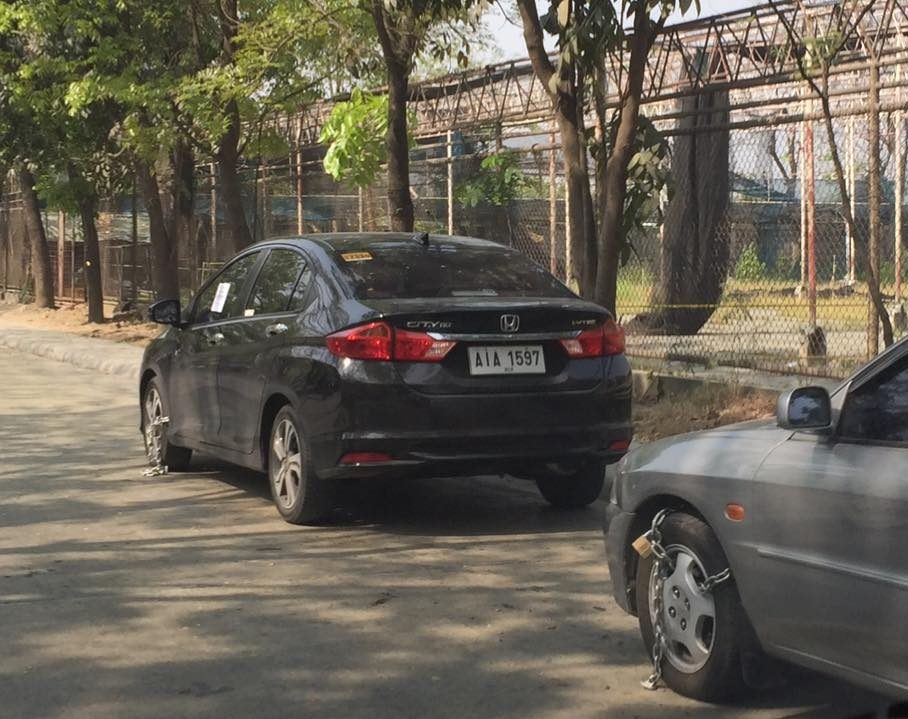 Car wheels chained and padlocked along Don Hilario Cruz in the Taytay Public Market area. The road connects the Manila East Road with the new Taytay municipal hall complex.
Anti-illegal parking enforcers also post a sheet of paper on the window of the vehicle to notify the driver about the violation. The enforcers are posted nearby; waiting for drivers to approach them. There’s supposed to be a fine similar to when a vehicle is towed and reclaimed by the driver or owner. This, campaign, however, seems to have been relaxed in the same area where I took the photo as there are again a lot of vehicles parked on either side of the street on the Saturdays that I pass by the area. I’m not yet sure if this is a case of ningas cogon on the part of the municipality or perhaps they are just exercising some flexibility considering the parking demand for the market and the numerous clothes shops there where wholesalers flock to for merchandise. I haven’t seen similar “chaining” activities in other parts of Taytay unlike Antipolo, which has been continuously and consistently conducting campaigns throughout the city.
–
Wheel clamping in Antipolo
Earlier this year, Antipolo City implemented an aggressive campaign against illegal on-street parking. This policy was borne out of a new ordinance penalizing on-street parking that has been perceived as the cause of traffic congestion along many of the city’s roads. A more detailed description of the conditions or situations warranting wheel clamping may be found in the Antipolo City website.
The following photos were taken from the Antipolo City Government Facebook page:


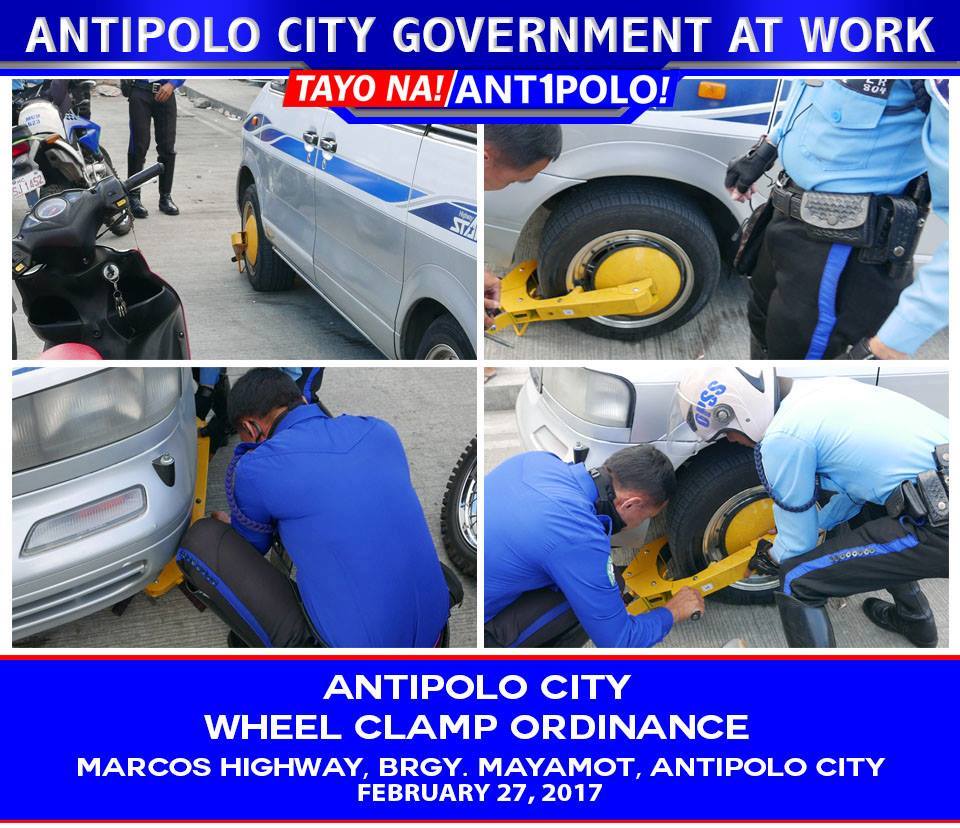
The ordinance and its implementation by the city is very timely (some may say overdue) considering that many streets particularly in the city center is already clogged with vehicles parked on-street. In certain cases, there’s double parking; severely constricting traffic flow even along one-way streets. There are (as always) evidence of resistance but hopefully, the city’s resolve will overcome and improve the situation.
I think another thing that should be in Antipolo’s agenda that’s very much related to the problem of on-street parking is the requirement for off-street parking spaces as stipulated in the National Building Code. The Code actually prescribes for the minimum number of slots per building or development but it is the local government that is tasked to implement or enforce the provisions in the NBC. Going around Antipolo, one can observe that there are many establishments clearly in violation of the Building Code provisions. One major university, for example, along Sumulong Highway does not have enough spaces considering the vehicle trips it generates. This situation is compounded by the expansion of the school to include a hospital and the adjacent commercial development that conspicuously also appears to not have enough parking spaces. An LGU can actually have a policy for stricter minimum parking slots. Quezon City and Makati City have ordinances stating so but have had mixed results compared to the outcomes they probably thought about as desirable.
Of course the topic of minimum parking spaces is currently the subject of discussions in other, more progressive cities and countries, and particularly those with better developed public transport and more disciplined land development. While relevant to us here in the Philippines, it is a topic that is not yet ripe for serious discussions given the many concerns (i.e., violations, non-compliance issues) that still need to be addressed by LGUs like Antipolo City at present.
–
Some issues abroad on car sharing/ride sharing companies
There are two articles recently that are worth reading for those who are into ride-sharing/car-sharing. And I am not necessarily referring to those who regularly take Uber or Grab, or those who opt to use these whenever they need a taxi ride. There are many who are already studying these services being provided not by your traditional or conventional taxi companies or rental vehicle companies but by supposedly private individuals who supposedly have the spare time and spare vehicle that they can use to provide transport for other people. I use the word “supposedly” here because this is a big assumption and the premise by which transport network companies like Uber, Grab and Lyft have been able to go around the bureaucratic processes that taxi and other companies have to go through as formal public transport (i.e., public utility vehicles). These articles are along the lines of the discussions in previous articles I have posted here about ride-sharing/car-sharing, and are mostly based on the experiences in countries who have more developed and presumably better transport than us in the Philippines.
Denton, J. (2017) Two Federal Lawsuits Could Spell Big Trouble for Uber, Pacific Standard, http://www.psmag.com, April 10, 2017.
McGraw, D.J. (2016) How Lyft and Uber are Ignoring the Poor, Pacific Standard, http://www.psmag.com, May 12, 2016.
I leave it up to my readers (any researchers out there?) to pick-up the main points and perhaps look at the issues from different perspectives. I have pointed out before that the situation in Metro Manila could be very different from the situations in other major cities like Cebu, Davao and Iloilo. And so transport network companies may not necessarily succeed in cities where taxi services, for example, are significantly better than what we have in Metro Manila.
–
Resources on traffic calming and recalling statistics on road safety in the Philippines
As I usually post on some interesting and useful articles on transportation and so I just couldn’t resist sharing this find on resources for traffic calming. This is always a timely source of material on how we can improve road safety particularly in residential areas or where there are more pedestrians exposed to transport and traffic. Such exposure increases the likelihood that they may be involved in a crash.
I recall an article from 2015 that appeared on Rappler:
Francisco, K. (2015) Road deaths in PH: Most are motorcycle riders, pedestrians, Rappler, http://www.rappler.com, October 27, 2015.
The WHO Global Status Report on Road Safety 2015 is a good resource for statistics and the report can be easily downloaded along with other information, and in different languages. Here is the entry for the Philippines appearing in the report:

–
On motorcycle taxis becoming the “new king of the road” (cont.)
This is a continuation of the yesterday’s post on motorcycle taxis. The feature appearing in Sunstar Philippines also focuses on the case of Cebu City where there is a rising demand for motorcycles and issues on public transport have given rise to a motorcycle taxi use despite their being basically illegal under current laws/guidelines. Habal-habal as these motorized 2-wheeler taxis are known have been in service in many cities and municipalities but are mostly tolerated in rural areas where conventional public transport services are scarce.
Part II of the feature by Sunstar:
New King of the Road – Part II
There are three articles in Part II:
Ramirez, J.A.C. (2017) Motorcycles on the rise, Sunstar Philippines, Retrieved from: http://www.sunstar.com.ph, April 4.
Ramirez, J.A.C. (2017) Habal-habal drivers form group to ‘professionalize’ services, Sunstar Philippines, Retrieved from http://www.sunstar.com.ph, April 4.
Ilano, M.V. (2017) Hailing a motorcycle taxi with your smartphone, Sunstar Philippines, Retrieved from http://www.sunstar.com.ph, April 4.
Part III of the feature by Sunstar:
New King of the Road – Part III
Ilano, M.V. (2017) Even with BRT, motorbikes still needed in Cebu City, Sunstar Philippines, Retrieved from www. sunstar.com.ph, April 4.
Ilano, M.V. (2017) Will Cebu City lead the way?, Sunstar Philippines, Retrieved from http://www.sunstar.com.ph, April 4.
I hope these articles on motorcycles and motorcycle taxis will generate meaningful discussions pertaining to their applications and perhaps their regulation. One issue, of course, that should definitely be on the table is safety. That is non-negotiable and assurances by motorcycle taxi transport providers should not be enough to persuade their becoming formalized as a public transport mode. The basis for mainstreaming these should be evidence-based including assessments based on crash (accident) data. Here is something that can be studied by the various schools around the country especially universities that have the capacities and capabilities to conduct such studies in aid of policy formulation at the national and local levels.
–
On motorcycle taxis becoming the new “king of the road”
There is a really nice feature on Sunstar about motorcycle taxis that came out today. This was shared by a good friend on his social media account, which got my attention as we just completed a study on motorcycles last January 2017. Here is the feature:
Part I includes two articles:
Ilano, M.V. (2017) Habal-habal invades cities, Sunstar Philippines, Retrieved from http://www.sunstar.com.ph, April 4.
Anunciado, D.D. (2017) Deadly motorcycle rides, Sunstar Philippines, Retrieved from http://www.sunstar.com.ph, April 4.
Here’s a graphic from the second article that says a lot about motorcycle safety in Metro Manila:

I would just like to comment that the graphic shows MMDA-recorded crashes in Metro Manila. There can be a lot of incidents that went unrecorded or unreported with the MMDA. It would be interesting to check with the local government units about their own statistics and compare these with the MMDA’s. Also, “crashes” is the preferred term over “accidents” as road safety practitioners and advocates argue that these are preventable incidents.
Sadly, such statistics can only be shown by cities doing the diligent work of recording such incidents. The Department of Public Works and Highways (DPWH) has already ceased collecting, processing, analyzing and reporting road crash reports many years ago (which is quite surprising for an agency mandated to plan, design, construct and maintain national roads). There is currently no agency (no, the Department of Transportation (DOTr) has not yet taken over the enormous task) that is collecting, processing, analyzing and reporting on road crashes at a nationwide scale and few LGUs do so at their levels.
I will also post about Part II once its out. There is a preview of what articles will be in the next feature and so that is something to look forward to.
–
“Great wall” of trucks along C5
The Metro Manila Development Authority (MMDA) has implemented a truck lane policy along Circumferential Road 5 during the last administration. It has continued at present and a long line of trucks are regularly observed along C-5 whenever the truck ban is lifted during what is designated as off-peak hours for all other traffic. Many travelers have termed the line as a “Great Wall of trucks” although in many instances, the line is “breached” by vehicles needing to shift lanes along this major thoroughfare. Strict implementation by the MMDA and the affected LGUs as well as the compliance of most trucks have led to the maximization of the occupancy of the designated truck lanes. These are easily observable along most of C-5 and particularly along sections close to the CBDs (e.g., BGC, Ortigas, Eastwood, etc.). Following are a few photos showing the long line of trucks along C-5:


Here’s another photo I took earlier last month:

We have a couple of students now at UP Diliman who are studying the policy and taking a look at the traffic and pavement conditions along C-5. Interesting would be their comparisons of traffic along the truck and non-truck lanes during both peak and off-peak periods as well as for weekdays and weekends. Interesting, too, will be their assessment of pavement conditions. So this will be something to look forward to once the research is completed this coming May 2017.
–
Incentives for not driving?
There’s a nice article on Wired that argues for giving an incentive to commuters to give up driving (i.e., using their cars to go to/from workplaces). My only comment here is that it might have better chances elsewhere but not in the Philippines where such incentives often are seen as dole-outs and, despite guidelines or rules for implementation, are likely to be abused or taken advantage of in many offices. This is especially true when cities do not have good quality public transportation and you have low priced motorcycles and cars on sale with the many dealerships. Sad to say but the Philippines is not ready (not mature enough?) for such schemes.
Want commuters to ditch driving? Try giving them cash money
The article is by Aarian Marshall and appeared on the online version Wired last March 26, 2017.
–
MMDA statement on the odd-even scheme
The MMDA released a statement today about the much criticized Odd-Even scheme for EDSA that was floated on mainstream and social media. I will not comment on the statement but instead just reproduce the post on Facebook here:

What do you think?
–

