
Home » Policy (Page 49)
Category Archives: Policy
Taming the beast(s) of traffic
An article came out of Rappler last weekend referring to addressing one of the most persistent problems in Metro Manila – traffic. It is a problem that is the result of years of neglect, poor planning, inconsistencies and a lack of foresight for future transport needs.
“Perhaps there are more than one beast to talk about considering that there is not one cause of the transport and traffic problems we experience everyday in Metro Manila (and elsewhere). We love ranting about how traffic is bad and how other people should leave their cars at home and yet we do little ourselves to pitch in to improve the situation. And so we are beasts ourselves in this manner. The discussions on public transport and road infrastructure have been going on since perhaps the author decided to practice transportation engineering. What has changed? Have things improved or have they worsened? It is really difficult to effect change when decision-makers and policy-makers are short of memory or have no memory or understanding at all of what’s going on. It seems that we are always starting on a clean slate every time someone new is at DOTC, DPWH or whichever agencies are supposed to handle transport and traffic in MM (and the country). Perhaps some criteria should be applied to whoever will be in-charge of transport and traffic, and one should be that the person or persons should be someone taking public transport to the workplace. At the least, we can be assured that he/she has first-hand experience of the painful way we travel each day and lead the person to really work towards improving transport in this country.”
I don’t usually write replies or comments on material posted online. I believe it is a very public platform and nowadays, when there’s a lot of talk on items like plagiarism, transparency, freedom of information, etc., it seems so easy to solicit opinions and comments from anyone who would care or dare post one. And transport and traffic seems to be a topic where everyone has his/her own opinion so much so that some people tend to project themselves as experts on the topic. Nevertheless, I thought that an opinion was necessary in order to offer another perspective on the matter of the “beast.” I would like to believe that in our case, we probably have had one too many “thought leaders” in transport and traffic. It is time that we also have “action leaders” who would do rather than simply say or write. We need people who will practice what they preach and actively and willingly contribute when called upon for help in solving this traffic mess we are in.
–
Loss of productivity due to congestion and inefficient public transport
I recently read two articles appearing in a major Philippine daily and a popular online site. The first one is an article that appeared in the Philippine Daily Inquirer – “PH economy losing $3.27B in human productivity due to traffic mess” – last September 25, 2012. The other article was posted on Rappler – “Traffic and infrastructure delays cost the Philippines” – last September 27, 2012. These were articles written after the authors’ attendance of what was an Energy and Infrastructure Forum last Sept. 25 where a transport official mentioned a recent study in his talk that estimates productivity losses of about 3.27B USD per year from Metro Manila traffic alone.
 Traffic congestion along Commonwealth Avenue
 Unusual traffic management scheme along Ortigas Avenue
The study from the National Center for Transportation Studies that was mentioned in both articles was actually first featured in a Yahoo! Philippines article – “Traffic congestion costs Metro Manila P137B per year” – that appeared a month earlier in Aug. 28, 2012. The study being referred to is actually a paper presented by Dr. Jose Regin F. Regidor in his Professorial Chair lecture at the University of the Philippines Diliman’s College of Engineering Colloquium in early August 2012. A copy of the paper may be found below:
Prof Chair 2012 JRFR 02July2012
The main reference for this paper is the study on congestion costs that was produced by the National Center for Transportation Studies back in 2000. Credits go to the core team of Dr. Ricardo Sigua (Institute of Civil Engineering of UP Diliman), Dr. Noriel Tiglao (now with the National College of Public Administration and Governance) and Dr. Val Teodoro (now in the US) for the study. The
Economic Impacts of Traffic Congestion in Metro Manila – Cover+Chap 1 and 2
Economic Impacts of Traffic Congestion in Metro Manila – Chap 3
Economic Impacts of Traffic Congestion in Metro Manila – Chap 4 and 5
Economic Impacts of Traffic Congestion in Metro Manila – Appendix
A much needed update may be possible in the next two years once the traffic model for Metro Manila is updated and calibrated using new data from Household Informations Surveys (HIS) and other transport and traffic surveys under the current MUCEP study that is supported by the Japan International Cooperation Agency (JICA). Hopefully, such a model can be updated and calibrated more often in order to assess losses due to congestion and our continuing inability to provide the necessary infrastructure to alleviate the situation. While the paper and the study mentioned above focus on productivity losses, it should be emphasized that there are other costs that should be highlighted including those related to health (respiratory diseases and road crash fatalities and injuries), energy (fuel consumption and inefficiencies), and emissions (carbon and other GHG).
–
Esplanade Drive
I enjoy walking in Singapore and perhaps to compare with walking in Japan, the only difference at times would be that at certain times of the year, it’s much cooler (or colder) in Tokyo or Yokohama. Outdoors in Singapore it can be uncomfortable due to the humidity but its actually the same in the temperate countries during summer. Among the more enjoyable walks even during workdays would perhaps be along the Esplanade connecting the Marina Square and Suntec areas with the offices across the river as well as the newly famous Marina Sands development.
 View of the drive from the Marina district towards Fullerton and the financial district across the bridge.
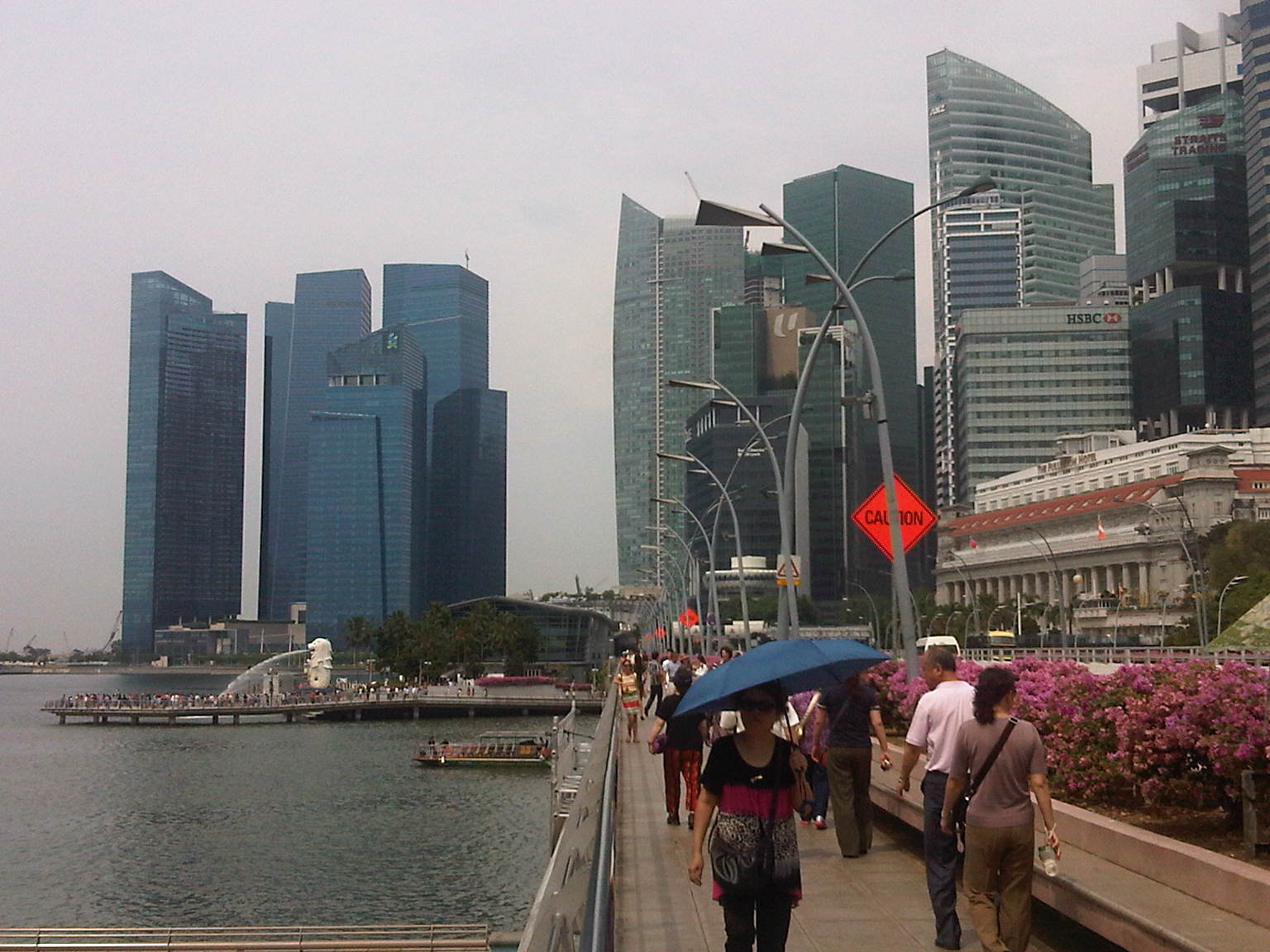 View of the walkway, which is alongside the carriageway but separated by a plant box. That’s the Merlion on the background with all the people crowding probably to take souvenir photos with the city state’s symbol.
 The Esplanade bridge with the skyscrapers of Singapore’s financial district in the background and the famous Fullerton Hotel at the center.
The key really is to enhance the walking experience such that people would not at all notice the distance they were traversing. Walking should be for everyone and not just something for those regarded as transport poor. In cities in progressive countries, for example, you see professionals in their suits mixed with people in casuals and students wearing their uniforms walking their chosen paces along streets provided with facilities suitable for walking and the volume of walkers (Yes, there is such a thing also as a level of service for pedestrian facilities and flow).
I would have taken photos of the connections between stations and places of interest in Singapore but I usually only had my trusty cell phone rather than a professional camera. With all the cameras installed around the city, my taking of photos might be misinterpreted rather than dismissed as just another camera nut taking souvenir or “artistic” shots of places.
–
But seriously…recognizing walking as a mode of transport
There is a general observation that urban planning in the Philippines, including planning and design for transport, revolves around motor vehicles. In fact, much of what we think are sound policies and guidelines, even rules of thumb, are car-oriented rather than people-oriented. Our love for the car is often traced to our being a colony of the United States and our orientation to cars have been reinforced over the years by policies, plans and projects that seem to be biased for car users while detrimental to commuters in general. In fact, we have been used to having roads built and widened that these types of projects seem automatic, no brainer solutions to the traffic problems we encounter everyday. Not that this is a bad thing, considering that we do have many missing links to complete and infrastructure to build where they are needed. Yet, for many of our highly urbanized cities, public transport infrastructure has been too slow to address the demand for movement.
Metro Manila is already choking in as far as traffic is concerned and our proposed solutions still are road widening and the call for elevated expressways. Meanwhile, we have poor road public transport services and a limited rail or mass transit network. It seems that most of the plans for trains and BRTs have never left the proverbial pipeline and as such, we continue to languish in I would like to think that a lot of people would want to take public transport if only the quality of service is similar to systems in Singapore, Hongkong, Kuala Lumpur or even Bangkok or Jakarta. We have to deliver on this end, which will also see our streets begin to become decongested as vehicles will naturally decrease with people choosing PT over their cars, especially in this period of increasing fuel prices.
Of course, these public transport infrastructure carry hefty price tags. And so to complete the picture and solve the puzzle of transport in cities like Metro Manila, Cebu and Davao, we would need to address what is perhaps the most basic for of transport that is often forgotten when talks center on highways and mass transit – walking. It is a fact that walking is the mode with the highest share for transport; dwarfing all other modes since we all walk at some point of our trips (e.g., Car users still have to walk to and from the parking spaces.) Unfortunately, we seem to have become lazy, preferring to ride than to walk and making so many excuses even when the facilities for walking are already provided and conditions favor walking over motorized transport. Of course, the main challenges for ensuring the safety and comfort of those who choose to walk remain and investments are required for more infrastructure to encourage walking. There are good practice examples like the walkways connecting buildings at the Makati CDB and the sidewalks of Quezon City. These are, however, more the exception than the rule and so there is still a need to actually “formalize” walking as a mode of transport and one that could probably save us a lot of fuel, reduce emissions and, most importantly, improve our health and well-being.
Following are excellent articles for reading, and for consideration when we re-think what we are doing to improve transport and mobility in our cities. A re-orientation is in order for us to address
(Note: the sources and links to the online articles are shown below and in the files. These are made downloadable here only to facilitate access to the articles. There is no intent for any copyright infringements.)
Why don’t Americans walk more? The crisis of pedestrianism:
What scientists know about how pedestrians really behave:
Walking_in_America__What_scientists_know_about_how_pedestrians_really_behave_
How walk score puts a number on walkability:
Walking_in_America__How_Walk_Score_puts_a_number_on_walkability_
With America and the rest of the world taking a second and perhaps critical look into how they are planning their transport systems and focusing on encouraging people to walk, we should perhaps take this as our cue to also re-think how we are planning and designing our systems. We should, and not be too dependent on the recommendations of studies past and present that seemingly try to simplify our plights as something that can be solved by roads and cars alone.
–
Noise Standards in the Philippines
Caught a show on television featuring noise pollution in the Philippines. The feature on noise included the reporter accompanied by a person who measured ambient noise using a portable noise meter.The results were quite interesting if not surprising, including the alarming measurements inside a high school classroom at a building beside EDSA. There was also the segment where hearing damage was covered, particularly those derived from workplaces (e.g., factories).
Of course there are many sources of noise, but it seems that much of it nowadays is associated to vehicular traffic (e.g., tricycles, trucks, etc.). Nevertheless, we often disregard a lot of the other sounds around us because they are part of what we hear everyday and we have gotten used to them. To be able to appreciate the totality of the sounds (noise) that we often disregard, much is actually eliminated when we have blackouts. That means no TV, no stereos, no electronics that produce sounds that we take for granted.
I reproduce below the three pages of what was the National Pollution Control Commission’s Memorandum Circular No. 002, Series of 1980, as published in the Official Gazette of the Republic of the Philippines, which until now serves as the basis for noise standards in the country. Recent initiatives led by the DENR’s Environmental Management Bureau seeks to update/revise these standards and a draft has been circulated to members of an inter-agency committee and industry. Perhaps our local governments could take a look at laws that are often set aside in part because of a lack of instruments to be able to quantify noise. I think curbing noise pollution should significantly improve our quality of life and would have positive impacts to our health.
 Page 1 of the NPCC Memorandum Circular No. 002, Series of 1980
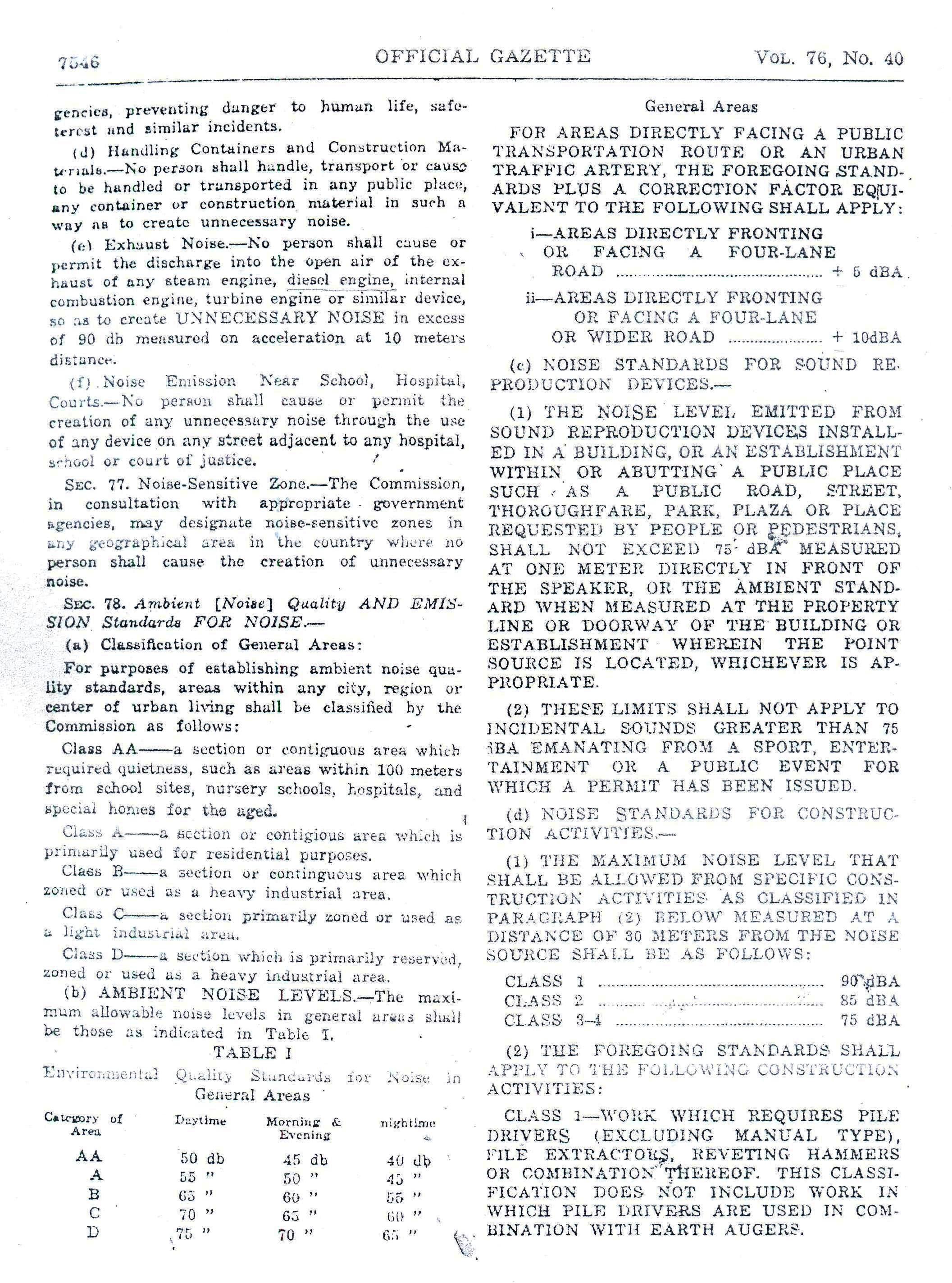 Page 2 of the NPCC Memorandum Circular No. 002, Series of 1980
 Page 3 of the NPCC Memorandum Circular No. 002, Series of 1980
Perhaps the material above should serve as a basic guide for local governments and private citizens in monitoring noise. People should be knowledgeable of what can be considered as unacceptable. We have never been known to understand and appreciate the concept of externalities such as those from congestion and emissions. So the next time your neighbor decides to go on a karaoke session or revs up his motorcycle, you have a basis for making a complaint and maybe even using the memo for reference in your barangay!
–
Lane separators along Commonwealth
The MMDA and the DPWH are currently constructing what they term as lane separators along Commonwealth Avenue. These are concrete islands very similar in form to curbs, whose function is to delineate the outer lanes of Commonwealth. These will physically separate public utility vehicles from motorcycles and most private vehicles who generally use the middle and inner lanes. There are, however, early criticisms due to what is perceived as an increased risk for crashes due to the separators themselves. Some motorcycle groups have already expressed their apprehensions about the facilities that were supposed to protect them from aggressive PUVs. Meanwhile, one DPWH official was interviewed and proudly claimed the safety features of the separators including their being unmountable by large vehicles. From the height of the separators shown in the following photos, I am not so sure that these devices can stop trucks or buses, even jeepneys or cars from going over the other side.
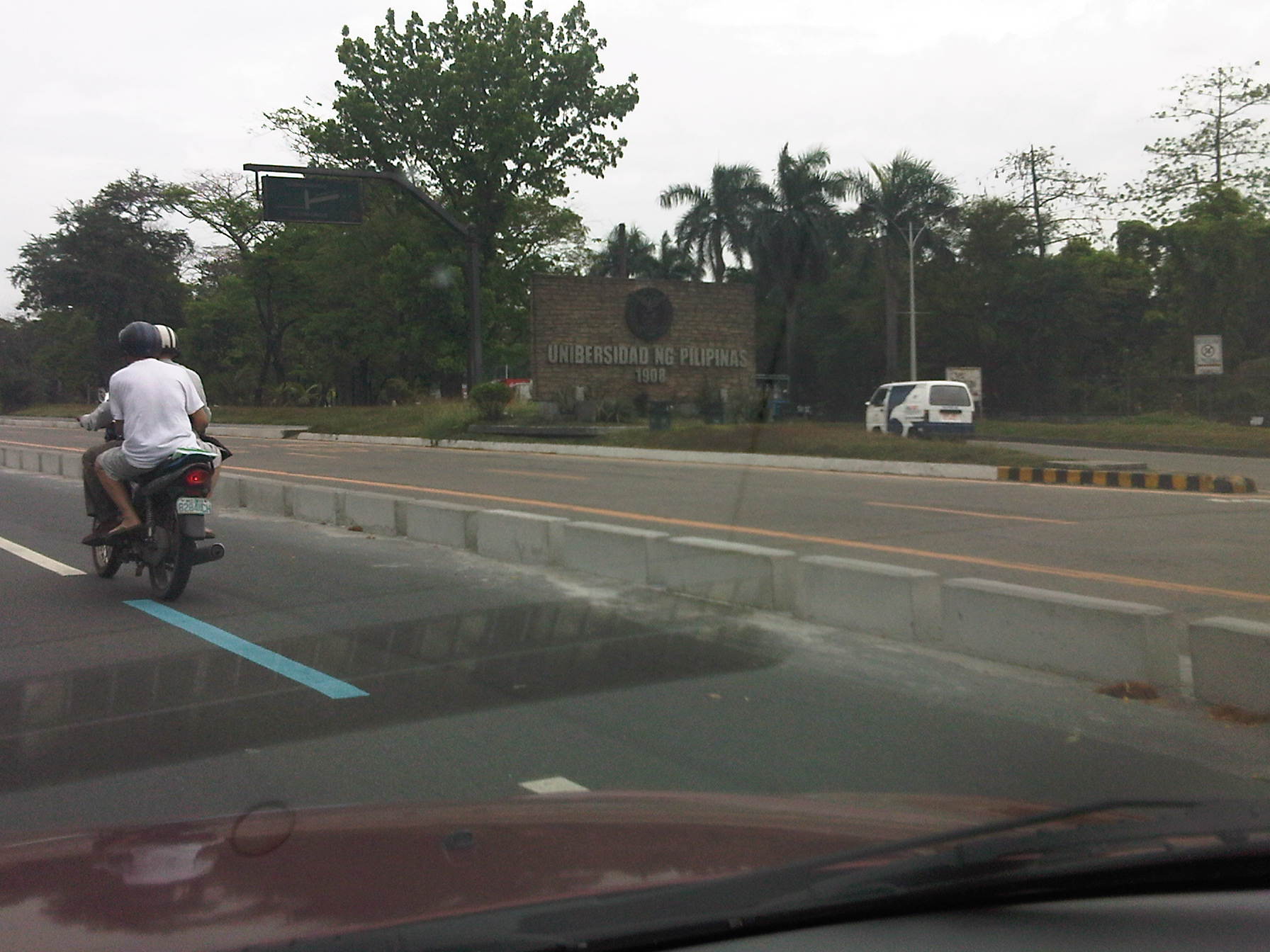 Separation device – the lane separators are basically barriers separating the 3 outermost lanes of Commonwealth from the rest. Of these 3 lanes, 2 are designated for public transport (yellow lanes) and one for private vehicles. The lane immediately to the left of the separator is the motorcycle lane. Note the blue lane marking denoting the MC lane.
 Service road – the separators practically create a service road along Commonwealth where PUVs and some private vehicles will travel along. Drivers and riders who intend to make right turns should shift towards the inner lanes through one of the relatively narrow slots along the separator line.
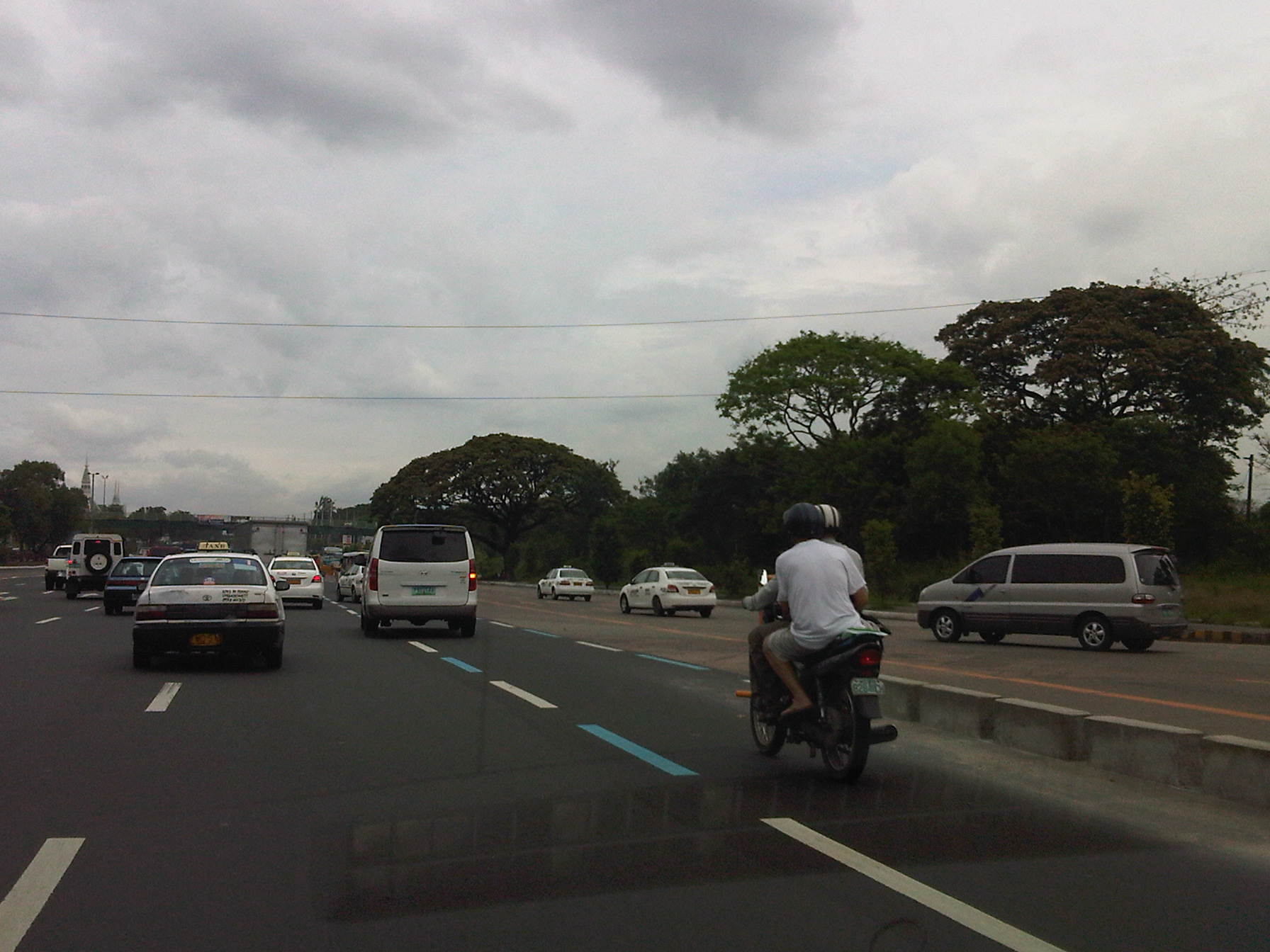 Small window of opportunity – vehicles turning from the University Avenue to Commonwealth must weave in traffic as many shift towards the nearest U-turn slot. The separators add another constraint to their movements. There is a similar narrow opening for vehicle turning towards the University Avenue from Philcoa but this can be quite tricky with the speeds of vehicles as well as the trajectories of those coming from the outer lanes of the mall to merge with the main flow along Commonwealth.
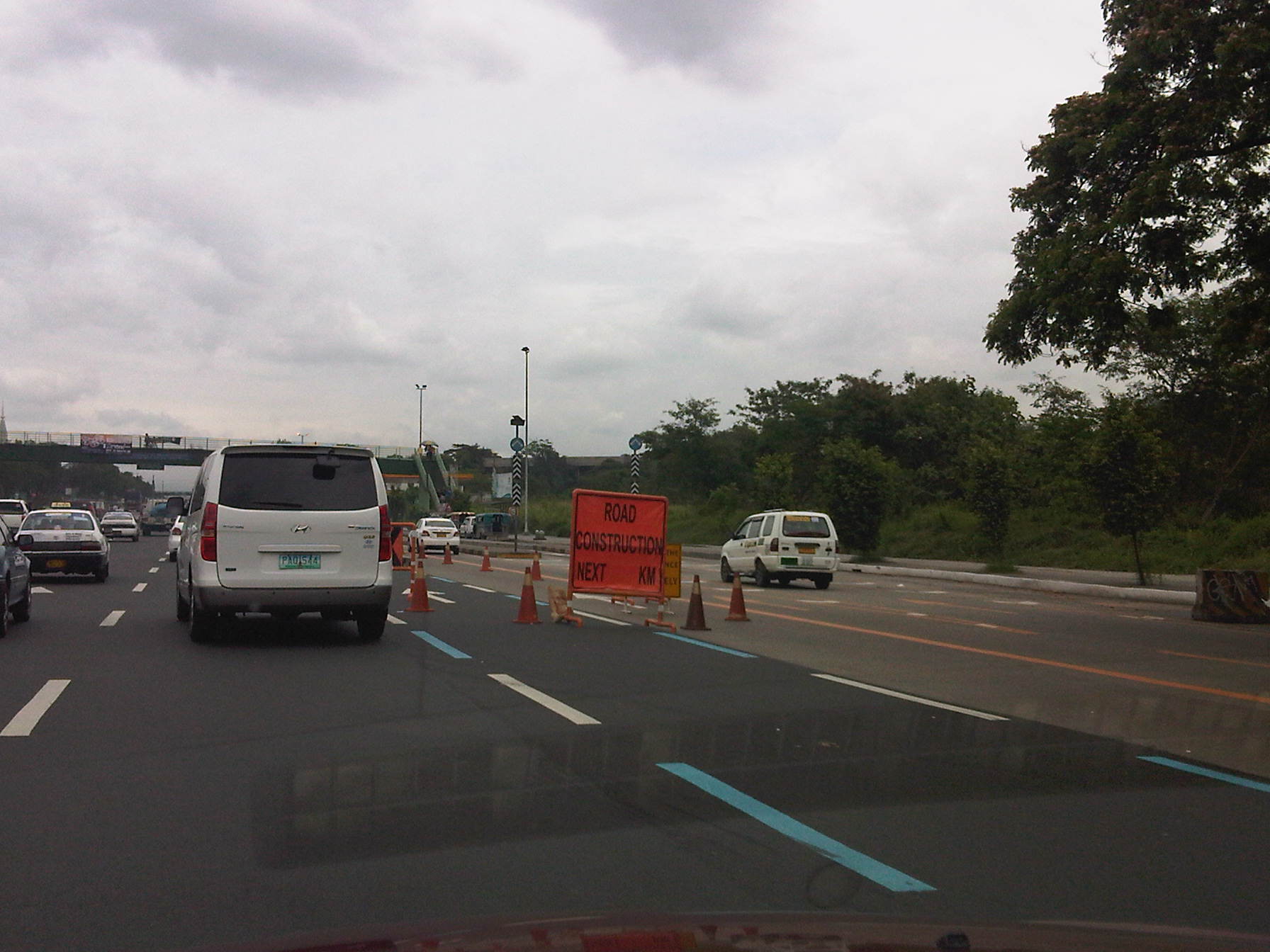 Under construction – tarpaulin sign and traffic cones mark the beginning of an area cordoned for the construction of the lane separators. The separators are supposed to be built along both directions of Commonwealth and may stretch all the way to Fairview. These should also aid traffic enforcers in apprehending PUVs traveling outside their designated lanes.
 Temporary displacement – motorcycles use the another lane as the construction of the separators use up the space of the motorcycle lane. Riders have become accustomed to using the lane from the time they were first implemented along Commonwealth.
 Now you see it, now you don’t – the motorcycle lane along Commonwealth northbound leads into the stairs of a pedestrian overpass. This necessitates motorcycles to shift towards the lane to their left. The rightmost lanes are for public transport.
 Respect and discipline – Motorcycles now typically use the lane designated for them and fewer vehicles encroach along these lanes for most part of Commonwealth where there are no weaving due to the U-turn slots. The separator will further lessen vehicle intrusions (and lane changing) as PUVs will be confined within the outer lanes courtesy of the separators.
The jury will definitely be out for the concrete lane separators currently being constructed along Commonwealth. It is still early for a fair assessment but many motorists are already pointing out the separators as increasing the risks for crashes. Surely, the MMDA and the DPWH carefully thought this out before its implementation and have the best intentions in favor of road safety. However, even the best intentions can still result in unintended consequences. Hopefully, this is not another case of the latter.
–
Decoupling transport and fossil fuels in the Philippines
An article appearing in the Business World today caught my attention as it provided, to me, a very good argument to support initiatives to wean transport away from its dependence on fossil fuels. Being a supporter of the initiatives for alternative energy to power public transport, especially the electric jeepneys, I can appreciate the discussions pertaining to urban transport. The DOTC, LGUs and the current dispensation should take heed of the main points in the article and focus attention and resources to building the transport infrastructure that our cities so badly need and that have been delayed for so long that we are often forced into short term (and short sighted) remedies (the FX or UV Express services come to mind).
The author is a former Dean of the School of Economics of the University of the Philippines Diliman and is well respected for his articulate views on practically everything connected to his field of expertise. His piece on urban transport in the Philippines includes mention of what many of our leaders already know but are afraid to touch due probably to its socio-political, and therefore painful, implications. I reproduce below the entire article as it appeared on the March 19, 2012 issue of Business World’s online edition. My sincere apologies for any copyright infringements that I might have committed.
The right thing is doing nothing
The clamor from public transport groups, mass organizations, a few politicians, media columnists, and — surprisingly — even some academics to reduce the VAT on oil products has now become so insistent that the government may just be tempted to cave in.
Doing so would be a big mistake.
It is hard to justify on first principles just why or how a solution to high oil prices should involve a reduction of the VAT on fuel. The VAT, after all, is based on the idea that all consumption must be uniformly taxed — that is, taxed at the same rate. Without good reason, the tax system should not itself be responsible for making some goods more or less expensive than others. Hence, if without taxes the price of a can of corned beef was, say,twice that of a bar of bath soap, then it should still be worth twice as much after a 12% tax is imposed on each. (Note that the ratio of X to Y is the same as the ratio of X(1.12)to Y(1.12).) That relationship is unchanged whether the uniform VAT is set at 5, 10, or 12%, as long as the rate is the same across all goods. (My colleague Ben Diokno has even seriously proposed that the VAT rate be raised to 15 percent in lieu of high income taxes — although he has curiously been reported as supporting a cut in the VAT on fuel.)
To argue that the VAT rate should be reduced for some products but not for others is to privilege the consumption of those products. But why should gasoline and diesel in themselves be more vital to consume than other goods? Why is a peso spent on fuel socially more important than, say, the peso a family spends on electricity or water? Or the toll paid by a bus using the NLEx? Or what a student pays for a cheap sandwich? Or a professional’s hard-won savings to purchase a laptop? Or more meritorious than a farmer’s purchase of fertiliser, pesticides, and farm tools? What entitles petroleum products to this special treatment?
If the answer given is that petroleum products are “consumed by the poor,” that’s not exactly true either. It is vehicle owners, both private and commercial, who consume petroleum-based fuel — and few of them are poor. Indeed, if the government were to cut the VAT on fuel, it would help not only jeepney — and bus — operators but also owners of BMWs, Benzes, Pajeros, and Fortuners. The effect would be to privilege heavier users of auto fuel — poor or not.
Tax-tinkering is fraught with danger, and its deleterious effects should by now be evident in our experience with an already existing fuel subsidy (which everyone seems to have forgotten), namely, the decades-old privilege given to diesel fuel. For starters, note that there is no inherent physical reason that diesel should be cheaper than gasoline. Indeed, from a pure cost perspective, diesel is more costly to refine, so that before any taxes, it is likely to be more expensive than gasoline. In the US and the UK, for example, where the two fuels are taxed uniformly, diesel is more expensive than gasoline; in Germany and Canada they cost virtually the same. So if only the 12% VAT were applied to both — say, at landed cost — gasoline would probably still be cheaper than diesel.
It is not the VAT but the lower specific tax on diesel — at only one-third of that applied to gasoline — that makes the latter more expensive by more than 20%. This low tax, which has been in place since time out of mind, was always meant as a concession to public transport, the predominant user of auto diesel.
And where has this discriminatory policy taken us? First, it has only deepened the country’s reliance on diesel fuel. It has discouraged any search for or shift to alternative fuels on the part of public transport. On the contrary, it has enticed an increasing number of private vehicle owners to shift to diesel fuel themselves. The latter, of course, is a completely unforeseen consequence and embarrassingly gives the same “pro-poor” diesel tax privilege to a jeepney driver and a Mercedes Benz owner. It’s basic Slutsky: cheapen something in relative terms and you divert consumption towards that thing. Similarly, lowering the VAT on fuel will do nothing but deepen the country’s dependence on all petroleum fuels.
The second effect is more pernicious. Cheap diesel — combined with the lax franchising of everything from buses to jeeps to pedicabs — has created an overcrowded and über-fragmented urban transport sector. A 2007 World Bank volume reports that Manila had 13,375 public transport vehicles per million people, compared to only 1,890 for Bangkok and 1,807 for Hong Kong. (Guess where the public is better served.) Philippine public transport today is dominated by numerous and fragmented small operators kept alive only by artificially cheap fuel.
Transport groups routinely blame high fuel prices for their woes. Under-appreciated is the fact that their own uncontrolled proliferation — which leads to cutthroat competition, congestion, and dangerous road rage and warfare — is the main reason for their low incomes. This proliferation of bit-players has itself been unwittingly brought about by the policy of subsidized fuel (diesel). Ultimately, however, this kind-hearted approach has only hurt the poor by depriving them of cheap, clean, and efficient transport. For just as large developers will be discouraged by squatters occupying a property, the transport sector’s preemption by an inefficient and fragmented small sector precludes the entry of firms with larger capacities and more efficient technologies, all of which could have led to better service.
Lowering the VAT on fuel addresses none of these problems. On the contrary, it would only perpetuate them. The country is better served by confronting the real problems of urban transport. Government time, imagination, and effort are better directed at encouraging higher capitalization in the transport sector, larger capacities, more fuel-efficient technologies, and less reliance on imported fuels whose prices are volatile. The initiative to field large numbers of natural gas-powered and electric buses is a promising start. Unlike the transport sector, the power industry weaned itself from imported oil many decades ago, and electric power now is largely sourced domestically and therefore largely immune to the price-gyrations of world oil markets. Using more electricity for transport is the more effective way to insulate the country from the speculative activity that characterizes world oil markets. The same goes for natural gas, which is something the country itself produces.
The sooner the petroleum dependency of public transport can be reduced, the better it will be for the country-including its poor. For that, the most urgent and bold actions are clearly warranted. But as for the demand to reduce the VAT rate on petroleum products-effectively undermining and distorting hard-won legislation for the sake of a temporary exigency-the best response is clearly inaction. And if there are those who choose to call this indolence, indifference, or “Noynoying” (the latest meme), if some critics cannot see the difference between a placebo and real medicine, between palliatives and real reforms-then the president would do well to pay them no heed.
He should simply-igNoy them.
Emmanuel S. de Dios is the treasurer of the Institute for Development and Econometric Analysis and a Professor at the UP School of Economics. For comments and inquiries, please email us at idea.introspective@gmail.com.
–
Indeed, Filipinos deserve better transport services. In most cases, the proliferation of informal modes where they are no longer suitable (e.g., tricycles dominating urban transport in many cities, jeepneys plying long distance routes, etc.) is actually a disservice with many operators no longer committed to providing safe and efficient service. For most, the livelihood aspect of transport has become so deeply rooted in the sector that our leaders have tended to turn a blind eye to the excesses and abuses such operators impose upon the riding public. The result? Filipinos will continue to aspire for their own vehicles (these days this vehicle would be the affordable motorcycle) because of the low quality of service of our public transport modes, eventually contributing to the worsening congestion we experience in our daily commutes. Meanwhile, we continue to envy the transport systems in the major cities of our neighbors like those in Bangkok, Kuala Lumpur and Jakarta. We are eons behind Singapore but soon, even Vietnam will probably overtake us in terms of public transport systems once they start building what they are currently planning for Hanoi and Ho Chi Minh. How long must we all suffer before our leaders are moved to finally address this problem head-on and not be satisfied with remedies.
–
Motorcycle lanes along EDSA?
The MMDA is implementing a one-week dry run of its motorcycle lane scheme along EDSA starting today, February 14. The scheme is the same as that implemented along Commonwealth Avenue where motorcycles are assigned to use only one lane of a road – in the case of EDSA the 4th lane from the curbside. To guide riders and drivers of other motor vehicles, the MMDA used alternating white and line blue pavement markings for the motorcycle lane similar to what was done along Commonwealth.
Following are photos taken last week along EDSA and a few observations on the traffic conditions with respect to the motorcycle lane scheme.
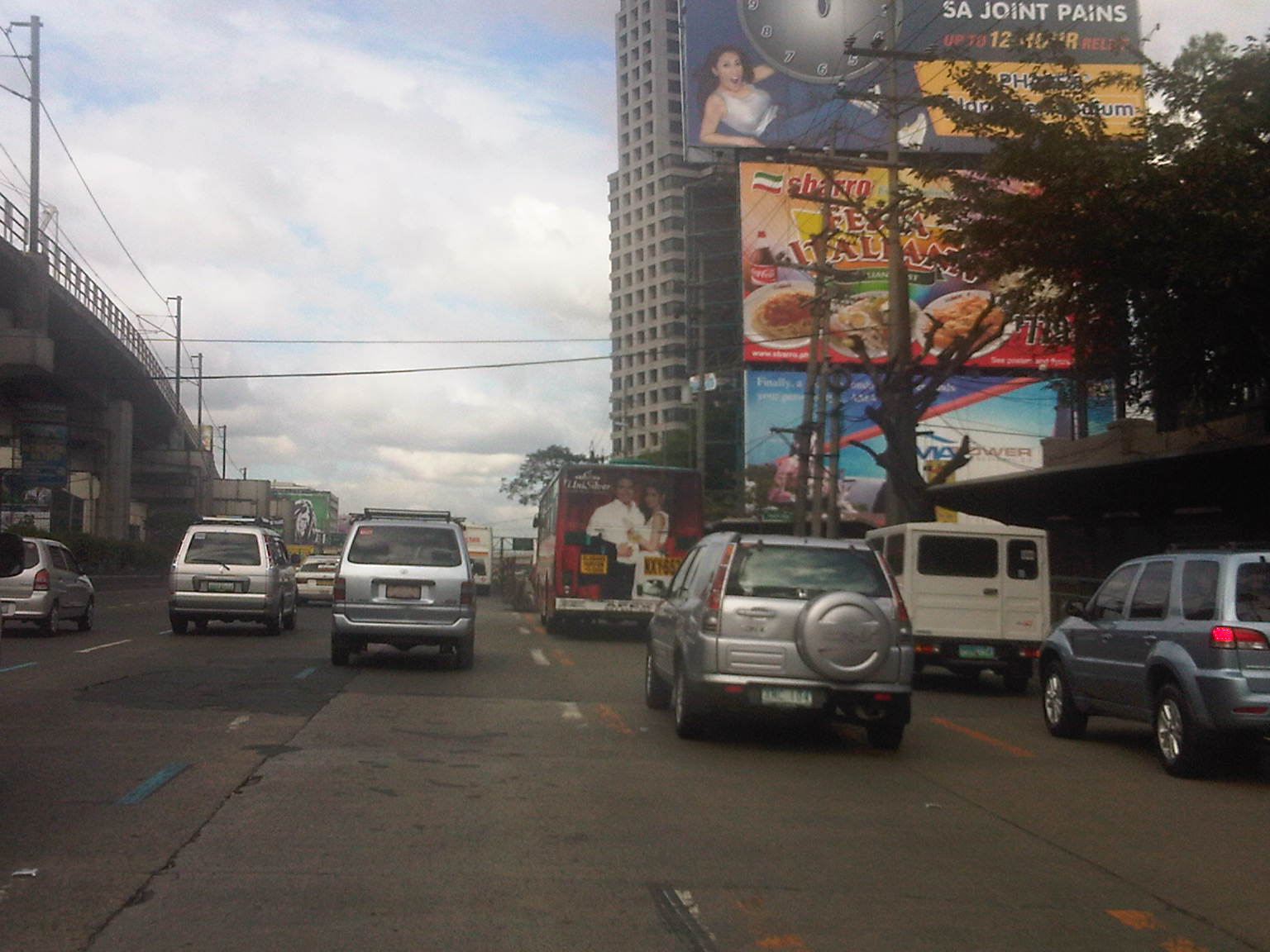 Light blue lane markings can be seen designating the 4th lane from the curbside for motorcycles. The yellow markings are for the two outermost lanes that are designated as bus lanes. While bus lanes are supposed to be for the exclusive use of buses, many private vehicles use the lanes throughout the day and are not apprehended by traffic enforcers for this encroachment.
 Sign for the motorcycle lane already installed along EDSA before the MRT Santolan Station as of February 9 – this photo was taken around 3 PM (not yet the afternoon peak period).
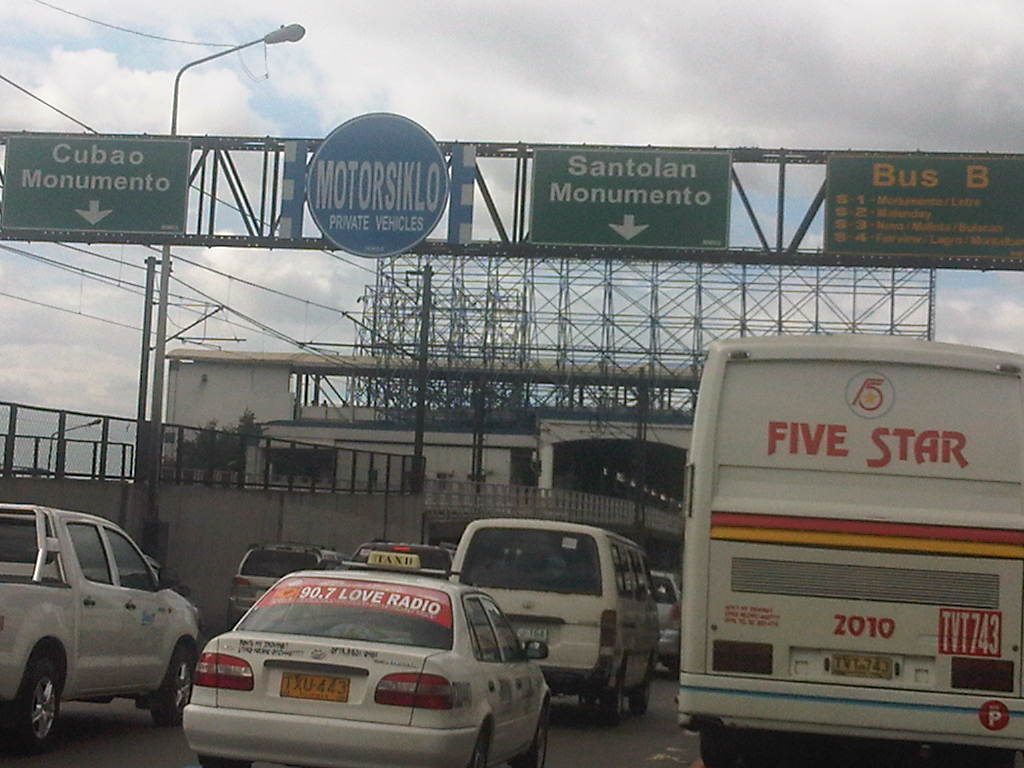 Close-up of sign for the motorcycle lane but with “fine print” indicating that the same lane may be used by private vehicles – herein lies the problem as private vehicles are sure to mix it up with motorcycles, with the high likelihood that riders will revert to lane splitting or using other lanes. This will be an enforcement nightmare.
 Motorcycle lane sign installed on pedestrian overpass between Aurora Blvd. and Kamias. Notice the provincial bus encroaching upon the adjacent lane designated for private vehicles.
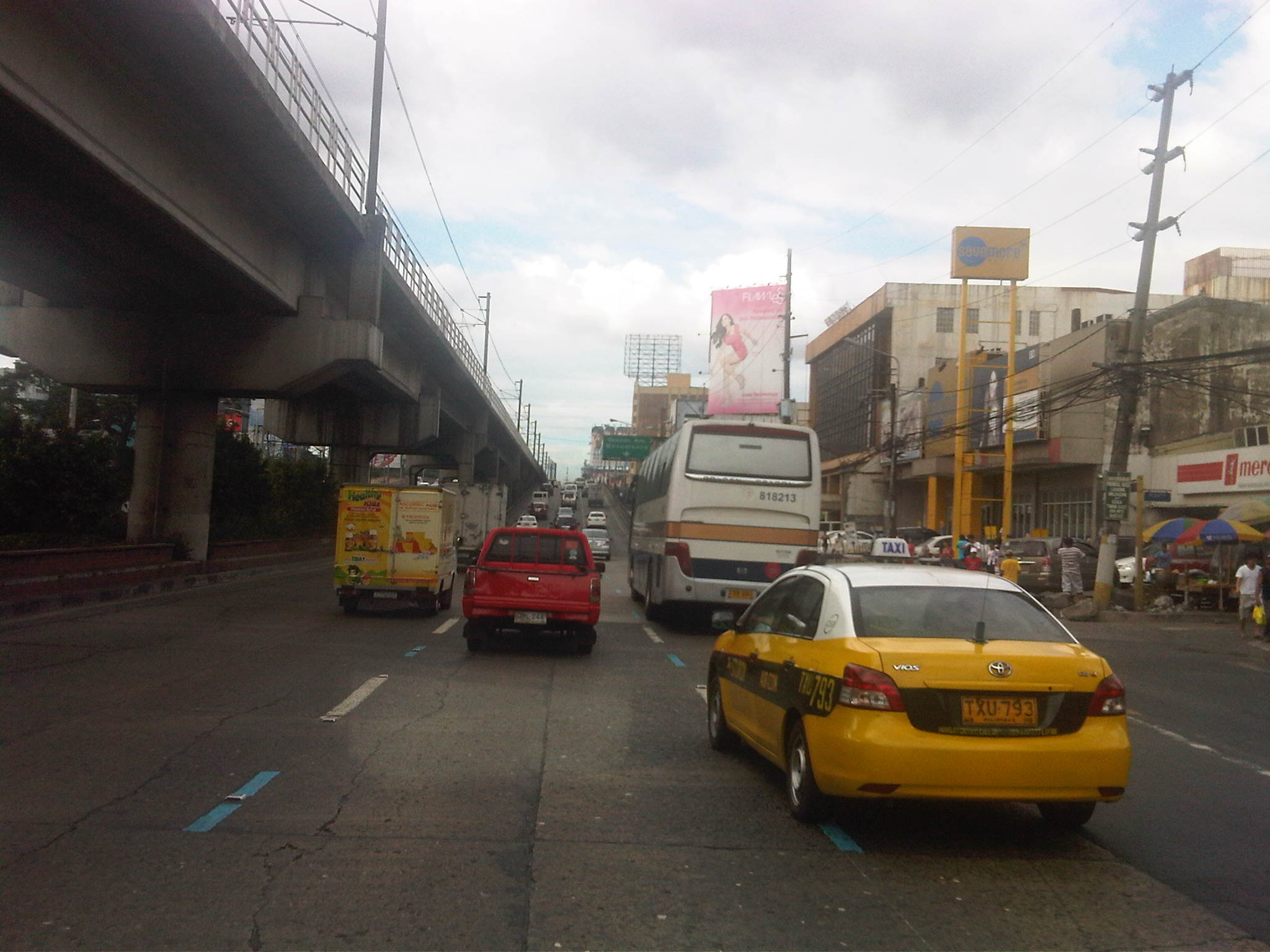 Motorcycle lane prior to the Kamias-East Avenue overpass along EDSA.
 The middle lane is designated as the motorcycle lane along the overpass
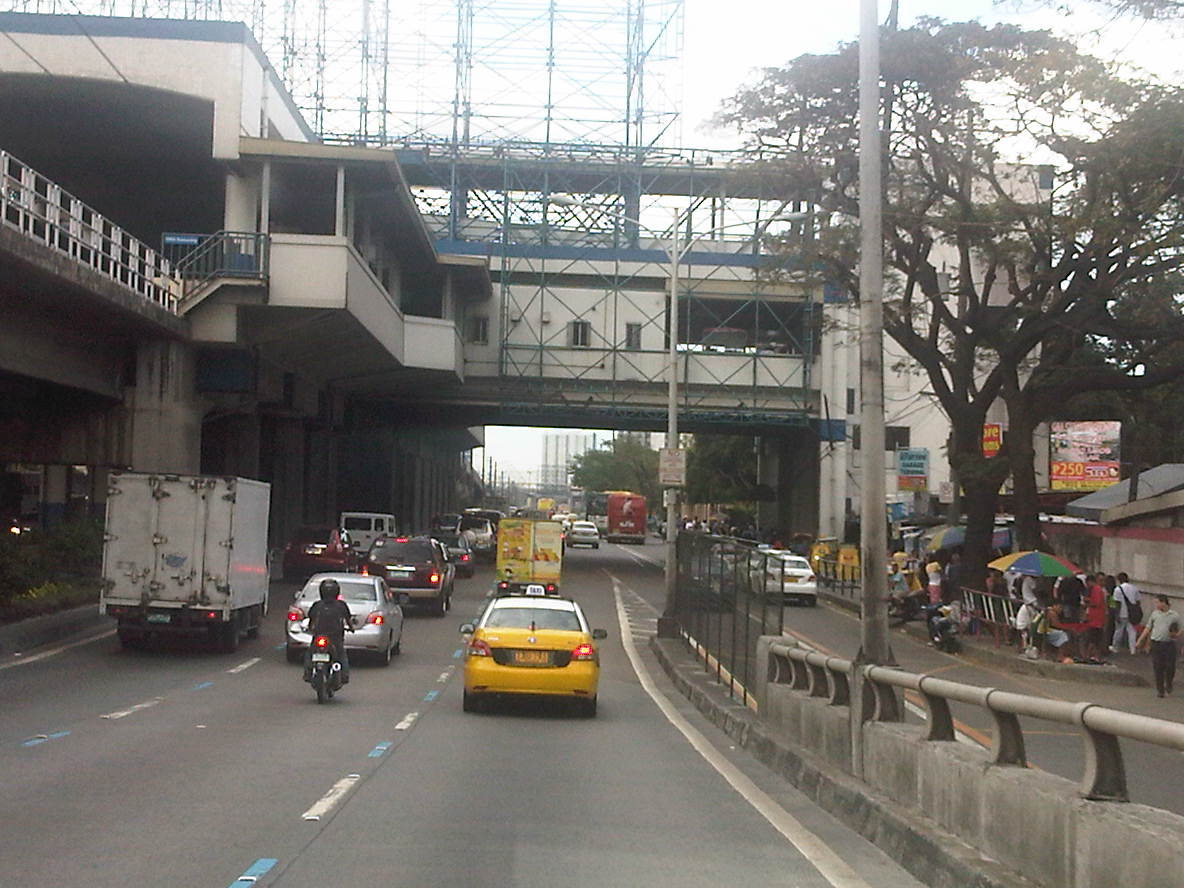 Motorcycle lane along EDSA beneath the EDSA-MRT GMA Station
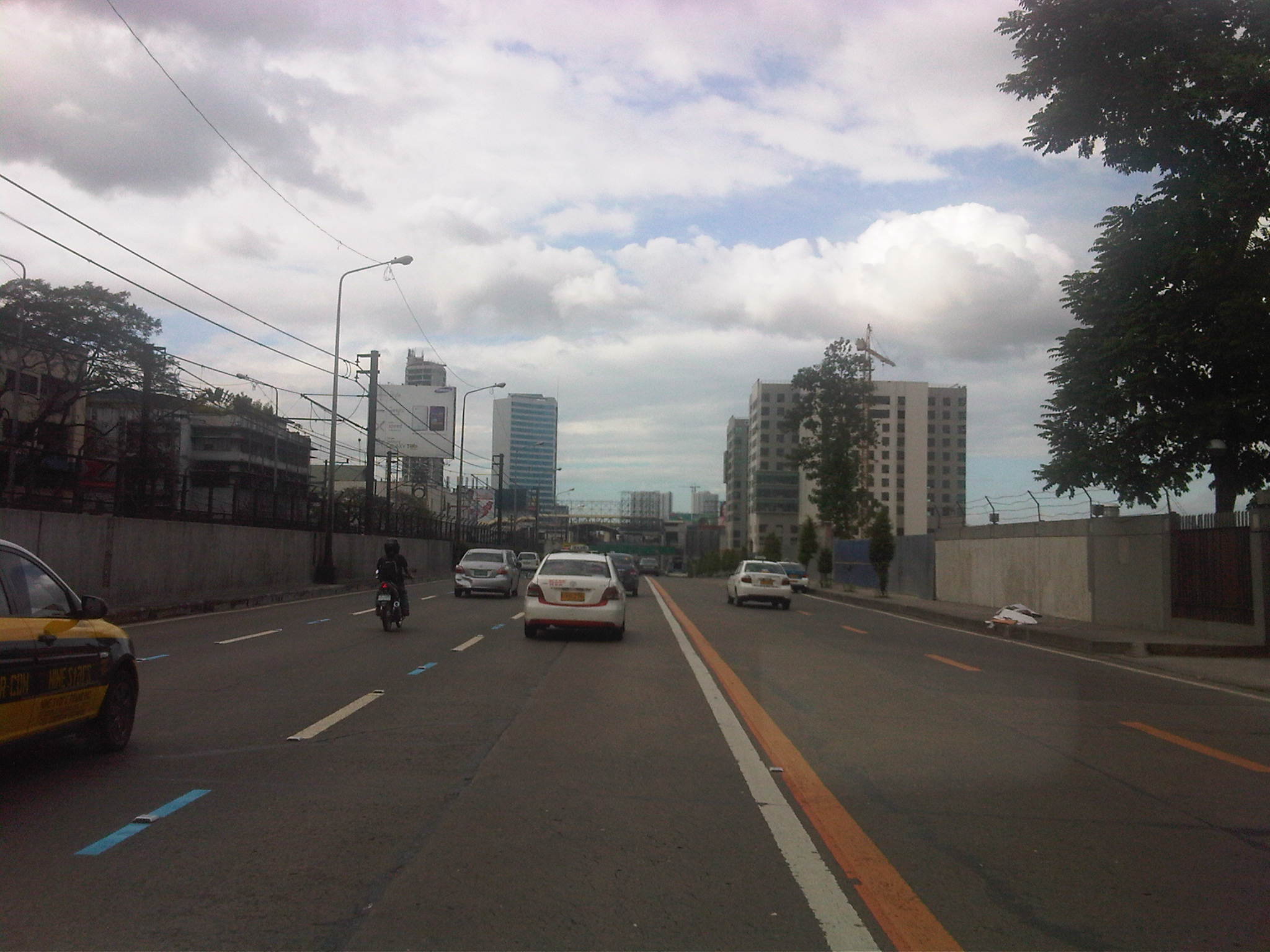 Bus and motorcycle lanes along EDSA past the the MRT GMA Station. Traffic is typically light along this stretch as many vehicles turn towards East Avenue or Timog Avenue.
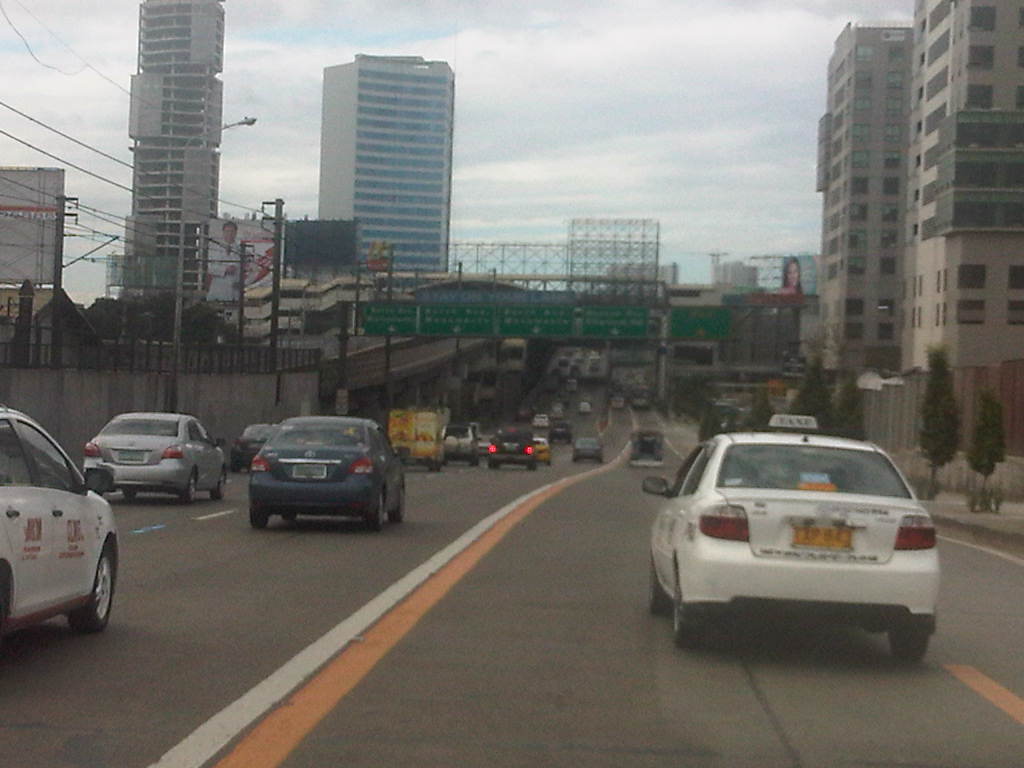 Typical light traffic between East Ave. and Quezon Ave. along EDSA northbound
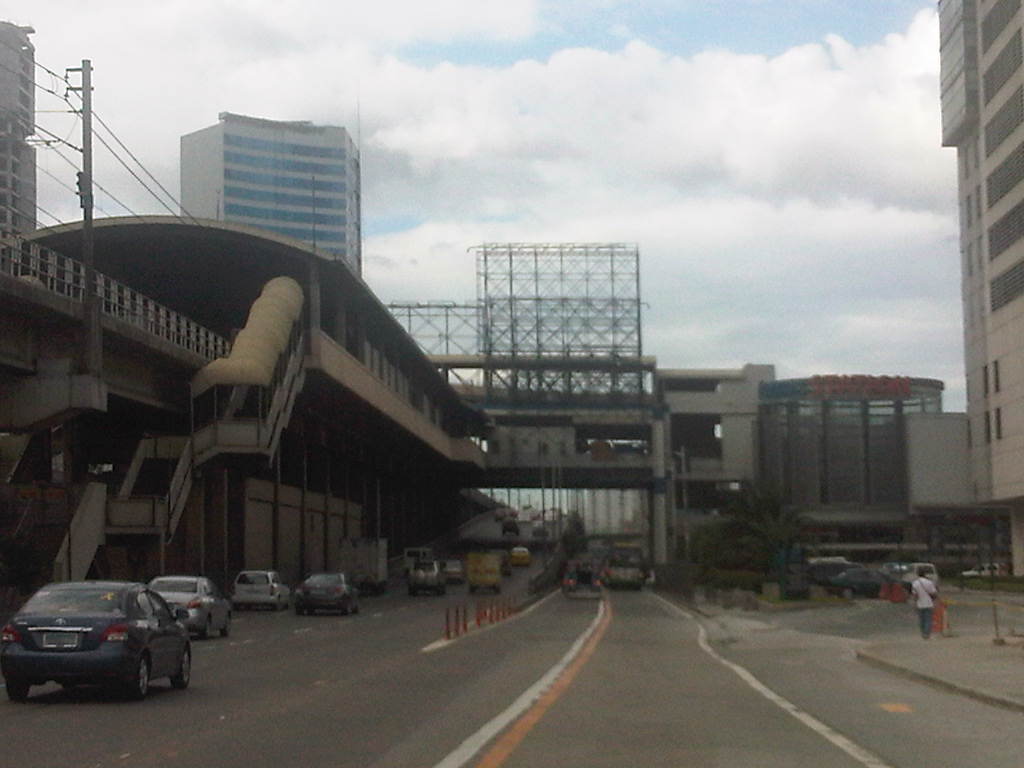 Motorcycle lane ascends the flyover crossing the junction with Quezon Avenue – the lane is again the middle of three lanes. That’s the EDSA-MRT Quezon Avenue station on the left and downstream in the photo and the Centris mall on the right.
If the implementation of the motorcycle lane scheme along Commonwealth is to be the basis for assessing the likelihood for success along EDSA, I believe that we can be expect significant behavioral changes along EDSA. For one, motorcycle riders along Commonwealth have been generally diligent in following the scheme. This can also be expected for most riders using EDSA should the MMDA be strict, firm and fair with their enforcement duties. Meanwhile, drivers of private vehicles have been becoming more aware and respectful of motorcyclists rights of way along Commonwealth and we are hopeful that such will eventually be the case along EDSA, although both enforcement and management will be much more challenging due to the sheer volume of vehicles involved and the more restricted space for traffic flow. It is to be expected that there will be many stubborn private vehicle drivers who even without the motorcycle lane are already encroaching on the bus lanes. Even more challenging will be the behavioral change required of buses given their propensity for reckless driving. I wanted to emphasize behavioral change here because I strongly believe that this is a critical factor for the improvement of traffic and transport in Metro Manila where many issues have roots on driver, rider and pedestrian behavior.
–
Pedestrianizing Session Road
When visiting Baguio City, one should never fail to go to Session Road whether to have a meal or just to take walk along the street. It is perhaps the city’s most famous street and a landmark itself where it used to be that a lot about Baguio is going about along Session Road. Here you will find shops, restaurants, bars and other establishments. Since my first time to go to Baguio in 1995, I have seen the city become more crowded and Session Road become more congested. There have been proposals for the street to be pedestrianized but I am unaware of any detailed study concerning pedestrianization and its implications on traffic and commerce in the area. This, I think, should now be among the things Baguio City should look into with more urgency and perhaps a study can be initiated among the universities there, together with the local chapters of planning, architecture and civil engineering societies.
The following article is from the Business Mirror entitled Road Revolution, which appeared in the newspaper’s February 4, 2012 issue:
BAGUIO CITY—Architect Joseph Alabanza keeps a long-held dream: to see Session Road pedestrianized.
As early as 1972, when Alabanza, former head of National Economic and Development Authoriy-Cordillera Administrative Region (Neda-CAR) was head of the city planning office, policies then had pointed out strongly that something had to be done about Session Road as it was predicted to soon become polluted and congested, and lose it aesthetic heritage, being at the heart of the city’s central business district.
A scene that is exactly what Session Road has become.
Then there were not too many cars and the population was much lower than the almost 400,000 mark today, and there was a lack of urgency to control the traffic situation in the city.
In more recent years, as lecturer and consultant of the architecture department of the St. Louis University, his class drafted, as their theses, a layout plan for the streets of the city. The central blueprint was that of Session Road pedestrianized.
Some consultations were made, but this was strongly opposed by business establishments around.
The yearly “Session Road in Bloom,” a market event for Panagbenga (meaning a season of blooming in the Igorot Kankanaey dialect) on Session Road, which stayed closed for a week, was used as a vehicle to test the plan. But it proved to be too hectic and the pedestrian is too heavy to be desirable for a longer period of time.
Even if it seemed that Alabanza’s dream was far from becoming a reality, the glimmer of hope remains as he continuously lamented the continuing deterioration of Session Road—the heavy pollution, the unkempt façades, the heavy traffic, crimes, the insane cat-and-dog chase of the police with sidewalk vendors. Life in the heart of the city was in shambles, but business thrived as usual.
Road Revo
THEN a group of environmental advocates heard of this dream. Something that was a success in Cebu. They came to tell the people of Baguio about their winning game plan in a forum on January 27.
It is called Road Revo—a revolution to change the way people think about the way they transport themselves.
Road Revo is a concept developed by lawyer and environmental activist, Antonio Oposa, a 2009 Ramon Magsaysay awardee in environment.
“We cannot have a Hollywood kind of transportation system, one of individual and expensive mobility. They have eight-lane highways and their roads are like moving parking lots,” he said.
Our insistence at individual mobility has resulted in serious collective mobility, he said.
“Kanya-kanyang galaw kaya lahat di makagalaw [Everybody wants his own way to move that’s why all could not move],” he said, referring to the traffic congestion that has also resulted in serious air and noise pollution.
The road is supposed to be for everyone, that is why Road Revo is for making road use fair. This would mean a turn-around in priorities.
“There’s a need to change mindsets. Road use and policies must have a bias for people, not for cars,” he said.
A World Bank study shows that only 300 out of a thousand own a car in the country. Oposa pointed out that only 3 percent own cars, and they occupy 97 percent of the road, while showing an image of a street jammed with cars in chaos, while people walked on narrow sidewalks.
He said Executive Order 774 specifically cites the new paradigm that the movement of men and cars must follow the principle that “those who have less in wheels must have more in roads,” and that the system must favor nonmotorized transportation and collective transportation.
EO 774 also ordered the Department of Transportation and Communications and the Department of Public Works and Highways to follow the same principle in transforming the road system.
Oposa said that ideally a good public transport system provides 30 percent for all-weather walkways, 30 percent for bicycle lanes, and 30 percent for a greenbelt and what remains would be for cars.
EO 774 also directs all public open spaces along sidewalks and roads no longer needed to be devoted to urban agriculture, something that has been done in Cebu.
“If we could do it in Cebu, so can you,” Oposa said.
Alabanza said that the city has lost its sense of space, referring to walking and open spaces.
“People used to have a sense of belonging here. Now we feel like strangers in our own place,” he said.
Session Road closed: Music, dining on road, sidewalks
AS an experiment, one side of Session Road was closed from 3 p.m. to midnight the day Oposa and his group of environmental activists were in the city on January 27.
And it did happen. Families dined on tables set on the road and sidewalks. Young people were seen just hanging out with one another. Lovers strolled leisurely. Musicians and poets drew a crowd as they beat on their percussions and read poems. Passersby even stopped to do a few dance steps.
For those few hours, the spirit of community was palpable, one of the aims for pedestrianizing Session Road.
Alabanza said that minimizing pollution was one of the first objectives of the proposed road closure as Session Road has become but a passageway for cars and people between the market and the SM Mall on opposite ends. The safety of pedestrians is also compromised as the sidewalks have become too narrow for the crowd who had to walk on parts of the road.
Oposa showed some examples of the ingenious Filipinos’ inventions of environment-friendly modes of transportation. There is the blueprint for a rail bus. There is already a carousel where people pedal to make it run. There is the idea of giving discounts to volunteers who pedal trolleys on train rails. A prototype for a wind-powered bamboo train is on the works, which can run both with an electric motor or the option for pedaling.
“We are a unique place and we cannot but just copy the transportation systems and models of other places,” Alabanza said. The transportation crisis can give rise to opportunities, something that will serve the city well, he said.
Change attitudes
OPOSA pointed out that the world is now experiencing so much disasters because of climate change and it becomes everybody’s responsibility to change attitudes about transportation systems, as this is the sector that emits one of the highest volume of carbon dioxide to the atmosphere.
He reminded that people need to think out of the box and to get out from the inertia of collective insanity, of doing the same thing because everybody else is doing it, no matter how senseless it has become. To illustrate, he said that the bicycle runs on fat and saves you money, while the car runs on money and makes you fat. But all the cars suffering the cost of insurance, stress and productivity lost to traffic jams, loss of a healthier lifestyle indicate that habits are hard to break.
Road Revo will help decrease man’s dependence on oil, restore sense of community, reduce criminality as this allows visibility of one another and, most of all, give people a sense of belonging and owning the space which is a secret tip to keeping it clean.
Oposa is on a nationwide campaign to promote Road Revo. Pasig City opened a road for a day on July 8 last year and Ongpin Street in Binondo became a festival road for the Chinese New Year celebration. After Baguio, Oposa will do the rounds in Subic, Dumaguete, Marikina, Davao and Puerto Princesa.
Alabanza’s dream may not even happen in his lifetime, but the wisdom of keeping the air clean, of enlivening the spirit of community and giving importance to people rather than cars has been sown in the few hours of not closing Session Road but opening it for people.
Perhaps pedestrianization will be more beneficial to the stakeholders of Session Road. It would not be an easy task to convince people that a car-free session road will be the way to go. There probably would also be other options, even a middle ground between status quo and pedestrianization. But doing nothing and letting Session deteriorate further is surely unacceptable to most people.
–
Truck weight limits in the Philippines
I noticed a lot of interest on the “truck ban” scheme from the statistics provided by WordPress on my dashboard. It seems there are very limited material available on the scheme especially in the Philippines where there have been variations of and misconceptions on this travel demand management (TDM) measure. Why do cities like Metro Manila implement a truck ban? Or better yet, why are there designated truck routes in cities? The answer can be quite simple if viewed from the perspective of asset preservation. That is, by restricting trucks to use specific roads, we are also limiting their impacts (read: damage) to the road infrastructure. Such impacts come in the way of damaged pavements and/or bridges that bear the brunt of the weights carried by heavy vehicles. But such argument begs the question of why, in the first place, shouldn’t we design our pavements and bridges so that they may be able to withstand the cumulative loads of heavy vehicle traffic over a prescribed period of time, say 20 years, give and take a few years for variability and reliability in design and construction methods? Such is a question that needs to be answered, and clearly, by our DPWH, at least for the case of our national roads and bridges. It is really not a simple matter and certainly not something that cannot be blamed solely on the fact that evidences in the Philippines point to truck overloading as one of the culprits for damaged pavements and bridges.
The website of the Department of Public Works and Highways provides information on the axle load and truck weight limits for national roads. The matrix of weights may easily be downloaded and is provided in the following document:
The maximum single axle loads for different countries around the world are provided below:
Max Permissible Truck Loads World
I found another table of values this time for European countries. Based on the table on weight limits in European Union Countries, France seems to have the heaviest single axle load limit.
Still, the question running in the minds of most people involved in policymaking, monitoring and enforcement, and research is “How did we come up with the 13.5-metric ton maximum single axle load value in the first place?” Surely, it wasn’t a number that was plucked out from the air?
The 13.5-metric ton was most probably derived from an axle load study conducted in the 1990’s. Such a study could have, among others, determined the appropriate maximum axle loads that could be adopted by the country in lieu of the limits at the time that were already deemed obsolete given the evolution of trucks over time (i.e., they’re bigger now compared to, say, 30 years ago). What is problematic is that it seems the study was only able to derive the maximum single axle load and was not able to estimate maximum loads for tandem and tridem axles. Tandem axles are two axles positioned one after the other while tridems are three axles grouped together. These tandems and tridems are typical configurations for the rear axles of large trucks and trailers, enabling them to support heavy loads that typically are distributed more towards the rear axles.
 Caught (up) in traffic