
Home » Public Transport » Bus (Page 2)
Category Archives: Bus
Article share: What Is Good Transit?
Here’s an article share on transit and what should be the attributes of a good transit system:
Source: What Is Good Transit?
To derive the main points from the article:
- Good transit is frequent
- Good transit is reliable
- Good transit is (reasonably) fast
- Good transit feels safe
- Good transit is equitable by nature
This is a good read whether you’re a regular commuter taking public transportation or perhaps one looking into topics for research or advocacy.
–
On posting the correct information on buses
I took this video on the way home via Ortigas Avenue Extension. The destination of the bus showed it is en route to the Guangzhuo Train Station. Apparently this not just for this bus but for others like it (same model).
While this is basically a minor or trivial thing, bus companies should still be providing the correct information on their buses. This is part of the service they provide to commuters.
–
Is there really a shortage of public transportation in Metro Manila? – Part 1 – Introduction
I will be doing a series of articles here on public transportation. More specifically, I will try to answer the question in the main title of the series – Is there really a shortage of public transportation in Metro Manila?
The quick answer probably is “yes” but we need to examine this concern from different perspectives and reasons so we can be objective about the “why” part of the shortage. Shortage may mean a real lack in terms of the number of public utility vehicles (PUVs) with approved franchises or perhaps the number actually operating on any given day. These two are actually different because it is possible to have fewer PUVs operating compared to the approved number or to have more PUVs operating than the approved number. The latter means there are “colorum” or illegal operations (i.e., vehicles providing public transport services without franchises).
Among the reasons why there is a perceived shortage of public transportation are as follows:
- Fewer than the number of franchises approved are operating.
- PUVs are not able to make a reasonable turnaround (e.g., due to traffic congestion).
- PUV drivers and operators refusing to operate their vehicles.
- Other factors.
- Any combination of the above including “all of the above.”
I hope I can write about these in a manner that can be easily understood – in layman’s terms.
–
Transport options between Naga and Legazpi
I wrote about the PNR still operating between Naga and Legazpi cities. However, there is only one roundtrip per day and that is the Legazpi-Naga-Legazpi trip. If you want to do the Naga-Legazpi-Naga trip, you have to spend at least the night in Legazpi. But the latter schedule is not so good for the return to Naga as the train leaves Legazpi at 4:30 AM! Aside from the rail option, most people will use road-based transport. That is, most people will probably take a bus or van. There are many bus companies and UV Express vans operating along the corridor (Pan Philippine Highway) connecting the major cities and municipalities of the Bicol Region.
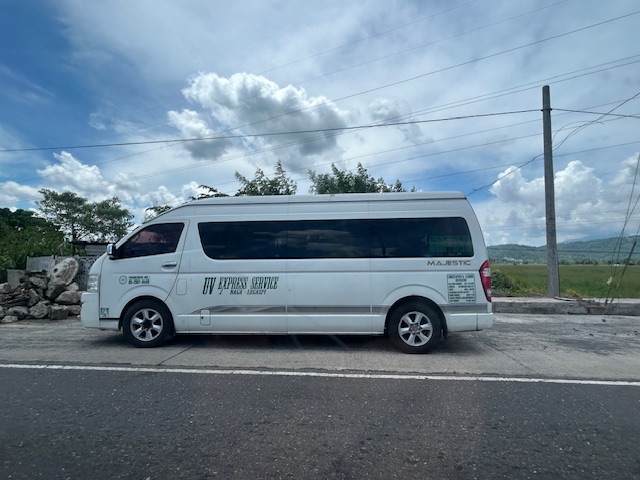 We saw this van parked along the roadside as we were waiting for our turn to proceed along a section under construction employing a alternating one way traffic scheme.
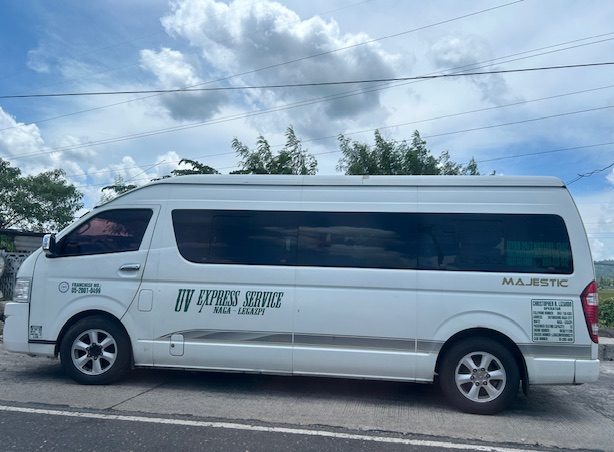 A close-up showing the UV Express van’s end points to be Naga and Legazpi. The declared passenger capacity is 23. Though this appears to be a long or stretched van, I can only imagine how comfortable or uncomfortable it is to ride these for 3 plus hours one way.
More on Bicol transportation in my posts this coming July!
–
To B(RT) or not to B(RT)?
I kind of expected questions or comments from my ‘students’ after my lecture last Wednesday about “Traffic Congestion.” Among my slides were those featuring solutions to transport and traffic problems. I presented both soft and hard approaches including travel demand management schemes and infrastructure that we should have built decades ago. The uniformed officers who were there had a very simple take on congestion – it’s basically because of a lack of discipline. While theirs may also be valid observations based on their experiences, ‘discipline’ is not the most critical problem that we have especially considering the ever increasing demand for travel. One government official present was very direct in his question about what I thought about the MMDA’s pronouncement that they plan to remove the EDSA Bus Carousel. I thought my reply and the following explanation was clear – it was a wrong move.
The EDSA Bus Carousel is simple. Bus lang sa bus lane (Only buses along the bus lane). Pag may private or pa-VIP, bawal at huli dapat (If there are private vehicles or those who regard themselves as VIPs using the lane, then they should be apprehended. An HOV (high occupancy vehicle) lane is more difficult to implement. Mas pahirapan ang pag monitor and enforce (It is very difficult to monitor and enforce). So this proposal to phase out the EDSA bus lanes don’t make sense from this perspective. In fact, I don’t agree with a couple of more senior transport experts who say that the MRT Line 3 is sufficient and that it hadn’t reached capacity yet. It has but in the time that the carousel has been operational, the carousel had absorbed much of the demand along the corridor. There is also the fact that it will take much time before Line 3 is upgraded. Are the new train sets here? Are the stations designed for these trains and more passengers? If the answers are no, then MRT3 will not have its capacity increased in such a short time. That also means the carousel is very much relevant not just to supplement MRT3 capacity but as a needed alternative mode for commuters.
–
Neutrality for public utility vehicles
I had written recently about how politicians are now using public utility vehicles for their premature campaigns. Promoting themselves illegally and ahead of the official campaign period. Today, I saw many modern jeepneys bearing posters of various politicians and party lists. Many of these PUVs are either private companies or cooperatives (i.e., in the case of modern jeepneys). I will not post their photos here as I don’t want to be inadvertently promoting these people and party lists. Instead here is an example of public transportation that does not promote any particular person or personality but instead speaks for a program that’s contributing to improve the commutes of people:
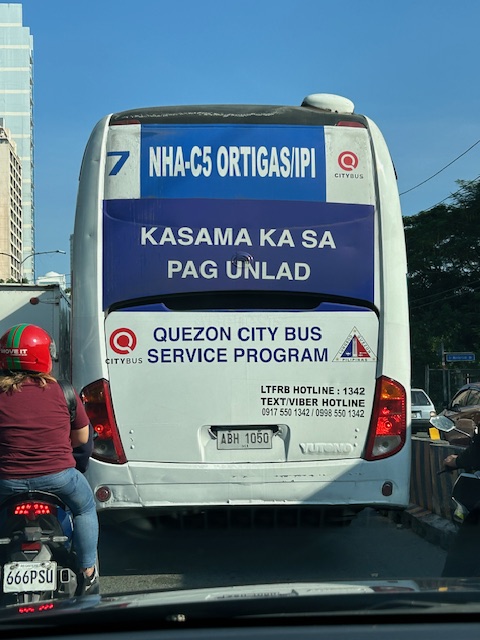 Quezon City’s buses don’t have any campaign materials posted on them.
Quezon City’s Bus Service Program is a good example of how a local government unit that has resources and the capability can help provide public transportation services to its constituents. It is a good example of what LGUs can do if they have the will, the capability, the capacity and the guidance for such initiatives. Of course, they should have good leaders who will support these endeavors and who do not have to put their faces and names on these programs.
–
On BRT being the solution to many cities’ public transport problems
Here is a very informative article about the benefits of a bus rapid transit (BRT) to a city:
Renn, A.M. (June 17, 2024) “The Bus Lines That Can Solve a Bunch of Urban Problems,” Governing, https://www.governing.com/transportation/the-bus-lines-that-can-solve-a-bunch-of-urban-problems [Last accessed: 6/25/2024]
To quote from the article:
“One benefit of BRT is that it is much more capital-efficient and faster to implement than light rail. For many years, urban advocates have promoted light rail over bus transit, impressed by the success of light rail systems such as the one in Portland, Ore. But today’s light rail lines are extremely expensive. One proposed in Austin, Texas, for example, is projected to cost $500 million per mile. Also, most of the cities that have desired light rail are low-density cities built around cars and with little history of extensive public transit ridership. Converting them to transit-oriented cities would be a heavy lift.
BRT is much cheaper. The 13-mile Red Line BRT in Indianapolis, opened in 2019, cost less than $100 million — not per mile, but in total. The much lower financial lift required for building bus rapid transit makes it more feasible for cities to raise the required funds.
Because they typically run on city streets, BRT systems also offer the chance to perform badly needed street and sewer repairs during construction. Sidewalks can be rebuilt or added. Traffic signals can be replaced, along with new features such as prioritizing buses over auto traffic and additional pedestrian safety measures. The reduction of traffic lanes itself is sometimes a worthwhile street redesign project.”
It’s been more than a decade (almost 2 decades to be more accurate) since a BRT was proposed in Cebu City and in Metro Manila. So far, there is still none operating in the Philippines. The EDSA Carousel probably wants to be one but is far from being a BRT based on operations and performance. Cebu’s is supposed to be currently in implementation but it seems Davao might just beat them to it with its high priority bus project. The Philippines requires a proof of concept of the BRT in one of its cities that could be the inspiration for similar projects in other cities especially those that are already highly urbanized.
–
Fare rates for the Antipolo – Iloilo bus service
I found these information on fare rates for the newly opened Antipolo – Iloilo bus service:

The information above indicates that there are three routes to Iloilo:
1) On the left is the route via the central roads of Panay Island (i.e., via Passi City, Iloilo);
2) In the middle is the route to the east of Panay Island to Kalibo, Aklan and Roxas City, Capiz, and terminates at Estancia, Iloilo; and
3) On the rights is the route along the west and crossing the province of Antique. This terminates at Oton, Iloilo and will pass through the town of Miag-ao, which is famous for its church recognized as a UN Heritage Site.
To book a seat on the bus, here is the step-by-step procedure shared on social media on the official Facebook page of Robinsons Antipolo:

–
Antipolo to any point of the Philippines
I wrote several times in the past about every road leading to Antipolo. Recently, a new route opened between Antipolo and Iloilo. This is interesting for me since my father’s hometown, which I also consider mine, is Cabatuan, Iloilo. We usually flew to the province though we also rode on inter-island ferries when I was a child. I have memories riding on the ships operated by the now defunct Negros Navigation and Sulpicio Lines. I had never used the SuperFerry ships that now connect the major islands of Luzon, Visayas and Mindanao.
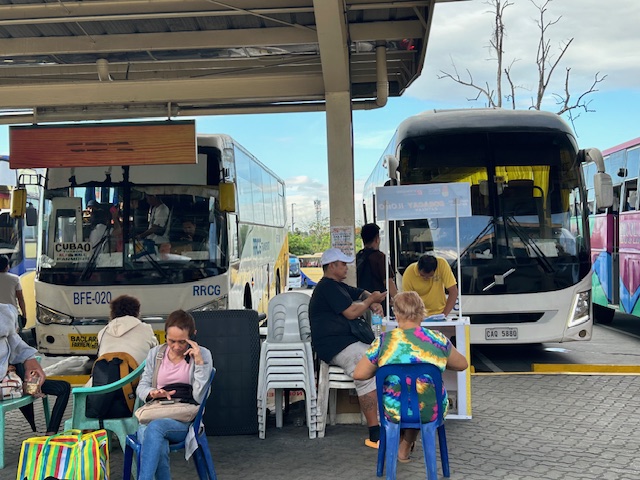 Buses at the public transport terminal at Robinsons Antipolo include those regularly dispatched to Cubao and Quiapo. There are many provincial and RORO buses including those bound for the Bicol Region and Eastern Visayas (i.e., Samar and Leyte). The latter are operated by several bus companies including RRCG whose buses are shown in the photo.
 RRCG bus bound for Iloilo via Batangas, Mindoro, Aklan (Caticlan), and Antique. The fare to Iloilo City is 2,700 pesos. It’s 2,400 pesos until Caticlan.
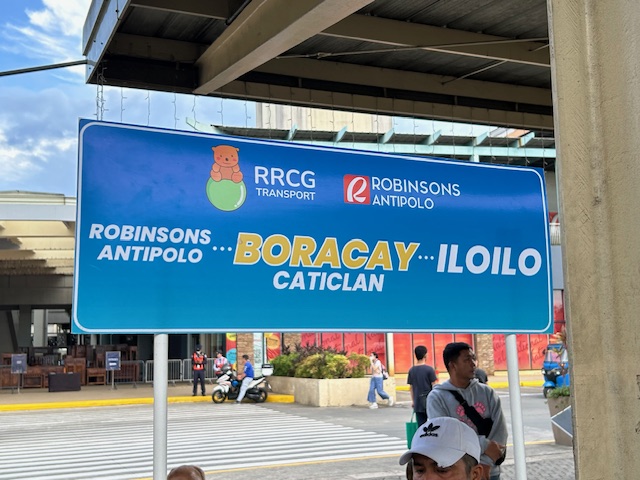 New sign for the route connecting Antipolo City and Iloilo City. Caticlan in the province of Aklan is along the way. I estimate the travel time to be roughly a day considering the bus will still go to Marikina’s transport terminal across from SM City Marikina. From there, the bus will proceed to Batangas Port via C5, SLEX and STAR Tollway. The bus will queue to be loaded unto a RORO ferry bound for Mindoro. It will travel by land to cross Mindoro Island before being transported via ferry from Mindoro to Caticlan.
 One bus company provides services to destinations in the Bicol Region. Both air-conditioned and ordinary (non-aircon) buses are available.
–
‘Modern’ jeepneys in Cebu
The jeepney is actually a jitney, a paratransit mode with a capacity between the bus and the mini-bus. Jitneys are quite popular in developing countries like those in Southeast Asia and Africa. In the Philippines, the jeepney evolved from the American Jeeps left by US Forces after World War 2 that were customized in the style of the auto calesas that developed before the war.
With the government’s public transport modernization program, there are now many so-called ‘modern’ jeepney models operating around the country. The following are photos I took while doing fieldwork in Mandaue City.
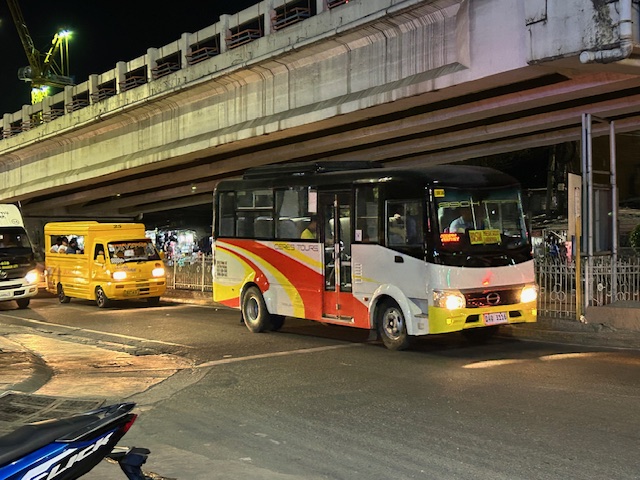 Many modern jeepneys are actually mini or micro buses like the one in the photo. They did not retain or adopt the look of the conventional jeepneys. This one is a model by Japanese automaker Hino. The one behind is another jitney form – a multi cab.
 Another modern jeepney / mini bus model manufactured by another company. I have to check which company given the emblem in front of the vehicle.
 Another Hino vehicle but by a different operator as evident in the livery.
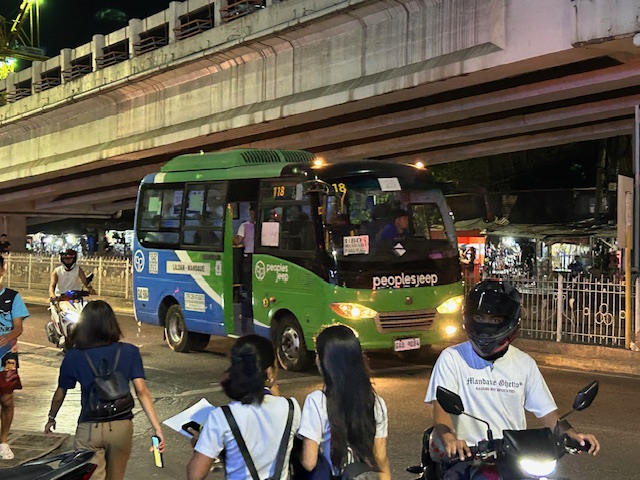 Another mini bus model

 A low floor bus operated by Ceres, a major bus company in the country that also operates RORO buses.
 Another modern jeepney model operated by another coop in Mandaue.
 Star 8 jeepneys are also operating in Mandaue City. I first saw these in Tacloban City many years ago. They were supposed to be able to recharge via solar panels installed on the roof the vehicle. That should allow them to replenish power while running. These days, we do have a lot of sun so the only question is whether the solar power feature is functional.
–
 Caught (up) in traffic