
Home » Public Transport (Page 11)
Category Archives: Public Transport
On Metro Manila having one of the worst transit systems in the world
This is a follow-up to the previous post on the UC-Berkeley Study. Here is an example of how media featured the study outcomes:
https://www.facebook.com/CNNPhilippines/videos/1089453421728393
I didn’t see whether there was a response from government. These studies end up as features and nothing more if these do not prompt or push authorities to act on the problem. Even experts from academe or industry are reduced to being commentators or even pundits providing context, assessments and opinions, even recommendations that are perceived to fall on deaf ears. Perhaps government is already desensitized about these issues and will just trudge along at its own pace? In the end, it is the commuters mostly taking public transportation who continue to suffer and lose productive time to their daily travels.
–
On the best public transit systems in the world
Manila’s poor ranking in recent study conducted by the University of California Berkeley’s Institute of Transportation Studies with think tank Oliver Wynam on public transit systems caught the attention of a lot of people. Media was quick to feature this in the news and I am aware of at least GMA and CNN Philippines doing features of this in their news programs. Here is the article on the same that mentions the UC Berkeley ITS study:
Pollard, A. (November 21, 2022 ) “These Cities Have the Best Public Transit Systems,” Bloomberg CityLab, https://www.bloomberg.com/news/articles/2022-11-21/these-cities-have-the-best-public-transit-systems [Last accessed: 12/11/2022]
Manila, or Metro Manila to be exact, placed only 56th in public transit while ranking 48th in sustainable mobility and 58th in urban mobility readiness. I leave it to the readers to go read the UC Berkeley report rather than depending on media or social med influencers for their takes on the ranking. The report can be downloaded from the link I provided above.
Perhaps there should be an assessment of cities (at least the highly urbanized ones) in the Philippines to see how they are ranked. There should be a criteria (UC Berkeley and Oliver Wynam used distance to public transit, affordability, operating hours, crowding and commute speeds among others in their study) to be agreed upon where experts can score cities using a simple-enough scale, say 1 to 10 with 10 being the highest score. What are your top 5 Philippine cities in terms of public transportation?
–
Commuting from/to Antipolo via the public transport terminal at Robinsons Antipolo
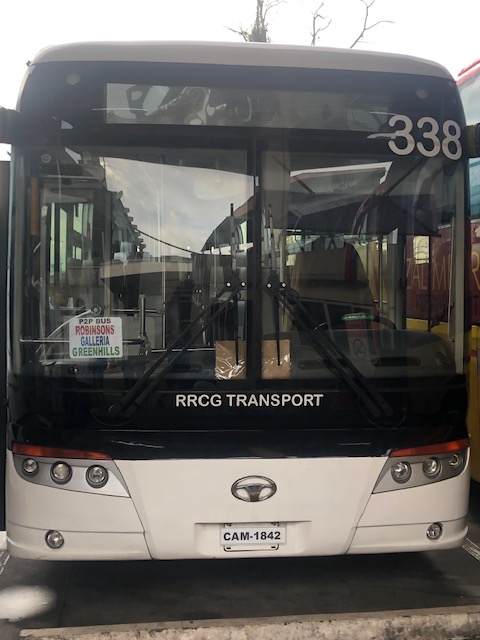
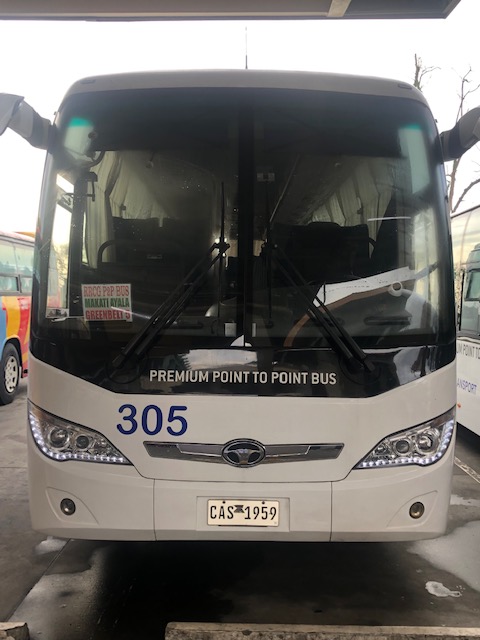
I was at the Robinsons Antipolo public transport terminal to take a P2P bus to Ortigas. I took a few photos before boarding the bus. The bus no longer terminates at Robinsons Galleria but instead goes to Greenhills. This is very convenient for people who need to go to Virra Mall or somewhere in its vicinity (e.g., Cardinal Santos Medical Center, LSGH, etc.).
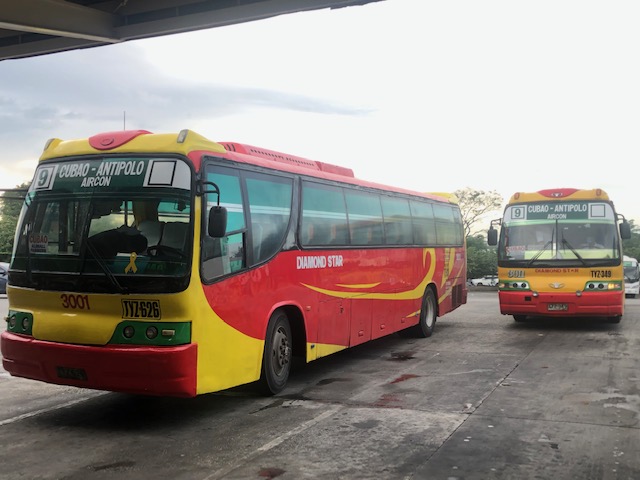
Then there are the buses plying the Antipolo-Cubao route via Sumulong Highway-Marcos Highway-Aurora Boulevard. These are regular aircon buses (not P2P) operated by various companies including G-Liner, RRCG, Jayross, etc. Below are photos of Diamond Star buses loading passengers bound for Cubao.
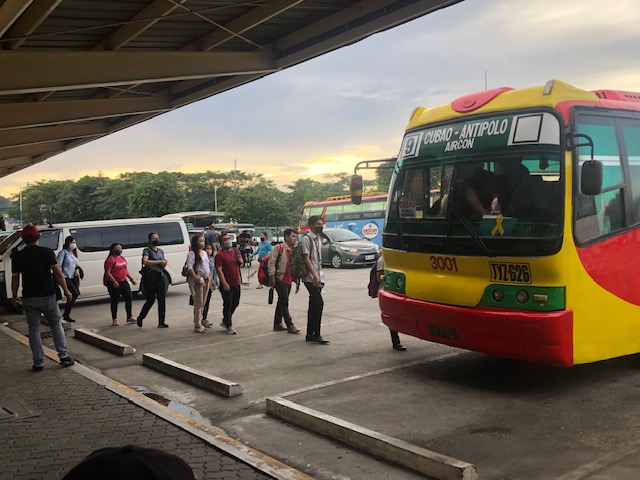
The lines can be very long depending on the time in the morning but I guess the assurance of a seat makes it worthwhile to go to the terminal rather than wait for the bus along its route. Passengers loads are practically back to pre-pandemic levels and with some jeepneys back, that means competition for the buses.
–
Provincial bus services via the transport terminal at Robinsons Antipolo
Robinsons Antipolo recently announced the daily trip schedule for provincial destinations for the transport terminal at the mall. These are for destinations in the Bicol region and the Visayan Islands of Samar, Leyte and Bohol. These will likely travel via Rizal’s “backdoor” through Teresa, Morong, Tanay and Pililla and proceed through the Laguna towns of Pangil, Pakil, Paete, Lumban and Pagsanjan, before going through Quezon province via Luisiana, Lucban towards Lucena, where there is a major bus. From Lucena, the trip will then take the usual routes through Bicol. Here is the posting from the Robinsons Antipolo Facebook page:

There are three bus companies serving the routes mentioned above and as shown at the bottom of the poster. While I am familiar with the routes in Bicol (I have experienced traveling by bus all the way to Gubat, Sorsogon, which is my mother’s hometown and where we have many close relatives.), I have not experienced crossing to Samar via Matnog. I have been to both Samar and Leyte and have crossed the San Juanico Bridge many times so I know how long those trips can be. The highways now are better and I assume the buses offer more comfortable rides so its the ferry (RORO) crossing between Matnog and Allen that will be the slowest and perhaps most uncertain part of the trip. I say uncertain because if the weather is not good, the coast guard will halt the ferry services. I was surprised there was a connection to Bohol. That is not a short trip from Leyte to Bohol. And I was expecting a service to Cebu instead, which was closer and had regular ferry services between Leyte and Cebu islands.
I don’t know about the demand for these services or routes. I hope these are sustainable and sustained as it offers an alternative for people residing in Rizal and nearby areas who want to go to Bicol, Samar, Leyte or Bohol via these routes.
–
On making streets safer through woonerfs
One of the new things I learned when I was taking up transportation planning as an undergraduate student in the 1990s was about the woonerf. Our teacher then was a Visiting Professor from the Tokyo Institute of Technology. He introduced to us many concepts in that elective course that paved the way to a number of us proceeding to specialize in transportation. What is a woonerf? Well, here’s a nice article defining the woonerf and providing some examples:
Ionescu, D. (October 6, 2022) “What is a Woonerf?” Planetizen, https://www.planetizen.com/definition/woonerf?utm_source=newswire&utm_medium=email&utm_campaign=news-10062022&mc_cid=9d60b3d668&mc_eid=9ccfe464b1 [Last accessed: 10/10/2022]
To quote from the article:
“Translated as “living street,” a woonerf employs strategies like traffic calming devices and low speed limits to force drivers to slow down and safely share street space with pedestrians, cylists, and others, often without raised curbs separating cars and pedestrians. In the Netherlands, where the woonerf originated in the 1960s, motorized traffic within woonerf zones is limited to walking speed…
…A woonerf is not a pedestrianized street, but rather one where multiple users and vehicles co-exist. However, a woonerf can be converted to car-free uses using bollards or other barriers. The woonerf maintains utilitarian uses like loading docks and parking while making the roadway safer and more accessible to non-drivers.”
There should be many applications to the woonerf in the Philippines especially in areas where the dominant land use is residential and through traffic should be discouraged. This is goes well with the complete streets concept that is now being promoted and in fact pre-dates the concept and was well ahead of its time.
–
On transit oriented development issues
I share this interesting article about some issues encountered in the US that affects transit operations and what planners term as transit-oriented development (TOD). While TOD remains a good concept and has been implemented successfully elsewhere (e.g., Japan, Korea, Singapore, European countries, etc.), the experience in the US may be quite different and even contrary. This underlines the importance of proper context when reading these articles that are likely written for an American audience (its published in a major US newspaper).
Sperance, C. (September 14, 2022) “Could it be the end of the line for transit-based development,” The Boston Globe, https://www.bostonglobe.com/2022/09/14/real-estate/could-it-be-end-line-transit-based-development/ [Last accessed: 9/24/2022]
The article describes how TOD came to be in the US:
“Even on a good day, when trains don’t derail or catch on fire, people move away anyway, looking for more space and the luxury of having their own car. But not everyone has the luxury to work from their living room in the burbs. The life sciences building boom in the area requires in-person work.
“We have a very strong economic engine that settled into places where people have to go to work, such as our academic institutions, our hospitals, and our labs,” Dimino said.
That’s a catalyst for transit-oriented development…”
The above quote looks to be very similar to what we have and are experiencing in many Philippine cities as well. I have mentioned and wrote about how housing affordability affects location choices in the Philippines. These choices of where to live ultimately affects transport mode choice and puts pressure on government to provide public transportation to connect suburbs to CBDs (i.e., residential areas to workplaces and even schools). We seem to be following the American model here and it does not help that the prices of residential units in the CBDs (and closer to workplaces) are not affordable to most people. The latter end up purchasing houses away from Metro Manila and in the adjacent provinces or Bulacan, Rizal, Laguna and Cavite. But it takes two to tango, as they say, and mass transit systems (their availability) also contributes to decisions of where to live. I conclude this post with another quote from the Boston Globe article:
“Transit will need to be an anchor and cornerstone of our future regarding equity, the economy, and climate and, therefore, will still be something that will have a relationship to housing decisions.”
–
On bicycles vs. self driving cars
You’ve probably seen this graphic, the top part of which is attributed to the Cycling Promotion Fund. The last image is reproduced in the lower part of the image but labeled to emphasize what space is required to transport 48 people on electric cars and autonomous or self-driving cars.
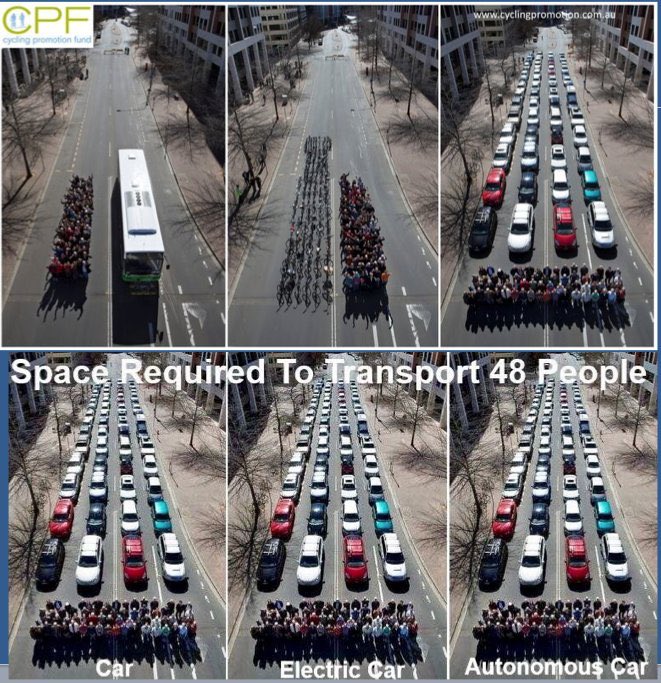
It is quite obvious that even if the current fleets of cars are replaced by electric and self-driving models, they will practically be the same problem in terms of road space occupied and the resulting congestion. So perhaps e-cars or autonomous cars are not really the solution we are looking for.
There is this nice article where the author articulates the how bikes (and active transport in general) should be the a more essential part of future transport and society than the automobile:
Collignon, N. (September 9, 2022) “Bikes, not self driving cars, are the technological gateway to urban progress,” Next City, https://nextcity.org/urbanist-news/bikes-not-self-driving-cars-are-the-technological-gateway-to-progress [Last accessed: 9/16/2022]
There are two quotable quotes from the article that I want to highlight here:
“Today the potential benefits from cycling on health, congestion, pollution and CO2 emissions are crystal clear and increasingly quantifiable, but the benefits of self-driving vehicles remain hazy. When ride-hailing companies like Uber and Lyft promised lower congestion and reduced car ownership, they instead increased congestion and led to a decline in transit ridership.”
and
“The concept of “jaywalking,” for example, is integral to the “car technology” of today. The crime of crossing a street without respecting the dominance of cars was invented by the car industry in the 1920s, who pushed hard to define streets as a place for cars, not people. Our car technology today is also defined by the restriction of movement it imposes on people.
When we begin to see technology through the lens of systems, it becomes clear that genuine technology-led progress will focus on dealing with the accelerating complexity of today’s world, not increasing the complexity of our tools.”
–
On micro transit and transportation gaps
I’ve written and shared articles before on how Paratransit, bicycles and micro transit helps alleviate the transport demand problems we are experiencing especially in highly urbanized cities. I think we should have as many options as possible for transport while also working towards the reduction of dependence on cars. Here’s an article that relates about experiences in the US:
Zukowski, D. (September 13, 2022) “Cities turn to microtransit to fill gaps in public transportation,” Smart Cities Dive, https://www.smartcitiesdive.com/news/microtransit-public-transportation-gaps-jersey-city-via/631592/ [Last accessed: 9/15/2022]
To quote from the article:
“Microtransit options are also helping to reduce the reliance on personal cars. “We’ve received feedback from people who say that because of Via they are now more consistently leaving their personal vehicle at home and using Via instead to travel within the city, which is exactly the kind of thing we want to see happen,” said Jersey City’s Patel.”
This final statement or paragraph in the article sums it up very well. Of course, we have to note that the experience in Asia is quite different especially in Southeast Asia where motorcycles are very popular and still on the rise in terms of their mode shares. While these may be considered micromobilities in western countries, they are definitely motorized private vehicles that, depending on how they are used and how the rider behaves, may be beneficial but at the same time also very dangerous for people.
–
On school bus services and the return to face-to-face classes
I did an interview last August with a major business daily but I couldn’t find it as published as part of an article. The topic was a very timely one as children return to schools for face-to-face (F2F) classes. Here are the questions sent to me and my responses as I remember them:
1. How will the transport sector cope with the expected increase in demand as more schools resume face-to-face classes?
For schools located in the cities, what we see is people opting to take private transportation in the form of cars or motorcycles to take their children to school. This is because public transportation supply is still not back to pre-pandemic levels while at the same time, parents and guardians and even students who commute by themselves (e.g., high school and college levels) may be hesitant to take public transportation as well as school service vehicles. The latter may be attributed to concerns about the safety particularly with regards to health (i.e., getting infected or exposed to Covid-19 if they take public transport or a vehicle where they share the ride with many other people). We need more public transportation capacity to be able to address the increased demand brought about by students coming back for face-to-face classes. We also need to have other options or alternatives for their safe journeys including walking and cycling for their commutes.
For schools in the rural areas, there may be little adjustment concerning transport since most schoolchildren walk or take motorcycles or tricycles to school. This is perhaps because most schoolchildren reside within the school district and do not have long commutes like what we have in many cities (e.g., most schoolchildren who study at schools like Ateneo, LaSalle, etc. likely live in another city or town rather than near the schools).
2. How many school buses are expected to resume operations? How many of them have permanently closed?
I currently don’t have the data on that but LTFRB should have reference or baseline data. School service vehicles are required to register with the LTFRB and perhaps a look at the number registered before and during the pandemic could show how many can be expected to resume operations nationwide and per region. LTO doesn’t have these numbers as they only register by vehicle type. We will not know from LTO data which jeepneys, vans or buses are used for school service. Most school service are tied to the schools the student of which they provide transport services to. If the school closed, then chances are that the school service may apply to other schools. That said, the last two years where schools operated online were a backbreaker to many school service and only the registered numbers with LTFRB can tell us just how many are not returning at least for this school year.
3. How does the surge in fuel prices affect the operations of those involved in school transportation? Will this affect the ability of teachers, schools staff and students to travel on-site?
School services might increase their rates, which are usually monthly or semi-monthly. This is to make up for the increase in fuel prices and vehicle maintenance as well. This will likely only affect students’ travel rather than those of their teachers or school staff. The latter group will likely take public transport or their own vehicles for their commutes. In their case, their travel may be affected by transport fare increase or their own fuel expenses if they use their own vehicles. They have little choice though because they have to travel to work. Student though may still enjoy some respite as many schools are adopting blended or flexible schedules that will only require students to do face-to-face classes on certain days of the week.
4. What’s the long term impact of the pandemic on the school bus industry?
People will remain to be apprehensive in letting their children share a school van or bus ride due to the pandemic. We can only promote vaccination and compliance with health protocols to ensure that schoolchildren will have safe journeys as far as Covid-19 is concerned. The return to face-to-face classes this school year will perhaps help determine if the pandemic will have a long term effect on the industry or if people’s (parents and guardians) trust to school bus services will return within the short term.
5. How can school bus drivers and operators cope with the challenges posed by the pandemic and rising fuel prices?
LTFRB issued Memorandum Circular 2022-066, which adds health protocols for school service:
• Regular examination of the drivers and conductors’ fitness to work by checking their body temperature and screening for symptoms related to COVID-19.
• Regular disinfection of frequently-touched surfaces, such as but not limited to seats, armrests, and handles.
• Mandatory wearing of face masks at all times by drivers and conductors, including passengers.School transport services must comply with these protocols and demonstrate the safety of their mode to convince people to return to using or subscribing to school service vehicles. Meanwhile, there is really no escaping rising fuel prices but collective transport in the form of school service vehicles are still more efficient and cheaper per passenger compared to using private vehicles; not to mention contribute to reducing traffic congestion along school routes. This must also be promoted (i.e., people made aware of the advantages) vs. private vehicle use.
–
On electric vehicles and informal transport
I’ve been involved in studies on electric vehicles and their applications in the past. I continue to take part in studies about informal transport including continuing research on motorcycle taxis or “habal-habal” as they are called in the Philippines. The combination of the two is an interesting research area and there are many topics that can be developed as we determine the most appropriate applications for electric vehicles. Here is an interesting article on electrifying informal transport that sets the context for research:
Ribet, L. (August 30, 2022) “The role of data in electrifying informal transport,” Slocat partnership, https://slocat.net/the-role-of-data-in-electrifying-informal-transport/ [Last accessed: 9/9/2022]
To quote from the article:
“However, electric two-and-three wheeler startups, informal transport retrofitting pilots and e-bus initiatives cannot be the only answer to the mobility challenges facing developing cities. Phasing out oil-reliant public transportation is needed and investing in electric mobility solutions may well improve the overall picture quite substantially, but there is a far larger challenge that is omitted from these ambitions: addressing the complex operations of informal transport systems that characterise lower-income countries’ urban mobility. Electrifying minibus taxis is not synonymous with more reliable, affordable and convenient public transport, and we need to prioritise the understanding and improvement of overall informal transport systems data first.”
–
 Caught (up) in traffic