
Home » Public Transport (Page 26)
Category Archives: Public Transport
Article on sustainable transport’s role in “saving the world”
Here is another quick post on another article I am sharing showing the importance of sustainable transport:
Milner, D. (2019) How sustainable transport can save the world, medium.com, https://medium.com/@djjmilner/how-sustainable-transport-can-save-the-world-f2f64517dc52 [Last accessed: 4/9/2019]
It goes without saying that sustainable transport has a lot of potential for helping mitigate climate change and other issues but much is expected of our leaders for policies and program & project development & implementation towards achieving sustainable transport in our cities and municipalities.
–
How many TNVS vehicles are enough?
There’s this old article I chanced upon on social media:
Badger, E. (2018) “What’s the right number of taxis (or Uber or Lyft cars) in a city?”, The Upshot, The New York Times, https://www.nytimes.com/2018/08/10/upshot/uber-lyft-taxi-ideal-number-per-city.html [Last access: 3/26/2019]
This article is still very much relevant since the government is still apparently unable to determine the number of TNVS vehicles needed to serve the demand in cities. The latter refers to those cities that TNCs have identified for operations and where they are already operating. Obviously, the question applies to taxis as well. But then taxis and TNVS have practically the same operational characteristics. I am not referring to business models but to the way these modes operate as parts of a cities transport system. What is really the demand for driven for-hire vehicles? Will this demand be significantly reduced once mass transit lines like MRT-7 and the MM subway are operational?
This also extends to motorcycle taxis as well. While there is already a proliferation of informal motorcycles taxis around the country including major cities and the capital, the formal services represented by Angkas shows just how many riders want in on this service. And it’s basically attractive due to the potential income they can derive from this. And so this begs the question: How many habal-habal units are enough?
–
Some concerns about future rail ridership
Traveling along Commonwealth Avenue and Marcos Highway the past week, I both hopeful and worried about what happens after the Line 7 and Line 2 Extension finally becomes operational. Much has been said or reported about the potential of these two lines to change the way people commute; at least from the areas served by these two mass transit lines. However, how big an impact these would have in terms of actual reduction of private car use remains to be seen.
Will there be significant decreases in the volume of motor vehicles along Commonwealth Avenue, Marcos Highway and Aurora Boulevard? Or will there be just the same traffic along these roads? The worry is based on the likelihood that those who would be taking Lines 2 and 7 would be people who are already taking public transportation and not those who have chosen to leave their cars (or motorcycles) at home.
Our students have been studying ridesharing and P2P bus operations the past few years and the conclusion has so far been a shift from one mode of public transport to what’s perceived as a better one. It’s somewhat a difficult thing to accept for advocates of public transport especially those behind TNVS, P2P buses and railways but it is what it is, and its important to accept such findings in order for us to understand what’s going on and come up with better ways to promote public transport and convince car users to use PT.
 Traffic flows at the Masinag junction with the Line 2 Masinag Station and elevated tracks in the background
What is more intriguing is the proposed subway line for Metro Manila. The alignment is different from the ones identified in previous studies for the metropolis and from what I’ve gathered should have stations that serve a North-South corridor that should make for a more straightforward commute (i.e., less transfers) for those taking the subway.
 Probable MM Subway alignment (from the internet)
It is another line that has a big potential as a game-changer for commuters but we won’t be able to know for sure until perhaps 5 or 6 years from now. What we know really is that there was a lost opportunity back in the 1970s when government should have pushed for its first subway line instead of opting for the LRT Line 1.
–
On the efficiency of transportation – a crash course on transportation engineering concepts
There is an excellent article on the efficiency of transportation systems:
Gleave, J. (2019) Space/Time and Transport Planning, Transport Futures, https://transportfutures.co/space-time-and-transport-planning-1aae891194e5 [Last accessed: February 25, 2019].
It is highly recommended not just for academics (including students) but also for anyone interested in transportation and traffic. It’s like a crash course in transportation engineering with a lot of basic concepts in traffic engineering and traffic flow theory being presented for easy understanding by anyone. Enjoy!
–
Reference on bike-focused street transformations
There’s an update to the “Rethinking Streets” guide with one that is focused on street transformation for bicycles. Here is the link to their site where they now have 2 guidebooks:
http://www.rethinkingstreets.com
You will have to click one of the guides to register (if you haven’t done so before) and download them.
–
Lessons to be learned from experiences on public transport abroad
There’s this “old” article that came out last year that is very much relevant as it is timeless for its topic. The title is intriguing as the many if not most US cities are known to be car-dependent. Few have good public transportation in terms of the efficiencies or qualities we see in Singapore, Hong Kong, Seoul or Tokyo (just to mention Asian examples). Clearly, quality of service is the main reason why people are apprehensive about using public transportation. In fact, the attraction of ride shares, for example, are precisely because people want to have what they perceive as safe, comfortable and convenient modes of transport for their regular commutes. Only, for many people, their choice is also limited by the affordability of such modes of transport. Perhaps the same is applicable if you extend the discussion to include active transport. Cities and municipalities would need to provide the right infrastructure and environment for people to opt out of cars, take public transport, walk or cycle.
English, J. (2018) Why did America give up on mass transit? , http://www.medium.com/citylab, https://medium.com/citylab/why-did-america-give-up-on-mass-transit-dont-blame-cars-d637536e9a95 [Last accessed: 08 March 2019]
–
References linking transportation and health
The Institute of Transportation Engineers (ITE) features several resources discussing the linkage between transportation and health. Here is the link to the page where they list references like reports from various sources as well as tools.
This is definitely a topic that needs more attention and studies in the Philippines in order to have local evidence (there are already strong evidence abroad) supporting active transportation and how it helps make citizens healthier. Of course, that goes without saying that active transport should be integrated with an efficient public transport system. That is so that the increasing share of private transport can be checked (no thanks to Grab and Uber) and we can either retain or increase public and active transport shares.
–
What happens now to the DOST’s AGTs?
The Automated Guideway Transit (AGT) vehicles that were used in the research and proof of concept at the previous test site in UP Diliman are scheduled to be transported back to DOST’s MIRDC soon. The vehicles are still in UP Diliman and are usable for R&D if someone decides to come up with a viable proposal for these. Unlike the hybrid electric train that is the AGT’s contemporary in terms of them being parallel projects, the future is unclear for both AGT models (i.e., there is another, higher capacity AGT already at MIRDC and tested using the test tracks there).
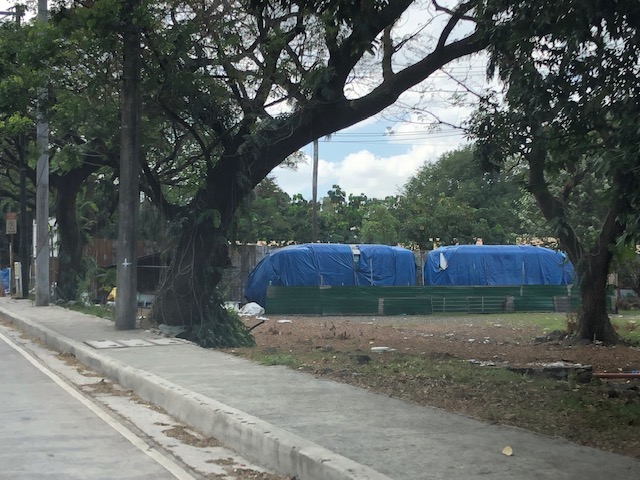 The two AGT vehicles are wrapped to protect them from the elements. These are functional and should still have value in case someone proposed to continue in their testing and refinement. It doesn’t need to be an elevated guideway for development to continue.
 Here’s a closer look a colleague managed to take before we turned at the intersection.
What’s next for the AGT? Is there a future for these vehicles? Will the DOST initiate something with the DOTr or maybe with an LGU (Taguig?) to come up with a project that will employ these vehicles in what can be a full system instead of one on test tracks? Let’s hope these assets can still be utilised and not be wasted.
–
On the P2P bus service between Antipolo and Ortigas Center
I decided to take the P2P bus from Robinsons Antipolo to Robinsons Galleria earlier this week. For one, the opportunity presented itself as I had meetings in the Ortigas Center area that day. Second, I didn’t want to drive in heavy traffic along Ortigas Avenue and the area. And third, I didn’t want to worry about parking (my meetings were not necessarily in buildings located near each other). I could easily walk or take a taxi (or Grab car) between meetings without having to worry about a parked car.
 Ticket/receipt issued upon payment of the 60-peso fare
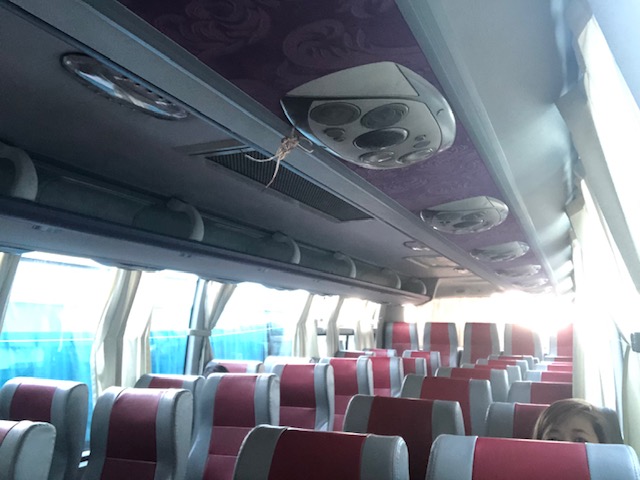 The bus was empty but for a few passengers when I boarded. I initially took as seat near the door but then saw the sign by the window stating that the first two rows of seats are preferably for persons with disabilities, senior citizens and others who may require these seats for convenience.
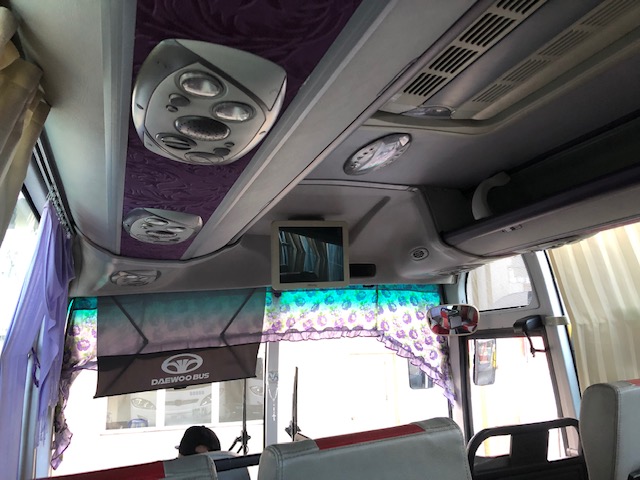 The bus I rode on is of Korean make (Daewoo) and a recent model based on the design and condition of the interiors. The air-conditioning was also strong so most passengers just close the aircon ducts above them.
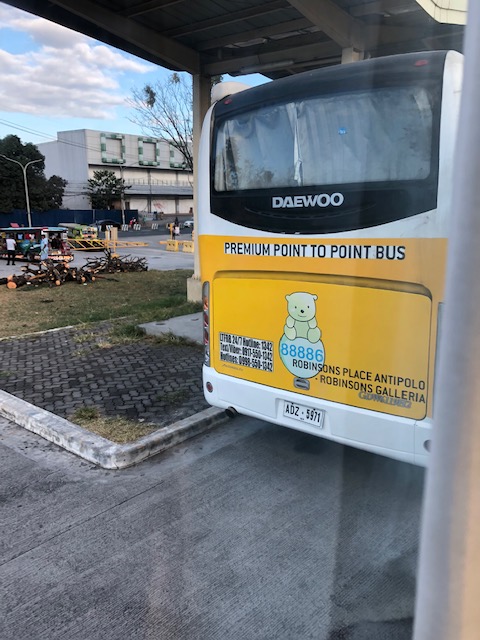 There’s a bus leaving every 30 minutes. There is a no standing policy so passengers will be directed to the next bus once all seats are taken, even if there’s a lot of time remaining before the full bus departs.
 Nearby the bus terminal is a jeepney terminal for the Antipolo-Cubao (via Sumulong Highway) route. Tricycles freely come and go at the terminal. Meanwhile, people may also leave their vehicles at the parking area (free of charge) for the final legs of their daily commutes. These allow for practically seamless transfers between different modes of road transport.
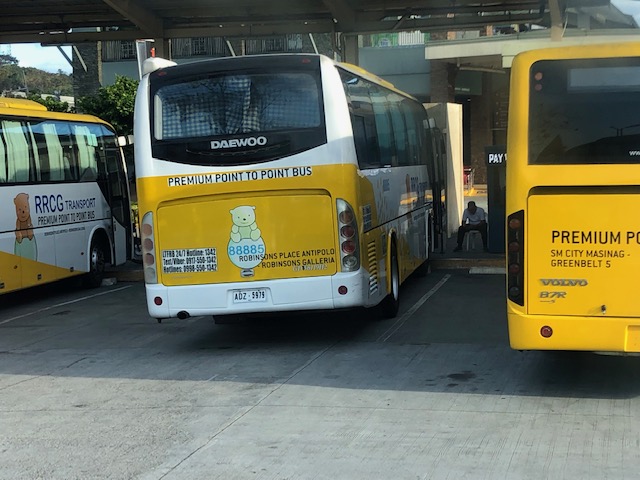 There are several buses at the terminal when I boarded in the morning. I wonder how many are committed to this particular route but the sign on the body of one bus stated that it was for the SM City Masinag – Greenbelt 5 route. I guess the Robinsons Place Antipolo terminal serves as a waypoint for these buses, which are deployed from the RRCG terminal in Taytay.
The trip started at 7:30AM and took about 75 minutes between Robinsons and Medical City, where I alighted from the bus. I figure it could have been about 1.5 hours until Robinsons Galleria if I continued to the end of the route. I actually thought I had to alight at Galleria but then noticed a couple of passengers who requested the driver to let them out at Medical City. Traffic was moving very slowly along that section of Ortigas Avenue and it wasn’t really an inconvenience to the rest of the passengers for a quick stop at Medical City.
And so I quickly changed plans and alighted at the hospital where I figured I could easily get a cab to my first meeting near Shaw Boulevard. I was right and and quickly got a Grab car to my first meeting. I just walked to the next meeting before taking another P2P bus to get home. The bus ride was comfortable and one can even have a short nap without much worry about security as the bus does not stop for most of the route (i.e., with the exception of the Medical City stop). You can easily squeeze in some work as I saw a couple of passengers typing away on their notebooks. Commutes have become difficult to many that the service provided by these P2P buses present a comfortable option to many who could afford it. The P2P buses actually provide services that are supposed to have been delivered by vans (i.e., FX, GTE, UV Express, etc.) but the latter has evolved to be more like an air-conditioned jitney rather than an express service in urban areas. Hopefully, these P2P buses can retain their quality and level of service and it attracts more car users. I suspect that their passengers might be those who are already using public transport and just shifted to one with a higher level of service.
–
More concerns about ride-hailing/ride-sharing
Here are two interesting (to me at least) articles about the negative aspects of ride hailing or ride sharing. The first is quite a curious one for me as I teach at UP Diliman, which has a sprawling campus in Quezon City. Students can have one class at a building on one end of the campus and have the next class at another end of the campus. I now wonder if there’s a significant number of Grab or Angkas trips within campus.
Kidambi, M. (2019) “Popularity of brief Uber, Lyft rides on campus raises environmental concerns,” Daily Bruin, http://dailybruin.com/2019/01/29/popularity-of-brief-uber-lyft-rides-on-campus-raises-environmental-concerns/ [Last accessed: 2/8/2019]
The second article relates on the a more general context of what’s bad about ride hailing/ride sharing. The author presents not just a list but evidence of each item mentioned.
Schmitt, A. (2019) “All the Bad Things About Uber and Lyft In One Simple List,” Streetsblog USA, https://usa.streetsblog.org/2019/02/04/all-the-bad-things-about-uber-and-lyft-in-one-simple-list/ [Last accessed: 2/8/2019]
As I’ve mentioned in previous articles here, there are still a lot we need to learn about ridehailing in this country and especially in our cities. I guess Angkas’ case can be different because motorcycle taxis were already operating in many areas even before the app-based service. But of course, we also need to understand about his enhanced ‘habal-habal’.
–
 Caught (up) in traffic