
Home » Public Transport (Page 28)
Category Archives: Public Transport
On school trip generation
I chanced upon the changing of the shifts for a national high school. This was the time of day when the morning shift students were dismissed (i.e., coming out of school) and the afternoon shift students were coming in.
 Students come out of the school to mainly either walk or take public transport (mostly tricycles) to their homes.
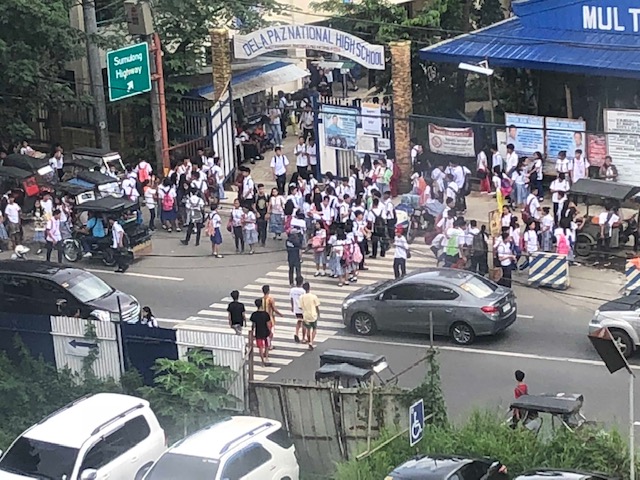 Most vehicles give way to people, especially students, crossing the busy street. There are usually traffic aides in the area who help manage traffic and to ensure pedestrians may safely cross or move about.
There are no severe traffic congestion here unlike those generated by many exclusive or private schools. There is actually a private school just beside this public high school that also generates significant private vehicle traffic but somehow manages not to congest this major road that’s part of the L. Sumulong Memorial Circle the way another private school congests Sumulong Highway in the mornings.
Is this simply because of the school being a public school as compared with private schools? Perhaps it is, given the perceived disparity in income classes concerning those going to typical public schools and those going to typical exclusive schools. But income disparity aside, wouldn’t it be possible for most students to just walk or take public transport to school? I actually envy the public school students in the photos above as they can walk to school. And that is because they likely live near the school, which is something that is a desirable situation if public schools are at least at par in quality with the more established private schools (especially the sectarian ones where many parents likely prefer their children to go to). This disparity in quality leads to people residing in relatively long distances away for the preferred schools to travel (often with their private vehicles) to and from the exclusive schools. The point here is that it really is more complicated than what it seems in terms of trip generation.
–
Progress of Line 2 Extension station construction
This is another one of those quick posts. Here are a couple of photos showing the progress of the construction of the stations of the Line 2 Extension:
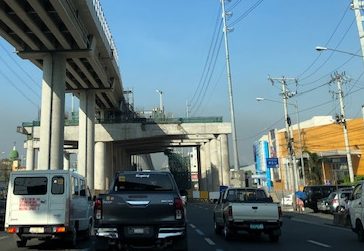 The Masinag Station under construction as viewed from the westbound side of Marcos Highway. That’s SM City Masinag on the right. The structure is very visible as you descend Sumulong Highway near the Valley Golf gate.
 Here is a blurry shot of the Emerald Station as viewed from the eastbound side of Marcos Highway. That’s Robinsons Metro East on the right side.
While the stations’ construction seem underway, a colleague pointed out that there seems to be nothing going on with the rest of the system including the electrical and the tracks for the extension from Santolan to Masinag. This is along my daily commute and I also haven’t seen anyone working on the tracks. Perhaps it hasn’t been bid out or there’s a timetable for this somewhere?
–
Partas’ Deluxe and Ms. Universe Buses
Colleagues are currently undertaking a study for the Partas Bus Company. The management was gracious to tour them around the current terminal in Cubao that is proposed for some major renovations. Part of the tour was taking them inside one of their new deluxe buses, and the bus used in the recent Ms. Universe pageant held in Manila. Here are photos of the interiors of those buses.
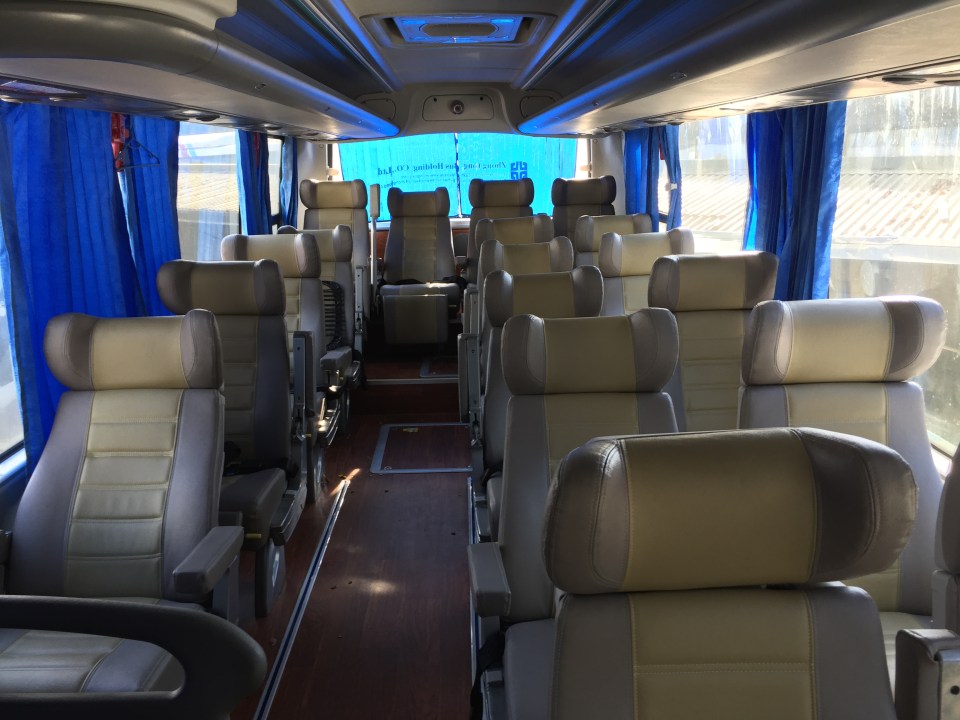 Interior of a Partas deluxe bus
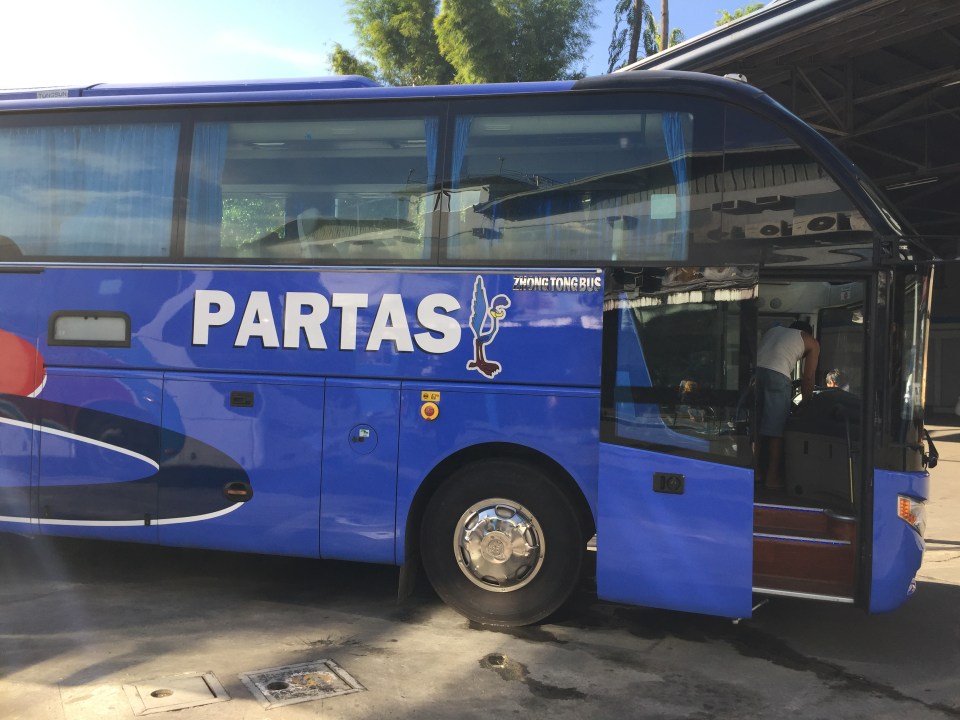 One of the company’s deluxe buses
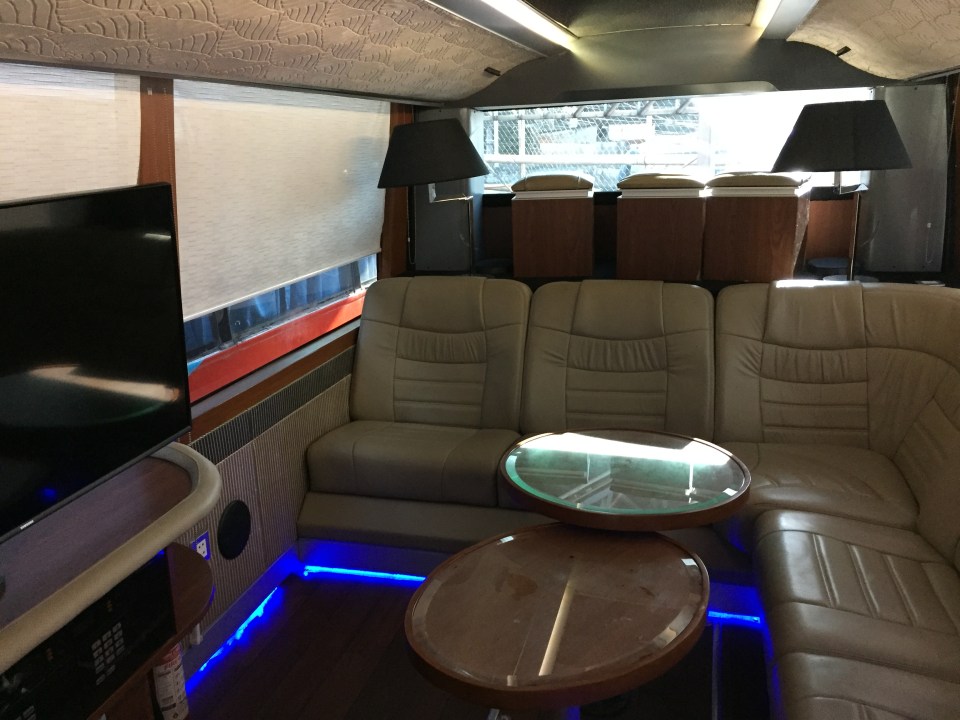 Interior of the “Ms. Universe bus”
 Another look at the interior, which includes an entertainment area
 The bus has a bar for passengers who might want to prepare some food and drinks while traveling
 The leather seats of the “Ms. Universe bus” look comfortable and perhaps perfect for long trips like those typical running between Manila and Vigan in Ilocos Sur (northern Philippines).
 Regular buses flanking the “Ms. Universe bus”
–
On good transit stop designs
We interrupt our regular programming to share this good reference for designing bus stops:
Transit Center (2018) From Sorry to Superb Everything You Need to Know about Great Bus Stops, transitcenter.org, http://transitcenter.org/publications/sorry-to-superb/#introduction [October 2018]

This is a new publication and though the focus is on bus stops, the principles and guides presented are very much adaptable and applicable to other public transport modes as well, particularly the road-based modes we have in the Philippines. The article contains a link for those who want to download the entire report.
–
A quick update on the Line 2 Emerald Station construction
Here are a couple of photos of Line 2’s Emerald Station, which is under construction. There’s significant progress in the construction but this will definitely take months to complete along with the Masinag Station, which is in a similar state of progress in construction.
 Here is what the Emerald Station, which is just across from Robinsons Metro East and Sta. Lucia Mall, looks like. It’s still far from being completed but you can already see what seems to be an area underneath the tracks where people can cross from one side to the other. Stairs have been constructed to connect what could be a station concourse to the street level. The building under construction to the right in the photo is Sta. Lucia’s. From the looks of it, this will be an office building, likely to host a BPO office. We hope that the station will have direct connections with the two malls as well as this office.
 Right after the station is the intersection of Marcos Highway with Felix Avenue and Gil Fernando Avenue where there is still pedestrian overpass that allows people to cross the wide roads safely. There are only rare instances when people attempt to cross at street level here but there were some security concerns as there was a spate of snatching incidents on the overpass. Cainta authorities seem to have addressed this despite some border issues with Marikina and the former has posted policemen to deter crime on the overpass.
The last image connects to the first one in the sense that there should be a connectivity for the existing pedestrian infrastructure (i.e., overpass and sidewalks) with the future Emerald Station. This connectivity would be in the form of suitably designed walkways that can and should include provisions for cyclists, too. Perhaps the two malls can pitch in to make these designs a reality and not just be content with token steel structures like what are usually constructed elsewhere and at the junction near the station. There is a good opportunity here to come up with good design that can become a good example for replication.
–
On the need to increase NMT and public transport use
A recent report reinforces what many of us already probably know or are aware of – that we need to shift away from dependence on car use to more sustainable modes of transport in the form of non-motorised transport (NMT) and public transportation. Here is the article from the AASHTO Journal:
Global Climate Report Calls For Expansion Of ‘Non-Motorized’ Transport And Public Transit (2018)
There is a link to the report in the journal article. The report is conveniently available in PDF form and is very readable (i.e., not overly technical).
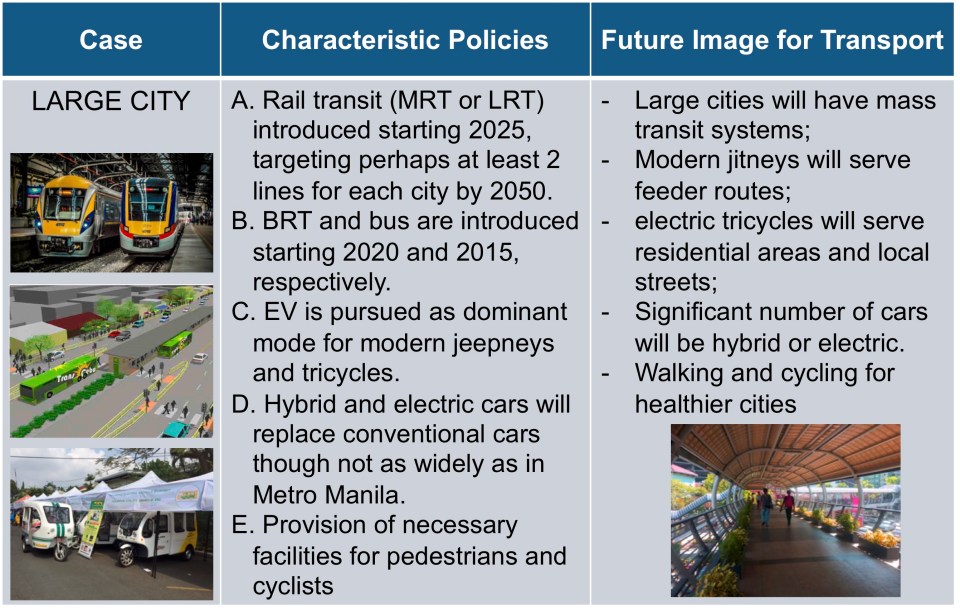
Incidentally, I was involved some time ago in a project led by the group Clean Air Asia (CAA), which involved several experts from across ASEAN as well as Japan that attempted to determine the necessary transport programs and projects in the region to stave off the projected increase in global temperatures. In all the scenarios evaluated, non-motorised transport (NMT) and a rationalised public transportation system By the term ‘rationalised’ I am referring to the use of higher capacity vehicles as against the taxis and tricycles that typically carry few if not one passenger. Here is a link to the final symposium for that study that has links to the materials presented:
The Final Symposium on the “Study on Long Term Transport Action Plan for ASEAN”
Here’s a slightly updated slide on the future image for a large city in the Philippines:
–
On the relationship between public transport use and enhanced traffic safety
I found this article while browsing the AASHTO Journal:
APTA Study Says Higher Transit Use Results In Fewer Traffic Deaths, https://aashtojournal.org/2018/08/31/apta-study-says-higher-transit-use-results-in-fewer-traffic-deaths/ [Last accessed: 9/5/2018]
The article contains a link to the report, which would be a good reference for those who want to show proof for the argument for public transportation development and use vs. dependence on cars. I think its possible to come up with our own version of the graphs shown in the report especially those that show less traffic fatalities per 10,000 residents vs. annual trips using transit per capita. However, this will require data collection and analysis for at least the highly urbanised cities (HUCs) in the country. I say at least because these cities would be the ones likely to have the resources to determine the stats necessary for such an assessment.
–
The ill-located terminal at Ligaya along Marcos Highway
There is a newly constructed public transport terminal in what is popularly known as the Ligaya area along Marcos Highway in Pasig City. The terminal is right across from the new Ayala Feliz Mall. The terminal is mostly unused or under-utilised. The jeepneys and UV Express vehicles that were supposed to use the terminal seldom go there as the natural stop for most coming from Pasig to Marikina would be closer to the junction of Marcos Highway with Amang Rodriguez Avenue. There is also the U-turn slot nearby where many passengers dare to cross to in order to catch a ride. Sinasalubong ng mga tao ang jeepney na lumiliko dito and the traffic enforcers in the area generally turn a blind eye to this.
 The practically empty terminal during evenings
Late at night, the terminal is dark with the lights turned off. Most times I pass by the area in the mornings and afternoons, there are few, if any, PUVs at the terminal and you don’t see a congregation of a lot of passengers there as with other terminals. Did Ayala make a mistake with this terminal? For one, it is known already that while this area is a transfer point for many passengers, the location of the terminal with respect to the established U-turn slots make it unsuitable and undesirable for most PUVs. Then there is the impending operations of the Line 2 Extension whose nearest station will be hundreds of meters away across Robinsons Metro East and Sta. Lucia Mall. I think Ayala needs to construct a physical connection to the terminal if only to increase the number of people going there and therefore attract PUVs. Finally, the area is not a terminus (or last stop) for PUVs so it doesn’t make sense for them to spend time there except perhaps during off-peak periods (i.e., for rest). However, it is not attractive even for the latter since there seems to be no amenities including stores or maintenance shops to support PUVs.
–
Article on housing and transportation
Here’s another excellent piece from Todd Litman about the dynamics of housing and transportation. This is a very relevant topic in many cities today and especially so for those like Metro Manila, which is struggling with issues pertaining to affordable housing and transportation infrastructure and services. Arguably, a lot of households are spending more than the 45% threshold of incomes mentioned in the article but people continue to get homes away from the city as these are relatively cheaper than those closer to their workplaces and schools. Unfortunately, transportation costs are on the rise and congestion and a lack of an efficient transport system are among the culprits for what many have already labelled as undignified and atrocious costs of commuting.
Litman, T. (2018) “Affordability Trade-Offs,” planetizen.com, https://www.planetizen.com/node/99920?utm_source=newswire&utm_medium=email&utm_campaign=news-08092018&mc_cid=e2a69b6eb4&mc_eid=9ccfe464b1 [Last accessed: 8/9/2018]
I envy the guy for being able to present these topics clearly. It is a complex subject and one that isn’t understood by many in government who are supposed to be responsible for crafting and implementing policies and programs to address issues pertaining to affordable housing and commutes. I wonder if Todd is coming over for the ADB Transport Forum. He’s make for a good resource person in some of the sessions there and perhaps can also be invited to speak about this and other relevant and urgent topics in a separate forum. Anyone out there care to sponsor him?
–
On EDSA transport and traffic, again
There’s a recent decision by the Metro Manila Council (MMC) comprised of the mayors of the cities and municipality of Metro Manila and chaired by the Metro Manila Development Authority (MMDA) Chair that vehicles bearing only one passenger (the driver) will be banned from travelling along EDSA. The problem with this is that by banning cars with one passenger from EDSA, you only succeed in making other roads like C5 more congested. It’s a simple case of transferring traffic and worsening it elsewhere since you’re not doing anything to alleviate congestion along those roads. Did MMDA run this and other scenarios using analytical or simulation tools at their disposal? If so, can these be shown and used to explain the soundness of this policy approved by the MMC? I suspect they didn’t and likely depended more on gut feel based on the data they have including what is often reported as 70% of vehicles traveling along EDSA having only one passenger. Meanwhile, the state of mass transit along EDSA still sucks.
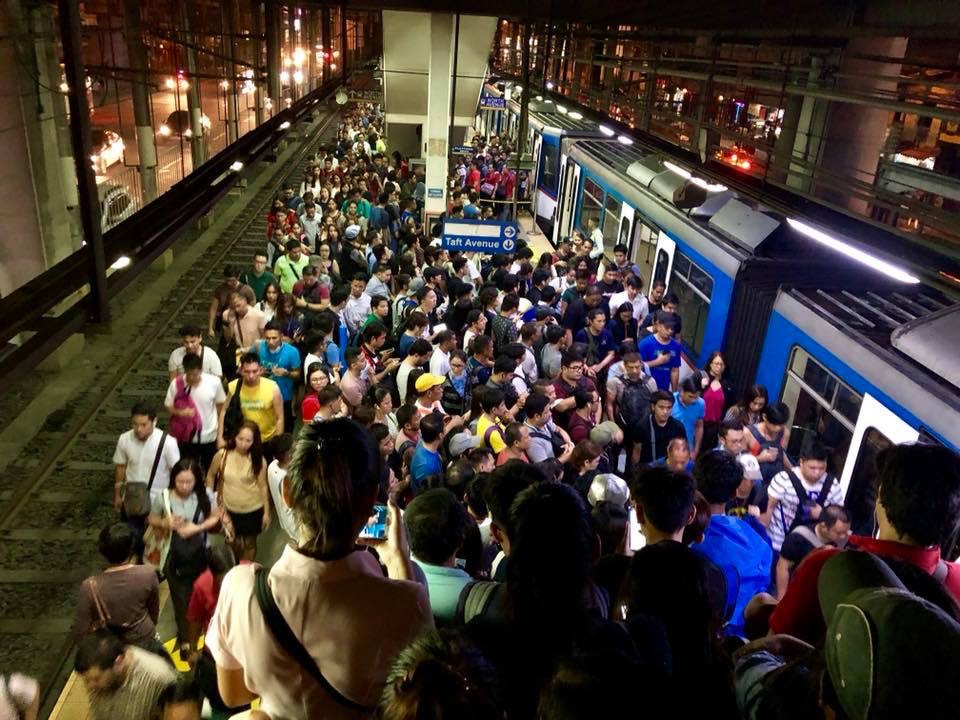 A very crowded Boni Avenue Station platform (photo courtesy of Mr. Raul Vibal)
Of course, the pronouncement from the MMDA launched quite a lot of memes on social media. Some people shared the typical quotes on planning (you know, like the ones about planning for people vs. planning for cars). Some offered their own ideas about how to “solve” traffic along EDSA. And so on…that only succeeded in showing how everyone had an opinion about transport and traffic. Everyone is an expert, so it seems.
Some thoughts and not in any order:
- The government can initially dedicate a lane each for express buses (a la Bus Rapid Transit or BRT). This idea has been circulating for quite some time now and has a good chance of succeeding. The DOTr is already deploying buses that they say are supplementing the MRT 3 trains (i.e., there aren’t enough trains running so passengers have the option of taking a bus instead). Running along the inner lanes of EDSA would mean, however, that they would have to find a way for passengers to cross the road and one idea would be for the stations to be retrofitted for this purpose.
- Those cars along EDSA are not necessarily for short trips so walking and cycling while needing space may have less impact in the immediate term for such a corridor. In the meantime, serious consideration should be made for bike lanes whether on the ground or elevated and improvements to walking spaces.
- But these efforts to improve passenger (and freight) flows should be a network-wide thing and not just along EDSA.
- It’s time to have serious discussions and perhaps simulations (even a dry run) of congestion pricing in Metro Manila. Congestion pricing for all major roads and not just one or two. Funds collected goes to mass transit, walkways and bikeways development. DOTr was supposed to have already discussed an Electronic Road Pricing (ERP) system like Singapore’s with the company and people behind the same in the city-state. That doesn’t seem to be moving along.
- Working and studying from home might work in terms of reducing vehicular traffic but then we generally have lousy internet services so that’s a barrier that needs to be broken down.
- How about legalizing, once and for all, motorcycle taxis? Many are opposed to this citing safety concerns but then we are running out of options outside the usual motherhood statements pertaining to building transport infrastructure. Think about it. Give it a chance. These motorcycles might just surprise us in a nice way; that is, helping alleviate congestion.
- Carpooling and lanes dedicated to High Occupancy Vehicles (HOV) would be good but the LTFRB made a pronouncement about these being illegal as they would be considered ‘colorum’. Such statements do not make the situation any easier and sends mixed signals as to the government’s being serious in considering all possible angles to improve transport and traffic particularly for commuting.
Do you have other ideas to share?
–
 Caught (up) in traffic