
Home » Public Transport (Page 29)
Category Archives: Public Transport
Increasing the number of TNVS units? Not so fast!
The Land Transportation Franchising and Regulatory Board (LTFRB) is planning to increase the number of TNVS units (i.e., rideshare vehicles) in Metro Manila to meet what is perceived as the demand for them based on the numbers provided by TNCs like Grab. The problem with this number they want to eventually achieve, 65,000 units supposedly, is that this is based on current transport conditions in the metropolis. Also, this is based on data that is biased for the interests of TNCs, which obviously want to increase their driver and vehicle base in order to maximise profits. Here is a nice article that should provide some context from abroad where rideshare vehicles are actually generating more car traffic and taking people away from public transport.
Fried, B. (2018) “Uber and Lyft Are Overwhelming Urban Streets, and Cities Need to Act Fast,” Streetsblog, https://nyc.streetsblog.org/2018/07/25/uber-and-lyft-are-overwhelming-urban-streets-and-cities-need-to-act-fast/ [Last accessed: 7/26/2018]
Currently under construction are the Line 7 and Line 2 Extension projects and soon there will also be the Line 1 Extension. Also, in the pipeline are the proposed subway and rehabilitation of PNR that is supposed to revitalise its commuter line. These are examples of projects that will likely be game changers in terms of commuting with the objective of drawing people away from car use. In the bigger scheme of things, perhaps there is a need to rethink numbers for TNVS and instead focus on improving taxi services in Metro Manila. The same can be said for other cities as well where there is already a need for better public transport services to avert a transport future similar to what Metro Manila is already experiencing now.
–
Safe and healthy journeys to school
I recently attended a workshop organised by UNICEF in cooperation with UN Environment and the WHO. The main topic was about road safety, particularly for children and focusing on their journeys between homes and schools. This is definitely a big issue and the concern is not without basis. Take the example shown in the photo below where two motorcycles are carrying more passengers than what they are designed for.
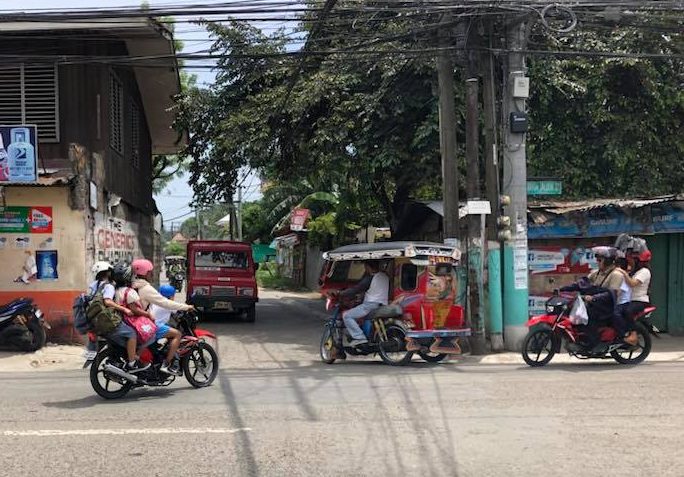 Children on-board motorcycles bound for a school in Zamboanga City
The passengers are children being taken by what looks like a parent or parents driving the motorcycles. Such are common scenes in Philippine roads and in many cases, the children are at risk of being involved in a crash. Most will have no protection and will likely be seriously injured or be killed in case of a crash. Then there are the cases of children walking between their homes and schools and are exposed to the dangers brought about mainly by motor vehicle traffic along the roads they travel on. It is a wonder how there are few crashes occurring despite these conditions (or is it because few are reported and recorded?)!
I will be pursuing research topics related to safe journeys to schools more than other road safety topics that the staff and students I supervise are usually taking on. Hopefully, too, my new advisees this coming semester will be interested in related topics particularly graduate students who work for the Department of Public Works and Highways (DPWH).
–
On the continuing evolution of Uber and Lyft, and some thoughts on TNCs in the Philippines
Here’s a nice read about ridesharing/ridehailing/ridesourcing in the US:
Madrigal, A.C. (2018) “Will Uber and Lyft Become Different Things?”, medium.com, https://medium.com/the-atlantic/will-uber-and-lyft-become-different-things-2d0442472a15 [Last accessed: 6/13/2018].
It seems that companies like Uber and Lyft are evolving and that should benefit commuters. Meanwhile, the latest news on TNCs in the Philippines is on the issuance of a Department Order by the Department of Transportation (DOTr). The new Department Order (DO) effectively amends and supersedes an earlier DO issued in 2015 (DO No. 2015-011), wherein TNCs were allowed to set their own fares, subject only to oversight by the Land Transportation Franchising and Regulatory Board (LTFRB). This means more regulations for TNCs that might actually harm the new players more than the remaining big player – Grab.
Uber recently sold its Philippine operations to Grab in exchange for shares of Grab. One colleague quipped “If you can’t beat ’em, join ’em!” And that seems to be the case here where Uber’s vulnerability was exposed when faced with a strong competitor together with a government bent on having a firm regulatory control of TNC operations. While I am for regulations in order to protect both the interests of commuters as well as the drivers-operators of TNCs, I believe too much regulations will weaken this mode while taxi services remain wanting (to use a kinder term). The DOTr and the LTFRB is again not addressing the root cause of a problem on taxi-type services and allowing generally poor services among taxi companies in Metro Manila to continue.
–
School is back and so are safety issues for schoolchildren
It’s school time once again in most parts of the Philippines. Public and private schools including most colleges and universities have resumed classes this month of June while others start this July and August. But with the resumption of classes, there is also the re-emergence of issues pertaining to the safety of these children. Students are exposed to the hazards of commuting. These include the likelihood of being injured or killed by vehicles running along the roads the students use to get to school.
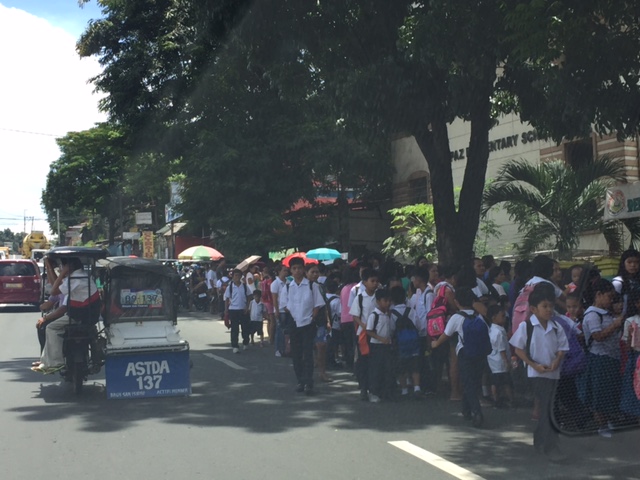 The photo above is a typical scene in front and around many public schools in the country. Schools are located along national roads and often lack spaces for students and their guardians. Many end up occupying the roads and causing congestion. Of course, that congestion is secondary to the safety of these children. Nevertheless, such issues need to be addressed in a more holistic manner rather than attempt to solve one as if they could be isolated.
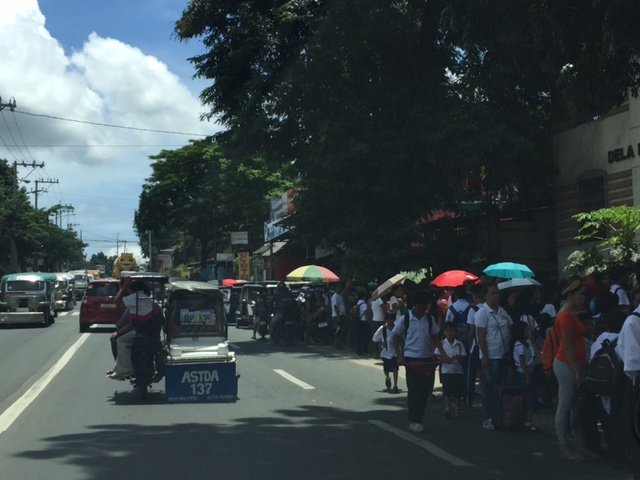 Most students of grade schools and high schools around the country either walk or take public transportation in their commutes. They are exposed almost daily to motor vehicle traffic along the roads and risk being sideswiped or run over by vehicles. In certain cases, small children walk significant distances thereby increasing the likelihood and risk of being harmed by traffic.
Traffic is particularly bad along most roads leading to schools mainly during the morning, mid-day and afternoon periods when students arrive or leave their schools. In Metro Manila, for example, the worst congestion are experienced along major roads like Katipunan Avenue (due to traffic generated by Ateneo, Miriam and UP) and Ortigas Avenue (due to La Salle Greenhills). That means a lot of time and fuel are wasted and more emissions are released into the air that we breathe. However, one can argue that in terms of road safety, this is better since gridlocks mean slow moving vehicles that make it safer for walking or cycling. This is not the same in the provinces or rural areas where there is less congestion and vehicles travel at faster speeds.
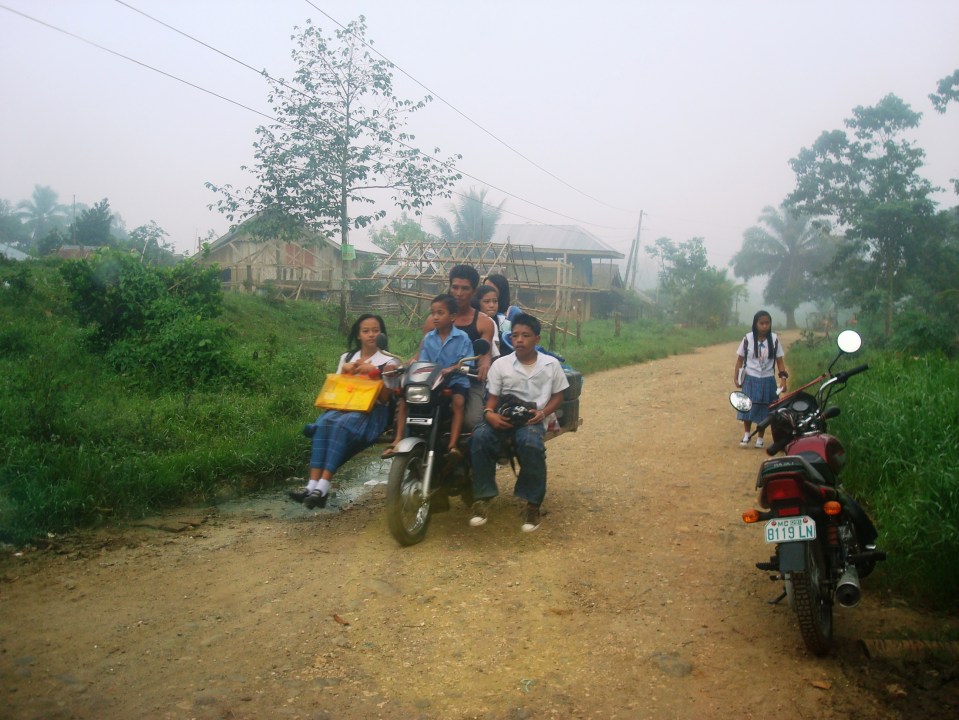 Children heading to school on a ‘skylab’ version of the motorcycle taxi
While there are initiatives pertaining to revisions in speed limits, such are limited (pun not intended) by how much action can be done in order to enforce these regulations. Add to this the requirement of having the instruments to measure and record speeds in aid of enforcement. This was what MMDA did along Commonwealth Ave. and Macapagal Blvd. with the acquisition of two speed guns. I don’t see them using these anymore and wonder if the instruments are still working. Meanwhile, expressway authorities are using these as they continue their enforcement of speed limits along tollways. [I am aware of NLEX and SCTEX enforcement units employing speed guns along those tollways.]
The DPWH is also doing its part by doing road safety audits and identifying measures to reduce the likelihood of crashes involving these students. Among these are rumbles strips and, in some cases, the construction of sidewalks but these are not enough. There were recommendations from an iRAP project many years ago but the agency was resistant to what they thought were new and innovative ideas that were actually already being implemented in other countries. Perhaps these recommendations and that iRAP study could be revisited and solutions drawn from there?
–
Failed experiments? On the DOST’s hybrid train and AGT
Our staff were implementing surveys in relation to the proposed railway projects supported by the Government of Japan. They came across this scene showing the DOST’s (through its MIRDC) hybrid electric train.
 The hybrid electric train at the PNR Calamba Station. It looks like its being maintained or checked although I’m not sure the crude set-up is appropriate for such undertaking.
The DOST had a much hyped program during the last administration about the development of Philippine-made transport. Among these were the two Automated Guideway Transport (AGT) train sets that were developed by the MIRDC – one with two 60-passenger (seated and standing) cars and a test track in UP Diliman, and another with two 120-passenger cars with test track at the MIRD compound in Bicutan. While both had what were claimed as extensive tests, these were mainly done by DOST/MIRDC personnel with no independent inspections or validations. At one time, I recall that we at UP had discussions with representatives of Mitsubishi Heavy Industries who offered to explore arranging for a technical cooperation project to have a full-scale testing of the AGT’s using their facilities in Japan. We referred them to MIRDC and that didn’t turn out well as the agency (or perhaps under the the instructions of a higher official?) was supposed to have rejected the offer preferring it to be tested locally. That was a major problem because there were no suitable testing facilities or qualified persons or institutions to grant certification for the AGT to be used as public transport.
The last time I checked with folks at DOST and UP, the AGT prototype set-up in Diliman was already being scheduled for dismantling. This probably comes as a welcome development for those who opposed the project from the start. However, there is potential here for continuing research if only funding could be secured and proponents kept open minds and objectivity in the way researches could be done. There was the perception before that the people behind the AGT projects were so engrossed with what they thought were their babies that they blocked critical but objective comments and recommendations about the prototypes and their applications.
As for the hybrid electric train, there is now supposed to be a cooperative project between the MIRDC and PNR. I recall a few months ago that they even had some test runs to show the hybrid train to be running on PNR tracks; even hyping that this could be part of the future of a rehabilitated PNR. Is this true or just PR? Hopefully, the DOST could get the context right, and the DOTr and PNR can support such initiatives for Philippine-made transport. This is especially as the current administration continues to pursue its Build, Build, Build program that has as major features several railway projects.
–
Proposed downtown traffic scheme for Tacloban City
The team from the National Center for Transportation Studies of the University of the Philippines presented their recommendations for the traffic scheme in downtown Tacloban City last May 4, 2018 in the city’s Traffic Summit cum City Development Council (CDC) meeting. I am sharing the image showing the proposed traffic circulation and other features for the proposed downtown scheme below:
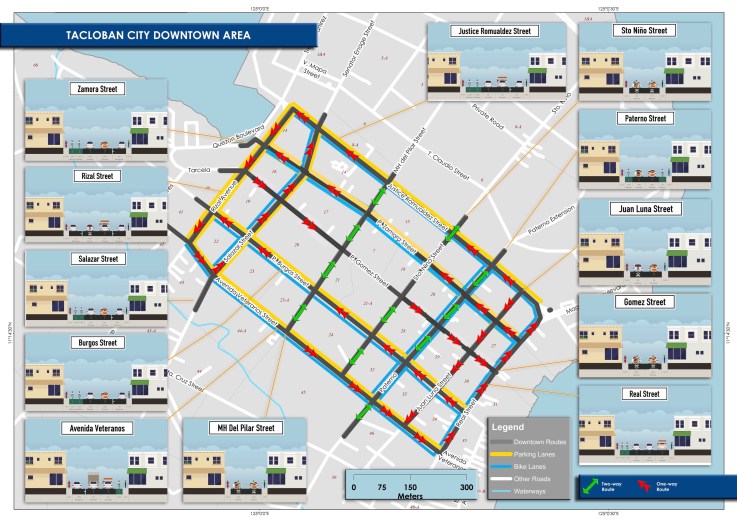
The scheme calls for a reduction in on-street parking; restricting such to one side of the street only and where applicable. That is, on-street parking is not allowed where there is already off-street parking along establishments, where there are driveways, and within one or two vehicle length from intersection corners. There will also be designated loading/unloading areas for public transport so parking is also prohibited there.
A couple of important features in the scheme are the enhancement of pedestrian facilities, particularly sidewalks, and the introduction of bicycle lanes. These are more clearly shown in the cross-section examples included in the map. Note that for other streets where there are no designated bike lanes indicated, it is assumed that lanes will be shared with motor vehicles. This is an application of the concept of shared right of way or “sharrow” as it is also termed. The scheme is contextualised along the lines of “people-oriented” transport rather than “car-oriented”, and hopefully would lead to a more walkable downtown area and encourage more people to use bicycles. This promotion of active transport should also lead to a healthier city. I will post about the transport plans prepared for the city in future articles here.
–
On the Grab – Uber merger
A couple of weeks ago, I received a message from Uber confirming what was in the news for some time then, and what was rumoured a longer while back. Uber Philippines was closing shop after merging with main competitor Grab, while the mother company also acquiring a stake in Grab. Later, I also received a message from Grab (I use either depending on availability and cost.) welcoming Uber users to Grab.

The result so far has been frustrating if not disappointing to many who have relied on Uber for commuting and the typical trips that you usually associate with taking a taxi.
Recent news revealed that Grab is using an even more punitive pricing scheme compared to Uber’s surge pricing. While the LTFRB moved to scrap this, Grab has been apprehensive, stating that this was an incentive for their drivers. There is actually another side to the concept of surge pricing that LTFRB does not or seems to refuse to understand. That is, that dynamic and more expensive fares related to congestion (or road conditions) is something that’s actually related to the concept of congestion pricing. This actually penalises the use of vehicles like private cars or taxis in favour of higher capacity transport like buses or, if available, trains.
Even more recent is the news that Grab is suspending about 500 of its drivers for excessive cancellation and/or rejection of trips. Unlike Uber before, Grab drivers have the “luxury” of knowing where a potential passenger is heading. That gives the driver the option to accept or reject a proposed fare. Uber drivers didn’t know where the potential passenger was heading and to my knowledge, was stricter with penalising their drivers. The only caveat I know is that passengers can also be penalised if the driver requests for a cancellation and the passenger obliges out of good faith (e.g., An Uber driver in Cebu requested me to cancel the request as he claimed he was caught in traffic and would be penalised if he canceled. I ended up protesting Uber penalising me 100 pesos for my cancellation. Uber did not act on it in my favour.).
The issues surrounding the Grab/Uber merger though should not be there in the first place if we had good taxi services. When I say good I am referring to the quality of service provided by taxis in Singapore and Japan. Of course, they also have good public transportation there so there’s also a case for what most people will likely be taking instead of cars and taxis (which operate similarly as cars). One wonders how and why LTFRB seems to be so strict vs TNCs while being lax with taxis. Meanwhile, DOTr is scrambling on the desperate catch-up work it has to do about mass transit lines and public transport rationalisation. Good luck to us commuters!
–
More high capacity transit for Antipolo!
Two years ago, I wrote about Antipolo being ripe for high capacity public transportation. So far, work is progressing along the Line 2 Extension to Masinag but there’s no word about it being extended further (Cogeo? Marikina?). I have always maintained that the demand in Cogeo, Antipolo is already established and a mass transit line terminating there will certainly be a game changer in terms of commuting. In fact, it may contribute to rapidly developing that area and hasten the development of Antipolo’s government centre, which is a few kilometres further along Marcos Highway.
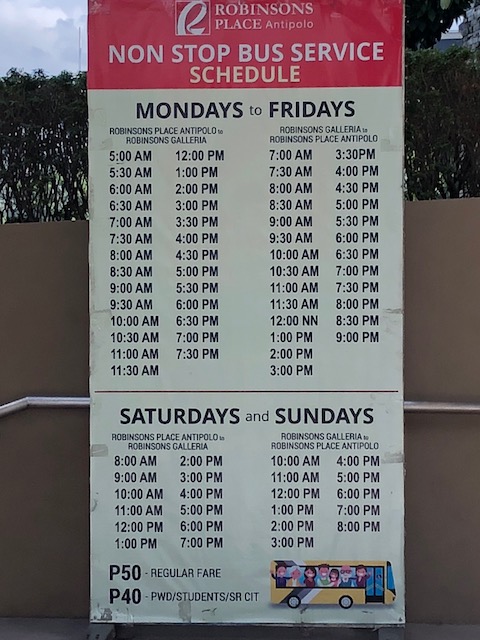 Schedule and fares for the P2P bus service between Robinsons Place Antipolo and Robinsons Galleria in Ortigas Center.
There is now a P2P bus service between Robinsons Place Antipolo and Robinsons Galleria via Ortigas Avenue. And then there is the newest P2P service between SM Masinag and the Makati CBD. The first has very limited capacity at present and have few patrons (regular passengers) based on what I’ve observed and the rough survey my students did for a class project. I still have to see the second one from SM Masinag but I assume it has a higher demand considering a lot of people already commute from that area to Makati. I say so because there’s a nearby UV Express terminal that’s always crowded with people every time I pass by in the morning. This should also translate into demand for the afternoon/evening period. However, I am not so optimistic about the off-peak periods (I hope I’m wrong!) as most P2P services my students have surveyed so far indicate really low occupancies during the off-peak periods.
Is P2P the way to go for Antipolo (and its neighbouring towns like Cainta, Taytay and Marikina)? I think this is still basically a stop-gap measure and a mass transit line as well as complementing conventional buses would still be the most suitable for these rapidly and steadily growing areas. Ortigas Avenue is ripe for a high capacity system that should perhaps be grade separated. The demand was there more than two decades ago. I seriously believe that the Province of Rizal, the City of Antipolo and the high-earning Municipalities of Cainta and Taytay should exert more effort and lobby for a mass transit line serving the Ortigas corridor.
–
Incomplete rationalisation of public transport?
The current initiative to rationalise road public transport services is not as comprehensive as necessary or as some people want us to believe. The drive appears to be mainly on (some say against) jeepneys while little has been done on buses and UV Express vehicles. Most notable among the modes not covered by rationalisation are the tricycles.
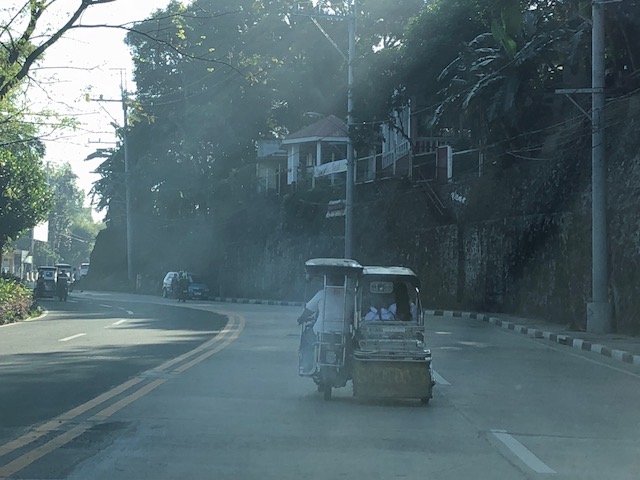 A smoke-belching tricycle along Daang Bakal in Antipolo City
What really should be the role and place of tricycles in the scheme of themes in public transportation? Are they supposed to provide “last mile” services along with walking and pedicabs (non-motorised 3-wheelers)? Or are they supposed to be another mode competing with jeepneys, buses and vans over distances longer than what they are supposed to be covering? It seems that the convenient excuse for not dealing with them is that tricycles are supposed to be under local governments. That should not be the case and I believe national agencies such as the DOTr and LTFRB should assert their authority but (of course) in close cooperation with LGUs to include tricycles in the rationalisation activities. Only then can we have a more complete rationalisation of transport services for the benefit of everyone.
–
Trams of Den Haag
Going around The Hague was no hassle. There were a lot less people there compared to Amsterdam last Easter Sunday. I felt more relaxed moving around. I also like it that I had transit options in the form of trams and buses to get from one place to somewhere walking seemed to be the less efficient mode to take. Not so many people were on bicycles but that’s probably because it was a Sunday and most bike traffic were for work or school trips? Here are some photos of trams at The Hague (Den Haag).
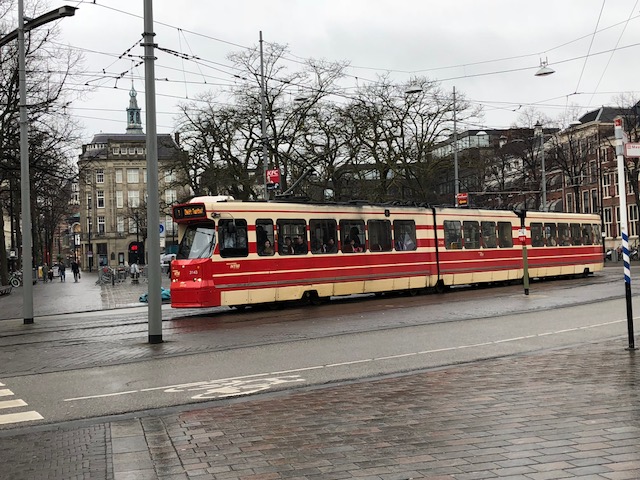 Saw this tram as we went around some of the attractions in the city.
 We rode this one going to the beach.
 I rode this tram going back to Den Haag Central Station
 Transit network map at Frankenslag stop
 Tram schedule posted at the stop
Our friends’ neighbourhood was a really nice one and I liked it that it is accessible to both tram and bus. The walks are short but you can easily get some exercise by getting off at an earlier stop or perhaps walking to a further one. The clear walking paths are definitely a plus and the environment is one conducive for such activities as well as for saying ‘hello’ to other people.
–
 Caught (up) in traffic