
Home » Public Transport (Page 40)
Category Archives: Public Transport
Line 2 to be transformed into a BRT? Definitely not a good idea!
There are news reports stating that the Department of Transportation (DoTr) is considering replacing the LRT Line 2 with a BRT instead. I think this is not something worth considering at this point since the construction of the Line 2 extension from Santolan to Masinag is already underway. Also, there is the fact that Line 2 is the only heavy rail system among the three LRT/MRT lines in Metro Manila. It has the potential to have the highest capacity among the three as well as the potential to have the highest ridership especially after the extension is complete and the two additional stations are operational.
With lots of people requiring public transport beyond Masinag, the question is not whether to convert Line 2 into a BRT but instead what services can be provided for a more efficient system for Rizal and Marikina. I took the following photos along my commute from Antipolo to Quezon City. Note the number of people waiting for public transport along Marcos Highway.

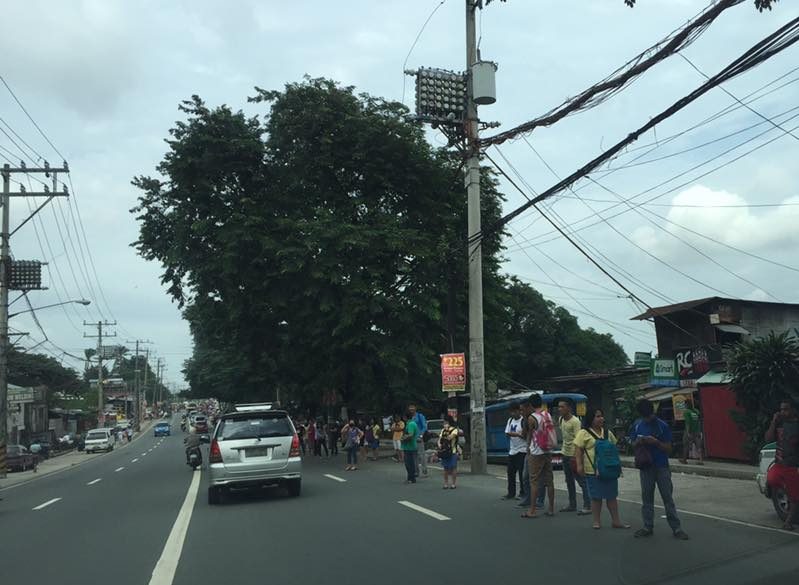
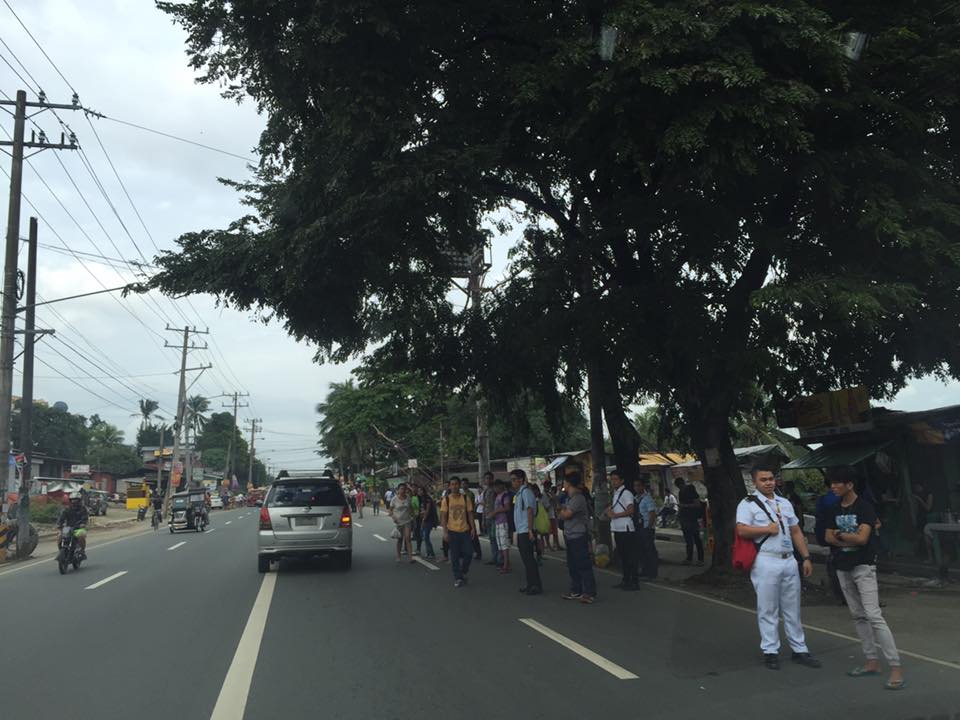

These are people who would typically take jeepneys or UV Express for their commutes. It is obvious from my regular observations that jeepneys and UV Express cannot cover the demand for public transportation and my opinion is that it is high time to introduce a higher capacity and more efficient mode in order to encourage people to keep taking public transport and to encourage those taking private transport to shift to PT.
A BRT service can be connected to Line 2. Since the Line 2 extension to Masinag is scheduled to be completed next year and be operational by third quarter of 2017, a bus service can already be piloted between Santolan and several end points. Four for consideration would be Cogeo, Antipolo Simbahan, Marikina and Cainta.
- Cogeo should be a no-brainer given that there is already demand there and this is growing rapidly with all the subdivisions being developed in this area.
- For Antipolo Simbahan, perhaps the final stop need not be at the shrine but at Robinsons Antipolo.
- For Marikina, there can be three lines – one branching from Ligaya where there is a major Ayala development, a second at Gil Fernando and another at Masinag. These may terminate at the city center, perhaps in the vicinity of the Rodriguez Sports Complex, which is near the Marikina City Hall and public market.
- The last line could traverse Felix Avenue (Imelda Avenue) and may terminate at Cainta Junction where commuters can transfer to transport along Ortigas Avenue Extension.
Surely, pilot services can be provided where limited stops or express services can be experimented on to see what clicks in terms of ridership. It would be nice to get feedback about such services and hopefully there will be champions for these bus services. Note that such services terminating at Santolan means that there should be terminal facilities in that area. Former MMDA Chair and now Marikina Congressman Bayani Fernando has developed an area precisely for an eastern transport terminal and so bus services present a good opportunity for this terminal to be a busy one. Maybe BF can champion these bus services? And perhaps the Antipolo and Cainta (paging Mayors Ynares and Nieto!) can also push for these services as commuters from these would stand to benefit the most from a good transport system.
–
TSSP 23rd Annual Conference Proceedings
The 23rd Annual Conference of the Transportation Science Society of the Philippines (TSSP) was held at the University of the Philippines (UP) Diliman last August 8, 2016. It was hosted by the National Center for Transportation Studies (NCTS), which for some time was practically inactive in its dealings with the society. The conference was a very successful one with more than 170 participants, mostly students from the undergraduate programs of Mapua Institute of Technology (MIT), De La Salle University (DLSU) and UP Diliman.
The Proceedings of the 23rd Annual Conference contains 22 technical papers, which I have already listed in a previous post showing the technical program for the conference. The link is to the current website of the TSSP hosted by NCTS. Those wishing to have copies of the papers may download them directly from the link. Meanwhile, those interested in the presentations should contact the authors. Their contact information are stated in the paper and it is ethical to get the nod of the authors for their presentation file as these still fall under what can be defined as their intellectual property. I am aware of people who tend to get presentation slides and then pass them of as their work when they use the slides or the data/information therein. There are proper ways for citations of references and sources but sadly such ways are not observed by many.
–
Straddling bus prototype?
What was peddled as a unique public transport mode concept in social media is now a reality. Check out the article and video here:
China’s Futuristic Straddling Bus Is Finally Here
This is a welcome development for public transportation. However, some issues need to be addressed, particularly regarding road safety. Motorists traveling under the straddling bus may have reactions to the vehicle as it passes above them and such may lead to road crashes. Of course, with the advent of driverless vehicles such incidents may be minimised if not altogether eliminated.
–
Standards for integrated railways in the Philippines
With the recent pronouncements about railway projects in Metro Manila including the ongoing Line 2 Extension to Masinag, the impending construction of Line 7 (i.e., along Commonwealth and Regalado Avenues and Quirino Highway) and the proposal for a Line 4 (Diliman, Quezon City to Lerma, Manila), it becomes more imperative to have integrated railway infrastructure including and especially common stations where lines intersect and common specifications guided by standards or guidelines. Do we have such or has there been work towards their formulation in the past? The simple answer to that question is yes. But then we have to qualify that affirmative response because while there was a study a decade and a half ago, the outcomes of that study, which is a comprehensive take on all aspects of railway systems was never formally adopted (again?) by the Philippines.
The following link is for the Executive Summary of the “Study on Integrated Railway Network for Metro Manila (SIRNMM) completed in 2001.
Perhaps there is a need to revisit the outcomes of this study? This can serve as a good platform from which updated guidelines and standards can be developed for a more harmonious development of railways systems not just for Metro Manila but for other cities as well.
–
Mobility for persons with disabilities
I saw these two people traveling along Marcos Highway just after the intersection with Imelda Avenue. I think they came from Tahanang Walang Hagdanan in Cainta. The tricycle is actually modified to allow for a person with disability to operate the motor vehicle. The side car is also customized to carry a person on wheelchair. Note that back of the sidecar? It is actually a ramp that is locked when traveling but can be lowered for wheelchairs to roll-on or roll-off. Since there are two persons on the vehicle, the driver’s wheelchair is seen folded and loaded in front of the lady on her wheelchair.

Such vehicles allow PWDs to be more mobile. Unfortunately, most public utility vehicles do not have features to allow wheelchair-bound people to ride on them. Such features may be seen in city buses in more progressive cities including those in Japan, Europe and the US. Trains can easily accommodate PWDs including those on wheelchairs as their floors are the same level as the station platforms and there is space inside the cars for PWDs. While access for PWDs is already contained in Philippine laws, there is still much to be done in terms of implementing provisions of such laws especially with respect to road-based public transportation.
–
On cable cars as a solution to Metro Manila transportation problems
I was asked about my take on the pronouncement about cable cars being a potential solution to Metro Manila’s traffic woes. I say pronouncement because careful qualification of the news articles on this clearly show that this is not yet a proposal. I leave it to the reader to Google these articles on cable cars for Metro Manila.
The first thing that came to my mind are capacity and demand. What would be the capacity for such a system and what could be the demand given that you would have to determine where stations would be. There’s also the fear factor as many people would not be comfortable riding a vehicle so high up in the air and then of course, there’s the wind that will obviously have to be factored in the operation of such cable cars. Suitability is very much an issue here. Perhaps cable cars like the one featured in the news articles are more appropriate for cities like Baguio, Antipolo and Tagaytay? There are very limited applications for Metro Manila even including perhaps possibilities for Ortigas and perhaps Loyola Heights.
I like what my friend, Rene Santiago, said about the cable being one possible answer but not The Answer to Metro Manila’s traffic problems. I am aware of and quite amused by the comments posted on social media about the so-called ‘cable car solution’ as it is definitely not going to make a big impact on Metro Manila transport. I like comments proposing instead improved river transport as well as protected bicycle lanes around the metropolis. These are well-grounded proposals that have been proven elsewhere to be very effective in reducing congestion while mass transit projects are under construction and to be operational in 2 to 3 years time. I think it would be wiser to put your money on bike lanes and even bike bridges than in cable cars.
I was also asked about what should be the first project the new Department of Transportation Secretary Art Tugade should take on. Metro Manila is still very much a “battleground” for transport and traffic, and there are already projects lined up for implementation like the much delayed MRT 7 and the extension of LRT1. The new administration should strongly support such efforts, whether its via Public Private Partnership (PPP) or public funded. That said, I think the incoming Department of Transportation Secretary should work on an urban mass transport project in one of our major cities. Either Cebu or Davao come to mind as these cities are already also congested and would need to have an urban transit system (rail?) very soon in order to avoid becoming another Metro Manila. There are low-hanging fruits in these cities, for example, with the Cebu BRT ready to be taken on by the new administration for full implementation and Davao already being the subject of public transport studies pointing to it being ripe for a rail transit system.
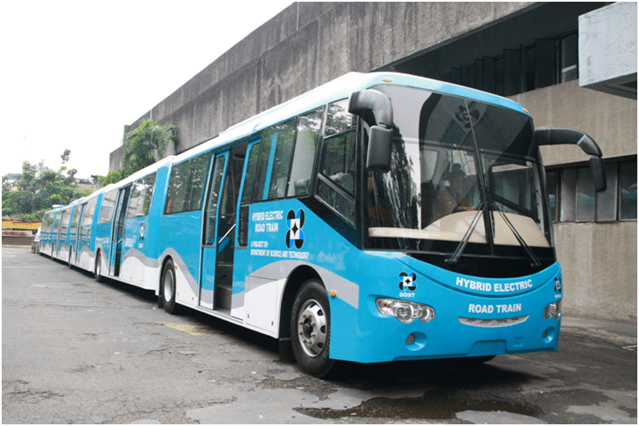
Finally, there are also the outcomes of research & development work by the Department of Science and Technology (DOST). I am referring to the DOST-MIRDC’s road train, AGT and hybrid train projects. The road trains, for example, may be used for Bus Rapid Transit (BRT) lines that are proposed for C5 and Quezon Avenue. I also think it is worth considering for EDSA. BRT is not technology-specific as far as buses go so why not use Philippine-made buses for this? While these are still subject to third party safety and technical certifications, the Transportation Department could lend a helpful hand towards this certification and this could perhaps ultimately lead to building an industry out of these buses and trains.
–
Latest model electric jeepney
In case my readers missed my feature on the recent electric vehicle summit hosted by Meralco, here are a few photos of the latest model of the electric jeepney. Note the passenger door is no longer at the rear but at the side across from the driver. They have also added a distinctive snout to the vehicle. This model is the latest from PhUV, which also manufactures electric tricycles.
 Profile of the electric jeepney currently in use for a Department of Energy-funded project being undertaken jointly by the National Engineering Center (NEC), the National Center for Transportation Studies (NCTS) and the Vehicle Research and Testing Laboratory (VRTL) of the Department of Mechanical Engineering; all of the University of the Philippines Diliman.
 A peak at the interior shows the passenger seats in bench layout and a more generous headroom for passengers.
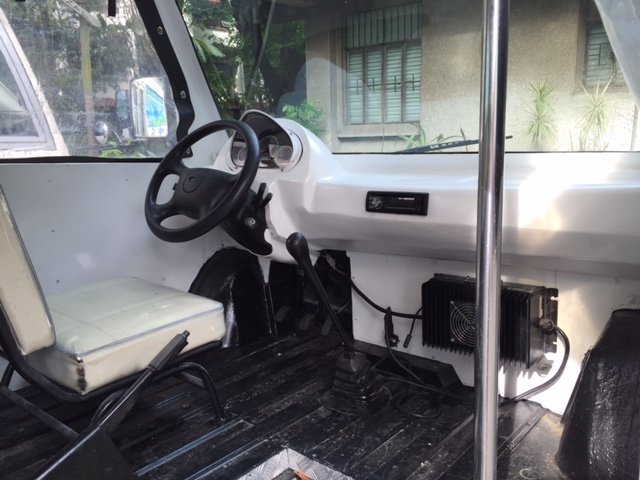 Driver’s seat and panel. There is space to install fare collection machines like the ones that can enable the use of BEEP cards by passengers.
 E-jeepney front showing the distinctive face from its conventional ‘ancestors/predecessors’. A colleague noted that perhaps the manufacturer should add some accessories like horses or airplanes on the hood.
This model is already similar in size with the big COMET electric jitneys. They also run on a more powerful electric motor that will enable these vehicles, according to the maker, to climb slopes like those along the route of Antipolo jeepneys. We hope that this design gets mainstreamed (read: replace conventional jeepneys) along the many existing jeepney routes not just in Metro Manila but in other cities as well.
–
Electric vehicle deployment in the Philippines
Electric vehicles have been around in the Philippines for quite some time now. Most of these have been electric 2- and 3-wheelers with electric tricycles or e-trikes being the most visible. Of course, there are also electric 4-wheelers in the form of jitneys or e-jeeps. The electric vehicle wave has not caught on with private transport with the exception of those who bought electric scooters or motorcycles (but these are few and are not in significant numbers compared to those using conventional motorcycles).
The following map from the Electric Vehicle Association of the Philippines (EVAP), the organization of e-vehicle manufacturers, importers and advocates in the country. It shows where electric vehicles are operating, what kind of vehicles and the manufacturer for the model in use in those places.

This is not a comprehensive rendering of the presence of e-vehicles throughout the country as there are also e-trikes and e-jeepneys in many other cities and towns as well. Perhaps EVAP only illustrated where e-vehicles have made significant strides or presence. I believe that with the right conditions including policies, incentives and infrastructure, e-vehicles will continue their rise among transport in the Philippines. Energy mix aside, e-vehicles have a great potential to reduce air pollution and noise, reduce fossil fuel consumption, and also has a potential to reduce road crashes. Cheaper operating costs from e-vehicles can also help increase income (i.e., take home pay) of public transport drivers and operators. It would be nice to find champions for electric vehicles in the incoming government especially from the heads of agencies like the Department of Transportation and Communications (DOTC), the Department of Interior and Local Government, the Department of Trade and Industry (DTI), the Department of Environment and Natural Resources (DENR), and the Department of Energy (DOE), among others that have a direct hand in transforming our fossil fuel dependent transport sector to an environment-friendly one.
–
Eastern transport terminal in Marikina City
I noticed the roadworks near SM Marikina beneath the Marcos Highway Bridge. These are part of what is being developed as an Eastern Transport Terminal. Although there is a sign there announcing the location as a terminal it is more a garage for UV Express vehicles and jeepneys that eventually proceed to the LRT Line 2 Santolan Station to get passengers.
The terminal is a pet project of former Metro Manila Development Authority (MMDA) Chair Bayani Fernando or BF. His company’s and his name is on a couple of signs proclaiming he gets it done. BF is now a newly minted congressman, having won the seat for the First District of Marikina City. In an upset of sorts, the former congressman who vacated this seat (after the maximum 3 terms), Marcelino ‘Marcy’ Teodoro, defeated incumbent mayor Del De Guzman who was running for a 3rd and final term. The development of the terminal actual started during BF’s stint as MMDA Chair where he conceptualized a terminal near SM Marikina and Santolan Station. Unfortunately, it did not materialize as he had planned with Typhoon Ondoy (Ketsana) flooding the area (and devastating much of Metro Manila and neighboring areas) and BF eventually exiting the MMDA to run for Vice President the following year.
The terminal will probably be completed but there are currently few public transport including provincial routes terminating at Santolan. Most jeepneys, for example, are bound for Cubao with the opposite trip ends in various towns of Rizal. Eastbound buses do not pass through Marcos Highway but instead take the older route through Ortigas Avenue and Antipolo and Teresa. It would take some effort to re-route these or perhaps there can be new routes via Marcos Highway? Provincial routes to the north and south are currently concentrated in Pasay, Cubao and Manila. It makes sense to decongest Cubao and have some buses have their terminal instead at Marikina. However, that means loading Aurora Boulevard, C5 and perhaps the FVR Road (Riverbanks) with additional bus traffic. Those impacts need to be evaluated and I am sure countermeasures can be developed for this transport terminal to work.
–
Electric vehicle models at the 5th Electric Vehicle Summit – Part 2
I already featured a lot of the electric vehicle models that were on display at the 5th EV Summit and this second part adds to those in the Part 1. There are some new models in the following photos including a mini-bus model that features a lot of doors and a similarly-designed jitney model. I took photos of the interiors as well to give the reader an idea of the layout of these models and perhaps imagine how they could fit as potential public utility vehicles.
 Electric minibus model
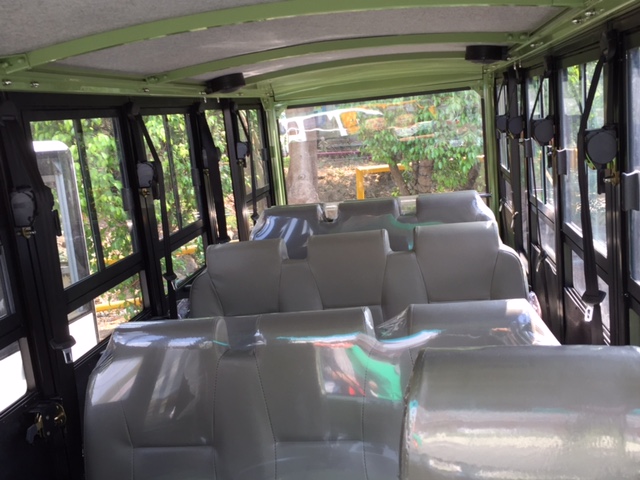 Interior of the minibus showing rows of seats
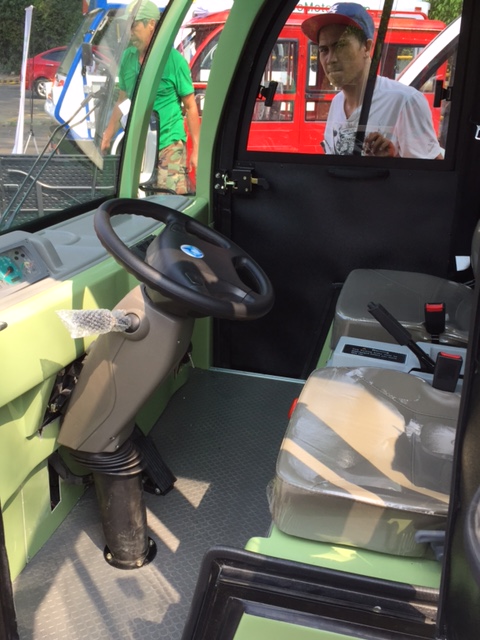 Driver and front seats
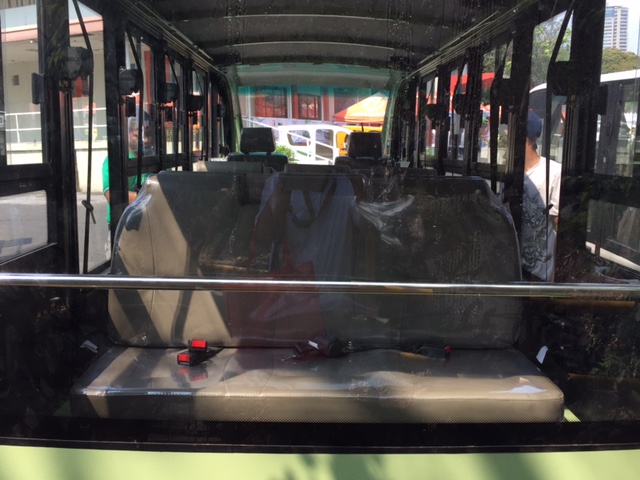 Rear seats facing the back instead of the front – the large window gives passengers a nice clear view of following vehicles, among others.
 The minibus had many doors (8 total) to allow passengers to board and alight from each row.
 Front of the mini-bus featuring a single large wiper
 Jeepney-sized version of the minibus also featured multiple side doors (6 of them for this vehicle).
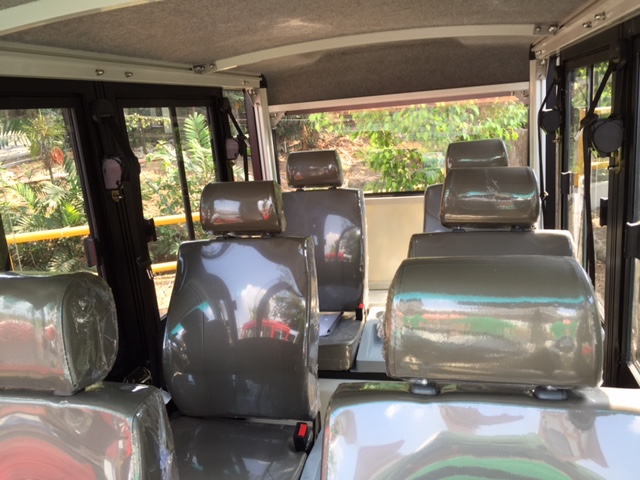 Seats inside the jitney
 Dashboard and steering wheel of the electric jitney
 Another look at the latest model of the electric jeepney
 The door is at the curbside
 Driver’s seat
 Bench seat layout for the e-jeepney
 Front view of the e-jeepney featuring a pronounced and familiar snout
 Setting up for display and demo
 Star8’s e-trike model featuring a side door instead of one at the rear
 Bench seat layout for Star8’s e-trike
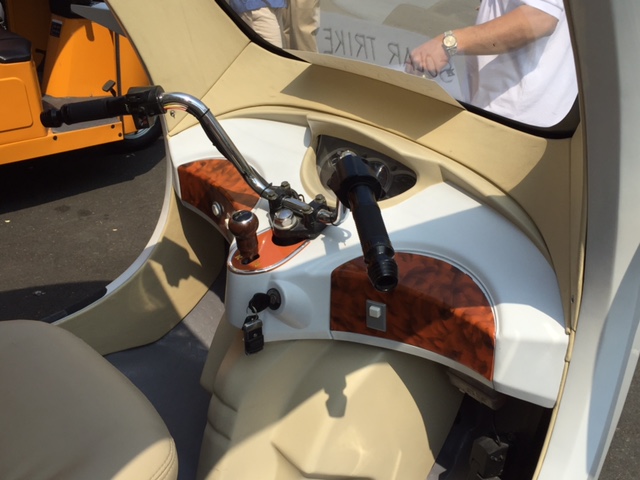 Dashboard and driver seat for the Star8 e-trike
 Star8’s tuktuk design for the e-trike
The variety of electric vehicle models and the increase in the number of industry players is encouraging. Interest in electric vehicles have steadily increased over the past half decade. Perhaps the government should have a stronger role as catalyst or enabler for this industry to flourish and perhaps transform not only the public transport scene but also for people to adopt e-vehicles for private use. This can only be done if the proper incentives are in place that include policy, fiscal and financial instruments favoring electric vehicles as well as their hybrid relatives. These will go a long way towards a low carbon transport future for the country.
–

