
Home » Public Transport (Page 5)
Category Archives: Public Transport
Electric taxis anyone?
Finally saw one of the taxis operated by Green GSM, which is a Vietnamese company. This is supposed to be the first all-electric taxi service in the Philippines.
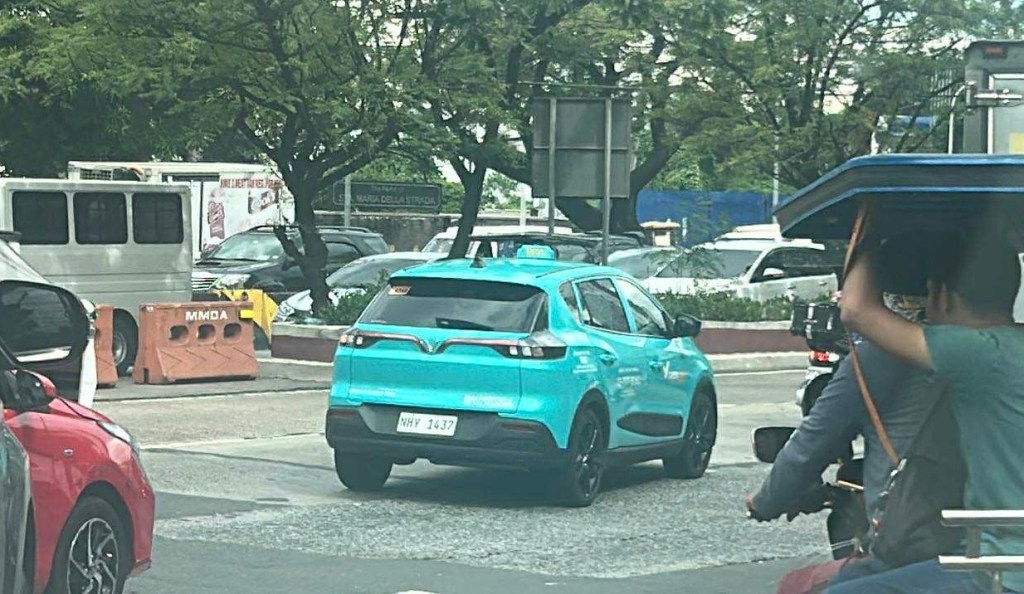
My colleagues and I were talking about this. Among other topics is whether these taxis will not encounter problems once the rains pour and many streets are flooded. We also wondered whether these vehicles will add to the congestion; slugging it out with the established competitors.
Another, more deeper and serious topic is whether these are really clean. While these are emission free as far as the proverbial tailpipe is concerned, the sources of power are not necessarily so.
While we do have renewables in the mix including hydro, geothermal, solar and wind, much of our power used to produce electricity uses fossil fuels.
–
Quick comments on the NCAP
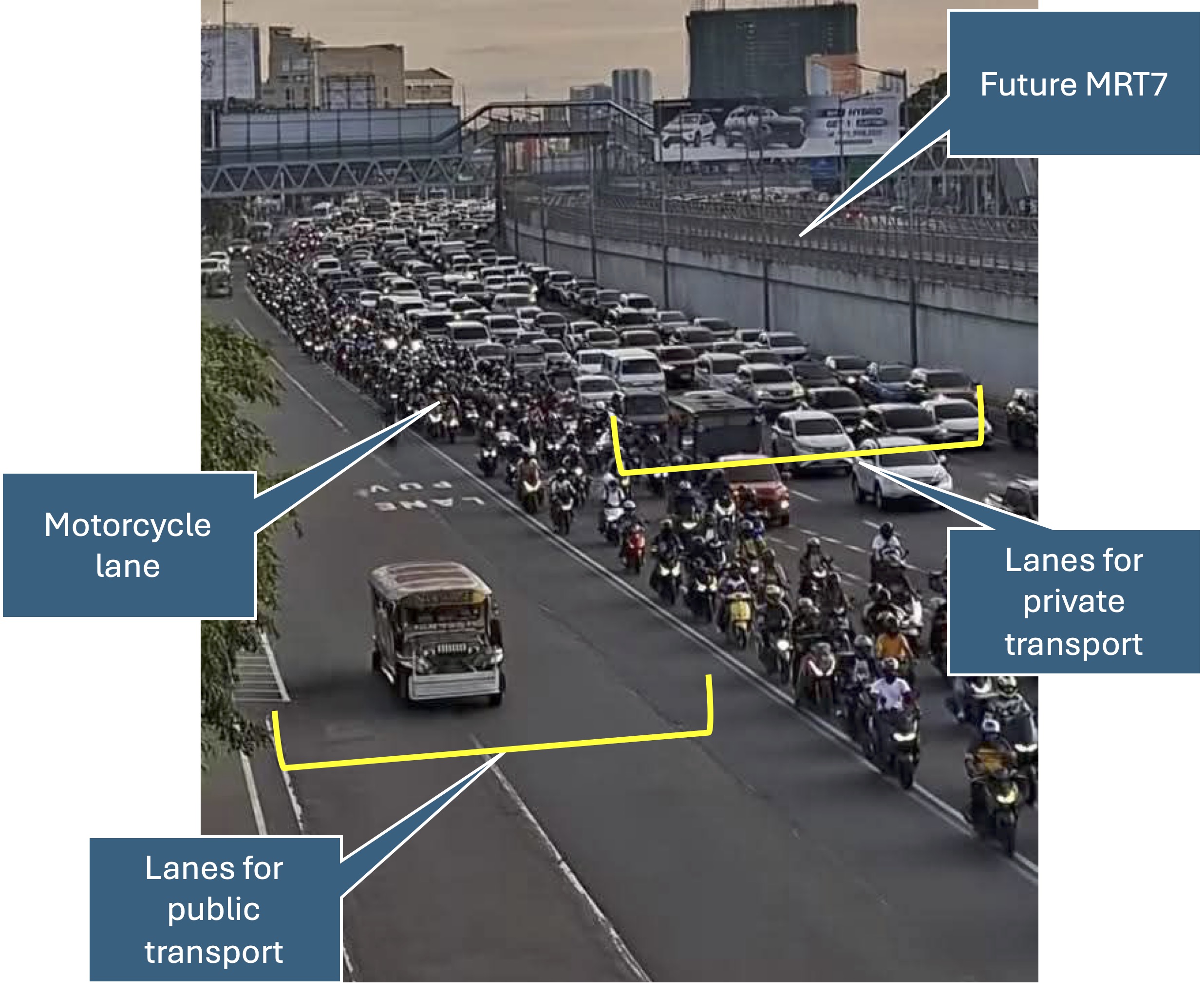
The No Contact Apprehension Policy (NCAP) is finally being implemented in Metro Manila. The results so far has been dramatic in terms of the number of violations recorded and the images being shared so far about how motorists are behaving. Below is one of those photos being shared on social media to which I added some annotations. I will use this later to comment on the NCAP and how we can use the outcomes to assess the transportation situation and determine what interventions can be done. Some are already obvious from the photo – the lack of public transport options lead to people depending on private motor vehicles like cars and motorcycles for their commutes. MRT7 is yet to be operational and road public transport has not been rationalized.
More on this topic soon!
–
Solutions to transport problems: the combination of congestion pricing and transit infrastructure development
Congestion pricing and transit infrastructure development (e.g., mass transit infrastructure) are often mentioned separately or independently. It is as if they are mutually exclusive alternatives or solutions to our transportation problems. They are not and should be considered together for greater impacts and also to complement each other. While the article below focuses on the experience in the United States, the experience is Singapore as applied to cities should provide a model that can be adopted if not outrightly replicated. Singapore’s version of congestion pricing in the form of its Electronic Road Pricing (ERP) scheme has been very effective in regulating congestion levels while helping fund public transportation in the city-state.
Descant, S. (May 8, 2025) “Congestion Pricing and Transit Are a Necessary Alliance,” Government Technology, https://www.govtech.com/transportation/congestion-pricing-and-transit-are-a-necessary-alliance %5BLast accessed: 11/05/2025]
Quoting from the article:
“In order to move a congestion pricing proposal forward, “you must have serious congestion, and you must have good transit,” said Sam Schwartz, a former New York City traffic commissioner, said during a March 21 panel on the New York City congestion pricing program. The event was organized by the Massachusetts Institute of Technology (MIT) Mobility Initiative. Schwartz is also the CEO of Sam Schwartz Pedestrian Traffic Management Services, a consulting firm.
A recent report by the Mineta Transportation Institute at San Jose State University in California concluded roadway tolling — a form of congestion pricing — can serve the dual purpose of reducing traffic congestion and supporting transit options, if the programs are structured properly.”
–
On strategies for urban mobility
Here is an interesting article on other strategies for urban mobility:
Menard, T. (March 24, 2025) “Beyond Congestion Pricing: Strategies for Revolutionizing Urban Mobility,” Planetizen, https://www.planetizen.com/features/134601-beyond-congestion-pricing-strategies-revolutionizing-urban-mobility [Last accessed: 4/6/2025]
To quote from the article:
“The common thread among successful urban transportation initiatives is the use of data to make mass transit more competitive. When cities invest in improving the transit experience through technology, service enhancements, and targeted incentives, the results are clear: increased ridership, reduced congestion, and lower emissions. These outcomes benefit not just individual commuters but the broader community as well, contributing to improved air quality, reduced traffic-related stress, and more livable urban environments.
In looking ahead, the lessons from New York’s congestion pricing experiment and the initiatives of other progressive cities offer a roadmap for transit agency leaders worldwide. By embracing data-driven strategies, investing in advanced technologies, and creating the right mix of incentives and disincentives, cities can transform their transportation systems to meet the challenges of the 21st century.
The key takeaway for transit agency leaders is clear: when mass transit is made more attractive, efficient, and competitive with private vehicle use, commuters will respond positively. The data from New York and other cities proves that well-designed transportation policies can yield significant benefits for urban communities. As more cities adopt these innovative approaches, we can look forward to a future of smarter, more sustainable urban mobility that enhances the quality of life for all residents.”
Perhaps the main statement to be emphasized here should be: “The common thread among successful urban transportation initiatives is the use of data to make mass transit more competitive.” How many of our cities are doing this now and in the context of the public transport rationalization and modernization? Does the LTFRB or the DOTr collect and use data towards improving public transportation? Are these efforts comprehensive rather than selective?
–
“Coding exempt” vehicles and the demise of the coding scheme
I saw this car ahead of me during my commute. I knew this was an electric vehicle and these as well as hybrid ones were given an incentive in Metro Manila. They are “coding exempt” meaning these vehicles can be driven any day and ay hour during the weekdays.
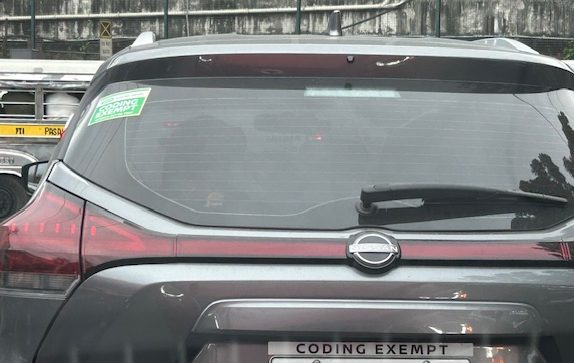 Are they selling these ‘coding exempt’ accessories or do these go free when you buy these cars?
People ask if the number coding scheme (UVVRP) in Metro Manila is still effective or relevant. Well, the answer is a ‘no’ and that is because over time, people have adjusted to it. Car owners have bought a second, even third vehicle that they call their ‘coding’ vehicle. Others opted to purchase motorcycles. And so that’s what we generally see along most roads in Metro Manila. It didn’t help that hybrid and electric vehicles are given exemption from the coding scheme. Those who can afford to buy yet another vehicle or perhaps replace their conventional ones are already buying these as evident from their increasing presence along our roads. While there is the perceived benefits with less emissions and air pollution, we still lose with congestion and its derivatives. Perhaps we should already have a congestion pricing scheme implemented for Metro Manila like the one in New York City. And proceeds should go to the improvement of public transportation to help arrest the erosion of its mode share in favor of private vehicles.
–
To B(RT) or not to B(RT)?
I kind of expected questions or comments from my ‘students’ after my lecture last Wednesday about “Traffic Congestion.” Among my slides were those featuring solutions to transport and traffic problems. I presented both soft and hard approaches including travel demand management schemes and infrastructure that we should have built decades ago. The uniformed officers who were there had a very simple take on congestion – it’s basically because of a lack of discipline. While theirs may also be valid observations based on their experiences, ‘discipline’ is not the most critical problem that we have especially considering the ever increasing demand for travel. One government official present was very direct in his question about what I thought about the MMDA’s pronouncement that they plan to remove the EDSA Bus Carousel. I thought my reply and the following explanation was clear – it was a wrong move.
The EDSA Bus Carousel is simple. Bus lang sa bus lane (Only buses along the bus lane). Pag may private or pa-VIP, bawal at huli dapat (If there are private vehicles or those who regard themselves as VIPs using the lane, then they should be apprehended. An HOV (high occupancy vehicle) lane is more difficult to implement. Mas pahirapan ang pag monitor and enforce (It is very difficult to monitor and enforce). So this proposal to phase out the EDSA bus lanes don’t make sense from this perspective. In fact, I don’t agree with a couple of more senior transport experts who say that the MRT Line 3 is sufficient and that it hadn’t reached capacity yet. It has but in the time that the carousel has been operational, the carousel had absorbed much of the demand along the corridor. There is also the fact that it will take much time before Line 3 is upgraded. Are the new train sets here? Are the stations designed for these trains and more passengers? If the answers are no, then MRT3 will not have its capacity increased in such a short time. That also means the carousel is very much relevant not just to supplement MRT3 capacity but as a needed alternative mode for commuters.
–
The journey to PHL’s railway renaissance
Here is a quick share of an article on railway development in the Philippines. It certainly took a while for railway development to get underway with considering rail transit would probably had a major impact on commuting particularly in Metro Manila and highly urbanized cities like Cebu and Davao that require mass transit systems to alleviate congestion.
Source: The journey to PHL’s railway renaissance
The article though doesn’t contain a narrative on the journey but rather only a summary of the rail projects that are currently being implemented as well as those in the pipeline. It would be a nice to have a more historical approach to this so-called journey so we can have an objective look at what happened to our railways from the 1970s when its decline began until the last few years when a so-called renaissance came to be.
–
Article share: On improving the Philippines’ transport system
I share this article on the desire for a sustainable transportation system for the country. This was written by a former Assistant Secretary of the Department of Transportation (on secondment) who has returned to teach at the School of Urban and Regional Planning of the University of the Philippines Diliman. Here is the article published by the Philippine Daily Inquirer:
To quote from the article:
“The present condition of the Philippine public transport system is indispensable to the desired transition from more sustainable, in this case, electric forms of transportation—to a better public transportation system. A good public transportation system is defined by reliability, accessibility, safety, and security…
The imperative to consolidate is clear and crucial. It is not just a technical necessity, but a pathway to inclusive growth where all stakeholders benefit from the transition, and where we can truly create an inclusive and sustainable system for public transportation.
Improving public transportation, by making it cleaner, safer, and more accessible, will directly enhance the quality of lives of Filipinos.”
–
Planning for True Transportation Affordability: Beyond Common Misconceptions
How much do we spend on transportation as part of our budgets? Is it 5% of your monthly budget? Is it 10%? Or is it eating up a substantial part of what you’re earning?
Source: Planning for True Transportation Affordability: Beyond Common Misconceptions
To quote from the article:
“This research indicates that many common policies favor expensive transportation and housing over lower-cost alternatives, which drives the cost of living beyond what is affordable, leaving too little money to purchase other necessities. The result is immiseration: growing stress, unhappiness, and discontent.
The solution is simple: planning should favor affordable over expensive modes and compact development over sprawl. This is not to suggest that automobile travel is bad and should be eliminated. Many people are justifiably proud of being able to afford a nice car, and automobiles are the most efficient option for some trips. However, automobile travel requires far more resources and is far more expensive than other modes, typically by an order of magnitude, so true affordability requires an efficient, multimodal transportation system that allows travelers to choose the options that truly reflect their needs and preferences.
Affordability requires a new economic paradigm; rather than trying to increase incomes or subsidies we need to increase affordability and efficiency so households can satisfy their basic needs consuming fewer resources and spending less money. Our planning should be guided by a new goal: how can we help families be poor but happy.”
I share this article because it provides a more complete narrative and assessment than those just focusing on transport. Home choice locations and affordable housing are part of the equation. Looking at transport alone can be myopic and leads us to think it is the only problem to solve.
–
Neutrality for public utility vehicles
I had written recently about how politicians are now using public utility vehicles for their premature campaigns. Promoting themselves illegally and ahead of the official campaign period. Today, I saw many modern jeepneys bearing posters of various politicians and party lists. Many of these PUVs are either private companies or cooperatives (i.e., in the case of modern jeepneys). I will not post their photos here as I don’t want to be inadvertently promoting these people and party lists. Instead here is an example of public transportation that does not promote any particular person or personality but instead speaks for a program that’s contributing to improve the commutes of people:
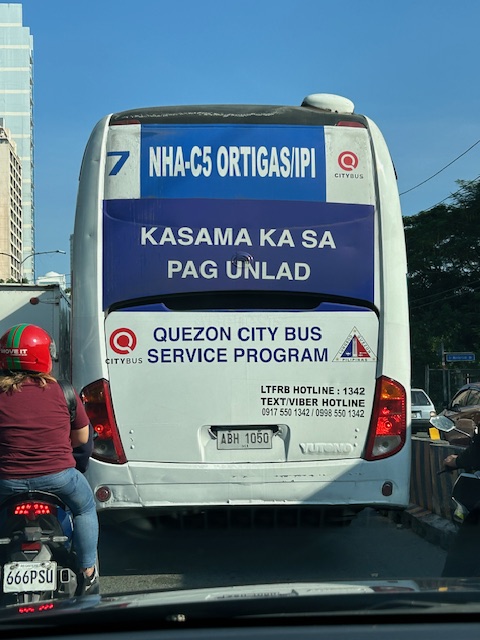 Quezon City’s buses don’t have any campaign materials posted on them.
Quezon City’s Bus Service Program is a good example of how a local government unit that has resources and the capability can help provide public transportation services to its constituents. It is a good example of what LGUs can do if they have the will, the capability, the capacity and the guidance for such initiatives. Of course, they should have good leaders who will support these endeavors and who do not have to put their faces and names on these programs.
–
 Caught (up) in traffic