
Home » Public Transport (Page 63)
Category Archives: Public Transport
The pitch for electric public transport
Electric vehicles have been in operation as public transport modes in the Philippines since 2007 when electric three-wheelers were introduced at the Bonifacio Global City in Taguig City, Metro Manila. At the time, the City Government of Taguig bought the pitch by the proponents of the E-Trike and supported their trial operations that have since expanded but are yet to be legitimized due to the vehicles not being registered with the Land Transport Office. These could not “legally” charge their passengers since they also did not have franchises with the Land Transport Franchising and Regulatory Board (LTFRB) nor with the local government (i.e., like conventional tricycles).
 E-trike in Fort Bonifacio
Meanwhile, around the same time, another electric vehicle was introduced in the Visayas. In this case the vehicle was in the form of a national icon – the jeepney. Electric jeepneys were first built out of China and directly imported as a “proof of concept.” What were initially launched in Bacolod and Silay Cities in Negros Occidental were examined by local partners based in Manila, and eventually a locally manufactured E-jeepney came out in 2009, care of the Motor Vehicle Parts Manufacturers Association of the Philippines (MVPMAP) and Motolite with assistance from the Dutch Stichting Doen. The project quickly gained proponents including two very influential mayors and their cities – Binay of Makati and Hagedorn of Puerto Princesa. It is to the credit of the cooperation between the Institute for Climate and Sustainable Cities (iCSC, the original proponents of the E-jeepney) and Makati City that there are currently two E-jeepney lines in that city. But while the vehicles have been registered with the LTO (using the conspicuous orange plates), they have yet to be granted franchises by the LTFRB. The vehicle gained more attention when the newly elected Vice President Binay rode the vehicle to the inauguration. Currently, the E-jeepney is subject to studies at the National Center for Transportation Studies of the University of the Philippines and has gained interest from private firms as well as other researchers. Together, the E-jeepney and the E-trike represent the strongest cases for electric vehicle applications in public transport.
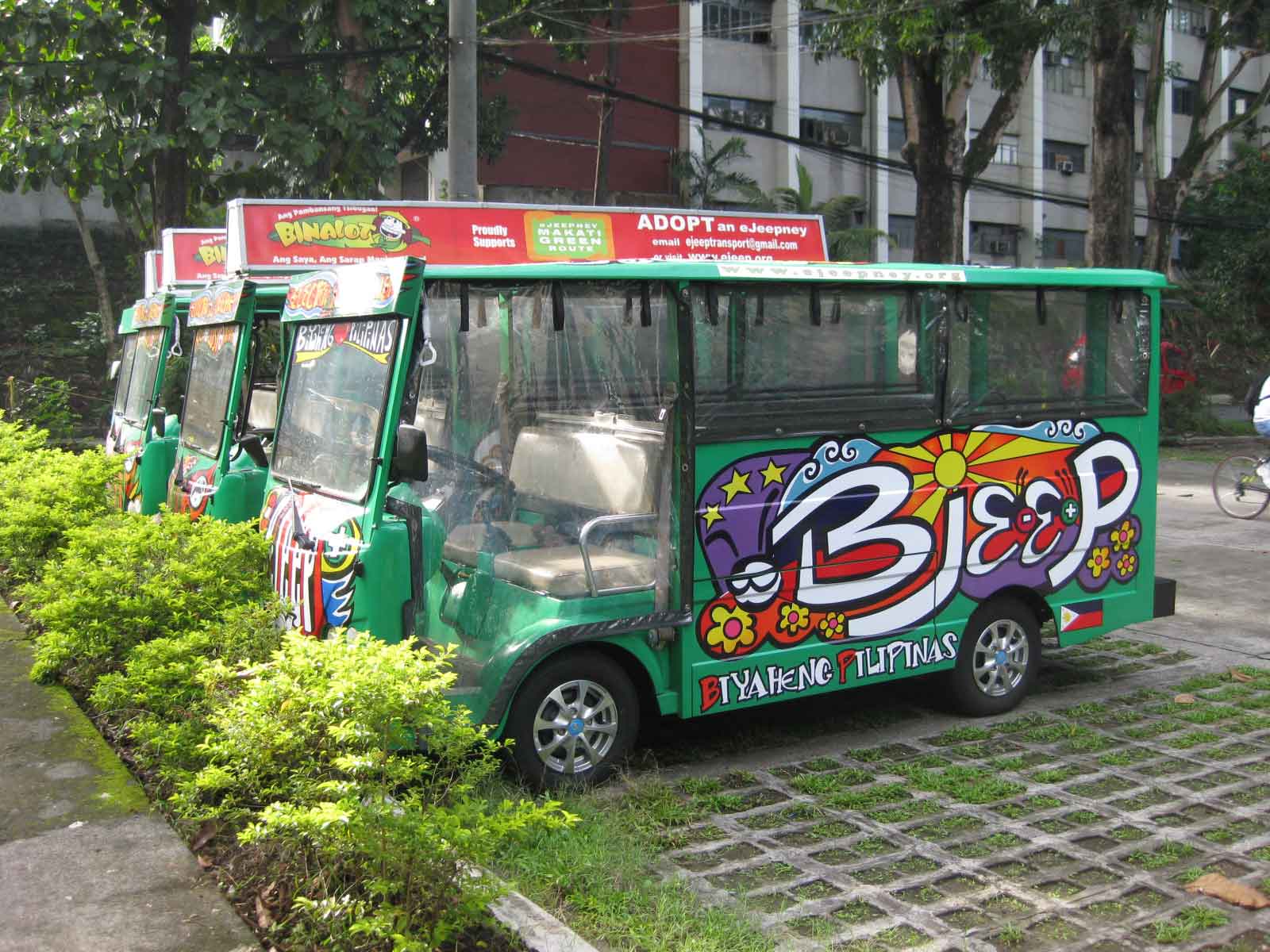 Electric jeepneys parked at UP Diliman – the Bjeep is the one used by Vice President Binay during the inaugurations
I reproduce below a news item from the GMA News website that features an initiative from the ADB that may finally push electric vehicles to gain a significant share of trips across the country:
The Asian Development Bank is offering as much as $280 million in loans for the Philippine government to finance a proposed re-fleeting program for tricycle drivers and operators shifting to electric motorbikes or e-bikes.
“The loan will be coursed through ADB conduit banks like Land Bank of the Philippines for re-lending to tricycle drivers who may want to shift into using e-bikes,” Environment Secretary Ramon Jesus Paje told reporters in a briefing Tuesday.
He said ADB will give 30 e-bikes as donation to city governments in the Metropolis.
“ADB wants to us to sample the bikes to see for ourselves that these machines are totally pollution-free. No emissions, less pollution,” he said.
If all Philippine tricycles are e-bikes, the country can save much as 20 million metric tons of carbon footprints a year.
“We could go into carbon trading. That will earn us dollar equivalent which we can use to offset a portion of the loan,” said Paje.
Tricycle drivers can save up to P300 in daily fuel costs with the use of e-bikes.
“Four hours of charging would only cost P40 compared to P340 for fossil-based fuels. The acquisition cost is about 20 to 30 percent higher than fuel-fired motorcycles but the overhead cost is certainly lower,” Paje said.
Of the total 5 million tricycles in the country, 2.8 million are in Manila.
The department said that the shift to e-bikes would reduce pollution 25 percent to 30 percent in the country’s urban centers by 2011.
As of 2009, the country’s total suspended particulates – a concentration of micro pollutants in the air – in all cities and urban centers is 134 micrograms per normal cubic meters, which is 48 percent beyond the normal standard of 90 micrograms per normal cubic meters.
The major sources of these particulates are diesel vehicles and coal-burning power plants. Dust from unpaved roads and construction activities contribute to the rise in particulates especially during summer months.
Vehicles contribute as much as 80 percent to air pollution, while the remaining 20 percent are from industries.
Department monitoring shows that more than 50 percent of vehicles are registered without prior actual testing by accredited Private Emission Testing Centers.
“If all vehicles are tested for emission prior to registration, the 30 percent reduction in particulates will be easily realized,” Paje said. —With MR Gavin/VS, GMANews.TV
The ADB initiative comes at a critical time when the national government is still finding its way with regards to local public transport modes, particularly how the tricycle has established itself as the primary (sometimes, the only) public transport option in cities and municipalities across the country. It is inevitable that the issue of proliferation and regulation of tricycles will have to be addressed. National and local government would have to discuss the nuances of the Local Government Code in as far as public transport operations, franchising and fare setting are concerned. On top of this, the time is critical also because there is a strong call for environmental sustainability; one that is anchored on the increasing awareness for climate change and its impacts. The long-standing perception is that the conventional tricycles contribute to the continuing degradation of our environment as the collective emissions from these vehicles effectively suffocate our cities, and the key is for local governments to realize this and be a major player in transforming local transport into the environment-friendly kind. It is, after all, in the best interests of their constituents that clean air be pursued to ensure that there will be a bright future for their cities and this country.
Sustainable Paratransit
Environmentally sustainable transport (EST) includes the provision of sustainable public transportation. Such public transport is premised on other aspects of EST such as emission reduction, green fuels or sustainable energy sources, noise, and inclusive services and safe vehicle design. Most paratransit modes found in the developing countries are customized vehicles of 2 to 4 wheels. Customized vehicles are often lacking in safety features and produce greenhouse gases at a significantly higher rate than conventional vehicles. As such, the former are perceived to be unfriendly to people and the environment, and therefore, unsustainable.
In the Philippines, for example, paratransit includes motorcycle taxis, tricycles, Asian utility vehicles (AUV), vans, and the jeepneys. With the exception of motorcycles, AUVs and vans, the two most dominant transport – the tricycle and the jeepney – are customized vehicles.
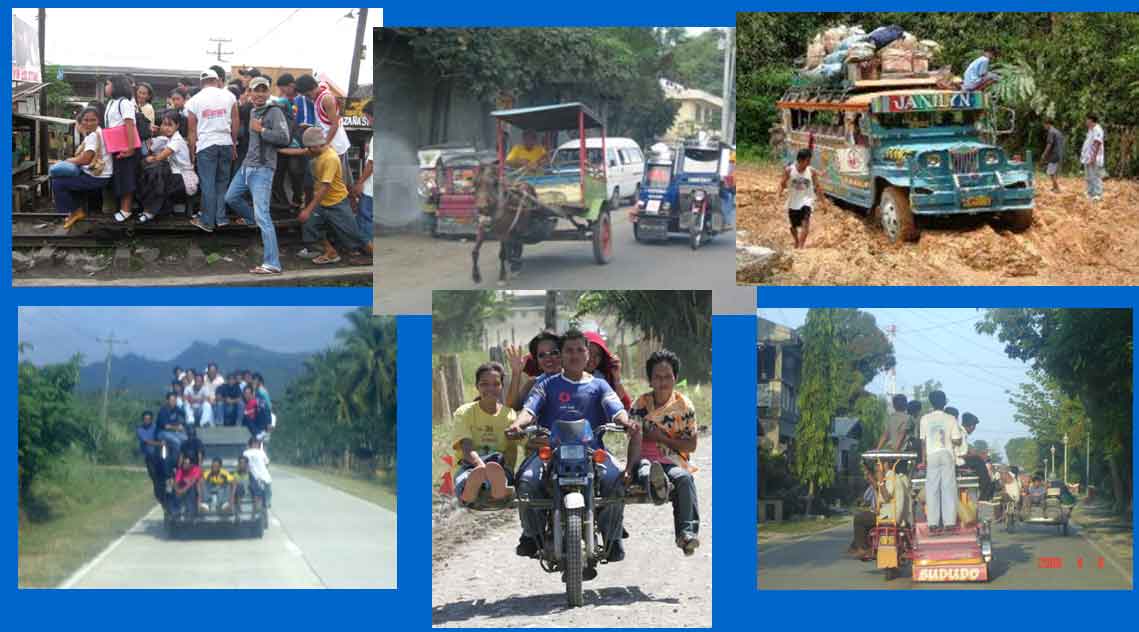
Jeepneys
The jeepney is the most popular mode of transport in the Philippines especially in cities because of its cheap fare and the convenience afforded to passengers to board and alight almost anywhere they want. In many parts of the Philippines, jeepneys provide long-distance transport services (rather than the bus) and may carry cargo, goods or freight in addition to passengers. Jeepneys in the provinces have also evolved to become significantly larger and tougher than those in the cities and are built to take on bad roads in all weather conditions. Jeepneys are locally manufactured and utilize surplus or second-hand diesel engines.
Tricycles and pedicabs
A tricycle is a motorcycle with a sidecar, while a pedicab is a bicycle with a sidecar and is classified as a non-motorized transport mode. These modes are 3-wheelers and are very convenient for passengers on short distance trip and feeder trip between residential area and arterial roads. Especially in the provinces, these modes play an important role because of insufficient bus and jeepney services. In Metro Manila the operation of tricycles is restricted partly because they cause traffic congestion. Franchising and supervision of tricycles including pedicabs have been devolved to the local government units.
AUVs
Asian utility vehicles (AUVs) refer to a variety of models designed according to the road and passenger characteristics of Asian countries particularly those in the Southeast Asian region. Vans include vehicle models produced by major Asian automakers like Toyota, Mitsubishi and Hyundai. AUVs and vans are four-wheeled vehicles with a seating capacity of seven to eleven persons including the driver. They provide services within a zone or fixed route of not more than 15 km. Fares may be set on a zonal asis or based on distance. FX services (so called FX because of the Toyota Tamaraw FX AUV that was very popular with those providing the service) evolved from the taxi as demand for a faster alternative to jeepneys arose in the 1990’s. Fares were higher than those for jeepneys but were eventually considered acceptable as longer travel times when using jeepneys became a major consideration for passengers, especially those who have constraints in their schedules like students and typical office workers (i.e., those who do not have the luxury of flexi-time). In 2003, the LTFRB issued a moratorium on the issuance of AUV franchises and pursued conversion and regulation of services into the Garage-to-Terminal Express (GTExpress). However, there is still a proliferation of vans for hire services, particularly those plying long distance routes in the rural areas. Meanwhile FX services remain in other cities in the Philippines.
Motorcycle taxis
Motorcycle taxis are also popular in the less urbanized areas including the small towns throughout the Philippines. These include the “habal-habal,” which are not regulated but have similar operations as their relatives in other countries like Thailand and Indonesia. Then there is the “skylab,” which is also a motorcycle taxi but with a wooden plank perpendicular to the motorcycle that allows for additional passengers balanced by the driver. Hence, the vehicle is made to appear like the fallen satellite of which it is named after.
Multicabs
Multicabs are similar to jeepneys but with most vehicles having about half the capacity of current jeepneys. However, their configurations are also evolving like the jeepneys, being customized vehicles like the latter. The resulting capacity has enabled these to have seating capacities equivalent to small or old model jeepneys. Multicabs are based on the Daihatsu or Suzuki mini-vans in terms of engine specifications and most came into being after the Philippines was flooded with second-hand or surplus vehicles. Their small bodies made them popular and they are now found in many cities, often competing with jeepneys and tricycles for passengers.
Other paratransit modes
Other paratransit modes are used in the Philippines in both urban and rural settings. There is the “kuliglig,” which uses a farm tractor to pull a wagon that is customized for passengers. These are mostly found in the country side where formal transport is lacking and even tricycles are unable to satisfy the demand for transport. Another paratransit mode is the “motorela,” which is a four-wheeler version of the motor tricycle. However, it is configured with the motorcycle in the front and middle instead of a one side such that it appears like the Thai “tuktuk.” These operate in cities and have capacities that are typically higher than the tricycles but significantly less than those for jeepneys.
Future of paratransit in the Philippines
The idea of environment and people friendly paratransit is always an attractive proposition. Given the current perceptions that paratransit like jeepneys and tricycles, there are many initiatives that are now being seriously considered if not yet engaged by both the government and the private sector. Some have been proposed for quite some time such as engine replacement and although financial schemes have also been proposed there have been very few takers for the program. Then there are those proposals for devices that have not been tested or validated but offer quick fixes to the emission problem, particularly claiming significant carbon reduction for a small price. Such are to be viewed as doubtful solutions that should not be pursued unless there is strong proof of their effectiveness.
Many taxis in Philippine cities have been converted to use LPG. Electric and LPG powered tricycles are now also being promoted in the Philippines. In fact, Quezon City, the biggest city in Metro Manila, only recently enacted an ordinance requiring all tricycles to convert to clean fuels or energy sources within 3 years. Such local legislation probably marks the beginning of a genuine and, perhaps, sustained effort towards making paratransit environment friendly. In the national context, a national EST strategy is currently being formulated (NCTS, 2009) and will ultimately recommend for actions to improve public transport in general.
An assessment of the jeepneys and tricycles as main public transport modes is necessary while at the same time it must be realized that jitney sized transport is necessary where passenger demand cannot justify mass transit modes including bus and rail transport. The World Bank (A Strategic Approach to Climate Change in the Philippines: An Assessment of Low-Carbon Interventions in the Transport and Power Sectors,2009) proposed medium and aggressive scenarios for the reduction of carbon in the transport sector. Among these scenarios are interventions for public transport particularly mentioning the conversion of jeepneys to CNG and assessing recent developments including options with high potential for carbon reduction, and technologies under testing such as CNG, LPG and electric powered vehicles. These are proof that the transformation of paratransit, in this case the jeepney, is essential and should be under way. Hopefully, it will be a matter of time when these popular modes of transport will gain the adjective “environment friendly.”
Transport and Energy
With the recent blackouts and all the talk about energy security and the high costs of electricity in the Philippines, I guess it was only fitting that the first full article on this blog will be about transport and energy. I reproduce below the full paper I wrote on Transport and Energy for the UP Diliman Academic Congress:
Sustainable Transport and Energy
Abstract
Sustainable transport is often associated with emission control and improving air quality, mass transit, and environment and people friendly transport systems. It also refers to energy efficient transport and the use of green fuels and renewable energy. The transportation sector represents a significant portion of the total energy demand in the Philippines. Its share of about 38% is the highest among sectors that include residential, commercial and industrial uses. About 80% of this share is associated with road transport. The promotion and realization of sustainable transport seeks to address issues pertaining to the dependence on fossil fuels as well as inefficiencies due to high fuel consumption especially for public transport. While there are many options already in use including interventions on vehicles like hybrid cars, CNG buses, LPG taxis and electric jeepneys, these represent only one part of a whole range of options that include traditional travel demand management techniques. The formulation of a national strategy for environmentally sustainable transport (EST) and its implementation at the local level will be critical to ensuring the transport sector’s effective contribution to energy security in this country.
1. Introduction
Dependence on fossil fuels is part of a vicious cycle that stems from rapid urban development. As cities keep growing in size and population, there is also increasing motorization that has led to traffic congestion, worsening air pollution and an alarming increase in the number of road traffic accidents. All these indicate deterioration in the quality of life for Filipinos and are regarded as manifestations of unsustainable transport.
The transport sector represents more than 40% of the total demand for energy. This share is larger than the shares of the industrial and residential sectors and is expected to increase further. From 1980 to 2008, transport energy use increased steadily from 1.9 million tons equivalent of oil (MTOE) to 10.9 MTOE – an average of 6.4% per year. Over 80% of the share of transport is attributed to road transport, which is overwhelmingly dependent on fossil fuels. Most private transport use gasoline while most public and freight transport utilize diesel.
There is also a strong correlation between inefficient fuel consumption and air pollution. A 2007 national emission inventory conducted by the DENR revealed that mobile sources account for 65.13% of total emissions. Such information dispels perceptions that stationary sources such as factories contribute more to air pollution. Clearly, addressing fuel efficiency concerns will have far-reaching impacts including potential curbing of air pollution in our cities.
2. Issues
The dependence of transport on fossil fuels has led to varied and usually negative reactions to fluctuations, particularly the increase, of crude oil prices. In fact, fuel price increases have always affected our lives as they trigger a chain reaction in the rising prices of commodities; fuel price increases are felt most in urban areas where consumers absorb the high cost of transporting goods. The high prices of food items especially fruits and vegetables are attributed to transport costs that are passed on to the consumers.
The commuting public is affected by fuel price increases as transport groups lobby for fare rate adjustments whenever there are gas price hikes. Such requests are articulated as demands that are accompanied by threats of transport strikes. In cases where transport strikes do push through, cities are often crippled by the limited availability of transport services leaving people to ponder what life would be like if there were other transit options.
In the interest of coming up with a clear picture of transport services in the Philippines, we must examine the characteristics of the three most dominant modes of public transport in relation to fuel efficiency. These modes are the tricycle, bus and jeepney. Tricycles are motorcycles with sidecars. Motorcycles were designed to carry at most 2 persons. Engines are forced to work harder with the additional load of the sidecar, passengers and in many instances even freight. Such have led to more emissions and higher fuel consumption when compared to normal motorcycle operations.
Many buses in the country are poorly maintained. In small cities served by few buses (mostly provincial operations), buses are often overloaded not just with passengers but with freight as well. Overloading leads to higher fuel consumption and is manifested in more emissions as engines are forced to work harder due to the loads they carry.
Jeepneys use surplus or second-hand engines originally designed for trucks. A study conducted by the U.P. National Center for Transportation Studies in 2008 revealed that jeepneys’ average fuel consumption is less than 6 kilometers per liter. Most efficient are short routes (coverage distance of 5 kilometers or less) consuming 6.0 km/L and about 11 L/day. Meanwhile, least efficient are medium routes (coverage distance of 6 to 9 kilometers) with about 5.5 km/L on 20 L/day.
It is easy to see that fuel inefficiency translate to higher costs borne by users even for private transport users. Prospective buyers of cars take note of mileage especially for used cars and are presently more aware of the implications of having gas guzzlers on their budgets. This is perhaps due to their experiencing first-hand the cost of travel based on fuel and maintenance costs.
The inefficiencies of public transport are often passed on to the commuters while service providers do little to ensure that their vehicles are well-maintained and therefore efficient in fuel consumption. Meanwhile, the commuting public is not at all aware of such and their implications on their wallets as they absorb rising fares that are partly due to high fuel consumptions.
3. Sustainable transport
Sustainable transport is the response of the transport sector to the challenge of attaining sustainable development. The EST approach adopts the pro-active integration of environmental consideration in the planning process itself. Thus, negative impacts are minimized and environmental sustainability is achieved. On the other hand, the traditional planning framework considers the environmental impacts after planning and thus mitigation measures are formulated after the implementation of the project.
When the concept of EST was first presented to the DOTC and the DENR, it was unclear how the agencies would work towards incorporating sustainable transport in their plans and programs. It was proposed and eventually decided that a national strategy was needed to have a practical framework to guide the development of plans and programs. The overall goals for the formulation of an EST strategy are the reduction of the annual growth rates of energy consumption and green house gas emissions, and mainstreaming EST through the promotion of low carbon transport systems and a shift towards sustainable transport modes.
Sustainable transport incorporates all aspects of transport including social and economic The EST thematic areas as defined by the Aichi Statement of 2005 are as follows:
- Public Health
- Strengthening Roadside Air Quality Monitoring and Assessment
- Traffic Noise Management
- Vehicle Emission Control, Standards, and Inspection and Maintenance
- Cleaner Fuels
- Public Transport Planning and Travel Demand Management (TDM)
- Non-Motorized Transport (NMT)
- Environment and People Friendly Infrastructure Development
- Social Equity and Gender Perspectives
- Road Safety and Maintenance
- Knowledge Base, Awareness and Public Participation
- Land-Use Planning
All thematic areas are related to efforts toward energy efficiency in the transport sector. Some are more strongly connected, like cleaner fuels, public transport planning and travel demand management, non-motorized transport, and land use planning. These thematic areas directly address the question of efficiency in the sense that initiatives under them deal with travel. Promoting public transportation and non-motorized transport over private transport, for example, results in significant fuel savings. Meanwhile, TDM focuses on interventions influencing trip making behavior. Cleaner fuels include CNG, LPG and biofuels and the use of renewable energy to power vehicles.
It is important to note at this point that the objective should be towards the efficient movement of people and goods rather than vehicles. There are principles of equity that allow us to understand that individuals driving cars should have less priority compared to a jeepney load or busload of passengers especially given the limited road space available.
Emissions and noise are by-products of fuel inefficiency. As such air quality monitoring, noise management and vehicle inspection and emission control go together in addressing the symptoms of fuel inefficiency. Meanwhile, proper road design and maintenance ensures safe and smooth flow of traffic that is also fuel efficient as vehicles are able to run on higher gear.
The interaction between land use and transportation has been the subject of much discussion in both academic and planning circles. There is a close relationship between the two since land use patterns have implications on the transport system and vice versa. Unfortunately, land use and transport are often planned separately. Dense areas are associated with shorter trips and require efficient public transport to move people and smaller vehicles for goods movement. Meanwhile, urban sprawl involves longer trips that, with the absence of a good transit system, encourage car ownership not to mention larger and often overloaded trucks to carry freight. While there are proponents for transit-oriented development, the reality in the Philippines is that land development will come before transport enters the picture. The type of transportation that evolves is usually reactionary and most likely informal. Therefore, there is a need to optimize land use planning in relation to sustainable transport.
4. Barriers to sustainability
Technology and its costs have always been the top concerns when it comes to providing the best solutions to problems. Technical feasibility is usually constrained by the availability of funds. There are also prevailing perceptions that effective solutions need to be “high tech” and that such solutions are expensive when measures such as TDM do not require significant capital outlay or operational costs. In fact, schemes like MMDA’s number coding was successful for some time until rapid motorization eventually caught up and rendered it marginally effective.
Transport groups have been successful in blocking efforts to improve transport, citing social and economic implications including unemployment. As such, the positive traffic impacts introduction of more efficient modes including rail and bus services where these mass transit systems are already required are diminished as conventional transport remain, increase in numbers and compete with them. Social and economic implications of rationalizing transport services have always led to friction with a sector that has been, from one perspective, coddled or pampered. On a number of occasions, government has acquiesced to the demands of the transport sector, which have used the threat of public transport strikes as a powerful instrument to bring government to the negotiating table.
There are also efforts involving the upgrading of conventional transport. Among these are proposals to replace old inefficient engines with new ones using CNG, LPG or diesel. Transport groups have resisted these, citing the costs of acquiring a new engine or conversion, lobbying instead for quick fixes such as devices claiming to reduce emissions and improve fuel efficiency. These quick fixes are not validated and approved by the Department of Science and Technology. Instead, they reflect the mindset of transport service providers while exposing the government’s inability to deal with a problem that has worsened as transport groups have become more aggressive in pushing for their sector’s agenda, including seeking representation by way of the party list system.
Bus companies have threatened to withdraw from the Natural Gas Vehicle Program for Public Transport (NGVPPT) over the government’s alleged failure to address the issues plaguing the program. There is a single daughter station for CNG in Mamplasan but this has been operated on a very limited basis, rendering CNG buses acquired through the program to be unused while continuously depreciating. This example can be seen as proof of government’s failure to provide the necessary infrastructure to support EST.
5. Initiatives towards energy efficiency
A study conducted by the Korea Transport Institute in 2009 shows the way towards energy efficiency for the transport sector by identifying the most effective initiatives. These initiatives are the following:
- Expansion of energy efficient transportation facilities
- Creation of public transportation-centered cities
- Enhancement of traffic demand management
- Establishment of incentives for energy-saving
- Utilization of new energy technologies
- Establishment of an energy saving cooperation system
- Establishment of an execution system for efficient energy consumption
Example applications of these initiatives are already found in the Philippines and are identified as good practices. Makati City has a system of pedestrian walkways interconnecting office buildings and malls that encourage walking as mode as opposed to using cars or motorized public transport for short trips. This has effectively decongested the city’s streets from cars previously being used for such short trips as office workers taking their lunch in Glorietta or Greenbelt.
Marikina City has a bikeways network that was constructed with assistance from the World Bank. The network serves as a good example for the promotion of non-motorized transport (NMT) in cities or municipalities seeking to provide energy efficient modes that are suitable for short trips. In this case, it is quite obvious that NMT’s do not require fuel and have zero emissions.
Cebu City is currently exploring public transport options via a strategic plan study being conducted in the Metro Cebu area. Such a study is envisioned to provide the city with a blueprint for establishing a suitable mass transit system for a city that is already comparable to Metro Manila in terms of urbanization and experience of traffic congestion. A pre-feasibility study is also underway for a proposed Bus Rapid Transit (BRT) system for the city. BRT systems are currently popular and favored by many cities that have budget constrains that prevent them from investing in expensive rail systems. The cities of Bogota in Colombia and Curitiba in Brazil have demonstrated the effectiveness of bus systems when combined with a strong effort in rationalizing conventional transport to complement mass transit.
San Fernando City in La Union has successfully implemented a program to upgrade tricycles from 2-stroke to 4-stroke while enforcing a limit on the number of tricycles in that city. The program incorporated a health awareness campaign that sought to educate tricycle drivers and the general public about the hazards of emissions through check-ups and sputum tests for drivers. Such programs address concerns (i.e., health) that are easily understood by the public. Limiting the number of tricycles employed a criteria that included residence (previously, many tricycles were operated by residents of neighboring towns) and compliance with the motorcycle conversion program. Moreover, an information campaign was also conducted to show drivers that more tricycles meant less income for them as they compete with others for the same market of passengers.
Puerto Princesa City is well on its way towards completing a green cycle that involves waste management, energy generation and sustainable transport. The concept for this is very simple in that energy is produced from waste and is used to charge the batteries of electric vehicles including e-jeepneys and e-tricycles. Fossil fuels are not utilized and zero emissions are achieved through the use of renewable energy.
6. Conclusion
Road public transport in the Philippines is comprised mainly of paratransit modes like the jeepney and the tricycle. These modes are perceived to be inefficient in terms of fuel consumption and impose costs on the general public by way of eating into our finances, air pollution and other externalities. In truth, many of our vehicles, whether private or public modes of transport, collectively contribute to the continuing rise in the share of energy attributed to the transport sector and consequently, the deterioration of our environment. We have to realize that the externalities brought about by the transport sector are strongly related to inefficiencies that have plagued the sector due to mismanagement on the side of transport service providers and a lack of planning foresight and political will on the side of national and local governments.
The need for extensive social marketing, employing a participatory approach in awareness building and the need for incentives and creative mechanisms to encourage engine replacement or upgrading of transport services cannot be overstated or underestimated. Indeed, there is a need to have a clear vision of the future and EST presents a framework for the vision to become reality. The traditional approach of forecasting scenarios and the mitigation measures for potential problems is set aside in favor of backcasting approach. That is, a future vision is set and we go back to the present to examine what steps must be done from now on to realize the vision.
In the end, leadership at both national and local levels is required to effect the changes necessary to ensure sustainable transport and sustainable development. The next administration must provide an enabling environment for national agencies like the DOTC and the LTFRB to succeed in rationalizing (read: overhauling) a transportation system that is seen as inefficient, ineffective and unsustainable. The same leadership must also be able to convince local governments to do their part in transforming their transport systems with proper guidance from national agencies. Policy formulation must be followed by a firm and consistent implementation of plans and programs consistent with the principles of sustainability. A strong commitment to sustainable transport will go a long way into ensuring the transport sector’s contribution to energy security. Security in this context, after all, is synonymous to sustainability.
 Caught (up) in traffic