
Home » Public Transport (Page 62)
Category Archives: Public Transport
Bus involvement in road crashes
The LTFRB recently release lists of bus companies that are in the top ten . Versions of the list may be found in this article from the Philippine Daily Inquirer, The Manila Times, and The Philippine Star.
From the Inquirer:
“…The list is broken down into three categories—number of deaths, injuries and property damage—and is based on accident reports submitted by all public utility buses to the LTFRB. The lists published by the LTFRB cover the whole of 2010 and the first half of 2011.
Lists of the 10 most dangerous bus operators in Metro Manila:
Based on the number of deaths (passengers and bus personnel)
1. Admiral Transport
2. Nova Auto Transport
3. JAM Liner
4. Gassat Express
5. Joyselle Express
6. Philippine Corinthian Liner
7. Rainbow Express Inc.
8. Alberto Garating
9. Alps the Bus
10. EM Transit ServiceBased on the number of injured (passengers and bus personnel)
1. Admiral Transport
2. Nova Auto Transport
3. AM Liner
4. Gassat Express
5. Joyselle Express
6. Miami Transport
7. Pascual Liner
8. Philippine Corinthian Liner
9. Rainbow Express Inc.
10. CEM Transit ServiceBased on damage to property
1. Don Mariano Transit
2. Nova Auto Transport
3. Gassat Express
4. Miami Transport
5. Pascual Liner
6. Rainbow Express Inc.
7. Ropal Transport
8. A&B Liner
9. GELL Transport
10. CEM Transit Service”
The above are generally companies plying routes in Metro Manila. Meanwhile, the list mentioned in another article, this time from the Manila Times, identifies provincial bus companies that frequently got involved in road crashes:
“…Topping the LTFRB list is the Victory Liner, Inc. plying routes from Manila to Isabela, Bataan, Zambales and Benguet with 31 accidents from 2009 to 2011; 15 drivers died from these accidents.
Second-placing Vallacar Transit Corporation had 26 accidents resulting in the death of six of its drivers. Silver Shuttle and Tours, Inc. is third with 24 accidents and 5 driver deaths
Fourth in the list, United Land Transit and Bus Company has routes from Quezon, Leyte and Samar with 18 cases of accidents killing four of its drivers.
Philtranco came in fifth with routes from Luzon and Visayas with 15 accidents and three driver deaths followed by the Five Star Bus Company Inc. and Valisno Express that has 14 road accidents each…”
While the reports above mention few statistics, there are actually more detailed information with the LTFRB. Such data have been demanded from them by Congressional committees “investigating” public transport franchising. In one meeting the LTFRB mentioned that it is coordinating with the MMDA in compiling the number of traffic violations for each bus company based on the MMDA’s records. Their preliminary results have shown that bus companies have been involved in thousands of violations! Perhaps these should be proof of the aggressiveness or recklessness of drivers in general? And I dare ask if these can be used to weed out public transport drivers who should have no right conveying the general public?
I just wonder what would be the statistics for PUJs, tricycles, trucks and private vehicles. These would be interesting to analyze in order for us to formulate better strategies and tactics for curbing road crash incidence, fatalities and injuries.
UP’s official pronouncement on the proposed AGT
I wrote about the proposal for a transit system at UP Diliman in a couple of posts where in one I included a figure of what was being put forward as a possible route for a loop at the Diliman campus. In another post, I included photos of the test track that was constructed at the DOST compound in Bicutan and featured a prototype vehicle that was more of a “confidence builder” than a viable transit vehicle. In the posts, I already articulated that a transit system such as an AGT or a monorail would most likely be not viable for an area like UP Diliman considering the limited demand and the prospect of having high maintenance costs. These are aside from the issues pertaining to social acceptability and other impacts of such a system on the campus. Perhaps an AGT or a monorail would be feasible elsewhere like how they are currently being used in CBDs or airports, where the demand would be enough to at least allow for decent revenues.
I’ve read a few articles including one that appeared a few days ago where it seemed to me that the writers were not really knowledgeable of what was going to be the collaboration between UP and DOST in as far as the transit prototype was concerned. Articles have even gone to the extent of saying farewell to the Ikot jeepneys as the primary mode of public transport when going around the campus. All these are mostly theoretical at best considering that perhaps road-based transport is still the best option for UP Diliman. We only need to ensure that such transport will be of the environmentally sustainable kind.
Meanwhile, UP’s official statement regarding what will really be constructed at the Diliman campus may be found at the university’s website. It is clear from the statement that a test track will be built and that a prototype will be tested to determine whether local designs actually work. This perhaps will be the basis for determining whether the system can be replicated elsewhere, even considering the prospects of scaling up where such transit may be applicable. Studies will also be able to validate the costs of a system since it is being touted as something that should be less costly than other systems that are already in operation elsewhere (i.e., other countries). For what its worth, a locally developed, cost-effective system will be a welcome option for many Philippine cities that badly need a modern public transport system.
Yurikamome – AGT in Tokyo
I lost a lot of photos and negatives to Ketsana. These included many about transportation systems in Japan during my 3 years while taking my doctorate. We loved to take pictures at railway platforms and I had a collection of photos of various trains approaching the platform including those taken by friends where I was in the picture as the train was approaching in the background. Fortunately, I have photos taken from more recent trips to Japan when I already had the benefit of having a digital camera for my shots. As I was browsing old photos, I came upon a set taken from a trip to Tokyo back in 2005. Following are a few photos I took when we went around the Odaiba district and used its popular Automated Guideway Transit (AGT) system called the Yurikamome or Seagull.
 Station platform – notice the doors that automatically open and close along with the AGT doors
 Another view of the station platform – notice the markings on the floor to designate queuing areas as well as standard guides for blind commuters (these are the yellow, dimpled tiles)
 Passengers’ waiting area with simple benches. The information boards for train arrivals are visible from this photo.
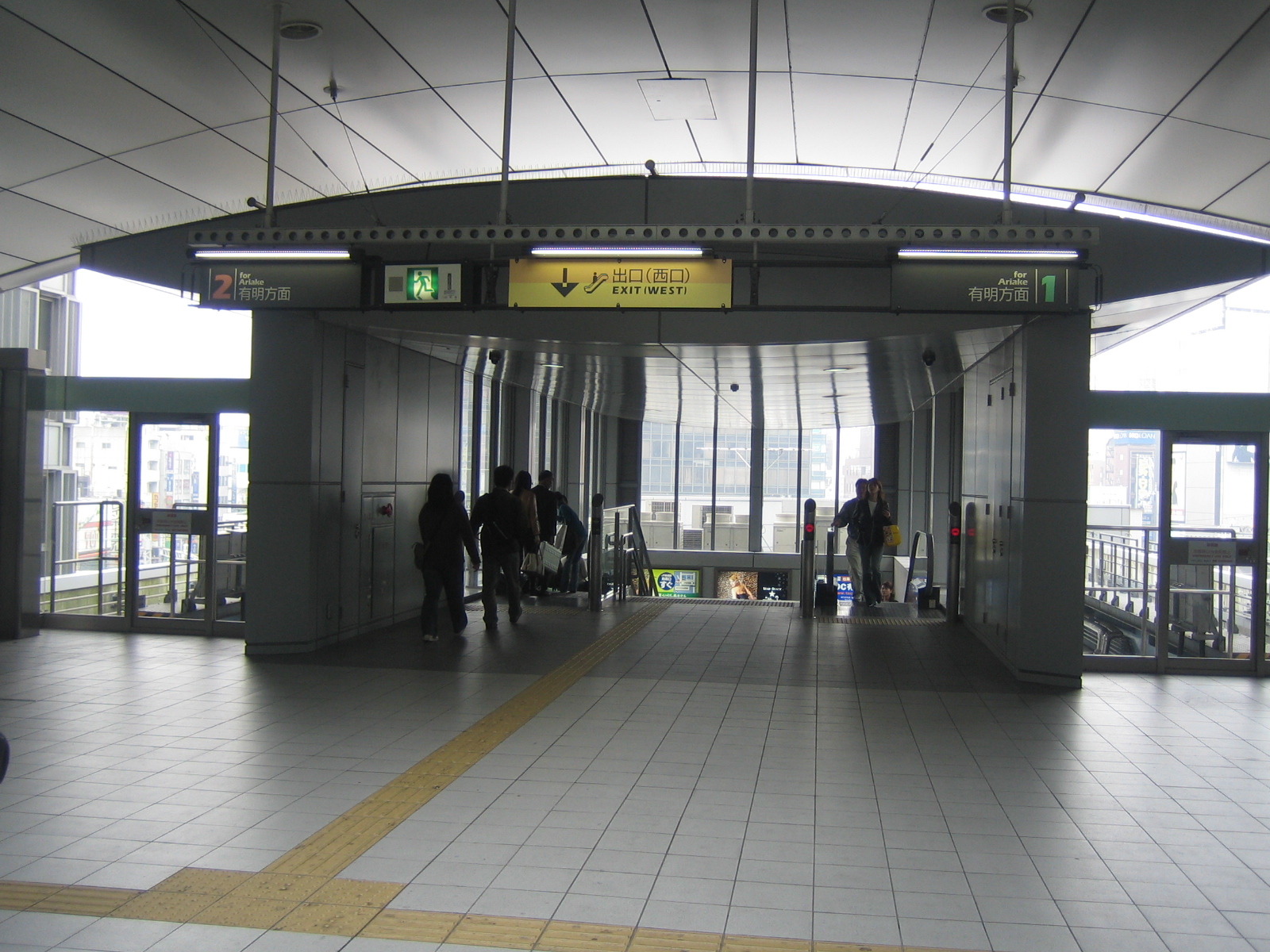 Entrance and exit to the station platform – both stairs and escalators are available to passengers.
 The Yurikamome’s guideway, which looks like a road. The AGT uses rubber tires much like road vehicles and employs a suspension system that ensures a smooth, comfortable ride.
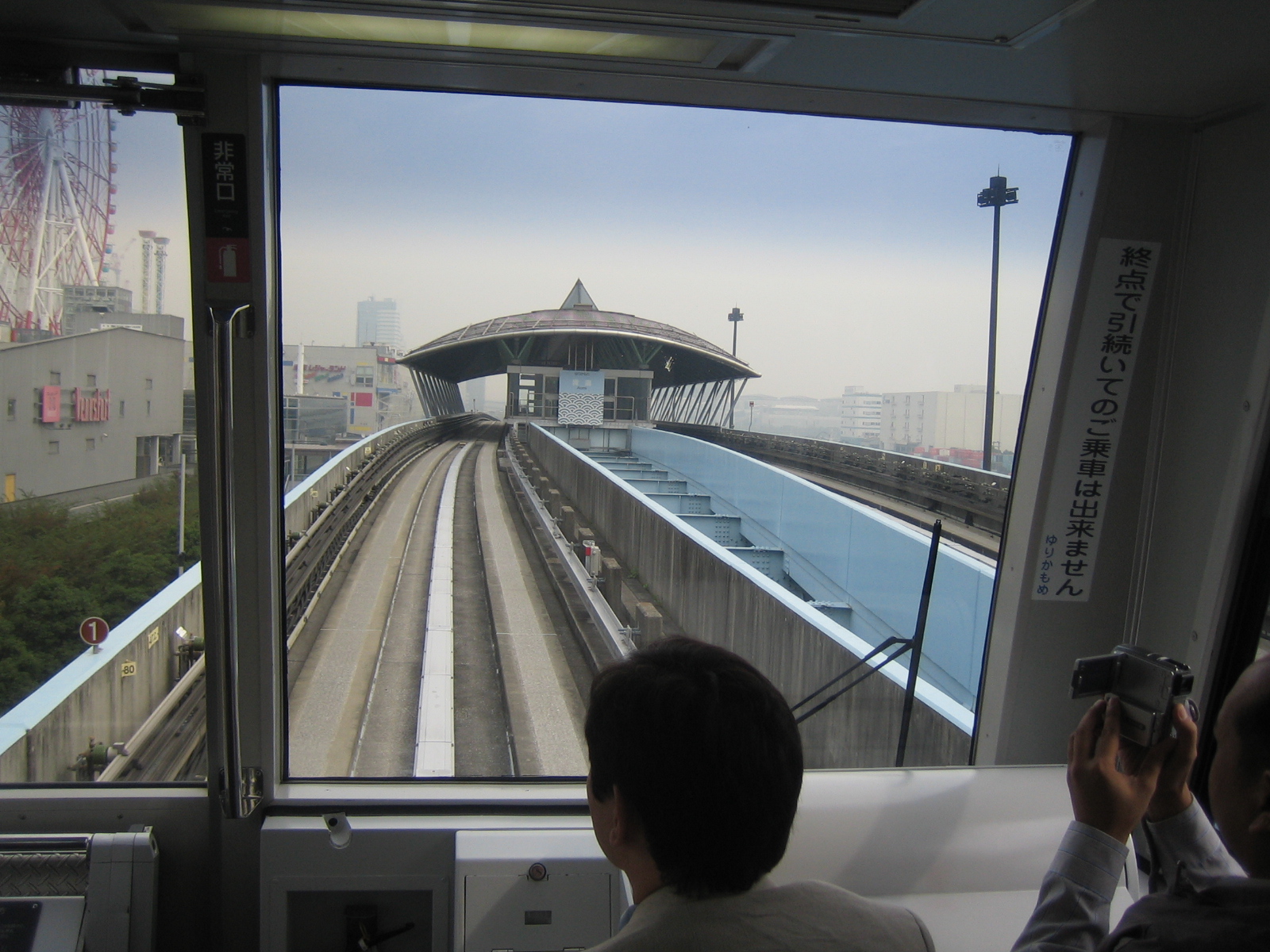 The Yurikamome is driverless (thus, automated). This is the view from the most coveted seats on the transit as the AGT approaches a station.
A glimpse of transport in the Philippines – General Santos
I’ve been fortunate to travel around the Philippines due to my line of work. In some cases, it is for our training programs, for others we do fieldwork for technical assistance or consultancies. You get to see not just the nice places around the country but also get to see transport in other cities and towns including a glimpse of its character and the behavior or preferences of its users. In the previous posts, I have included photos I’ve taken myself of some transport curiosities and there are many more that I have collected over the last few years. I guess I just need to find time to sort through the many folders containing these photos. Unlike before when the conventional cameras required photo development and I had to scan each one that I intend to save for my lectures or for posterity, nowadays there seems to be no limit with what you can take with a digital camera except perhaps the battery life and the size of you storage media.
Below are a couple of shots I took during one visit to General Santos City (GenSan) in south western Mindanao. The scenes do have similarities with others I have taken in other cities like the one I took while traversing Kennon Road en route to Baguio City. I believe the first 2 photos were taken along the Digos-Makar Road also known as Asian Highway 26 (AH 26). Note what seems to be the comfortable state of the passengers sitting on the roof of the jeepney and the disregard for safety for the bunch on top of a local truck.
 Passengers sitting on top and hanging behind a jeepney in GenSan
 Typical tricycle and people riding on top of a local truck
 Typical tricycle and multicab in GenSan (photo taken along Catolico Sr. Avenue)
Local transport services for moving about in the city are generally provided by jeepneys, multicabs (which are actually a form of jitney service), tricycles and non-motorized pedicabs. There are also the informal motorcycle taxis (habal-habal) but these are to be found mainly in the outer parts of the city. Taxicabs generally ferry passengers to and from the airport. Buses and vans are used for inter-city or inter-town transport (i.e., long distance transport) and are banned from plying routes in the city center. These may only use the national roads to get to the terminals. Tricycles are actually banned from the national roads and this is indicated in the sidecar bodies. However, the enforcement is usually lax and you can take the tricycle almost anywhere using any road in the city. Perhaps it is really too difficult to implement the ban due to the number of tricycles?
Sustainability and the roads to Baguio
News about the garbage in Baguio City and the slide that caused the death of many in that city brought back memories of my last visit. That was back in June 2009 when we were conducting consultation workshops for the formulation of the national environmentally sustainable transport strategy. We stayed and held the workshop at a hotel that was a short walk away from the Good Shepherd Convent. The convent, of course, is famous for the strawberry jams and other delicacies bearing the convent’s name. Also nearby was the Mines View Park that used to give a breathtaking view of mountains covered with pine trees. Those among my older friends who were able to experience this many years ago attest to the pleasing scent of pine in the cool breeze that is also a characteristic of this city. Nowadays, the view is mainly of mountains covered with shanties and looking downwards you would have a good view of a lot of roofs and, surprise, even a couple of structures that look like graves! If you’re unlucky enough, you would be taking in the scent of smoke coming from something that is being burned nearby.
Another thing that caught my attention in 2009 was the uncollected garbage along the streets and in front of many houses and other buildings leading to the convent and the park. Residents explained to us that Baguio already had a garbage problem and that waste management and disposal has been an issue in the city for quite some time. Previous to this visit, I had the chance to go to the city a few other times, even staying there for almost week in 2004 when we were conducting another study. At that time, I was not aware of the garbage problem probably because the problem has not yet manifested itself as it did in 2009. It is sad that the city has done little to address such issues considering the many indications of impending (if not ongoing) disaster due to their waste. It is also disappointing to see their leaders pointing fingers at others but seemingly refusing to take responsibility for the tragedy of the garbage slide.
On the way up to Baguio, we usually take Kennon Road, which is usually my choice when riding our own vehicle, rather than the more common Marcos Highway. The latter is a relatively easier route that was constructed as a safer alternative to the two more traditional routes via Kennon or Naguilian Roads. I usually choose Kennon because the drive provides great vistas including those you can view from observations points along the road. During bad weather, however, Kennon and Naguilian can be treacherous with both being relatively narrow as compared to the newer and upgraded Marcos Highway. There are many incidences of rockslides or landslides that have often made these roads impassable. In fact, Kennon Road is usually only for light vehicles and can be challenging to those who are unfamiliar with its combination of curves and slopes. Naguilian is no longer a choice among travelers from Metro Manila as it starts further from both Kennon and Marcos. Buses and trucks commonly use Marcos Highway, which has slope protection along critical sections and even a roof along one that makes it look like a tunnel section. It is also easier to negotiate this highway for most motorists though there is one long climbing section just before you get off the highway that has caused many radiators to overheat or brakes and clutches to malfunction.
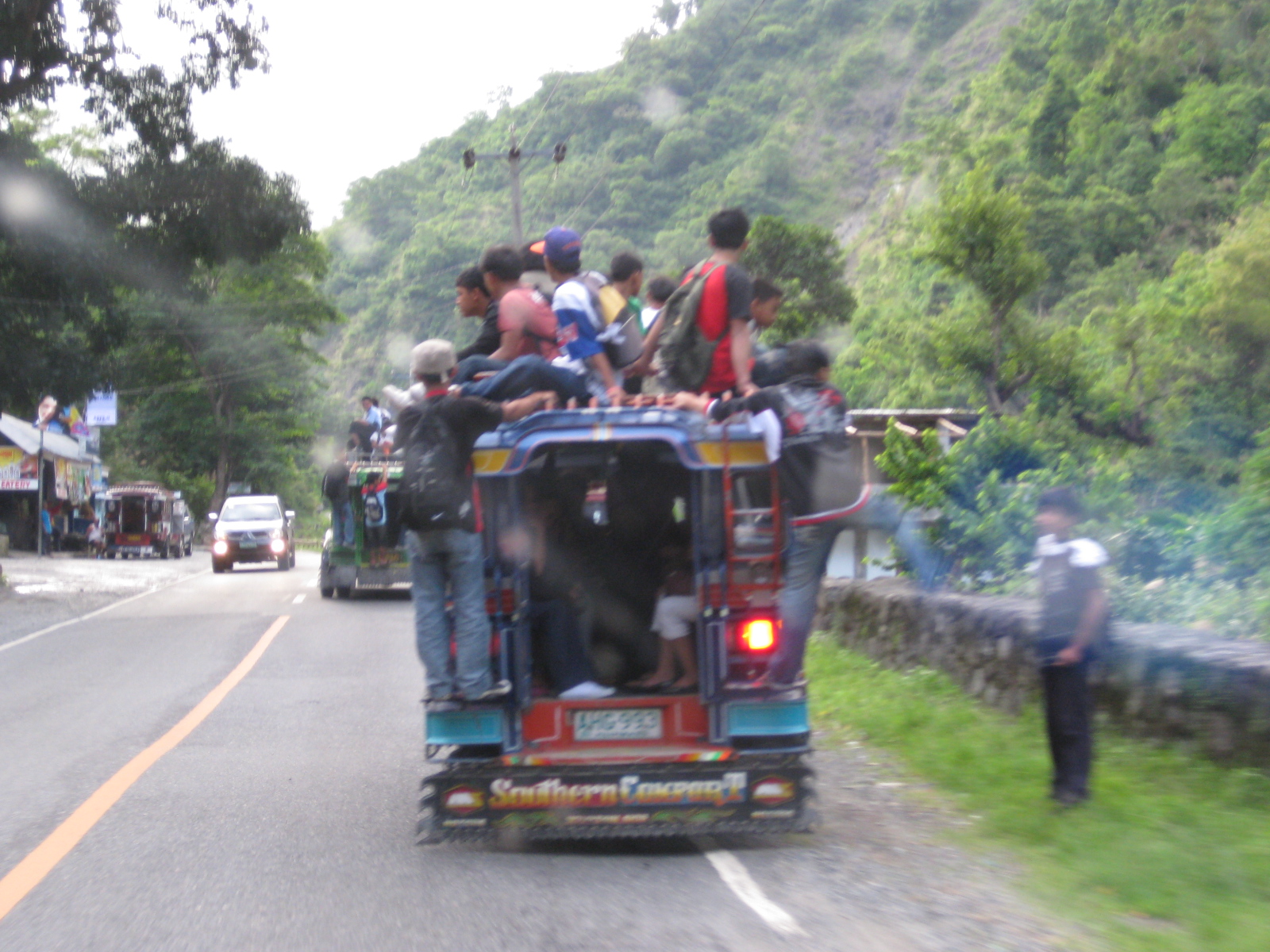
The photo below was taken as we negotiated a populated area along Kennon Road in 2009. Note the two jeepneys in the photo that are loaded with passengers. It was a surprise that no passengers were hanging by the door of the jeepney like what we usually see in Metro Manila during the peak hours. Nevertheless, such an image suggests that the public transport supply is no longer sufficient for the passenger demand along this route. Perhaps their numbers are no longer enough or maybe there is a need for a public utility vehicle with a larger capacity? One thing is sure and that the practice of overloading is unsafe and is a fatal crash waiting to happen given the geometry of Kennon Road. While this seems acceptable to many (I couldn’t even count how many people were sitting on the roofs of the jeepneys we passed.), this is not something that should be encouraged, and careful examination of services is necessary for both the local government (in this case Baguio) and the national agency in-charge (LTFRB).
More on Baguio and jeepneys on future posts.
Buses tagged…now what?
The MMDA issued a memo requiring all Metro Manila buses to paint their license plates at strategic areas of the bus exterior. These include standard sizes for “tags” to be placed on the roof, front, sides and back of the bus that are supposed to clearly show consistency with the license plate. Needless to say, if the license plate and the painted tags do not match, then the bus will be labeled colorum or illegally operating. Tags are also colored according to the general routes of the buses, with the yellow background applicable to buses plying routes along EDSA while an orange background applies to non-EDSA routes like those along Ortigas Ave. and Quezon Ave.
The tagging seems to be the latest in a long list of schemes that have been implemented to address the issue of colorum public transportation. While this is generally a matter for the LTFRB, the agency with the mandate to regulate road public transportation, the enforcement aspect is really quite demanding for an agency with few personnel to do this. As such, the LTFRB is usually assisted by other agencies like the MMDA or local government units. Franchise enforcement, however, is generally not the province of the MMDA or LGUs unlike their being deputized by the LTO in enforcing traffic rules and regulations (thus allowing the MMDA and LGUs to issue traffic tickets). The deputized MMDA and LGU enforcers may apprehend public utility vehicle drivers for traffic violations and in an ideal set-up, such violations should be considered when evaluating franchises for renewals. The propensity for violating traffic rules and regulations is a manifestation of poor driving habits and unsafe behavior on the road. Again ideally, such should be taken against operators who have the responsibility for hiring and training their staff. Operators should be held accountable should there be a high incidence of traffic violations and especially when there are incidences of crashes.
I am curious as to how the MMDA will be taking advantage of the bus tags in managing not only public transport but overall traffic as well. The tags present an opportunity where data collection may be facilitated and for various purposes. Such include a variation of the license plate surveys that are usually conducted to trace the movement of vehicles and determine whether they are speeding or travelling too slowly. An application of the outcomes of such surveys is the estimation of travel time along particular routes. For enforcement purposes, one can determine the reasonable turnaround time for public transport vehicles and allow for the checking of trip-cutting and the verification of the incidence of multiple plates. With the video cameras located at strategic points along Metro Manila’s major thoroughfares, sophisticated software employing image processing may be able to expedite the process, an example of an intelligent transport systems (ITS) as applied to public transportation.
The MMDA could even go further by consolidating travel time/speed data from public transport vehicles in order to derive real-time road network statistics. These could easily be visualized using digital maps that can be made online and shared to motorists and commuters alike to allow for better travel planning around the metropolis. Travel time/speed data have been used by researchers and agencies in other countries to estimate road traffic performance throughout the day and may be employed in modeling traffic in order to predict travel characteristics given typical factors affecting the traffic stream. Private vehicle characteristics are approximated by taxis that operate pretty much like private vehicles given that they do not have fixed routes and are not confined to lanes normally assigned to buses and jeepneys.
Such a comprehensive and sophisticated system for traffic management would require that all public transport vehicles be tagged including jeepneys and taxis. This also requires both hardware and software, and most importantly, capacity and on the part of Perhaps this is an alternative to requiring all to have GPS or RFID installed. Of course, the latter devices have more applications due to their potential for data storage (e.g., vehicle registration, franchise, location, etc.) but unfortunately, there are issues that still need to be addressed and questions left unanswered that are associated with these devices. Sayang! But even so, the bus tags (and maybe jeepney and taxi tags in the future) already present a lot of opportunities for monitoring, evaluation and improvement of traffic in Metro Manila. If only such potential can be realized and maximized by the MMDA and other agencies…
Locally made AGT
I got my first look at the vehicle currently being developed by the DOST-MIRDC at the DOST complex in Bicutan. This was the same vehicle that was shown on some news programs a couple of days ago when there was some buzz about a MOA being signed between UP and DOST for the development of an automated guideway transit (AGT) prototype and test track at UP Diliman. The DOST Secretary was supposed to have said that it would cost somewhere between a fourth or a fifth of those developed elsewhere (read: other cities abroad) and that it would have a capacity of 60 passengers. The Secretary also was reported to have said that the AGT would eventually be travelling at 100 – 120 kilometers per hour! That’s quite fast for something that’s being packaged as an urban mass transit system.
Together with the reports, both on TV and print (I haven’t heard anything from radio.), were images of a transit vehicle used by DOST in publicizing the project. What appeared was an artist’s impression (or so it seems) of what looked more like a monorail than an AGT. But coming to Taguig for a meeting, I made it a point to ask our friends at DOST to give us a brief tour of the test track they constructed at the complex where the MIRDC with a little help from another agency involved in rail transit was testing a prototype vehicle that was shown on TV. I wasn’t able to catch those news reports so I was a little excited to see the vehicle being developed and by local engineers and scientists. Below are a few of photos of the vehicle together with the test track.
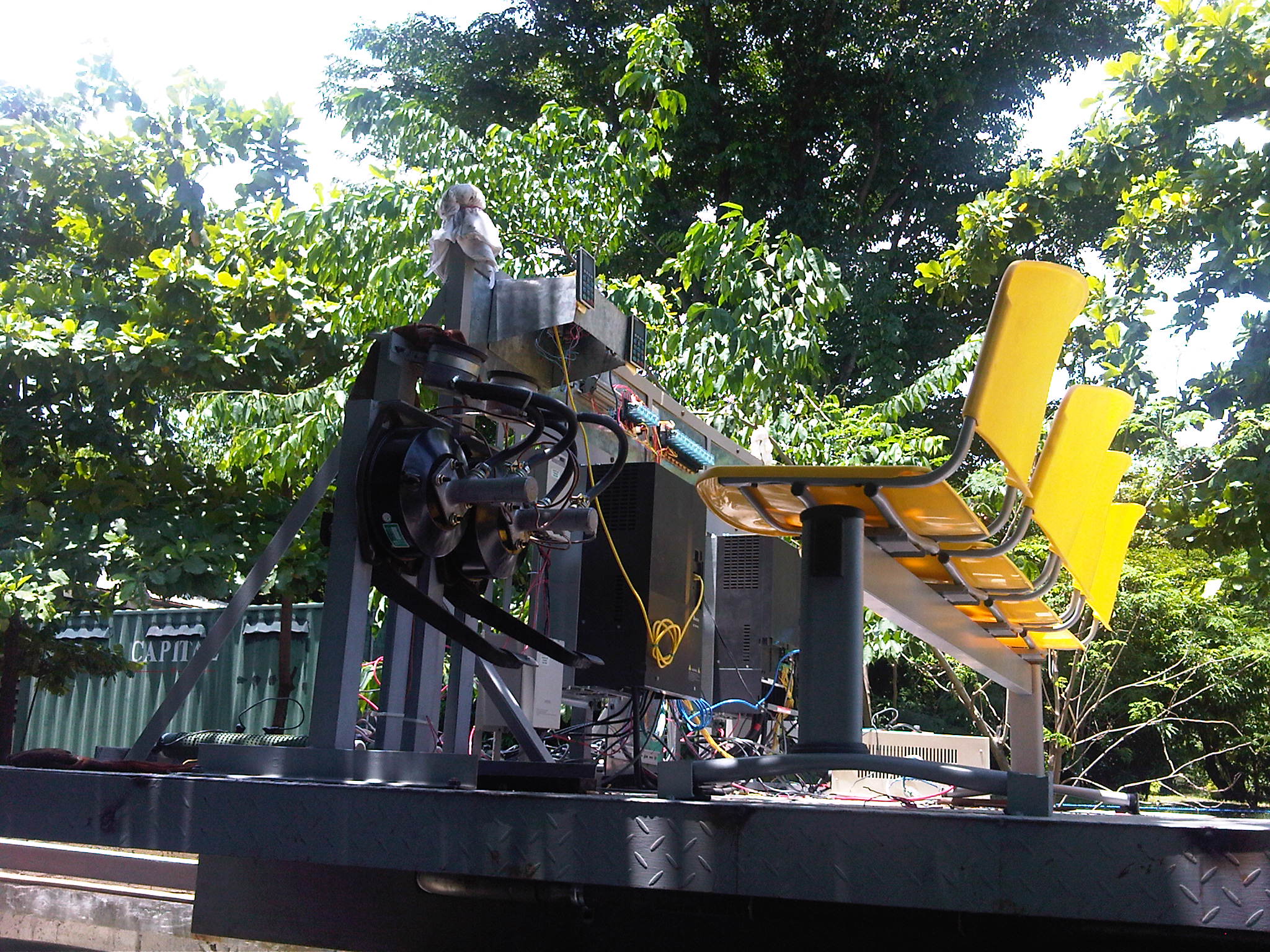
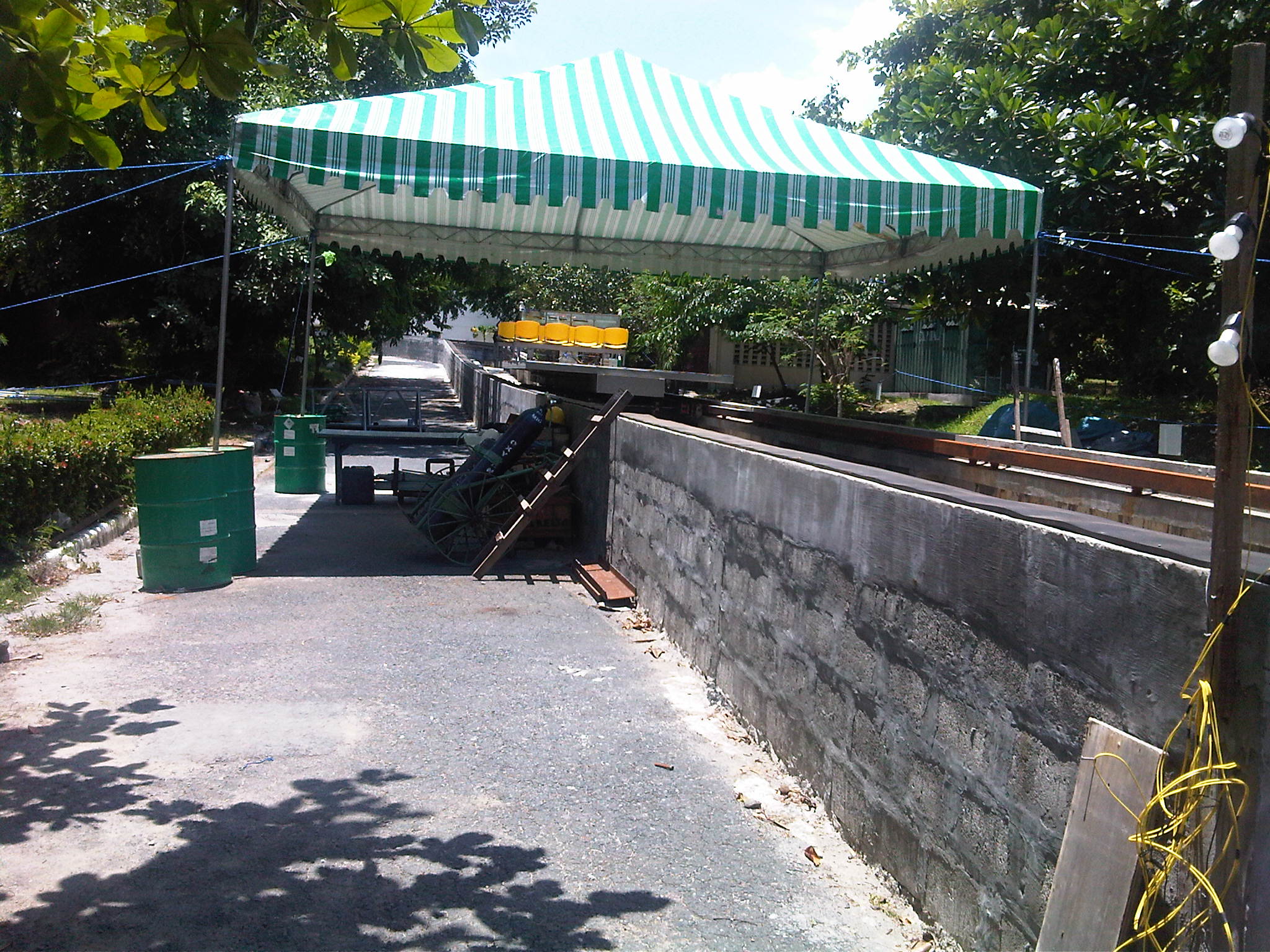
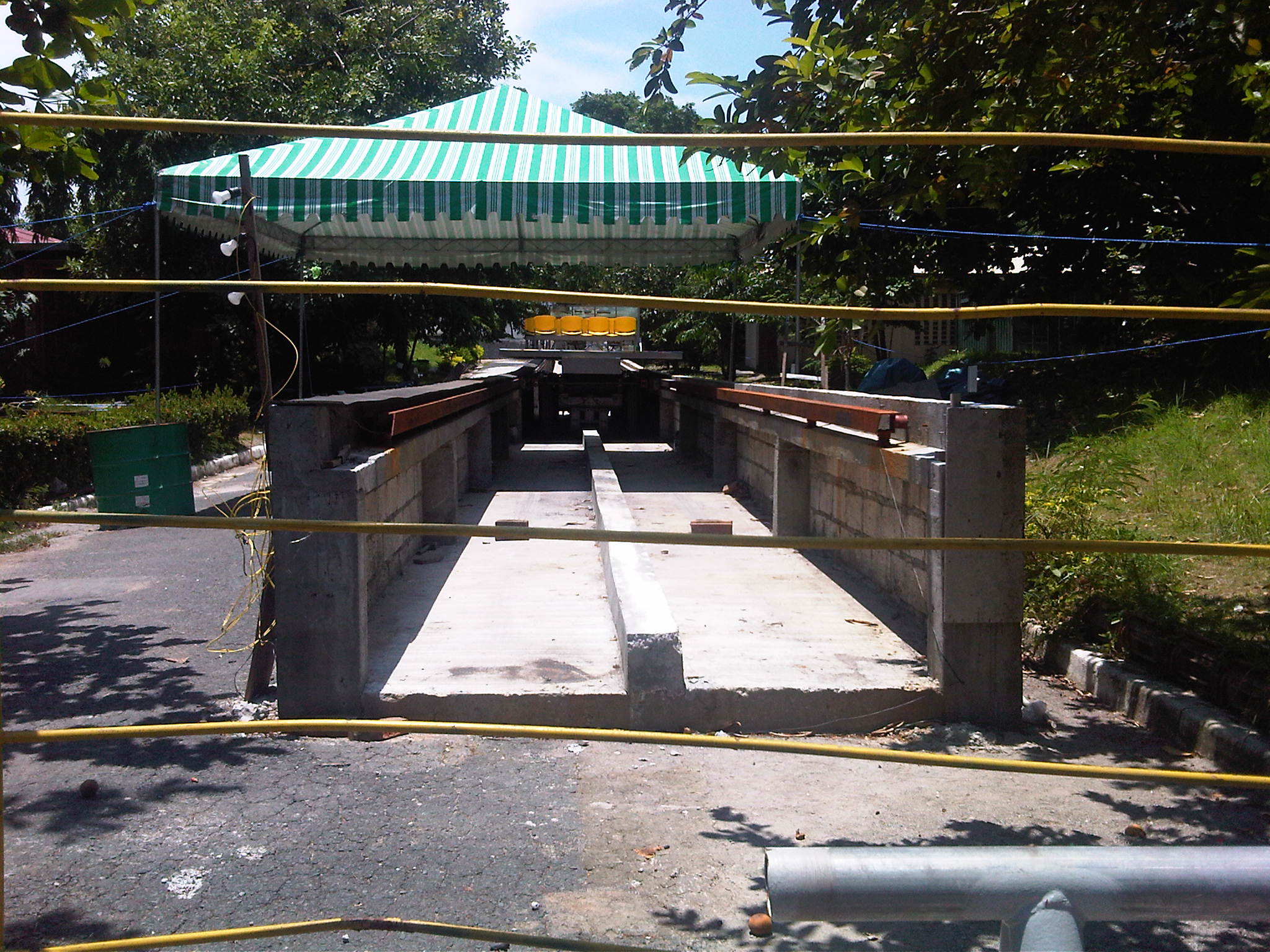
I’m sure a lot of pundits out there were disappointed with what they saw after getting all the hype about the UP AGT. However, it turns out that this won’t even be what will run along the test track to be constructed at UP Diliman. Our friends at the DOST say that this was just a practice vehicle of sorts that DOST staff experimented on just to prove that we (Filipinos) are capable of developing a transit vehicle and the track that will carry it. Of course, the future track and the proposed loop in UP Diliman will be overhead. Also, there will be other challenges pertaining to the superstructure (foundations, columns, girders, stations, etc.). Then there is the vehicle itself that should be safe and comfortable with designs adhering to ergonomic standards, an efficient motor and controller (it will be electric), and a suspension system that should give a smooth ride. Needless to say, the vehicle should also look good to be able to attract people and for it to be marketable. These are tremendous expectations indeed and it could really use all-out support from the government and maybe the private sector. I would not be talking about the funds and other resources required for this undertaking. Info on these are already available from the DOST and UP, and there are already initiatives to attract the private sector into having a look at the project and perhaps provide support in whatever way they can.
I can’t help but be proud of what has been accomplished and what is still to come in as far as the project is concerned. I believe we should be eager to pitch in what we can in order to ensure the success of this collaboration between UP and DOST. Who would not want to be involved in a project where Filipino engineers and scientists will come together to come up with a product we can not only showcase as home-grown but something that would have a significant impact on public transportation in this country.
Meanwhile, it would be better for DOST and UP to temper expectations so as not to put undue pressure on those who will be involved in the project. Pronouncements claiming that the system will replace the IKOT jeepneys are at this stage premature and only raises flags that would not be in the interest of the project. Claims, too, that the vehicle will run at 100 kph is unfounded and unnecessary considering, for one, that the average running speeds of such systems would be between 30 and 40 kph and probably top at 60 kph if there were sufficient distance between stations. I understand that the statements made were probably words of encouragement but I guess we have our work cut out before us and the challenges have been revealed on the way to the development of a home-grown AGT.
Technology-driven transit system development
The proposed UP transit system, whether it will be an AGT or a monorail, is a technology-driven project. As such, it can be argued that it does not need hard studies to establish the need for the system. Indeed, it is packaged as a prototype and one which, if implemented properly, will hopefully be a good example that can be deployed elsewhere where such a system is necessary. Such places may include CBDs like the rapidly emerging one in Bonifacio Global City or in small cities where there is a need for a more efficient form of mass transportation but could not afford the conventional MRTs or LRTs that have been constructed in Metro Manila. Also, a significant part of the initiative is the development of the vehicle, which is being undertaken by the DOST’s MIRDC. Their design and their production process should be replicable and they should have been able to bring down the costs according to the marching orders of their Secretary. After all, this system is being touted as something that would cost a fifth of a conventional system.
The conventional way of planning, designing and building transit systems require a lot of studies including the so-called ridership studies that would establish the demand for the system. Of course, there are also considerations pertaining to the stations and analysis of the superstructure that will also cost something. It is no joke that the best examples of AGTs or monorails in other countries are priced so because of all the effort and expertise that went into their developments. We should not kid ourselves by claiming this will cost much less because we did not take into consideration just compensation to people who will be devoting their time and expertise to develop a “home-grown” version of what has been built in other cities. We shouldn’t also sacrifice the quality of the superstructure that includes the stations just because we want to reduce costs. We have to keep in mind that the infrastructure should be able to resist typhoons and the possibility of earthquakes. The foundations for the columns, in fact, should be designed well considering UP’s soil characteristics.
On Wednesday I might just get my first look at the prototype vehicle when I visit the DOST for a meeting not quite related to the proposed transit system although it would be about customized vehicles. The vehicle that is the rolling stock for the proposed system is supposed to have already been built and being tested on a very limited basis at the DOST compound. Perhaps I can see for myself if it is something that will eventually be an impressive piece or something that will need much work once it is brought to UP.
An AGT at UP
The signing of a Memorandum of Agreement (MOA) and groundbreaking for a proposed prototype transit system at the University of the Philippines Diliman campus is scheduled for the morning of July 18, 2011, Monday. The site will be at the open lot near the corner of Lakandula and Jacinto Streets just across from the College of Fine Arts and near UP Diliman’s Campus Maintenance Office (CMO). The prototype system is a pet project of the DOST Secretary and was originally billed as the system to replace the IKOT jeepneys of UP Diliman. It will be a major undertaking for the university considering that its expertise (i.e., faculty, staff and students) will be tapped to undertake the studies and designs for the system. It will be a multi-disciplinary project that would involve architects, engineers and planners as well as social scientists who will be assigned with the unenviable task of securing social acceptability of the project.
The prototype system will have several phases in order to complete a loop. It is to be designed as a one-track, and therefore likely a one-way system. The “rolling stock” of modified buses each with a capacity of 60 passengers are supposed to have already been finished and are being tested at the DOST compound in Bicutan. It is still not known what the capacity of the system will be since there have been no studies to support demand (i.e., ridership), which will be affected by factors such as the route, direction and headways. among others. The project is one that is technology-driven rather than demand-driven. It is going to be an experimental system and one that will probably have to be tweaked from time to time given that it will be “home-grown” and attempting to reduce costs commonly associated with existing systems in other countries. Below is one of the proposed alignments for the system showing the initial phase from Philcoa (in yellow). The circles indicate the 2-minute walking distance radius although this is a crude concept considering people will be walking along the roads or sidewalks and not necessarily along a straight line leading to the proposed stations.

Whether it will eventually replace the jeepneys is still up in the air but the stakes are high considering that a locally made AGT may be transferable or feasible in other settings. Perhaps areas such as Bonifacio Global City, the reclamation areas along Macapagal Boulevard and even the Batasan can have their own AGTs in the future. My only hesitation for the prototype at UP Diliman is that it is still unclear who will be shouldering the operations and maintenance costs of a system that is sure to have revenues that won’t be able to cover such. Then there is the issue of aesthetics that cannot really be addressed now considering most plans are still in the minds of the proponents and have not been transferred unto the drawing boards or computers. We hope to be able to answer these questions and answer them correctly and appropriately. Otherwise, our legacy for the campus would be a white elephant that nobody would have wanted in the first place.
Regular salary or commission?
Still related to the topic of the road crash that claimed the life of a UP Professor last week are current discussions on the compensation of public utility vehicle drivers – particularly drivers of buses. The boundary system is the one that is predominantly employed by many operators or companies with their drivers. It is quite a simple system where the driver practically rents the vehicle from the operator for a certain amount that is related to the characteristics of the route that he or she will be plying. Thus, the longer routes with the higher passenger demands typically pay more than shorter ones or those with less demand.
What a driver would earn during his shift (in a day) would include the amount he would be spending for fuel and maintenance costs. This means that the driver would have to earn significantly more than what he plans to take home because from the gross income for a day’s work he would have to subtract the boundary (vehicle rental) fee, fuel costs and maintenance costs. Should he be apprehended for any traffic violation, he may also have to shell out more money for fines or, in certain cases, bribes to crooked traffic enforcers. Theoretically, however, if a driver is able to cover more round trips in a day he has the potential earn more in terms of net income. Thus, it can be inferred that traffic congestion would be among his main problems if he is to reach his goal of a decent take home pay. As such, the objective for any driver is to maximize his passengers for every trip that he makes and maximize the number of trips that he makes in order to maximize his income.
Meanwhile, the salary type of compensation involves a fixed payment for services rendered by a driver regardless of the number of passengers he is able to pick up or of even maybe the number of round trips per day that he is able to make. The latter parts of that last sentence is probably the most significant difference in the characteristics of the two compensation schemes that we are now attempting to compare. These are the characteristics that are often mentioned whenever inefficiencies and inconveniences in road public transport services are discussed since it is argued that scheduled services and behavior change, ergo better public transport services, will be possible if drivers won’t have to compete against each other for passengers or recklessly speed up in order to cut travel and turnaround times.
But can a fixed salary or a system much like those in most conventional or regular companies be acceptable in the first place to both driver and operator? What are the views from the drivers and operators themselves? What would be the implications and impacts of having salaried drivers much like employees of a conventional company?
The theoretical answer to the first question, and one that would most likely be provided by proponents of regular salaries, is a resounding yes. However, the response to the second question would be problematic once one realizes that the answers to number three seem to be unfavorable to both driver and operator while appearing to be beneficial for commuters. For the first question, a fixed salary may not necessarily be acceptable to drivers since it is not necessarily advantageous to them. A fixed salary means they will lose the potential of earning more income that is possible from the current practices of driving aggressively and pursuing as many passengers as possible.
The idea of putting a cap on their income is one thing, the prospect of having a paper trail for a regular salary is another. If, as proposed, drivers would have regular salaries like most employees working in offices, then companies may have to employ a system similar to that in other business where they will now be withholding taxes and other dues for benefits like social security and healthcare. While the BIR might end up happier with this set-up, surely the drivers who until now perhaps do not even pay their taxes at all will oppose a system where they will end up with potentially less net income.
On the part of the operator or company, having drivers with fixed salaries would also mean less potential income at the end of the day as revenues may be reduced. The reduction would be mainly due to less passengers as drivers are no longer pressured to take as many passengers as they can. They are, after all, assured of a fixed salary and do not have to stay longer at stops just to maximize the number of passengers they could pick up. Such result would definitely be welcome to passengers who would benefit from shorter dwell times (delays) and faster travel speeds. But from the perspective of operators or companies, it is bad business and they may end up being exposed for their financial incapacity.
This perspective of the operators and drivers is validated by the recent interviews by news crews of the former group where they practically opposed regular salaries for drivers. Operators reasoned that drivers would be on the losing end of the deal while not discussing how it would affect them and how the prospect of salaried drivers may lead to increased efficiencies of public transport services and even alleviate traffic congestion. On the part of the drivers, there are basically mixed views on regular salaries with one group saying it is acceptable to them and another saying it is disadvantageous in their cases. The impression for both groups, however, is that they are basically ill-informed and do not fully understand the implications of having regular wages. Perhaps their understanding is limited also by the fact that many of these drivers might feel beholden if not loyal to their operators/companies.
While the jury is still out on salary vs. commission, it should be noted further that salaries may only be applicable to companies or operators with several units of PUVs (perhaps something that resembles a fleet). As such, the preceding discussions and arguments may not be applicable to drivers of jeepneys or AUVs and perhaps even tricycles and pedicabs, most of which are individually owned. This becomes a weakness of the proposal for regular salaries as it becomes clear that only buses will be affected and their operations influences. In Metro Manila, perhaps the impacts would be marginal since jeepneys comprise much of the public transport supply and would pose more unique problems pertaining to driver compensation.
 Caught (up) in traffic