
Home » Public Transport (Page 63)
Category Archives: Public Transport
Upgrades: the Ayala BRT
The Ayala Land Inc. (ALI) has been issuing press releases about their plan to put up a Bus Rapid Transit (BRT) system for the Makati CBD and the Bonifacio Global City. The system will serve both the old financial center in Makati and the rapidly emerging one in Taguig, connecting the two via Ayala Avenue-McKinley Road and Gil Puyat (Buendia) Avenue-Kalayaan Avenue corridors. It is a project that is long overdue although the buses serving the Fort have shown us at least what a higher capacity mode of transport can do if managed properly.
The Fort Buses load and unload passengers at designated stops. They follow traffic rules and regulations enforced more strictly inside the Global City. Many of the newer bus units also happen to have layouts that are more appropriate for city operations. The Mercedes Benz coaches are designed such that they can accommodate more passengers as they have ample standing space and there are only enough seats for passengers who may actually need them like the elderly, pregnant women, persons with disabilities, and perhaps those who are burdened with heavy bags or packages. The doors of these units are also designed for more efficient fare collection and discharging of passengers, with the narrower front door accommodating boarding commuters who are already queued at bus stops and the wide two door rear egress allowing for efficient alighting. Surely, an automated fare collection system such as those using smart cards or other machines will be in place in the near future and greatly improve the operations of these buses. But the most significant feature, it seems, of the Fort Bus is the compensation scheme for its employees, particularly its drivers. Unlike most bus companies, Fort Bus drivers are given a regular monthly salary and reportedly enjoy benefits much like regular employees in typical companies or offices. This feature, I believe, is what makes it work in the first place and what is required for a transformation in public transport services as it does away with the rabid competition that is the derivative of a commission-based or “boundary” system compensation scheme that is used for both buses and jeepneys.
Considering the calls for more efficient as well as more safer public transport systems, let this Ayala BRT be a test case for what to do with transport systems that should have been phased out a long time ago (jeepneys) along corridors or routes that demand higher capacity vehicles. Public utility vehicles with low capacities and perhaps low quality of service should be replaced by more efficient modes especially along arterials. Also, all the elements are there for a potentially successful PPP in transport. You have a major player from the private sector (Ayala) offering to put up a system that it has studied and designed over the past few years. You have two CBDs in Makati and Taguig that currently serve as the present and future financial centers. And you have the challenge of doing away with an inefficient transport system. Though there sure will be compromises that are not necessarily palatable (e.g., re-routing PUJ and PUB lines) the government should start realizing that it should be more deliberate and even unforgiving when it deals with the issue on PUJ and PUB franchises here.
The local governments of Makati and Taguig should cooperate with Ayala to make this work for these LGUS should put aside certain interests including those pertaining to PUJ and PUB operators and drivers, many of whom may be their constituents and comprise a significant part of their voting populations. The LGUs should facilitate discussions including those dealing with livelihood and othe social issues that are the province of local governments. The Land Transport Franchising and Regulatory Board (LTFRB) should get out of its shell and make a stand now considering the opportunity for public transport transformation. And its mother agency, the Department of Transportation and Communications (DOTC) should support this stand, all out, if only to show that it is indeed committed to reforming and modernizing public transport systems in this country.
A BRT finally being realized for Makati and Global City will indeed be a showcase. We just hope that it will be a showcase of an efficient transformation of a public transport system from an outdated to a modern and efficient one rather than a showcase of futility and ineptness on the side of those in government. As they say, something has to start somewhere. A modern, efficient public transport system that is deserved by Filipinos may just start in Makati and Taguig, and with a BRT that may actually mean “better rapid transit.”
Ortigas traffic
Ortigas Avenue traffic is very familiar to me. For one, I have used the road since childhood because it was the most direct route to and from school. We lived in Cainta and I went to school for 11 years in Mandaluyong. Before that, I even have memories of the section of Ortigas Avenue where Valle Verde phases are now located being carved quite literally from the adobe mountain that it was back in the mid 1970’s. Ortigas was the only access for those living in the east, particularly the Antipolo-Cainta-Taytay-Binangonan-Angono towsn of Rizal Province, for quite some time. Marcos Highway was still a dirt road and Marikina and Cogeo were somewhat out of the way. Meanwhile, Ortigas was already an important corridor as it led to Antipolo, an important religious and popular recreational site.
As the populations of the Rizal towns I mentioned increased, mostly due to their proximity to Metro Manila and being popular for residential developments then as now, Ortigas became congested. The avenue itself was widened but as any traffic engineering textbook will tell us, the bottlenecks were really the bridges. And I also remember the Rosario Bridge across the Pasig River being widened twice, both before the Manggahan Floodway was constructed. I experienced the impacts of both widening endeavors and did not enjoy having to wake up earlier than when I usually did because of the horrific traffic. It was worse, I guess, when the Manggahan Floodway was being constructed and there were too few options as to alternative routes. In fact, there were too few bridges across the floodway and Pasig River.
Nowadays, traffic congestion along Ortigas Avenue seem much worse than before. This I get from my siblings who still use the corridor as part of their routes to their workplaces. I trust in their assessment considering that my brother went to the same Mandaluyong school I attended and my sister attended another exclusive school in Pasig. My sister’s husband attests to the worsening traffic as he’s also lived at a residential area along Ortigas. From firsthand observation, I can also validate that Ortigas is worse these days than say 10 and 20 years ago.
The counterflow scheme along Ortigas is not new. In fact, my father and our school service drivers knew about this and would often time their trips to coincide with the scheme so that they can drive almost continuously to their destinations in the morning. Back then, I remember that the counterflow scheme was in effect for 10 to 15 minutes at the 0630, 0700, 0730 and 0800 times. It was also actually a regulated one-way scheme and was called thus since it benefited vehicles traveling along the outbound (from Rizal) direction. Inbound traffic were stopped at strategic points along the avenue including Rosario Bridge.
Such schemes are possible only when there is a dominant direction during the peak hours. In the case of Ortigas the directional distribution before was practically 90% outbound in the morning peak. A one-way, counterflow scheme was possible and practical for an undivided road. There were no medians or island to prevent vehicles from moving over to the opposing lane and back. That was then and at a time when I suppose that there were less friction along the avenue. Road friction, particularly those caused by public utility vehicles stopping for passengers, is more serious these days as the number of PUVs have also dramatically increased to address the demand for travel. Only now, there seem to be more informal terminals and longer dwell times at strategic points along Ortigas. These cause the bottlenecks that are also complicated by Ortigas now having median barriers along its length.
I believe congestion can be significantly alleviated by developing and implementing a simple dispatching system for PUVs along strategic points like the designated loading and unloading zones at either ends of the Manggahan and Rosario bridges. The dispatching system should be implemented along with a strict enforcement regime to ensure quick boarding and alighting times and prohibiting PUVs from spilling over and occupying other lanes, that often results in blockage of general traffic. Perhaps, a counter-flow scheme may be re-evaluated and become unnecessary. This recommendation comes in the heels of a survey we conducted along Ortigas only yesterday, February 10 in Manila, where I personally experienced PUVs making a terminal out of the outbound lanes before the Manggahan bridge and effectively blocking outbound traffic along the avenue. I can imagine the frustration of those caught in traffic along Ortigas and its implications along the extension and the Imelda and Bonifacio Avenues from Cainta Junction. The result of that blockage and the implementation of a counterflow around 0715 is shown in the following two photos I took.
 Figure A: Image downstream along Ortigas Avenue (to Rosario Bridge and C5)
 Figure B: Image upstream along Ortigas Avenue (from Cainta Junction)
It is clear from the photos that private vehicles were the ones who benefited from the counterflow. However, it is interesting to see that the outbound lanes were practically empty especially along the Manggahan Bridge. This clearly shows that there is actually enough road capacity but that it is not utilized (and counterflows were required) because of the blockage caused by PUVs upstream of our position. This is another strong case for going back to the basics in as far as traffic engineering and management is concerned. It does not take a PhD degree to see what’s wrong in the photos and certainly an advanced degree is not required for a solution to the problem.
Discipline along a killer highway
Commonwealth Avenue in Quezon City was given a tag as a killer highway due to the frequent occurrence of road crashes along the road, many of them resulting in fatalities. Only last December, a retired judge was about to cross the highway on his vehicle, his wife (a retired teacher from a prestigious science high school) with him as they were heading to church. It was very early in the morning since they were going to the Simbang Gabi or night mass – a tradition in the Philippines during the Advent Season leading up to Christmas Day. Despite probably signalling and their being cautious enough, their vehicle was hit by a speeding bus. The driver of the bus was to claim later that he used his lights and horns to warn the judge against crossing. There was no mention if the bus driver attempted to slow down, the safest thing to do when driving at night and knowing that there are many crossings along the road he is traversing. In fact, this should be the first thing on the mind of anyone aware and conscious about safe driving.
There are many incidents like the one above and not just along Commonwealth or other Metro Manila road. Road crashes occur along many of our national and local roads everyday and the casualties just pile up, and many are often just treated as statistics especially when nothing is done to address the issue. Such road crashes occur due to many factors that are usually categorized into human, vehicle or environment-related. Most often, as findings in the Philippines indicate, it is the human factor that results in a road crash.
Driver error, poor maintenance of vehicles, and ill-designed roads can all be traced to human shortcomings. Environmental factors are also ultimately rooted on the human element. Speeding is one thing and aggressive driving is probably another but altogether general driver behavior along Philippine roads are clearly a manifestation of a lack of discipline and not necessarily the lack of skill, although the latter is also a significant factor if one is to focus on public transport and trucks.
There are few exceptions and it seems “few” is a relative term often leading to the example of Subic. At Subic, we always wonder how and why drivers seem to be disciplined. Some say it is because of the fines or penalties for traffic violations. Others say it is psychological and a legacy of the base being previously under the US military. I would say it is more of the traffic rules and regulations being enforced firmly and fairly in the free port area. I would add that motorists and pedestrians have embedded this in their consciousness such that there is something like an invisible switch turning on when they drive in Subic and turning off once they are out of the free port.
For a corridor like Commonwealth, perhaps the best example to emulate would be the North Luzon Expressway (NLEX). Along that highway, its operators the Tollways Management Corporation (TMC) have established a strict regimen of enforcement and have applied state of the art tools for both monitoring and apprehension. These tools include high speed cameras equipped with speed radars that detect speeds and capture on photo cases of overspeeding. Photos are used as evidence upon the apprehension of the guilty party at the exit of the expressway.
The current campaign along Commonwealth is premised on the strict enforcement of a 60 kph speed limit along the arterial and the designation of PUV lanes (e.g., yellow lanes) along the length of the corridor. The initiative would be manpower intensive and features novel tools such as the use of placards, loudspeakers and public relations in order to encourage motorists and pedestrians to follow traffic rules and regulations. The results as of today look promising and there has been a significant reduction in speeds and general compliance for PUVs serving the corridor. The numbers might be misleading if we attempt to conclude about the success of the program now. Perhaps the more reliable statistics would come out after the campaign has been implemented and the effort sustained over a month’s time. Nevertheless, it gives us a nice feeling to see less speeding and less weaving among vehicles that were once observed as though they were driven along a race track. It would be nice to once and for all kill the “killer highway” tag and make Commonwealth an example of how traffic management should be implemented. We are always searching for examples of good if not best practices that can be replicated elsewhere. If we succeed in the “Battle of Commonwealth” then perhaps we could eventually win the “War Against Irresponsible Driving and Jaywalking.”
Monorail or AGT?
I’ve been asked a lot about the proposal to have a monorail or an AGT for the University of the Philippines Diliman campus. A monorail is a rail system much like what we have with the difference mainly that it runs on a single rail. Monorails may be of the straddle type where the vehicle is in the conventional position above the rail or it can be the suspended type where the vehicle is essentially hanging from the rail structure. Capacities vary since many monorail systems are considered light rail while there are few that significant capacity to be categorized above light rail but still below conventional mass transit heavy rail systems. By the nature of monorails, these are all elevated systems. Among the examples of monorails I’ve used myself are the Tokyo Monorail (straddle) and the Chiba Monorail (suspended).
AGT stands for automated guideway transit and designs vary with some operating along railway tracks and others running along guideways using pneumatic tires that are not so different from buses only that these are trains. AGTs are also driver-less hence the “automated” tag. Unlike the monorail, it is possible to have AGTs constructed at ground level. Many guideways are essentially parallel strips of pavement where the wheels would traverse and there are devices such as sensors built in to the vehicle that allows it to steer with respect to a rail or wall constructed along both sides of the guideway. In certain cases, the guideway cross section is L- or U-shaped for this purpose. I rode on two such systems – the Tokyo New Transit System or Yurikamome (translated as Sea Gull) and the Yokohama Seaside Line. An attraction for these systems because they are driver-less is that passengers can be seated at the front of the train thereby availing a view that only drivers used to have. It is actually popular for first-time passengers as well as children.
There are many other examples of such monorail and AGT systems in other cities around the world. However, there are none yet in the Philippines. Perhaps the closest we got to having a monorail was the proposal for one to be constructed in Makati City back in the 1990’s. It was envisioned that the system would serve the CBD and connect buildings along the alignment to the EDSA MRT. It would be a loop system to serve the many offices and commercial establishments in the CBD. The proposal, however, fizzled out and was never constructed although the idea has been revived time and again in relation to other plans for public transport in that city.
A newer proposal is a monorail system for Bonifacio Global City. This system, however, will not be serving the entire development but only the area in its northern part including what is called the Bonifacio Triangle that is adjacent to Kalayaan Avenue. This is partly due to the live proposal and current efforts to put up a bus rapid transit (BRT) service between the Makati CBD and Bonifacio and serving the core areas including developments adjacent to C-5 (e.g., Market! Market! and Serendra). There is no timetable yet for this proposal and there are no detailed information available so far for public consumption although it has been mentioned to possibly utilize Japanese technology.
Now, there is also a proposal for either a monorail or an AGT for the UP Diliman campus. It was mentioned already in several news articles in media and is apparently the idea of the head of the science and technology agency of the country. Among the things mentioned is that the system will be replacing the jeepneys that currently provide transport services to both UP and non-UP commuters. The campus, after all, is located strategically between two major thoroughfares – Commonwealth Avenue and Katipunan Avenue (Circumferential Road 5).
While I advocate modern transport systems and would like to have these realized in our country, I have apprehensions with regards to having a monorail or AGT inside the campus. Among these apprehensions concern the appropriateness of such a system for UP considering that it is an academic institution that, despite the existing land use, will not be generating much traffic. What would be increasing here is the amount of through traffic, particularly those trips using public transport due to the nature of the location of UP. Thus, it is UP’s call whether as a policy the university will allow such through traffic in the future. This would send a mixed signal to the public considering that the existing sticker system and gate entry/exit policy for private transport seeks to minimize through traffic in the campus.
Jeepneys plying routes inside the campus are actually tolerated by the university due to the demand for public transport among its constituents, which includes students, staff and faculty. Two particular routes, the Ikot and Toki, travel only within the campus, ferrying their passengers to and from the different academic units (e.g., Palma Hall to the College of Science complex) and other places of interest such as the Shopping Center and the dormitories. In fact, there used to be no C.P. Garcia Street that physically connects Commonwealth and Katipunan and bypasses the campus core. And through the years, development along C.P. Garcia has progressed to a point that there is now a perceived demand for public transport along this corridor. So perhaps a proposed monorail or AGT should be along this corridor and not inside the campus itself where
On the engineering side, I have no doubt that the expertise for the development, construction, and operations and maintenance of such a system is available. Yet, the biggest and usually the most important question is who will finance the system? Will the revenues be enough to pay for the initial outlay and be able to sustain the system? Or will the government fund a demonstration line (2 kilometers as some articles mention) to provide proof of concept but will actually fall short of connecting Commonwealth and C5 – a prerequisite for its success? Where will the money be sourced from? Government coffers? That would mean that it is the taxpayers who would be paying for the system and from the initial looks of it, it certainly will not be a good investment given the limitations and its justification as a proof of concept rather than a viable mode of transport.
Thus, a lot of caution should be taken if such a project is to be pushed for UP. A jeepney-sized vehicle may still be the more appropriate form of transport though buses service may also be explored. The arguments against these conventional vehicles usually pertain to driver behavior and the common complaint against air and noise pollution, particularly the former where poorly maintained or non-compliant vehicles belch smoke that leads to the deterioration of the environment. These issues, however, may already be addressed by a combination of governance and technology. The University reserves its right to bar entry of polluting and recklessly driven vehicles and it has shown it can firmly enforce traffic rules and regulations inside the campus. Then there are already initiatives and options to “clean up” the jeepney and introduce features to make it a safe ride for commuters. The bottom line still is whether UP would decide for or against through traffic now and for the future.
Aesthetics? That’s another story and would surely require another set of expertise to discuss.
Simplify
I still remember what our calculus teacher told us while discussing a problem in integration. At the time, I believe he was setting up the working equation for a problem involving trajectories. He was reminding us that in problem solving it was very important to remember how to “kiss.” As we were practically in awe of him, he followed up by asking us what “kiss” meant. He called on one of our classmates and then another, all the while smirking like a child who thought he alone knew the answer to his question. “Kiss,” he said, meant – keep it simple, stupid. Of course, the last word was intended to drive home the point with a little sarcastic humor to a class of sophomores, most of whom were engineering students. Years later, perhaps its time we realize and accept that we do indeed need to “kiss.” This time, we need to apply the same principle to public transport.
In the past few weeks as I and my colleagues pondered the development of public transport planning support system that would include, among others, a franchising module specifically for Mega Manila and generally for other Philippine cities, I came to the obvious conclusion – “kiss.” It seems that based on the secondary data we got from the LTFRB and the DOTC, and the primary data derived from field surveys validating routes and allowing us to estimate both supply and demand that Mega Manila public transport has become so complicated due to the overlaps and tangles that are the bus, jeepney and AUV routes in this mega city. Through the years and despite opportunities to untangle the mess of routes, there was no strong effort to do so and today, there seems to be little interest in rocking the boat that is the current state of public transport in this country.
It is often asked why, despite having EDSA-MRT, have the numbers of buses along EDSA seemed to have increased instead of the logical decrease as the rail system covered much of the demand along its corridor of operation. One answer seems to be related to provincial buses since continuously increasing populations outside Metro Manila coupled with better roads have led to more economic activity that translates into more travel (and person trips).
The same is true for origins and destinations within the National Capital Region and thereby affects the supply side for buses for city operation. Yet, there is always the specter of colorums or illegally operating buses that are often difficult to catch and to distinguish from the legitimate units. There are even allegations that some unscrupulous operators allow colorums among their ranks in order to generate more revenue.
However, such situations are not exclusive to EDSA. There are the similar questions pertaining primarily to jeepneys along corridors already served by LRT 1 (since 1984) and LRT 2 (since 2004). Why have authorities allowed most jeepneys to continue plying routes along these two lines? Why are there no strong efforts to rationalize (a word very much abused when referring to public transport in Philippines) routes to complement established mass transport systems rather than to compete with them? Is it really a matter of political will among our leaders especially those in-charge of our transport agencies? Are there conflicting interests, some probably vested, among politicians, transport groups and operators themselves? And are we dead serious about addressing, once and for all, the challenges of putting in place a public transport system that is both modern and sustainable?
Why is it that transport systems in cities such as Tokyo, Singapore, Hongkong and those in Europe and the US appeal to us? What is different about the transport systems in these countries especially those cities that have similar if not larger populations and sprawl? Is it their high tech attributes? Is it their fare systems? Or, if we look close enough, is it their simplicity? It should be noted and emphasized that these cities follow closely the ideal hierarchy of public transport services. In a nutshell, this is where high capacity modes form the backbone of the transport system while lower modes complement these, acting as feeders from the main lines. This is simplicity as applied to public transportation.
Mathematicians, scientists and chess grandmasters then and now have often invoked the principle of simplification to solve problems of different magnitudes. It is quite a common approach for the most complex predicaments since it is also believed that a system that is too complex and requiring so many inputs is impractical and unmanageable – precisely the descriptions for public transport systems in this country. Perhaps one city should show the way in coming up with a proof of concept for simplicity. Maybe that will be Cebu once it builds what is touted as the country’s first BRT line. Maybe that will be Davao should it implement possible recommendations pertaining to sustainable transport from an ongoing study. But I hope it will be Metro Manila, not necessarily at a grand scale but something that will show signs of life in an otherwise deteriorating system.
Replicating success
In his inaugural speech, P-Noy stated his disdain for “wang-wang,” referring to the abusive of the sirens by certain people. “Wang-wang” then symbolized how these people practically claimed privilege over other people haplessly caught in traffic jams. The mere reference to “wang-wang” and the marching orders for the PNP-HPG and the LTO to crack down on the abuse led to an aggressive, fast and effective campaign that resulted in the confiscation of illegal sirens. In effect, the campaign brought back the sirens to its original purpose. And that is to get the attention of motorists for them to give way to emergency vehicles such as ambulances and fire trucks.
I’ve always wondered after that successful campaign why our agencies can’t replicate this for other traffic violations as well. Surely, a similar campaign will go along way in establishing firm enforcement of traffic rules and regulations – something that has been cited time and again as what needs to be done to bring order to the traffic mess we experience everyday.
Perhaps we can start off by listing something like a Top Ten rules that are violated and apply the “wang-wang” campaign to these. I nominate the following to be included in the Top Ten:
1. Counterflowing
2. Use of illegal license plates
3. Speeding
4. Jaywalking
These combined with another aggressive campaign but this time on the environment side (i.e., no-nonsense emission testing and anti-smoke belching) should help ease traffic in many major thoroughfares. These could all be under the banner of a Traffic Discipline Zone (TDZ) or corridor and if implemented properly may help bring respect back to our traffic enforcers. I am optimistic that enforcement will go beyond just being a motherhood statement and that its contributions would be very significant.
Capacity Building
We’ve been quite busy at the National Center for Transportation Studies during this month of September. So far, we’ve conducted 3 training programs in the during each week of the month. Each program was conducted over a period of 5 days. We held the 3rd offering of the Traffic Administration Course (TAC-3) from September 6-10, 2010. That was followed by a Road Safety Audit training course for sister companies the Manila North Tollways Corporation (MNTC) and the Tollways Management Corporation (TMC) from September 13-17, 2010. And only yesterday, we completed the first offering of the Advanced Traffic Administration Course (ATAC) for participants from the Metro Iloilo-Guimaras Economic Development Council (MIGEDC) and sponsored by the Japan International Cooperation Agency (JICA). Also last week, I was among the a handful of participants for a special training on Eco-Driving conducted by Dr. Taniguchi of the Eco Drive Promotion Division of The Energy Conservation Center, Japan. Hopefully, the knowledge and experience gained from the training will allow me and my colleagues to share Eco-Driving to other drivers and enable the promotion and application of Eco-driving in the Philippines.
Next week, we will be resuming the Public Utility Vehicle Drivers’ Training Program, which is offered in cooperation with the Land Transport Franchising and Regulatory Board (LTFRB). This is a 3-day course that was formulated for PUV drivers in order for them to have a re-education of sorts. In the course, the fundamentals of traffic rules and regulations, road signs, ethics and customer service are taught by select lecturers from the DOTC, the PNP and UP. Such education is a necessity considering that most PUV drivers have not undergone any formal training considering how most of them were able to get their licenses. There is a tremendous amount of actual and anecdotal evidence out there pertaining to how most PUVs are driven. Hopefully, this course will benefit them and influence them to drive safely and prevent the loss of more lives as a result of crashes they may become involved in.
Fare hikes – MRT3
I was at a meeting this morning at the Department of Transportation and Communications (DOTC) when we heard what seemed like a rally in front of the building. The rallyists claimed and appeared to be students though it was really difficult to determine based on our view from the 16th floor. The issue of the rally was the impending increase in the fares for the EDSA Mass Rapid Transit (MRT-3). The rallyists proclaimed their opposition to such an increase and laid out their reasons while calling for the DOTC to cease and desist from the fare hike.
Their arguments are designed to appeal to the masses, particularly those who have a basic understanding of what it takes to provide infrastructure such as the MRT. I say basic here because they get information from common sources such as popular TV, radio and newspapers (most probably tabloids rather than the dailies). In most cases, the kinds of information are likely commentaries by opinion writers or even opinionated (but not necessarily knowledgeable and fair) personalities. Some of these may actually be misleading people regarding the circumstances leading to and surrounding the government’s intervention on MRT, particularly its take-over of a losing venture from a failed consortium.
One of those who were at the meeting with me joked that he be allowed to come down and face the rallyists. His argument against theirs will be based on the inconvenient truth that the main (and perhaps strongest) justification for the fare increase is that the government can no longer sustain its huge subsidies for the payments for the loans that covered the construction of the system. These subsidies are drawn from the national treasury, which in turn is derived from the taxes that we pay from our hard earned income.
However, the tax-base is the entire country (i.e., all taxpayers) and not just from Metro Manila and its adjacent areas. The latter area represents what could probably be assumed as the region that benefits the most from the operation of EDSA-MRT. Thus, it is safe to say that taxpayers in major cities like Cebu and Davao do not derive much, if any, benefit from the MRT. This last statement is an argument that is always challenged by those who prefer to imagine that the rest of the country actually benefits (indirectly?) from the operation of MRT, notwithstanding that the country is an archipelago and that the interconnections of these islands are unlike those in developed archipelagoes like Japan and the UK. But even for these countries it would be very difficult to attribute say Osaka’s development to the operation of Tokyo’s Yamanote Line. In numerical terms, why should 30 million taxpayers pay for something that effectively benefits about 3 million taxpayers? Note, too, that many people residing in Metro Manila aren’t paying taxes. Perhaps an eminent economist or two can shed light on this.
For sure, there are a lot of issues concerning the EDA-MRT. It has been hounded by controversies even during its planning when the flavor of the season was public-private partnership (PPP) in the form of BOTs. Incidentally, the current government has stated that it is encouraging PPP for the development of big ticket infrastructure projects. I just hope that the government has learned its lessons and can forge contracts that are advantageous to us taxpayers who will effectively be paying for the costs of development. And perhaps, I dare say, these projects will be in other regions where cities are rapidly developing without the benefit of much needed transport infrastructure.
Licensed to Drive?
One recommendation often made in light of the increasing frequency of road crashes is on the review of the licensing system of drivers in this country. It may sound like a broken record but there are again calls for a review and even overhaul of a licensing system that appears to be insufficient in ensuring that drivers have an orientation towards road safety. Any person observing traffic along Philippine roads will easily come to the conclusion that most drivers are undisciplined and are not knowledgeable of even basic traffic rules and regulations.
Public utility vehicle drivers, in particular, can be seen speeding and making risky maneuvers, their drivers not seeming to care at all that they are responsible for the safety of their passengers. Truck drivers change lanes as if they are using compact cars. Motorcyclists seem to be oblivious that they are also covered by the same traffic rules and regulations governing all other road users. This is not to say that private car drivers do not have the propensity for aggressive or risky driving. In fact, we have the tendency to put much of the blame on PUV and truck drivers for dangerous situations in traffic when private car drivers are also highly likely to cause road crashes. Truly, it is one thing to know how to operate a vehicle and another to know how to drive one.
In the Philippines, a lot of people learn to operate a vehicle but even after several years, still do not know how to drive. This is a result of how these people learned to operate vehicles; a method that is often referred to by its sole requirement – lakas ng loob. Learning to drive via established schools or academies, after all, is not required as a prerequisite to qualifying for a license. One can take the written examination Practical examinations are virtually inexistent and unlike the ones conducted in countries with strict licensing systems. When I took my examinations for my license, I was surprised to learn that the only distinction between the practical tests for non-professional and professional licenses was that you get to drive a dilapidated truck forward then backward for the professional license. That was more than 15 years ago and at the central office of the licensing agency. This experience has always reminded me of how easy it was for one to get a professional driver’s license.
Perhaps there is a need to revisit how we grant drivers’ licenses in this country. There are many examples of good practices in other countries that it begs the question why we haven’t followed their lead. The Singapore Safety Driving Center offers at least twelve courses for different types of drivers including those for heavy vehicles, buses, taxis, motorcycles and motor vehicles. Such is required since each type of vehicle would require different skills. People wanting to become bus drivers in that country must secure a vocational license. Prospective truck drivers have a stricter regimen for training and an even stricter set of requirements in terms of experience.
In Japan, one is required to learn driving through a formal school. Schools have their own driving facilities where skills are taught and students are able to practice various maneuvers before they are even allowed to drive in actual traffic. New drivers are even required to attach a sticker (0ne that looks like a leaf) to their cars so that other drivers may be made aware of the former’s presence.
In the US and Canada, theoretical tests are computerized and questions are selected in random by a computer. This ensures that the people taking the exams will be tested for their knowledge of traffic rules and regulations, including signs that are often regarded as mere suggestions in the Philippines if not neglected outright by many who claim to be drivers. Practical tests are also conducted in a strict manner and the exam is designed to challenge one’s skills given different situations including what to do when changing lanes, making a turn and approaching an intersection. There is also the dreaded parallel parking maneuver that is a required skill for anyone intending to use roadside parking spaces.
It is not difficult to see that a review of our licensing system is long past due. Examples in other countries may serve as models for coming up with a system that will encourage safe driving and weed out those who are not qualified to drive. True, these countries especially the US have their own problems concerning road safety. However, we must realize that these are countries with good licensing systems – systems that were designed to at least minimize the likelihood of having people not unsuitable for driving being granted licenses and the responsibility of having in their hands the lives of other people. Such systems are not perfect but what system is? Human and other factors are also in the mix but then these results in what can rightfully be called “accidents,” incidents that could not be prevented let alone be predicted. In the Philippines, we cannot even categorize crashes as accidents because most are preventable and predictable, the latter being a result of the way people drive their vehicle in our streets and highways.
A quick rundown of recommendations include (but are not limited to) the following:
- The professional driver’s license should have at least 4 categories in the Philippines: (a) Basic – for drivers of taxis, rental cars and companies (limited to light vehicles including vans); (b) Intermediate – for drivers of jeepneys, AUVs/FX; (c) Advanced – for drivers of mini-buses, buses (including company shuttles and tourist buses); and (d) Heavy vehicles – for drivers of trucks of different types (incidentally, there could be a stricter rule for those driving articulated vehicles). Intermediate drivers may handle taxis and company cars and Advanced drivers may handle vehicles covered by Basic and Intermediate licenses. However, Heavy vehicle licenses are specifically for truck drivers and do not include passenger utility vehicles. All licenses mentioned allows the driver to handle private cars such as their own.
- Current drivers of PUVs and trucks should be required to undergo theoretical and practical examinations within a grace period (say 2 years) set by the LTO. Practical examinations should be able to simulate actual situations on the road. Failure in any or both examinations will require re-training of the person as a prerequisite for a second and last chance to pass the examinations.
- Theoretical tests must be computerized and questions selected randomly in order to ensure that both examination and the examinees are honest, and results are reliable.
Needless to say, the LTO is required to build capacity for such upgrading of the licensing system. The agency may even want to consider the acquisition of state of the art driving simulators for the practical exams. That way, it may be possible to have a very objective test for persons wanting to acquire a specific license. Expensive? Yes it is, but if that is what it takes to make our roads safe and arrest the rapidly increasing death toll due to road crashes, then it is a necessity. The loss of a life and/or a limb cost much more than a simulator. What more if we are talking about lives and limbs. Investing in road safety through investing in a more rigid licensing system is a necessity that we need not delay in addressing. After all, there is also that observation that the traffic in our streets reflect what we are as a nation. Figure that out!
The pitch for electric public transport
Electric vehicles have been in operation as public transport modes in the Philippines since 2007 when electric three-wheelers were introduced at the Bonifacio Global City in Taguig City, Metro Manila. At the time, the City Government of Taguig bought the pitch by the proponents of the E-Trike and supported their trial operations that have since expanded but are yet to be legitimized due to the vehicles not being registered with the Land Transport Office. These could not “legally” charge their passengers since they also did not have franchises with the Land Transport Franchising and Regulatory Board (LTFRB) nor with the local government (i.e., like conventional tricycles).
 E-trike in Fort Bonifacio
Meanwhile, around the same time, another electric vehicle was introduced in the Visayas. In this case the vehicle was in the form of a national icon – the jeepney. Electric jeepneys were first built out of China and directly imported as a “proof of concept.” What were initially launched in Bacolod and Silay Cities in Negros Occidental were examined by local partners based in Manila, and eventually a locally manufactured E-jeepney came out in 2009, care of the Motor Vehicle Parts Manufacturers Association of the Philippines (MVPMAP) and Motolite with assistance from the Dutch Stichting Doen. The project quickly gained proponents including two very influential mayors and their cities – Binay of Makati and Hagedorn of Puerto Princesa. It is to the credit of the cooperation between the Institute for Climate and Sustainable Cities (iCSC, the original proponents of the E-jeepney) and Makati City that there are currently two E-jeepney lines in that city. But while the vehicles have been registered with the LTO (using the conspicuous orange plates), they have yet to be granted franchises by the LTFRB. The vehicle gained more attention when the newly elected Vice President Binay rode the vehicle to the inauguration. Currently, the E-jeepney is subject to studies at the National Center for Transportation Studies of the University of the Philippines and has gained interest from private firms as well as other researchers. Together, the E-jeepney and the E-trike represent the strongest cases for electric vehicle applications in public transport.
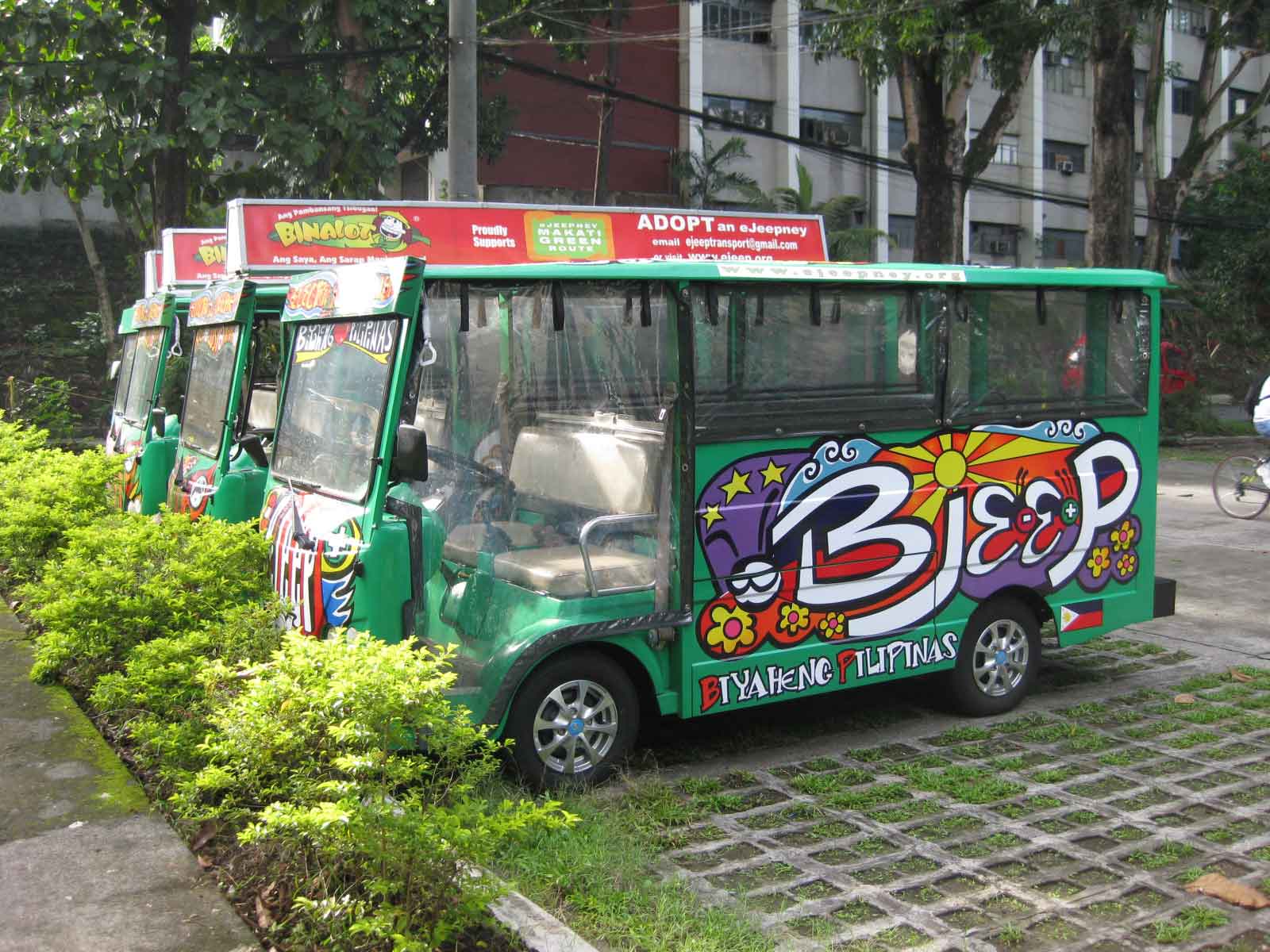 Electric jeepneys parked at UP Diliman – the Bjeep is the one used by Vice President Binay during the inaugurations
I reproduce below a news item from the GMA News website that features an initiative from the ADB that may finally push electric vehicles to gain a significant share of trips across the country:
The Asian Development Bank is offering as much as $280 million in loans for the Philippine government to finance a proposed re-fleeting program for tricycle drivers and operators shifting to electric motorbikes or e-bikes.
“The loan will be coursed through ADB conduit banks like Land Bank of the Philippines for re-lending to tricycle drivers who may want to shift into using e-bikes,” Environment Secretary Ramon Jesus Paje told reporters in a briefing Tuesday.
He said ADB will give 30 e-bikes as donation to city governments in the Metropolis.
“ADB wants to us to sample the bikes to see for ourselves that these machines are totally pollution-free. No emissions, less pollution,” he said.
If all Philippine tricycles are e-bikes, the country can save much as 20 million metric tons of carbon footprints a year.
“We could go into carbon trading. That will earn us dollar equivalent which we can use to offset a portion of the loan,” said Paje.
Tricycle drivers can save up to P300 in daily fuel costs with the use of e-bikes.
“Four hours of charging would only cost P40 compared to P340 for fossil-based fuels. The acquisition cost is about 20 to 30 percent higher than fuel-fired motorcycles but the overhead cost is certainly lower,” Paje said.
Of the total 5 million tricycles in the country, 2.8 million are in Manila.
The department said that the shift to e-bikes would reduce pollution 25 percent to 30 percent in the country’s urban centers by 2011.
As of 2009, the country’s total suspended particulates – a concentration of micro pollutants in the air – in all cities and urban centers is 134 micrograms per normal cubic meters, which is 48 percent beyond the normal standard of 90 micrograms per normal cubic meters.
The major sources of these particulates are diesel vehicles and coal-burning power plants. Dust from unpaved roads and construction activities contribute to the rise in particulates especially during summer months.
Vehicles contribute as much as 80 percent to air pollution, while the remaining 20 percent are from industries.
Department monitoring shows that more than 50 percent of vehicles are registered without prior actual testing by accredited Private Emission Testing Centers.
“If all vehicles are tested for emission prior to registration, the 30 percent reduction in particulates will be easily realized,” Paje said. —With MR Gavin/VS, GMANews.TV
The ADB initiative comes at a critical time when the national government is still finding its way with regards to local public transport modes, particularly how the tricycle has established itself as the primary (sometimes, the only) public transport option in cities and municipalities across the country. It is inevitable that the issue of proliferation and regulation of tricycles will have to be addressed. National and local government would have to discuss the nuances of the Local Government Code in as far as public transport operations, franchising and fare setting are concerned. On top of this, the time is critical also because there is a strong call for environmental sustainability; one that is anchored on the increasing awareness for climate change and its impacts. The long-standing perception is that the conventional tricycles contribute to the continuing degradation of our environment as the collective emissions from these vehicles effectively suffocate our cities, and the key is for local governments to realize this and be a major player in transforming local transport into the environment-friendly kind. It is, after all, in the best interests of their constituents that clean air be pursued to ensure that there will be a bright future for their cities and this country.
 Caught (up) in traffic