
Home » Research (Page 10)
Category Archives: Research
New publication on urban transport by ITDP and UC-Davis
There is a new publication on urban transportation from Institute for Transportation and Development Policy (ITDP) and the University of California-Davis. The link may be found here:
Three Revolutions in Urban Transportation

The content reminded me of similar exercise we did back in 2013-2014 for ASEAN where we did visioning and simulations for low carbon transport in the region by 2050. Electrification was a major assumption for the Philippine case as electric vehicles were gaining ground (they seem to be in a limbo now) back then and on the verge of a breakthrough. Not yet evident for the Philippines was the eventual rise of sharing, and though the idea is out there, automation seems to be too high tech for the country (even Metro Manila) for now.
–
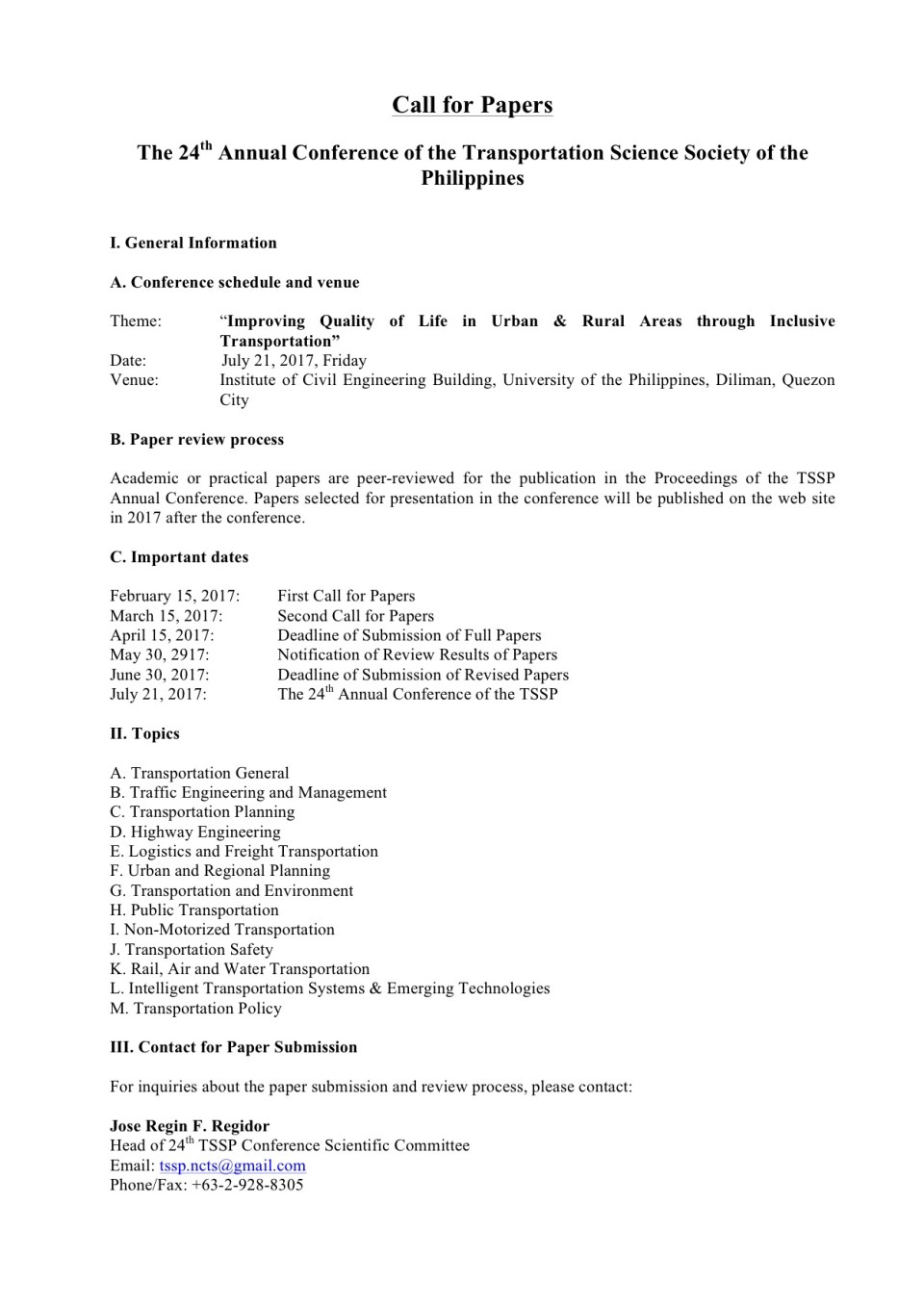
First call for papers for the TSSP 2017 conference
The first call for papers for the 24th Annual Conference of the Transportation Science Society of the Philippines came out last Wednesday, Feb. 15:
–
Research topics for transportation engineering and planning for 2016-2017?
I observed from my site’s statistics that there have been a lot of interest on research topics in transportation engineering and planning. I regularly post on the undergraduate research topics our students have engaged in. At this point in the first semester of the current 2016-2017 academic year, topics have not yet been assigned and we have only learned how many students have been assigned to our research group. As such, we are still in the process of determining who takes on which topic. Following are topics we have identified in addition to those that had no takers the previous semesters:
Traffic engineering
- Anatomy of congestion along EDSA
- Anatomy of congestion along C-5
- Segregated lane for motorcycles
- Impacts of the MMDA’s truck lane policy along C-5
- Congestion study in the vicinity of UP Town Center
- Assessment of through traffic for the UP Diliman campus
Public transportation
- Connectivity study for UP AGT and MRT 7
- Feasibility of bus services beyond Masinag junction
- Characterization of Internal Public Transportation Operation in UP Diliman and Viability of Introduction of Electric Vehicles
- Modelling the Public Transport System of UP Diliman Campus Using CUBE Travel Demand Software
- Estimation of Passenger Demand for New Transit System for UP Diliman Using Discrete Choice Model
- Characteristics of motorcycle taxis in the Philippines [Habal-habal, skylab, etc.]
Road safety
- Severity of injuries of motorcycle riders (helmet and non-helmet users)
Pedestrian & non-motorised transport
- A study on walkability along Ortigas Avenue
- A study on the characteristics of bike share users in the UP Diliman campus
Transport & Environment
- Assessment of Roadside Air Quality along C.P. Garcia Avenue in the Vicinity of UP-ICE Compound
Other topics
- Study on the mobility of PWDs in Metro Manila
- Assessment of ridesharing in the context of sustainable transport
I’m sure there are other topics but I’m not aware of the specifics at present. Also, we welcome the ideas of our students should they already have topics in mind as long as these preferably fall under the research agenda of our Institute. The topics listed above may appear to be specific but these are still basically very general and can be refined after the students establish their scope and limitations. They can only do that once they have undertaken a decent enough literature review for them also to have a more firm appreciation of their chosen topics. I will post again on this later this year when students would have already put in substantial work on their research proposals (i.e., the objective for this semester).
–
TSSP 23rd Annual Conference Proceedings
The 23rd Annual Conference of the Transportation Science Society of the Philippines (TSSP) was held at the University of the Philippines (UP) Diliman last August 8, 2016. It was hosted by the National Center for Transportation Studies (NCTS), which for some time was practically inactive in its dealings with the society. The conference was a very successful one with more than 170 participants, mostly students from the undergraduate programs of Mapua Institute of Technology (MIT), De La Salle University (DLSU) and UP Diliman.
The Proceedings of the 23rd Annual Conference contains 22 technical papers, which I have already listed in a previous post showing the technical program for the conference. The link is to the current website of the TSSP hosted by NCTS. Those wishing to have copies of the papers may download them directly from the link. Meanwhile, those interested in the presentations should contact the authors. Their contact information are stated in the paper and it is ethical to get the nod of the authors for their presentation file as these still fall under what can be defined as their intellectual property. I am aware of people who tend to get presentation slides and then pass them of as their work when they use the slides or the data/information therein. There are proper ways for citations of references and sources but sadly such ways are not observed by many.
–
TSSP 2016 Conference Program
I am sharing the banner and final program for the Transportation Science Society of the Philippines 23rd Annual Conference to be held on Monday, August 8, 2016. The final program features a Keynote Speech by the Undersecretary for Road Transport and Infrastructure Anneli R. Lontoc, a Panel Discussion on Road Safety, and technical sessions in the afternoon.


 –
–
Straddling bus prototype?
What was peddled as a unique public transport mode concept in social media is now a reality. Check out the article and video here:
China’s Futuristic Straddling Bus Is Finally Here
This is a welcome development for public transportation. However, some issues need to be addressed, particularly regarding road safety. Motorists traveling under the straddling bus may have reactions to the vehicle as it passes above them and such may lead to road crashes. Of course, with the advent of driverless vehicles such incidents may be minimised if not altogether eliminated.
–
TSSP 2016 Conference: Tentative Program
I am sharing below the tentative program for the 23rd Annual Conference of the Transportation Science Society of the Philippines (TSSP):

Soon, I will post on the list of papers to be presented for the Technical Sessions to be held in the afternoon part of the one-day conference.
–
TSSP 2016 Conference – August 8, 2016
I start August with an announcement, promoting the 23rd Annual Conference of the Transportation Science Society of the Philippines (TSSP). The theme of this year’s conference is “What Gets Measured, Gets Managed: Transportation, Data and Statistics.” The conference will have a panel discussion in the morning and parallel technical sessions in the afternoon.

The topic for the panel discussion is “Road Safety Data: Issues, Challenges and Opportunities”. Confirmed are resource persons from the Department of Transportation, the Department of Public Works and Highways, and the Global Road Safety Partnership Philippines. The session will feature presentations and reactions on agency or organization initiatives on road safety with emphasis on road safety data. An open forum will immediately follow for the audience to be able to participate in the discussions.
The afternoon will feature 4 parallel technical sessions where selected papers will be presented. These would be the output of researches from leading universities including the University of the Philippines, De La Salle University and Mapua Institute of Technology. I will post on the paper titles as soon as I get a copy of the program.
The one-day conference will be held at the National Center for Transportation Studies at the University of the Philippines in Diliman, Quezon City.
–
Progress in promoting and realizing sustainable transport in the Philippines
There is a very good article that came out of Rappler last March 28, 2016:
Creating sustainable transport systems: PH’s progress so far
The article caught my attention as I have lost track of what should be the monitoring of sustainable transport initiatives anchored on the pillars of EST as described in the National EST Strategy and the article. The formulation of the national EST strategy started under the administration of President Gloria Macapagal-Arroyo (DOTC Secretary Leandro Mendoza) and was completed under President Benigno C. Aquino III (DOTC Secretary Jose Dela Cruz). The formulation was initiated and supported by the United Nations Centre for Regional Development (UNCRD) and is unique partly because it is the only one to be completed among similar projects across ASEAN. The other countries like Indonesia, Vietnam and Cambodia were only able to get to the baseline and consultations stages of their own national EST strategy formulations. The Philippines National EST Strategy document eventually became an input for the formulation of the National Transport Policy Framework (supported by AusAID) as well as the National Transport Infrastructure Framework (supported by the WB).
–
Undergraduate research topics on transportation for Academic Year 2015-2016
Our students at the University of the Philippines Diliman are currently making their final presentations for the research topic proposals to be implemented in the next second semester (January to May 2016). The first semester (August to December 2015) focused on research topic formulation including problem identification and formulation, review of related literature, and development of methodologies for data collection and analysis. Here are the topics of our students in transportation engineering and planning (not in any order):
- Economic Feasibility of Electric Tricycles as Shuttle-Type Transport Service in Medium Density Residential Areas with Linear-Type Local Road
- A Study on Road Public Transport Policies and Planning in Metropolitan Manila: 1970s to the Present
- Comparative Study of GrabTaxi and Regular Taxi within Metro Manila
- Comparative Study of Uber and Regular Taxi
- An Analysis of Road User Behavior Influence on Unsignalized Intersection Performance
- An Assessment of Cycling and Bicycle Lanes along Marcos Highway
- Energy Efficiency of Electric Jeepneys
- Application of Discrete Choice Modeling in UP Diliman
- Development of Vissim Traffic Simulation Model of UP Diliman (Focus on Vehicle Characteristics)
- Evaluation of Runway Design and Capacity of Ninoy Aquino International Airport (MNL)
- Determination of Satellite Parking Locations and Capacities in the University of the Philippines Diliman Campus
- Critical Review of Practices Abroad Towards Identifying Pavement Performance Indicators in the Philippines
- A Study on the Suitability of Tricycles as an Urban Transport Mode in the Philippines
- Benefit Monitoring and Evaluation of the South Metro Manila Skyway Project (Stages 1 and 2)
- Predicting Student Trip Patterns Using Enrolment Data within UP Diliman
- Video Image Processing for Parking Management
- Analysis of Occupancy and Dwell Time of Buses in EDSA
- Development of Public Transport Information System in UP-Diliman
- Philippine Air Transport Safety: Analysis of Incidents over the Last Two Decades
- Evaluation of Transfer Facilities for Public Transportation in Metro Manila
- Survey of Maintenance Practices for Concrete Structures in Transportation Facilities
- Road Safety Audit Evaluation of Expressways
- Calibrating MOBIL Lane Changing Model for Local Traffic Micro- Simulators
- Development of VISSIM Traffic Simulation Model of UP Diliman
Again, note that there are many topics here that have as a study area the UP Diliman campus. These are part of the studies the Institute of Civil Engineering and the National Center for Transportation Studies are conducting to address transportation issues in the campus, which is an open campus with public roads.
 Caught (up) in traffic