
Home » Research (Page 10)
Category Archives: Research
A new transport planning process?
December’s already “Chrismassy” in our part of the world and so in keeping with the spirit of Christmas, here is another article I am sharing:
Polzin, S. (2017) “All I Want for Christmas is a New Transport Planning Process,” Planetizen.com, https://www.planetizen.com/node/96036?utm_source=newswire&utm_medium=email&utm_campaign=news-12042017&mc_cid=e64f0c0c60&mc_eid=9ccfe464b1 (Last accessed: 12/6/2017)
In school, we’ve been taught and are still teaching many of the old concepts of transportation planning. I believe these are still important and relevant especially since the fundamentals, or the basics if I may say, are still needed in many situations around the country (i.e., the Philippines). The article above is relevant to our case because it helps build awareness of what is now being discussed and what the future will bring to us. That future for transport is not necessarily immediate although there are already pressures coming from various sectors and technology has been key to the disruptions and the leapfrogging we are experiencing. I like what a friend opines overtime he gets the chance. That is, that the technology-push is not the solution to a lot of our problems because we cannot ignore the basic deficiencies in our transportation system that technology alone cannot overcome.
–
Recommended reading: “A New Traffic Safety Paradigm”
I begin December by sharing another paper from the highly respected Todd Litman:
Litman, T. (2017) “A New Traffic Safety Paradigm,” Victoria Transport Policy Institute, http://www.vtpi.org/ntsp.pdf (Last accessed: 12/2/2017).
I believe that this should be recommended reading for those doing work traffic safety.
–
Some recommended references for sustainable transportation design
We conclude the month of October with the following recommended readings:
- Designing Walkable Urban Thoroughfares: A Context Sensitive Approach, An ITE Recommended Practice, 2010
- Model Design Manual for Living Streets, 2011
- Smart Transportation Guidebook, Planning and Designing Highways and Streets that Support Sustainable and Livable Communities, 2008
While these are guidelines and manuals developed and published in the United States, the principles and much of the content and context are very much applicable here.
As an additional reference, here is the latest version of functional classifications for streets that is supposed to be context-sensitive:
- Stamatiadis, N., A. Kirk, D. Hartman, J. Jasper, S. Wright, M. King, and R. Chellman. 2017. An Expanded Functional Classification System for Highways and Streets. Pre- publication draft of NCHRP Research Report 855. Transportation Research Board, Washington, D.C.
–
New study on ride-hailing
Here’s a nice article that has a link to a study conducted at the University of California-Davis written by one of the authors of the study:
Clewlow, R.R. (2017) “New Research on How Ride-Hailing Impacts Travel Behavior” in Planetizen, October 11, 2017.
And here’s an article about that same study:
Bliss, L. (2017) “The Ride-Hailing Effect: More Cars, More Trips, More Miles ” in Citylab, October 12, 2017.
As usual, I am posting this for reference not just for my readers but for myself and my students who are currently doing research on ridesharing/ride-hailing in the Philippines.
–
EASTS 2017 Conference in Ho Chi Minh City, Vietnam
The 12th International Conference of the Eastern Asia Society for Transportation Studies (EASTS) will be held in Ho Chi Minh City, Vietnam from September 18-21, 2017. The conference promises to be an improvement from the 11th conference held in Cebu City, Philippines two years ago. That conference was not as well attended as past conferences and the arrangements were quite shaky considering a lot of supposed commitments for sponsorships backed out during the critical stages of the organization. That included the host city and the transport department (the then Department of Transportation and Communications or DOTC), both of which promised so much when the conference was proposed but somewhat disappeared when the going got tough. EASTS 2017 should exorcise that memory and perhaps the Philippines can host another conference in the future to make amends for Cebu.
Here’s a link to the local organizing committee’s conference site for the details on the EASTS 2017 conference:
12th International Conference of the Eastern Asia Society for Transportation Studies (EASTS 2017)
–
Topics for transportation research
I notice that I have been getting a lot of traffic on my site lately from people searching about research topics. I guess its that time of year when students (undergraduate, graduate, post-graduate) are looking for topics. I have written before that it seems to me that many schools don’t really provide much guidance to students in their topic selection for their undergraduate research, masters thesis and even doctoral dissertations. I have received and seen emails from students from other schools asking if I or one of my colleagues at the university can be their research advisers. We usually politely decline so as we also have our own students to advise and researches to undertake. While I believe we should encourage research on transportation topics, I would dare say that schools should be responsible enough to build capacity for their faculty to be able to effectively guide their students and not unfairly pass them on to others.
Here are some topics that I think are quite relevant at present:
- Anything that’s about ride sharing (i.e., Uber, Grab, etc.) and particularly on passengers’ and drivers’ characteristics.
- Carpooling as applied in offices, schools, communities. There’s an app that promotes this – Wunder.
- Motorcycle taxis – this includes habal-habal, Skylab and other variations both in the urban and rural setting. What are their characteristics? Passengers? Drivers?
- Complete streets – how can we apply its principles to our cities, towns, communities, even specific roads?
- Road safety – this genre covers a lot of topics including pedestrian safety, motorcycle safety, public transport safety, child safety, driver behavior, safe road designs, etc.
- Transportation costs/expenditures – characteristics of commuting and commuters in relation to the modes they take as well as the distances between their homes and workplaces or schools.
I believe there are a lot of topics that can be developed from the above. But perhaps schools can first formulate research agendas first and not attempt to snipe at every and all topics that come to mind.
Good luck on topic selection and here’s hoping your outcomes are useful to improve transport and traffic in the Philippines.
–
TSSP 2017 Conference
The Transportation Science Society of the Philippines (TSSP) holds its 24th Annual Conference tomorrow, July 21, 2017. It will be held at the National Center for Transportation Studies at the University of the Philippines Diliman, Quezon City. More than a hundred participants are expected to attend this 1-day affair.
The final program for the conference may be found in the following link:
http://ncts.upd.edu.ph/tssp/index.php/2017/07/17/tssp-conference-program/
The theme for this year’s conference is “Improving Quality of Life in Urban and Rural Areas Through Inclusive Transportation.” This is also the theme for the panel discussion in the morning. The afternoon will feature four parallel technical sessions where 18 papers will be presented.
The keynote lecture will be delivered at the start of the conference by Prof. Tetsuo Yai of the Tokyo Institute of Technology, who is also the current President of the Eastern Asia Society for Transportation Studies (EASTS) under whose umbrella the TSSP is part of. TSSP is a founding member of EASTS and actually preceded EASTS by a year.
–
Challenges for students commuting to/from schools
Its our first day of school for our daughter today. But unlike her, I recall that I had to wake up early when I was in grade school and high school because the ‘service’ providing transport to and from school had to pick me up and then others. That usually meant a 5:30 AM wake up, a quick shower, dress-up (we wore uniforms) and breakfast before the ‘service’, an AUV, picked me up at home. School started at 7:30 AM and it took something like 45 minutes (depending on traffic) from our last pick-up to get to school at exactly 7:30. If our vehicle is able to finish pick-ups earlier, that meant we were assured of not being late for homeroom period. If the other kids (and there are many) are running late and we end up waiting longer for each, then we would likely be late. In many cases, our driver would have to resort to being reckless in order to make the time.
Nowadays, I think its much more difficult for kids due to the worsening traffic congestion. What was a 30 to 45-minute travel time between our home in Cainta to Pasig/Mandaluyong is now easily twice or longer that. And I am only referring to a direct trip. Even with Waze available, one can only have few options for routes between home and school.
While there are still many school ‘service’ vehicles (and not so many actually buses), many parents seem to have opted to Ateneo, for example, used to have a fleet of buses transporting students. These were replaced by AUVs and vans accredited by the school, and the many (too many?) private vehicles ferrying mostly individual students to and from their Quezon City campus.
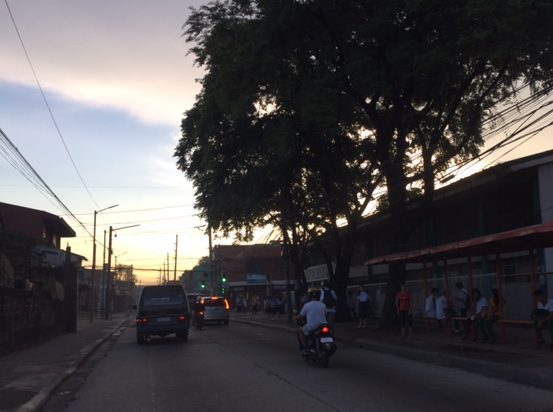 School children have to wake up early to go to school. Some probably take their breakfasts as baon in order to save time for traveling. Some take their breakfasts at nearby eateries or fast-food restaurants.
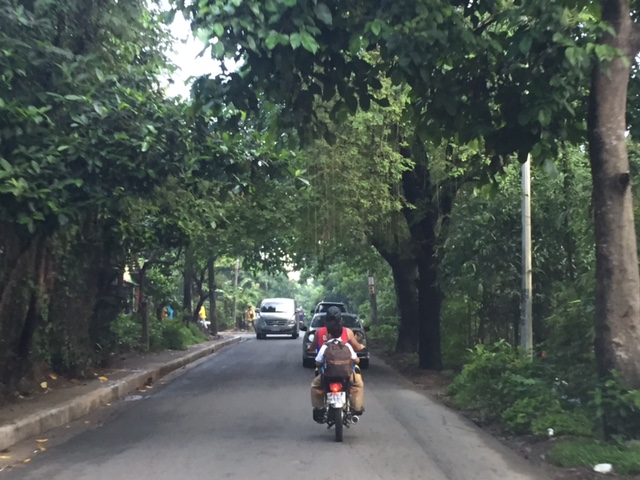 Many children may be at risk as they are ferried to school via motorcycles and usually without helmets. In other cases, there are tricycles acting as school service vehicles. Often these are overloaded with children and their school bags.
Pedestrian facilities are also lacking in many cases and particularly in rural areas where public schools are located along highways that have no sidewalks or cities where pedestrian walkways are not built to standards for one reason or another. These are issues that need to be addressed and would be nice topics for research, especially those with practical and safety applications.
–
New publication on urban transport by ITDP and UC-Davis
There is a new publication on urban transportation from Institute for Transportation and Development Policy (ITDP) and the University of California-Davis. The link may be found here:
Three Revolutions in Urban Transportation

The content reminded me of similar exercise we did back in 2013-2014 for ASEAN where we did visioning and simulations for low carbon transport in the region by 2050. Electrification was a major assumption for the Philippine case as electric vehicles were gaining ground (they seem to be in a limbo now) back then and on the verge of a breakthrough. Not yet evident for the Philippines was the eventual rise of sharing, and though the idea is out there, automation seems to be too high tech for the country (even Metro Manila) for now.
–
First call for papers for the TSSP 2017 conference
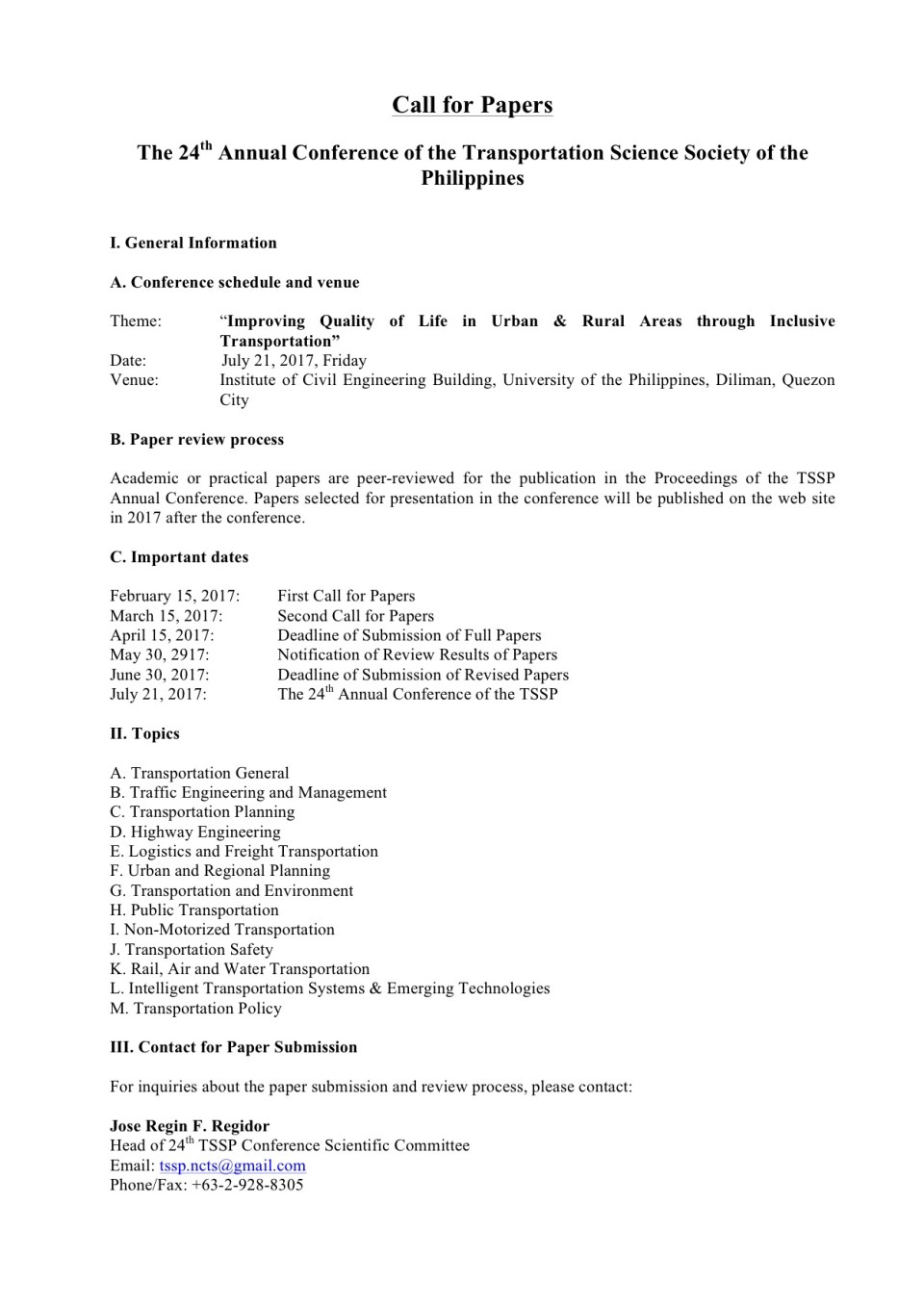
The first call for papers for the 24th Annual Conference of the Transportation Science Society of the Philippines came out last Wednesday, Feb. 15:
–

