
Home » Research (Page 11)
Category Archives: Research
Working with big data on transportation
There have been a few initiatives working on big data from government agencies whose responsibilities are primarily on transportation. Among them are past projects implemented by the University of the Philippines Diliman (UPD) and current projects being implemented by UPD, Ateneo de Manila University (ADMU) and De La Salle University (DLSU) with support from the Department of Science and Technology (DOST). While these projects are more oriented towards some specific objectives often linked to research & development (mandates of DOST and these academic institutions), there are still a lot of data out there that needs to be digitized, processed and analyzed. UPD has done this to some extent through its National Center for Transportation Studies (NCTS), which had been a repository for data and reports from DOTC and DPWH. However, the center does not have a funded program to undertake that repository or archival function it is expected to do. Despite much lip service from DOTC, DPWH and NEDA, no support has been extend by these agencies in the past many years.
I recently came upon this excellent work from a private firm specializing in data science. Here’s a link to one of their recent ‘stories’ showing us relevant statistics on road safety in Metro Manila:
http://stories.thinkingmachin.es/road-danger-pedestrians/
Their website says the data set the stats and graphs are based from are from the Metropolitan Manila Development Authority (MMDA), which maintains the Metro Manila Accident Reporting and Analysis System (MMARAS). This is good work and something road safety experts can use to be able to come up with programs and projects to improve safety in Metro Manila. I hope they could also get a hand of the DPWH’s Traffic Accident Reporting and Analysis System (TARAS) data that covers national roads. Unfortunately, the DPWH has stopped encoding TARAS data recently (the PNP still collects data though) so I am not sure how recent their data set is.
We need more of such work on a lot of data our agencies are producing including data from the Land Transportation Office (LTO) and the Land Transportation Franchising and Regulatory Board (LTFRB). Such information could be used to understand our transport systems including determining how to optimise supply and demand when combined with other data sets such as geographical information systems (GIS) and socio-economic data from the census.
–
Looking back at EST social marketing
With all that are happening today that are related to sustainable transport, I tend to pause and look back with a smile on how it was more many years ago when we were struggling to promote environmentally sustainable transport (EST). At that time, most local government units were not yet into sustainable transport and were unaware of the principles. There were a few who already had a project or program in place but didn’t know that these were classified as EST.
CAPACITY-BUILDING AND SOCIAL MARKETING FOR ENVIRONMENTALLY SUSTAINABLE TRANSPORT
Under the project, we identified several local good practice examples for EST and invited representatives of those LGUs to spread the word to other LGUs. Those who regularly went with us to promote EST were representatives of the Marikina City Bikeways Office, and San Fernando, La Union’s City Planning Office who shared their experiences in phasing out 2-stroke motorcycle-run tricycles.
I recall that one major Visayan city wasn’t so receptive at the time as the City Planning Coordinator seemed more interested in international trainings and foreign assisted projects than the city actually developing sustainable programs and projects on its own. The irony now is that despite his being not so excited about sustainable transport that city now has good examples for EST including a bicycle corridor and pedestrian and bike-friendly riverside developments.
But there was the case of the very receptive and progressive City Planning Coordinator of another major Visayan city who helped us immensely in promoting EST. His eagerness, particularly for public transport options, paved the way for Bus Rapid Transit (BRT) to gain a foothold in the discussions paving the way for more efficient transit systems to be considered (and now planned and designed) for his city. That interest led to his city getting the attention of an international agency that brought in then former mayor and now the recently re-elected Mayor of Bogota, Colombia, Enrique Penalosa, to do talks about his city’s Trans Milenio BRT system. I remember a couple of visits of Mr. Penalosa including a series of dinner meetings sponsored by the private sector in Makati City who were interested in the Bogota’s transport success story.
We always wondered who, when and how EST would be advocated by others and particularly by a younger generation who would turn out to be more outspoken and aggressive in promoting EST. These include those calling for better public transport systems, those advocating for pedestrian and bicycle facilities, those pushing for safer roads, and those lobbying for clean air. With all that we are seeing now around us (Congratulations Firefly Brigade for a very successful Tour of the Fireflies last Sunday!) and on various media platforms, I strongly believe that we are on the right path towards achieving better quality, sustainable and equitable transport for everyone.
–
Local papers presented at the EASTS 2015 conference – Xavier University
I almost forgot to post this article showing the technical papers coming out of Xavier University. Following is the list of papers from Xavier University. Xavier University is basically Ateneo de Cagayan De Oro and is a leading institution in Northern Mindanao in the southern part of the Philippines.
- Sustainable Paratransit: Best Practice Cases in Europe and the Philippines [Martin Smoliner & Anabel Abuzo]
- On-street Parking Evaluation Divisoria, Cagayan De Oro City [David Jorey Alfaro, Francis Camomot, Allison Cyril Escalante, Hipolito Bair & Anabel Abuzo]
- Pavement Distress Evaluation Using Pavement Condition Index around Agora Market, Barangay Lapasan, Cagayan de Oro City [Risa Gwen Martinez & Anabel Abuzo]
- An Analysis of Pedestrian Traffic Safety in Public School Zones in Cagayan de Oro City [Jefferson Vallente Jr., Ferven Cabugao & Anabel Abuzo]
- Agent-Based Mobility Simulation Model for Disaster Response Vehicles [Elvira Yaneza, Gerardo Doroja & Anabel Abuzo]
- A Traffic Congestion Study of Non-signalized Intersections along Yacapin-Capt. Vicente Roa, Yacapin-Osmena, J.R. Borja-Capt. Vicente Roa and J.R. Borja-Osmeña Streets in Cagayan de Oro City [Jude Añana, Kevin Calma, Carlo Flores, Dennis Tantoy & Anabele Abuzo]
Many of the papers are on local problems and very specific to certain streets or areas in Cagayan de Oro City with the exception of the first one in the list, which is on a comparative study of transport in the Philippines and in Europe. Transportation research in Xavier University basically is conducted through its Civil Engineering Department via Dr Anabele Abuzo who obtained her MSCE degree from the University of the Philippines Diliman and her doctorate from the Tokyo Institute of Technology.
–
Local papers presented at the EASTS 2015 conference – Mapua Institute of Technology
Mapua Institute of Technology (MIT) has a relatively young program under its School of Civil Engineering. This is led by their Dean, Dr Francis Aldrine Uy, who is also active with the Philippine Institute of Civil Engineers (PICE). Mapua has been aggressive the recent years in presenting and publishing papers in transportation engineering and planning. Following are the papers from the MIT:
- Integrated Non-Motorized Transportation System For A Sustainability Oriented Intramuros [Francis Aldrine Uy]
- A Study on the Effectiveness of Eco-Mobility Component: E-Jeepneys in Makati City [Francis Aldrine Uy]
- Comparative Study of the Effects of Fuel Sources (Diesel, Gasoline and Autogas) in Public Transportation in Metro Manila on Price, Emission and Health Issues [Francis Aldrine Uy]
- Determinants of Demands of Pasig River Ferry Service [Francis Aldrine Uy]
- Determination of Cost Impact using Mathematical Model Comprising City Logistics to Quick Service Restaurants in Metro Manila [Francis Aldrine Uy]
- Development of Evacuation Plan by Utilizing Transportation Modeling in the City of Borongan, Eastern Samar [Riches Bacero]
- Operational Performance Analysis of Median U-Turn Intersections as Traffic Control Facility in EDSA [Riches Bacero]
- Community Perception on Trans-operability of Intramuros [Riches Bacero]
- Paradigm Shift Strategy of Inclusive Mobility: The Applicability of Bus Rapid Transit along Commonwealth Avenue [Riches Bacero]
- Evaluation of Strontium Aluminate in Traffic Paint Pavement Marking for Rural and Unilluminated Roads [Riches Bacero]
- Study on the Impact of the Construction Activity of Skyway Stage 3 on Traffic Conditions along Osmeña Highway and San Andres Street [Geoffrey Cueto]
- A Design for Silver Star Integrated Green Bus Terminal [Geoffrey Cueto]
- Proposed Diversion Road to Improve Traffic Movement of Commercially Developed Areas in Bacoor, Cavite [Geoffrey Cueto]
- Establishing the City Logistic Concept in Improving the Freight Distribution in Metro Manila [Geoffrey Cueto]
- An Analysis on the Accessibility Level of Public Transit for Persons with Disability: In care of Light Rail Transit (LRT 1) [Geoffrey Cueto]
- Design and Development of the Puerto Princesa Airport Passenger Terminal [Jocelyn Buluran]
- Design and Development of Passenger Terminal at Batangas Port [Jocelyn Buluran]
- Design and Development of Passenger Terminal Extension of Clark International Airport [Jocelyn Buluran]
- Determinants of “Travel with Dignity” of Passengers of MRT3 [Jocelyn Buluran]
- Integrating Sustainable Non – Motorized Public Transport in the City of Manila, Philippines Through Analytic Hierarchy Process (AHP) [Jocelyn Buluran]
My only comment about certain papers in the list is that many do not seem to be research papers and definitely more on the practice (i.e., design) side than the academic. I can say this based on the presentations made that I was able to attend as well as the papers themselves in the proceedings of the conference that I was able to browse. Still, Mapua has very good potential to come up with good papers from the prolific Dr Uy and his young faculty members led by Engr. Riches Bacero.
The current President of Mapua, Dr Reynaldo Vea, is also the current President of the Transportation Science Society of the Philippines (TSSP). Dr Vea was formerly Dean of UP Diliman’s College of Engineering and Officer-in-charge of UP’s National Center for Transportation Studies (NCTS). His specialty is on maritime transport as he has a degree in naval architecture.
–
Local papers presented at the EASTS 2015 conference – University of the Philippines
There were a lot of technical papers from Philippine universities that were presented in the recently concluded 11th International Conference of the Eastern Asia Society for Transportation Studies (EASTS 2015). In the interest of dissemination, I will be featuring a list of papers produced by leading universities in the Philippines that are doing studies on transportation. Following is a list of papers from University of the Philippines Diliman that were presented at the EASTS 2015 held in Cebu City last Sept. 11-13, 2015:
- Innovative Collection of Road and Traffic Data for Road Safety Audit (Aileen Mappala & Ricardo Sigua)
- Study on Safety of Railway/Highway Grade Crossings in the Philippines (Albie Clarito, Beverly May Ramos & Ricardo Sigua)
- Instantaneous Fuel Consumption Models of Light Duty Vehicles and a Case Study on the Fuel Consumption at Different Traffic Conditions in Metro Manila using Shepard’s Interpolation Method (Ernesto Abaya, Karl Vergel, Ricardo Sigua, Edwin Quiros & Jose Bienvenido Biona)
- Development of Drive Cycles and Measurement of Fuel Economies of Light Duty Vehicles in Metro Manila (Ernesto Abaya, Karl Vergel, Ricardo Sigua & Edwin Quiros)
- Selection of Metro Manila BRT Corridors Using Multi- Criteria Assessment (Ricardo Sigua & Cresencio Montalbo, Jr.)
- An Assessment of Walkability in a Medium-Sized Philippine City (Hilario Sean Palmiano, Sheila Flor Javier & Jose Regin Regidor)
- Traffic Noise Measurement, Perception, and Modelling in a University Campus (Hilario Sean Palmiano, John Carlo Villar & Michelle Monelle Quilatan)
- Assessment of Metro Manila Bus Fare Computation (Sylvia Chavez & Hilario Sean Palmiano)
- Estimating Road Roughness Conditions Using Ubiquitous Smartphones and Geographic Information Systems and its Application to Road Network Planning in the Philippines (Joel Cruz & Jun Castro)
- Fuel Economy and Public Utility Jeepneys Using 2% and 5% Coco-Metyl Ester (CME)-Diesel Blends (Edwin Quiros & Karl Vergel)
- Comparison of Fuel Economy of Fuel and Operating Characteristics of Diesel and Auto-LPG Jeepneys through On-Road and Vehicle Tests (Edwin Quiros, Karl Vergel, Ernesto Abaya, Ervin Santos & Jose Gabriel Mercado)
- Challenges of Urban Transport Development in Metro Manila: A look back at the last 40 years (Maria Sheilah Napalang & Jose Regin Regidor)
- An Assessment of the Public Necessity Concept for Estimating the Requirements for Public Transport Vehicle (Arnel Manresa, Karl Vergel & Jose Regin Regidor)
- State of Pavement Engineering in the Philippines and Implications on the Economic Life of National Roads (Maria Sheilah Napalang, Jose Regin Regidor & Nathaniel Diola)
- Planning Metro Manila’s Mass Transit System (Ricardo Jose, Daniel Mabazza, Jose Regin Regidor, Marco Stefan Lagman & Jonathan Villasper)
- Evaluation of Compliance of Dimensions and Selected Systems and Components of Customized Local Road Vehicles (CLRV) with Vehicle Regulations and Standards (Karl Vergel, Rachel Habana, Nonilo Peña, Loreto Carasi, Albert Mariño & Alorna Abao)
- An O-D Approach of Estimating Energy Demand and CO2 Emission for the Luzon Road Transport using Inter- Regional Passenger and Freight Flow Data (Marloe Sundo & Karl Vergel)
- Dignity of Travel: BRT Development in the Philippines (Cresencio Montalbo Jr & Colin Brader)
- Mending a Metropolis – Understanding Passenger Demand Across Metro Manila To Improve Road Transit (Nicholas Greaves & Cresencio Montalbo Jr)
- Accident Hotspot Mapping in Quezon City: The case of Katipunan Avenue (Jerome Ballarta, Nelson Doroy, Ishtar Padao & Cecil Villanueva)
Not included in the list are papers coming out of International Research Groups (IRG) as well as those where involvement by UP faculty were incidental to projects. Many of these papers will soon be posted on the official site of the International Scientific Committee of EASTS as part of either Proceedings or Journal of EASTS. Some may be nominated for the Asian Transport Journal (ATS), which is also published by EASTS.
Transportation research in UP Diliman is the most developed among schools doing research on these topics in the country. Papers came from a variety of disciplines and academic units including Civil Engineering, Mechanical Engineering, Urban Planning, Geography and History. These mostly were and are undertaken through the National Center for Transportation Studies (NCTS), which is with UP Diliman.
Next up: De La Salle University
–
EASTS 2015 – Cebu City, September 11-13, 2015
The 11th International Conference of the Eastern Asia Society for Transportation Studies (EASTS 2015) will be held in Cebu City this September 11-13, 2015. For information on the conference and program, check out their website here:
You can also download a brochure about EASTS here:
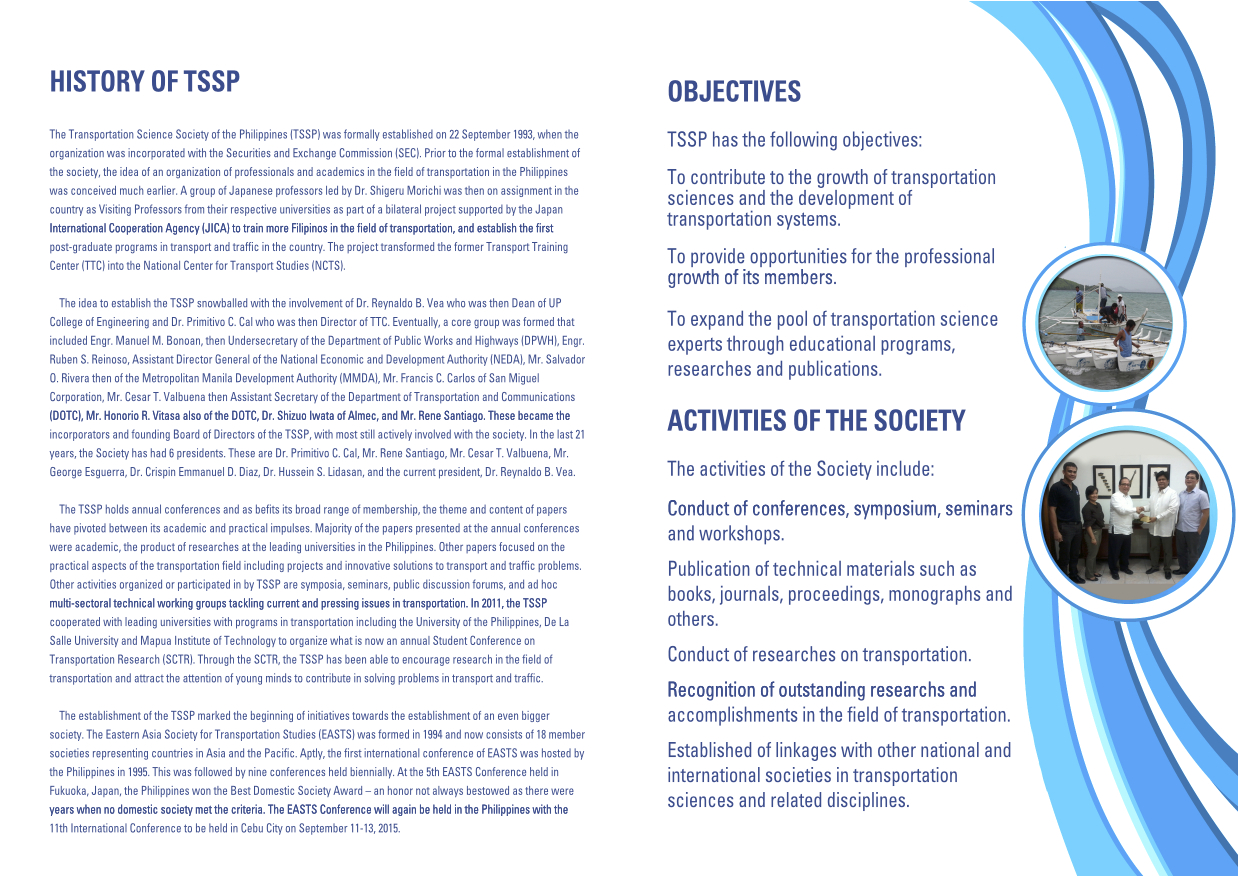
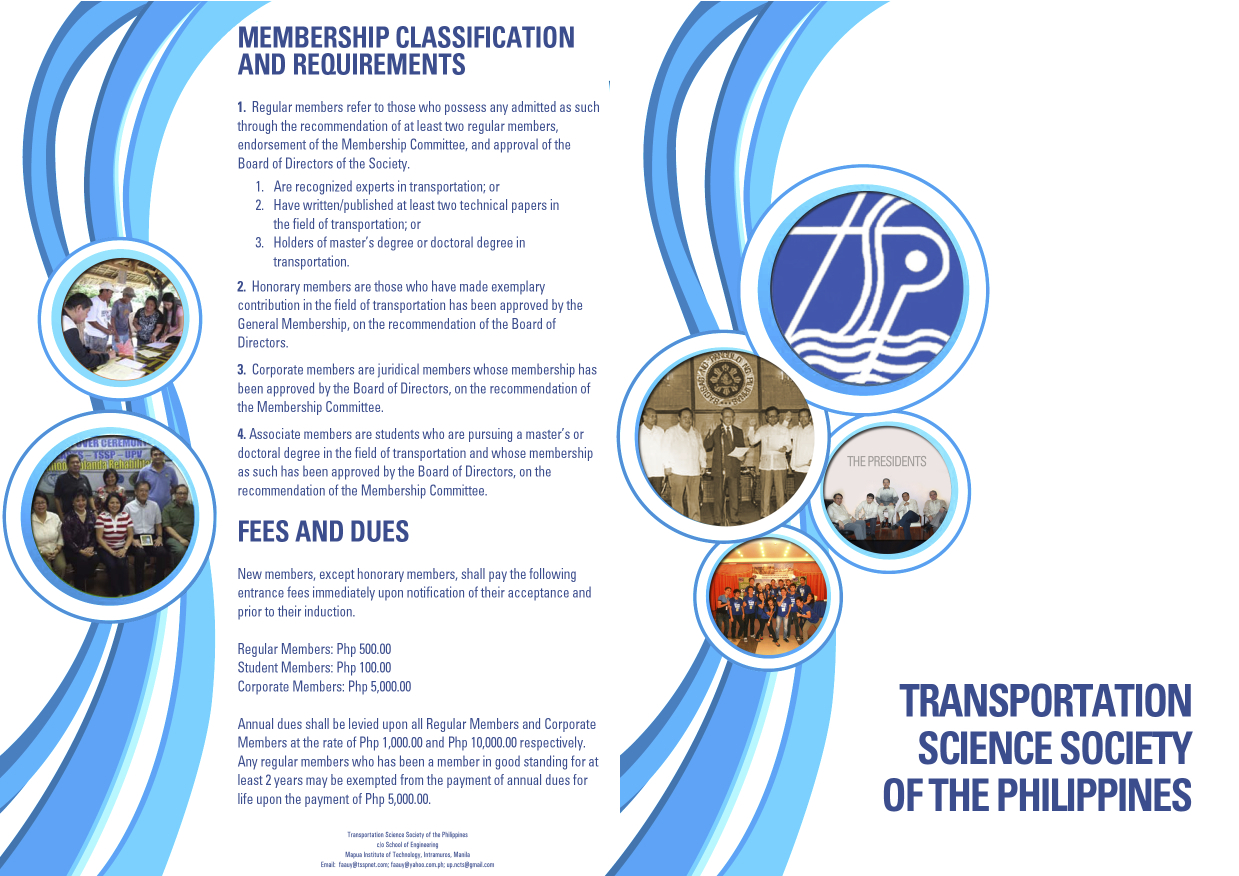
The conference is hosted by the Transportation Science Society of the Philippines (TSSP), which is the local affiliate of the EASTS. More information on the TSSP are found below:
–
2015 National Science and Technology Week and the Hybrid Road Train
The Philippines’ Department of Science and Technology National Science and Technology Week 2015 on July 24-28, 9am-6pm, SMX Convention Center, Mall of Asia, Pasay City. NSTW 2015 has 9,300 square meters showcasing 145 technologies, 51 forum sessions, 11 technology demonstrations, 25 other S&T events, 1 road train. Admission is free. Details at National Science and Technology Week  A special feature this week is the Hybrid Electric Road Train developed by the Metals Industry Research and Development Center (MIRDC) with 5 coaches and capacity of 240 passengers. You can find a description of the road train project in the MIRDC’s site from this link. Here’s a screen grab from the same site/link showing what the road train looks like:

Incidentally, the MIRDC is also the DOST center in-charge of development of Automated Guideway Transit (AGT) vehicles currently being tested in the University of the Philippines Diliman and the MIRDC Compound in Bicutan. Free rides are scheduled on July 24 12nn-4pm; July 25-28, 10am-12nn, 2-4 pm. The road train is envisioned to provide for mass transit needs of cities particularly those with long stretches of major roads like EDSA or C5 in Metro Manila.
–
Transport research agenda
As promised, I am posting our research agenda from the last academic year. This has been revised every year since we established our undergraduate research program more than a decade ago. Back then, the document had been informal in the sense that it was not an official document that was submitted to the university for approval. Over the years, the agenda had been developed alongside that of the National Center for Transportation Studies and has evolved according to the current issues and concerns (including trending topics) in transportation.
A. Traffic Flow Theory and Analysis, and Traffic Engineering
1. Evaluation of Intersection Performance Considering Pedestrian Movement
2. Car-Following and Lane-Changing Models for Local Traffic Micro-simulators
3. Optimization of Traffic Signal Settings
4. Highway and Intersection Capacity and Level of Service
B. Highway Engineering
1. Local Pavement Design Practice
2. Coordination of Horizontal and Vertical Alignments
C. Intelligent Transport Systems (ITS)
1. Advanced Traveller Information and Navigation
2. Advanced Public Transportation and Travel Information
3. Microscopic Traffic Simulation Modelling
4. Advanced Parking Management
5. Integrated Fare Collection for Public Transport
6. Probe Car System for Road Safety and Travel Time Assessment
7. Development of Devices/Sensors for In-Vehicle Air Quality Measurement
8. ITS Support for PWDs, Senior Citizens and Women
9. Smart City and PUV Connectivity for Fully Automated Driving: Internet of Vehicles (IoV)
10. Advanced Traffic Data Collection Tools and Methods
D. Transport Safety
1. Road Safety Audit
2. Road Crash Data Analysis and Management System
3. Road-Based Public Transport Safety
4. Philippine Air Transport Safety
5. Philippine Maritime Safety
6. Safety and Comfort Assessment of Public Utility Vehicles
7. Safety Assessment of Buses Equipped with GPS
E. Public Transport
1. Indigenous Modes of Transport
2. Public Transport Operation and Management
3. Public Transport Station/Stop and Terminals
4. Assessment of Mass Transport Options (e.g. BRT, AGT, AFV)
5. Multi-Modal Transfer Stations in Urban Areas
F. Mobility Management
1. Parking Management Systems
2. Traffic Calming
3. Bikeways Planning and Management
4. Pedestrian Facilities and Walkability
5. Assessment of Freight Vehicle Restraint Schemes
G. Transportation, Environment, Energy and Vehicle Technologies
1. Fuel and Energy Efficiency of Alternative Fuel Vehicles for Public Transport
2. Roadside Air Quality Assessment and Modelling
3. Roadside and Airport Noise Modelling
4. Utilization and Customization of GHG Emissions Estimation Tools for Assessment of Avoid-Shift-Improve Policies and Transport Infrastructure Projects
5. Customized Local Road Vehicles for Public Transport (jeepneys and tricycles)
6. Transport Energy Demand
Note from the above agenda that there are few items that are very specific. The above are not working titles for researches but very general topics that can be the basis for formulating specific topics for each student/group that will be working on that topic. Not indicated in the agenda are information on which faculty members are assigned to each topic. Faculty members have various specializations and have contributed items to the agenda. Students choosing a particular topic will be assigned to the faculty member who will be guiding the students towards proposal formulation and eventually, research implementation.
–
Research topics on transport and traffic in the Philippines?
I noticed that this site has received a lot of hits for inquiries regarding undergraduate research topics. While we at UP have yet to start our first semester of the academic year 2015-2016, other schools have already started their semesters, trimesters or quarterms. I suspect students in their final or graduating year would be looking for topics for their research projects or, what some schools refer to as the undergraduate thesis projects.
I have written about our undergraduate researches at UP Diliman the past few years and listed down the topics our students have implemented for their undergraduate projects. In our case, we have 2 subjects that our students take during their final year – CE 190, a one unit course that focuses on the formulation and approval of the research project and CE 199, a three unit course for the implementation of the approved project. These are taken over 2 semesters, usually the last 2 that the student takes before graduating.
Unfortunately, not all schools would have the capability and capacity to advise students taking on topics on transport and traffic. I noticed that many schools and their advisers just let their students select topics of their own choice. Many provide minimal if any guidance to students. The latter often choose topics on current issues or problems without checking if they have the knowledge and tools to undertake substantive studies. Often too, it seems to us that the advisers are not capable of providing guidance to their own students and as such just let them seek advise elsewhere including people they would identify as resource persons but to whom they would be more dependent on for advice than their schools’ faculty members. Although their enthusiasm and interest in various topics are commendable and there are many out there who would be gracious and generous to share their time, knowledge and experience with these students, they cannot do so as regularly as full-time faculty members. In fact, it is unfair to these people whose times and resources are already constrained by their own responsibilities (e.g., a professor at DLSU also has his own students to guide and classes to teach).
Schools need to develop their own research agendas. That is so that students would be able to choose topics that their faculty can realistically and effectively guide their students instead of sending them out to become the burdens of others. These would include topics concerning local issues. Are there road safety issues at locations such as intersections near the school? Are the streets in the nearby CBD experiencing congestion? Is there an oversupply or lack of public transport services in the city or a nearby town? It seems awkward for a university in Pampanga, for example, to have students taking on a topic concerning EDSA-MRT or students of a university in Metro Manila taking on a topic on Mindanao railways, if their faculty have no relevant experiences or capabilities to properly guide the students.
I would encourage schools to identify topics concerning local issues first. As they say, charity begins at home, and working on solutions for local problems should be top of the agenda of any school. That includes us at UP and there are many topics that focus on issues in and around UP Diliman. If we can’t solve our own problems then how can we be believable in addressing those outside our direct influence area?
In the next post, I will share and example research agenda from the last academic year. This was the basis for our students selecting topics for their undergraduate researches and as starting points for our graduate students in formulating topics for their MS thesis.
–
Future jeepney: COMET
Another vehicle being considered for the study on the comparison of customised vehicles being used for public transport is the COMET (City Optimised Managed Electric Transport). This is a 20-seater vehicle that we have written about in previous posts and was touted by its makers and supporters as the best and most suitable replacement for the conventional jeepney. Unlike the BEEP that was featured in the previous post, it is currently operating along a route with trip ends at North Avenue and Aurora Boulevard via Mindanao Avenue, Congressional Avenue, Luzon Avenue and Katipunan Avenue. This route overlaps in operation with established jeepney routes in those areas and thus competes directly with these jeepneys.

Notice that both the COMET and the BEEP have seating capacities of 20 passengers (except the driver). However, the COMET is the larger vehicle as it is both wider, longer and higher than the BEEP. In fact, a passenger can stand inside the COMET without having to bow his/her head so as not to bump against the ceiling. Perhaps the more significant difference with current operations is that COMET drivers have been trained to drive more responsibly (i.e., less aggressively) than the typical jeepney driver. So far they do not weave in traffic and stop only at designated points along their route. Future jeepneys should have drivers like these but they should also be compensated according to the requirements of their jobs as drivers. Such compensation schemes are among the biggest factors for the way jeepney drivers behave in traffic. Technology-wise, current and subsequent developments in motors, batteries and other components of the vehicle itself should make electric and other environment-friendly vehicles more attractive as replacements (successors?) to jeepneys.
–
 Caught (up) in traffic