
Home » Road Safety (Page 20)
Category Archives: Road Safety
The need for speed (limits)?
My social media newsfeed regularly contains updates being posted by various entities about transport and traffic in Metro Manila and across the Philippines. Among those I regularly see are posts on road safety and interesting to me are the frequent posts on legislating speed limits at the local level. These are in the form of city or municipal ordinances that are supposed to strengthen, supplement and/or clarify speed limits that are actually already stated in the road design guidelines of the Department of Public Works and Highways (DPWH). These limits apply not only to national roads but to local ones as well. However, their effectiveness may be limited or reduced by the absence or lack of signs, markings and, most importantly, traffic law enforcers who are supposed to monitor traffic and apprehend those violating rules and regulations.
While there is a need for defining and clarifying speed limits perhaps in the form of local legislation, I believe the more urgent matter is the implementation and enforcement of laws. It has often been mentioned that we already have so many laws, rules, regulations and the truth is we do, and may not need more. One really has to go back to the basics in terms of enforcing these laws and that means enforcers need the knowledge and tools to be effective in their work. There is an opinion that many enforcers are not knowledgeable about many rules and regulations and therefore are prone to just focus on a few including violations of the number coding scheme, truck bans and the much maligned “swerving”. You do not often seen apprehensions for beating the red light, beating the green light (yes, there is such a violation), speeding, or “counter-flowing” (or using the opposing lane to get ahead of traffic in the correct lanes). There are also turning violations as well as those involving vehicle (busted tail lights, busted headlights, busted signal lights, obscured license plates, etc.). More recently, there are anti-drunk-driving laws that also urgently need proper implementation.
I think the current work that includes sidewalk clearing operations and anti-illegal on street parking of the Metropolitan Manila Development Authority (MMDA) is one good example of going back to the basics. These address the necessity of clearing space for both pedestrians and vehicles; space that have been constrained by obstacles that should not be there in the first place but so often have gotten the blind eye treatment. Going to the “next level” though requires tools such as speed guns, high speed cameras at intersections, and instruments for measuring blood alcohol levels in the field (breath analyzers). And these require resources for acquisitions as well as capability building in the form of training personnel to handle equipment. No, I don’t think we need more laws, rules and regulations. What we urgently if not direly need is their proper implementation to effect behavior change that will improve both safety and the flow of traffic.
–
Recommended reading: “A New Traffic Safety Paradigm”
I begin December by sharing another paper from the highly respected Todd Litman:
Litman, T. (2017) “A New Traffic Safety Paradigm,” Victoria Transport Policy Institute, http://www.vtpi.org/ntsp.pdf (Last accessed: 12/2/2017).
I believe that this should be recommended reading for those doing work traffic safety.
–
On “phone zombies” and road safety
You see a lot of people these days who are always on their smart phones. Many are walking while doing something with their phones whether making a call, typing away, listening to music or perhaps attending to social media. Many are not aware of what are happening around them and this puts them in a situation where that increases their vulnerability. There are those who cross streets without checking for oncoming traffic. There are those walking along the roadside who are not mindful of the likelihood of being sideswiped by vehicles. As such, there is a need to address this behavioral concern to reduce the occurrence of incidents that could lead to deaths if not injuries.
There is a nice article I read recently about an initiative in the Netherlands where they installed pavement traffic lights:
Scott, G.L. (2017) “Dutch City Installs Pavement Traffic Lights to Help ‘Phone Zombies’,” Inverse, https://www.inverse.com/article/38472-dutch-city-installs-pavement-traffic-lights-to-help-phone-zombies?utm_source=newsletter&utm_medium=culture&utm_campaign=photo, (Last accessed 11/19/2017).
The assessment for this initiative is quite limited – one day as mentioned in the article – but is promising especially from the perspective of innovation. We need such innovative thinking in order to address the issues about safety. This is but one example of many aimed at curbing road crashes that lead to injuries and deaths particularly with respect to the most vulnerable among us.
–
Vested interests, Part 1
An old friend and I met up some time ago and he casually mentioned the ongoing transit projects, particularly one that has affected him along his commute via Commonwealth Avenue. He said he can’t wait until Line 7 was completed and running. Perhaps then, there will be less vehicles along Commonwealth and he can have a shorter (travel time) drive from his home to his office in Ortigas. This type of comment did not surprise me as it is a reality that many would still likely prefer to take their cars or perhaps opt for car-share services rather than take public transportation, even with a new and note efficient option like the Line 7 available.
I have read or browsed articles, both technical and anecdotal, about many drivers wanting (and even encouraging) others to shift to public transport in order to lessen the cars on the road. This is so they can benefit from the reduction in vehicular traffic (i.e., less congestion equals faster travel by car). One article in the US even went as far as saying that if you didn’t drive 60,000 miles per year then you probably didn’t need a car. This is understandable for those who probably are, by default, dependent on their cars. It is frustrating, if not ironic, for those who don’t have to drive or take their cars but opt to do so. The latter includes people who have shorter commuting distances and with less transfers (less inconvenience) in case they do take public transport.
Next: Ridesharing as sustainable transport?
–
In memoriam of road crash victims
I wrote earlier this year about a beloved aunt who was involved in a road crash. She was hit by a jeepney driven recklessly as she was walking; on her way to church one early morning. She was in the hospital for weeks before she finally passed away. It was painful to see her in her hospital bed, unconscious but fighting for her life.
No, I don’t feel anger anymore whenever I recall the incident and note that if the driver were just careful then she would still have been alive today. I feel sad. I feel sad and frustrated that despite all the efforts a lot of people have put into road safety programs and projects, there seems to be little in terms of the reduction of recklessness on the roads. The recent weeks, for example, are full of reports of crashes that claimed the lives of many and injured more. These often involved trucks that mowed down everyone in their paths. Then, you see a lot of motorcycles weaving in and out of traffic, many ride like stuntmen and without regard for life, limb or property as long as they can get away with it.
Additional laws in the form of local ordinances or Republic Acts will not be effective in reducing road crashes and the death toll it has brought upon us. It is the enforcement, the implementation of these rules and regulations. Rules and regulations are just words that, if not acted upon, do not have any effectiveness. And so we get to the root of the problem and that is enforcement; the lacking if not missing ingredient in the road safety broth that is necessary to save lives and create a safer environment for all. Does it deserve more attention and resources from our national government and local authorities who are in-charge of most of the enforce aspects of road safety? I do think so. Statistics on traffic-related deaths, injuries and damage to property compare strongly with if not exceed those attributed to drug abuse. When you purposely drive recklessly and crash into another vehicle or person, one is practically murderous. You also destroy the lives of people related to the person you kill or injure (e.g., that person could be the sole breadwinner of a family). The comparisons and examples are plenty and I am sure a lot of people have their own personal experiences about this as well as their opinions. For now though, let us reflect on those who perished from road crashes and perhaps think not about “what could have been” but instead of “what can be done.”
–
Some recommended references for sustainable transportation design
We conclude the month of October with the following recommended readings:
- Designing Walkable Urban Thoroughfares: A Context Sensitive Approach, An ITE Recommended Practice, 2010
- Model Design Manual for Living Streets, 2011
- Smart Transportation Guidebook, Planning and Designing Highways and Streets that Support Sustainable and Livable Communities, 2008
While these are guidelines and manuals developed and published in the United States, the principles and much of the content and context are very much applicable here.
As an additional reference, here is the latest version of functional classifications for streets that is supposed to be context-sensitive:
- Stamatiadis, N., A. Kirk, D. Hartman, J. Jasper, S. Wright, M. King, and R. Chellman. 2017. An Expanded Functional Classification System for Highways and Streets. Pre- publication draft of NCHRP Research Report 855. Transportation Research Board, Washington, D.C.
–
Differences in opinions about safer roads?
I posted on a road safety-related page and suddenly there’s this guy who pounces on the post and delivers what he probably thought was an amusing commentary. From his posts, it was clear that he was one of those hard-core cyclists. I don’t want to use the word ‘fanatic’ but that is how many people would probably see him given his posts, comments and stand regarding cycling and safety. He also seems to revel in his claim to be a victim but the way he states this won’t really give him as much sympathy as he probably hopes to get. You have be more engaging and diplomatic if you want to be taken seriously whether as a stakeholder, a government official or an expert.
Everybody is certainly entitled to their own opinion (but not their own facts and that’s another story for another article that’s transport-related) about how roads can become safer for all. I say all because it is not only a concern of cyclists and motorists but pedestrians as well. Everyone, regardless of age, gender, economic status, etc. is vulnerable. And the only way we can succeed is if there is a collective effort that is fact/evidence-based and structured or organized. Cooperation is vital among various sectors and we must accept that there are many approaches, ways by which we can achieve the objective of safer roads and transport. Going hardline on one’s stand and trying to impose this on others will not get us anywhere.
–
Why do we need to reduce speeds?
A common observation made of Philippine drivers is that they seem to hesitate from slowing down even at hazardous locations or situations. Note, for example, vehicles approaching an intersection and you will observe that many if not most will not reduce their speeds. Most guilty for me are motorcycle riders who tend to maneuver and even speed up instead of slowing down for a safer approach. Slowing down (i.e., reducing one’s vehicle’s speed) is actually a no-brainer and something that is explicit in any country’s traffic rules and regulations and driver’s handbook.
I saw a lecture on why reducing speeds are important. This is not just from the specific perspective of safety but is explained in favor of mobility and quality of life. Here’s the lecture:
Reducing speeds for better mobility and quality of life by CarlosFelipe Pardo
–
TSSP 2017 Conference
The Transportation Science Society of the Philippines (TSSP) holds its 24th Annual Conference tomorrow, July 21, 2017. It will be held at the National Center for Transportation Studies at the University of the Philippines Diliman, Quezon City. More than a hundred participants are expected to attend this 1-day affair.
The final program for the conference may be found in the following link:
http://ncts.upd.edu.ph/tssp/index.php/2017/07/17/tssp-conference-program/
The theme for this year’s conference is “Improving Quality of Life in Urban and Rural Areas Through Inclusive Transportation.” This is also the theme for the panel discussion in the morning. The afternoon will feature four parallel technical sessions where 18 papers will be presented.
The keynote lecture will be delivered at the start of the conference by Prof. Tetsuo Yai of the Tokyo Institute of Technology, who is also the current President of the Eastern Asia Society for Transportation Studies (EASTS) under whose umbrella the TSSP is part of. TSSP is a founding member of EASTS and actually preceded EASTS by a year.
–
Ortigas Center walkways under construction
Currently under construction at the Ortigas Center are elevated walkways that are part of the Ortigas Greenways Project. Following are some photos I took a few weeks back (they’re old!), and so the current state should show significant progress from what is in the photos.
 Elevated walkways are currently under construction at the Ortigas Center. This part can be seen along Julia Vargas Ave. at the intersection with Garnet St.
 Structure at F. Ortigas, Jr.
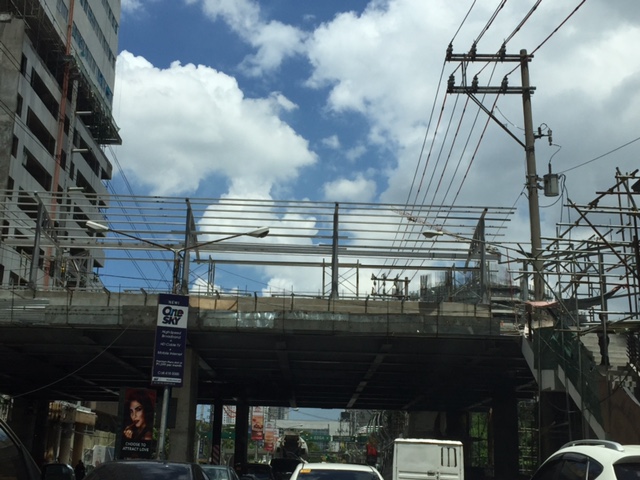 Close-up of the F. Ortigas part of the elevated walkways
 Walkway section under construction along the approach of ADB Ave./San Miguel Ave.
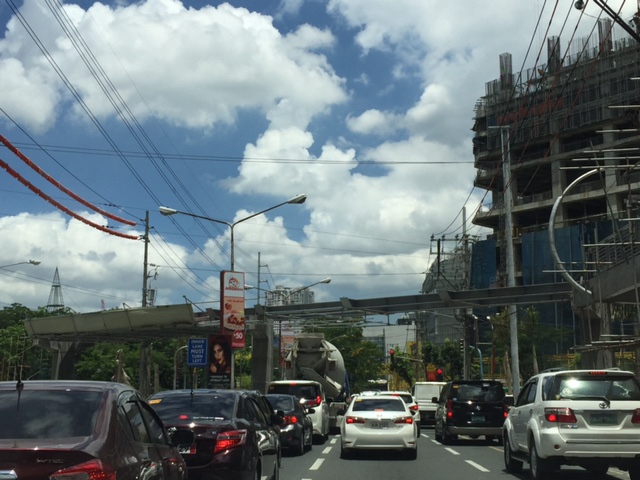 Crossing under construction at the intersection of Julia Vargas with San Miguel Ave. (to the left) and ADB Ave. (to the right).

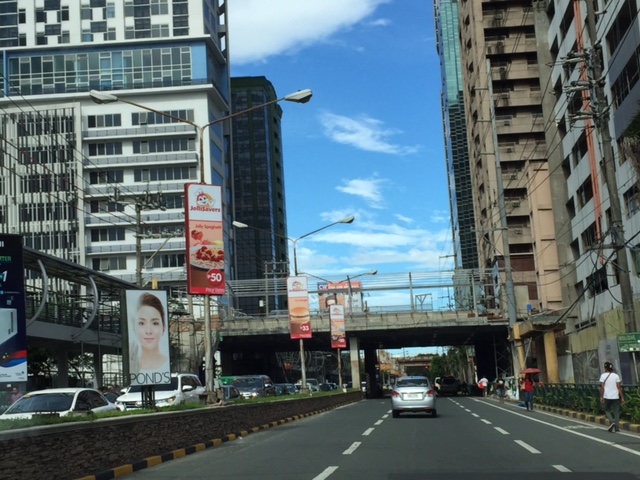 View of the F. Ortigas crossing walkway along the eastbound direction of Julia Vargas Ave.
This project is perhaps one of the most hyped pedestrian facilities in Metro Manila and if I recall right, the concept for this can be traced to workshops conducted during one of the Transport Forums organized by the Asian Development Bank (ADB), whose headquarters are located in Ortigas Center. It took a while to be realized but should be completed soon. This won’t be the first of its kind in Metro Manila as Makati already has one connecting office and residential buildings to Greenbelt and Glorietta. I really do hope it is able to reduce congestion in the area but this would require studies after the facilities are opened for public use. We need more of these around Metro Manila as well as other major cities. We direly need facilities to encourage walking as a preferred mode over motorized transport.
–
 Caught (up) in traffic