
Home » Road Safety (Page 31)
Category Archives: Road Safety
Preventable road crashes and congestion
The driver of the Don Mariano Transit bus that plunged from the Skyway died last Monday after being confined to a hospital after the incident. To some, perhaps, the first thing that came to mind was that his passing meant one less reckless driver in our roads. The idea that streets are safer without him and his kind of drivers is not at all new nor is it considered unfair by many who have experienced or victimized by reckless driving by bus, jeepney, UV express, or taxi drivers or have encountered them in traffic. To be fair, included in this list are private car and truck drivers and motorcyclists who seem to think they had the roads to themselves and all other road users must adjust to their driving styles.
The thing is, most road crashes are preventable if only people drove more carefully. Discipline on our roads have been the subject of a lot of writings, news reports and documentaries, and nowadays even amateur videos uploaded on the net. The latter videos show how difficult (or terrifying) it is to drive in Philippine roads. In fact, I have a balikbayan friend who’s on vacation from the U.S. who says she screamed every time her father maneuvered their car in traffic as they drove to Makati. She seemed to have gotten used to the more discipline driving in Memphis that she forgot about how to drive in Manila streets.
One problem is that many professional drivers, those whose jobs are to drive vehicles like taxis, trucks, buses, jeepneys and UV Express, are not formally trained. I say many because few are certified by the government-run Technical Education and Skills Development Authority (TESDA) or any school offering formal driving courses. Those who get certification are usually people who want to work abroad and need formal certification as a requirement by foreign firms or recruitment agencies.
Driving schools are generally for those seeking a non-professional licenses, i.e., those who want to drive their own cars. And from what we see when traveling along our roads, most private car drivers are also guilty of reckless driving. I have seen many who seem to think that they are stunt drivers, weaving in and out of traffic, frequently changing lanes and cutting the path of other motorists (many motorcycle riders are guilty of this, too). This is a systemic failure on the part of the Land Transportation Office (LTO), which is the agency in-charge of licensing drivers.
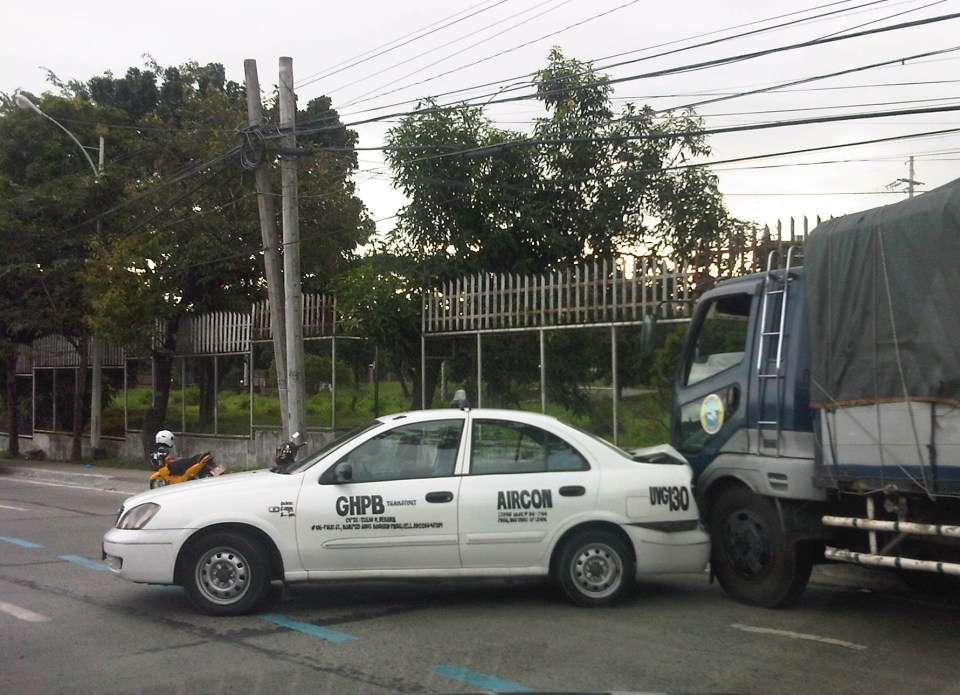 This crash involving a taxi and truck in Katipunan just across from the U.P. Town Center backed up traffic along C-5 as the two vehicles occupied 2 of the 3 southbound lanes of the road. From the looks of it, is seems the truck driver either lost control of his vehicle or made an error as he attempted to switch lanes.
Preventable, too, are many causes of traffic congestion such as minor road incidents and vehicle breakdowns. In the latter cases, it is the responsibility of vehicle owners whether they be private individuals or bus companies or logistics firms to properly maintain and operate their vehicles. As such, they are primarily to blame for most breakdowns. I say most, because there are instances when flat tires are caused by objects on the road. In many cases of breakdowns and other incidents, congestion results from these vehicles not being quickly removed from blocking the road. There is also the tendency for other drivers to be inquisitive (usyoso) so much so that they slow down unnecessarily and thereby contribute to the congestion.
 This truck broke down just after entering the C-5 E. Rodriguez Flyover in Pasig City at around 5:30 AM. There are only 2 lanes on either the northbound or southbound direction so the blockage created a traffic jam early in the morning that stretched all the way to Lanuza at the time I passed by the area. What was expected by many as free flowing traffic that time of the day turned out to be an early traffic jam. I can just imagine the congestion afterwards when peak traffic started around 7:00 AM. The MMDA enforcers seemed helpless as they watch vehicles passing the truck.
In the coming year 2014, we are hopeful that these issues on driving, breakdowns and congestion can be addressed by the responsible authorities. Of course, there will be difficulties, but then as they say “Kung gusto, gagawa ng paraan. Kung ayaw, maraming dahilan.” (If they want it solved, they will find a way. If they don’t, they will make all the excuses.).
–
Road crashes: everyday disasters
The occurrence of road crashes involving road public transport has hit an alarming rate the past few weeks. Only this morning, a bus fell of the Skyway and as of this writing over 20 people have been confirmed dead from the tragic incident. These casualties add to those from other crashes this past month alone. Consider the following recent incidents involving buses:
- Yesterday, more than 50 people were hurt in a crash involving 2 buses in Olongapo City;
- Last November 16, 6 people died in a collision involving 2 buses in Camarines Sur;
- Last November 14, 6 people were killed in a crash along EDSA;
There are countless more people who have died in other crashes involving other vehicles including private cars and vans that have not been reported or were considered minor news in comparison with bigger events like those related to super typhoon Yolanda (Haiyan) and the powerful earthquake that hit the Cebu-Bohol areas. These are disasters happening everyday. However, unlike the earthquake and typhoon, these are very much predictable and the deaths and injuries preventable if the drivers of the vehicles only exercised caution given the conditions at the time the crashes occurred.
The Land Transportation Franchising and Regulatory Board (LTFRB) should examine their approach to punishing erring bus companies. So far, the policy of temporarily suspending the operations of the bus companies involved and investigating the cases of drivers involved in the crashes have not been effective in improving safety as such appear to have had no positive impacts to road crash occurrences in our roads. Given the bad safety records of such bus companies, it is high time to make a strong point by not only suspending these companies but by revoking their franchises. How many more people should die if bus companies do not comply with having their drivers practice safe driving? Their excuses of their drivers being the ones to blame do not hold any water as they have responsibility over them as stipulated in their franchises. The Land Transportation Office (LTO) should also move towards revoking the licenses of these drivers and to never allow these people to handle vehicles again whether as public utility vehicle or private drivers!
–
Rail incidents
The big news in Japan today seems to be the rail incident where a woman saved the life of a man who attempted suicide or fell unto the rail tracks of the JR Yokohama Line. Unfortunately, the woman died as she was ran over by the train as she apparently positioned the man in between the tracks. As far as I could understand, it seemed that the barriers for a crossing were already down and the alarms announcing the arriving train were also engaged when a man entered the danger zone and fell (or laid) at the tracks. People including pedestrians and those in their cars were shocked by the situation but only the woman who was with a companion in a car decided to act to save the man from the oncoming train. Following are photos I took from a TV news report on the incident.
 Simulation of train operations using JR East’s simulator to review what could have happened
 Demonstration of train approach to station
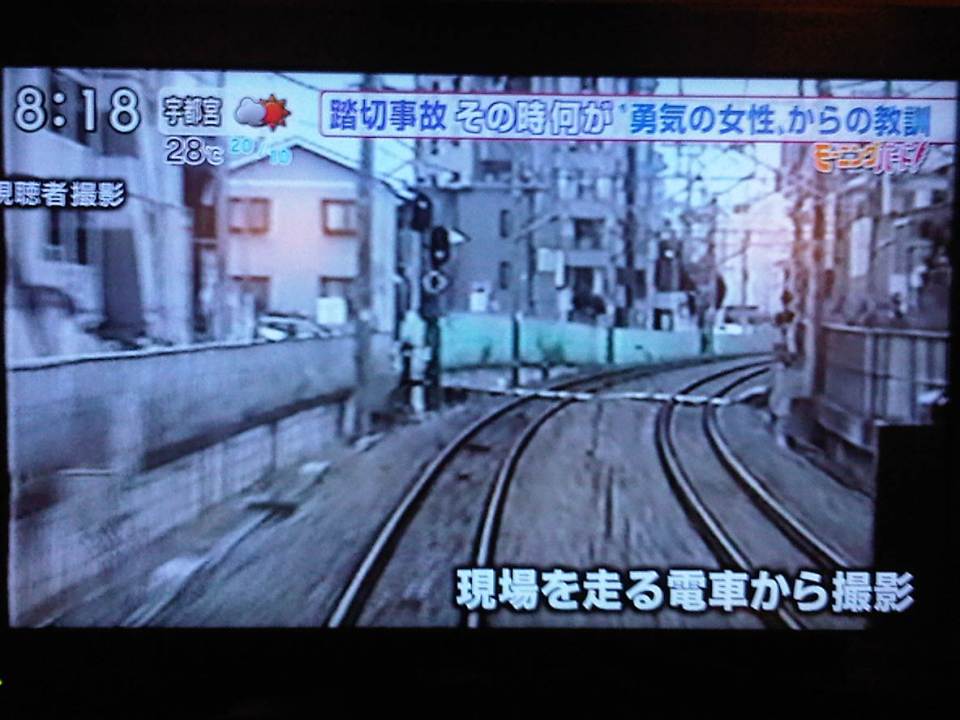 Footage of the crossing where the woman perished.
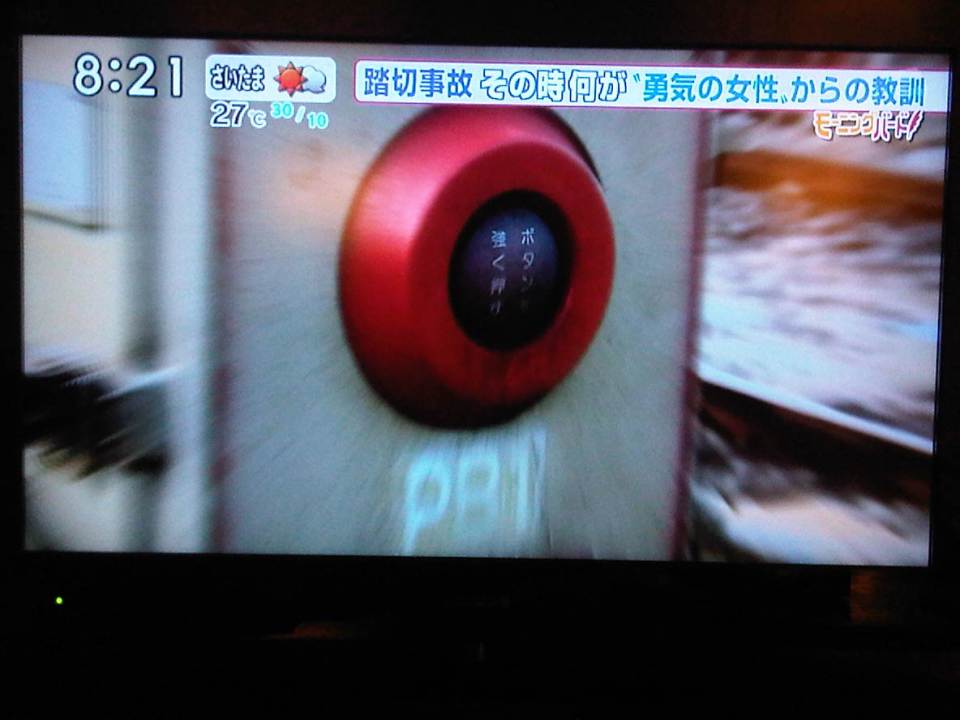 Emergency button that was supposed to be used by people in exactly such cases but people were apparently too shocked or unfamiliar with this safety device at railway crossings.
 Demonstration of the ill-fated rescue
 Photo of the heroine who, if I understood from the report, will be awarded posthumously for her effort to save another person.
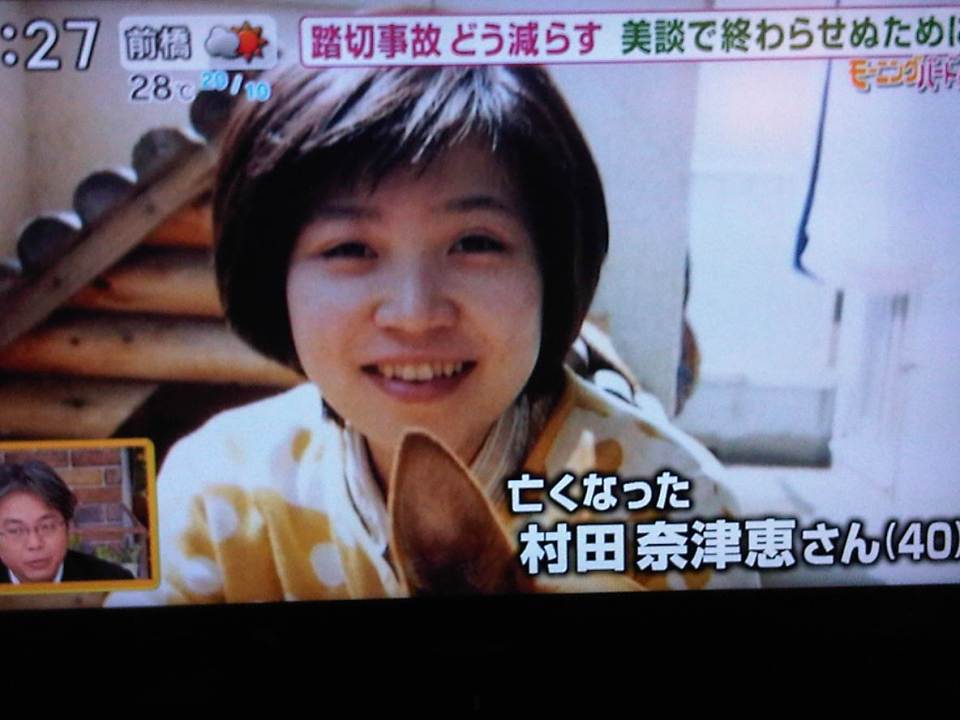 Another photo of the 40-year old woman, Murata-san.
Japan takes pride in their work towards making their transport systems safe. Rail incidents have been minimized by using modern, high technology tools including sensors and monitoring systems. However, it seems that there are cases such as these where the intervention of people (including those who might be spectators of an incident) are still necessary as these are likely beyond the capabilities of even high tech countermeasures installed at rail crossings. We salute and honor this woman who was willing to help another person at the cost of her own life. She deserves the honor and recognition for this great humanitarian act.
–
Swapang! or the perils of walking
Walking to the jeepney terminal for a ride to the university, I was irritated by the constant honking behind me as motorcycles rode up the sidewalk to avoid the weaving into congested traffic along Aurora Boulevard. And so I tried to stand my ground allowing only half the space of the sidewalk for these motorcycles to pass through. As far as I’m concerned, I was already too generous giving part of the space that is for pedestrians and not for motorized traffic. Still, there were a few motorcyclists who seem to think they had the right of way as they attempted to convince me give up more space so they could practically take over the sidewalk. I didn’t give way and assumed they were cursing me inside their helmets. Manigas sila! I thought that in the end, sila ang asar at talo in this situation, not me.
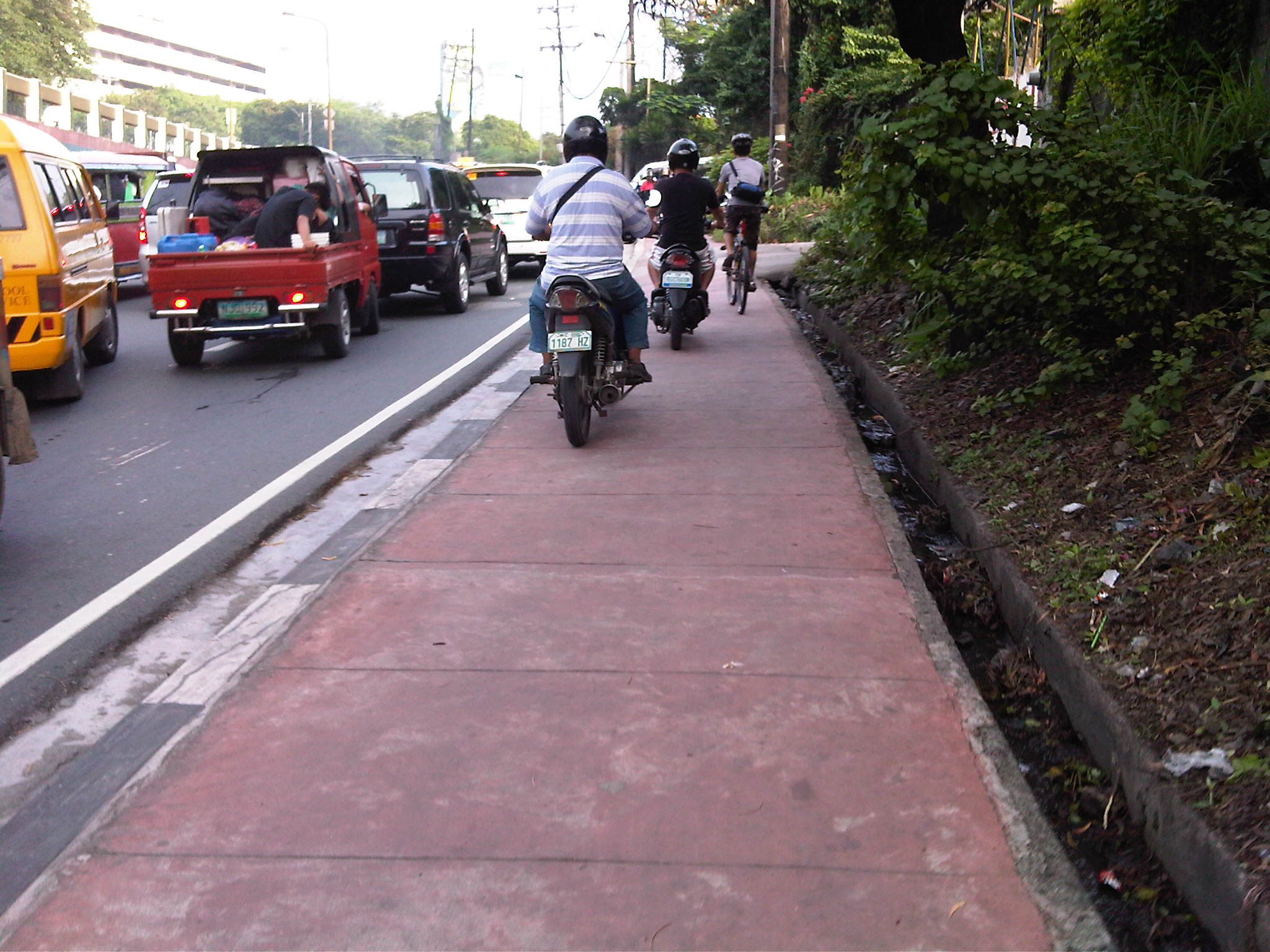 Motorcycles dominating space for pedestrians
At one point, I held my ground and didn’t give way to the motorcycles behind me [Advisory: This is not for everyone especially those who are “pikon” or who are looking for a fight.]. I knew my rights and I was walking on the pedestrian sidewalk. Unfortunately, a bicycle came along and I gave way only because I also appreciated cycling and understood that pedestrians and cyclists are sort of “kindred spirits” in a world dominated by motorized transport. The bicycle was immediately followed by two motorcycles including one that almost sideswiped the cyclist. I took the photo above to better show the situation.
The other day, I chanced upon a similar situation as I was driving in heavy traffic along Amang Rodriguez in Pasig City. What little space was available for pedestrians along a narrow sidewalk along this road connecting Marikina and Pasig cities.
 Motorcycles using a narrow pedestrian sidewalk to avoid traffic congestion along Amang Rodriguez
These cases are clear examples of swapang attitude or behavior that is prevalent among many road users. Unfortunately, these are not apprehended or accosted by traffic enforcers. The latter seem to be more engrossed with number coding and swerving violations, anyway, that they seem to have forgotten all the other traffic violations that included this brazen behavior of motorcyclists. Perhaps enforcers should go back to the basics and take more notice of all those other violations (e.g., speeding, counter flowing, beating the red light, beating the green light, etc.) to improve and promote discipline on our roads.
–
Transport related topics in the 2013 UP College of Engineering Professorial Chair Colloquium
The College of Engineering of the University of the Philippines Diliman is holding its Professorial Chair Colloquium on July 11 and 12, 2013. These will be held mainly at the Melchor Hall, which has been the home of the College since it transferred to Quezon City after the Second World War. The colloquium is an annual event where Professorial Chair holders deliver lectures on selected topics of research being undertaken in the various institutes and departments of the college.
On July 11, 2013 (Thursday) at the Geodetic Engineering Theater, 4th Floor, Melchor Hall, U.P. Diliman:
- Dr. Hilario Sean O. Palmiano, Institute of Civil Engineering, “Traffic Noise Perception in UP Campus Dormitories” [DMCI Developers Professorial Chair] – 0950 to 1010.
- Dr. Nathaniel B. Diola, Institute of Civil Engineering, “Blended Cement for Road Construction” [Prof. Jose Ma. Diago de Castro Professorial Chair in Civil Engineering] – 1010 to 1030.
- Dr. Ricardo G. Sigua, Institute of Civil Engineering, “Blackspots and Their Identification” [Primary Group of Builders Professorial Chair Award in Engineering] – 1050 to 1110.
On July 12, 2013 (Friday) at the Maynilad Room, 3rd Floor, Melchor Hall, U.P. Diliman:
- Dr. Jose Regin F. Regidor, Institute of Civil Engineering, “Transport Infrastructure, Poverty and Inclusive Growth” [Pozzolanic Philippines Inc. Professorial Chair] – 0910 to 0930.
- Asst. Prof. Gerald Jo C. Denoga, Department of Mechanical Engineering, “Optimization of Parallel-Series Hybrid Powertrain for Public Transportation” [Emerson Professorial Chair in Engineering] – 0930 to 0950.
- Dr. Karl B.N. Vergel, Institute of Civil Engineering, “Evaluation of Compliance of Specifications of Customized Local Road Vehicles (CLRV) with Local Regulations and International Standards” [Maynilad Professorial Chair] – 0950 to 1010.
- Dr. Edwin N. Quiros, Department of Mechanical Engineering, ” Coconut Methyl Esther (CME) Performance and Emission Characteristics Using a Common-Rail Direct Injection (CRDI) Engine” [Emerson Professorial Chair in Mechanical Engineering] – 1010 to 1030.
Dr. Palmiano is the current Director of the National Center for Transportation Studies (NCTS). Dr. Diola is the immediate past Director of the Building Research Service (BRS). Dr. Sigua is the head of the Road Safety Research Laboratory (RSRL) of the NCTS. Dr. Regidor is past Director of the NCTS. And Dr. Vergel is the head of the Transport & Environment Laboratory of the NCTS.
Asst. Prof. Denoga is the past Chair of the Dept. of Mechanical Engineering (DME) and has led teams in the design of vehicles that participated and won in international competitions on energy efficient vehicles, representing the country and the university in these contests. Dr. Quiroz is the head of the DME’s Vehicle Research and Testing Laboratory (VRTL).
These lectures as well as others on the mornings of July 11 and 12 are open to the public. Venues are at the Melchor Hall (along the Academic Oval), and the UPAE Hall and the EEEI Building at the College of Engineering Complex along Velasquez Street (across from the College of Science complex).
–
MNTC Donation to UP-NCTS Road Safety Research Laboratory
The Manila North Tollways Corporation (MNTC) recently donated software and equipment to the University of the Philippines Diliman’s Road Safety Research Laboratory (RSRL) at the National Center for Transportation Studies (NCTS). Gracing the Turnover Ceremony were no less than MNTC Chair Manuel V. Pangilinan and UP System President Alfredo E. Pascual. Dr. Hilario Sean O. Palmiano, the current NCTS Director, welcomed guests from MNTC and its parent firm Metro Pacific Tollways Corporation as well as from UP and the media. Dr. Ricardo DG. Sigua provided a background on the RSRL and how the donated equipment would help in the implementation of researches. The following photos show some highlights of the Turnover Ceremony last April 11, 2013.
 UP President Alfredo E. Pascual shaking the hands of MNTC Chair Manuel V. Pangilinan after they delivered messages during the Turnover Ceremony held at the NCTS. Looking on are Road Safety Laboratory Head Dr. Ricardo Sigua and NCTS Director Sean Palmiano.
 Unveiling of the plaque by (L-R) Dr. Ric Sigua, MNTC President & CEO Rodrigo Franco, UP Pres. Alfredo Pascual, MNTC Chair Manny Pangilinan, Dir. Sean Palmiano, and Metro Pacific President & CEO Ramoncito Fernandez
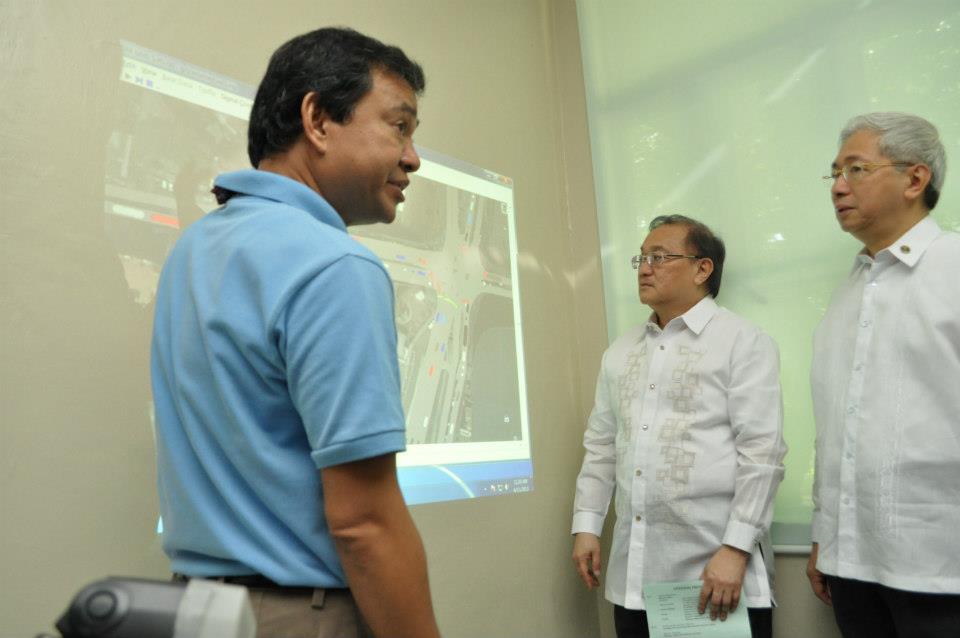 Dr. Sigua demonstrating VISSIM, one of the software donated by MNTC to UP-NCTS
 MNTC Chair MVP making a point about the microsimulation demo as UP Pres. Pascual looks on.
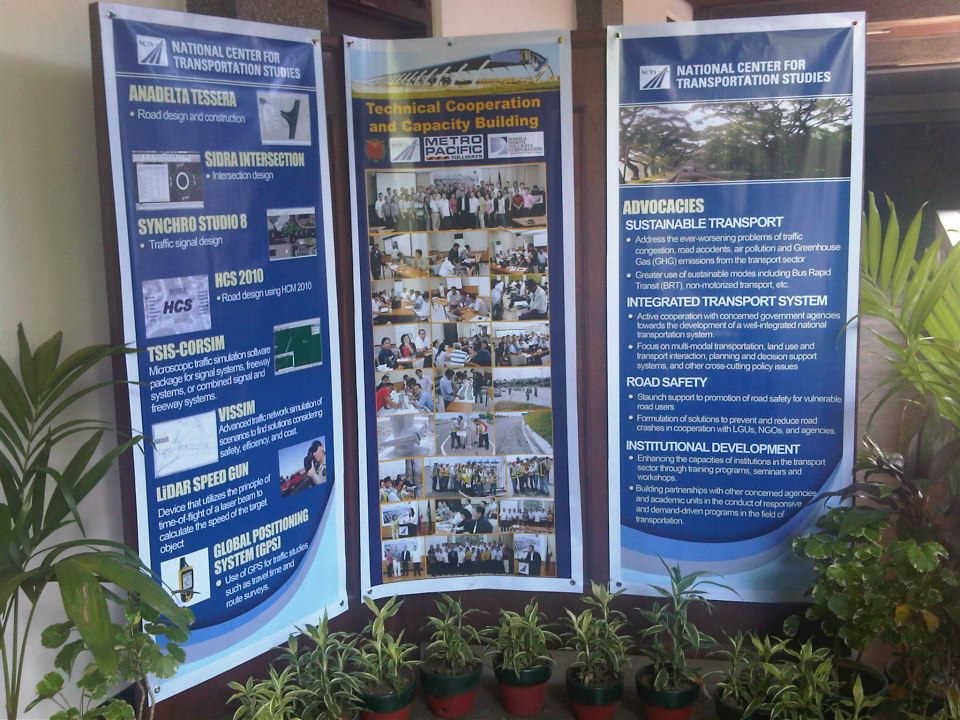 Tarps on display showing a list of donated software and equipment, photos of technical cooperation and capacity building between NCTS and MNTC/MPTC, and the advocacies of NCTS.
The following links are for news items on the turnover:
AKSYON TV ANDAR NG MGA BALITA Road Safety Lab binuksan para sa pagaaral ng kaligtasan sa kalsada
http://article.mediabanc.ws/stream/default.aspx?cc=T0T06d8bb4U%3d&file=k177n0SVBnt2RaICvoFJhiFjxgfZyCtN6NoXOXnMSGyal1UJ64YKNpL2BU77bIOvciz4Fow7jHs%3d&title=t52vKVnKl2UOiPwLKMoBIY7qOmbKBwO1BvxSsh3vvK9bxrfWReUGvonLroiSCcRES9sS3xiZeZJwE1Fge2YBny9SUwnOgsxVTV5 AKSYON Dalawang aksidente kada minuto nangyayari sa buong mundo
ayon sa pag aaral
http://article.mediabanc.ws/stream/default.aspx?cc=T0T06d8bb4U%3d&file=k177n0SVBnsls4maYTmszSUZ5hGB8cannnCtIw38rXSPzVAYSki5Ja9OXLfu2SRW0MoCtizKBHI%3d&title=lpnzG7ZYupO9oIfbLTmmnyPuzDcsckTf7KQri2OPzrjD3PZBucpQvITV0xUGBlObShdIgViH%2fltBVsTf70AwjRR5y3I
+hqdT0uag3PAgkU0%3d
[Note: To view the videos, you must have Microsoft Silverlight installed on your computer.]
–
Buses speeding along Commonwealth Avenue
Traveling along Commonwealth Avenue last Holy Thursday, we couldn’t help but notice the buses racing against each other along the wide highway. One bus speeding along the motorcycle lane almost hit a motorcycle along that lane. Traffic was free flowing and speed limits obviously were not being enforced or followed. Running at 60 kph, our vehicle was always passed by buses and cars alike, their drivers probably enjoying the wide space and the knowledge that there will be few if any traffic enforcers along Commonwealth. We saw a few underneath the Tandang Sora flyover but they were relaxed and seem to turn a blind eye over speeding violations along the highway. The video below was taken last Thursday and showed three buses speeding along Commonwealth, occupying lanes that they are not supposed to be using (Note: Public transport are supposed to run along the two outermost lanes of the highway marked with yellow lines.)
–
Air quality and road safety concerns for public transport
While traveling home one late afternoon, I couldn’t help but take a quick photo of a jeepney in front of me that was belching smoke while also carrying several people as sabit (hangers). Though a bit blurry, the photo still shows clearly the cloud of smoke coming out of jeepney’s tailpipe and the three people hanging behind the vehicle. Not obvious from the photo are the speed and lateral motion of the jeepney as it traversed this section of Marcos Highway.
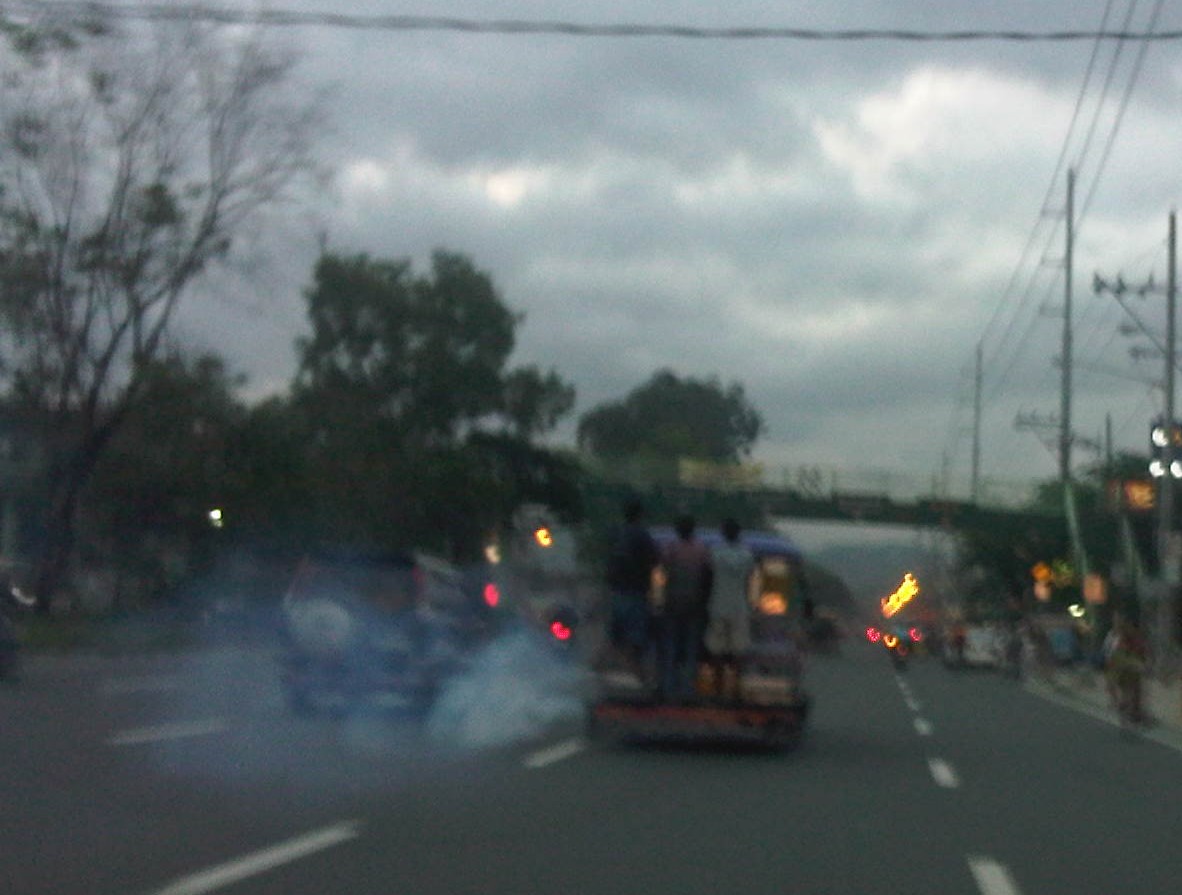
This is a scene we see everyday in our streets despite initiatives or efforts to address problems pertaining to vehicle emissions and safety. The Clean Air Act while enacted more than a decade ago has not been effectively implemented for vehicles. A lot of vehicles are able to register or renew their registrations without really going through a proper emissions test (or smog test for those in the US). “Non-appearance,” the term used for people going through the motions of a test but skipping the measurement itself while getting print-outs stating the vehicle “passed” the test is prevalent throughout the country.
The Land Transportation Office (LTO) has experimented with a lot of schemes to address the problem. These includes the requirement of a photograph showing the actual performance of the emission test on the vehicle. More recent was an initiative where RFID units were supposed to be installed/attached to vehicles and these would be used to ensure that emission tests really were conducted prior to registration. However, with very few Motor Vehicle Inspection Stations (MVIS), the LTO has no choice but to delegate emission testing to private emission testing centers (PETCs). The long standing suspicion, however, is that most of these PETCs collude with vehicle owners and fixers within the LTO to maintain a status quo in “non-appearances” and non-compliance with emission regulations.
Local governments have pitched in with their mobile anti-smoke belching units (ASBUs). In Metro Manila, many cities including Quezon City, Pasig City and Makati City have multiple ASBUs allowing them to set-up several stations along roads in their jurisdictions. These are usually seen along busy roads with policemen assisting them in flagging down vehicles (mostly trucks) observed to be smokebelchers. These vehicles are tested and penalties are imposed on emission regulations violators. The equipment of these ASBUs, however, are only for diesel engines and so are operations of these mobile units are limited in scope from the start. There have also been allegations that some ASBUs have been taking advantage of erring drivers resulting in bribery so as not to be issued violation tickets and penalties.
The bottom line for most cases of emission violations is that most violators are not properly educated about emission regulations including the requirement for them to pass emission tests at any time and not during the registration process only. This is a fact that most drivers or vehicle owners do not understand or choose not to understand, usually because of maintenance cost implications. Nevertheless, we will continue to be in the losing end of the war against air pollution if we cannot properly enforce provisions of the Clean Air Act, particularly for mobile sources that contribute most of the air pollution we experience in this country.
–
Roadside barriers
A few weeks ago, the evening news reported a truck losing control along Marcos Highway and slamming into houses along the roadside. The site of the crash was along the Quezon City-bound stretch of the road between the Marcos Highway Bridge and Bonifacio Avenue in Barangay Barangka, Marikina City. I took a couple of photos of the area when we passed by last weekend from a trip to Antipolo. The first photo shows where the truck went off the road, smashing through the barrier and hitting some houses just beside and below the road. Marcos Highway at this section is elevated because the adjacent land on the north side of the highway is a flood plain. The second photo shows a typical road side section just after the crash site, illustrating the type of barrier used that is supposed to protect residents from wayward vehicles. Clearly, the barriers were not sufficient for the purpose, which brings us to the question of what is appropriate in such cases. Fortunately, no one was killed in the crash.
 Site where the truck rammed into a barrier and fell off the road into houses in Bgy. Barangka, Marikina City
 Semi-rigid barrier along the Marcos Highway – on the right are houses in Bgy. Barangka, Marikina City
Traffic barriers are used to minimize the severity of potential road crashes that may occur when vehicles leave the traveled way. There are three types of longitudinal barriers: flexible, semi-rigid, and rigid. Flexible barriers are usually of the cable type and depend on their tensile strength to hold off vehicles or pedestrians. Semi-rigid barriers are usually rail and post systems such as the one shown in the previous photos. These combine tensile and flexural strength of the rail and posts to stop vehicles from getting off the road. Rigid barriers are made out of reinforced concrete and are not supposed to deflect on impact. Energy is dissipated by raising the vehicle plus the deformation of the vehicle itself. These are what are usually provided for bridges and overpasses to keep vehicles from going over in cases where there are road crashes or control of the vehicle is lost.

Based on the adjacent land use and the traffic characteristics along Marco Highway along with the incidence of crashes along this section, rigid barriers satisfying Test Level 4 at the very least should be constructed along the roadside. These should be designed to provide adequate protection for people residing along the road given also that vehicle speeds would naturally be reduced by the upward slope of this section. On the side of safety, perhaps Test Level 5 barriers could be provided considering observations of vehicles speeding along this section.
–
Merry Christmas!
Merry Christmas to all!
In this time of celebrations and gatherings among families and friends, may I just remind you – Don’t Drink and Drive! Have a designated driver or take public transportation. Keep our roads safe and make sure there are no tragedies that will make this an unhappy time for you, your kin, your friends and other road users.
–
 Caught (up) in traffic