
Home » Road Safety (Page 34)
Category Archives: Road Safety
Motorcycle lanes – a few comments
The Metropolitan Manila Development Authority (MMDA) recently established motorcycle lanes along Commonwealth Avenue in Quezon City and Macapagal Boulevard in Pasay City. The main intention is to reduce crashes involving motorcycles by attempting to segregate them from other vehicles in traffic. Following are a few photos I took this afternoon along Commonwealth where I observed the MMDA painting blue lines to mark the motorcycle lane. In this case, the lane is the 4th from the outer edge (shoulder) of the highway.
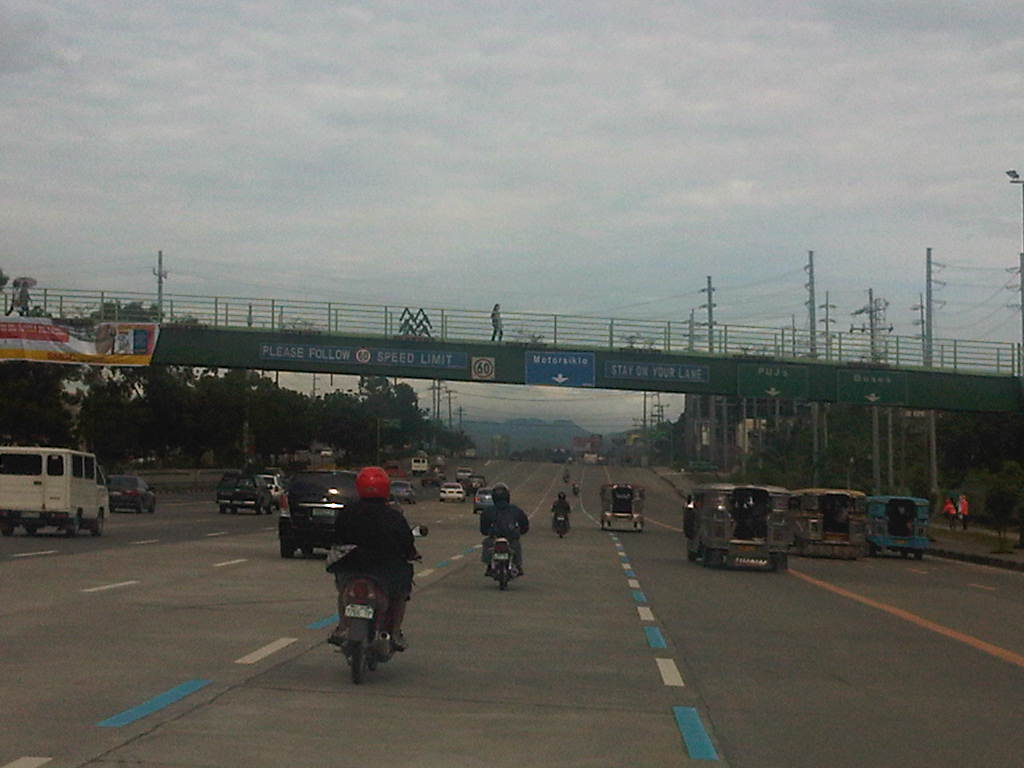 Newly painted blue lines mark the motorcycle lanes. Photo shows riders following the new policy, probably knowing that getting apprehended will lead to a 15-minute lecture on motorcycle safety. Such a penalty will only be applicable this week when the MMDA is implementing a dry-run of the policy. From Monday next week, the penalty would be a 500-peso fine for every apprehension.
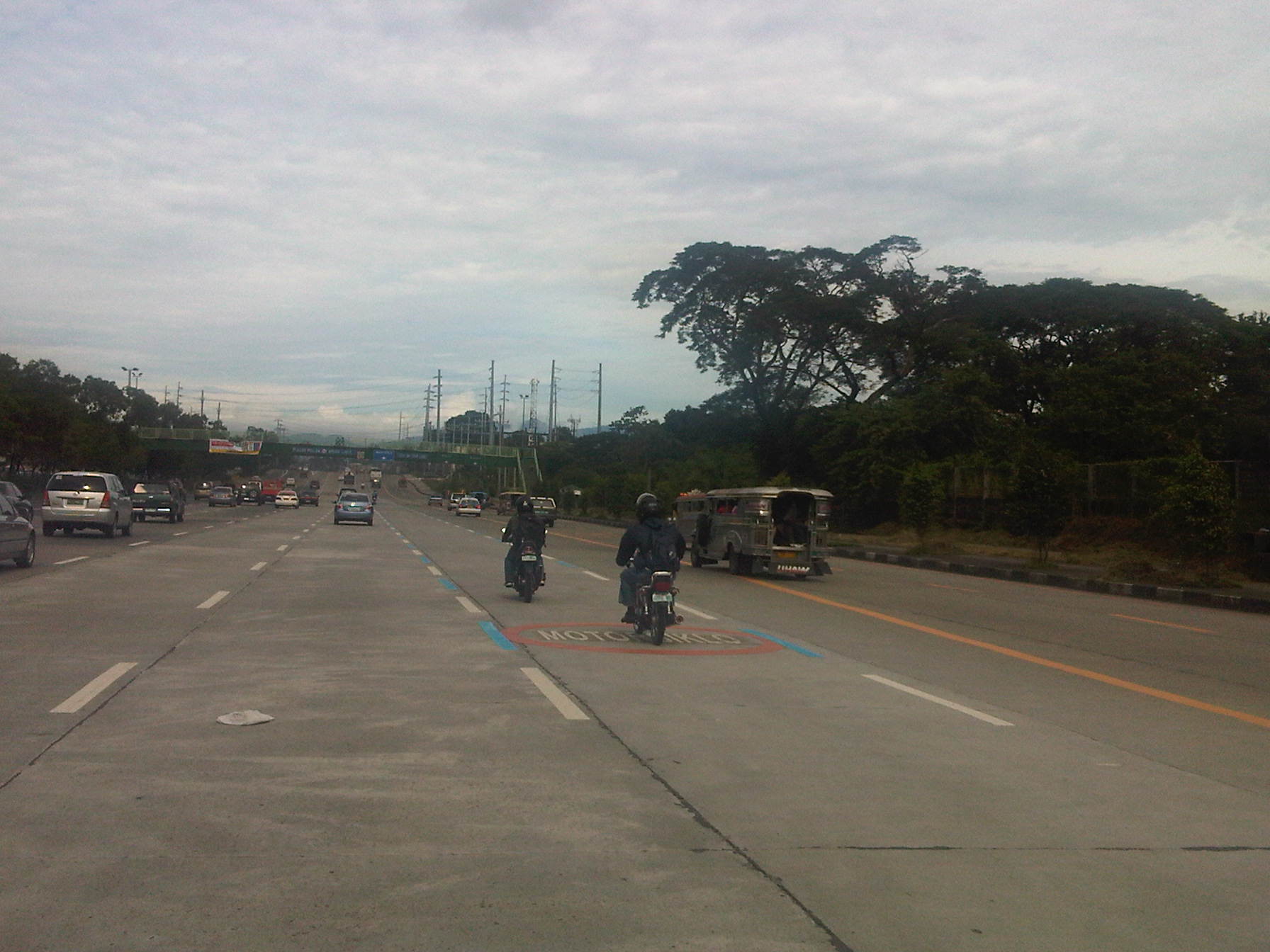 Pavement markings for the motorcycle lane along Commonwealth. Note that the lane is quite close to the lanes designated for public utility vehicles like jeepneys and buses. This situation creates a high potential for the occurrence of crashes involving motorcycles and PUVs. Of particular concern is the behavior of PUVs, especially buses that tend to encroach upon the lanes to the left of the PUV lanes including the motorcycle lane. Another issue is the fact that private vehicles are allowed along the motorcycle lanes and not just for maneuvering. I share the opinion of riders that motorcycle lanes should be for motorcycles only.
Undergraduate research topics on transportation 2011-2012
The Institute of Civil Engineering of the University of the Philippines Diliman is conducting its undergraduate research colloquium today. Expected to present are students who are either at the proposal stage or completing their research. Topics being completed are the following:
- Analysis of Road Accidents Involving Children Below 15 Years Old
- Analysis of the Impact of Billboards on Road Accidents Along EDSA
- Assessment of the Parking Management System in Shopping Malls
- In-Depth Comparative Analysis of Female and Male Bus Drivers for Public Transport in Metro Manila
Meanwhile, topics being proposed are the following:
- Accident Risk by Mode of Public Road-Based Passenger Transport in Metro Manila
- Analysis of Operations of Electric Tricycles
- Applicability of Unconventional Transit Systems in Selected Metropolitan Areas in the Philippines
- Assessment of the Philippine National Railways Commuter Line Services
- Assessment of the Re-Introduction of Traffic Signal at the University Avenue-Commonwealth Avenue Intersection
- Development of a Public Transport Information System for the UP Diliman Campus
- Estimating Ridership for a Proposed Public Transport System for UP Diliman
- Measuring Delay Caused by U-turn as Traffic Control Facility
- Quantitative Assessment of Road Safety Initiatives Along EDSA
- Travel Time Estimation of Jeepneys: The Case of University of the Philippines Diliman, Quezon City
The coverage of undergraduate research this year concerns mainly public transportation and road traffic safety but with one topic dealing primarily with traffic engineering. It is hoped that these researches would be able to answer certain nagging questions pertaining to transport and traffic particularly where safety and efficiency are concerned. In the case of topics on mass transport such as those on the PNR commuter services and the applicability of unconventional systems such as the automated guideway transit (AGT) and the monorail, the potential outcomes may actually be able to address questions that concern alternatives or options to road-based transport. This is essential and presently a very relevant issue given the shortcomings in transport infrastructure in many Philippine cities and the current efforts exploring the possibility and feasibility of systems that will alleviate congestion and address travel demand. Overall, such researches are targeted towards contributing to the body of knowledge that should serve as inputs to the formulation of solutions suitable for the Philippine setting.
Bus involvement in road crashes
The LTFRB recently release lists of bus companies that are in the top ten . Versions of the list may be found in this article from the Philippine Daily Inquirer, The Manila Times, and The Philippine Star.
From the Inquirer:
“…The list is broken down into three categories—number of deaths, injuries and property damage—and is based on accident reports submitted by all public utility buses to the LTFRB. The lists published by the LTFRB cover the whole of 2010 and the first half of 2011.
Lists of the 10 most dangerous bus operators in Metro Manila:
Based on the number of deaths (passengers and bus personnel)
1. Admiral Transport
2. Nova Auto Transport
3. JAM Liner
4. Gassat Express
5. Joyselle Express
6. Philippine Corinthian Liner
7. Rainbow Express Inc.
8. Alberto Garating
9. Alps the Bus
10. EM Transit ServiceBased on the number of injured (passengers and bus personnel)
1. Admiral Transport
2. Nova Auto Transport
3. AM Liner
4. Gassat Express
5. Joyselle Express
6. Miami Transport
7. Pascual Liner
8. Philippine Corinthian Liner
9. Rainbow Express Inc.
10. CEM Transit ServiceBased on damage to property
1. Don Mariano Transit
2. Nova Auto Transport
3. Gassat Express
4. Miami Transport
5. Pascual Liner
6. Rainbow Express Inc.
7. Ropal Transport
8. A&B Liner
9. GELL Transport
10. CEM Transit Service”
The above are generally companies plying routes in Metro Manila. Meanwhile, the list mentioned in another article, this time from the Manila Times, identifies provincial bus companies that frequently got involved in road crashes:
“…Topping the LTFRB list is the Victory Liner, Inc. plying routes from Manila to Isabela, Bataan, Zambales and Benguet with 31 accidents from 2009 to 2011; 15 drivers died from these accidents.
Second-placing Vallacar Transit Corporation had 26 accidents resulting in the death of six of its drivers. Silver Shuttle and Tours, Inc. is third with 24 accidents and 5 driver deaths
Fourth in the list, United Land Transit and Bus Company has routes from Quezon, Leyte and Samar with 18 cases of accidents killing four of its drivers.
Philtranco came in fifth with routes from Luzon and Visayas with 15 accidents and three driver deaths followed by the Five Star Bus Company Inc. and Valisno Express that has 14 road accidents each…”
While the reports above mention few statistics, there are actually more detailed information with the LTFRB. Such data have been demanded from them by Congressional committees “investigating” public transport franchising. In one meeting the LTFRB mentioned that it is coordinating with the MMDA in compiling the number of traffic violations for each bus company based on the MMDA’s records. Their preliminary results have shown that bus companies have been involved in thousands of violations! Perhaps these should be proof of the aggressiveness or recklessness of drivers in general? And I dare ask if these can be used to weed out public transport drivers who should have no right conveying the general public?
I just wonder what would be the statistics for PUJs, tricycles, trucks and private vehicles. These would be interesting to analyze in order for us to formulate better strategies and tactics for curbing road crash incidence, fatalities and injuries.
Risky behavior at intersections
I saw these three vehicles, two motorcycles and a car, slowly encroaching towards the center of the intersection of Katipunan and C.P. Garcia Avenues last night. The red light was clearly displayed along with the number of seconds remaining that was indicated in the countdown timer installed along the southbound approach of the junction. They seemed to be unaware of the significant amount of time remaining before the green light. Worrisome was their being unmindful of the trucks turning left to C.P. Garcia from the northbound approach of Katipunan. Many of these trucks were the big trailer types that could easily wreck the car or crush the motorcycles should they mistakenly cross their paths. Requiring more space for their turning movements, many trucks encroach upon the second and third lanes from the median and would probably have hit one of the vehicles that were already past the nose of the median island on our side of the road.

There was no yellow box or markings clearly indicating the clear area for the intersection. However, it was quite clear where vehicles should stop considering there was a pedestrian crossing (incorrectly painted as zebra despite the traffic signals) at the approach of the intersection and vehicles should stop before these markings. The driver of the vehicle to our left obviously wanted to follow the example of the black car and already positioned his car over the pedestrian crossing. Is this a manifestation of being swapang or maybe the thinking that you want to be ahead of the rest?
Such behavior and others similar to this are risky and may lead to crashes that could have been prevented if the drivers and riders followed basic traffic rules and regulations. In fact, aside from the potential for road crashes, congestion due to clogged intersections are often due to many drivers and riders not following the rule of keeping an intersection open. Such a rule applies even when the green light is given to a particular movement considering that the intersection exit ahead is already full and further movement and the resulting queue will only block other movements once the lights change. The yellow box is supposed to define “no-man’s land” in as far as designating exactly which space should be clear of vehicles to facilitate traffic flow and as a matter of courtesy among drivers and riders. These are very basic principles in driving and among those consistently and constantly being violated. Meanwhile, traffic enforcers are either ignorant of these rules and prefer to just stick to catching violators of the number coding scheme or playing blind as they may have practically given up trying to enforce the rule while managing traffic. Perhaps they should try harder and be persistent in order to influence behavior change? After all, the last time I checked there are so many other rules and penalties other than swerving or violating number coding.
Dim your lights
I took the photo below in Cebu during one visit in 2010. The signs were posted along the coastal highway in the South Road Properties (SRP). Our friend explained that the signs were supposed to have been posted there as a spiteful message by a former mayor of the city to a political rival whose entourage commonly used the highway going to the city. Apparently, the vehicles on the politician’s convoy have the habit of using their lights even during the day to announce their presence in traffic. It seems their headlights are always on high beam (i.e., bright), which can be distracting for opposing traffic even if there is a median island along the highway. I can also imagine that in the past, vehicles on the convoy would probably use sirens or wangwang.

Many Philippine roads, especially in the rural areas, do not have lighting or are poorly lit, and it would be a lucky night when the moonlight is sufficient to provide illumination. Thus, it is understandable if we use the high beam or bright mode of our headlights when we are driving along dark roads and if there are no traffic on the opposing lanes. However, I think it is a matter of road courtesy that we dim lights when we encounter other vehicles on the road at night. Maybe it’s okay if the opposing lanes are divided by a median (like the island with plants in the photo) or barrier such that the lights are dissipated somehow. But most Philippine highways are undivided and thus, bright lights may become a hazard for motorists and lead to road crashes. If only for this, then there is actually a sound basis for reminding drivers to dim their headlights, especially in the city where there is significant vehicular traffic.
Sustainability and the roads to Baguio
News about the garbage in Baguio City and the slide that caused the death of many in that city brought back memories of my last visit. That was back in June 2009 when we were conducting consultation workshops for the formulation of the national environmentally sustainable transport strategy. We stayed and held the workshop at a hotel that was a short walk away from the Good Shepherd Convent. The convent, of course, is famous for the strawberry jams and other delicacies bearing the convent’s name. Also nearby was the Mines View Park that used to give a breathtaking view of mountains covered with pine trees. Those among my older friends who were able to experience this many years ago attest to the pleasing scent of pine in the cool breeze that is also a characteristic of this city. Nowadays, the view is mainly of mountains covered with shanties and looking downwards you would have a good view of a lot of roofs and, surprise, even a couple of structures that look like graves! If you’re unlucky enough, you would be taking in the scent of smoke coming from something that is being burned nearby.
Another thing that caught my attention in 2009 was the uncollected garbage along the streets and in front of many houses and other buildings leading to the convent and the park. Residents explained to us that Baguio already had a garbage problem and that waste management and disposal has been an issue in the city for quite some time. Previous to this visit, I had the chance to go to the city a few other times, even staying there for almost week in 2004 when we were conducting another study. At that time, I was not aware of the garbage problem probably because the problem has not yet manifested itself as it did in 2009. It is sad that the city has done little to address such issues considering the many indications of impending (if not ongoing) disaster due to their waste. It is also disappointing to see their leaders pointing fingers at others but seemingly refusing to take responsibility for the tragedy of the garbage slide.
On the way up to Baguio, we usually take Kennon Road, which is usually my choice when riding our own vehicle, rather than the more common Marcos Highway. The latter is a relatively easier route that was constructed as a safer alternative to the two more traditional routes via Kennon or Naguilian Roads. I usually choose Kennon because the drive provides great vistas including those you can view from observations points along the road. During bad weather, however, Kennon and Naguilian can be treacherous with both being relatively narrow as compared to the newer and upgraded Marcos Highway. There are many incidences of rockslides or landslides that have often made these roads impassable. In fact, Kennon Road is usually only for light vehicles and can be challenging to those who are unfamiliar with its combination of curves and slopes. Naguilian is no longer a choice among travelers from Metro Manila as it starts further from both Kennon and Marcos. Buses and trucks commonly use Marcos Highway, which has slope protection along critical sections and even a roof along one that makes it look like a tunnel section. It is also easier to negotiate this highway for most motorists though there is one long climbing section just before you get off the highway that has caused many radiators to overheat or brakes and clutches to malfunction.
The photo below was taken as we negotiated a populated area along Kennon Road in 2009. Note the two jeepneys in the photo that are loaded with passengers. It was a surprise that no passengers were hanging by the door of the jeepney like what we usually see in Metro Manila during the peak hours. Nevertheless, such an image suggests that the public transport supply is no longer sufficient for the passenger demand along this route. Perhaps their numbers are no longer enough or maybe there is a need for a public utility vehicle with a larger capacity? One thing is sure and that the practice of overloading is unsafe and is a fatal crash waiting to happen given the geometry of Kennon Road. While this seems acceptable to many (I couldn’t even count how many people were sitting on the roofs of the jeepneys we passed.), this is not something that should be encouraged, and careful examination of services is necessary for both the local government (in this case Baguio) and the national agency in-charge (LTFRB).
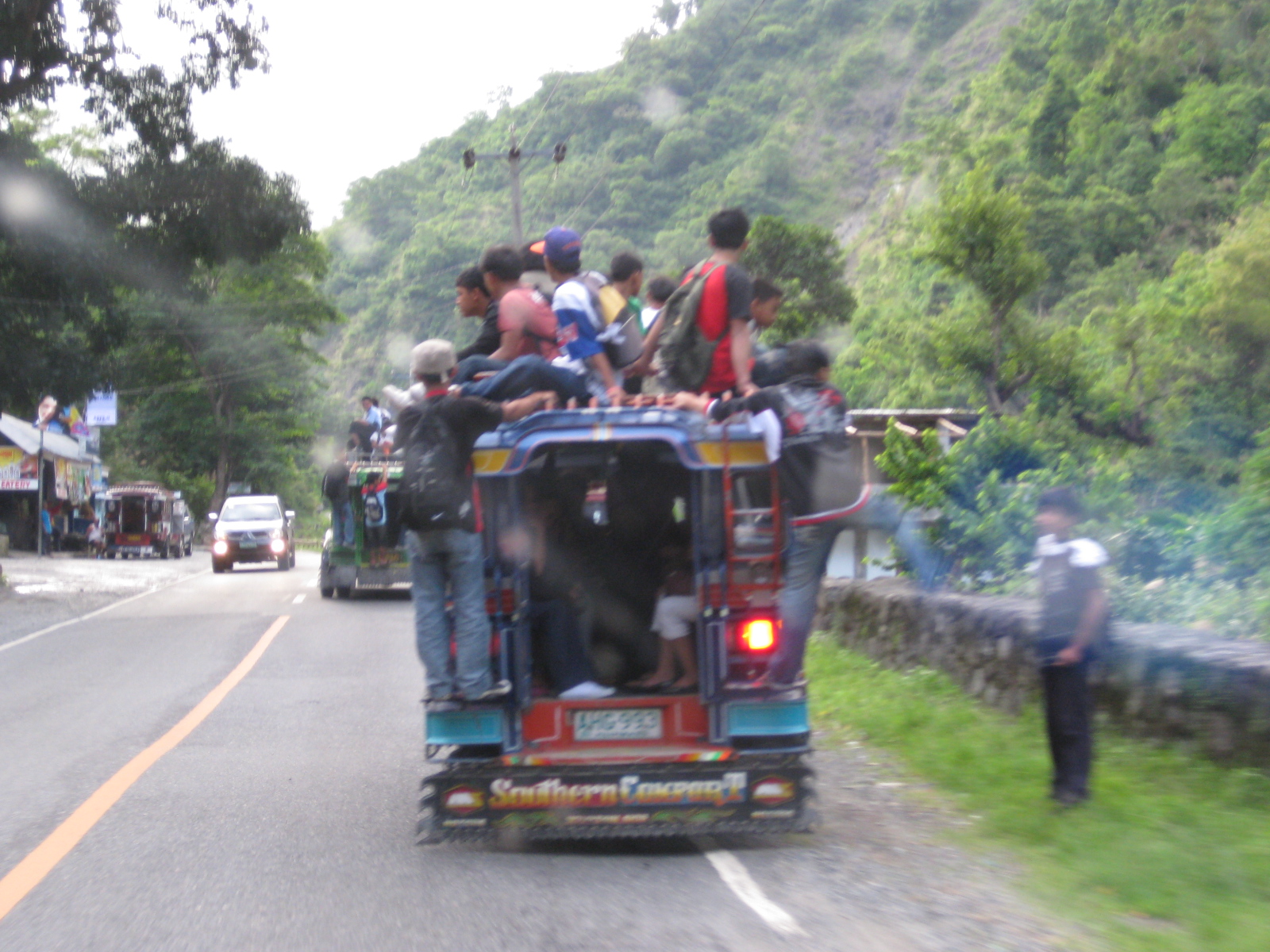
More on Baguio and jeepneys on future posts.
Pedestrian overpasses along Commonwealth Avenue
Commonwealth Avenue is still regarded as a “killer” highway despite the efforts to reduce road crash incidence along this thoroughfare. Many of these crashes involve pedestrians who continue to cross the highway on at-grade or on ground level at many points of the highway despite this being prohibited or discouraged. To cross the avenue, pedestrian overpasses have been constructed at strategic locations along the highway including those at Fairview Market, at Ever/Shopwise and at Tandang Sora, at U.P. (2 overpasses – one at AIT/CHK and another at Technohub), and at Philcoa. Despite these facilities being constructed and possibly with a few more to be constructed in the future, many people still choose to jaywalk. Among the reasons cited are stairs being too steep and the long distances they have to walk to and from the overpasses.
Following are photos taken on a Sunday drive from Novaliches to UP showing the conditions on and around overpasses along Commonwealth Avenue. Noticeable are overpasses across Fairview Market and Ever/Don Antonio where vendors have set up shop and impede the flow of pedestrian traffic.
 Pedestrian overpass across Commonwealth at Litex and before Fairview Market (section is at Commonwealth southbound) – the overpass is surprisingly free of vendors despite its being well within the influence area of the market.
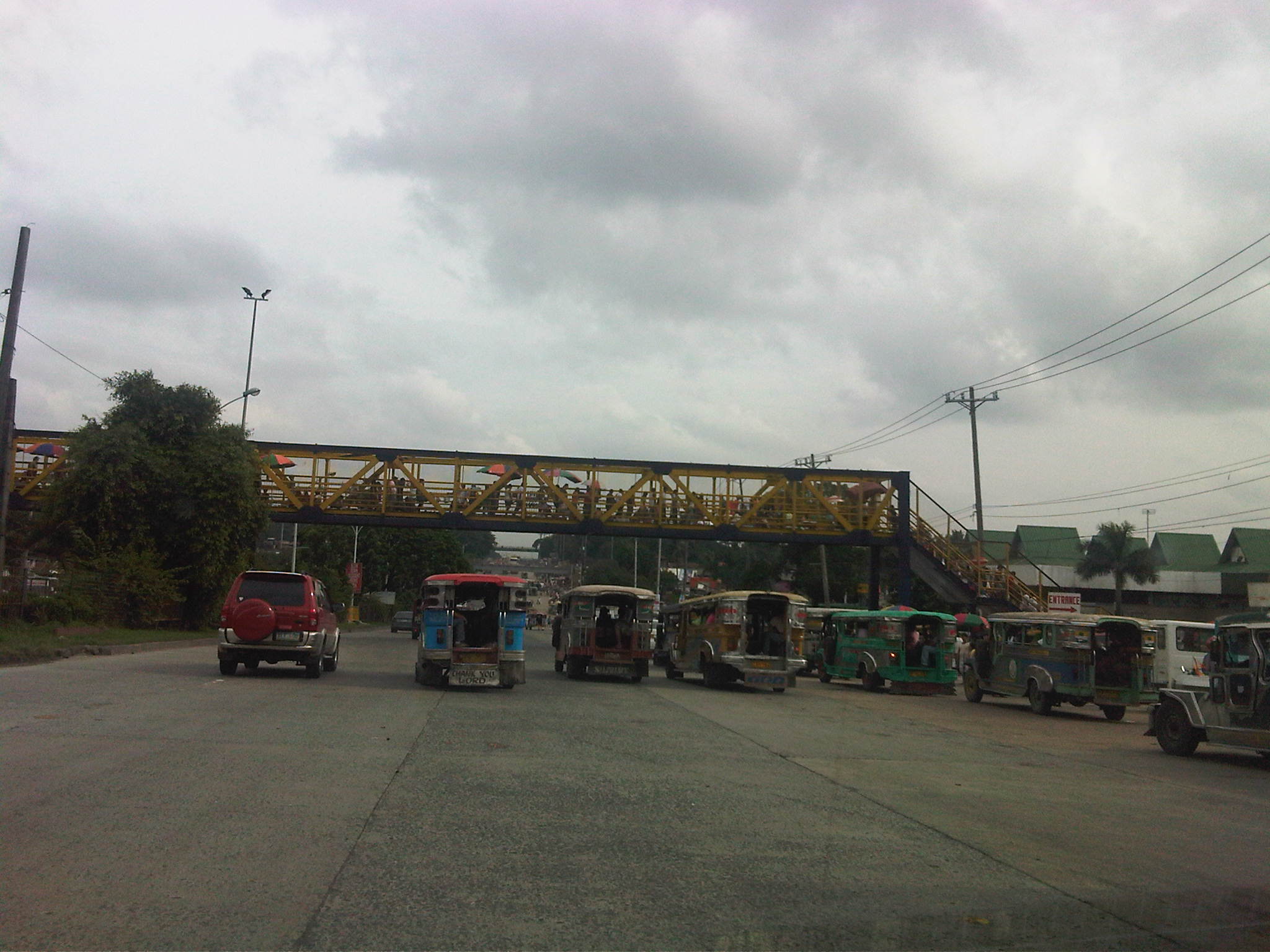 Overpass across Fairview Market (section is across Commonwealth southbound) where vendors have set up to sell various merchandise. Notice the umbrellas to shield vendors from the elements. Note, too, the jeepneys congregating under the overpass and taking up 2, 3 or even 4 lanes of road space and thereby causing congestion along the wide avenue.
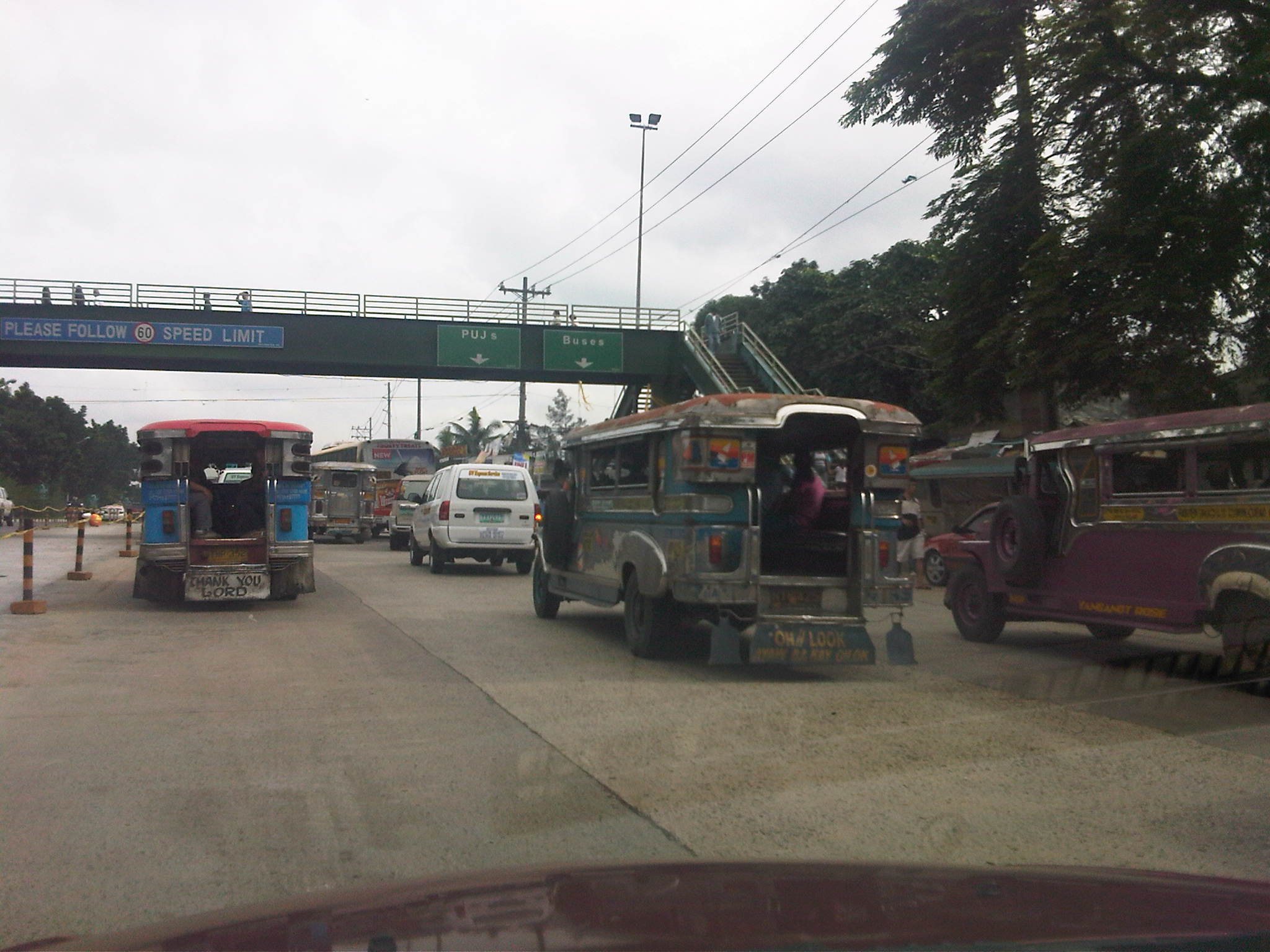 Overpass after Fairview Market and across densely populated areas that are mostly informal settlements. Jeepneys and buses usually congregate under this overpass and another downstream which is across from the Sandiganbayan. The bollards to the left are to segregate a lane with recently laid concrete (re-blocking of certain lanes along Commonwealth).
 Overpass across Ever Commonwealth where vendors have also set up to sell merchandise. The design evokes those of old steel truss bridges in Manila across the Pasig River like the Quezon and Ayala Bridges. Notice the congestion at the overpass at the left portion of the photo.
 Overpass across Tandang Sora where the middle portion descends under the T. Sora flyover in an unusual design that calls to mind the adjustments made for pedestrian facilities constructed across EDSA, and above or below the MRT3 alignment. Notice the countdown timer for the signals at this major intersection.
 Overpass across AIT and CHK of UP Diliman. The canopy is one of two set up atop the overpass for MMDA personnel taking random speed samples to enforce the 60 kph speed limits along Commonwealth. On most days I travel along Commonwealth, there is usually no one taking measuring speed along the NB direction of the highway.
The overpass across the UP Technohub is relatively new but it is free from vendors. In fact, the two overpasses across UP are free from vendors and are regarded as safe and secure because of guards (and even MMDA enforcers) posted at the overpasses to ensure the safety of users of the facilities, especially students and employees of UP and of the Technohub. However, the Philcoa overpass continues to be occupied by vendors despite its roof being removed by the MMDA a few years ago with reasoning that this would deter vendors from setting up atop the overpass.
The problem of vendors on the overpasses is an enduring issue and one that is quite easy to solve if authorities are serious about addressing it. In fact, it is so easy for enforcers or police to prevent or even apprehend/accost vendors as frequent as the latter attempt to set up on the overpass. The continued presence of vendors suggest that there is no sustained effort against these vendors. There are those who even suspect (and are perhaps correct in certain cases) that enforcers or police are being paid to turn a blind eye to these vendors. This is a story that is replicated in many parts of Metro Manila as well as in other cities across the country where overpasses become small time malls or shopping streets, thereby defeating the purpose of having these facilities in the first place. The challenge is for local government units to do what is right in such cases if only to ensure that facilities for pedestrians are safe, secure and unimpeded for efficient flow.
Slippery when wet
The MMDA reported a high of 30 road crashes occurring in Metro Manila. These happened during a very wet day with heavy rains brought about by a typhoon approaching Luzon. Among the high profile crashes yesterday were one involving a bus that fell from the Skyway that cost the lives of 3 people including the driver of the bus. The other involved multiple vehicles including buses (again) and several private vehicles along the underpass section of EDSA near Ayala Avenue in Makati City.
In both cases, those involved and those investigating the incidents all cited the wet and slippery road as the probably cause of the crashes. The statements were all too familiar with drivers stating that they didn’t have enough time and space to stop because of the slippery road. Such reasoning only indicates that there is the likelihood that these drivers did not apply safe driving practices to keep their distance from vehicles ahead of them and to regulate their speeds given that wet roads offer less friction or resistance that would allow for shorter braking distances.
Despite denials, it is likely that the bus that plunged from the Skyway was speeding and that the driver lost control of the vehicle. I would like to believe that the barriers of the elevated highway were designed according to standards set by the DPWH, which are based on international standards that are incorporated in their safe design manual. Despite the standard design for the barriers, the bus still managed to penetrate it, apparently elevating once it hit the barrier.
Barriers are designed according to certain test levels that are deemed suitable for the specific facility. Such test levels that need to be satisfied incorporate elements like vehicle mass, speed, angle of impact and height of center of gravity of the vehicle (Reference: DPWH Highway Safety Design Standards, Part 1: Road Safety Design Manual, 2004). Since traffic along the Skyway consists of a significant number of heavy vehicles including trucks and buses, then the barriers should satisfy the test levels appropriate for these type of vehicles. Thus, it would be easy to check if the Skyway barrier design satisfies standards by checking the as-built specifications of the facility with the DPWH manual.
Nevertheless, speeding and not keeping a safe distance between vehicles are typically causes that may be attributed to the driver. These lead to such road crashes being categorized under driver error as their cause, which is quite justified given that perhaps there are no problems pertaining to the infrastructure/road or the vehicles involved. The weather is not really to blame since it is beyond control but road conditions may deteriorate due to rains if, for example, road drainage is not properly designed or provided. In fact, hydroplaning may occur should there be significant amounts of water on a road and becomes a hazard when vehicles travel at speeds that effectively allow water to come between the tires and the pavement. In such cases, it is also necessary to check whether the tires are able to pump out water as the vehicle runs along the road. In fact, the ridges in tires are supposed to be designed to be able to pump out water, which is the basis for tires to be also checked to make sure that they are suitable for wet roads.
Basically, all drivers should heed the message from a road sign that is provided along roads that are treacherous when the pavement is wet. “Slippery when wet” actually applies to all roads whether it be of Portland cement concrete or asphalt concrete surface, whether of good or bad condition. The mere presence of water on the road pavement presents hazards that can only be addressed if drivers practice safe driving. That is, to regulate their speeds, keep safe distances and lessen maneuvers regarded as risky even when roads are dry.
Vehicle development and safety
As I drove to work this morning, I chanced upon a new model Korean-brand SUV along the highway. I couldn’t help but notice the sleek exteriors and was again impressed by what seemed to me, at least from where I was sitting, was a nicely performing vehicle along a road that was already starting to congest with morning traffic and with pavements still under rehabilitation. As I pulled ahead of the vehicle, I was able to appreciate its front design (the snout in particular) and noticed its lights that were very much similar to those already being used by late model German cars. Of course, the initial reaction would be that perhaps the Korean vehicle was a copy of the original European one. However, I was also aware that Korea already had strong partnerships with leading German automakers and routinely benchmarked their vehicles with their German counterparts. In fact, there are models of German vehicles that were and are developed and tested in Korea, which
I believe that much of the Korean vehicle manufacturers’ success in the design and development of vehicles that are at par if not better than its European counterparts may be attributed to Korea’s testing and research facilities. At the head of the effort for vehicle development and testing is the Korea Transportation Safety Authority or TS, and they work closely with other institutions including the very influential Korea Transport Institute (KOTI). It is a good example of a successful working relationship between government, the private sector and the academe.
I was fortunate to have been able to visit the Korean testing and research facilities back in 2009. At that time, I was part of a small party from the Philippines attending the Regional Environmentally Sustainable Transport (EST) Forum in Seoul, and was among those invited by Korean Transportation Safety Authority (TS) to visit the Korea Automobile Testing & Research Institute. We were very impressed with their facilities and perhaps could only dream of having a similar one in the Philippines. We were toured around the different areas where various tests were being conducted and I was particularly interested in the proving grounds where new models were being tested for various operating conditions. I have some photos taken of the research and testing facilities but I defer from posting these here as there might be some restrictions applicable. Also, I’m afraid my photos won’t do justice to the impressive facilities at KATRI. Nevertheless, I have provided the links to the websites of the institutions I mentioned above for easy reference for anyone interested in their activities. The details may be found there and there are many photos and illustrations that would allow anyone who would at least browse their website to have an idea of just how far Korea has made progress in vehicle development and how much effort they put in to ensure safety on the part of the vehicle.
Is it “Commonwealth” or “Commondeath” Avenue?
There is an excellent article appearing today in the Philippine Star written by Arch. Paulo Alcazaren aptly titled “‘Commondeath’ Avenue.” I stumbled on when it was shared by a friend, Dr. Dayo Montalbo, who is a faculty member of the UP School of Urban and Regional Planning. It provides a rare insight into the history of our highways and streets in Metro Manila. It is required reading for planners and engineers with backgrounds in civil engineering, architecture, urban planning, etc., and, I must say, for anyone who can appreciate history and how we seem to not have learned (or refused to learn) from it. It certainly should be required reading for students who want to become future planners and engineers.
When the MMDA “discovered” plans where it was indicated how wide the RROW for Commonwealth should be and started acquiring land left and right from those who were supposed to have been encroaching on the avenue, including UP Diliman, it apparently didn’t study the old plans and the context by which the capitol, Commonwealth, UP and other institutions where laid out back in the day. That interpretation translated into what we see now as probably the widest highway in the country.
I see the article as something that can be used by the DPWH and the MMDA as an input to whatever planning or engineering they plan along Commonwealth. The avenue is just too wide and definitely not friendly to people. Perhaps it should be transformed into the parkway it was meant to be in the first place.
 Caught (up) in traffic