
Home » Traffic Management (Page 12)
Category Archives: Traffic Management
Running out of answers? How about congestion pricing?
A lot of people ask me about solutions to transport and traffic problems. Some are very general like the question “How do we solve traffic congestion in Metro Manila?” and others are more specific like “How do we solve congestion along EDSA?” These questions are becoming quite tricky because, for one, we are running out of answers of the ‘short term’ kind. All these ‘stop-gap’ or ‘band aid’ measures will only provide short-term relief and we have used many of them already including vehicle restraint measures we are very familiar with like the number coding and truck ban schemes currently implemented in the metropolis.
The general answer and likely an inconvenient truth is that we can’t solve congestion. It is here to stay and is a given considering the continued growth experienced throughout the country. Accepting this phenomenon of congestion, we can proceed towards managing it and work towards alleviating it. Denying that there is a problem or dismissing such as an issue requiring urgent action sets a dangerous course towards unsuitable responses or worse, inaction on the part of the government.
Like cholesterol, there is good congestion and bad congestion. Good traffic congestion is when it is predictable in occurrence and period. For example, the morning rush hour is termed so because it used to last only about an hour or so. Congestion occurring between 7:30 – 8:30 AM is okay but between 6:30 – 11:30 AM is undesirable. The cases between those two vary in acceptability based on the tolerance levels of commuters. In Metro Manila, for example, many people probably have been conditioned to think that 2-hour congestion is okay but more than that is severe. This is actually related to travel times or the time it takes to travel between, say, one’s home and workplace.
And so, are there better options other than a return to the “Odd-Even” scheme? There are actually many other options but they are more complicated to the point that many are unpalatable to people who are in a hurry to get a solution our traffic mess. Note that this is to get out of a hole that’s deep enough already but they still managed to dig deeper the last 5 years. Among these solutions would be congestion pricing.
Singapore offers a successful model for this where tolls vary according to the levels of congestion for these roads. There is a base rate for peak periods when congestion is most likely or expected. The government determines the desirable speed ranges along roads as a basis for congestion charges. Along urban streets, that range may be between 20 – 30 km/h. If speeds reduce to below 20 km/h (i.e., congested) then charges or tolls increase. If speeds increased to above 30 km/h, the rates decrease. The image below is screen capture from a presentation made by an official of Singapore’s Land Transportation Authority (LTA).

Note the item on the scheme being ‘equitable’ that is very essential in understanding how road space must be shared among users and that there is an option to use public transport instead. This scheme, of course, will require a lot of consultations but the technical part should not be worrisome given the wealth of talent at universities, private sector and government agencies who can be involved in the analysis and simulations. Important here also is to determine or institute where the money collected from congestion pricing will go. Logic tells us that this should go to public transportation infrastructure and services. In Singapore, a big part of the funds collected from ERP goes to mass transit including their SMRT trains and buses. Funds help build, operate and maintain their trains and buses. The city-state already has a good public transport system that is subsidized by congestion charges and this system is able to attract people from using their cars especially during the weekdays when transport is used for work and school trips. That way, people who don’t really need to own and use their cars are discouraged from doing so (Note: This works together with Singapore’s restrictive car ownership policies.).
Would it be possible to have congestion pricing for Metro Manila or other cities in the Philippines? Yes, it is and but entails a lot of serious effort for it to work the right way. We can probably start by identifying major roads whose volumes we want regulated, installing sensors for monitoring traffic conditions and tagging vehicles and requiring most if not all vehicles to have transponders for motorists to be charges accordingly. However, there should be an attractive and efficient public transport option for this program to work. Unfortunately, we don’t have such along most roads. Perhaps an experiment or simulation can be undertaken once the LRT 2 extension is completed and operational? That corridor of Marcos Highway and Aurora Boulevard, I believe is a good candidate for congestion pricing.
With the sophisticated software that are now available, it is possible to conduct studies that would employ modelling and simulation to determine the potential impacts of congestion pricing on traffic. It should have a significant impact on congestion reduction even without mass transit systems such as Singapore’s. However, without good public transport, it would be punishing for people who are currently using their own vehicles to avoid taking public transport. I used the term ‘punishing’ because congestion pricing will be a back breaker for people who purchased vehicles to improve their commutes (i.e., they likely were not satisfied with taking public transportation). These are the working people and part of the small middle class whose transport needs should be addressed with urgency.
–
Construction of pedestrian overpass at Masinag
What’s been causing a lot of traffic jams the past week emanating from the Masinag area is the installation of the pedestrian overpasses (or footbridges, if you prefer the term) at the junction. Components of the overpasses were constructed and installed intermittently over several months already. Last Sunday, major works were undertaken including the raising of the main girders that are also to be the walkways for pedestrians. The work entailed closing sections or parts of the intersection and resulted in monstrous traffic jams along both Marcos Highway and Sumulong Highway. The congestion spread to local roads that were used to divert traffic as work was underway during the daytime. Yes, daytime! I found it unusual that such works would be undertaken when traffic was already significant for the two major roads here even if it were a Sunday. Most people had little or no information about this including residents of Antipolo and Marikina who were the most affected by partial closures.
 The still unfinished pedestrian facility at Masinag Junction
The pedestrian facility at Masinag junction has four spans that are supposed to cover crossings across all four legs of the intersection. Thus, theoretically, pedestrians may cross any time despite the busy traffic at ground level. I haven’t seen the stairs yet but if they are much like other footbridges including recent ones of similar design, then I would say that they are not that friendly to senior citizens, persons with disabilities and those who want to cross with their bicycles. Then there are those who are just too lazy to use the overpass and instead would just risk it by braving traffic as they cross at ground level. Already, many pedestrians choose to cross the roads a few meters from the intersection (it used to be that they crossed at the intersection) and it will take a lot of education and enforcement to make most people use the footbridges. Meanwhile, Antipolo should ensure that vendors do not set up shop at the overpasses. This facility is for walking and not shopping.
Among the implications of the four overpasses is the need to re-install traffic signals at the intersection as the current set-up is already obscured by the pedestrian structure. Incidentally, that it also why Antipolo City had to assign personnel to manage traffic at the intersection for much of the day. It is expected that the signals will be installed where motorists can easily see them. The pedestrian facility is also expected to enhance safety at the intersection especially for pedestrians as well as ease congestion for vehicular traffic. Call it car-oriented but it is a necessity given the steadily increasing volume of traffic at the junction. Until there is a good public transport system to help reduce the number of motor vehicles on roads such as Sumulong and Marcos Highways, cars and the like will continue to rule our road space. Ultimately, the provision of pedestrian facilities (hopefully, appropriately designed) is a people-oriented endeavor that should be promoted.
–
Ortigas Avenue Extension Roadworks
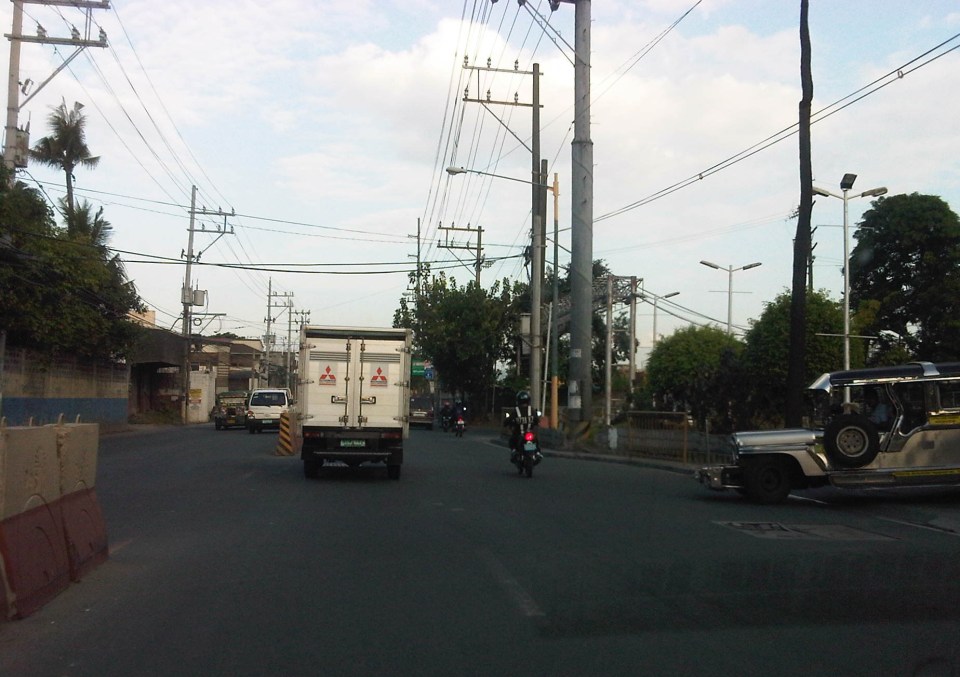
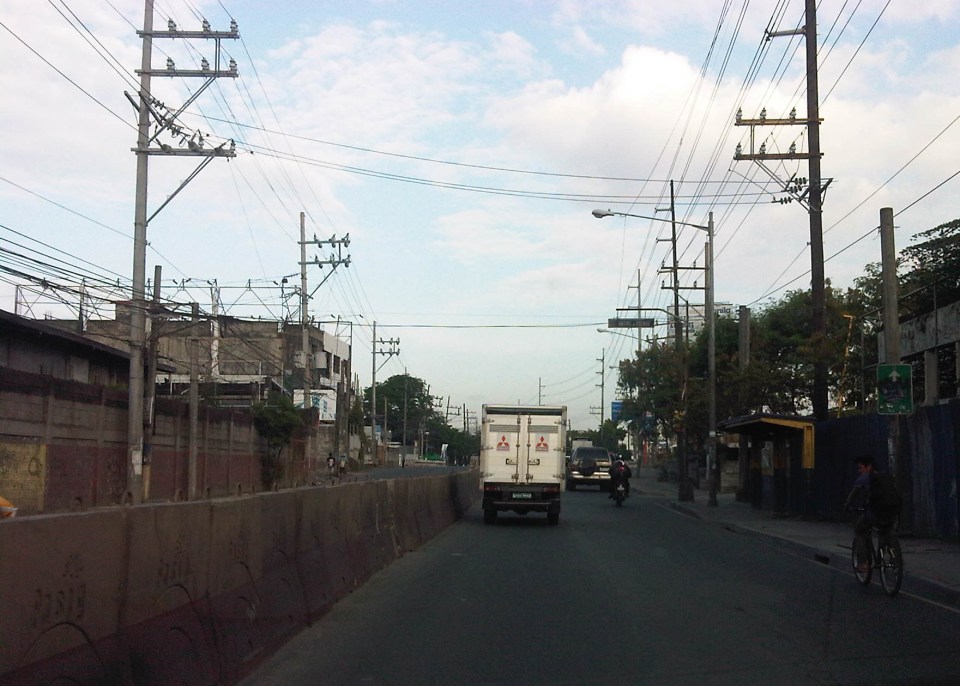
Causing much traffic congestion the past weeks and especially these days are sections of Ortigas Avenue Extension. This is basically caused by roadworks between Cainta Junction and Valley Golf. The section between Brookside and Valley Golf is being raised. The section is a low portion of the road and is almost always flooded whenever there are heavy rains due also in part to the creek in the area. The westbound side of that section is completed and the contractor is now working on the eastbound side. The section is a wider segment of Ortigas and it’s possible to close one lane at a time while having 2 lanes usable for traffic along either side of the road.
The more severe congestion is along the westbound side where another contractor is working on drainage between Junction and Brookside. The section in front of the RRCG bus depot only has one lane usable by traffic and so westbound traffic is regularly backed up for hundreds of meters. How bad is it on a weekday? It took me 30 minutes to pass the area between 5:15 and 6:00 AM last Monday.
 Eastbound traffic splits into two lanes separated by roadworks
 The left lane is part of an already elevated westbound side of Ortigas Ave. Ext. The inner eastbound land has already been graded and ready for concrete pouring. The base course layer is visible in the photo.
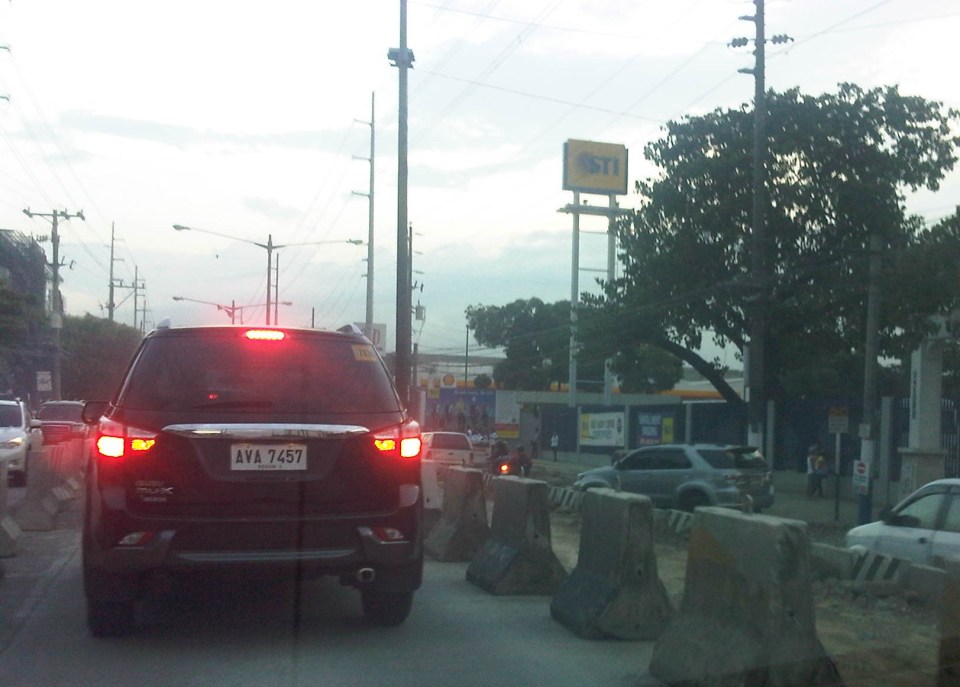 Section near Hunters ROTC Road (right where the grey SUV is coming from) and STI, and approaching Valley Golf.
 Past STI, the traffic lanes go back to normal just before the intersection at Valley Golf.
Traffic is so severe along Ortigas Ave. Ext. that I am sure a lot of people are looking for alternate routes. Those from Antipolo, Taytay and towns along the Manila East Road would likely take the routes utilizing the floodway including Highway 2000 and C-6. Others would find the longer route via Sumulong Highway and/or Marcos Highway to be worth the time and fuel. Hopefully, work will be continuous along Ortigas and roadworks will be completed before we are deep into the typhoon season this year.
–
Ortigas Ave. Extension choke points
One alternative route for my daily commute is Ortigas Avenue. While there are several choke points along this road, I will focus on those between the Ever mall and Cainta Junction. Congestion is also usually experienced between the Manggahan Bridge and Ever but these are mostly due to traffic interruptions because of vehicles turning to and from the many subdivisions whose access/egress line up along Ortigas Ave.
The Ever mall is already a given as a significant traffic generator in the area. However, there is something about its circulation particularly the flow of vehicles in and out of the complex that detrimentally affects Ortigas Ave. traffic. While through traffic along the eastbound direction should use Ortigas Ave., many opt to go through the wide driveway of Ever in order to bypass the choke point that is the exit driveway of the mall. Many of these exiting vehicles are jeepneys turning left into Ortigas westbound (their routes terminate here and make their turnaround via Ever’s driveway). These effectively block the flow of traffic along Ortigas eastbound especially in cases when the westbound direction is also congested (i.e., due to sheer volume as well as stopping vehicles across the mall).
 Vehicles exiting from Ever and turning left to Ortigas westbound
Once eastbound vehicles are freed from the blockage of left-turning vehicles, they have to merge with significant right-turning traffic from Ever that includes buses and mostly through traffic vehicles whose drivers were ‘wise’ to have taken the driveway instead of Ortigas to get through the choke point. The situation results in another choke point right after the first one as the traffic along two lanes of Ortigas eastbound merge with the traffic equivalent to 2-3 lanes turning right from Ever. The total of 5 lanes of traffic squeezing into 2 lanes immediately after is a prime example of a bottleneck.
 Narrow eastbound two-lane section – additional space should be expropriated to widen Ortigas at this section
Right after the short 2-lane section is a sudden widening of Ortigas Ave. in front of BF Metals. I have heard it said that this is the ideal road width for Ortigas Ave. considering the volume of traffic passing through this major corridor connecting Rizal province with Metro Manila. There are practically 4 lanes for each direction at this short section so its easy to project these lanes on maps to see what properties would need to be expropriated if the objective is road widening. (Of course, the best option should still be to pursue a mass transit system along this corridor.)
 Ideal road width – Ortigas Avenue at its widest is the section across BF Metals. Vehicles here spread out along the many lanes suddenly available. But then people will eventually and immediately realize this is the mouth of a funnel. Note the sign indicating that vehicles are entering the Province of Rizal from this point.
 The eastbound section in front of BF Metals is usually parking lot in the evenings. This is due mainly to the 4 lanes almost abruptly constricting into 2 lanes just past BF Metals. Compounding things is the U-turn slot located here where many jeepneys whose routes end at Cainta Junction make their turnaround. Turning vehicles are assisted by “tambays” earning their money by blocking eastbound vehicles to make way for U-turning vehicles.
Finally, there is Cainta Junction itself, which is a signalized 4-leg intersection that handles a tremendous volume of traffic all-day. I am sure that there are efforts for the traffic signal settings to be optimized but more often there is human intervention for traffic management at the intersection. Whether this causes more severe congestion is quite obvious to many travelers going through this intersection. Queues along Imelda Ave./Felix Ave., for example, can reach way past Village East even reaching Vista Verde on a bad day. This only shows that the intersection is already severely saturated and conventional traffic management or signal settings can no longer handle the traffic. Perhaps the next stage of engineering intervention for this intersection is grade separation or the construction of a flyover or two at the intersection. Notably, such a project should including strategic widening along Ortigas Ave in order to balance the number of lanes feeding into and receiving traffic from the intersection.
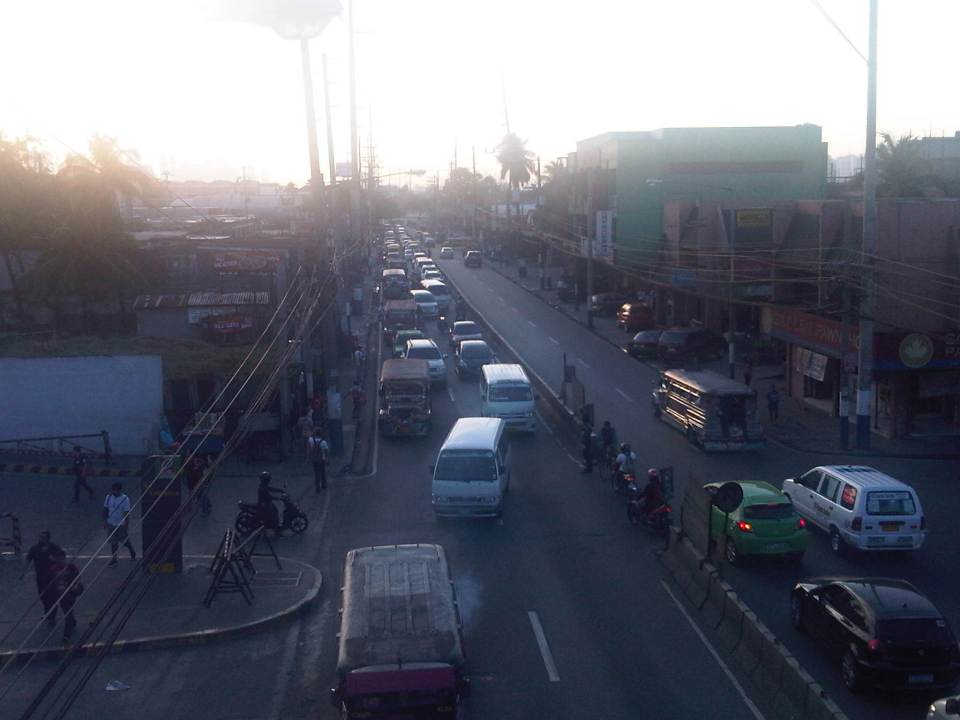 A view of the traffic approaching Cainta junction – there are only 2 lanes along the eastbound side of Ortigas and public utility vehicles stopping here only exacerbates the congestion along the road.
Is road widening the ultimate solution to Ortigas Ave congestion? I personally don’t think so. As I have mentioned earlier in this post and in previous posts the key is still to come up with a mass transit system to serve this eastern corridor. Yes, there will eventually be a Line 2 along Marcos Highway, the main alternate (or competing?) route to Ortigas but is is obvious that even with a railway line along Marcos Highway and connecting to Aurora Blvd., there will still be an urgent need for a similar capacity line along Ortigas. The buses and jeepneys can no longer handle the demand and their poor levels and qualities of service have given rise to a proliferation of UV Express and pushed people to purchase cars and motorcycles. Congestion can be reduced significantly with a mass transit system along Ortigas. Without this transit system, Ortigas will just continue to be congested even if the entire corridor is widened; except perhaps if it is widened like Commonwealth Ave. in Quezon City. I don’t think that is possible and practical.
–
On the uncommon sense on license plates
The issuance of new license plates has been a very “painful” process and experience to a lot of people and it is not without serious issues. For one, there is still a backlog in license plates as evident from Strictly speaking, these vehicles shouldn’t be operating or not allowed to be driven even considering they are technically registered with the Land Transportation Office (LTO). The proliferation of vehicles without license plates allows for the abuse of such by owners of relatively new vehicles who can remove their plates in order to be able to take their cars on their coding days. It is also possible to be involved in a road crash or incident where the driver of a vehicle without a license plate can make an escape (the details on the conduction sticker are not easy to spot and memorize) or evade apprehension.
Among the most problematic is the issuance of plates of the same design as that used by private vehicles to public utility vehicles like UV Express and taxis. This creates a lot of opportunities for abuse especially private vehicles masquerading as PUVs. These are without the proper franchises and are illegal (i.e., colorum). What the LTO claims as security features on the plate are meaningless as the uniform color of the plates defy the simple logic behind the old policy of having a specific color to quickly distinguish among vehicles bearing different color plates. This makes it easier for traffic officers including the Philippine National Police (PNP) to spot vehicles with mismatched or inappropriate license plates.
 Taxi cab bearing plate with the same design as that used by private vehicles.
 UV Express van bearing license plate for private vehicles
The purpose of having plates with different colors is for quick identification and distinction of vehicles. A plate with yellow background has always been associated with public utility vehicles. Those with blue lettering or background are those for diplomatic plates. Those with red lettering or background are for government plates. Fortunately, the LTO has reverted to the original policy pertaining to the license plate colors and new plates to be issued to PUVs will once again be a distinctive yellow. Perhaps corrections are due for those legitimate PUVs that were issued inappropriate design (i.e., color) plates.
–
All roads lead to Antipolo: rerouting for the Alay Lakad
The Rizal Provincial Government and the Antipolo City Government recently posted traffic rerouting schemes on their Facebook pages. Lalawigan ng Rizal was the first to post schemes that affect traffic in at least 3 major local government jurisdictions – Antipolo, Cainta and Taytay. The schemes affect the two major corridors that basically lead to Antipolo’s National Shrine of Our Lady of Peace and Good Voyage (or Antipolo Cathedral to many) – the Ortigas Avenue corridor and the Marcos Highway-Sumulong Highway corridor. There are many major and minor routes connecting to these corridors and are clearly seen in the maps.
Within Antipolo, there are also re-routing schemes, which the Antipolo City Government posted along with a “clearer” re-posting of the maps from the Rizal FB page. The Antipolo FB page includes information/maps on the rerouting within the city center. These schemes will affect traffic circulation including public transport routes. Critical would be the permanent and temporary terminals and parking areas set-up around the city that should be able to accommodate the thousands of vehicles that are also expected to be used by people who won’t be walking or cycling.
What the maps basically say is that from 4:00 PM today, Maundy Thursday, to 6:00 AM tomorrow, Good Friday, the stretch from Cainta Junction to the Shrine will be closed to traffic. This is to allow the hundreds of thousands expected to make the trek to Antipolo to have the road for themselves. What the maps don’t say is that motorcycles and tricycles would likely be allowed, too. I can understand that motorcycles could easily squeeze into the throngs of people but then allowing tricycles to operate among the walkers and bikers would be risky given their drivers’ behavior. Add to this that they would be making a killing out of charging opportunistic fares.
Technically, the rerouting schemes don’t appear to be as well thought of as can be expected from the LGUs. Baka ito lang nakayanan ng staff o ng consultants nila, and surrender na agad ang Rizal and Antipolo with regards to the coming up with more options for people to travel to the Antipolo Shrine? Not all people can walk or cycle but are willing to an could take public transport for their pilgrimage. The maps themselves are a bit crude and the Province of Rizal and City of Antipolo could have done much better maps given the resources of these LGUs. There are open source tools now available as well as your basic software like PowerPoint or Photoshop (even Word!) that can be used to render good quality images to guide people making the Alay Lakad. This is a regular event and though it happens once a year then perhaps the LGUs could have better plans especially to transport people who cannot make the walk to Antipolo. The objective after all is to convey the masses to and from the shrine safely and efficiently – something a mass transport system can do whether via Marcos/Sumulong or Ortigas corridors.
One reminder to all doing the Alay Lakad: keep your garbage to yourselves if you cannot find a proper waste bin. Do not dispose of your waste along the route and make a dumpsite out of Ortigas Avenue, Marcos Highway, Sumulong Highway or whatever roads you are taking! Kasalanan din po ang irresponsableng pagtatapon ng basura. While you might be forgiven for these “sins” through the Sacrament of Reconciliation (which many will likely take at the Cathedral), nature will have a way of getting back at you for your environmental travesty. –
“Gatong” comments by traffic enforcers
Friends who have been involved in a road crash have noted that traffic enforcers seem to have the propensity for making unnecessary remarks while attending to a crash scene. I have experienced this first hand. Some of the more common comments that enforcers make include:
– How crash or accident-prone an area is (citing issues in the area);
– How certain motorists are more likely to be involved in crashes (often referring to one of the parties involved); and
– How one party’s behavior leads or led to a crash (essentially blaming one party for the incident).
[You’re free to add a comment you heard yourself or someone else got from a crash scene.]
Traffic enforcers or police should not make such comments at the scene of a crash especially in front of the parties involved. It is not about whether they have the right to do so but whether it is appropriate coming from a person of authority who should first and foremost be neutral in such circumstances. For one, such unnecessary comments could affect how people involved in a crash could behave. Generalized statements could wrongly favor one party over the other simply because a person of authority made a comment to the contrary of how things really happened. Enforcers should be neutral and go about their business in getting the facts about an incident and proceed in making the formal report for the crash. Even the investigator assigned to the scene should be as objective as possible in order to have a fair assessment of the incident.
–
On school trip generation and exclusive villages
In the news weeks ago is the coding scheme for vehicles that Ayala Alabang, a posh residential subdivision in Muntinlupa City, imposed on vehicles coming in and out of the village. According to media reports, affected are vehicles bound for and coming out of De La Salle Zobel (DLSZ), which is an exclusive school located inside the subdivision. There is another exclusive school inside the village but they don’t seem to be in the news regarding this issue on car stickers and access through the subdivision roads. Perhaps they generate a lot less cars from outside the village?
I lived in villages where there are exclusive schools also located inside the villages. They are smaller compared to DLSZ and likely generate significantly less vehicles than the latter. Also, the numbers of vehicles they generated from outside the subdivisions are not enough to cause traffic congestion along the main roads to and from the schools and the village gates.
For the school in the former subdivision we used to reside in, I noticed that most students arrived via school service. School service vehicles carry more passengers than private cars and so help reduce the number of vehicles generated by the school. These were mostly vans or AUVs and not the mini-buses, coasters or regular buses of when I was in grade school and high school myself. Though lower in capacity compared to buses, AUVs and vans could take in 10 to 12 students comfortably and perhaps max out at 14 to 16 people depending on the sizes of the children the ferry between school and their homes.
In the current subdivision where I live, most students go by car and the wider main road that they use translated to faster cars running between the village gate and the school. I have observed many instances when speeding vehicles do not slow down at intersections or when there are people about to cross the street. There are no humps along the main road like those in the previous village. Humps or speed bumps can be very effective in reducing speeds but improperly designed humps can eventually damage your car’s suspension. The rolling terrain of our village does not seem to be a deterrent against speeding and limited sight distances along the main road presents a significant likelihood that a crash can occur involving speeding vehicles. Thus, some traffic calming measures need to be formulated and implemented before tragedy strikes.
Now that school is almost out for most schools (including the ones inside subdivisions) I think the attention the issue has been getting will steadily die down. But that will be until schools open again in June and residents again feel the impacts of traffic generated by the schools from without the subdivision whether its traffic congestion or road safety that is the more pressing issue in residential subdivisions hosting schools. Perhaps a sticker system and the restriction of the number of vehicles of outsiders is one way to reduce the negative impacts of traffic generated and then there is also the option of not allowing a major school to be located inside a residential subdivision in the first place.
–
Enforcing bus lanes along Commonwealth Avenue
Commonwealth Avenue always seems to be the subject of road safety or traffic discipline initiatives every now and again. Quezon City together with partners in other government agencies like the Philippine National Police (PNP) and the Department of Transportation and Communications (DOTC) have embarked on another program aimed at reducing the occurrence of road crashes and other incidents along this busy corridor. It actually reminds me of the “traffic discipline zone” designation of Commonwealth not a decade ago and before public transport lanes were physically allocated along the highway.
They are failing miserably if I am to base success on observations of the behavior of drivers of public transport vehicles alone along this major highway. They get away with a lot of reckless driving including suddenly switching lanes, speeding, and tailgating. There are also cases where vehicles and pedestrians cross the wide highway at points that are prone to crashes. I am not aware of a lot of apprehensions being made of these reckless drivers along Commonwealth except perhaps at the foot of the Tandang Sora flyover where MMDA enforcers seem to be congregating on most days armed with one of two of the agency’s speed guns. But then it seems “business as usual” for the same drivers and riders along the rest of Commonwealth so the initiatives are not effective deterrents against irresponsible road use.
 You can always see buses on the wrong side of the road along Commonwealth Avenue especially along the section between Fairview Market and Regalado. They do this to get ahead of other buses and then bully their way to make a stop or turn right at an intersection.
 This bus in particular was weaving in traffic, bullying smaller vehicles to give way as it raced other buses along Commonwealth Avenue. Such behavior among public transport drivers is one of the major ingredients for road crashes.
It’s been a year now since the tragic crash involving an out of line provincial bus in the Cordillera. That was partly the result of poor monitoring and enforcement by the LTFRB. While the major reason for the crash was reckless driving (i.e., the driver was allegedly speeding at a critical section of the highway), this could have been avoided if the bus wasn’t operating in the first place. The very same policies along Commonwealth apply to these provincial buses and fatal crashes could’ve been avoided or minimised if the LTFRB can just exercise its mandate effectively.
–
On jaywalking, overpasses and informal terminals
I had some errands last December and decided to take public transport instead of taking our car and wasting time parking the vehicle. There was significantly less traffic at that time of the year because schools already on Christmas break and everyone else seemed to be on the slow side of the holiday mode (read: not in shopping mode). I needed to cross the wide road that is Quezon Avenue and there was a sign where I usually crossed that it was now prohibited to cross there. I had to take the overpass to get to the other side and to the jeepney stop to board one to get back to the university.
The overpass at the Quezon Ave.-Araneta Ave. intersection is under-utilized. I base this on the several times I’ve used the overpass. Most people prefer to cross at road level, taking advantage of the traffic signal cycle that allows for gaps in the traffic for pedestrians to cross safely. Of course, there are those who cross any time and seem to tempt fate by their behaviour. They seem to tempt also the MMDA traffic enforcers assigned in the area but from what I have observed, enforcement of the “no jaywalking” policy is usually lax or non-existent. People regularly cross at ground level in plain view of traffic enforcers.
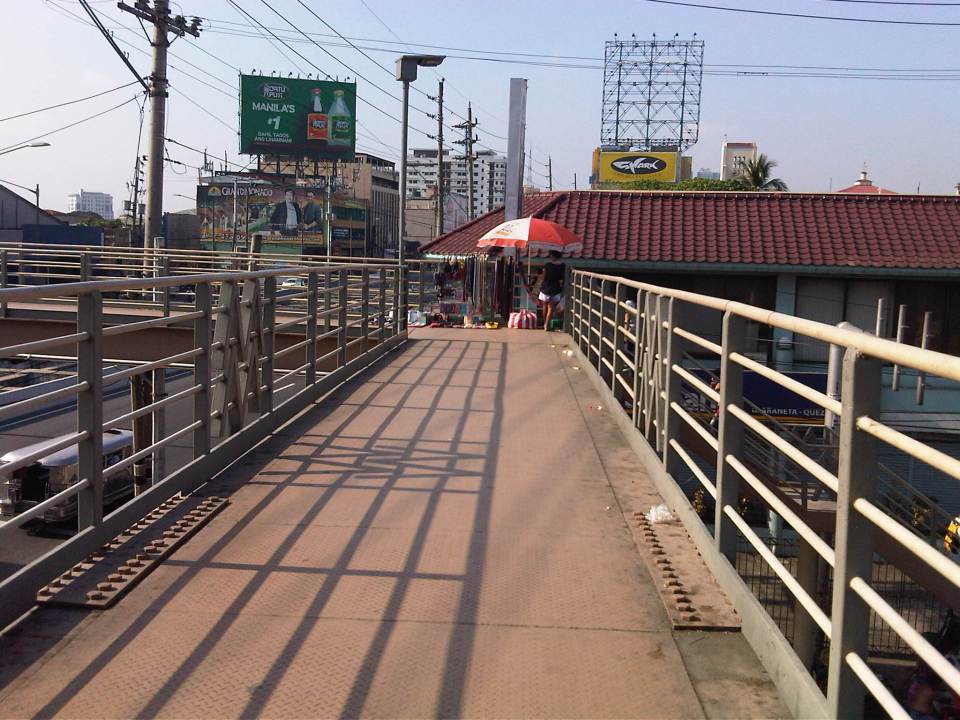 A vendor set-up at the corner of the pedestrian overpass at the Quezon Ave.-Araneta Ave. intersection. Obviously, there are few pedestrians using this overpass as most prefer to cross at ground level.
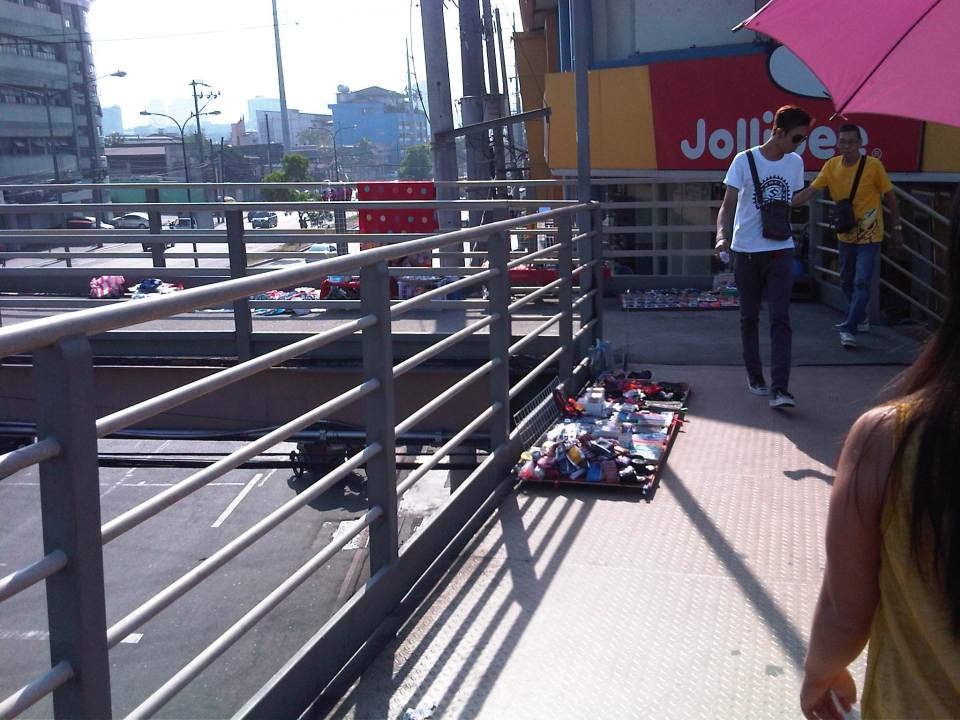 More vendors on the overpass – fortunately, there were few pedestrians using the overpass at the time. Its not the same for other overpasses that are crowded due in part to vendors occupying much of the facility.
 The stairs for many overpasses around Metro Manila are a bit on the steep side. That’s generally not okay with senior citizens, children or persons with disabilities.
There is an informal, on-street jeepney terminal right at the foot of the overpass. If you are in a hurry, its best to try to board a jeepney on the second lane as they are more likely to proceed when the approach is given a green light. From my experience, it takes about 2-3 cycles before the “queued” jeepneys finally cross the intersection. It takes that time to at least have several passengers for the jeepneys before it proceeds to cross the intersection. Most passengers here are transferring from jeepneys plying routes along Araneta Ave. There shouldn’t be an informal terminal here and jeepneys occupy 1-2 lanes of the road at a critical point – the intersection approach. This means intersection capacity is significantly affected and many vehicles could not proceed as they are blocked by the jeepneys. Special mention is made of vehicles wanting to make a right turn but have to go through this “gauntlet” of public utility vehicles. Again, there are MMDA enforcers in the area but it seems the jeepneys and the barkers hold sway and likely with the blessing of enforcers. Such situations are commonplace in Metro Manila and many other cities, and contribute to traffic congestion and other problems commuters regularly encounter.
–
 Caught (up) in traffic