
Home » Traffic Management (Page 13)
Category Archives: Traffic Management
“Gatong” comments by traffic enforcers
Friends who have been involved in a road crash have noted that traffic enforcers seem to have the propensity for making unnecessary remarks while attending to a crash scene. I have experienced this first hand. Some of the more common comments that enforcers make include:
– How crash or accident-prone an area is (citing issues in the area);
– How certain motorists are more likely to be involved in crashes (often referring to one of the parties involved); and
– How one party’s behavior leads or led to a crash (essentially blaming one party for the incident).
[You’re free to add a comment you heard yourself or someone else got from a crash scene.]
Traffic enforcers or police should not make such comments at the scene of a crash especially in front of the parties involved. It is not about whether they have the right to do so but whether it is appropriate coming from a person of authority who should first and foremost be neutral in such circumstances. For one, such unnecessary comments could affect how people involved in a crash could behave. Generalized statements could wrongly favor one party over the other simply because a person of authority made a comment to the contrary of how things really happened. Enforcers should be neutral and go about their business in getting the facts about an incident and proceed in making the formal report for the crash. Even the investigator assigned to the scene should be as objective as possible in order to have a fair assessment of the incident.
–
On school trip generation and exclusive villages
In the news weeks ago is the coding scheme for vehicles that Ayala Alabang, a posh residential subdivision in Muntinlupa City, imposed on vehicles coming in and out of the village. According to media reports, affected are vehicles bound for and coming out of De La Salle Zobel (DLSZ), which is an exclusive school located inside the subdivision. There is another exclusive school inside the village but they don’t seem to be in the news regarding this issue on car stickers and access through the subdivision roads. Perhaps they generate a lot less cars from outside the village?
I lived in villages where there are exclusive schools also located inside the villages. They are smaller compared to DLSZ and likely generate significantly less vehicles than the latter. Also, the numbers of vehicles they generated from outside the subdivisions are not enough to cause traffic congestion along the main roads to and from the schools and the village gates.
For the school in the former subdivision we used to reside in, I noticed that most students arrived via school service. School service vehicles carry more passengers than private cars and so help reduce the number of vehicles generated by the school. These were mostly vans or AUVs and not the mini-buses, coasters or regular buses of when I was in grade school and high school myself. Though lower in capacity compared to buses, AUVs and vans could take in 10 to 12 students comfortably and perhaps max out at 14 to 16 people depending on the sizes of the children the ferry between school and their homes.
In the current subdivision where I live, most students go by car and the wider main road that they use translated to faster cars running between the village gate and the school. I have observed many instances when speeding vehicles do not slow down at intersections or when there are people about to cross the street. There are no humps along the main road like those in the previous village. Humps or speed bumps can be very effective in reducing speeds but improperly designed humps can eventually damage your car’s suspension. The rolling terrain of our village does not seem to be a deterrent against speeding and limited sight distances along the main road presents a significant likelihood that a crash can occur involving speeding vehicles. Thus, some traffic calming measures need to be formulated and implemented before tragedy strikes.
Now that school is almost out for most schools (including the ones inside subdivisions) I think the attention the issue has been getting will steadily die down. But that will be until schools open again in June and residents again feel the impacts of traffic generated by the schools from without the subdivision whether its traffic congestion or road safety that is the more pressing issue in residential subdivisions hosting schools. Perhaps a sticker system and the restriction of the number of vehicles of outsiders is one way to reduce the negative impacts of traffic generated and then there is also the option of not allowing a major school to be located inside a residential subdivision in the first place.
–
Enforcing bus lanes along Commonwealth Avenue
Commonwealth Avenue always seems to be the subject of road safety or traffic discipline initiatives every now and again. Quezon City together with partners in other government agencies like the Philippine National Police (PNP) and the Department of Transportation and Communications (DOTC) have embarked on another program aimed at reducing the occurrence of road crashes and other incidents along this busy corridor. It actually reminds me of the “traffic discipline zone” designation of Commonwealth not a decade ago and before public transport lanes were physically allocated along the highway.
They are failing miserably if I am to base success on observations of the behavior of drivers of public transport vehicles alone along this major highway. They get away with a lot of reckless driving including suddenly switching lanes, speeding, and tailgating. There are also cases where vehicles and pedestrians cross the wide highway at points that are prone to crashes. I am not aware of a lot of apprehensions being made of these reckless drivers along Commonwealth except perhaps at the foot of the Tandang Sora flyover where MMDA enforcers seem to be congregating on most days armed with one of two of the agency’s speed guns. But then it seems “business as usual” for the same drivers and riders along the rest of Commonwealth so the initiatives are not effective deterrents against irresponsible road use.
 You can always see buses on the wrong side of the road along Commonwealth Avenue especially along the section between Fairview Market and Regalado. They do this to get ahead of other buses and then bully their way to make a stop or turn right at an intersection.
 This bus in particular was weaving in traffic, bullying smaller vehicles to give way as it raced other buses along Commonwealth Avenue. Such behavior among public transport drivers is one of the major ingredients for road crashes.
It’s been a year now since the tragic crash involving an out of line provincial bus in the Cordillera. That was partly the result of poor monitoring and enforcement by the LTFRB. While the major reason for the crash was reckless driving (i.e., the driver was allegedly speeding at a critical section of the highway), this could have been avoided if the bus wasn’t operating in the first place. The very same policies along Commonwealth apply to these provincial buses and fatal crashes could’ve been avoided or minimised if the LTFRB can just exercise its mandate effectively.
–
On jaywalking, overpasses and informal terminals
I had some errands last December and decided to take public transport instead of taking our car and wasting time parking the vehicle. There was significantly less traffic at that time of the year because schools already on Christmas break and everyone else seemed to be on the slow side of the holiday mode (read: not in shopping mode). I needed to cross the wide road that is Quezon Avenue and there was a sign where I usually crossed that it was now prohibited to cross there. I had to take the overpass to get to the other side and to the jeepney stop to board one to get back to the university.
The overpass at the Quezon Ave.-Araneta Ave. intersection is under-utilized. I base this on the several times I’ve used the overpass. Most people prefer to cross at road level, taking advantage of the traffic signal cycle that allows for gaps in the traffic for pedestrians to cross safely. Of course, there are those who cross any time and seem to tempt fate by their behaviour. They seem to tempt also the MMDA traffic enforcers assigned in the area but from what I have observed, enforcement of the “no jaywalking” policy is usually lax or non-existent. People regularly cross at ground level in plain view of traffic enforcers.
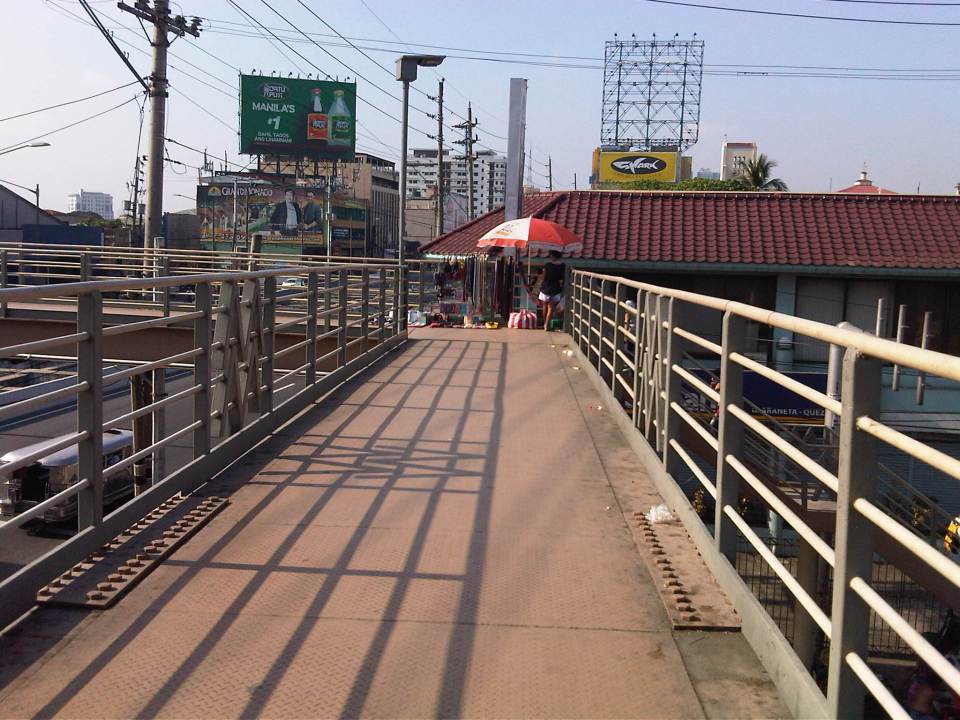 A vendor set-up at the corner of the pedestrian overpass at the Quezon Ave.-Araneta Ave. intersection. Obviously, there are few pedestrians using this overpass as most prefer to cross at ground level.
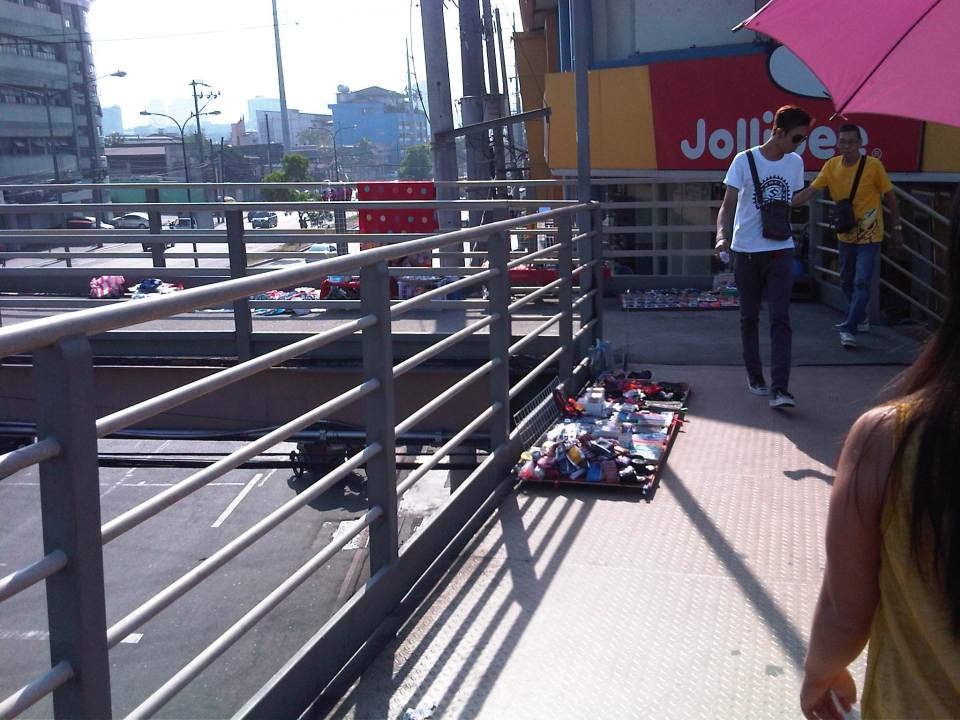 More vendors on the overpass – fortunately, there were few pedestrians using the overpass at the time. Its not the same for other overpasses that are crowded due in part to vendors occupying much of the facility.
 The stairs for many overpasses around Metro Manila are a bit on the steep side. That’s generally not okay with senior citizens, children or persons with disabilities.
There is an informal, on-street jeepney terminal right at the foot of the overpass. If you are in a hurry, its best to try to board a jeepney on the second lane as they are more likely to proceed when the approach is given a green light. From my experience, it takes about 2-3 cycles before the “queued” jeepneys finally cross the intersection. It takes that time to at least have several passengers for the jeepneys before it proceeds to cross the intersection. Most passengers here are transferring from jeepneys plying routes along Araneta Ave. There shouldn’t be an informal terminal here and jeepneys occupy 1-2 lanes of the road at a critical point – the intersection approach. This means intersection capacity is significantly affected and many vehicles could not proceed as they are blocked by the jeepneys. Special mention is made of vehicles wanting to make a right turn but have to go through this “gauntlet” of public utility vehicles. Again, there are MMDA enforcers in the area but it seems the jeepneys and the barkers hold sway and likely with the blessing of enforcers. Such situations are commonplace in Metro Manila and many other cities, and contribute to traffic congestion and other problems commuters regularly encounter.
–
The Metro Manila Transportation Planning Study II (JUMSUT II)
Similar to the previous JUMSUT Phase I, the recommendations of Phase II focused on route structure planning and improvement for road public transport to avoid unnecessary competition between LRT, bus and jeepney. Recommendations for route structure planning included the modification of route schemes for the central eastern sector of Metro Manila mainly to alleviate traffic congestion and improve schedules. The study reiterated the recommendations of Phase I.

Following are more photos showing the recommendations of JUMSUT II:

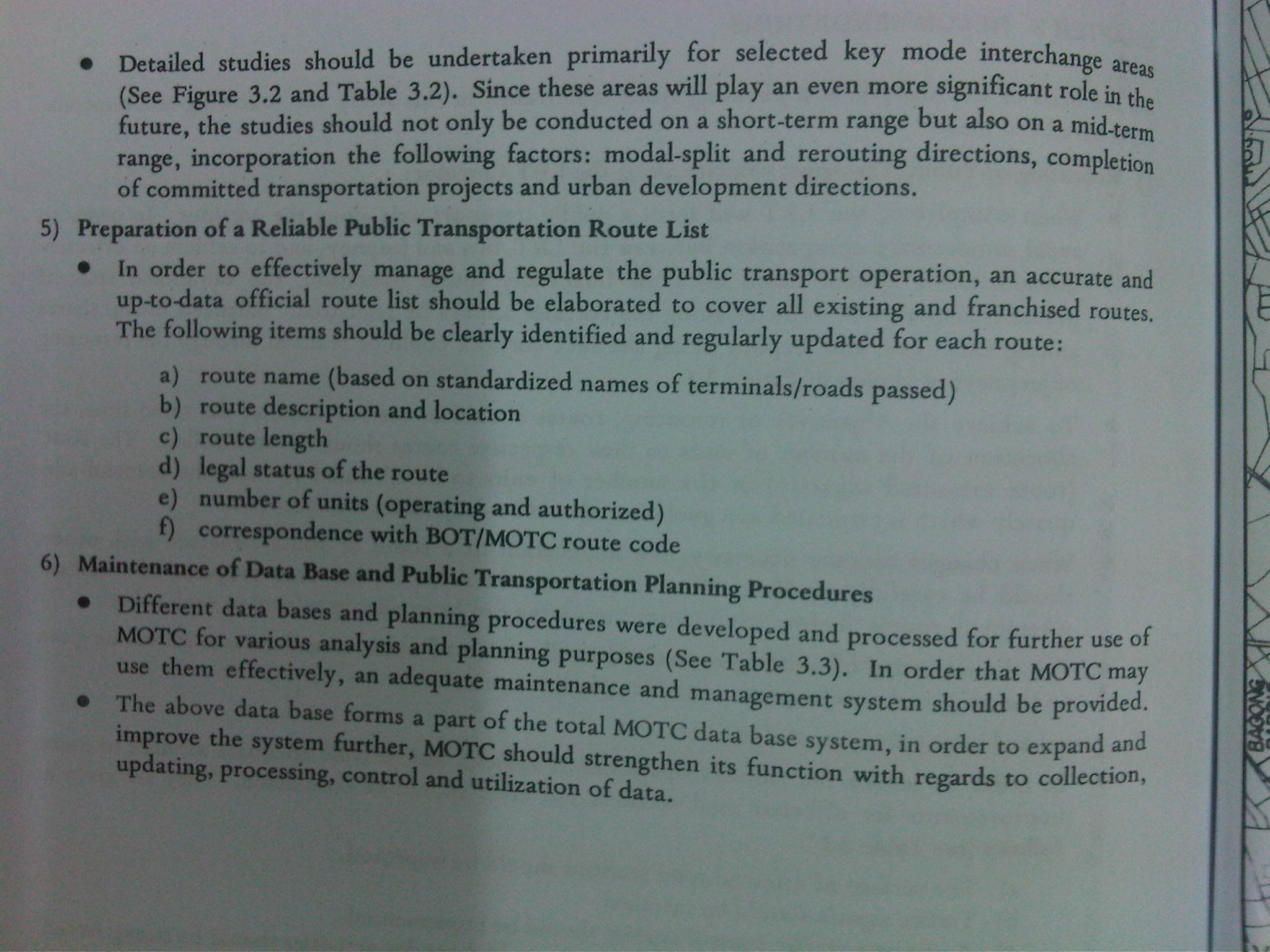
[Reference: JUMSUT II Final Report, NCTS Library, University of the Philippines Diliman]
–
The Metro Manila Transportation Planning Study I (JUMSUT I)
I continue with the series of posts I had started last year on past studies conducted for Metro Manila. It is important to review these studies in order for us to understand how transport in the metropolis came to be how it is now. I believe there are many lessons to be learned and history does not need to repeat itself (although as we can see, it has in as far as transport in Metro Manila is concerned).
The Metro Manila Transportation Planning Study better known as the JICA Update on Manila Study on Urban Transport (JUMSUT) was conducted in two phases, the first one from November 1982 – March 1984 and the second from June 1984 – March 1985, respectively, as a follow-up to MMUTSTRAP. JUMSUT focused on studies to support the implementation of the LRT Line 1 project along Rizal and Taft Avenues.

Recommendations of the first phase are mostly on the rerouting of public transport vehicles along LRT corridor and the traffic management required for the construction and eventual operation of the LRT Line 1. The rerouting is presented as a necessity to avoid unnecessary competition between LRT, bus and jeepney as well as to achieve balanced mode share among LRT, bus and jeepney along the corridor. Following are photos showing a summary of recommendations for JUMSUT I.

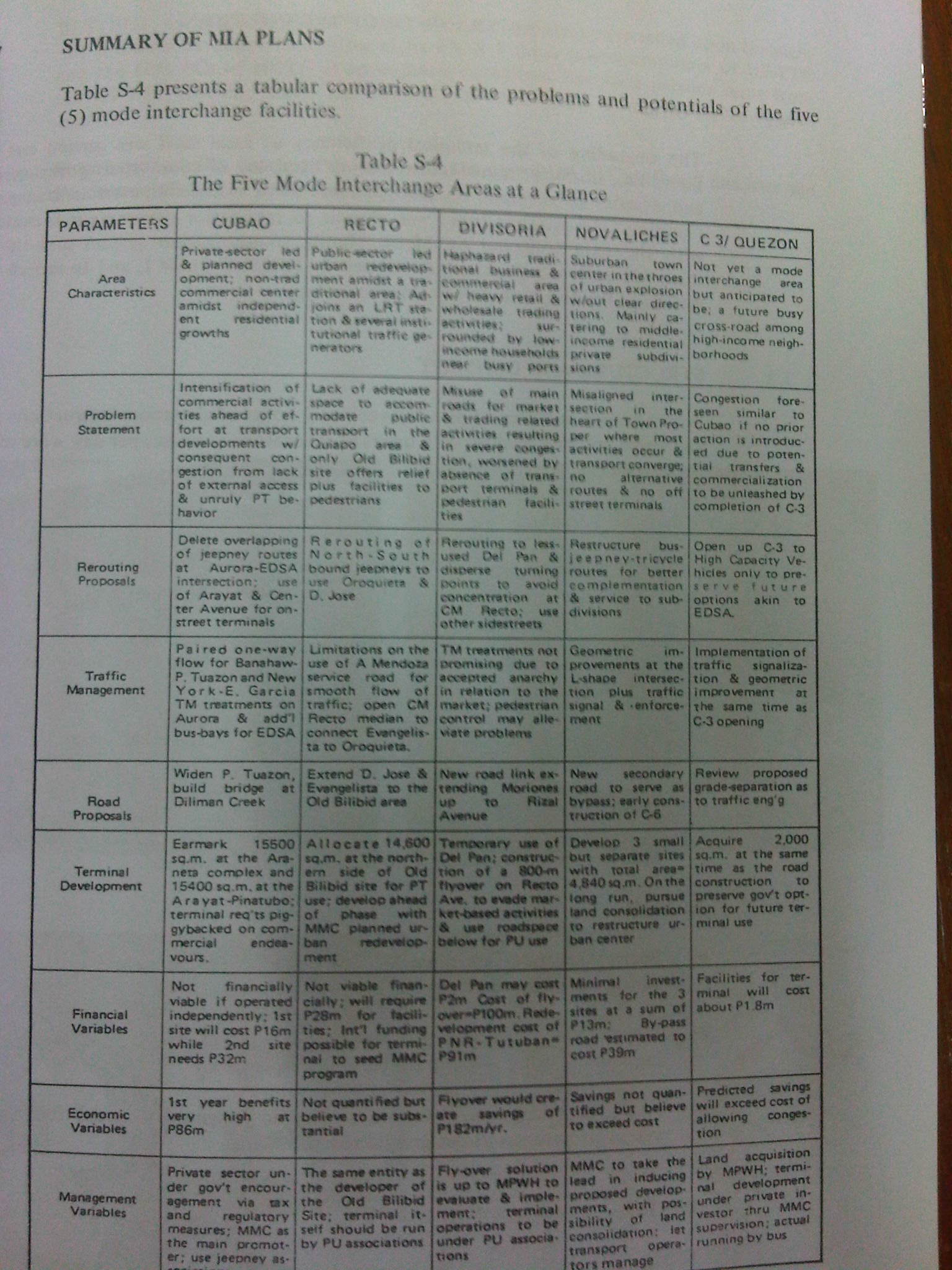
[Reference: JUMSUT I Final Report, NCTS Library, University of the Philippines Diliman]
Next: JUMSUT II
–
On the new vehicle plates in the Philippines
A lot has been written about the new license plates being issued by the Land Transportation Office (LTO) for vehicles. I have read and heard many opinions or explanations from officials, experts and pundits about how the current license plates were better than the old ones due to its security features. As well, I have heard the opposite – criticisms by similar officials, experts and pundits usually focusing on the flaws of the new plates compared to the previous ones. They do agree on one thing, that the 4 numbers now appearing on the new vehicle plates issued to vehicles registered from January 2014 (5 numbers for the new motorcycles) are a necessity due in part to the rapidly increasing number of registered vehicles in the Philippines. Of course, the delays in the actual issuance of the plates themselves for new vehicles is another story.
Green plates are for private vehicles (not for hire). Red plates are for government vehicles. Blue plates (with only numbers and no letters) are diplomatic plates. Orange plates are the newest type of plates and were issued to electric vehicles. These solid orange plates and not of similar design to those bearing the Rizal Monument. Yellow plates are for “for hire” vehicles including public utility vehicles like buses, jeepneys, taxis and vans-for-hire. Recently, there were actually two types of yellow plates. One type used the design with the Rizal monument in the middle and these were issued to limousines such as those operated by hotels and tour companies. The other is the solid yellow plates (no Rizal Monument) that were issued to PUVs.
 UV Express vehicle with the solid yellow plate.
The new plates issued by the LTO are black and white – basically black lettering on white plates. Recently, friends have been telling me about their seeing the new black and white plates on taxis. I had thought that this shouldn’t be the case since PUVs like taxis are supposed to have distinctive color (yellow) plates in order for illegally (so-called colorum) operating vehicles to be spotted easily by authorities. It turned out that the LTO under the previous head of the agency did away with the yellow plates in favor of what they claimed to be more sophisticated new plates. My reaction was that this was absurd and visual identification (i.e., seeing the color of the vehicle’s plate) is still the easiest was to spot colorum vehicles. I had wondered, too, how the LTO came up with that obviously flawed decision and if they consulted among law enforcement agencies like the PNP who would be tasked to apprehend illegally operating road transport.
 Such incidence of green plates on public utility vehicles were a no-no (illegal) in previous administrations. I assume that this one is “temporary” in the absence of what were phased out yellow plates.
Fortunately, the LTO led by its current chief has decided to bring back the yellow plates. These will probably follow the new plate design but with yellow instead of a white background. Hopefully, all legitimate PUVs will have these yellow plates instead of the “temporary” private plates many have been issued. These will aid in the enforcement of regulations pertaining to PUVs and will help weed out colorum vehicles.
–
A tale of two consultants
I attended a seminar last November where there were two foreign consultants who gave talks about public transport and the reforms required for Metro Manila. One consultant had extensive experience in public transport, having worked in Hong Kong and Singapore, and is currently a consultant in Jakarta. The other appeared to have the more limited experience but claimed credit (I think partial at best) for public transport reforms in a major Asian city. I was impressed by the first in part because he was very honest with his statements especially as he explained a list of prerequisites for fixing public transport in Metro Manila (and other large cities). The bottomline from his presentation was that it was not possible to have a quick fix and there are no easy paths towards solving public transport problems in Metro Manila and elsewhere in the Philippines.
The second consultant was more on the patronizing side – promising a lot and a little too optimistic to be realistic or practical in his presentation on how to solve Metro Manila’s public transport woes. His material was hodge-podge at best with lots of visuals but not really getting to the point in terms of concrete solutions. It only betrayed his very limited if not unfamiliarity with transport and traffic in the metropolis despite his being a consultant with the office of the highest official of the transport department. There is a saying that if something seems to good to be true, it probably is. I think the same applies to what the second consultant presented to us that morning.
We need more of the first type of consultants who will tell us how it really is with regards to the “challenges” we face in solving transport and traffic problems in this country. The second type just lets us into a false sense of confidence or a feeling that the problems are not so big or complicated and that we are not in a big, deep hole that we need to climb out of. Its one thing to throw caution to the wind and another to have oneself firmly grounded in terms of the understanding of the problem at hand. Understanding the problem is the first step in the formulation of suitable alternatives and allows for the elimination or at least the minimisation of non-practical and non-realistic options.
–
Transport wish list for 2015
Last year, I opened with a very hopeful post on opportunities with certain mass transit projects that were hyped to be starting construction in 2014. The year 2014 went by and practically nothing really concrete happened (Yes, there were soil tests conducted for the LRT 2 extension but after that nothing else happened with the project.) with respect to these very critical mass transit projects that were already much delayed. It’s the same thing again this year so that same blog post from Jan. 1, 2014 applies this year.
I will not write down a list of New Year’s resolutions for the transport-related government agencies to adopt this 2015 though that stuff is quite tempting to do. Instead, I will just rattle of a wish list that includes very general and very specific programs and projects I would like to see realized or implemented (e.g., start construction) within the year; preferably from the first quarter and not the last. For brevity, I came up only with a list of 10 items. It is not necessarily a Top Ten list as it was difficult for me to rank these projects.
1. LRT Line 2 Extension from Santolan to Masinag
2. LRT Line 1 Extension to Cavite
3. MRT Line 7 from Quezon City to San Jose del Monte, Bulacan
4. Cebu BRT
5. People-friendly road designs
6. Integrated fare collection system for Metro Manila trains
7. Bikeways in major cities
8. Any mass transit project for Davao City or any other major city outside of Metro Manila or Cebu
9. Northrail or whatever it is that will connect Metro Manila with Clark
10. Protection of heritage homes and sites along highways and streets
The reader is free to agree or disagree with the list or to add to the list. I’m sure there are a lot of other projects out there that are also quite urgent that are not on my list but are likely to be equally important.
–
Conditioning
Was traffic really bad yesterday, Dec. 21, or was it typical Friday traffic? A lot of people have been talking or posting about how traffic last Friday was expected to be the worst of the year. Apparently, it was not.
Based on posts on my social media accounts yesterday, it seems that traffic was not at all that bad in many parts of Metro Manila, especially along roads that were expected to be hellish in terms of congestion. One post stated that it him only an hour to travel from Ayala to Trinoma by bus. People usually post about really bad experiences about traffic congestion and this crowd-sourcing approach is usually very reliable. I went home early yesterday and it didn’t take me long to travel between stops for errands I had to do along the way home. Media also would have reported about terrible congestion along major roads including EDSA, C5 and the expressways.
Statements like what the MMDA made prior to Dec. 21 are typical of a psychological approach that some agencies seem to have been resorting to in order to manage people’s expectations and perceptions. Conditioning people’s minds is not a new strategy or tactic. The MMDA has been doing this a lot for as long as I can remember, including during the stint of its former chair Bayani Fernando. Many if not most of these “conditioning” activities are done through media with the agency making statements through its officials about issues such as traffic, garbage and flooding. This is no different to the perception of one agency making frequent “power point presentations” (a reference to projects involving the private sector) to announce much delayed projects supposedly for immediate implementation.
One opinion is that this is a form of damage control. People will usually have strong opinions about what government is doing to address issues like congestion. For people not react too strongly against agencies that are supposed to be responsible for the problem, the same agencies have anticipated and preempted the manifestation of their ineptness by stating the obvious ahead of its occurrence. This would not have been necessary if the agencies did what they were supposed to do in the first place. Hopefully, in the near future such conditioning and other psychological tactics will indeed not be necessary once programs and projects are finally implemented and help alleviate or solve problems.
–
 Caught (up) in traffic