
Home » Transport Planning (Page 24)
Category Archives: Transport Planning
Presentations at Usad EDSA consultation, Sept. 24, 2015
Following are presentation materials from the Usad EDSA consultation held at the GT Toyota Asian Center Auditorium of UP Diliman yesterday. I assume these are all for public consumption and for sharing among all stakeholders (all of us traveling in Metro Manila whether we use EDSA or not).
Situationer and actions: 09242015 SRDA EDC_rev
DOTC Express Bus Project: DOTC – Final Expanding Express Bus Services–EDSA Decongestion 24 Sept 2015
DPWH Road Engineering Projects: DPWH
MMDA presentation of situation and data: MMDA-Katupunan Mtg
I will refrain from making comments in this post as I need to understand the contents of the materials first. The important thins is to note that the government is doing what seems to be a best effort given the constraint of resources and time (The Presidential elections are coming up in May 2016.). Everyone of us must pitch in and do our part in making our commutes more pleasant than what they are now.
–
Technology push?
An acquaintance announced that his company is planning to sponsor an event aiming to attract developers to come up with apps that could help alleviate transport problems in Metro Manila (and probably and potentially, elsewhere). This reminded me of a similar event a few years ago that was sponsored by an international institution that sought to have people come up with applications (apps) that would enhance transport using transport data they have compiled. While the event attracted a healthy number of app developers and arguably came up with some useful software, the impact of such apps on commuting is at best marginal. For one, some apps attempted to reinvent the wheel, so to speak, as one app developed was too similar to the well-established Waze but with an inferior interface. Then there were those which probably could be useful if only most people had smart phones and were dependent on them for their trips.
Metro Manila is at the point when most major arterials are already saturated. Stricter traffic management (as it should be) can only do so much to address congestion along thoroughfares such as EDSA and Circumferential Road 5. Apps that are aimed at enhancing commuting would ultimately be limited as the transport infrastructure is lacking and those proposed or under construction would take time to complete. Yes, carpooling can probably help and an app enabling people to find travel/commuting companions would probably help. But it does not assure participants (both drivers and passengers) of their safety or security and so isn’t for everyone. Apps and similar or related technology pushes are categorized along with other stop-gap or band aid solutions. It might have some positive impact but these are short lived and eventually will not be productive. It definitely though will satisfy a lot of geek or nerdy egos in terms of what they can create that they think can help improve transport or traffic. And I suddenly recall a term used by one of my friends chiding others one night we were engaging in some academic discourse about transportation theory as applied to traffic problems in Metro Manila – “intellectual masturbation” – which seems an apt description for this (app development, etc.) type of exercise. One colleague even made the observation that such efforts only provide an excuse for government not to act on the urgent matter of traffic. Innovation may be welcome but it seems such a waste of time and talent to be solving the unsolvable through apps. (Can someone develop an app to fix MRT trains? Or perhaps solve contract issues of the PPP kind? I think you get my point.)
The main reason why people buy and drive their own vehicles is because these cars and motorcycles enable them from being dependent of public transport, which is generally perceived as having low service quality. While there is a need to manage the demand for private vehicles, restraint without the suitable public transport alternatives (think Singapore or Hong Kong for best practice examples) will not make sense as these punish people for something the government is not able to deliver in terms of transport services. This is a message I have seen in many papers that are the outputs of many studies presented at the recently concluded 11th International Conference of the Eastern Asia Society for Transportation Studies. In fact, this has been a message in past conferences as well. You can find the technical papers in their searchable site at the following link: www.east.info
–
EASTS 2015 – Cebu City, September 11-13, 2015
The 11th International Conference of the Eastern Asia Society for Transportation Studies (EASTS 2015) will be held in Cebu City this September 11-13, 2015. For information on the conference and program, check out their website here:
You can also download a brochure about EASTS here:
The conference is hosted by the Transportation Science Society of the Philippines (TSSP), which is the local affiliate of the EASTS. More information on the TSSP are found below:
–
Running out of answers? How about congestion pricing?
A lot of people ask me about solutions to transport and traffic problems. Some are very general like the question “How do we solve traffic congestion in Metro Manila?” and others are more specific like “How do we solve congestion along EDSA?” These questions are becoming quite tricky because, for one, we are running out of answers of the ‘short term’ kind. All these ‘stop-gap’ or ‘band aid’ measures will only provide short-term relief and we have used many of them already including vehicle restraint measures we are very familiar with like the number coding and truck ban schemes currently implemented in the metropolis.
The general answer and likely an inconvenient truth is that we can’t solve congestion. It is here to stay and is a given considering the continued growth experienced throughout the country. Accepting this phenomenon of congestion, we can proceed towards managing it and work towards alleviating it. Denying that there is a problem or dismissing such as an issue requiring urgent action sets a dangerous course towards unsuitable responses or worse, inaction on the part of the government.
Like cholesterol, there is good congestion and bad congestion. Good traffic congestion is when it is predictable in occurrence and period. For example, the morning rush hour is termed so because it used to last only about an hour or so. Congestion occurring between 7:30 – 8:30 AM is okay but between 6:30 – 11:30 AM is undesirable. The cases between those two vary in acceptability based on the tolerance levels of commuters. In Metro Manila, for example, many people probably have been conditioned to think that 2-hour congestion is okay but more than that is severe. This is actually related to travel times or the time it takes to travel between, say, one’s home and workplace.
And so, are there better options other than a return to the “Odd-Even” scheme? There are actually many other options but they are more complicated to the point that many are unpalatable to people who are in a hurry to get a solution our traffic mess. Note that this is to get out of a hole that’s deep enough already but they still managed to dig deeper the last 5 years. Among these solutions would be congestion pricing.
Singapore offers a successful model for this where tolls vary according to the levels of congestion for these roads. There is a base rate for peak periods when congestion is most likely or expected. The government determines the desirable speed ranges along roads as a basis for congestion charges. Along urban streets, that range may be between 20 – 30 km/h. If speeds reduce to below 20 km/h (i.e., congested) then charges or tolls increase. If speeds increased to above 30 km/h, the rates decrease. The image below is screen capture from a presentation made by an official of Singapore’s Land Transportation Authority (LTA).

Note the item on the scheme being ‘equitable’ that is very essential in understanding how road space must be shared among users and that there is an option to use public transport instead. This scheme, of course, will require a lot of consultations but the technical part should not be worrisome given the wealth of talent at universities, private sector and government agencies who can be involved in the analysis and simulations. Important here also is to determine or institute where the money collected from congestion pricing will go. Logic tells us that this should go to public transportation infrastructure and services. In Singapore, a big part of the funds collected from ERP goes to mass transit including their SMRT trains and buses. Funds help build, operate and maintain their trains and buses. The city-state already has a good public transport system that is subsidized by congestion charges and this system is able to attract people from using their cars especially during the weekdays when transport is used for work and school trips. That way, people who don’t really need to own and use their cars are discouraged from doing so (Note: This works together with Singapore’s restrictive car ownership policies.).
Would it be possible to have congestion pricing for Metro Manila or other cities in the Philippines? Yes, it is and but entails a lot of serious effort for it to work the right way. We can probably start by identifying major roads whose volumes we want regulated, installing sensors for monitoring traffic conditions and tagging vehicles and requiring most if not all vehicles to have transponders for motorists to be charges accordingly. However, there should be an attractive and efficient public transport option for this program to work. Unfortunately, we don’t have such along most roads. Perhaps an experiment or simulation can be undertaken once the LRT 2 extension is completed and operational? That corridor of Marcos Highway and Aurora Boulevard, I believe is a good candidate for congestion pricing.
With the sophisticated software that are now available, it is possible to conduct studies that would employ modelling and simulation to determine the potential impacts of congestion pricing on traffic. It should have a significant impact on congestion reduction even without mass transit systems such as Singapore’s. However, without good public transport, it would be punishing for people who are currently using their own vehicles to avoid taking public transport. I used the term ‘punishing’ because congestion pricing will be a back breaker for people who purchased vehicles to improve their commutes (i.e., they likely were not satisfied with taking public transportation). These are the working people and part of the small middle class whose transport needs should be addressed with urgency.
–
Transport in times of rains and insensitive statements
How important is a good public transport system? Part of the definition of a good public transport system is that it should be an all-weather system. This means that even if there is inclement weather, the system would still be functioning and able to ferry people between their homes, workplaces, schools and other destinations. Of course, the exception here would be the times when there are extreme weather conditions like typhoons passing through cities. The rains today and past other days reminds us how difficult it is to commute even when you have your own vehicle. Those who opt to use their own cars now encounter severe traffic congestion with increasing frequencies while those with only public transport as their choice usually have difficulty getting a ride home.
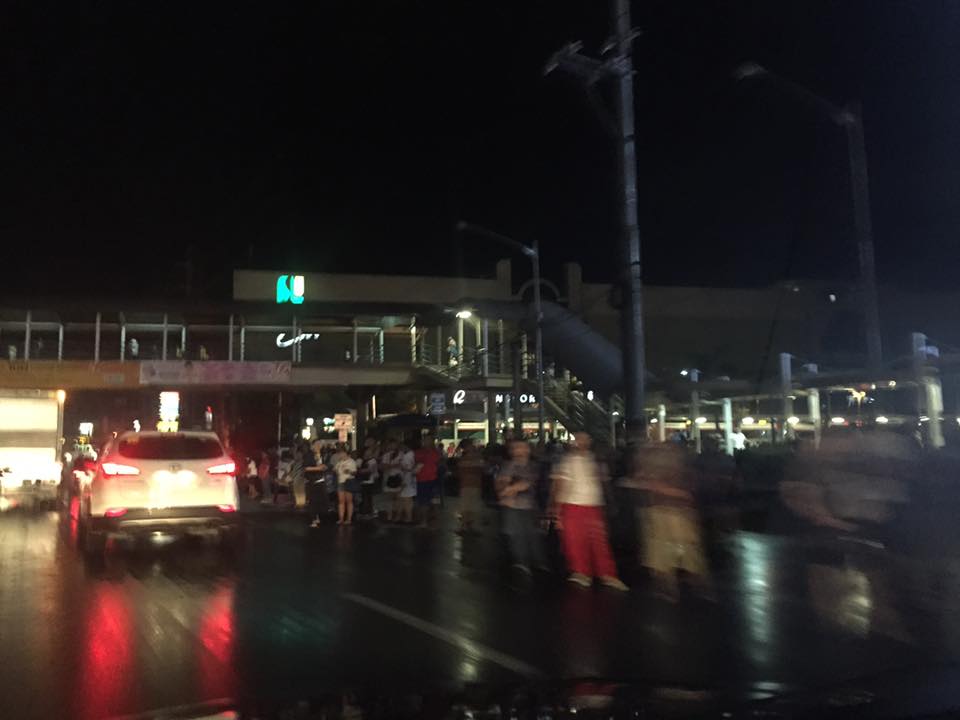 Commuters on the carriageway trying to get a ride home – many brave the strong rains to get ahead of others
It is not just unfortunate but rather depressing that Metro Manila and other major Philippine cities have no efficient public transport systems. The current modes of transport are road-based and dominated by paratransit including jeepneys, multicabs and tricycles. The state of disrepair of the PNR and MRT3, the much-delayed extensions of LRT1 and LRT2, and the much-delayed construction of MRT7 and BRT lines all contribute to the hellish commutes people experience everyday. Combine these with what experts regard as deficient station plaza designs that have led to inefficient transfers between the trains and road-based transport. It is no wonder that a person on bicycle can beat a commuter on a trip between Trinoma in Quezon City and a university in Manila considering the state of MRT3 and the poor transfer conditions between MRT3 and LRT1. This won’t likely be the case in Singapore or Tokyo where the proper hierarchies of transport are well established and with the necessary facilities to support their people-friendly systems.
What’s more depressing, frustrating and disappointing (if its possible to feel all three simultaneously) is how transport officials, including and especially the top official of the Department of Transportation and Communications (DOTC), apparently see our transport woes as “not fatal”. Is it really “not fatal”? Increases in the incidence of respiratory diseases due to the increased emissions are attributable to mobile sources (vehicles) and the long hours of road traffic congestion. The increase in the number of fatal road crashes as reported by the Metropolitan Manila Development Authority (MMDA) is also attributable to a significant increase in traffic volumes. One comment on social media was right on the dot on emergency cases ending up dying due to the ambulances being unable to make it to the hospitals in time for their passengers’ treatments.
And so, there were renewed calls for transport officials to get out of their chauffeured cars and take regular public transport between their homes and offices. The dares include riding the MRT3 during the peak periods and actually experiencing the queues and the crowded platforms and trains. It is no wonder that the image of the Dutch ambassador riding his bicycle to his office has been a popular share in social media because a lot of people feel that leaders should be examples themselves on how each one of us can pitch in to solve transport and traffic problems. Attempts by some government officials (including the top official of the transport department) to ride the MRT3, for example, are met with much criticism because they are given special treatment – they skip the lines and have bodyguards escorting them and clearing the way and space for them to ride comfortably. Clearly, this is not what the common commuter experiences everyday when he or she would have to use something short of MMA skills to get a ride.
Are we helpless against such insensitivity of our officials, many of whom are politicians and professionals associated with oligarchs? Not totally. And next year’s elections offer the commuting public a chance to express what they think about transport in this country and in their cities and municipalities by making transport and traffic urgent issues that need to be addressed and prioritized. Will you vote for candidates who had a hand in the continuing deterioration of transport in the Philippines and who consistently dismiss transport and traffic issues as secondary and just a by-product of non-inclusive economic growth? I surely won’t and will be very critical of candidates’ platforms and proposed programs should they win and become the leaders of this land. A big part of those programs should be how to address transport and traffic issues especially the deficiencies in infrastructure. Addressing these pressing issues on transport and traffic will go a long way in improving the quality of life of Filipinos and ensure a sustainable and inclusive growth for the country.
–
Health and commuting
Why is good public transportation especially transit important? Perhaps transport engineers and planners often get lost in trying to explain this from the perspectives of travel efficiency (e.g., reduced travel times, fuel efficiency, more capacity in terms of people carried, etc.) and environmental concerns (e.g., reduced emissions, reduced noise, etc.). Perhaps, too, there’s a need to articulate the importance of good public transport from the perspective of health. How many people do running, jogging or walking in the mornings, afternoons or evenings just to lose weight? How many go to gyms to workout? Perhaps the key to health lies in just walking everyday and integrating that healthy walk in your daily commutes. Here is a nice article from the Wall Street Journal on the link between the way you commute and a healthy life:
Your Commute Could Help You Lose Weight
Somethings I miss from living in Japan and Singapore are my regular walks to and from the transit station. I recall really good walks between the Transport Laboratory in YNU to the Soetetsu Line Kami Hoshikawa Station. You have to walk up a small mountain almost everyday from the station to the university. I also had good walking buddies back then during my 3 years in Yokohama. Later, I also enjoyed walking or cycling between the Transport Lab at Saitama University and the International House. Often, too, I would walk or cycle to the supermarket, the transit station or just around the neighborhood during free times. In Singapore, our home and the office were also near transit stations so we could take nice walks between them aside from the four flight of stairs to our apartment on the fourth floor. Such healthy commutes can be realized in Philippine cities if proper planning is undertaken and transit projects are implemented not just from the perspective of efficiency but, importantly, from the viewpoint of health. The current state of public transport is not healthy and many, especially those taking the EDSA MRT 3, will say that it is quite stressful to commute in Metro Manila. And stress is definitely not the way to lose weight. Is this true for other Philippine cities as well? Hopefully, we can work out transport solutions that include good public transport to promote healthy lifestyles.
–
State of the nation’s transport – 2015
The National Center for Transportation Studies (NCTS) of the University of the Philippines Diliman received a few letters from media the past week or so asking for resource persons on transport for today’s State of the Nation Address (SONA) by the Philippines President. It is something like a routine for media to come up with commentaries or reports assessing the performance of the government. This year is a bit special because today’s is the final SONA to be delivered by the current administration. The presidential elections will be in May next year and the next SONA will be delivered by whoever wins in that election. There is already a long list of aspirants, declared or expressing interest, for the top government post in the country, and this includes many who are perceived to be critical if not hostile to the current administration.
I was invited to give an assessment by a major media network back in 2010 and I remember giving that previous administration a grade (using the UP grading system) of 2.0. I explained that I could not give a very high grade because a lot of transport infrastructure remained unimplemented. These included airports, ports, highways and bridges, and, most notably, mass transit systems. I had knowledge though that many of the infrastructure projects were at the end of the project development or already have their feasibility studies and were ready for implementation by the succeeding administration. These were the so-called “low hanging fruits” that were “ripe for the picking” the following years. Sadly, many of the notable low-hanging fruits remain unimplemented. These include the LRT 2 Extension to Masinag in Antipolo City, the expansion of Clark Airport, the rehabilitation of the PNR, and the BRT in Cebu City.
 Traffic congestion along Commonwealth Avenue – whatever happened to the proposed MRT 7? [Photo courtesy of Rodel Velasco]
I recall a short exchange in social media with a government official whose favourite tagline was something like “We can do it!” He is fond of applying the tagline to a lot of things but especially with certain advocacies and politicians that he wanted to promote. When I asked him about transport and traffic at a CBD his office was involved in developing, the tagline immediately vanished in mention. He was quick to express what seemed to be his resignation that transport and traffic could not be improved in that rapidly developing CBD. This may be partly because they could not influence certain government agencies to expedite the implementation of urgent transport projects that would benefit the CBD. Clearly, to me, the tagline had a limit in terms of its applicability.
It seems the more appropriate tagline should be “Just do it!” as the Nike commercial goes and as adopted by a great senator who recently passed away (one who could have been a good president). It took the current administration a long time to evaluate projects and much of the delay appears to be related to the government’s fascination for PPP (Public Private Partnerships) to the point that their mention of projects being planned for implementation became another type of PPP – PowerPoint Presentation. It has been a frustrating last 5 years for transport infrastructure development especially public transportation and it is partly due t the insistence of the government to almost exclusively depend on the private sector for mass transport infrastructure. One opinion by a colleague that I also share in is for government to put its money (actually the people’s money) where its mouth is (in a manner of speaking) and invest in the construction of mass transit systems for major cities and then look to the private sector to operate/manage these systems. The government doesn’t have a good track record for managing transit systems (e.g., Metro Manila Transit Corporation, Pasig River Ferry Ferry, LRT Lines 1 and 2, etc.) but it has shown that it can build these (again LRT 1 and 2) and others (SCTEX, Iloilo and Bacolod Airports, etc.) if it wanted to. Perhaps we should again reflect on the real state of the nation’s transport come 2016 but do this very quickly so that we could finally alleviate the daily suffering experienced by most commuters.
Rains, floods and traffic
The wet season is here and with it the now typically heavy rains in the afternoons. Last week, the heavy rains brought upon flash floods in Metro Manila and adjacent towns. There have been no typhoons yet so these are mainly monsoon rains (Habagat), which we expect to be daily occurrences. Many of these floods are along major roads including EDSA, C5, Espana, and Quezon Ave. that transformed these roads into parking lots as most light vehicles are unable to traverse flooded streets.
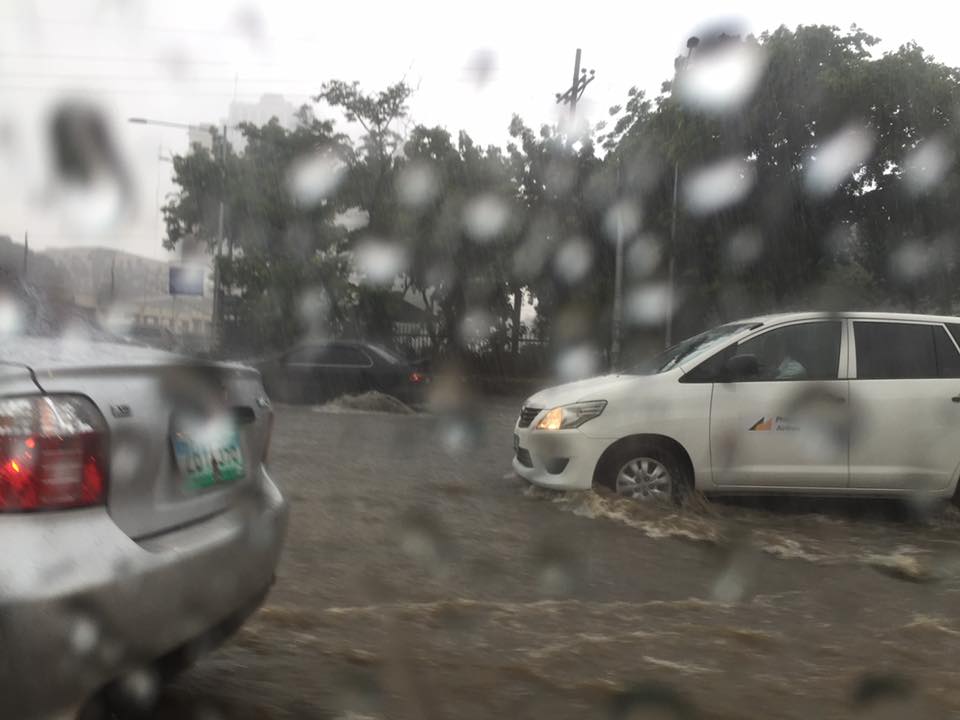 Vehicles run along the flooded Elliptical Road in Quezon City
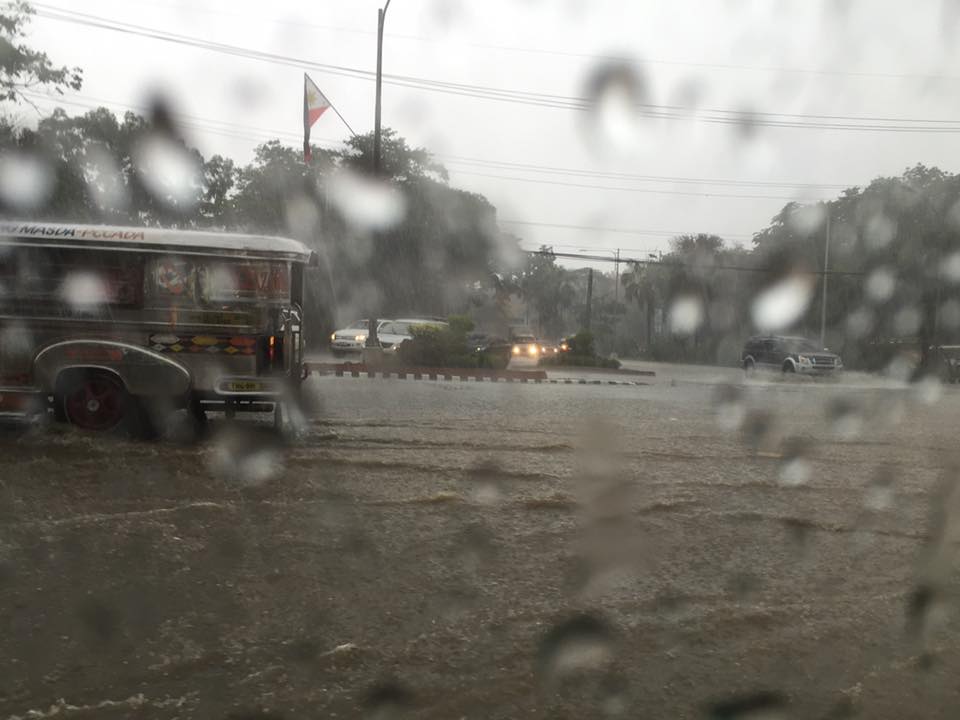 Jeepneys and SUVs (at right in the photo) take on the flooded Elliptical Road-Quezon Avenue intersection
Due to the traffic congestion resulting from the floods, many public utility vehicles especially jeepneys and UV Express vehicles were not able to go back and make their round trips.
 Cars risk the floods along Elliptical Road – the deepest waters are, ironically and curiously, along the section fronting Quezon City Hall where there is a pedestrian underpass connecting city hall with the Quezon Memorial Circle. Since the underpass is not flooded then it can be concluded that there’s something wrong with the drainage for Elliptical Road.
The weather is a very significant consideration for transport planning for cities in the Philippines. For Metro Manila it is almost everyone’s concern about how they can travel between their homes, offices, schools and other destinations without them and their things getting wet. This is what a lot of people advocating for road sharing seem to forget or choose to forget in their arguments for walking and cycling. A person residing in Fairview in Quezon City and working in Makati City will most likely not walk or cycle between his home and office because of the weather. This is a reality that could be solved by good public transportation, which, unfortunately, we also don’t have (yet) so people are ‘forced’ to do what they can to improve their plight. Unfortunately, too, what they are forced to do is purchase a car (or more). The proposal to build infrastructure to enable walking and cycling especially over medium to long distance is in the same dilemma as those for mass transit. And the latter is the more urgent matter needing action for the sheer volume of people they can carry and therefore benefit.
–
Some setbacks for sustainable transport
There have been a few setbacks for sustainable transport in the news recently and not so recently. One is the burning of an electric vehicle, a COMET to be precise, that saw one unit burn to the ground near the UP Town Center along Katipunan Avenue. I am not aware of any official or formal findings being released as to what really happened to the vehicle but that is basically a big PR problem now as detractors of e-vehicles will point to the incident as proof that e-vehicles still have a long way to becoming a viable and safe option as public utility vehicles. E-vehicles have a lot to prove especially as an option for public transport and such setbacks only strengthen the argument against them and leaves us with the current conventional options.
Another is the discontinuance of service inside the Bonifacio Global City (BGC) of hybrid buses operated by Green Frog Transport. This one is due to what Green Frog described as exorbitant fees being charged by Bonifacio Estates Services Corp (BESC) for their buses to enter BGC. This is making the rounds of social media but there seems to be no response from BESC nor from the Bases Conversion and Development Authority (BCDA), which is supposed to also have a say with policies in BGC. Perhaps BESC thought it best to just give Green Frog the silent treatment for what appears as a trial by publicity approach by Green Frog. One commuter commented that maybe BGC authorities should push for their Fort Buses to be hybrid and phase out the jeepneys in favour of higher capacity transit inside BGC.
There have also been issue on road safety including many incidents of pedestrians getting run over by vehicles. Many of these have been captured on video particularly by the Metropolitan Manila Development Authority (MMDA), which has set-up a network of cameras in many intersections along major roads. Many show vehicles Given that many cases feature jaywalking, it is still the responsibility of any motorist to exercise caution when manoeuvring, especially when turning at intersections. Drivers will always have blind sides or weak sides when they manoeuvre so they should be very careful when in doubt and not immediately proceed when it is not clear that they have a clear path. At BGC (again) one will notice that many motorists do not give way to pedestrians even when the latter are crossing at the right locations and according to the sign clearing them to cross the street. In one case involving two speeding SUVs, one lost control and hit a pregnant woman crossing the street. While a significant number of vehicles in BGC are through traffic, it is still the responsibility of BGC’s traffic enforcers to ensure motorists follow traffic rules and regulations including prioritising safety over haste. Simply attributing such safety issues to through traffic is no excuse for traffic enforcement being as lax as or par with the rest of Metro Manila, especially for a CBD that packages itself as better than the rest of Metro Manila.
Transport Planning in the Philippines (WB, 1976)
[Important note: I have noticed that the material on this blog site has been used by certain people to further misinformation including revisionism to credit the Marcos dictatorship and put the blame on subsequent administrations (not that these also had failures of their own). This and other posts on past projects present the facts about the projects and contain minimal opinions, if any on the politics or political economy at the time and afterwards. Do your research and refrain from using the material on this page and others to promote misinformation. I suggest you go to the The Mass Transit System in Metro Manila site for more facts about railway development and history. I do not consent to the use of my articles for the purposes of misinformation and historical revisionism. 10/13/2019]
I know its been a long while since the posts on UTSMMA (1973), MMETROPLAN (1978) and other studies – past studies and plans concerning transport in Metro Manila. It seems apt that I finally was able to finish this piece in time for the Philippines Independence Day. Sinasadya talaga. I left a question hanging about what caused the changes in mindset reflected in MMETROPLAN that practically did away with the proposed mass transit network in UTSMMA. Browsing other materials at the NCTS Library, I came upon a report that I thought would have likely influenced the MMETROPLAN study team as well as government officials at the time. This is the report that I think would be the vital link between UTSMMA and MMETROPLAN – for what happened between these two studies and why the “about face” when feasibility studies were already underway for what could have been the country’s first subway line. The World Bank published a report entitled “Transport Planning in the Philippines” in 1976. The report had recommendations that were not favorable to rail transport whether for long distance or urban applications. Some excerpts are shown in the succeeding photos of pages of the document:
 Cover of the report indicating some disclaimers and restrictions to circulation. I assume that since a copy is found in a public library then it is already declassified. It is definitely a historical document and a valuable one if we are to understand transport in the Philippines and Metro Manila.
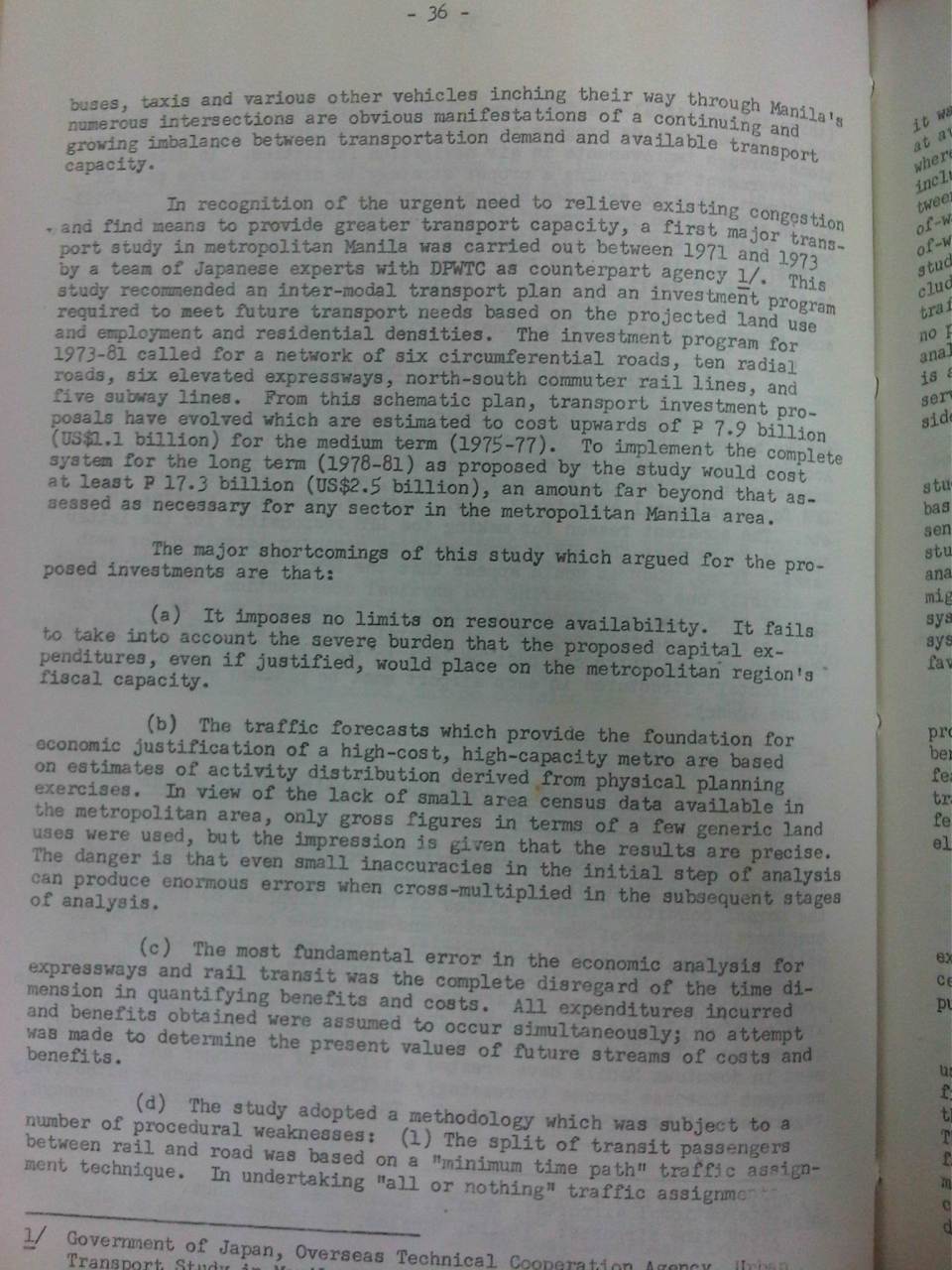 Scan of page 36 showing the WB’s assessment of UTSMMA
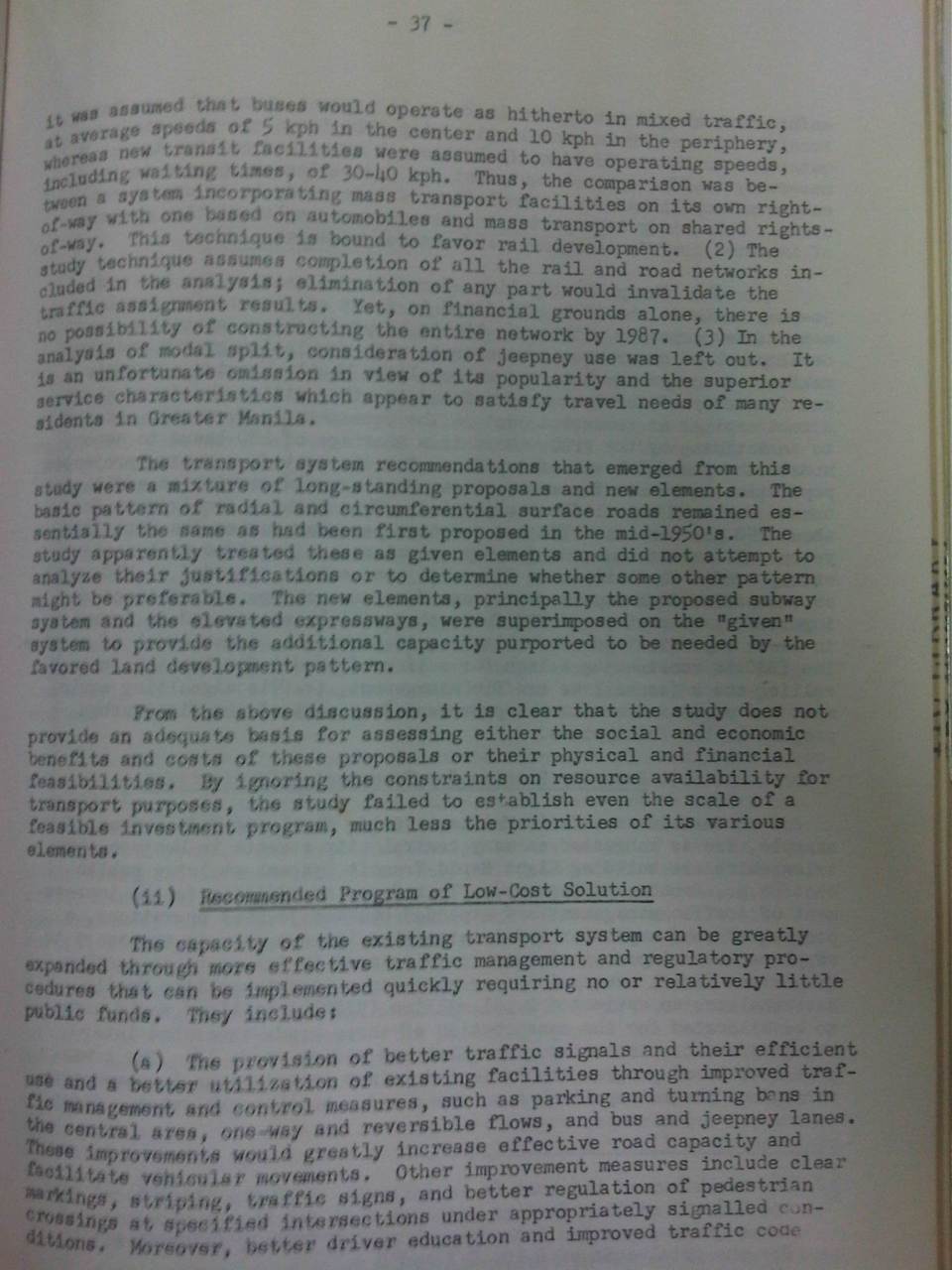 Page 37 states the conclusion of the WB report regarding UTSMMA.
I leave it up to the reader how he/she will interpret this but I think it is also important to contextualize this contents of this report to the situation of the Philippines at the time. In my opinion, too, it is basically one consultant’s word against another. From what I’ve learned, the recommended plan in UTSMMA came from a team led by a very senior and well-respected professor of the University of Tokyo’s Department of Urban Engineering. Looking back now, it seems that their work was visionary and its refuting by this WB report was a critical point in the (non)development of Metro Manila’s transport.
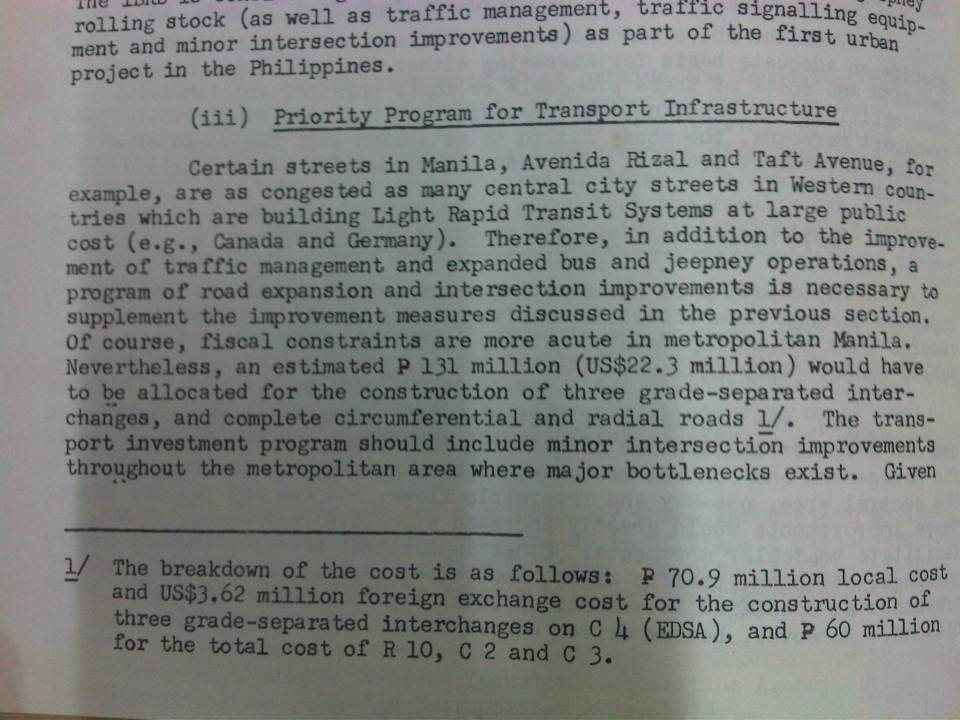 A reference to LRT systems, which to some will seem like a counter-recommendation to UTSMMA
The same report suggested taking a look at LRT instead of the heavy rail recommendations of UTSMMA. This eventually led to subsequent studies seemingly having bias towards LRTs and distancing from much needed resources to improve the plight of the PNR.
 Recommendations for the long term were explicit about the importance of having a sound spatial strategy for Philippine cities.
One could only speculate what went on in the background that were off the record or not documented. Did the WB exert its influence and ‘convince’ the Philippines to shelve ambitious plans for a heavy rail network in favor of what we now know as ill-planned light rail lines? It is this same WB report that recommended for the reorganization of the then DPWTC and DPH into the DOTC and DPWH that we know today. Thus, it is not only transport policy and infrastructure influenced by this report but also institutions dealing with transport. One person’s guess is as good as another in terms of the thinking back then as there are very few people who were directly involved in planning and decision-making then who survive now and are likely willing to divulge anything that will lead us to the truth and some closure regarding what went wrong at this critical time for transport development in the Philippines.
The data and evidence points to something Marcos loyalists would cringe to admit, that the former President ultimately failed in bringing a modern public transport system to this country and its capital. [No, the LRT wasn’t as modern and progressive as they thought it to be back then. We know now that Lee Kwan Yew got it right by investing in heavy rail urban transit at that same time.] We can only speculate that perhaps the WB and those behind the scenes knew Marcos and his ilk would probably steal much of the funds that could have been allocated for the rail rapid transit system and so did their best to come up with the conclusion that it was too expensive and the Philippines couldn’t afford it. I hope my economist friends would correct me but I am leaning towards thinking that “Uutang ka na din lang, umutang ka na para sa imprastraktura na magagamit di lamang ng mga anak mo kundi pati na rin ng mga apo mo at nila.” This seems to be the basic philosophy applied by other nations that have invested much on their transportation infrastructure. Such infrastructure has already paid off many times more and are part of the backbone of strong and resilient economies.
One colleague offered the analogy that the new JICA Dream Plan for Mega Manila is actually an updated version of UTSMMA. I also believe so and it is an updated and much more validated version of what we had back in the 1970s that was at best only partly realized (the recommendations for roads were mostly implemented). However, the price for such infrastructure will not be cheap and it will only become more expensive while we procrastinate in building them. Perhaps this should be an election issue come 2016 and something that we should strongly advocate for from our leaders.
–
 Caught (up) in traffic