
Home » Transport Planning (Page 4)
Category Archives: Transport Planning
Article share: Planners’ Complicity in Excessive Traffic Deaths
Here is a recent article on safety and the involvement on traffic engineers from Todd Litman:
Source: Planners’ Complicity in Excessive Traffic Deaths
Let me note here about the interchangeability of the terms ‘traffic engineer’, ‘transportation engineer’ and ‘planner’. This is important to contextualize who is actually complicit or involved or responsible particularly in the Philippine setting. Too often and too quickly, traffic engineers or even civil engineers (in general) are blamed for traffic deaths or flaws in road designs. Disregarded is the fact that, as the article mentions, of the two major elements of travel – distance and speed – distance is often determined by the plans and designs of non-engineers. These are planners, or to be accurate land use planners, many of whom are architects by profession. We also want to differentiate between traffic engineers and highway engineers, who in the Philippine setting are actually quite different. One common thing about many of them is that they are slow to adopt progressive ideas or concepts of road planning and design such as complete streets and road diets. The outcome of this stubbornness is the specter of road crashes that lead to fatalities and serious injuries. But then they are not solely to blame or who should take responsibility for the atrocious road safety situation. The ‘distance’ component of travel is very much a product of land use planning and land development as practiced in our country. For many if not most developments, architects and planners are the ones who call the shots for the roads and transportation in the proposals. Traffic engineers are involved later and if not progressive complicates the situation regarding safety. Thankfully, some local government units are becoming progressive and are more mindful of development proposals including implications to road safety. Hopefully, many things will change among those involved so we can improve travel safety.
–
On the ‘modern jeepney’, consolidation and the modernization program
Last April 30, 2024, the deadline for consolidation of jeepney operators and drivers expired. That basically and generally meant the phaseout of individuality in so far as operators were concerned. It also meant, for many, the phaseout of the conventional jeepney in favor of the so-called ‘modern jeepney’, which are actually mini-buses by specs and design. There are many ‘modern jeepney’ models (I recently posted photos on these.). Some are better than others in terms of their features including the engine, seats, air-conditioning and suspension. Thus, there are models that are superior to the conventional jeepneys that are all practically custom built and utilizing surplus engines. Others may be of questionable quality as evidenced from reports that many are more prone to breakdowns than others. There is, of course, the issue of cost. These new vehicles are more expensive than conventional jeepneys and many individual operators cannot afford to purchase new units even with the current incentives government has provided. This is probably the bigger issue rather than the vehicles themselves despite claims pertaining to culture and aesthetics.
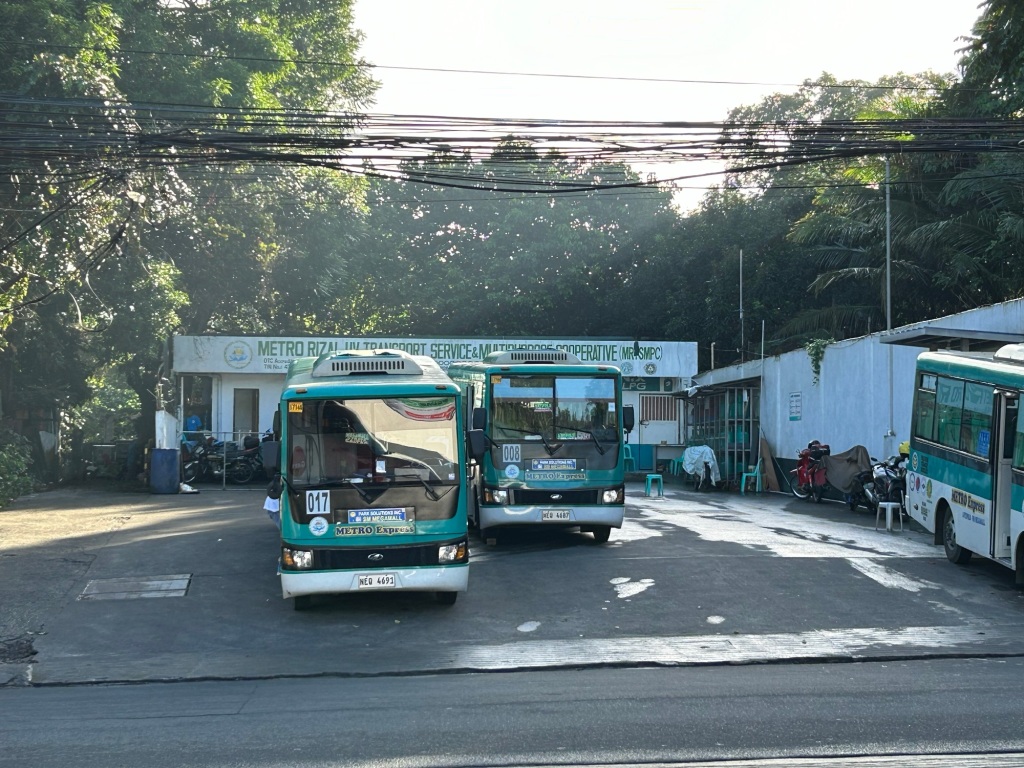
Operators and drivers were required to consolidate or organize themselves into cooperatives. Banks or other financial institutions were supposed to engage these cooperatives for financing the acquisition of new vehicles. While the DOTr has pushed for this, there seems to be a lot still lacking from their modernization program considering the feedback/ backlash it has received from stakeholders. The department has pursued modernization and rationalization at least more than 2 decades ago. These have not materialized for various reasons including shortcomings on the government side and the persistent resistance of the transport operators and drivers. The latter and their supporters though are not without fault as they have not provided viable alternatives aside from status quo.
–
Another roadblock for active transport?
The Metro Manila Development Authority (MMDA) recently released what they claim to be their counts of bicycle traffic along major roads in Metro Manila from 2020 to 2023.
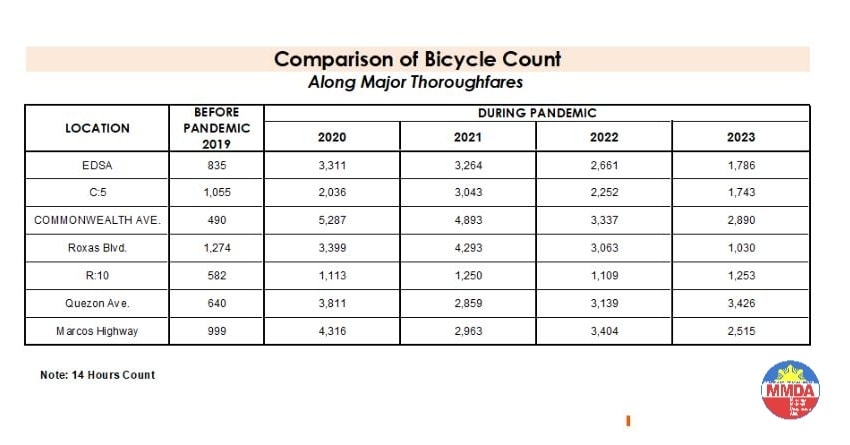
These are supposed to be official data as it is issued by the government agency in-charge of traffic management for Metro Manila roads (aside from its other functions and roles). What are not stated, and are actually very important details, are the locations of the counts and when the counts were conducted. The Traffic Engineering Center (TEC) that was under the DPWH and currently with the MMDA used to publish traffic volume maps for major roads in Metro Manila. So along EDSA, for example, the volume per section are shown on the map. The same for other major roads like Commonwealth, Quezon Avenue and SLEX. The thicker lines mean higher volumes along those sections, and vice versa. However, they did not consciously count bicycles (only motor vehicles) and perhaps MMDA only started counting during the pandemic (i.e., 2020). So there is no one value to represent a road. And counts vary over time of day, day of the week and even throughout the year (i.e., monthly variations).
There were many reactions to the MMDA’s posting of the data and most were critical and even derided the agency for what to them appeared to be inaccurate data. The problem is that it seems there are no other counts that can validate and perhaps refute the MMDA data. Previous bike counts were not conducted according to how the MMDA and DPWH count vehicles. That is, counts are typically done over a 14 or 16-hour period and ideally on several days in a year. Expansion and conversion factors are applied based on established stations along major roads that are supposed to have more frequent if not continuous counts. This methodology is how Annual Average Daily Traffic (AADT) is computed. Call it car-centric if you like but the methodology is very much applicable to bicycles as well. Peak hour counts for bikes are not enough and the peak hour factor for motor vehicles does not apply to bicycles (if this is to be used to expand/convert peak volumes to daily values). In fact, if you go into the math, there should be a peak hour factor for each type of vehicle considering each vehicle’s volume will vary differently over time. So yes, the solution here is to conduct bicycle counts according to how MMDA or DPWH counts vehicles and these should be done along several stations along major roads (e.g., those in the table above) to validate the MMDA counts.
More on this topic in the next post!
–
Planning for Accessibility: Proximity is More Important than Mobility
Here is a quick share of another very informative article that discusses the importance of proximity and more dense development in order to reduce car dependence.
Source: Planning for Accessibility: Proximity is More Important than Mobility
Here are some excerpts from the article:
“This shows that proximity is much more important than mobility in providing accessibility: location, location, location. For the last century, our transportation planning practices have contradicted this principle. Transportation agencies built urban highways that destroyed and degraded accessible and multimodal neighborhoods to benefit suburban motorists. This was racist and classist, but the mechanism was the way that transportation planners valued increased traffic speeds, measured as travel time savings, while ignoring the loss of accessibility imposed on urban neighborhood residents.
Of course, many other factors affect people’s transportation and neighborhood preferences. Some people need their cars for work or after-work activities, and not everybody can bicycle or use transit even if it is available. However, surveys such as the National Association of Realtor’s National Community Preference Survey indicate that many people would prefer living in more compact, walkable neighborhoods than they currently do but cannot due to a lack of supply.”
Such articles are a must read for those who want to understand why government needs to invest in land at or near the CBDs, and develop that land so people will not need to reside far from their workplaces and schools. Truly, there are many other factors affecting transport preferences or mode choice. Housing is one such factor that we continue to treat separately from transport. It is very (prohibitively) expensive to buy or rent in the city particularly in or near the CBDs. The result is people opting to purchase or rent homes in the suburbs. It doesn’t help that developers are also actively promoting subdivisions there and therefore are contributing to sprawl that puts so much pressure on transportation systems.
–
Article share: on subsidies to public transportation
Here’s a nice article that presents arguments for subsidies to support transit or public transportation:
Wilson, K. (February 5, 2024) “Study: Subsidizing Transit Actually Makes It More Efficient,” Streets Blog USA, https://usa.streetsblog.org/2024/02/05/study-subsidizing-transit-actually-makes-it-more-efficient [Last accessed: 2/18/2024]
Subsidies to public transportation can be quite tricky and may require quite a balancing act. There seems to be few options outside of the straightforward subsidies national and local governments in the Philippines provide. Rail transit, for example, is heavily subsidized but these are rare for road-based public transportation. The concept of service contracting has been considered but it also has a few variations. While there seems to have been a proof of concept tested during the pandemic, it required so much funds that government apparently lost interest (i.e., the funds were also needed by other sectors). Local governments meanwhile, or at least those that had resources, decided to operate their own public transport (e.g., Quezon City bus).
To quote from the article:
“Newmark’s study doesn’t definitively determine why, exactly, high subsidies seem to correlate with better efficiency and transit agencies collecting more fares, but he has some theories. Some systems, he says, use subsidies to increase service frequency or install dedicated lanes to speed routes up along heavily-utilized corridors — and riders are responding, predictably, by showing up in droves. (Route expansion can help, too, he said, but only if agencies expand service to places “where there’s actual demand.”) Others use subsidies to keep ticket prices low, but not to eliminate fares outright, which Newmark argues is a smart move.
“People value stuff they pay for, and they pay for stuff they value,” Newmark added. “An underlying point in this paper is that transit offers something [valuable], and it’s worth trying to capture that value, whether through fares or in other ways.”
If transit networks and the taxpayers who support them can get that recipe right, it could create a virtuous cycle.
“If people see the benefits [of subsidies], that may make them more willing to invest [their taxpayer dollars],” he adds. “Good transit leads to a real social movement for more subsidies.” “
What do you think about subsidies to public transport in the Philippine setting? Of course, we are referring to ‘formal’ public transportation here. There are many ‘informal’ or paratransit modes like tricycles and non-motorized pedicabs. There are also motorcycle taxis providing services or filling in the gaps in transport services.
–
Why College Campuses Make Ideal Models for Cities
I recently read this article on college campuses being models for cities. Of course, this refers to campuses or perhaps university towns that have developed in the US. These appear to be microcosms of cities or what cities should be. I can imagine this for the UP Diliman and UP Los Banos campuses. There are others that are similarly structured but most universities and colleges in the Philippines may not even have full campuses like UP including those in the University Belt in Manila. Many are practically just buildings. Others that have land like UST and Ateneo do not have the residential areas like UP’s that would make the campus a town in itself.
To quote from the article:
“Universities and other educational institutions make the lives of their students easier by placing amenities close to student housing so they can travel on foot or by bicycle to reach their destinations. This design encourages human interaction and improves quality of life.
The same can be done for cities and towns. Urban planners can look to college campuses for inspiration, borrow the features that enable this lifestyle, and incorporate them into city design. Such a holistic approach will make it preferable to travel on foot, make sustainable transport more accessible, and create thriving local economies.”
Opinion: The Arrogance of Social Media Urbanists
Here’s a quick share of an interesting article. It’s basically a reaction (I prefer not to call it a rant as the author refers to it.) and a fair one for those who are exasperated with the generalizations and criticisms often posted on social media that are thrown vs. planners. I would extend this observation about engineering as well. I suddenly remember discussing in one of my classes about how unreinforced concrete pavements are legit and not because a contractor or highway agency settled for inferior design or were corrupt that they decided not to use steel bars. It is very easy these days to post your opinion or criticism without understanding all the other (and probably essential) factors that come into play.
Source: Opinion: The Arrogance of Social Media Urbanists
Quoting from the article:
“What is the point of this rant, besides easing my frustration with my social media feed? It’s to hopefully educate those who think that changing close to a century of development patterns should happen overnight and that anyone who is not in lock-step agreement with the right way to develop is too ignorant to know better. No opinion has ever been changed by a snarky meme. Change happens through education, outreach, and time. Planners are not ‘afraid’ to build good things; they’re constrained by obsolete regulations and policies, deeply embedded political values, financial barriers, and the momentum of existing patterns of behavior. The goal should be to address those things and make it just as easy to build dense, mixed-use, walkable communities as it is currently to build single-use sprawl. If we get to that point, consumers will have equal access to the products they want, whether it be a single-family home on a cul-de-sac or a townhome with a coffee shop on the corner.
That is how we effect change. Arrogant and condescending posts on social media will not win converts to your cause, only harden their resistance.”
–
A real battle of Katipunan – the search for a transportation solution
Is it obvious that I was alluding to the classic match-ups of the two major universities – Ateneo De Manila University and the University of the Philippines Diliman – that are located along Katipunan Avenue for the title of this article? That is deliberate on my part as there is a ‘real’ battle along Katipunan Avenue, and it does not involve sports.
Following is a recent article from the Philippine Collegian that reports on the current state of traffic along the corridor:
https://phkule.org/article/971/private-cars-mainly-to-blame-for-katipunan-traffic-transport-experts
I have written before and many times about transport and traffic along Katipunan Avenue. This road has been part of my daily commute since 1988 when I was admitted to UP Diliman as a B.S. Civil Engineering major. Back then Katipunan was not as wide as it is now, especially along the section between UP Diliman and the MWSS complex. That section only had 2 lanes then. What is not a wide center island with large, old acacia trees used to be the frontage of MWSS. So now you can probably imagine how much land was ceded by MWSS for road widening.
I also wanted to write about Katipunan in part as a sort of farewell to the former MMDA Chair and Marikina Mayor Bayani Fernando (BF), who recently passed away. Much of how Katipunan looks like and the traffic situation today can be traced to what transpired during his time at MMDA. I will refrain from writing about this and him for now. I am actually thinking of writing a series about BF and his time as Mayor in Marikina, as MMDA Chair, and his brief stint as DPWH Secretary. This short article will do for now.
On home location preferences
There’s an interesting article on the preference of Americans for big houses even if these
(August 2, 2023) “Majority of Americans prefer a community with big houses, even if local amenities are far away,” Pew Research Center, https://www.pewresearch.org/short-reads/2023/08/02/majority-of-americans-prefer-a-community-with-big-houses-even-if-local-amenities-are-farther-away/ [Last accessed: 8/12/2023]
Quoting from the article:
“A majority of Americans (57%) say they would prefer to live in a community where “houses are larger and farther apart, but schools, stores and restaurants are several miles away,” according to a Pew Research Center survey conducted March 27-April 2, 2023. About four-in-ten (42%) would prefer a community where “houses are smaller and closer to each other, but schools, stores and restaurants are within walking distance.”
As general as that statement appears to be, as they say, “the devil is in the details.” The article goes to qualify the statistics according to partisanship, age, education, race and ethnicity, ideology, community type, and community type & partisanship. The resulting stats are quite revealing and helps one understand the survey results.
I wonder what would be the result of a similar survey if one were conduced in the Philippines. There is no partisanship factor here that is similar to the characteristics of Republicans and Democrats in the US. What will it reveal about our preferences? Do Filipinos prefer to have their own houses even if these are located far from workplaces and schools? Or do Filipinos prefer living closer to their workplaces and schools even if it means living in smaller homes? Certainly affordability, which was not mentioned in the article, is a major factor considering the cost of homes in cities compared to prices in the suburbs.
There is a link in the article for the methodology and questions used in the study. That means it would be possible to replicate or adapt these for the Philippine setting.
–
Article on “Fair Share Transportation Planning”
I am sharing this new article from Todd Litman on fair share transportation planning. The content is relevant and very timely in the Philippines considering many people including and especially transport officials are struggling with the thought of allocating resources to provide or improve facilities geared towards more equitable transport systems (e.g., more facilities for active transport).
Here’s the summary as quoted from the article:
“To be efficient and equitable, a transportation system must serve diverse demands. A diverse transportation system allows travelers to use the most efficient option for each trip—safe walking and bicycling for local errands, efficient public transit when traveling on busy travel corridors, and automobiles when they are truly the most cost-effective mode considering all impact—and it ensures that people who cannot, should not, or prefer not to drive receive their fair share of public investments.
Current transportation planning practices are biased in various ways that overinvest in automobile infrastructure and underinvest in more affordable, inclusive, and efficient modes. It is time for planners to reconsider our analysis methods and funding practices to ensure that non-auto modes, and therefore non-drivers, receive their fair share of transportation resources.
This is not anti-car. Motorists have good reasons to support more investments in non-auto modes that reduce their traffic and parking congestion, reduce their chauffeuring burdens and crash risk, and provide better options when their vehicles are unavailable. Everybody wins from a more diverse and efficient transportation system.”
 Caught (up) in traffic