
Home » Posts tagged 'behavior' (Page 3)
Tag Archives: behavior
On floods, transport and traffic, again
It’s that time of year again when the heavy rains lead to flash floods along many roads. I took the following photo as we slowly progressed towards Cainta Junction early this week. The Felix Avenue approach was flooded after more than an hour of heavy rains fell upon Cainta and neighboring towns. We learned later that the rains fell on a larger area as EDSA and other major road in Metro Manila also experience flash floods. These cause traffic to slow down if not outright stoppage. Many commuters can get stranded when PUVs are not able to run due to the floods. Deeper waters mean light vehicles including motorcycles and bicycles cannot proceed along certain roads, further exacerbating the traffic situation.
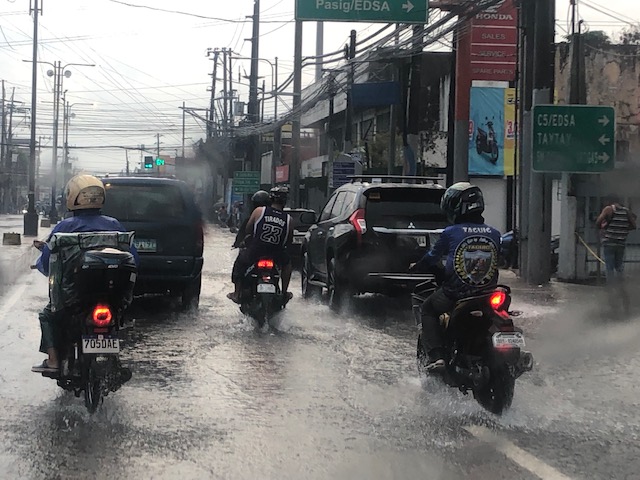 Motorcyclists emerge from their shelters to travel along flooded roads. A common sight when there are downpours are motorcyclists huddling under overpasses, bridges, or whatever shelter may be available to them. Many bring rain gear but opt to just stop and wait it out until the rain stops.
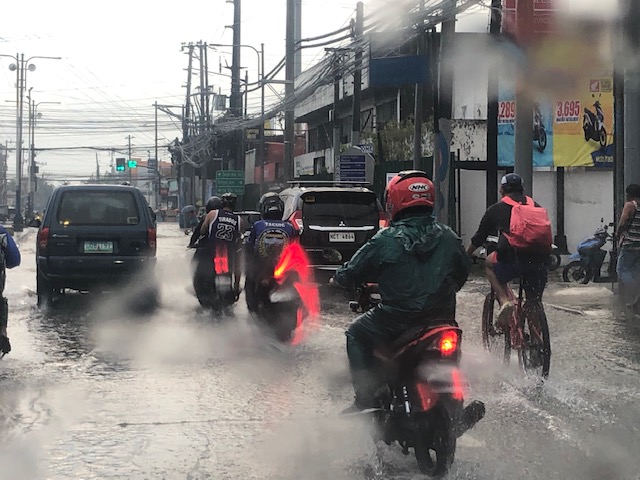 A cyclist braves the floods – while pedestrians will likely stop and wait it out for the rains to stop or for the floods to subside, cyclist might just pedal on. They just have to be more careful as potholes and other dangers may be hidden by the floodwaters.
 Cainta Junction has been submerged by so many floods over so many years. Even with the new drainage constructed under and along Ortigas Avenue Extension, Felix Avenue and Bonifacio Avenue, it seems their capacities are not enough to handle the rainwaters. That or perhaps their intakes need to be redesigned to more efficiently take on the heavy rains and the resulting runoff.
–
On the right to a walkable life
Here is an article from a perspective that’s very relevant today everywhere. We need to examine our daily routines particularly when it comes to commuting or moving about. Do we live in walkable communities? Is walking to certain places like school, the market, or the office an option to many of us? Or do we automatically choose to ride a car, a tricycle or motorcycle to get to these places?
Malchik, A. (May 13, 2022) “Driving is killing us,” Medium.com, https://antoniamalchik.medium.com/driving-is-killing-us-6a1b35158458 [Last accessed: 5/28/2022]
To quote from the article:
“Ask yourself this question: if you stepped foot outside your door, would you be able to walk anywhere you needed or wanted to go? Can you walk to a store, a library, school, or work? If your answer is “no,” what’s stopping you? Distance, highways, private property, broken or absent or inaccessible sidewalks? …
The loss of walking as an individual and a community act has the potential to destroy our deepest spiritual connections, our democratic societies, our neighborhoods, our freedom, our health, and our lives. But we can reclaim it. We can start to make a world that welcomes the walker, the pedestrian, rather than paving over that incredible human inheritance.”
I myself have enjoyed the benefits of walking when I was a college student in UP, when I was studying abroad in Japan, when we lived in Singapore and now in our community in the midst of the pandemic. I always think about opportunities and even schedule times for walking. Nowadays I am even conscious of my daily step count, which I equate with being active.
–
On ways to make streets safer
Here’s a quick share of an article suggesting a simple way to make streets safer:
Berg, N. (April 27, 2022) “The ridiculously simple way to make streets safer for pedestrians,” Fast Company, https://www.fastcompany.com/90745296/the-ridiculously-simple-way-to-make-streets-safer-for-pedestrians [Last accessed 5/1/2022]
To quote from the article: “Art projects painted onto streets and intersections significantly improve safety, reducing the rate of crashes involving cars and pedestrians by up to 50% and all crashes by 17%, according to the study.”
The article’s sub title states that you only need a bucket of paint rather than expensive new traffic signals or road blocks to keep pedestrians safe. I remember there were similar attempts to do the same in Antipolo prior to the pandemic. A group painted on the pedestrian crossings along major roads in the city. These, however, appeared to be somewhat invisible to most motorists and did not succeed to slow down traffic. Perhaps, as the article states, the artwork needs to be more visible or conspicuous in addition to its being comprehensive for intersections as the examples in the article show. These cannot be piecemeal or appear as publicity stunts for them to influence driver behavior and help improve safety.
–
On the increase of road crash fatalities during the pandemic
The general observation has been that roads have become less safe as drivers and riders have tended to speed up their vehicles during this pandemic. Speeding up apparently is just part of a bigger picture and even bigger concern considering what is perhaps also an issue related to mental health. We’ve read, heard or watched something about people’s transformation once they are behind the wheel or riding their motorcycles. I remember a Disney cartoon showing how Goofy transforms from being mild-mannered to somewhat demonic once behind the wheel of the car. The article below reinforces that and relates this behavior with the pandemic.
To quote from the article:
Art Markman, a cognitive scientist at the University of Texas at Austin, said that such emotions partly reflected “two years of having to stop ourselves from doing things that we’d like to do.”
“We’re all a bit at the end of our rope on things,” Dr. Markman said. “When you get angry in the car, it generates energy — and how do you dissipate that energy? Well, one way is to put your foot down a little bit more on the accelerator.”
Lessons to be learned about e-scooters
I recently wrote about e-scooters and I am sharing this article on the experience of Chicago from their pilots of this emerging new mobility option.
I won’t be offering much in terms of opinions at this point as there really hasn’t been much about e-scooters at present in the country. You see them every now and again but not as frequently as motorcycles and bicycles. There seems to be something about them on social media but out on the road, they are not yet significant in terms of volume but are a concern regarding safety.
–
On the “safe system” approach in road safety
We kick-off the UN Global Road Safety Week with a road safety feature. Here is an excellent read from Johns Hopkins University’s Hub:
(May 13, 2021) “Safe system” approach could dramatically reduce road deaths while improving equity, Hub, https://hub.jhu.edu/2021/05/13/safe-system-roads-could-reduce-road-accidents-deaths/ [Last accessed: 5/14/2021]
To quote from the article:
“The Safe System approach engineers road systems so that they are safe when used intuitively, the way people tend to use them. A Safe System minimizes the chances for mistakes by drivers, pedestrians, and bicyclists, and reduces the intensity of crashes when they do occur.”
There are so many situations and locations around the country that could be improved using this approach. The safe system approach is actually embedded in the country’s current Road Safety Action Plan (RSAP).
 Road and traffic environment in front of the main gate of a high school in Zamboanga City
–
Painted lines are not enough for bike lanes
From the experiences of many biking or trying to bike in the Philippines, painted lines are not enough for bike lanes. Only recently, cyclists using bike lanes that did not have any physical barriers to deter motorists from encroaching have been involved in crashes, with at least a couple being reported as fatal for the cyclists. Here is an article on what cyclists need in order to ensure or at least improve the safety of their commutes.
UTC (2020) “White lines? Cyclists need more,” ITS International, https://www.itsinternational.com/its8/feature/white-lines-cyclists-need-more [Last accessed: 8/6/2020]
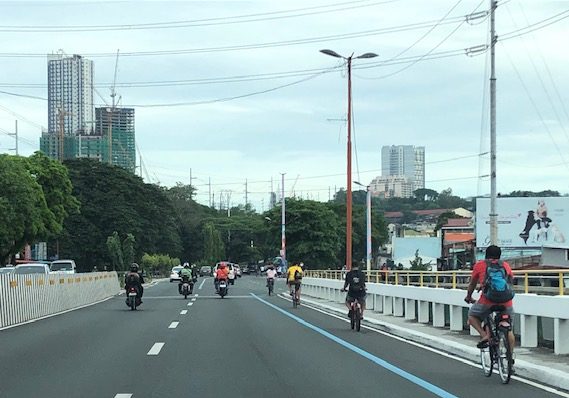 Commuters on bicycles along the Marcos Highway bridge bike lane
Are there differences regarding cycling in different countries? From a somewhat cultural-behavioral perspective, perhaps there are studies (though I am not aware of them yet) about how peoples from different countries or cities behave with respect to cyclists whether or not there are bike lanes designated for the latter’s use. I recall my experiences cycling in Japan and drivers are generally respectful of cyclists on the roads. Pedestrians, too, are very tolerant of cyclists on the sidewalks or designated areas for walking. Of course, the cyclist would have to do their share of respecting others’ spaces, too, and should behave and position themselves accordingly while traveling.
–
Whatever happened to those ‘enhanced’ pedestrian crossings?
Before the lockdowns, a lot of people seem to have become excited with what a private company did as part of their PR campaign (I’m certain about this because their ads feature these.). That is, they painted on the existing pedestrian crossings in Antipolo City along major roads such as Sumulong Highway and the Sumulong Memorial Circle. While coordination with the LGU was done, there seems to be none with the DPWH considering these are national roads and any matter concerning them are under the agency’s jurisdiction through their District Engineering Office. The following photos were taken prior to the lockdown and as you can see (if you were objective) there’s nothing really notable about them though they appear to enhance the existing crosswalks.
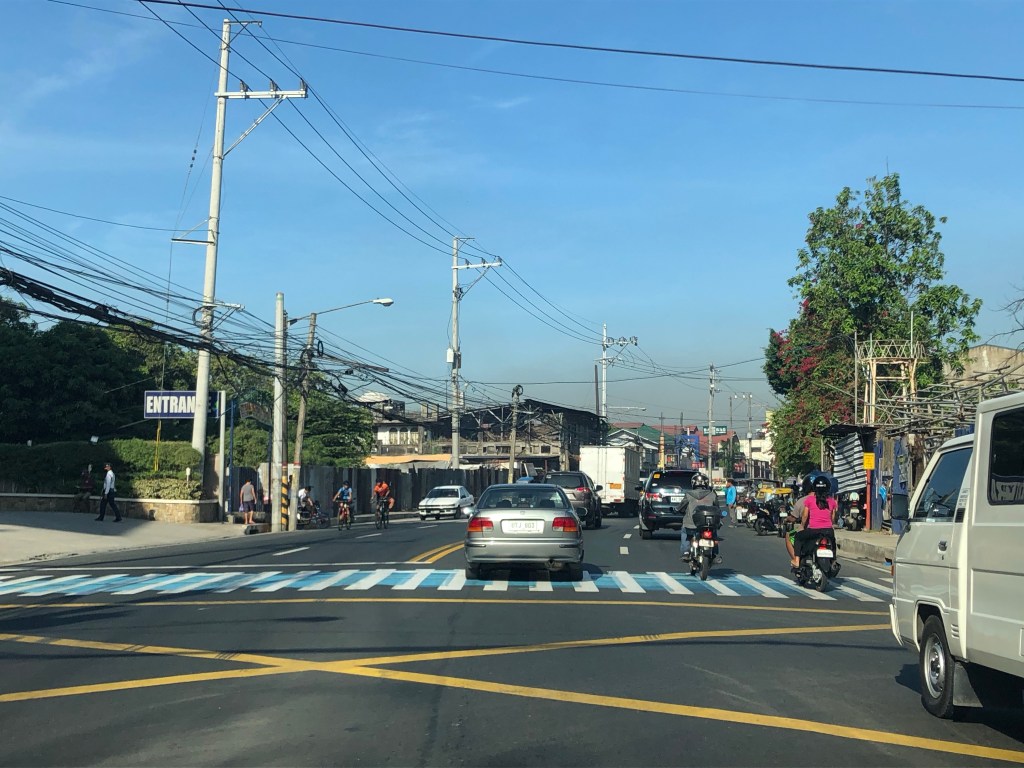
The artwork is practically invisible to motorists especially those on cars whose drivers’ eyes are lower than those driving SUVs, jeepneys, buses or trucks (i.e., larger and taller vehicles).
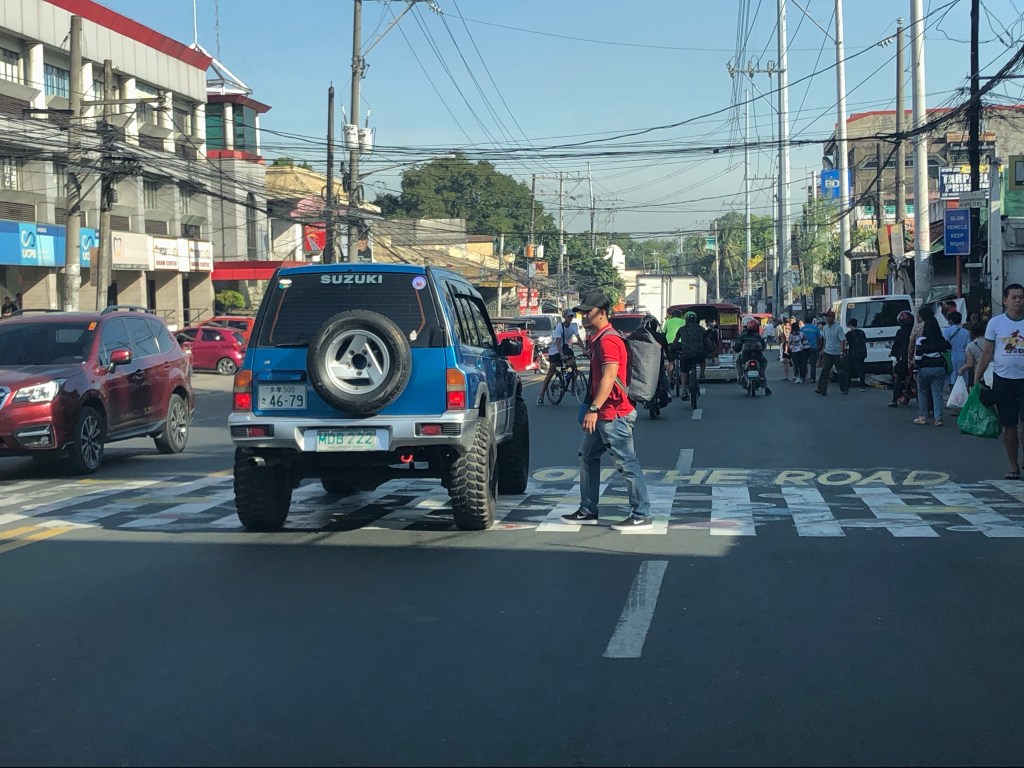
There is no strong evidence that such works enhance road safety.
There is no strong evidence that such works enhance road safety and you can check on this by doing either a quick or even an extensive search for literature proving significant impact. I guess the key here is to also install other devices such as a speed table or rumble strips for motorists to feel that they are approaching a pedestrian crossing. Also, perhaps instead of just painting on the crosswalks, they could have painted so as to widen the crosswalk. Then they could have increased the visibility for pedestrian crossings. That said, they should also have used the standard paints for these facilities that make them visible at night and could have been more resistant to weathering.
–
On people’s apprehension to use public transport
Public transport supply issues aside, there is also an apprehension to use public transport in the Philippines because of the perception that using public transportation will expose you to COVID-19 and lead to an infection. So far, this is far from the truth, which is that if proper precautions or countermeasures are applied (including physical distancing), public transportation can be safer than taking a car to move about.
Here is an article from the US co-written by Janette Sadik-Khan, who presided over the complete streets transformation in New York City. Aside from explaining how public transport can be safe, COVID-19-wise, the authors state that one must be most worried about conditions in places they go to including their workplaces, markets and yes, homes.
Sadik-Khan, J. and Solomonow, S. (2020) “Fear of Public Transit Got Ahead of the Evidence,” The Atlantic, https://www.theatlantic.com/ideas/archive/2020/06/fear-transit-bad-cities/612979/ [Last accessed: 6/25/2020].
Several groups have already called for jeepneys to resume services. Unfortunately, DOTr and LTFRB have other plans to implement; opting for a hard-push of the modernization and rationalization programs of the government. As such, despite the demand for public transport, the latter’s unavailability meant that many commuters had to take private vehicles to go to their workplaces. That meant those who usually could leave their cars home or at least opt for public transport most days reverted to their vehicles (note: the number coding scheme is still suspended for Metro Manila). Tricycles could only carry one passenger each; effectively making them 3-wheeler taxis. While train and bus operations have resumed, both have limited passenger capacities due to the physical distancing requirements.
Again, there are precautions and countermeasures that can be applied in order to ensure the reduction or minimization of infection risks. Public transport providers need to follow these guideline to prevent infections that can be attributed to public transport use, and help people trust in using these modes over cars.
–
On changes in traffic patterns after the pandemic
We start April with a nice article from Cities of the Future. The article explains how traffic patterns will be changing due to Covid-19. They have already changed for most of us who have to deal with quarantines and lockdowns. And we should not expect things to go back to normal. “Normal” here, of course, is “Business As Usual” or was that. It is quite clear that we cannot and should not go back to BAU and it is probably going to be good for most of us. There will definitely be a lot of adjustments and sacrifices especially for commuters who have been dependent on cars for travel. The transport industry, too, will have to deal with the new supply and demand dynamics. And government should be up to the task of engaging and rethinking how policies and regulations should evolve to address issues coming out of the “new normal” in transportation.
Valerio, P. (2020) Traffic patterns are going to drastically be very different, says Micromobility expert , Cities of the Future, https://citiesofthefuture.eu/traffic-patterns-are-going-to-drastically-be-very-different/ [Last accessed: 4/3/2020]
–
 Caught (up) in traffic