
Home » Posts tagged 'behavior' (Page 5)
Tag Archives: behavior
Counterflow culture: pang-iisa
There are several videos currently circulating in social media showing counter-flowing motorists. In one, a driver with a camera on his dashboard proactively positions his vehicle along the middle lane of the correct side of the road and engages a counterflowing motorist who initially appeared as if he were going to insist on his wrong behavior (feeling entitled perhaps?). The driver with the dash cam didn’t budge or give way and the errant driver had to go back to his correct lane.
In another, more serious video, another dash cam records a scene along a curved 2-lane section of Marcos Highway where an oncoming motorcycle slammed into a counterflowing vehicle coming from the left side of the vehicle with the dashcam. It was clear that the counterflowing motorist violated the double yellow line rule, which led to the dreadful crash.
These are examples of what seems to be a counterflow epidemic among many motorists. Counterflowing is not only prevalent among motorcycles and public utility vehicles but among private vehicles as well. There are even those who follow emergency vehicles that legitimately and urgently use the opposing traffic lane. This behavior seems to be associated with these motorists wanting to get ahead of others. In Filipino or Tagalog, the term is translated to pang-iisa or gustong maka-isa (wanting to get one up on other people). This behavior can be attributed to a person being impatient, undisciplined, reckless, feeling entitled, or – all of the above.
Such issues could have been preempted by a stricter licensing system that can be administered by the Land Transportation Office (LTO). However, since many already have their licenses then the burden for correcting such behavior falls upon traffic enforcement agencies and their personnel including the Highway Patrol Group (HPG) and the MMDA. Hopefully, such errant behavior can be corrected and our roads can be safer for all users.
–
Endangering others by your behavior on the road
A major concern in road safety is the behavioral aspect that includes the attitudes of drivers and riders. Aggressive and irresponsible driving can be observed along many Philippine roads including low traffic roads along which there is a tendency for motorists to speed up. Social media contains many posts of videos showing reckless behaviour (e.g., vehicles zig-zagging along roads), placing other road users in danger with the possibility of crashes involving or influenced by these same vehicles. There are also posts of photos allegedly taken by speedsters boasting of the high speeds they are able to attain or cruise along on tollways and even regular roads.
Such behavior, however, may be influenced by strict and proper enforcement of traffic rules and regulations. I would like to believe that it it should be easier these days to determine if vehicles are speeding beyond the safe speeds roads are designed for. There are many tools such as speed guns or radars. However, these are few with the Metro Manila Development Authority (MMDA) having only two guns at their disposal. Operators of NLEX and SLEX are supposed to have their own speed guns and they have been apprehending speedsters as best they can. However, it seems that there are still many who are not apprehended and continue to pose as dangers to their fellow travelers. (I assume that those apprehended may also continue to speed up and do not get caught in most times they do.)
One creative approach for traffic law enforcement should be to browse social media of posts by people who claim to be running their vehicles at high speeds, violating road speed limits. Speeding is dangerous because drivers and riders will have less control over their vehicles and other elements affecting the vehicle. Perhaps the Land Transportation Office’s (LTO) enforcement arm should have an internet unit charged with searching for such cases online and investigate the identities of these people in order to flag them in the LTO licensing system?
 Example photo posted on social media where the driver boasts of his reaching high speeds while driving in a Metro Manila road.
–
Sudden intended acceleration? Intended ones are more dangerous!
The motoring community in the Philippines has been in rather heated discussions regarding the Mitsubishi Montero’s alleged defect that causes what has been termed as ‘sudden unintended acceleration’ or SUA. This term refers to the vehicle suddenly, and without the driver doing anything, rapidly accelerating, forward or backward, and hitting anything in its path. The proofs to these alleged incidences are supposed to have been documented by many including videos that have been uploaded to YouTube and even shared or used by mainstream media. The vehicle’s manufacturer itself denies that there is a defect in the model(s) being cited for SUA. They have also released a new model of the vehicle in the market and most people not paranoid about SUA seem not to mind the buzz about the alleged defect. The new model, after all, is supposed to be free of that particular defect considering the manufacturer, despite its denials, should have been aware of the complaints and concerns.
Defect or none, I think what’s more dangerous is not the ‘sudden unintended acceleration’ of vehicles. In fact, I am not aware of any fatalities attributed to this and all the videos I’ve seen alleging the defect happened in parking lots and driveways. These have caused only minor injuries and, surely, damage to properties. What is more dangerous and should be the concern by all is the intended acceleration leading to speeding (or over-speeding) that is so common in our roads regardless of whether these are expressways or city streets. Such behaviour are almost always intended and therefore the drivers are very much aware of their actions and in control of their vehicles. In control, that is, until they hit something or, worse, someone. Such irresponsible and often reckless behavior plague our roads and one person’s folly can be the doom of others as is usually the case in road crashes involving (over)speeding.
–
On road crashes (again)
I was driving to work early this morning and despite today being the first day of school for public schools, I was surprised to encounter heavy traffic so early as I approached the Santolan Station of LRT Line 2. Most commuters using the station were university/college students and workers but most of the latter won’t have school until next week and it was too early (around 5:50 AM) for most workers to be at the station given that offices open either 8:00 AM (government) or 9:00 AM (private). It turned out that there was a road crash involving a large truck and a motorcycle. The motorcycle rider survived and was texting on the median island. A close look revealed that he was bloodied by the close encounter with the truck and that despite stopping, no one from the truck got down to check on the motorcycle rider. This has become a typical scene and fortunately (especially for the rider) it was not a fatal crash.
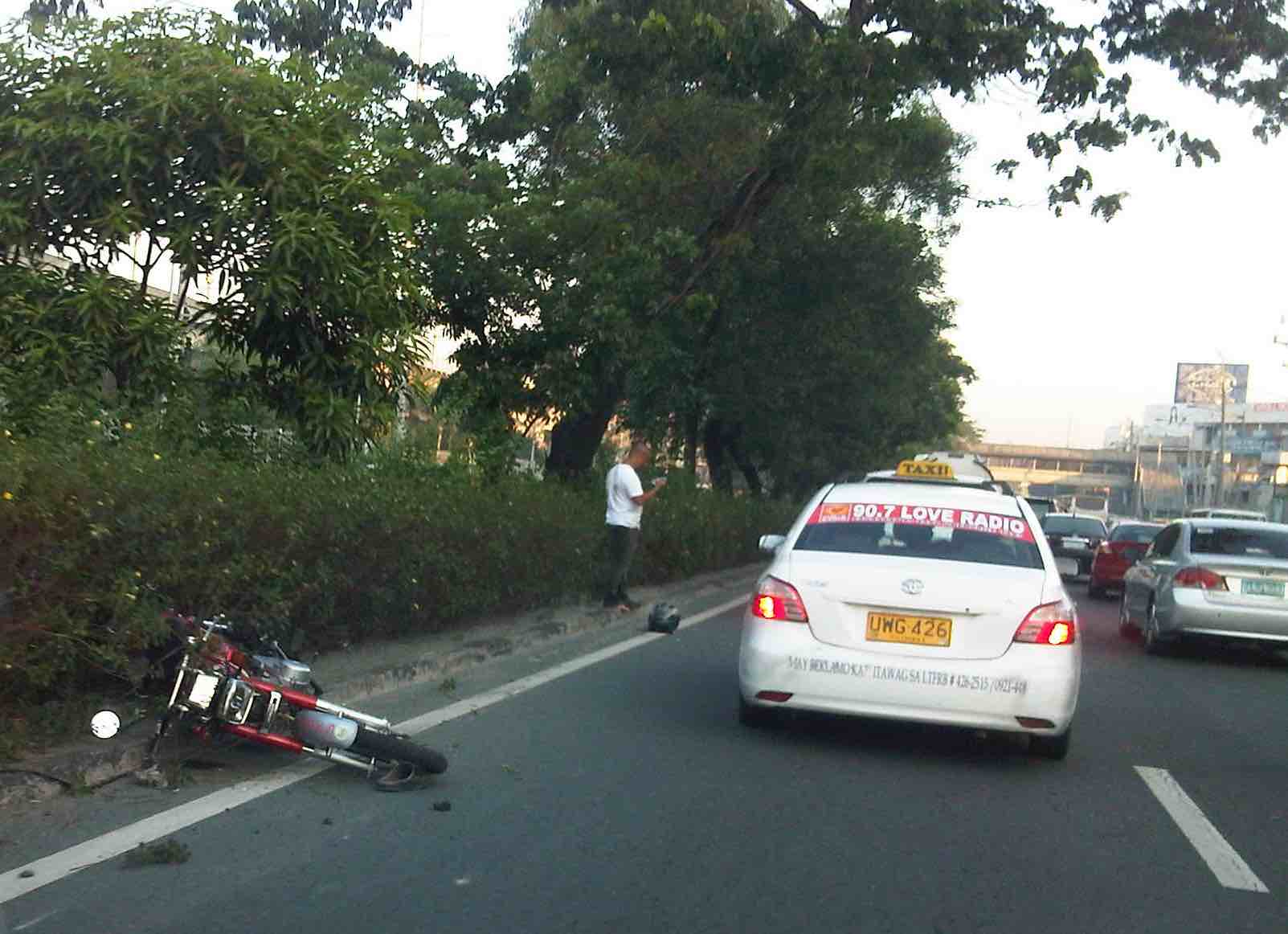 Motorcycle involved in crash with a large truck (covered by taxi in the photo).
Some quick recommendations are provided for different road users in order to avoid such situations leading to crashes:
a. For people driving large vehicles like trucks and buses: Always keep in mind that you are driving a large (and likely long) vehicle that has limitations in terms of manoeuvrability. Don’t drive as if your vehicle is a car and keep in mind that a slight mistake can lead to a fatal crash.
b. For people on motorcycles: Always ride along lanes assigned to motorcycles or refrain from aggressive weaving or lane-splitting. 2-wheelers require balance and so anything to distract the rider (e.g., using cellphones while riding) or aggressive behaviour (e.g., speeding, frequent lane changing, etc. and their combinations) lead to the high likelihood of being involved in a crash. No matter how minor these may be (e.g., dents on vehicles) the cumulative impacts are still significant in terms of costs.
c. For people driving jeepneys, UV Express and taxis: Always keep in mind that you are supposed to be driving safely as you are driving public utility vehicles carrying passengers whom you must convey safely to their destinations. This means you should exercise utmost care in driving and not doing because you simply want to earn money means you have no business providing public transport service.
d. For people driving private cars: Follow traffic rules and regulations. Common causes of traffic congestion and road crashes can be the simplest violations. The more dangerous behaviour include counter flowing, speeding and cutting (or aggressive lane changing).
e. For pedestrians: Cross at designated areas. If there are none or you choose to cross anywhere (i.e., jaywalk) make sure that you are alert and that there are clear gaps allowing for “safe” crossings.
f. For cyclists: People using bicycles should use assigned lanes whenever available. Admittedly, there is a lack or absence of bike lanes in most Philippine cities and the reality is that these will not be provided in an instant. And so cyclists should also be responsible and exercise care as they pedal along. “Sharing the road” also means cyclists need to follow road traffic rules and regulations. They are not excused, for example, from stopping at intersections when the red light is on disregarding one way streets.
With the onset of the wet season, roads will be slippery from rains and therefore add to the challenges of ensuring safe roads. We should not forget that every road user is a vulnerable person. Vulnerability is not limited to the pedestrian or cyclist though they may be the most vulnerable, often with little protection that will allow them to survive collisions with motor vehicles. Though valuable time can be lost by exercising extra care and discipline on the roads, the time cannot substitute or compensate the possible loss of life and limbs due to crashes.
–
Enforcing bus lanes along Commonwealth Avenue
Commonwealth Avenue always seems to be the subject of road safety or traffic discipline initiatives every now and again. Quezon City together with partners in other government agencies like the Philippine National Police (PNP) and the Department of Transportation and Communications (DOTC) have embarked on another program aimed at reducing the occurrence of road crashes and other incidents along this busy corridor. It actually reminds me of the “traffic discipline zone” designation of Commonwealth not a decade ago and before public transport lanes were physically allocated along the highway.
They are failing miserably if I am to base success on observations of the behavior of drivers of public transport vehicles alone along this major highway. They get away with a lot of reckless driving including suddenly switching lanes, speeding, and tailgating. There are also cases where vehicles and pedestrians cross the wide highway at points that are prone to crashes. I am not aware of a lot of apprehensions being made of these reckless drivers along Commonwealth except perhaps at the foot of the Tandang Sora flyover where MMDA enforcers seem to be congregating on most days armed with one of two of the agency’s speed guns. But then it seems “business as usual” for the same drivers and riders along the rest of Commonwealth so the initiatives are not effective deterrents against irresponsible road use.
 You can always see buses on the wrong side of the road along Commonwealth Avenue especially along the section between Fairview Market and Regalado. They do this to get ahead of other buses and then bully their way to make a stop or turn right at an intersection.
 This bus in particular was weaving in traffic, bullying smaller vehicles to give way as it raced other buses along Commonwealth Avenue. Such behavior among public transport drivers is one of the major ingredients for road crashes.
It’s been a year now since the tragic crash involving an out of line provincial bus in the Cordillera. That was partly the result of poor monitoring and enforcement by the LTFRB. While the major reason for the crash was reckless driving (i.e., the driver was allegedly speeding at a critical section of the highway), this could have been avoided if the bus wasn’t operating in the first place. The very same policies along Commonwealth apply to these provincial buses and fatal crashes could’ve been avoided or minimised if the LTFRB can just exercise its mandate effectively.
–
Conditioning
Was traffic really bad yesterday, Dec. 21, or was it typical Friday traffic? A lot of people have been talking or posting about how traffic last Friday was expected to be the worst of the year. Apparently, it was not.
Based on posts on my social media accounts yesterday, it seems that traffic was not at all that bad in many parts of Metro Manila, especially along roads that were expected to be hellish in terms of congestion. One post stated that it him only an hour to travel from Ayala to Trinoma by bus. People usually post about really bad experiences about traffic congestion and this crowd-sourcing approach is usually very reliable. I went home early yesterday and it didn’t take me long to travel between stops for errands I had to do along the way home. Media also would have reported about terrible congestion along major roads including EDSA, C5 and the expressways.
Statements like what the MMDA made prior to Dec. 21 are typical of a psychological approach that some agencies seem to have been resorting to in order to manage people’s expectations and perceptions. Conditioning people’s minds is not a new strategy or tactic. The MMDA has been doing this a lot for as long as I can remember, including during the stint of its former chair Bayani Fernando. Many if not most of these “conditioning” activities are done through media with the agency making statements through its officials about issues such as traffic, garbage and flooding. This is no different to the perception of one agency making frequent “power point presentations” (a reference to projects involving the private sector) to announce much delayed projects supposedly for immediate implementation.
One opinion is that this is a form of damage control. People will usually have strong opinions about what government is doing to address issues like congestion. For people not react too strongly against agencies that are supposed to be responsible for the problem, the same agencies have anticipated and preempted the manifestation of their ineptness by stating the obvious ahead of its occurrence. This would not have been necessary if the agencies did what they were supposed to do in the first place. Hopefully, in the near future such conditioning and other psychological tactics will indeed not be necessary once programs and projects are finally implemented and help alleviate or solve problems.
–
Risky switching of lanes
Many Filipino drivers have the propensity for frequently changing lanes. These happen even at locations where they are not supposed to be changing lanes (e.g., at intersections, while going up or down a steep slope, at curves, etc.). Such maneuvers are risky and basically among the reasons why there are double yellow solid lane markings separating opposing traffic at these sections. I have seen many incidents where in a matter of seconds at least one person is suddenly inconvenienced by the crash. I say at least one person because whether traffic is light or heavy, there will be vehicles slowing down and causing a chain reaction of other vehicles slowing down to stop or avoid the vehicles involved in the collision. These incidents occur because of at least one person’s propensity for suddenly switching lanes.
 The rear bumper of a car gets torn-off (not just detached) by the bull bar of a vehicle whose driver decided to suddenly shift to the right. Apparently, the guilty driver was not able to factor his vehicle’s bull bar when he immediately encroached on the adjacent lane.
 A closer look at the damage on the vehicle in front of us. We had to change lanes ourselves in order to avoid the stopped car. We could only imagine the traffic build-up resulting from the incident at the C5-Lanuza intersection.
I’m not sure how these people learned to drive. Driving schools will likely claim that they did their part in instructing their students/clients the proper way to drive. However, going through driving school is not an assurance for responsible driving. What more can be said for people who learned to drive the informal way (i.e., taught by a friend, relative or other people). Of course, this could have been addressed early on if the licensing system under the Land Transportation Office (LTO) was a lot stricter and exercised due diligence in their licensing examinations.
–
Swapang! or the perils of walking
Walking to the jeepney terminal for a ride to the university, I was irritated by the constant honking behind me as motorcycles rode up the sidewalk to avoid the weaving into congested traffic along Aurora Boulevard. And so I tried to stand my ground allowing only half the space of the sidewalk for these motorcycles to pass through. As far as I’m concerned, I was already too generous giving part of the space that is for pedestrians and not for motorized traffic. Still, there were a few motorcyclists who seem to think they had the right of way as they attempted to convince me give up more space so they could practically take over the sidewalk. I didn’t give way and assumed they were cursing me inside their helmets. Manigas sila! I thought that in the end, sila ang asar at talo in this situation, not me.
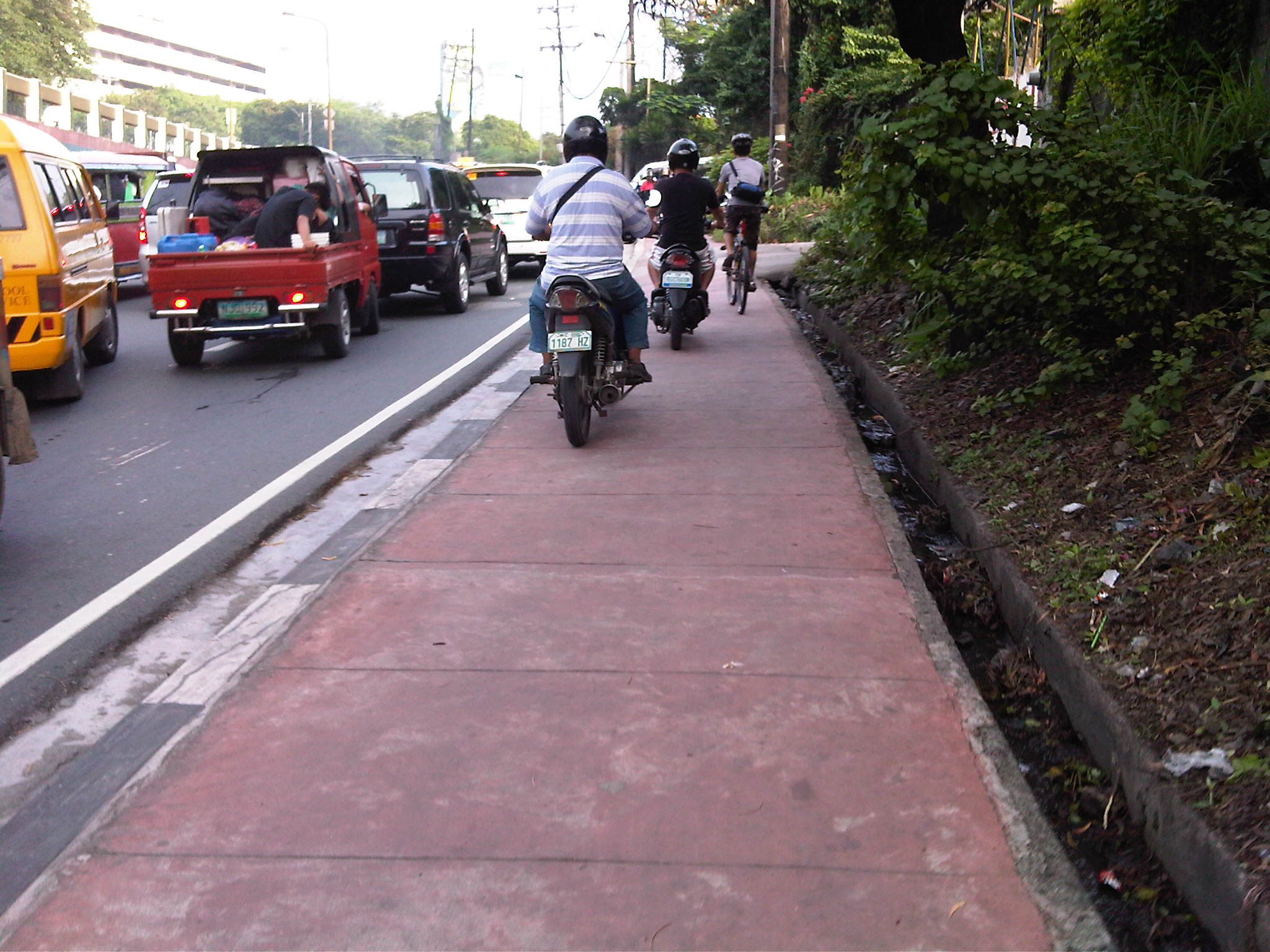 Motorcycles dominating space for pedestrians
At one point, I held my ground and didn’t give way to the motorcycles behind me [Advisory: This is not for everyone especially those who are “pikon” or who are looking for a fight.]. I knew my rights and I was walking on the pedestrian sidewalk. Unfortunately, a bicycle came along and I gave way only because I also appreciated cycling and understood that pedestrians and cyclists are sort of “kindred spirits” in a world dominated by motorized transport. The bicycle was immediately followed by two motorcycles including one that almost sideswiped the cyclist. I took the photo above to better show the situation.
The other day, I chanced upon a similar situation as I was driving in heavy traffic along Amang Rodriguez in Pasig City. What little space was available for pedestrians along a narrow sidewalk along this road connecting Marikina and Pasig cities.
 Motorcycles using a narrow pedestrian sidewalk to avoid traffic congestion along Amang Rodriguez
These cases are clear examples of swapang attitude or behavior that is prevalent among many road users. Unfortunately, these are not apprehended or accosted by traffic enforcers. The latter seem to be more engrossed with number coding and swerving violations, anyway, that they seem to have forgotten all the other traffic violations that included this brazen behavior of motorcyclists. Perhaps enforcers should go back to the basics and take more notice of all those other violations (e.g., speeding, counter flowing, beating the red light, beating the green light, etc.) to improve and promote discipline on our roads.
–
Slippery when wet
The MMDA reported a high of 30 road crashes occurring in Metro Manila. These happened during a very wet day with heavy rains brought about by a typhoon approaching Luzon. Among the high profile crashes yesterday were one involving a bus that fell from the Skyway that cost the lives of 3 people including the driver of the bus. The other involved multiple vehicles including buses (again) and several private vehicles along the underpass section of EDSA near Ayala Avenue in Makati City.
In both cases, those involved and those investigating the incidents all cited the wet and slippery road as the probably cause of the crashes. The statements were all too familiar with drivers stating that they didn’t have enough time and space to stop because of the slippery road. Such reasoning only indicates that there is the likelihood that these drivers did not apply safe driving practices to keep their distance from vehicles ahead of them and to regulate their speeds given that wet roads offer less friction or resistance that would allow for shorter braking distances.
Despite denials, it is likely that the bus that plunged from the Skyway was speeding and that the driver lost control of the vehicle. I would like to believe that the barriers of the elevated highway were designed according to standards set by the DPWH, which are based on international standards that are incorporated in their safe design manual. Despite the standard design for the barriers, the bus still managed to penetrate it, apparently elevating once it hit the barrier.
Barriers are designed according to certain test levels that are deemed suitable for the specific facility. Such test levels that need to be satisfied incorporate elements like vehicle mass, speed, angle of impact and height of center of gravity of the vehicle (Reference: DPWH Highway Safety Design Standards, Part 1: Road Safety Design Manual, 2004). Since traffic along the Skyway consists of a significant number of heavy vehicles including trucks and buses, then the barriers should satisfy the test levels appropriate for these type of vehicles. Thus, it would be easy to check if the Skyway barrier design satisfies standards by checking the as-built specifications of the facility with the DPWH manual.
Nevertheless, speeding and not keeping a safe distance between vehicles are typically causes that may be attributed to the driver. These lead to such road crashes being categorized under driver error as their cause, which is quite justified given that perhaps there are no problems pertaining to the infrastructure/road or the vehicles involved. The weather is not really to blame since it is beyond control but road conditions may deteriorate due to rains if, for example, road drainage is not properly designed or provided. In fact, hydroplaning may occur should there be significant amounts of water on a road and becomes a hazard when vehicles travel at speeds that effectively allow water to come between the tires and the pavement. In such cases, it is also necessary to check whether the tires are able to pump out water as the vehicle runs along the road. In fact, the ridges in tires are supposed to be designed to be able to pump out water, which is the basis for tires to be also checked to make sure that they are suitable for wet roads.
Basically, all drivers should heed the message from a road sign that is provided along roads that are treacherous when the pavement is wet. “Slippery when wet” actually applies to all roads whether it be of Portland cement concrete or asphalt concrete surface, whether of good or bad condition. The mere presence of water on the road pavement presents hazards that can only be addressed if drivers practice safe driving. That is, to regulate their speeds, keep safe distances and lessen maneuvers regarded as risky even when roads are dry.
Tragedy and mockery
Friday the 13th turned out to be tragic to a faculty member of the College of Mass Communications of the University of the Philippines Diliman. Prof. Lourdes Estella-Simbulan was killed when a bus hit the taxi she was riding along Commonwealth Avenue in Quezon City at around 6:00 PM yesterday. By the looks of the crumpled taxi cab shown in photos and videos taken by the media, it would have been a miracle if she survived such a crash.
Adding insult to injury were reports that the bus driver fled after the incident. The name of the bus company is not familiar to me despite our Center currently immersed in a project developing a planning support system for public transportation that included a database component that required us collecting data on companies and operators of public transport in Metro Manila. I suspect that the bus is one of those fly-by-night units taking advantage of the night in operating illegally or maybe one that is part of the kabit system that would be difficult to take to task by the HPG or the LTFRB. It is indeed a mockery of traffic rules and regulations that drivers can get away with murder when they are involved in crashes such as this. It is even more frustrating that the most common reason mentioned by drivers when asked why they drive recklessly is that they are just “naghahanap buhay” or earning a living. Such is unacceptable and those charged to bring order to traffic should be decisive and assertive on acting to prevent such crashes from happening again.
To me there is some irony in what had transpired considering that a couple of days ago, the Philippine joined other countries around the world in launching a program geared towards the reduction of road crashes and victims in the next ten years. Forget about the decade – there is a need to reduce crashes and victims NOW. This is because people are getting killed (or dare I say murdered) now, and there are terrible costs even as I write this post.
The College of Mass Communications is a partner in our advocacy for road traffic safety. In fact, that college produced a video for driver education that was supported by resources extended by the private sector led by the Automobile Association Philippines and Toyota Motor Philippines. I am sure that their faculty are now wondering if their efforts have been to naught considering the proliferation of drivers disregarding traffic rules and regulations, throwing caution to the air when they drive their vehicles.
On my part as head of a Center providing training to public utility vehicle drivers, I feel responsible and frustrated at the same time as I question myself if indeed our efforts are even having the slightest influence to improve PUV drivers’ behaviors. In fact, I have been admonishing participants in our training courses about how they sit in and pretend to learn, and then go out and drive like hell. I just hope that the driver involved in the crash that killed Prof. Simbulan is not among those whom we trained at the Center. It would be a shame and one that makes a mockery out of our efforts in promoting road safety. It is our failure as educators that our students and trainees do not practice what they are taught in terms of road safety. We just take it with a grain of salt, so to speak, that responsibility for such PUV drivers’ behavior can also be linked to a flawed licensing system as well as shortcomings in the regulations of public transport services. Indeed, we have our work cut out for us and we can only hope that our persistent efforts would eventually prevail and lead to a significant improvement to safety along our roads.
 Caught (up) in traffic