
Home » Posts tagged 'bike lanes' (Page 6)
Tag Archives: bike lanes
On Quezon City’s Kalayaan Avenue bike lanes
Another example of what can be called “pwede na iyan” bike lanes are those found along Kalayaan Avenue in Quezon City. To be fair, the city made an effort to paint the bicycle lane and put up signs for this. However, one will observe that there is poor enforcement in relation to the bike lane as you would find vehicles parked on the lane. There is also the question of bicycle traffic as there doesn’t seem to be many cyclists along Kalayaan, making the space fair game for other vehicles including tricycles and motorcycles. Then there is the matter of connectivity. The Kalayaan bike lane seems to be isolated and does not have a connection to any other bike lane. The lane around the Elliptical Road, for example, is in the inner side of that road. Teacher’s Village does not have bicycle lanes but perhaps it is not (yet) necessary to have exclusive lanes in the still predominantly residential area (note: commercial establishments are still on the rise along major roads in the village).
 Vehicles parked on the Kalayaan Avenue bike lane
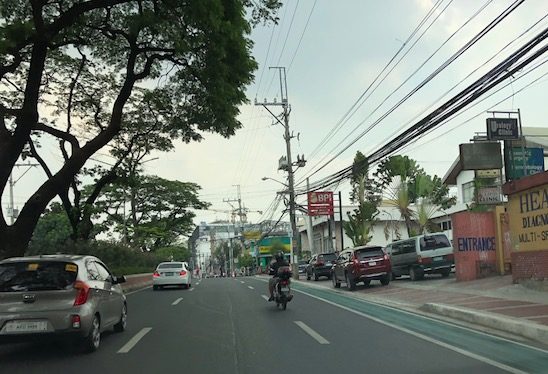 Free flowing traffic along Kalayaan – notice the vehicles parked on the sidewalk?
One big question comes to mind with regards to such bike lanes: How do we improve the situation in order to encourage more people to bike? There are many answers to this question and the answers branch out to the infrastructure, policy, social and even societal, and other aspects concerning cycling. What we should bear in mind and what Quezon City and perhaps MMDA should work on is a strategy for promoting non-motorised transport (NMT) that includes walking and cycling that can be implemented metro-wide with safety and efficiency (incl. connectivity) as the main objectives rather than have piecemeal projects for show or demonstration.
–
In support of bike lanes
Here is another interesting article about bike lanes but from the perspective of a non-cyclist. I believe this (support for bike lanes) is a view shared by many but not much articulated. The assumption is usually that car-owners would like to have less of other’s cars on the road so they could benefit from the presumed reduction in congestion should more people take up cycling. But then the same can be said for public transportation and its users as well. That is, car-users would want others to take public transport so as to also reduce road congestion; allowing them faster trips/drives.
Lewyn, M. (2018) “A Non-Cyclist’s Case for Bike Lanes,” planetizen.com, https://www.planetizen.com/node/97632?utm_source=newswire&utm_medium=email&utm_campaign=news-03152018&mc_cid=0e22636014&mc_eid=9ccfe464b1 [Last accessed: 3/17/2018]
–
On the Pasig HOV lane experiment, again
I recently wrote about some thoughts on Pasig City’s HOV lane experiment along Julia Vargas Avenue. Here are a few more considering the experiment didn’t push through last February 28.
 Screen cap (courtesy of ABS CBN) showing the starting date for the HOV lane experiment. I think ‘HOV’ is more appropriate than ‘carpool’ since the requirement is for vehicles using the lane to have 4 or more passengers. Having only 2 passengers still qualify as a carpool.
I learned recently that the experiment has been put off to March 26, 2018:
 [Photo courtesy of Dulce Justiniani]
The current set-up has 2 lanes for motorised vehicles including a wide lane for HOV’s (including public utility vehicles like buses and vans). HOV’s here also include cars but those with at least 4 occupants. Here are a couple of photos showing us what could possibly happen should enforcement be weak given the configuration of the lanes along Julia Vargas:
 Private van running along the lane designated for HOV’s alongside a solitary cyclist on the bike lane.
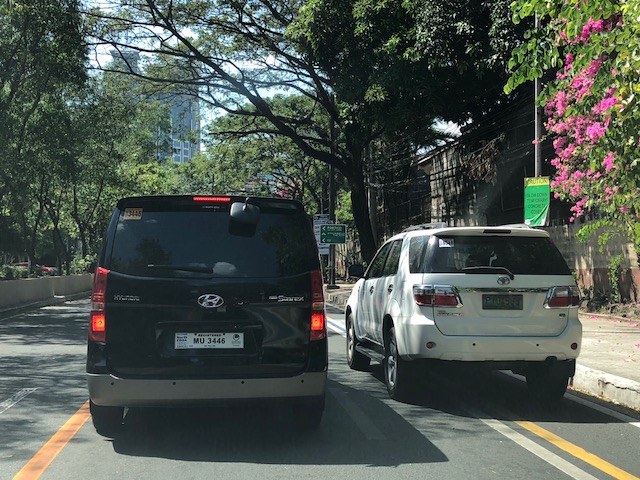 An SUV overtaking the van via the bike lane and the extra space of the HOV lane.
Wide lanes generally encourage higher speeds. I believe the way to go would be to have narrower lanes. And should these be considered, it would be possible to have 3 lanes for motorised traffic with one assigned for HOV’s and another for motorcycles. These are aside from the bicycle lane that I think should also be a protected lane. Protection here may be through the provision of “forgiving” physical dividers in the form of, say, rubber bollards.
Here’s how the Julia Vargas carriageway could be laid out:

Again, these are just suggestions for whoever are in-charge of the experiment-to-be along Julia Vargas Avenue. I hope that they are able to make some assessments even prior to the experiment. Such can be done using simulation software in order to have a handle on traffic related issues that may crop up during the implementation. Still, a big factor would be the enforcement aspects of the proposed policy for motor vehicles. Strict, firm and sustained enforcement would be necessary in order for this to succeed.
–
New guidelines for bikeways
I want to share an article discussing new guidelines for bikeways released in the US.
Andersen, M. (2017) “Which Bike Lanes Should Be Protected? New Guide Offers Specifics,” Streets Blog USA, https://usa.streetsblog.org/2017/11/01/which-bike-lanes-should-be-protected-new-guide-offers-specifics/ (Last accessed 11/16/2017)
This is useful not only for practitioners or planners but also for academic purposes such as in transportation planning or engineering courses where future planners and engineers are molded.
–
Article on building support for walking and cycling infrastructure
There is another recent article on non-motorized transport (NMT). This is a good read and something that I think should be required for those who are little too serious or staunch about their advocacies.
Doyon, S. (2017) “Building support for walking and bicycling infrastructure” Public Square, A CNU Journal, https://www.cnu.org/publicsquare/2017/11/11/building-support-walking-and-bicycling-infrastructure (Last accessed 11/11/2017)
I believe that if you want to convince people to appreciate and support your cause, you should not take the hardline. Instead, there should be a more persuasive process for wooing people. This is especially true in transportation and the advocacies for walking and cycling. You will not get a lot of support, for example, by condemning car users and telling everyone they should bike instead.
–
 Caught (up) in traffic