
Home » Posts tagged 'bus' (Page 2)
Tag Archives: bus
Fare rates for the Antipolo – Iloilo bus service
I found these information on fare rates for the newly opened Antipolo – Iloilo bus service:

The information above indicates that there are three routes to Iloilo:
1) On the left is the route via the central roads of Panay Island (i.e., via Passi City, Iloilo);
2) In the middle is the route to the east of Panay Island to Kalibo, Aklan and Roxas City, Capiz, and terminates at Estancia, Iloilo; and
3) On the rights is the route along the west and crossing the province of Antique. This terminates at Oton, Iloilo and will pass through the town of Miag-ao, which is famous for its church recognized as a UN Heritage Site.
To book a seat on the bus, here is the step-by-step procedure shared on social media on the official Facebook page of Robinsons Antipolo:
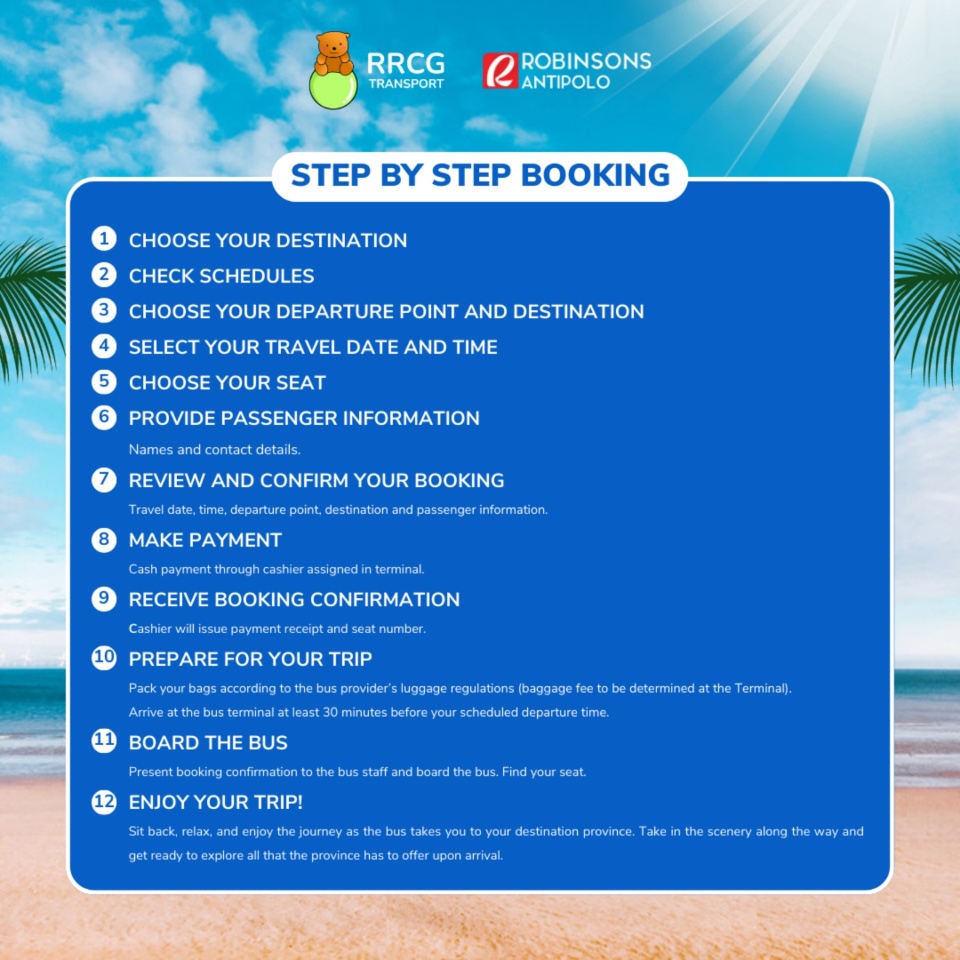
–
Antipolo to any point of the Philippines
I wrote several times in the past about every road leading to Antipolo. Recently, a new route opened between Antipolo and Iloilo. This is interesting for me since my father’s hometown, which I also consider mine, is Cabatuan, Iloilo. We usually flew to the province though we also rode on inter-island ferries when I was a child. I have memories riding on the ships operated by the now defunct Negros Navigation and Sulpicio Lines. I had never used the SuperFerry ships that now connect the major islands of Luzon, Visayas and Mindanao.
 Buses at the public transport terminal at Robinsons Antipolo include those regularly dispatched to Cubao and Quiapo. There are many provincial and RORO buses including those bound for the Bicol Region and Eastern Visayas (i.e., Samar and Leyte). The latter are operated by several bus companies including RRCG whose buses are shown in the photo.
 RRCG bus bound for Iloilo via Batangas, Mindoro, Aklan (Caticlan), and Antique. The fare to Iloilo City is 2,700 pesos. It’s 2,400 pesos until Caticlan.
 New sign for the route connecting Antipolo City and Iloilo City. Caticlan in the province of Aklan is along the way. I estimate the travel time to be roughly a day considering the bus will still go to Marikina’s transport terminal across from SM City Marikina. From there, the bus will proceed to Batangas Port via C5, SLEX and STAR Tollway. The bus will queue to be loaded unto a RORO ferry bound for Mindoro. It will travel by land to cross Mindoro Island before being transported via ferry from Mindoro to Caticlan.
 One bus company provides services to destinations in the Bicol Region. Both air-conditioned and ordinary (non-aircon) buses are available.
–
Congestion near bus terminals during the Christmas season
I attended a formal event yesterday at the Philippine International Convention Center (PICC) in Pasay City. Along the way and back, I already noticed the congestion along Gil Puyat Avenue (formerly Buendia Avenue) as well as the congestion or how crowded the bus passenger terminals were. In fact, the buses at the JAC Liner terminal along Gil Puyat were all on the streets. The terminal itself was filled with passengers, many of whom were queued as they waited to board their buses. Others I assumed were in line to purchase tickets there. The latter apparently have not done so online, which is already an available and more convenient option for provincial travel.
 |
| Buses lined along the Makati-bound side of Gil Puyat Avenue. These are queued towards to the U-turn slot that will take them to the bus terminals on the other side and near Taft Avenue. |
 |
| Other buses are lined along the Pasay-bound side of Gil Puyat Avenue. These come from the South Superhighway where these buses eventually head to after boarding passengers en route to Southern Luzon, Bicol and even Visayas and Mindanao destinations. |
Then as now, the junction of Gil Puyat and Taft Avenues is a major convergence area for transportation especially provincial routes. Even before the construction of the LRT Line 1 (which has a station at Gil Puyat) there have been a number of bus terminals here. Currently, I am aware of the JAC Liner and DLTB bus terminal near the junction. There are others including small terminals or garages for provincial buses. These generate much traffic particularly during this Christmas, which is considered peak season for travel in the country.
–
On concert and sports event venues being accessible to transit
Among the major concert or sports event venues in the Philippines, perhaps the Araneta Coliseum is the most accessible to public transportation. Others like the SM Mall of Asia Arena in Pasay City is accessible to public transport but only for road-based modes. The Philippine Arena in Bulacan is accessible only by private transport or shuttle vehicles (basically also private as they are leased or rented). Compare this to say Singapore’s National Stadium, Tokyo Dome or Saitama Arena, which are all served by mass transit systems. It was so easy to go to the U2 concert in Singapore or Japan because of this. It was difficult for the same when they came to the Philippines because going to the Philippine Arena required a long drive both ways.
With all the fuss about Taylor Swift’s concert tour, I found this article about how fans or Swifties as they are called get to the concerts – they take public transportation:
Brady, T., Caldera, L. and Worthington, P. (July 14, 2023) “Transit Funding Problems Too Big Even for Taylor Swift to Solve,” Next City, https://nextcity.org/urbanist-news/transit-funding-problems-too-big-even-for-taylor-swift-to-solve?utm_source=Next+City+Newsletter&utm_campaign=c480374b80-DailyNL_2023_07_14&utm_medium=email&utm_term=0_fcee5bf7a0-c480374b80-44383929 [Last accessed: 7/19/2023]
To quote from the article:
“And how did the nation’s Swifties get to these concerts? As a recent Crain’s article explains, transit.
Fans took buses and trains to see superstar Swift, adding 43,000 bus and rail rides in Chicago and tripling the number of weekend riders in Atlanta. Her Philadelphia concerts in mid-May brought an estimated 27,000 additional riders to SEPTA’s (Southeastern Pennsylvania Transportation Authority) subway line next to Lincoln Financial field.”
If she held at least one concert here, I’m afraid that concert will generate more car traffic than transit ridership if held at the Philippine Arena. NLEX will definitely generate a lot of toll revenue but traffic will be hell for the event.
–
Article share: What Is Bus Rapid Transit?
I found this short article defining and describing Bus Rapid Transit (BRT). I include this as a topic under public transportation in one of the graduate courses that I teach. Fortunately, I have materials for lecture coming from previous engagements concerning BRT including lectures by my former adviser who is an expert on public transportation and has studied the BRT in Curitiba, Brazil. Here is the article appearing in Planetizen:
Source: What Is Bus Rapid Transit?
Quoting from the article:
“Bus rapid transit, known as BRT, is a form of transit widely seen by transportation planning professionals and transit officials as a less costly alternative to light rail that offers a significant improvement over other fixed-route bus services that share lanes with regular traffic and makes bus service faster and more reliable.
BRT generally includes dedicated transit-only lanes or busways for at least part of the route, as well as prioritized traffic signal timing. BRT lanes are often located in the center of the roadway to limit interaction with cars, bikes, and pedestrians. In some cases, busways are elevated or underground.”
Definitions are good in that they provide us with a characterization of the system. There are many good examples of BRT particularly in South America (e.g., Curitiba and Bogota). These should be the models to replicate or adopt in Philippine cities rather than what local officials and their consultants propose and/or implement that are basically aberrations of the BRT concept.
–
On building the ideal city from a transportation perspective
There’s a not so old article that popped in my timeline of articles I’ve read the past years. I thought I would make a quick share of it here. It is a good read and something that will never be irrelevant for as long as we have not redeveloped our cities and municipalities for transport equity and sustainability. Here’s a takeaway from the article:
“The ideal city is a place where lots of different kinds of people with lots of different amounts of money can live and work. It has to be easy to get around without a car, even for people whose bodies can’t ride bikes or hop over potholes, and for people who have kids to drop off on the way to work and groceries to buy on the way home, and maybe flowers to buy next door to the dry cleaner’s. These are places where people want to live, because it’s nice there. The fact that those places also adapt to and mitigate climate change instead of causing it is a bonus.”
Here’s the article from last year:
Rogers, A. (April 1, 2020) “Build Cities for Bikes, Buses, and Feet—Not Cars,” Wired, https://www.wired.com/story/cities-without-cars-san-francisco-jeff-tumlin/?bxid=5bd6761b3f92a41245dde413&cndid=37243643&esrc=AUTO_OTHER&source=EDT_WIR_NEWSLETTER_0_ENGAGEMENT_ZZ&utm_brand=wired&utm_campaign=aud-dev&utm_mailing=WIR_Classics_042921&utm_medium=email&utm_source=nl&utm_term=WIR_Daily_TopClickers [Last accessed: 4/30/2021]
–
Route 9: Antipolo-Cubao
I keep forgetting posting something about the buses that now operate along the Antipolo-Cubao route. Route 9, as the DOTr and LTFRB have designated this route covers one of 2 routes connecting Antipolo and Quezon City’s older CBD. Route 9 is via Sumulong Highway and Masinag Junction. The older route via Felix Avenue and Cainta Junction has not been revived. Both routes used to be served by jeepneys; many of them the “patok” kind that were known for speeding and risky maneuvers. It seems, at this time, that these will not be allowed to operate again along these routes with the rationalization efforts of the government. Following are photos taken at the Robinsons Antipolo transport terminal, which is where one of the end points of Route 9 is located.
 Buses maneuver at the spacious terminal grounds at Robinsons Antipolo.
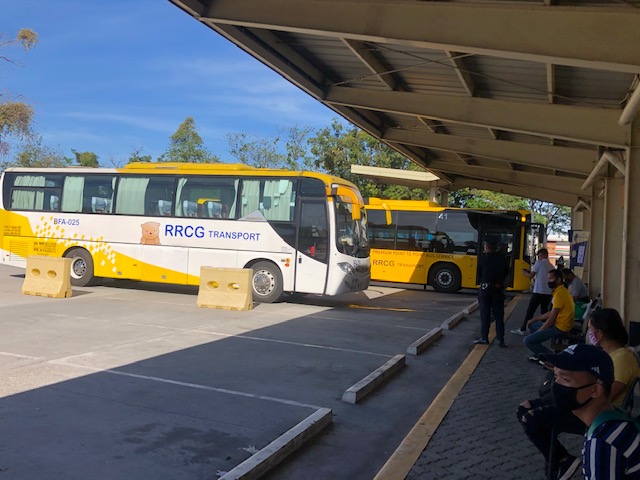 There are two bus services currently terminating here. One is the P2P bus service between Robinsons Antipolo and Robinsons Galleria, and the other is Route 9 between Antipolo and Cubao, Quezon City.
 Many of the buses were “pulled out” from their former routes. The term pulled out is actually inaccurate since public transport operations were suspended during the lockdown.
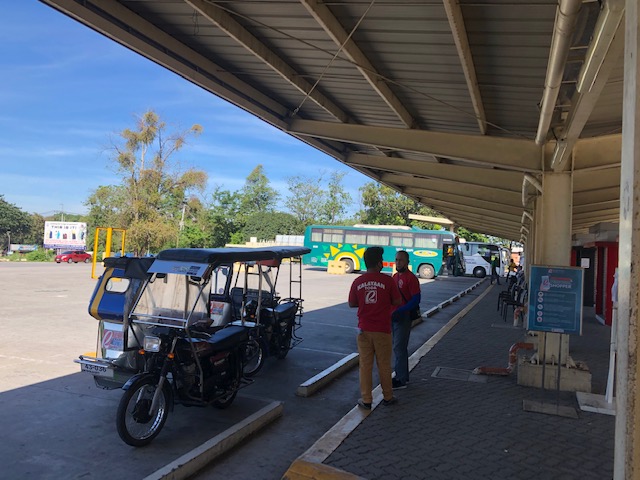 The transport terminal is an intermodal one that’s supposed to cater to buses, jeepneys, vans and tricycles. There are currently no UV Express vans operating here and traditional or conventional jeepneys have yet to return to Antipolo.
 A big part of the terminal is an area reclaimed from a failed amusement park that occupied the corner of this lot. The rides and other equipment were removed prior to the lockdowns.
 There are minimal restrictions to the vehicles accessing the terminal grounds. Here you see a taxi and tricycle moving about. Cars may be parked nearby and these (parked cars) were not uncommon before the lockdown as some people practiced “park and ride” with the P2P buses.
 EMBC buses such as this one used to ply the Tanay – Divisoria and Tanay – Quiapo routes
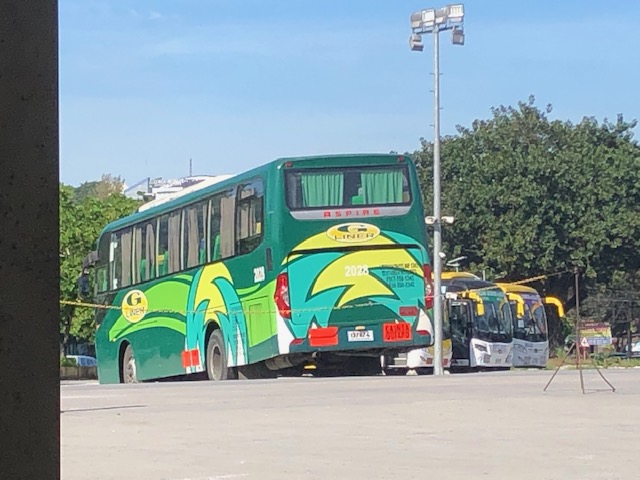 G-Liner buses are a familiar sight in Rizal where they are probably the oldest company continuing service since the 1980s. Correct me if I’m wrong but I only remember them being in operation in the 1980s. Before them were Metro Manila Transit Corp. buses and the baby buses that plied the Binangonan-Recto route.
 G-Liners now operate two routes from the rationalization program: Antipolo-Cubao and Taytay-Gilmore.
The passenger capacities of the buses and the service between Antipolo & Cubao have been significantly reduced due to health protocols. Thus, buses can only carry perhaps up to 40 or 50% of their seating capacity. I mentioned seating capacity here because of physical distancing requirements and the ban on standees. Previously, a bus left every 5 minutes and their frequency could not cover the demand along the route. Recently, I observed more buses in operation and the addition buses from two more bus companies that used to ply the Fairview-Baclaran and Fairview-Alabang routes. These could probably help ease the supply issues.
More on the Antipol-Cubao service soon!
–
Regular bus services for Antipolo
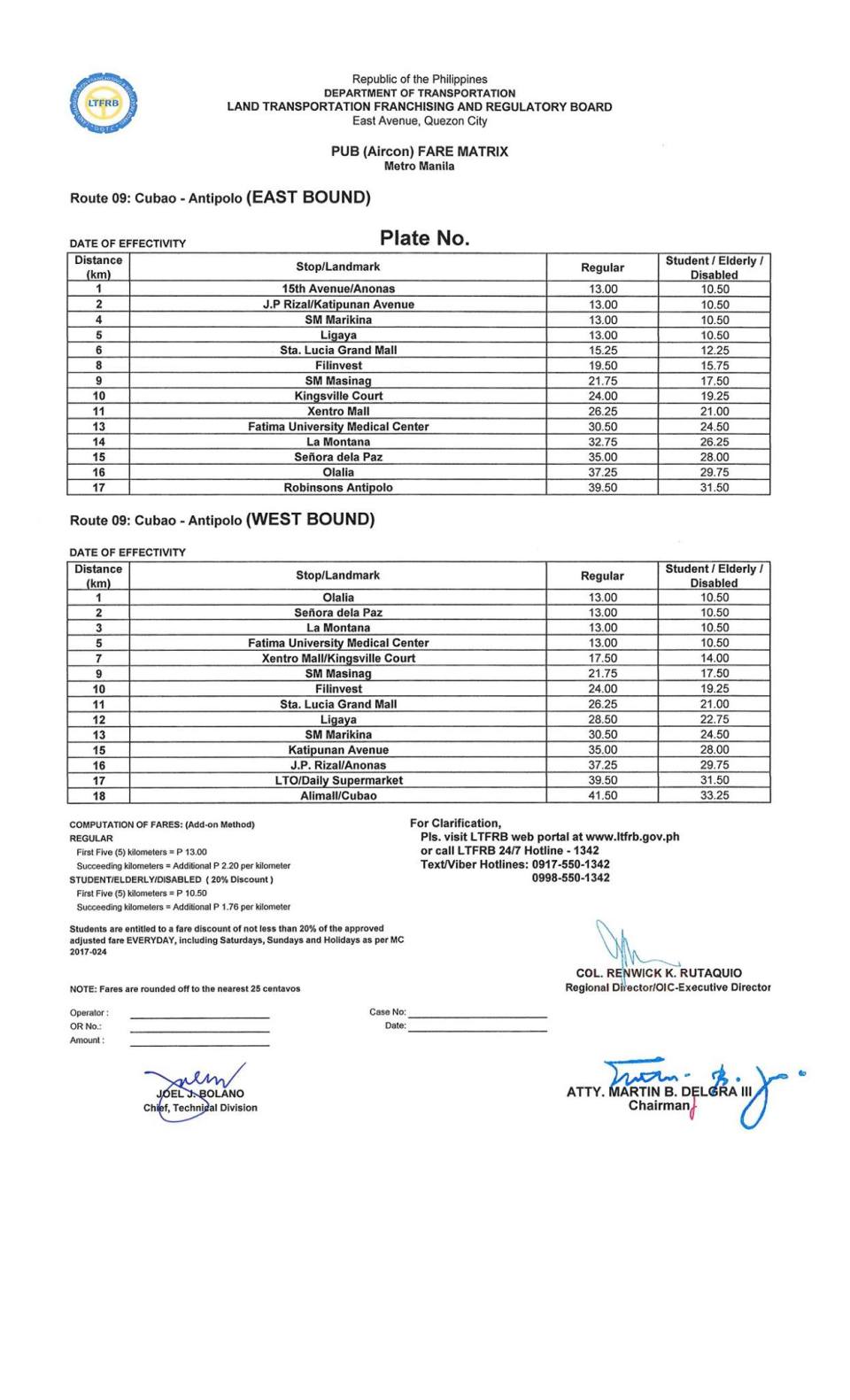
Finally, there is a regular bus service between Antipolo and Cubao. This will be between the Robinsons Antipolo transport terminal and the Araneta City (formerly Araneta Center) via Sumulong Highway, Marcos Highway and Aurora Boulevard. This is a more significant development than the P2P bus service between Antipolo and Ortigas CBD (i.e., Robinsons Antipolo and Robinsons Galeria) as this is a regular bus service with what appears to be designated stops. I say what appears to be designated stops based on the fare matrix released by the Land Transportation Franchising and Regulatory Board (LTFRB).
I have written about this in the past and communicated this to local and national officials and yetWill this spell the decline and eventually phasing out of the Antipolo-Cubao jeepneys? Probably not unless there is a strong move for a phaseout. The operation of the Line 2 Extension will surely impact them, too. But they can and should survive even for feeder services with respect to the rail and buses.
Mixed messages for commuters?
I had spotted buses (or perhaps its just the same bus?) for a P2P service between Antipolo and Ortigas Center bearing what appears to be a statement for improving the quality of life of commuters. Many have been suffering and continue to suffer on their daily commutes starting from difficulties getting a ride to very long travel times. The term “dignity of travel” comes to mind, which a colleague coined many years ago to describe
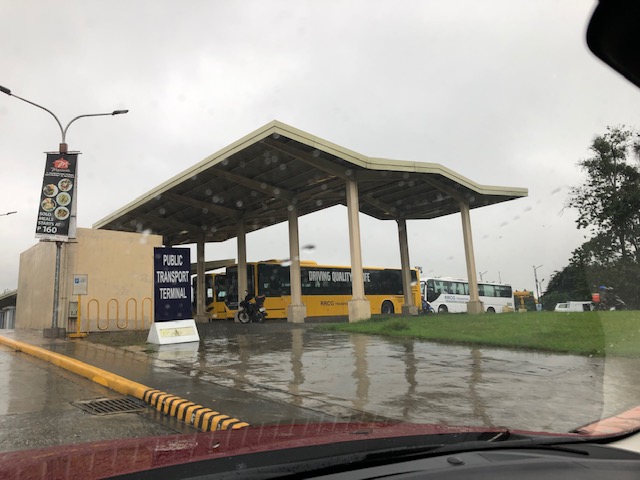 P2P buses at the public transport terminal at Robinsons Place Antipolo
 Whoever thought of this probably meant well; thinking about improving quality of life. The choice of words though may convey a different message as “driving” is in all caps and usually associated with a different, less appealing activity to sustainable transport advocates. I think they should have chosen “improving” instead of “driving” here.
This is somewhat similar to a much earlier post of mine showing SMRT buses in Singapore with ads promoting Uber and how it was supposed to complement public transport. That, of course, was a bit of a stretch in the city-state, which already has excellent public transport compared to elsewhere, and already complemented by very good taxi services.
Yesterday, there was a nationwide transport strike and depending on which side you are on, the reality is that we are still far from having more efficient public transport. But that’s another story and hopefully, I get to write about it in the next few days.
–
MyBus at the Mactan Cebu Airport
Arriving at the Mactan Cebu International Airport (MCIA), we moved towards the transport terminal where a rental van was picking us up. We were a big group and had luggage for a week’s stay so we arranged for the van, which we rented until the evening so we can go to dinner without hassle. As we walked towards the terminal, I saw a man waving a board with MyBus on it. He was calling out to passengers who might want to take this bus to Cebu City (MCIA is in Lapu-Lapu City). I wasn’t able to take a photo of the man but was able to take few as we waited for our van.
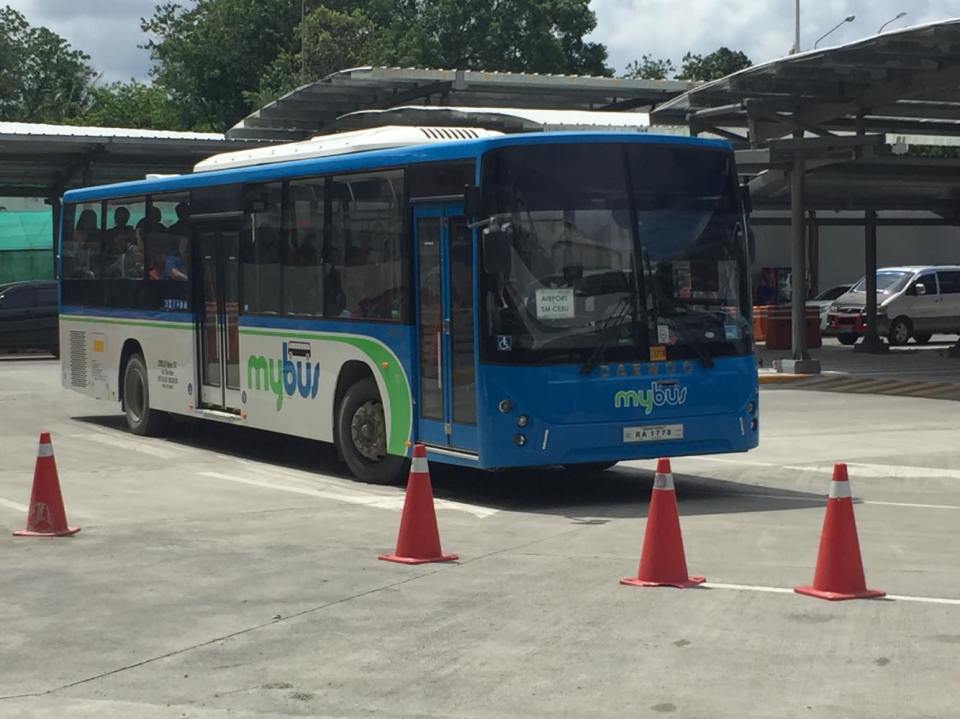 MyBus turning along the MCIA terminal driveway after picking up passengers
 MyBus turning towards the terminal exit. There were a good number of passengers on the bus so that’s a good thing. That means they already have established some ridership between the airport and Cebu City.
 Another photo of the bus as it waited for a car to clear its path. MCIA has very good road transport terminal facilities, which I thought was excellent when compared to those in other airports in the country.
Perhaps I would try MyBus next time I am traveling to Cebu and with less luggage? The bus as shown in the photo is configured for city operations and not for long distance travel (i.e., with luggage compartments on belly of the bus) like the limousine buses I took in Japan.
–
 Caught (up) in traffic