
Home » Posts tagged 'environment'
Tag Archives: environment
How the Built Environment Affects Your Mood
Here’s a nice read as we do our storm watch, and probably explains why when we reminisce about college or university as “the best years of our lives”.
Source: How the Built Environment Affects Your Mood
To quote from the article:
“It is not for nothing that older adults often regard college as “the best years of your life” because in some cases it truly is. College years serve as a gateway drug to all the amenities and benefits of urban-core living — until you graduate that is. Then you have to return to your parents’ suburban home (as many Americans do) and suddenly all the amenities you had disappear. Your newfound college friends might make up for the lack of a diverse built environment. Nope, they all have moved back to their sprawling neighborhoods too, probably dozens of miles if not hundreds of miles away from your town. You might get a new car to celebrate your graduation and your new 9 to 5 corporate job. Work will keep you busy! But you know what else? Driving. No more waking up 10 minutes before class and arriving just on time. You might now have to wake up a few hours early to drive to your job through rush hour morning traffic, and do it all again in the afternoon.
You might also gain weight — not because you are eating more, but because you are walking less. Various studies demonstrate the link between car usage and obesity, showing “greater levels of obesity in communities where the private automobile is the dominant means of transportation.” And let’s not forget that obesity leads to other health issues such as diabetes and hypertension, among others. Mental health conditions such as depression are more prevalent in adults with obesity. Hence once college ends, graduates stop socializing, stop enjoying public amenities every day, start driving everywhere, stop walking and hence gain a little more weight in the process. Then it is no surprise that young graduates feel unfulfilled, and sometimes even depressed after college — for them, it feels they were robbed of an integral part of their new lives.
Our surroundings impact our mental and physical health. Living in neighborhoods with negative qualities can increase the risk of mental health conditions such as depression. At the same time, the pandemic made us appreciate diversity in our lives and what happens when we are deprived of it. Walkable cities are not “just a preference”; they develop happiness by fostering community trust, promoting physical activity, and offering nearby amenities. As learned, these spaces encourage healthy behaviors, reduce car dependency, and create opportunities for social interaction — all things that are crucial for our well-being.”
Based on this, no wonder I love to stay at the University of the Philippines campus in Diliman. I’m sure my colleagues in UP Los Banos feel similarly.
–
On trees as solution to many of our urban problems
I am sharing this nice article on trees being the solution to many of our urban problems. I think many people have come to notice the importance of trees and the role they play with the increasing temperatures (i.e., heat) we’ve experienced the past years. The science on this state much more and covers not just temperatures but flooding, energy and infrastructure as well. Discussions and examples on these are in the article:
Durand-Wood, E. (August 8, 2024) “The Multi-Tasking Marvel: How Street Trees Can Solve Many Municipal Problems,” Strong Towns, https://www.strongtowns.org/journal/2024/8/8/the-multitasking-marvel-how-street-trees-can-solve-many-municipal-problems [Last accessed: 8/28/2024]
To quote from the article:
“Planting and maintaining street trees is an investment, but it’s one that pays for itself over and over again. Cities around the world are starting to calculate the economic value of their urban forests, a task made feasible with tools like i-Tree.
And more research is finding that trees pay for themselves many times over. A U.S. Forest Service study “conducted in five U.S. cities found that every dollar invested in the management of urban trees [ …] yields annual benefits of $1.37 to $3.09.
Trees are also the perfect example of a small bet. They cost relatively little, but the many varied returns are so high.”
–
On urban noise
We open February with an article share. The article is about noise in urban areas. Not surprisingly, most noise comes from transportation and the solutions mentioned in the article not only addresses transportation noise but at the same time addresses other concerns about transportation, including safety.
Durand-Wood, E. (January 25, 2024) “Why Are Cities So Noisy? And Can We Do Anything About It?“ Strong Towns, https://www.strongtowns.org/journal/2024/1/25/why-are-cities-so-noisy-and-can-we-do-anything-about-it [Last accessed: 2/2/2024]
To quote from the article:
“In 2011, the WHO set recommendations for daytime and nighttime environmental noise levels, and found the maximum safe noise level for daytime is 55db (somewhere between moderate rain and normal conversation) and at night, 40db (about the level of a quiet library). Beyond these levels, prolonged exposure to environmental noise has been shown to cause health problems, and not just hearing-related ones.”In 2011, the WHO set recommendations for daytime and nighttime environmental noise levels, and found the maximum safe noise level for daytime is 55db (somewhere between moderate rain and normal conversation) and at night, 40db (about the level of a quiet library). Beyond these levels, prolonged exposure to environmental noise has been shown to cause health problems, and not just hearing-related ones.
Until recently, most analysis related to urban noise has focused on noise as an annoyance or disruptor to humans. But with these new guidelines, there was an acknowledgement that too much environmental noise can actually have grave health consequences, noting that “at least one million healthy life years are lost every year from traffic-related noise in the western part of Europe.”
We now know that higher levels of environmental noise raise heart rate and blood pressure, cause harmful sleep interruptions, and are linked to cardiovascular disease, dementia, and cognitive impairment in children, among others. And as with environmental pollution, there are racial and socioeconomic disparities with noise pollution.
In a 2022 report, the United Nations identified urban noise pollution as a top environmental risk.”
Have you noticed how noisy it is in our cities? Many actually choose to live in the suburbs as the perception is its quieter especially during the night. The health risks due to noise are well-established as presented also in the article. However, there are ways to address this and reduce the noise, particularly the type attributed to transportation and traffic.
–
Why do we keep widening roads?
I’m just going to share this article here. The article from The NY Times asks a question that has been bugging planners and engineers, particularly those who are in government and perhaps under the agencies like the DPWH, DOTr and NEDA. This also applies to planners, engineers and those from other disciplines involved in transportation infrastructure development and particularly roads or highways.
–
Traffic and air quality
Along one of my commuting routes, I couldn’t help but take a photo of what lied ahead as our vehicle was crawling along Marcos Highway in Antipolo. The following photo pretty much captures the relationship between transportation and the environment; the latter in terms of air quality and the former in the form of our congested roads.
 Smoggy Metro Manila in the horizon as vehicles are crawl along Marcos Highway towards Masinag Junction
With traffic practically back or even worse than pre-pandemic levels, one cannot help but think about what could have been if government planned and executed during the time of the lockdowns in preparation for the eventual return to workplaces and schools by most people. The peak of the pandemic when total lockdowns were implemented was supposed to provide the opportunity to make the drastic changes required of transportation. You cannot find a better time for a reboot and yet here we are and again struggling with our daily commutes. We can just hope that other cities and municipalities will not go the way of Metro Manila.
–
On addressing global warming
Here is another quick share of an article; this time on “warming”. The evidence for global warming is strong and we need to address this pressing issue if future generations are to survive a planet that is heating up fast.
Litman, T. (August 31, 2022) “Cool Planning for a Hotter Future,” Planetizen.com, https://www.planetizen.com/blogs/118535-cool-planning-hotter-future?utm_source=newswire&utm_medium=email&utm_campaign=news-09012022&mc_cid=ead7ee914a&mc_eid=9ccfe464b1 [Last accessed: 9/5/2022]
To quote:
“Many of these strategies provide significant co-benefits. For example, reducing road and parking supply with more efficient traffic and parking management helps reduce infrastructure costs and traffic problems, and by reducing impervious surface area it reduces stormwater management costs. Planting more urban shade trees helps create more attractive neighborhoods and increase wildlife habitat. Improving natural ventilation creates more comfortable and healthier buildings, as summarized below.”
I recall people calling for more trees to be planted along roads and how our city streets can become something like Orchard Road in Singapore. I agree with having more trees and other plants, landscaping, along our roads. I also lament the times (and it continues) when the DPWH chopped so many old trees along national roads for road widening projects that didn’t need to destroy so many that gave those roads shade as well as character. We need more change in mindsets particularly when we design highways and streets towards sustainability and yes- reducing heat.
–
We need to do more to reduce transport emissions
I did some work on long term action plans on low carbon transport for the ASEAN region before. We were able identify many of interventions that were being implemented as well as those that can be done to reduce transport emissions. Such reductions for the region would ultimately contribute to alleviating global warming. Unfortunately, while ASEAN is a significant contributor to emissions, it pales in comparison to emissions by individual countries like China and the US. If these two and others in the industrialized world do not commit to reducing their emissions, all work will come to naught. Here is an article that serves as a pre-event write-up for COP26, a major climate summit that will be held in Glasgow in the coming days.
–
On the importance of trees in the urban setting
Having lived in two other countries and traveled in many others, I have seen and experienced for myself examples of tree lined avenues and streets in the urban setting. And I am not talking about small cities but big ones like Tokyo and Singapore. I have gone to many of the big cities in Japan to be able to say that trees should have their place in the so-called urban jungle and the benefits of having them are tremendous. Here is a nice article recently published in The Guardian that explains the advantages of green streets:
Balch, O. (2019) “Green streets: which city has the most streets?”, The Guardian, https://www.theguardian.com/cities/2019/nov/05/green-streets-which-city-has-the-most-trees [Last accessed: 11/08/2019]
Philippine cities should heed the advice from the author and city and municipal planners should make sure that plans incorporate trees and other flora. Obviously, they are not just ornamental but rather should be indispensable components of our towns whether it is highly urbanized or not. I guess the same concepts apply also to the roadsides of our national highways. The Department of Public Works and Highways (DPWH) clearly had little or no regard for greenery; chopping down even the elder trees along the way of their road widening programs. As such, they have contributed to blight along these roads and it would take some time and effort to bring back what used to be tree-lined, canopied roads in many provinces.
–
On the need to increase NMT and public transport use
A recent report reinforces what many of us already probably know or are aware of – that we need to shift away from dependence on car use to more sustainable modes of transport in the form of non-motorised transport (NMT) and public transportation. Here is the article from the AASHTO Journal:
Global Climate Report Calls For Expansion Of ‘Non-Motorized’ Transport And Public Transit (2018)
There is a link to the report in the journal article. The report is conveniently available in PDF form and is very readable (i.e., not overly technical).
Incidentally, I was involved some time ago in a project led by the group Clean Air Asia (CAA), which involved several experts from across ASEAN as well as Japan that attempted to determine the necessary transport programs and projects in the region to stave off the projected increase in global temperatures. In all the scenarios evaluated, non-motorised transport (NMT) and a rationalised public transportation system By the term ‘rationalised’ I am referring to the use of higher capacity vehicles as against the taxis and tricycles that typically carry few if not one passenger. Here is a link to the final symposium for that study that has links to the materials presented:
The Final Symposium on the “Study on Long Term Transport Action Plan for ASEAN”
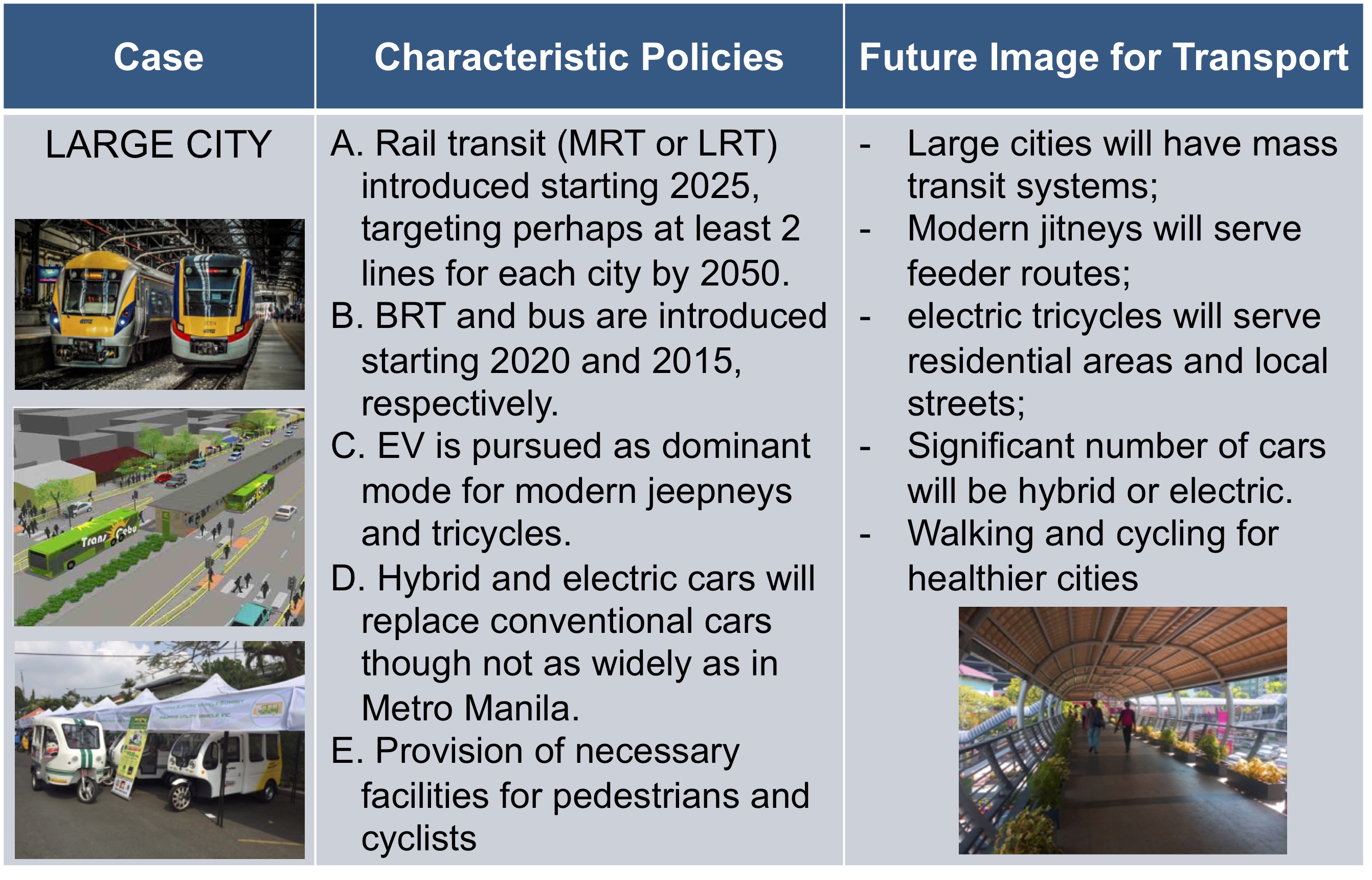
Here’s a slightly updated slide on the future image for a large city in the Philippines:
–
On child-friendly cities
Here’s another article that I want to share. This time it is about child-friendly cities. Here is an article that present many good practice examples in other cities. Many are easily replicable in our towns and cities, and should be considered by local governments in order to enhance safety and health aspects in their jurisdictions.
Laker, L. (2018) “What would the ultimate child-friendly city look like?”, theguardian.com, https://www.theguardian.com/cities/2018/feb/28/child-friendly-city-indoors-playing-healthy-sociable-outdoors [Last accessed 3/9/2018]
–
 Caught (up) in traffic